
🇰🇷 한국어판: 건조한 피부 보습 성분 TOP5 – 가을에 고르는 기준
Hello, I’m Dr. J. Autumn is when the same question arrives every year: which moisturizing ingredients actually do something for dry skin? Here are five, each with a human study attached, and each with the numbers read the way I would read them in the lab.
This is not a ranking. The five do different jobs, and the one you want depends on what your skin does after cleansing: tightness, roughness and flaking, or stinging. Match that first and the shelf gets much smaller.
Below: one table with all five studies side by side, then each ingredient in turn, then the part most ingredient articles skip — what each number was compared with, because “improved by 72%” and “better than placebo” are not the same claim. At the end, how Korean regulation treats these five, and why squalane is not among them.
――――――――――――――――――――――――――――
📄 If you’d rather read the primary sources
📄 Lodén et al. 2002 — glycerin 20% and urea 4% creams, 197 patients, 30 days (Acta Derm Venereol)
📄 Spada et al. 2021 — ceramide-dominant cream and cleanser, 28-day randomized trial (Dermatol Ther)
📄 Stettler et al. 2021 — panthenol emollients, three 28-day studies (open access)
📄 Pavicic et al. 2011 — hyaluronic acid 0.1%, 76 women, 60 days (PubMed)
📄 Korea — Cosmetic Safety Standards, Annex 2: ingredients with use limits (Korean)
The Stettler paper is fully open, tables included. The Korean annex downloads as the original table.
――――――――――――――――――――――――――――
――――――――――――――――――――――――――――
The short version
✔ Tight skin — humectants that hold water: glycerin, hyaluronic acid
✔ Rough, flaking skin — urea, capped at 10% in cosmetics sold in Korea
✔ Stinging after cleansing — barrier ingredients: ceramides, panthenol
✔ All five have human studies of one to two months
✔ Before trusting a percentage, ask what it was compared with (Table 2)
――――――――――――――――――――――――――――
All five studies in one table
| Ingredient | Study | People · duration | Compared with | What was measured |
|---|---|---|---|---|
| Glycerin 20% | Lodén et al. 2002 | 68 of 197 · 30 days | the same cream without glycerin | dryness improved in 85% (placebo 63%) |
| Urea 4% with 4% sodium chloride |
Lodén et al. 2002 | 63 in the same study · 30 days | the other creams in that study | improved in 89%; smarting in 24% |
| Ceramides | Spada et al. 2021 | 100 adults (83 completed) · 28 days | a comparator regimen · double-blind | water loss P=.0342; hydration P<.0001 |
| Panthenol | Stettler et al. 2021 | 42 people × 3 studies · 28 days | the untreated opposite arm | hydration +38.1% to +72.4% vs baseline |
| Hyaluronic acid 0.1% | Pavicic et al. 2011 | 76 women · 60 days | placebo | all five molecular weights improved hydration |
Read the “compared with” column first. It is the column that decides how much weight each number can carry, and it is the one marketing copy leaves out.
――――――――――――――――――――――――――――
1 and 2. Glycerin and urea — measured in the same study
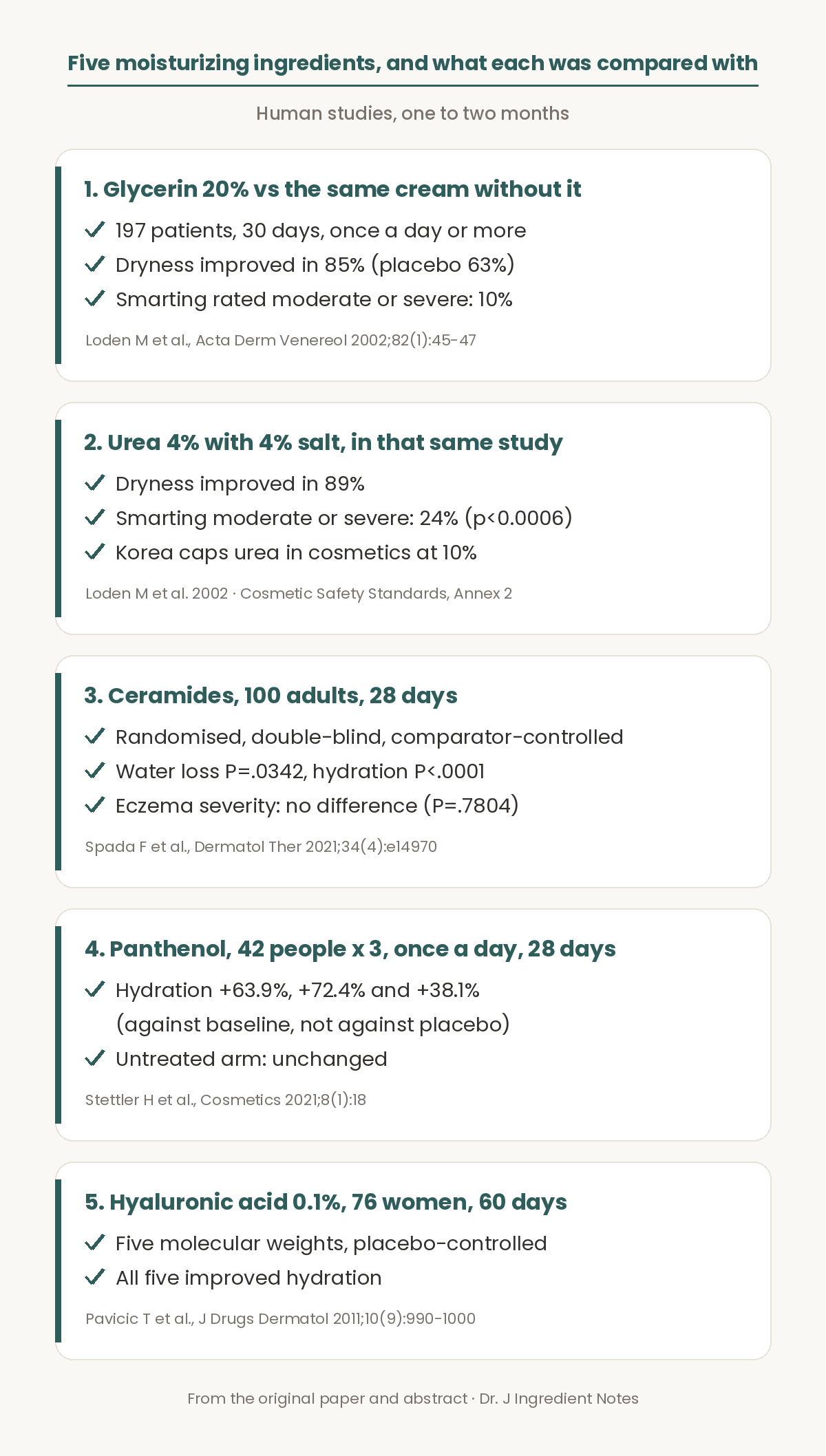
In this trial, 197 patients with atopic dermatitis used one of three creams at least once a day for 30 days (Lodén et al., Acta Derm Venereol 2002):
✔ a cream with 20% glycerin — 68 people
✔ the same cream base without glycerin, as placebo — 66 people
✔ a cream with 4% urea and 4% sodium chloride — 63 people
After 30 days, dermatologist-assessed dryness had improved in 85% of the glycerin group, 63% of the placebo group and 89% of the urea group. Taking the patients’ own assessments together with the dermatologist’s, the paper’s conclusion is that the glycerin cream and the urea-saline cream had equal effects on dryness.
What separated them was how they felt. Smarting — that brief sting on application — was rated severe or moderate by 10% of people on the glycerin cream and 24% on the urea-saline cream (p<0.0006). For stinging, itching and dryness/irritation as separate reactions, the paper reports no differences.
That is why I treat urea as an ingredient to choose on calm days, and why it earns its place on heels, elbows and anywhere the skin is genuinely thickened rather than simply dry.
※ The participants had atopic dermatitis. I am quoting the dryness and sensory results, not treating this as a treatment claim. The creams were supplied by the manufacturer (Aco Hud AB).
――――――――――――――――――――――――――――
3. Ceramides — the barrier numbers move first
A ceramide-dominant cream used together with a matching cleanser for 28 days, in a randomized, double-blind trial of 100 adults with moderate eczema, 83 of whom completed it (Spada et al., Dermatol Ther 2021).
✔ Transepidermal water loss fell compared with the comparator (P=.0342)
✔ Stratum corneum hydration rose compared with the comparator (P<.0001)
✔ Eczema severity (EASI) showed no difference between the groups (P=.7804)
✔ Satisfaction with itch, dryness and smoothness was higher on the ceramide regimen
The third line is the honest one, and it is why I like this study. The barrier measurements moved; the disease score did not. A moisturizer is a moisturizer. Ceramides also work as part of a set — with cholesterol and fatty acids — which is the subject of the ceramide guide linked at the end.
――――――――――――――――――――――――――――
4. Panthenol — once a day, 28 days
Three parallel studies of panthenol-containing emollients that differed in lipid content: low, intermediate and high. Each had 42 participants applying the product to one forearm once daily for 28 days, leaving the other forearm untreated (Stettler et al., Cosmetics 2021).
At day 28, hydration had risen from baseline by 63.9% (low lipid), 72.4% (intermediate) and 38.1% (high). On the untreated arm, hydration did not move — which is what makes the rise hard to attribute to the weather.
Two caveats travel with those percentages: they are measured against baseline, not against a panthenol-free cream, and they belong to the whole formulation, which also contained lipids such as shea butter and squalane. The full reading of this study is in the panthenol guide.
――――――――――――――――――――――――――――
5. Hyaluronic acid — five molecular weights in one study
Creams with 0.1% hyaluronic acid at five different molecular weights, used by 76 women for 60 days against placebo (Pavicic et al., J Drugs Dermatol 2011). All five improved hydration relative to placebo.
So on a label, what I look for is more than one molecular weight listed, rather than a single impressive-sounding number. How to read those numbers is covered in the hyaluronic acid guide.
――――――――――――――――――――――――――――
How to read the numbers — the comparator decides the meaning
The five studies did not use the same yardstick. Here is what each comparison can and cannot tell you.
| Comparator | Used here by | How to read the number |
|---|---|---|
| The same cream minus one ingredient | glycerin | The closest thing to what that ingredient added |
| A different product | ceramides | A product-versus-product result, not one ingredient |
| Untreated skin | panthenol | The whole cream versus applying nothing |
| Day 0 (baseline) | the panthenol percentages | Season and humidity ride along; check whether untreated skin was measured too |
| Placebo | hyaluronic acid | Same formula, different ingredient |
The strongest design here is the same cream with one ingredient removed: formulation held constant, so the difference is attributable to the ingredient. The weakest, in this sense, is a percentage against baseline, because the season is inside that number — unless, as in the panthenol studies, untreated skin was measured alongside and stayed flat.
――――――――――――――――――――――――――――
How Korea regulates these five
One of the five appears in Annex 2 of the Cosmetic Safety Standards — the list of ingredients with use limits.
| Korea | What that means on a label | |
|---|---|---|
| Urea | listed in Annex 2 of the Cosmetic Safety Standards at 10% (CAS 57-13-6) | A product sold in Korea stays at or below 10% |
| Glycerin · ceramides · panthenol · hyaluronic acid | not in that annex | No ceiling, and no minimum either — concentration varies by product |
| Brightening · anti-wrinkle ingredients | listed with set amounts in Annex 4 of the functional-cosmetics review rules | Moisturizing ingredients are not in that kind of table |
This is worth knowing when you compare a Korean product with one from elsewhere. Korea sets a ceiling for urea at 10%; the study above used 4%, well inside it. For the other four, there is no number in the regulation at all — no maximum, and equally no minimum, which is why the ingredient list’s order matters more than any claim on the front of the bottle.
It is also why moisturizing ingredients are not “functional cosmetics” in the Korean sense. Brightening and anti-wrinkle ingredients have an annex listing set amounts; hydration does not work that way.
――――――――――――――――――――――――――――
Why squalane is not on this list
Squalane comes up in every autumn skincare article, so I went looking again. I could not find a study in which squalane was applied to human skin and its hydration effect compared with a placebo. What exists is work outside the body — an ex vivo study of how a squalane-based emulsion carries other compounds into skin, and a cell study of squalane and UV-related collagen effects in fibroblasts.
That is not evidence of absence; it is a statement about what I could verify. If I find a human trial, squalane gets its own guide.
――――――――――――――――――――――――――――
Five things to check on the label
✔ Glycerin — near the top of the ingredient list; higher means more of it
✔ Urea — if a percentage is printed, 10% or below, and start low
✔ Ceramides — cholesterol and fatty acids listed alongside them
✔ Panthenol — for a cream you will use on stinging days, fragrance low on the list or absent
✔ Hyaluronic acid — more than one molecular weight listed
My own order is simple. If tightness comes first after cleansing, I reach for the water-binding side. If stinging comes first, I reach for the barrier side. If both, one product containing both is a reasonable place to start.
――――――――――――――――――――――――――――
In one line
Tight skin: glycerin and hyaluronic acid. Rough skin: urea. Stinging skin: ceramides and panthenol. Start from what your skin does, and read every percentage together with what it was compared against.
――――――――――――――――――――――――――――
📌 Earlier guides
📌 Ceramides – the cholesterol and fatty acid ratio (Ingredient Guide 4)
📌 Panthenol for Skin: What the Dexpanthenol Studies Show (Ingredient Guide 7)
📌 Hyaluronic Acid: How to Read the Molecular Weight (Ingredient Guide 6)
📌 How to Read a Korean Cosmetic Ingredient List — Where the Order Stops at 1% (Ingredient Guide 14)
About the author · Dr. J
MS in Veterinary Medicine, PhD in Life Sciences. I worked as a researcher at the Korea Research Institute of Bioscience and Biotechnology (KRIBB) and now run Beaurea, a cosmetics manufacturing company, where I write the formulas myself. This blog reads the research papers and the regulatory documents and turns them into plain-language criteria for choosing ingredients. I don’t recommend specific products here – only criteria that apply to any product.
📄 References
· Lodén M, Andersson AC, Anderson C, et al. Acta Derm Venereol 2002;82(1):45-47
· Spada F, Harrison IP, Barnes TM, et al. Dermatol Ther 2021;34(4):e14970
· Stettler H, de Salvo R, Olsavszky R, et al. Cosmetics 2021;8(1):18
· Pavicic T, Gauglitz GG, Lersch P, et al. J Drugs Dermatol 2011;10(9):990-1000
· Korea MFDS — Regulation on Safety Standards for Cosmetics, Annex 2 (ingredients with use limits)
――――――――――――――――――――――――――――
This article summarises published research and safety assessments. It is information, not a diagnosis or a treatment plan. If something about your skin worries you, please talk to a professional.
— Dr. J Ingredient Notes
Leave a Reply