Tag: hyaluronic acid

  • Firmness Actives in Korea: Wrinkle Is Notified, Elasticity Is Substantiated

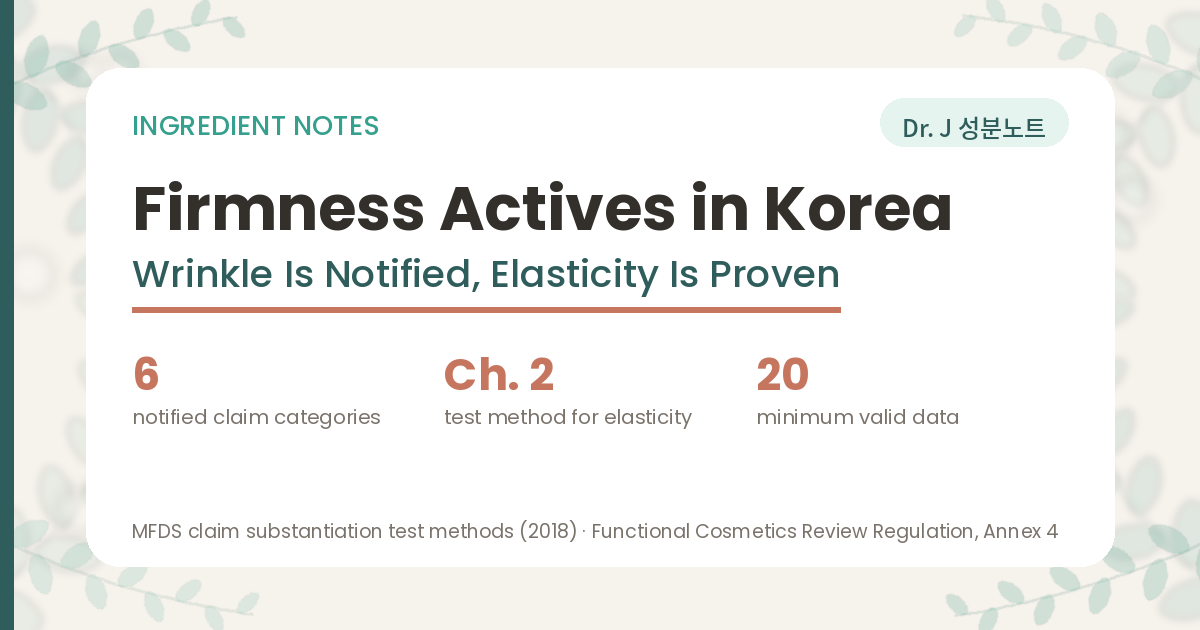
    Cover image for a guide to firmness and elasticity actives in Korean cosmetics. Korea's functional cosmetics notification lists six claim categories, and the wrinkle category names four actives: retinol 2,500 IU per gram, retinyl palmitate 10,000 IU per gram, adenosine 0.04 percent and polyethoxylated retinamide 0.05 to 0.2 percent. The word elasticity does not appear in that table. Instead Chapter 2 of the regulator's claim substantiation guideline writes down how to measure it, with a Cutometer or Dermaflex applying negative pressure and at least 20 valid data sets. Dr. J Ingredient Notes.

    🇰🇷 한국어판

    Hello, this is Dr. J. Today, five actives people reach for when they want firmer skin — chosen by what the human studies actually measured.

    Start with the odd part. In Korea, the regulator reviews “wrinkle improvement” and names the actives for it. It does not use the word elasticity anywhere in that table. Instead it wrote down how to measure elasticity, in a different document.

    ――――――――――――――――――――――――――――

    Primary sources

    📄 Functional Cosmetics Review Regulation, Annex 4 (Korea Law Service)

    📄 MFDS, Guideline on test methods for claim substantiation (March 2018, PDF, Korean)

    📄 Hyaluronic acid, 8-week study (J Clin Aesthet Dermatol 2014)

    📄 0.4% retinol, 24-week trial (Arch Dermatol 2007)

    Annex 4 holds six claim categories. The guideline holds ten test methods. Elasticity appears in the second document only.

    ――――――――――――――――――――――――――――

    ――――――――――――――――――――――――――――

    The short version

    ● Korea notifies six claim categories, and wrinkle improvement names four actives
    ● The word elasticity is not in that table
    ● Chapter 2 of the substantiation guideline is “Skin elasticity improvement”
    ● A Cutometer® or Dermaflex® applies negative pressure and measures the return
    ● So the test to apply to a product is: what did the study measure?

    ――――――――――――――――――――――――――――

    How Korea splits one face into two boxes

    Korean cosmetics law carves out a class called functional cosmetics. For each claim in that class the regulator publishes an annex that names the active and the percentage, and a product built to those numbers is spared from filing new efficacy data. Annex 4 is that table.

    Category What the annex sets Reading
    UV protection and tanning Actives and maximum percentages Both the name and the number are fixed
    Whitening Nine actives (arbutin 2–5%, niacinamide 2–5%, and others) Same
    Wrinkle improvement Four actives (retinol 2,500 IU/g, adenosine 0.04%, and others) The box next to today’s subject
    Hair colour change A list of dye actives Same
    Hair removal Thioglycolic acid 3.0–4.5% A single active
    Acne relief Salicylic acid 0.5% Same
    Firmness / elasticity No category at all Not a claim the regulator reviews

    The wrinkle box, in full

    Active Percentage Reading
    Retinol 2,500 IU/g One of the few set in international units
    Retinyl palmitate 10,000 IU/g A larger number than retinol
    Adenosine 0.04% The smallest percentage of the four
    Polyethoxylated retinamide 0.05–0.2% Written as a range

    Annex 4, wrinkle entry — as written

    Dosage forms: “limited to lotions, solutions, creams and impregnated masks”
    Claim: “helps improve skin wrinkles”
    Directions: “apply an appropriate amount evenly to the skin; or apply the product to the skin, remove the support after 10–20 minutes and spread the remaining product evenly (impregnated masks only)”

    Even the sentence a brand may print is fixed. Elasticity is in none of those cells.

    ――――――――――――――――――――――――――――

    What exists instead: a written test method

    The second document is a civil petitioner guideline published by the Ministry of Food and Drug Safety in March 2018. It sets out how to substantiate ten claims that fall outside the functional class.

    Chapter Claim Added
    Ch. 1 Skin moisturisation 2012.5 (original)
    Ch. 2 Skin elasticity improvement 2012.5 (original)
    Ch. 3 Sebum control 2012.5 (original)
    Ch. 4 Temporary cellulite reduction 2013.11
    Ch. 5 Suitable for acne-prone skin 2013.11
    Ch. 6 Dark circle relief 2014.8
    Ch. 7 Improved skin blood flow 2015.12
    Ch. 8 Puffiness relief 2015.12
    Ch. 9 Paraben-free 2017.3.31
    Ch. 10 Fine dust protection 2018.3.28

    Chapter 2, Skin elasticity improvement — the guideline’s own sentences

    “This is a test in which a Cutometer® or Dermaflex® applies negative pressure to the skin and measures the degree to which it returns to its original state”
    “The number of subjects shall provide at least 20 sets of valid data so that statistical comparison is possible”
    “from among adult men and women aged 20 or over”
    “The test site shall be the whole face, including the eye area (the measurement site)”

    The conditions are written down as well: no air movement or direct sunlight, 20–24 °C and 40–60% relative humidity, 30 minutes of acclimatisation before measurement, a significance level of 0.05, and non-parametric tests as the default when an arm holds 30 subjects or fewer.

    ⚠ What Chapter 2 does not contain is as telling. There is no list of permitted wordings and no pass mark, and no parameter is named — R2, R5 and R7 appear nowhere. The state writes the procedure and leaves the threshold open.
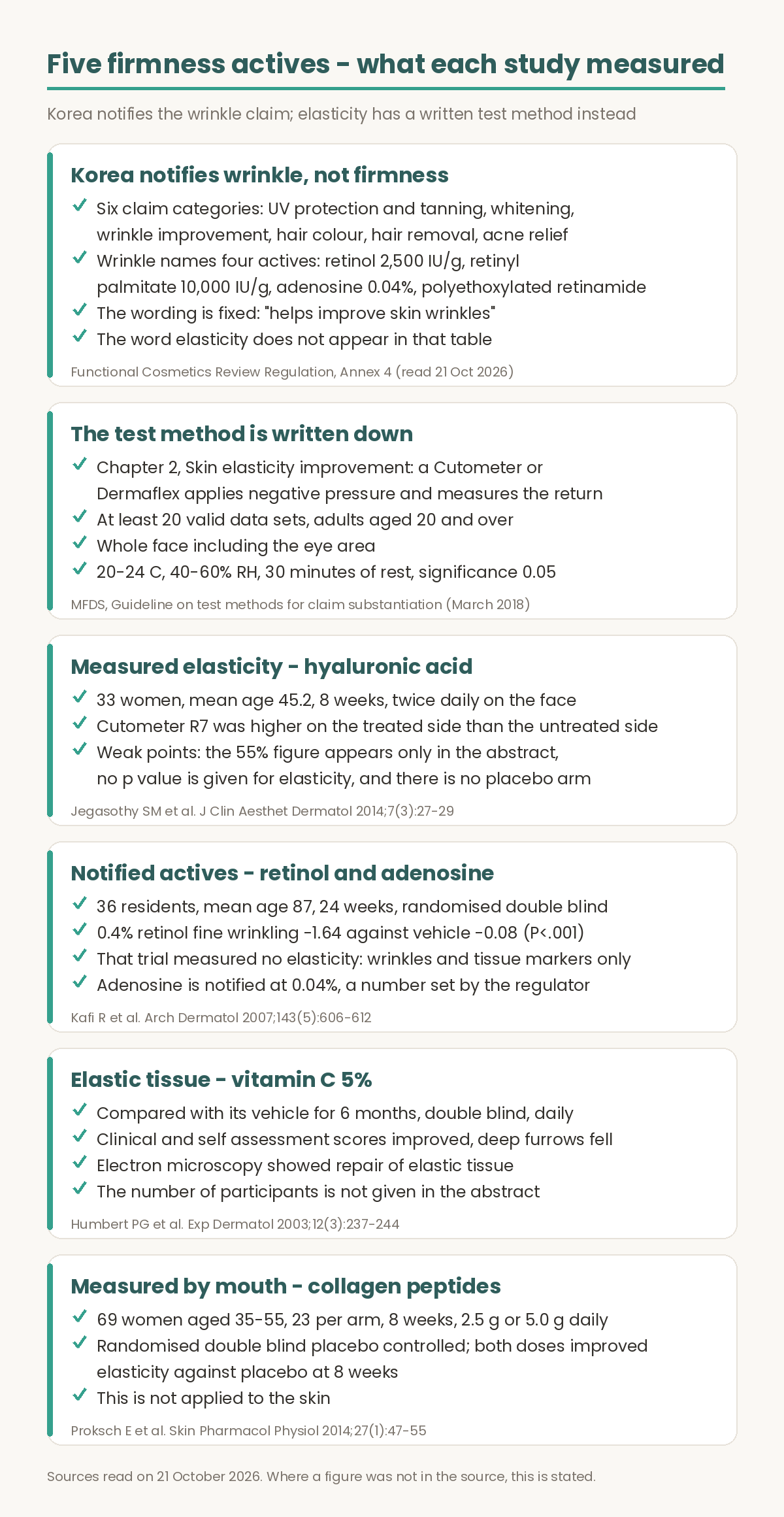
    Evidence summary for five firmness actives. First, Korea notifies wrinkle, not firmness: the six categories are UV protection and tanning, whitening, wrinkle improvement, hair colour change, hair removal and acne relief, and the wrinkle category names four actives with set percentages, while the word elasticity is absent. Second, the test method is written down in Chapter 2 of the claim substantiation guideline: a Cutometer or Dermaflex applies negative pressure and measures how far the skin returns, with at least 20 valid data sets, adults aged 20 and over, the whole face including the eye area, 20 to 24 degrees Celsius and 40 to 60 percent relative humidity, 30 minutes of rest before measurement and a significance level of 0.05. Third, hyaluronic acid measured elasticity directly in 33 women of mean age 45.2 over 8 weeks, where the Cutometer R7 value was higher on the treated side, although the 55 percent figure appears only in the abstract, no p value is given for elasticity and there is no placebo arm. Fourth, retinol and adenosine are the notified actives: a 24 week randomised double blind vehicle controlled trial in 36 residents of mean age 87 found a fine wrinkling change of minus 1.64 against minus 0.08 for vehicle with P below 0.001, and that trial measured no elasticity. Fifth, vitamin C 5 percent was compared with its vehicle for 6 months and electron microscopy showed repair of elastic tissue, but the number of participants is not in the abstract. Sixth, collagen peptides were measured by mouth, not on the skin: 69 women aged 35 to 55 took 2.5 or 5.0 grams daily for 8 weeks and both doses improved elasticity against placebo.

    ――――――――――――――――――――――――――――

    One study measured elasticity directly — hyaluronic acid

    33 women, mean age 45.2 ± 3.9, over 8 weeks at a contract institute in Hamburg. A low molecular weight hyaluronic acid lotion, serum and cream were applied twice a day to the whole face, with measurements at baseline and on days 15, 29 and 57.

    Elasticity was read with a Cutometer, and the treated side rose significantly above the untreated side. Moisture, roughness and erythema were measured too; the only p value printed in the body of the paper belongs to erythema.

    The weak points belong in the same paragraph. The “up to 55%” figure lives in the abstract and is not carried into the text, no p value is given for elasticity, and there is no placebo arm — the comparison is with an untreated area. The concentration of the product is not disclosed either.

    ――――――――――――――――――――――――――――

    Two are notified actives — retinol and adenosine

    The retinol trial measured wrinkles. 36 residents of two long-term care facilities, mean age 87, were followed for 24 weeks in a randomised, double-blind, vehicle-controlled design: 0.4% retinol lotion on one arm, its vehicle on the other, up to three times a week.

    Fine wrinkling scores changed by −1.64 (95% CI −2.06 to −1.22) with retinol against −0.08 (−0.17 to 0.01) with vehicle, P<.001. In biopsy subsets, glycosaminoglycan expression rose (P=.02) and procollagen I staining increased (P=.049).

    That trial measured no elasticity. It measured wrinkle scores and tissue markers. Adenosine, meanwhile, carries a number the regulator chose: 0.04%, set in Annex 4, not by the brand.

    ――――――――――――――――――――――――――――

    One looked at the fibres — vitamin C 5%

    A 5% ascorbic acid cream was compared with its own excipient for 6 months, double-blind, applied daily, with assessments at baseline, 3 months and 6 months and biopsies at the end.

    Global scores from both the dermatologist and the volunteer improved against control, the density of the skin microrelief rose and deep furrows fell. Electron microscopy showed repair of elastic tissue, consistent with the clinical and surface findings.

    Two limits: the number of participants is not stated in the abstract (healthy female volunteers with photoaged skin is as far as it goes), and what this study saw is tissue, not an elasticity reading.

    ――――――――――――――――――――――――――――

    One was measured by mouth — collagen peptides

    69 women aged 35–55, 23 per arm, took 2.5 g or 5.0 g of collagen hydrolysate or placebo once daily for 8 weeks, with a 4-week follow-up after the supplement stopped.

    Both doses improved skin elasticity against placebo at 8 weeks, and four weeks after stopping, elasticity remained significantly higher in the older women. Hydration and transepidermal water loss moved in subgroup analysis but not significantly.

    This one is not applied to the skin. It belongs on a different shelf from the jar, and the exact figures, p values and the instrument used sit behind a paywall this piece could not open.

    ――――――――――――――――――――――――――――

    The five in one table

    Active Subjects Duration Design Measured Result
    Hyaluronic acid 33 8 weeks Treated vs untreated area Elasticity Significantly higher on the treated side
    Retinol 0.4% 36 24 weeks Randomised, double-blind, vehicle Wrinkles, tissue −1.64 vs −0.08 (P<.001)
    Adenosine 0.04% — — Set by Annex 4 — Notified for wrinkle improvement
    Vitamin C 5% not in abstract 6 months Double-blind, vehicle Elastic tissue Repair on electron microscopy
    Collagen peptides 69 8 weeks Randomised, double-blind, placebo Elasticity (oral) Both doses above placebo

    And where each one is weak

    Active What this study cannot say
    Hyaluronic acid The 55% figure is abstract-only; no p value for elasticity and no placebo arm; the concentration is undisclosed
    Retinol It did not measure elasticity. The cohort is also a mean age of 87 in residential care, which does not transfer cleanly to younger skin
    Adenosine What the regulator approved is wrinkle improvement, not an elasticity figure
    Vitamin C No participant count in the abstract, and it looked at tissue rather than an elasticity reading
    Collagen peptides Not a topical result. The numbers, p values and instrument could not be verified in the full text

    ――――――――――――――――――――――――――――

    Korea, the United States and the EU — reviewed names and proven names

    Korea United States EU
    Ingredient list per claim Annex 4 of the functional cosmetics regulation — actives and percentages for six claims None Positive lists cover colorants, preservatives and UV filters only (Regulation 1223/2009, Art. 14)
    “Wrinkle” Reviewed or notified before sale as a functional claim No approved list of claims Handled as a claim, under the common criteria
    “Elasticity” Chapter 2 writes down the measuring procedure No procedure written by the regulator The six common criteria demand evidence
    In their words “a Cutometer® or Dermaflex® applies negative pressure to the skin…” “FDA does not have a list of approved or accepted claims for cosmetics” “adequate and verifiable evidence” · “state of the art practices” (655/2013)
    When it is checked Functional claims before sale; elasticity when asked No pre-market approval for cosmetics No pre-market approval; the evidence must exist

    Lined up, the Korean position is unusual in a specific way. One face, two boxes. The claim closest to firmness — wrinkles — is handled by ingredient, in advance. Firmness itself is handled by procedure, afterwards. Neither the United States nor the EU keeps the first box for this kind of claim at all, which is why an exporter reads the two sentences in opposite order: in Seoul the first question is which active and what percentage, and in Brussels or Washington it is what evidence is on file.

    ――――――――――――――――――――――――――――

    What was left out, and why

    ✔ The niacinamide elasticity trial (Bissett et al., Dermatol Surg 2005) — the abstract could not be opened at a primary source today. Europe PMC returned 429 on all three attempts and Wiley, the journal’s own full text and Semantic Scholar all errored
    ✔ Injected hyaluronic acid (mesotherapy) — a procedure, not a cosmetic
    ✔ Lasers, radiofrequency and thread lifts — same reason
    ✔ Madecassoside — the primary sources found were reviews
    ✔ A green tea study (Chiu 2005) — oral and topical treatment were given together, so neither arm can be read alone
    ✔ A pass mark for Chapter 2 — the guideline does not set one

    About the author · Dr. J

    MS in Veterinary Medicine, PhD in Life Sciences. I worked as a researcher at the Korea Research Institute of Bioscience and Biotechnology (KRIBB) and now run Beaurea, a cosmetics manufacturing company, where I write the formulas myself. This blog reads the research papers and the regulatory documents and turns them into plain-language criteria for choosing ingredients. I don’t recommend specific products here – only criteria that apply to any product.

    📌 Related

    📌 Adenosine 0.04%: who decided that number — the box next door, wrinkle improvement

    📌 Hyaluronic acid: how to read the molecular weight — the one active here that measured elasticity

    📌 Collagen: topical vs oral — the longer version of the oral section

    📌 Pores and sebum: the test method the regulator wrote down — Chapter 3 of the same guideline

    📄 References

    · Functional Cosmetics Review Regulation, Annex 4 (Korea Law Service, read 21 October 2026)

    · MFDS, Guideline on test methods for the substantiation of cosmetic labelling and advertising (civil petitioner guideline, March 2018), Chapter 2

    · Jegasothy SM, Zabolotniaia V, Bielfeldt S. J Clin Aesthet Dermatol 2014;7(3):27-29

    · Kafi R, Kwak HSR, Schumacher WE, Cho S, Hanft VN, Hamilton TA, King AL, Neal JD, Varani J, Fisher GJ, Voorhees JJ, Kang S. Arch Dermatol 2007;143(5):606-612

    · Humbert PG, Haftek M, Creidi P, Lapière C, Nusgens B, Richard A, Schmitt D, Rougier A, Zahouani H. Exp Dermatol 2003;12(3):237-244

    · Proksch E, Segger D, Degwert J, Schunck M, Zague V, Oesser S. Skin Pharmacol Physiol 2014;27(1):47-55

    · U.S. FDA, “Cosmetics Labeling Claims” (content current as of 21 November 2022)

    · Commission Regulation (EU) No 655/2013, common criteria · Regulation (EC) No 1223/2009, Article 14

    ――――――――――――――――――――――――――――

    This article summarises published research and public regulatory documents; it is not medical advice. Annex 4 and Chapter 2 of the substantiation guideline were read at source on 21 October 2026, and the Korean documents are quoted here in translation. Of the four studies, one does not state its participant count, one measured no elasticity at all, and one was taken by mouth. Those facts are in the tables. Ingredient names and percentages are given as criteria for reading a product, not as a recommendation of any product.

    — Dr. J Ingredient Notes
  • Moisturizing Ingredients for Dry Skin: What the Research Shows for Five of Them (Autumn Guide)

    Cover image for a Dr. J Ingredient Notes autumn guide on moisturizing ingredients for dry skin. Five ingredients with human studies: glycerin, urea, ceramides, panthenol and hyaluronic acid, with what each number was compared with.

    🇰🇷 한국어판: 건조한 피부 보습 성분 TOP5 – 가을에 고르는 기준

    Hello, I’m Dr. J. Autumn is when the same question arrives every year: which moisturizing ingredients actually do something for dry skin? Here are five, each with a human study attached, and each with the numbers read the way I would read them in the lab.

    This is not a ranking. The five do different jobs, and the one you want depends on what your skin does after cleansing: tightness, roughness and flaking, or stinging. Match that first and the shelf gets much smaller.

    Below: one table with all five studies side by side, then each ingredient in turn, then the part most ingredient articles skip — what each number was compared with, because “improved by 72%” and “better than placebo” are not the same claim. At the end, how Korean regulation treats these five, and why squalane is not among them.

    ――――――――――――――――――――――――――――

    📄 If you’d rather read the primary sources

    📄 Lodén et al. 2002 — glycerin 20% and urea 4% creams, 197 patients, 30 days (Acta Derm Venereol)

    📄 Spada et al. 2021 — ceramide-dominant cream and cleanser, 28-day randomized trial (Dermatol Ther)

    📄 Stettler et al. 2021 — panthenol emollients, three 28-day studies (open access)

    📄 Pavicic et al. 2011 — hyaluronic acid 0.1%, 76 women, 60 days (PubMed)

    📄 Korea — Cosmetic Safety Standards, Annex 2: ingredients with use limits (Korean)

    The Stettler paper is fully open, tables included. The Korean annex downloads as the original table.

    ――――――――――――――――――――――――――――

    ――――――――――――――――――――――――――――

    The short version

    ✔ Tight skin — humectants that hold water: glycerin, hyaluronic acid

    ✔ Rough, flaking skin — urea, capped at 10% in cosmetics sold in Korea

    ✔ Stinging after cleansing — barrier ingredients: ceramides, panthenol

    ✔ All five have human studies of one to two months

    ✔ Before trusting a percentage, ask what it was compared with (Table 2)

    ――――――――――――――――――――――――――――

    All five studies in one table

    Ingredient Study People · duration Compared with What was measured
    Glycerin 20% Lodén et al. 2002 68 of 197 · 30 days the same cream without glycerin dryness improved in 85% (placebo 63%)
    Urea 4%
    with 4% sodium chloride
    Lodén et al. 2002 63 in the same study · 30 days the other creams in that study improved in 89%; smarting in 24%
    Ceramides Spada et al. 2021 100 adults (83 completed) · 28 days a comparator regimen · double-blind water loss P=.0342; hydration P<.0001
    Panthenol Stettler et al. 2021 42 people × 3 studies · 28 days the untreated opposite arm hydration +38.1% to +72.4% vs baseline
    Hyaluronic acid 0.1% Pavicic et al. 2011 76 women · 60 days placebo all five molecular weights improved hydration

    Read the “compared with” column first. It is the column that decides how much weight each number can carry, and it is the one marketing copy leaves out.

    ――――――――――――――――――――――――――――

    1 and 2. Glycerin and urea — measured in the same study

    In this trial, 197 patients with atopic dermatitis used one of three creams at least once a day for 30 days (Lodén et al., Acta Derm Venereol 2002):

    ✔ a cream with 20% glycerin — 68 people

    ✔ the same cream base without glycerin, as placebo — 66 people

    ✔ a cream with 4% urea and 4% sodium chloride — 63 people

    After 30 days, dermatologist-assessed dryness had improved in 85% of the glycerin group, 63% of the placebo group and 89% of the urea group. Taking the patients’ own assessments together with the dermatologist’s, the paper’s conclusion is that the glycerin cream and the urea-saline cream had equal effects on dryness.

    What separated them was how they felt. Smarting — that brief sting on application — was rated severe or moderate by 10% of people on the glycerin cream and 24% on the urea-saline cream (p<0.0006). For stinging, itching and dryness/irritation as separate reactions, the paper reports no differences.

    That is why I treat urea as an ingredient to choose on calm days, and why it earns its place on heels, elbows and anywhere the skin is genuinely thickened rather than simply dry.

    ※ The participants had atopic dermatitis. I am quoting the dryness and sensory results, not treating this as a treatment claim. The creams were supplied by the manufacturer (Aco Hud AB).

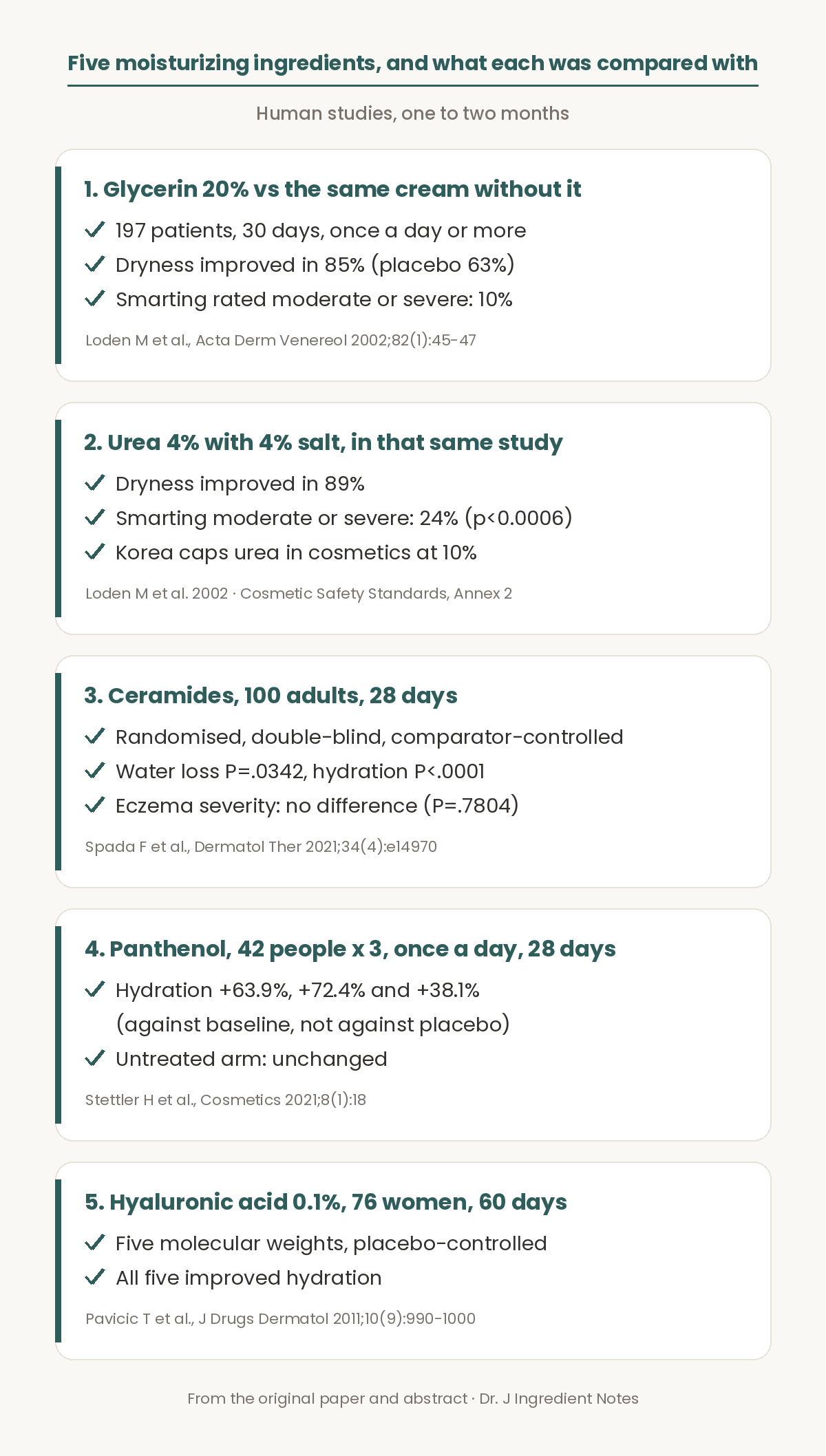
    Evidence figure for five moisturizing ingredients. First, in 197 patients using creams for 30 days, dermatologist-assessed dryness improved in 85 percent with 20 percent glycerin versus 63 percent with the same cream without glycerin, Loden and colleagues, Acta Dermato-Venereologica 2002. Second, in the same study, 4 percent urea with 4 percent sodium chloride improved dryness in 89 percent, but smarting was rated moderate or severe by 24 percent versus 10 percent for glycerin; Korea caps urea at 10 percent. Third, a ceramide-dominant cream and cleanser used by 100 adults with moderate eczema for 28 days reduced water loss, P equals .0342, and raised hydration, P below .0001, while eczema severity did not differ between groups, Spada and colleagues 2021. Fourth, panthenol emollients used once daily for 28 days by 42 people in each of three studies raised hydration from baseline by 38.1 to 72.4 percent while the untreated arm stayed unchanged, Stettler and colleagues 2021. Fifth, hyaluronic acid at 0.1 percent in five molecular weights used by 76 women for 60 days improved hydration versus placebo, Pavicic and colleagues 2011.

    ――――――――――――――――――――――――――――

    3. Ceramides — the barrier numbers move first

    A ceramide-dominant cream used together with a matching cleanser for 28 days, in a randomized, double-blind trial of 100 adults with moderate eczema, 83 of whom completed it (Spada et al., Dermatol Ther 2021).

    ✔ Transepidermal water loss fell compared with the comparator (P=.0342)

    ✔ Stratum corneum hydration rose compared with the comparator (P<.0001)

    ✔ Eczema severity (EASI) showed no difference between the groups (P=.7804)

    ✔ Satisfaction with itch, dryness and smoothness was higher on the ceramide regimen

    The third line is the honest one, and it is why I like this study. The barrier measurements moved; the disease score did not. A moisturizer is a moisturizer. Ceramides also work as part of a set — with cholesterol and fatty acids — which is the subject of the ceramide guide linked at the end.

    ――――――――――――――――――――――――――――

    4. Panthenol — once a day, 28 days

    Three parallel studies of panthenol-containing emollients that differed in lipid content: low, intermediate and high. Each had 42 participants applying the product to one forearm once daily for 28 days, leaving the other forearm untreated (Stettler et al., Cosmetics 2021).

    At day 28, hydration had risen from baseline by 63.9% (low lipid), 72.4% (intermediate) and 38.1% (high). On the untreated arm, hydration did not move — which is what makes the rise hard to attribute to the weather.

    Two caveats travel with those percentages: they are measured against baseline, not against a panthenol-free cream, and they belong to the whole formulation, which also contained lipids such as shea butter and squalane. The full reading of this study is in the panthenol guide.

    ――――――――――――――――――――――――――――

    5. Hyaluronic acid — five molecular weights in one study

    Creams with 0.1% hyaluronic acid at five different molecular weights, used by 76 women for 60 days against placebo (Pavicic et al., J Drugs Dermatol 2011). All five improved hydration relative to placebo.

    So on a label, what I look for is more than one molecular weight listed, rather than a single impressive-sounding number. How to read those numbers is covered in the hyaluronic acid guide.

    ――――――――――――――――――――――――――――

    How to read the numbers — the comparator decides the meaning

    The five studies did not use the same yardstick. Here is what each comparison can and cannot tell you.

    Comparator Used here by How to read the number
    The same cream minus one ingredient glycerin The closest thing to what that ingredient added
    A different product ceramides A product-versus-product result, not one ingredient
    Untreated skin panthenol The whole cream versus applying nothing
    Day 0 (baseline) the panthenol percentages Season and humidity ride along; check whether untreated skin was measured too
    Placebo hyaluronic acid Same formula, different ingredient

    The strongest design here is the same cream with one ingredient removed: formulation held constant, so the difference is attributable to the ingredient. The weakest, in this sense, is a percentage against baseline, because the season is inside that number — unless, as in the panthenol studies, untreated skin was measured alongside and stayed flat.

    ――――――――――――――――――――――――――――

    How Korea regulates these five

    One of the five appears in Annex 2 of the Cosmetic Safety Standards — the list of ingredients with use limits.

    Korea What that means on a label
    Urea listed in Annex 2 of the Cosmetic Safety Standards at 10% (CAS 57-13-6) A product sold in Korea stays at or below 10%
    Glycerin · ceramides · panthenol · hyaluronic acid not in that annex No ceiling, and no minimum either — concentration varies by product
    Brightening · anti-wrinkle ingredients listed with set amounts in Annex 4 of the functional-cosmetics review rules Moisturizing ingredients are not in that kind of table

    This is worth knowing when you compare a Korean product with one from elsewhere. Korea sets a ceiling for urea at 10%; the study above used 4%, well inside it. For the other four, there is no number in the regulation at all — no maximum, and equally no minimum, which is why the ingredient list’s order matters more than any claim on the front of the bottle.

    It is also why moisturizing ingredients are not “functional cosmetics” in the Korean sense. Brightening and anti-wrinkle ingredients have an annex listing set amounts; hydration does not work that way.

    ――――――――――――――――――――――――――――

    Why squalane is not on this list

    Squalane comes up in every autumn skincare article, so I went looking again. I could not find a study in which squalane was applied to human skin and its hydration effect compared with a placebo. What exists is work outside the body — an ex vivo study of how a squalane-based emulsion carries other compounds into skin, and a cell study of squalane and UV-related collagen effects in fibroblasts.

    That is not evidence of absence; it is a statement about what I could verify. If I find a human trial, squalane gets its own guide.

    ――――――――――――――――――――――――――――

    Five things to check on the label

    ✔ Glycerin — near the top of the ingredient list; higher means more of it

    ✔ Urea — if a percentage is printed, 10% or below, and start low

    ✔ Ceramides — cholesterol and fatty acids listed alongside them

    ✔ Panthenol — for a cream you will use on stinging days, fragrance low on the list or absent

    ✔ Hyaluronic acid — more than one molecular weight listed

    My own order is simple. If tightness comes first after cleansing, I reach for the water-binding side. If stinging comes first, I reach for the barrier side. If both, one product containing both is a reasonable place to start.

    ――――――――――――――――――――――――――――

    In one line

    Tight skin: glycerin and hyaluronic acid. Rough skin: urea. Stinging skin: ceramides and panthenol. Start from what your skin does, and read every percentage together with what it was compared against.

    ――――――――――――――――――――――――――――

    📌 Earlier guides

    📌 Ceramides – the cholesterol and fatty acid ratio (Ingredient Guide 4)

    📌 Panthenol for Skin: What the Dexpanthenol Studies Show (Ingredient Guide 7)

    📌 Hyaluronic Acid: How to Read the Molecular Weight (Ingredient Guide 6)

    📌 How to Read a Korean Cosmetic Ingredient List — Where the Order Stops at 1% (Ingredient Guide 14)

    About the author · Dr. J

    MS in Veterinary Medicine, PhD in Life Sciences. I worked as a researcher at the Korea Research Institute of Bioscience and Biotechnology (KRIBB) and now run Beaurea, a cosmetics manufacturing company, where I write the formulas myself. This blog reads the research papers and the regulatory documents and turns them into plain-language criteria for choosing ingredients. I don’t recommend specific products here – only criteria that apply to any product.

    📄 References

    · Lodén M, Andersson AC, Anderson C, et al. Acta Derm Venereol 2002;82(1):45-47

    · Spada F, Harrison IP, Barnes TM, et al. Dermatol Ther 2021;34(4):e14970

    · Stettler H, de Salvo R, Olsavszky R, et al. Cosmetics 2021;8(1):18

    · Pavicic T, Gauglitz GG, Lersch P, et al. J Drugs Dermatol 2011;10(9):990-1000

    · Korea MFDS — Regulation on Safety Standards for Cosmetics, Annex 2 (ingredients with use limits)

    ――――――――――――――――――――――――――――

    This article summarises published research and safety assessments. It is information, not a diagnosis or a treatment plan. If something about your skin worries you, please talk to a professional.

    — Dr. J Ingredient Notes

  • Hyaluronic Acid: How to Read the Molecular Weight – Where Low Weights Go and What High Weights Do (Ingredient Guide 6)

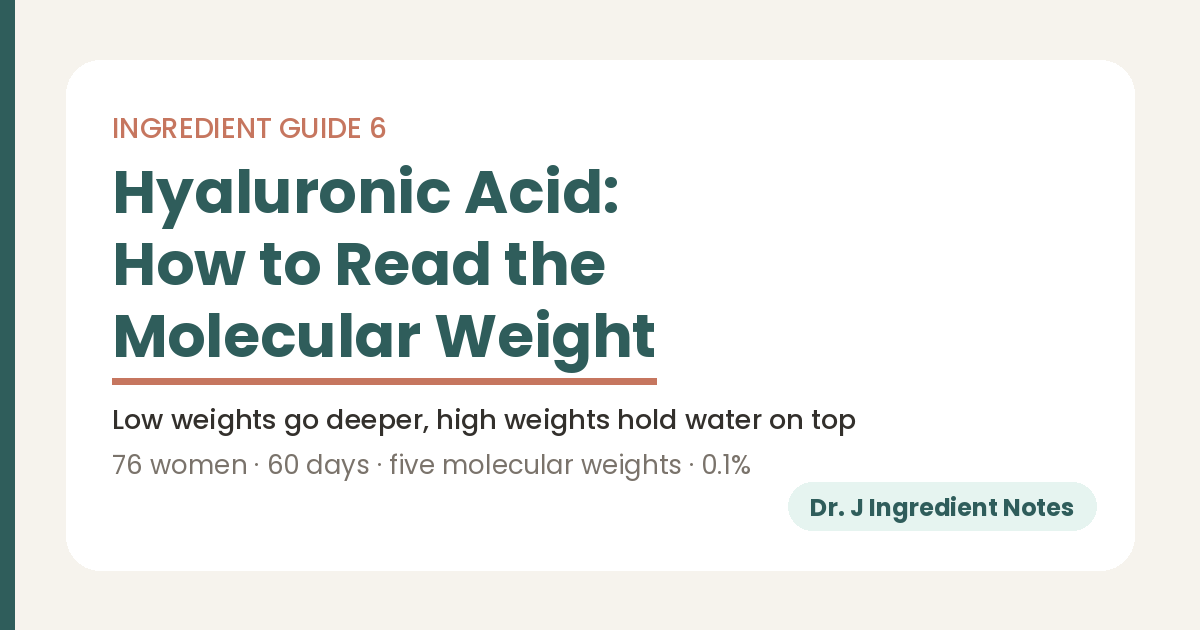
    Cover image for Ingredient Guide 6 on hyaluronic acid: how to read the molecular weight number, how deep low and high molecular weights reach in skin, a Raman spectroscopy study and a 76-woman 60-day cream trial. Dr. J Ingredient Notes.

    Hello, this is Dr. J.

    Ingredient Guide number six is hyaluronic acid. Once autumn arrives, a lot of people tell me their cheeks feel tight right after washing – and this is the ingredient they reach for.

    The trouble is the label. One product says low molecular weight, another says high, a third says ultra-low or prints a number like “1,000 daltons” on the front. It is hard to know what to look at. This post explains how to read that number, and then uses two studies on human skin to show what actually changes with molecular weight.

    The short version: hydration and elasticity improved with all five molecular weights tested against placebo. Where they split was wrinkle depth.

    🇰🇷 Read this in Korean: 히알루론산, 분자량 숫자 읽는 법 (성분 백과 ⑥)

    ―――――――――――――――――――――

    📄 Read the sources first

    · Essendoubi M et al., Skin Res Technol 2016;22(1):55–62 – skin penetration by molecular weight, Raman spectroscopy

    · Pavicic T et al., J Drugs Dermatol 2011;10(9):990–1000 – 0.1% creams, 76 women, 60 days, five molecular weights

    · 🏠 COSMILE Europe ingredient database – look up “Sodium Hyaluronate”

    The abstracts give the method and the placebo cream. The 2016 abstract also makes clear that the depth values come from excised skin sections, not skin on a living person.

    ―――――――――――――――――――――

    15-second summary · no sound

    ―――――――――――――――――――――

    In a hurry? Four lines

    ✔ Molecular weight is read in kilodaltons (kDa). Take a dalton figure and drop three zeros

    ✔ The smaller the number, the deeper it reached – 20–50 kDa about 100 µm, while 1,000–1,400 kDa stayed in the outer layer at about 25 µm

    ✔ In a 76-woman, 60-day cream trial, hydration and elasticity improved with all five molecular weights versus placebo

    ✔ Wrinkle depth changed with 50 and 130 kDa. Low weights work at depth, high weights work on the surface

    ―――――――――――――――――――――

    What hyaluronic acid does – a place to hold water

    Hyaluronic acid is already in our skin, in the dermis. It attracts and holds water very strongly, so in cosmetics its job is hydration. On an ingredient list it appears as “Sodium Hyaluronate” or “Hyaluronic Acid”.

    What separates one product from another is the size of the molecule. Hyaluronic acid is a chain of repeating units. A short chain slips in lightly; a long chain sits on the surface and forms a water-holding layer. If ceramides are the mortar that fills the gaps between the bricks, hyaluronic acid is the wet cloth laid over the wall that holds water. Two ingredients can share the word “moisturising” and still do different jobs.

    “How far does a big molecule get?” came up in the collagen guide too. Collagen is a protein and hyaluronic acid is a sugar chain, so they are different kinds of molecule, but the rule is the same: size decides where it goes.

    ―――――――――――――――――――――

    How to read the number – daltons, kilodaltons and the word “low”

    Molecular weight is written in daltons (Da). 1,000 daltons make 1 kilodalton (kDa), so 50,000 Da is 50 kDa and 1,000,000 Da is 1,000 kDa. If a product prints daltons, drop three zeros and read it in kDa. “Low” and “high” have no fixed boundary, so the table below uses the ranges the two studies actually tested.

    What the label says Weight range How deep it reached What it does
    Low · ultra-low · oligo Below a few tens of kDa (50,000 Da = 50 kDa) Past the stratum corneum, about 100 µm (20–50 kDa) Hydration at depth · the range where wrinkle depth changed
    Medium 100–300 kDa About 50 µm Hydration · elasticity
    High Above 1,000 kDa (1,000,000 Da = 1,000 kDa) About 25 µm · stays in the stratum corneum A water-holding layer on the surface · the quick relief for tightness

    So neither “low is better” nor “high is better” is the answer. A product that lists two weights covers the deep layer and the surface at once. Which weight did what is in the two studies below.

    ―――――――――――――――――――――

    How deep did it get – the Raman spectroscopy study

    Researchers applied three molecular weights of hyaluronic acid to abdominal skin from a 44-year-old woman, cut the skin in cross-section and mapped the signal layer by layer with Raman spectroscopy. Raman reads the vibration signature of a molecule, so it can tell the applied hyaluronic acid apart from the skin’s own components and show which layer it reached – Essendoubi et al., Skin Res Technol 2016.

    ✔ 20–50 kDa – about 100 µm

    ✔ 100–300 kDa – about 50 µm

    ✔ 1,000–1,400 kDa – about 25 µm, it stayed in the stratum corneum

    The smaller the molecule, the deeper it went. One caveat: these values come from excised skin sections, from a single donor, not from skin on a living person. The direction is clear; the exact micrometre figure could differ from one person to the next. That is why the next study matters – people actually used the cream.

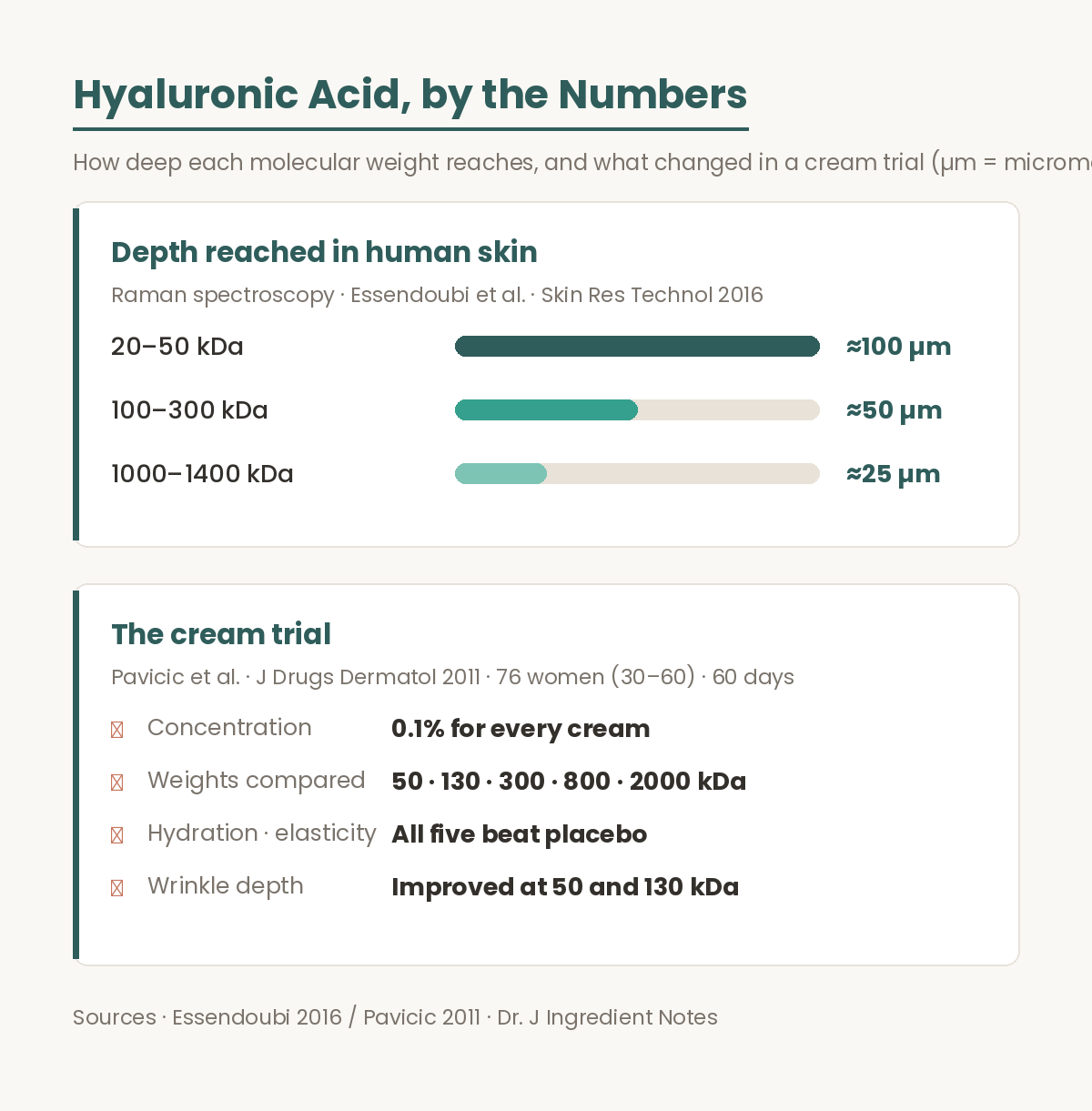
    Hyaluronic acid evidence summary. Depth reached in human skin measured by Raman spectroscopy: 20 to 50 kilodaltons about 100 micrometers, 100 to 300 kilodaltons about 50 micrometers, 1000 to 1400 kilodaltons about 25 micrometers, Skin Research and Technology 2016. In a 60-day cream trial with 76 women aged 30 to 60 at a fixed 0.1 percent, all five molecular weights improved hydration and elasticity versus placebo, and wrinkle depth improved with 50 and 130 kilodaltons, Journal of Drugs in Dermatology 2011.

    ―――――――――――――――――――――

    As a cream – 76 women, 60 days

    The concentration was fixed at 0.1% and only the molecular weight changed: 50, 130, 300, 800 and 2,000 kDa. 76 women aged 30–60 applied the cream to one eye area and the same cream without hyaluronic acid to the other, twice a day for 60 days. Hydration, elasticity and wrinkle depth were measured at baseline, day 30 and day 60 – Pavicic et al., J Drugs Dermatol 2011.

    Measured 50 · 130 kDa 300 · 800 · 2,000 kDa
    Hydration Significantly better than placebo Significantly better than placebo
    Elasticity (R2) Significantly better than placebo Significantly better than placebo
    Wrinkle depth Improved versus placebo – the largest reduction was in these two No clear difference

    The authors put it down to better penetration at low molecular weight. Read side by side, the two studies say this: if hydration is the goal, the number matters less; if you are hoping for something on wrinkle depth, the low numbers (50–130 kDa) are the ones with evidence behind them. The individual percentages are not in the abstract, so this post says “improved versus placebo” and leaves it there.

    ―――――――――――――――――――――

    How to use it – damp skin and one layer on top

    ✔ Apply while the skin is still damp after cleansing. It needs water to hold on to

    ✔ Then seal it with one layer – a cream or an oil. Without a seal, the water it holds heads for the air, and a dry room makes that worse

    ✔ It sits comfortably in the same routine as retinol, vitamin C or niacinamide. On nights with an active, laying it down first takes the edge off the tightness

    ✔ In the morning it goes before sunscreen. Thin textures first

    Which ingredients can share a night is in the ingredient compatibility chart.

    ―――――――――――――――――――――

    Five things to check before you buy

    ✔ Are two or more molecular weights listed? – they divide the deep layer and the surface between them

    ✔ What unit is the number in? – if daltons, drop three zeros and read kDa. A number tells you more than the word “low”

    ✔ Is it near the top of the ingredient list? – “Sodium Hyaluronate” or “Hyaluronic Acid”. The trial used 0.1%

    ✔ Is there something to seal it with? – if it is a serum, plan the cream that goes on top as part of the set

    ✔ Can you give it 60 days? – that is how long the cream trial ran. Hydration you feel at once; wrinkle depth takes time

    Save these five lines for the shop. Reading the back of the box takes five minutes.

    ―――――――――――――――――――――

    One-line summary

    🧪 Hyaluronic acid is an ingredient you choose by reading the molecular weight. Small numbers go deep, big numbers stay on top – a product with both numbers covers both, and applying it to damp skin and sealing it with one layer completes the set.

    The next Ingredient Guide is panthenol (Ingredient Guide 7). Where hyaluronic acid holds water, panthenol calms the barrier.

    📌 Earlier posts

    · Retinol: Start at 0.1% – How to Read the Concentration Numbers (Ingredient Guide 1)

    · Skincare Ingredient Compatibility Chart – 12 Ingredients, What to Layer and What to Split

    · Dull, Rough Skin? Glycolic Acid (AHA) – What the Research Shows

    · Collagen: Topical vs Oral – What the Research Says (Ingredient Guide 5)

    · Ceramides: The Three-Line Label Check (Ingredient Guide 4)

    About the author · Dr. J

    MS in Veterinary Medicine, PhD in Life Sciences. I worked as a researcher at the Korea Research Institute of Bioscience and Biotechnology (KRIBB) and now run Beaurea, a cosmetics manufacturing company, where I write the formulas myself. This blog reads the research papers and the regulatory documents and turns them into plain-language criteria for choosing ingredients. I don’t recommend specific products here – only criteria that apply to any product.

    📄 References

    · Essendoubi M, Gobinet C, Reynaud R, Angiboust JF, Manfait M, Piot O. Human skin penetration of hyaluronic acid of different molecular weights as probed by Raman spectroscopy. Skin Res Technol 2016;22(1):55–62

    · Pavicic T, Gauglitz GG, Lersch P, Schwach-Abdellaoui K, Malle B, Korting HC, Farwick M. Efficacy of cream-based novel formulations of hyaluronic acid of different molecular weights in anti-wrinkle treatment. J Drugs Dermatol 2011;10(9):990–1000

    · COSMILE Europe – INCI ingredient database

    This article summarises published research and public documents for information. It is not a diagnosis or a treatment. If you have a skin concern that worries you, please see a professional.

    — Dr. J Ingredient Notes