Tag: dry skin

  • Moisturizing Ingredients for Dry Skin: What the Research Shows for Five of Them (Autumn Guide)

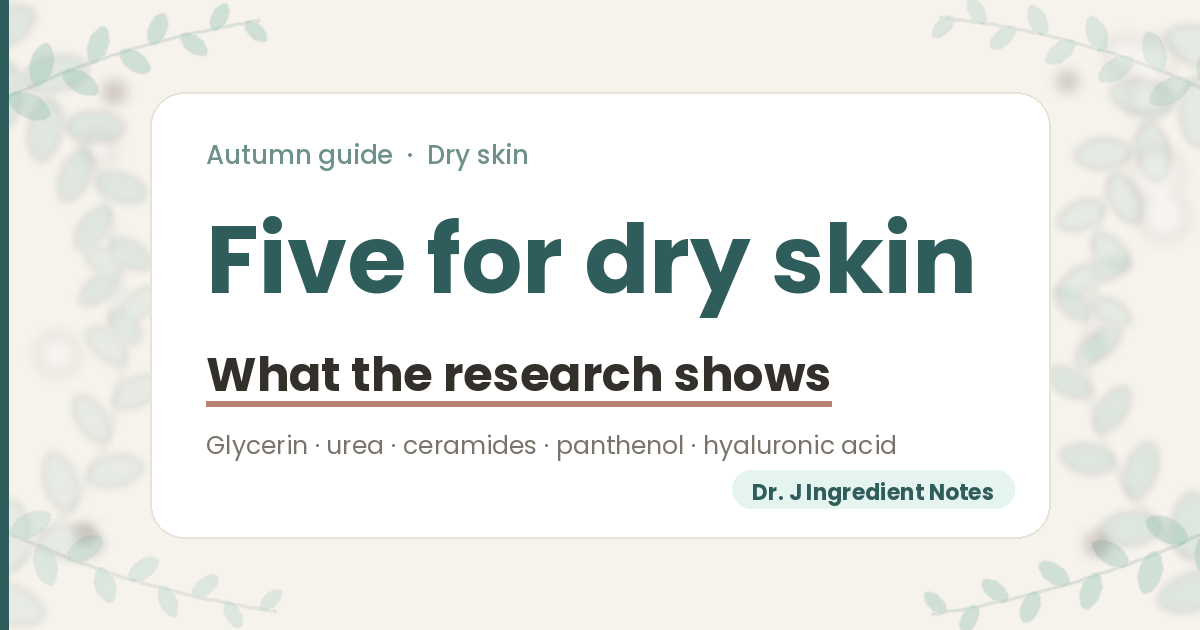
    Cover image for a Dr. J Ingredient Notes autumn guide on moisturizing ingredients for dry skin. Five ingredients with human studies: glycerin, urea, ceramides, panthenol and hyaluronic acid, with what each number was compared with.

    🇰🇷 한국어판: 건조한 피부 보습 성분 TOP5 – 가을에 고르는 기준

    Hello, I’m Dr. J. Autumn is when the same question arrives every year: which moisturizing ingredients actually do something for dry skin? Here are five, each with a human study attached, and each with the numbers read the way I would read them in the lab.

    This is not a ranking. The five do different jobs, and the one you want depends on what your skin does after cleansing: tightness, roughness and flaking, or stinging. Match that first and the shelf gets much smaller.

    Below: one table with all five studies side by side, then each ingredient in turn, then the part most ingredient articles skip — what each number was compared with, because “improved by 72%” and “better than placebo” are not the same claim. At the end, how Korean regulation treats these five, and why squalane is not among them.

    ――――――――――――――――――――――――――――

    📄 If you’d rather read the primary sources

    📄 Lodén et al. 2002 — glycerin 20% and urea 4% creams, 197 patients, 30 days (Acta Derm Venereol)

    📄 Spada et al. 2021 — ceramide-dominant cream and cleanser, 28-day randomized trial (Dermatol Ther)

    📄 Stettler et al. 2021 — panthenol emollients, three 28-day studies (open access)

    📄 Pavicic et al. 2011 — hyaluronic acid 0.1%, 76 women, 60 days (PubMed)

    📄 Korea — Cosmetic Safety Standards, Annex 2: ingredients with use limits (Korean)

    The Stettler paper is fully open, tables included. The Korean annex downloads as the original table.

    ――――――――――――――――――――――――――――

    ――――――――――――――――――――――――――――

    The short version

    ✔ Tight skin — humectants that hold water: glycerin, hyaluronic acid

    ✔ Rough, flaking skin — urea, capped at 10% in cosmetics sold in Korea

    ✔ Stinging after cleansing — barrier ingredients: ceramides, panthenol

    ✔ All five have human studies of one to two months

    ✔ Before trusting a percentage, ask what it was compared with (Table 2)

    ――――――――――――――――――――――――――――

    All five studies in one table

    Ingredient Study People · duration Compared with What was measured
    Glycerin 20% Lodén et al. 2002 68 of 197 · 30 days the same cream without glycerin dryness improved in 85% (placebo 63%)
    Urea 4%
    with 4% sodium chloride
    Lodén et al. 2002 63 in the same study · 30 days the other creams in that study improved in 89%; smarting in 24%
    Ceramides Spada et al. 2021 100 adults (83 completed) · 28 days a comparator regimen · double-blind water loss P=.0342; hydration P<.0001
    Panthenol Stettler et al. 2021 42 people × 3 studies · 28 days the untreated opposite arm hydration +38.1% to +72.4% vs baseline
    Hyaluronic acid 0.1% Pavicic et al. 2011 76 women · 60 days placebo all five molecular weights improved hydration

    Read the “compared with” column first. It is the column that decides how much weight each number can carry, and it is the one marketing copy leaves out.

    ――――――――――――――――――――――――――――

    1 and 2. Glycerin and urea — measured in the same study

    In this trial, 197 patients with atopic dermatitis used one of three creams at least once a day for 30 days (Lodén et al., Acta Derm Venereol 2002):

    ✔ a cream with 20% glycerin — 68 people

    ✔ the same cream base without glycerin, as placebo — 66 people

    ✔ a cream with 4% urea and 4% sodium chloride — 63 people

    After 30 days, dermatologist-assessed dryness had improved in 85% of the glycerin group, 63% of the placebo group and 89% of the urea group. Taking the patients’ own assessments together with the dermatologist’s, the paper’s conclusion is that the glycerin cream and the urea-saline cream had equal effects on dryness.

    What separated them was how they felt. Smarting — that brief sting on application — was rated severe or moderate by 10% of people on the glycerin cream and 24% on the urea-saline cream (p<0.0006). For stinging, itching and dryness/irritation as separate reactions, the paper reports no differences.

    That is why I treat urea as an ingredient to choose on calm days, and why it earns its place on heels, elbows and anywhere the skin is genuinely thickened rather than simply dry.

    ※ The participants had atopic dermatitis. I am quoting the dryness and sensory results, not treating this as a treatment claim. The creams were supplied by the manufacturer (Aco Hud AB).
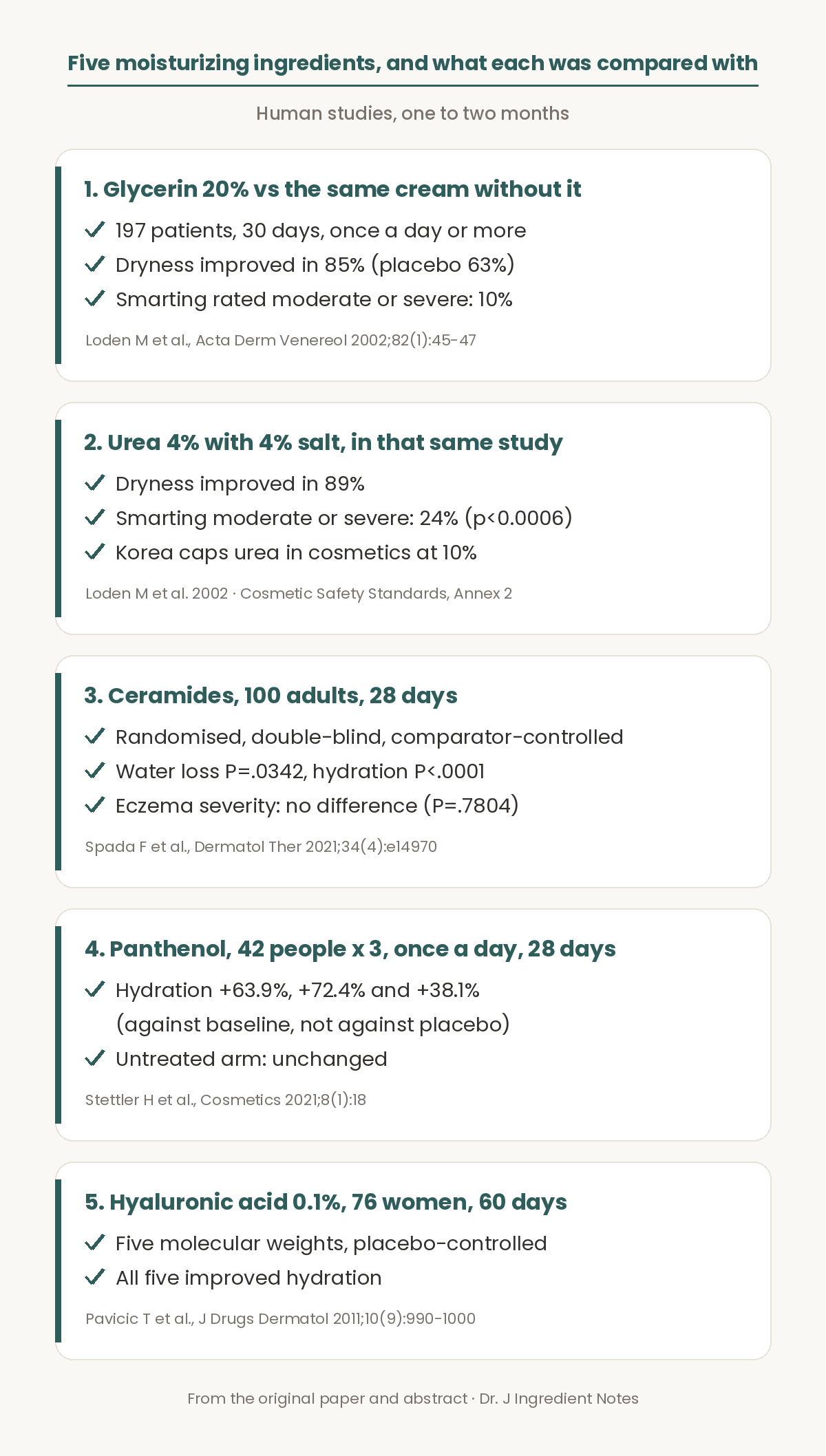
    Evidence figure for five moisturizing ingredients. First, in 197 patients using creams for 30 days, dermatologist-assessed dryness improved in 85 percent with 20 percent glycerin versus 63 percent with the same cream without glycerin, Loden and colleagues, Acta Dermato-Venereologica 2002. Second, in the same study, 4 percent urea with 4 percent sodium chloride improved dryness in 89 percent, but smarting was rated moderate or severe by 24 percent versus 10 percent for glycerin; Korea caps urea at 10 percent. Third, a ceramide-dominant cream and cleanser used by 100 adults with moderate eczema for 28 days reduced water loss, P equals .0342, and raised hydration, P below .0001, while eczema severity did not differ between groups, Spada and colleagues 2021. Fourth, panthenol emollients used once daily for 28 days by 42 people in each of three studies raised hydration from baseline by 38.1 to 72.4 percent while the untreated arm stayed unchanged, Stettler and colleagues 2021. Fifth, hyaluronic acid at 0.1 percent in five molecular weights used by 76 women for 60 days improved hydration versus placebo, Pavicic and colleagues 2011.

    ――――――――――――――――――――――――――――

    3. Ceramides — the barrier numbers move first

    A ceramide-dominant cream used together with a matching cleanser for 28 days, in a randomized, double-blind trial of 100 adults with moderate eczema, 83 of whom completed it (Spada et al., Dermatol Ther 2021).

    ✔ Transepidermal water loss fell compared with the comparator (P=.0342)

    ✔ Stratum corneum hydration rose compared with the comparator (P<.0001)

    ✔ Eczema severity (EASI) showed no difference between the groups (P=.7804)

    ✔ Satisfaction with itch, dryness and smoothness was higher on the ceramide regimen

    The third line is the honest one, and it is why I like this study. The barrier measurements moved; the disease score did not. A moisturizer is a moisturizer. Ceramides also work as part of a set — with cholesterol and fatty acids — which is the subject of the ceramide guide linked at the end.

    ――――――――――――――――――――――――――――

    4. Panthenol — once a day, 28 days

    Three parallel studies of panthenol-containing emollients that differed in lipid content: low, intermediate and high. Each had 42 participants applying the product to one forearm once daily for 28 days, leaving the other forearm untreated (Stettler et al., Cosmetics 2021).

    At day 28, hydration had risen from baseline by 63.9% (low lipid), 72.4% (intermediate) and 38.1% (high). On the untreated arm, hydration did not move — which is what makes the rise hard to attribute to the weather.

    Two caveats travel with those percentages: they are measured against baseline, not against a panthenol-free cream, and they belong to the whole formulation, which also contained lipids such as shea butter and squalane. The full reading of this study is in the panthenol guide.

    ――――――――――――――――――――――――――――

    5. Hyaluronic acid — five molecular weights in one study

    Creams with 0.1% hyaluronic acid at five different molecular weights, used by 76 women for 60 days against placebo (Pavicic et al., J Drugs Dermatol 2011). All five improved hydration relative to placebo.

    So on a label, what I look for is more than one molecular weight listed, rather than a single impressive-sounding number. How to read those numbers is covered in the hyaluronic acid guide.

    ――――――――――――――――――――――――――――

    How to read the numbers — the comparator decides the meaning

    The five studies did not use the same yardstick. Here is what each comparison can and cannot tell you.

    Comparator Used here by How to read the number
    The same cream minus one ingredient glycerin The closest thing to what that ingredient added
    A different product ceramides A product-versus-product result, not one ingredient
    Untreated skin panthenol The whole cream versus applying nothing
    Day 0 (baseline) the panthenol percentages Season and humidity ride along; check whether untreated skin was measured too
    Placebo hyaluronic acid Same formula, different ingredient

    The strongest design here is the same cream with one ingredient removed: formulation held constant, so the difference is attributable to the ingredient. The weakest, in this sense, is a percentage against baseline, because the season is inside that number — unless, as in the panthenol studies, untreated skin was measured alongside and stayed flat.

    ――――――――――――――――――――――――――――

    How Korea regulates these five

    One of the five appears in Annex 2 of the Cosmetic Safety Standards — the list of ingredients with use limits.

    Korea What that means on a label
    Urea listed in Annex 2 of the Cosmetic Safety Standards at 10% (CAS 57-13-6) A product sold in Korea stays at or below 10%
    Glycerin · ceramides · panthenol · hyaluronic acid not in that annex No ceiling, and no minimum either — concentration varies by product
    Brightening · anti-wrinkle ingredients listed with set amounts in Annex 4 of the functional-cosmetics review rules Moisturizing ingredients are not in that kind of table

    This is worth knowing when you compare a Korean product with one from elsewhere. Korea sets a ceiling for urea at 10%; the study above used 4%, well inside it. For the other four, there is no number in the regulation at all — no maximum, and equally no minimum, which is why the ingredient list’s order matters more than any claim on the front of the bottle.

    It is also why moisturizing ingredients are not “functional cosmetics” in the Korean sense. Brightening and anti-wrinkle ingredients have an annex listing set amounts; hydration does not work that way.

    ――――――――――――――――――――――――――――

    Why squalane is not on this list

    Squalane comes up in every autumn skincare article, so I went looking again. I could not find a study in which squalane was applied to human skin and its hydration effect compared with a placebo. What exists is work outside the body — an ex vivo study of how a squalane-based emulsion carries other compounds into skin, and a cell study of squalane and UV-related collagen effects in fibroblasts.

    That is not evidence of absence; it is a statement about what I could verify. If I find a human trial, squalane gets its own guide.

    ――――――――――――――――――――――――――――

    Five things to check on the label

    ✔ Glycerin — near the top of the ingredient list; higher means more of it

    ✔ Urea — if a percentage is printed, 10% or below, and start low

    ✔ Ceramides — cholesterol and fatty acids listed alongside them

    ✔ Panthenol — for a cream you will use on stinging days, fragrance low on the list or absent

    ✔ Hyaluronic acid — more than one molecular weight listed

    My own order is simple. If tightness comes first after cleansing, I reach for the water-binding side. If stinging comes first, I reach for the barrier side. If both, one product containing both is a reasonable place to start.

    ――――――――――――――――――――――――――――

    In one line

    Tight skin: glycerin and hyaluronic acid. Rough skin: urea. Stinging skin: ceramides and panthenol. Start from what your skin does, and read every percentage together with what it was compared against.

    ――――――――――――――――――――――――――――

    📌 Earlier guides

    📌 Ceramides – the cholesterol and fatty acid ratio (Ingredient Guide 4)

    📌 Panthenol for Skin: What the Dexpanthenol Studies Show (Ingredient Guide 7)

    📌 Hyaluronic Acid: How to Read the Molecular Weight (Ingredient Guide 6)

    📌 How to Read a Korean Cosmetic Ingredient List — Where the Order Stops at 1% (Ingredient Guide 14)

    About the author · Dr. J

    MS in Veterinary Medicine, PhD in Life Sciences. I worked as a researcher at the Korea Research Institute of Bioscience and Biotechnology (KRIBB) and now run Beaurea, a cosmetics manufacturing company, where I write the formulas myself. This blog reads the research papers and the regulatory documents and turns them into plain-language criteria for choosing ingredients. I don’t recommend specific products here – only criteria that apply to any product.

    📄 References

    · Lodén M, Andersson AC, Anderson C, et al. Acta Derm Venereol 2002;82(1):45-47

    · Spada F, Harrison IP, Barnes TM, et al. Dermatol Ther 2021;34(4):e14970

    · Stettler H, de Salvo R, Olsavszky R, et al. Cosmetics 2021;8(1):18

    · Pavicic T, Gauglitz GG, Lersch P, et al. J Drugs Dermatol 2011;10(9):990-1000

    · Korea MFDS — Regulation on Safety Standards for Cosmetics, Annex 2 (ingredients with use limits)

    ――――――――――――――――――――――――――――

    This article summarises published research and safety assessments. It is information, not a diagnosis or a treatment plan. If something about your skin worries you, please talk to a professional.

    — Dr. J Ingredient Notes
  • Panthenol for Skin: What the Dexpanthenol Studies Show (Ingredient Guide 7)

    Cover image for a Dr. J Ingredient Notes guide on panthenol, ingredient guide 7. What the research shows about panthenol for skin: a dexpanthenol cream tested against the same cream without it on irritated skin, and three 28-day studies of panthenol moisturisers on very dry skin with 42 people each.

    🇰🇷 한국어판: 판테놀 효능, 숫자로 확인된 것 (성분 백과 ⑦)

    Hello, I’m Dr. J. Today’s question is a simple one: what does panthenol actually do for skin, and how much of that has been measured in people? This is Ingredient Guide 7.

    Panthenol turns up on the back of almost every soothing cream, barrier cream and “recovery” product, and in plenty of shampoos too. It is usually described in a word or two – soothing, hydrating, vitamin B5 – and rarely with a number attached. So here is the first surprise: panthenol isn’t the thing that does the work. Skin converts it into something else first.

    Below I put two human studies side by side. One tested a dexpanthenol cream on deliberately irritated skin against the same cream without dexpanthenol. The other ran three 28-day studies of panthenol-containing moisturisers on very dry skin, 42 people each. At the end is the conclusion of the US Cosmetic Ingredient Review panel on panthenol’s safety – and a short list of claims I left out, with the reason for each.

    ――――――――――――――――――――――――――――

    📄 If you’d rather read the primary sources

    📄 Proksch & Nissen 2002 — irritated skin, dexpanthenol cream vs vehicle

    📄 Stettler et al. 2021 — three 28-day studies, 42 people each (open access)

    📄 Cosmetic Ingredient Review 2022 — safety assessment of panthenol and derivatives

    The Stettler paper is open access, including the per-product tables and the measurement methods. The Proksch paper’s abstract is public.

    ――――――――――――――――――――――――――――

    ――――――――――――――――――――――――――――

    The short version

    ✔ Panthenol and dexpanthenol are names for the same family; in skin, dexpanthenol becomes pantothenic acid (vitamin B5)

    ✔ On irritated skin, a dexpanthenol cream applied twice a day repaired the barrier faster than the same cream without it

    ✔ In three 28-day studies on very dry skin (42 people each), skin hydration rose 38.1% to 72.4% from baseline

    ✔ In the same studies, hydration on the untreated arm did not move

    ✔ The US Cosmetic Ingredient Review panel concluded panthenol is safe as currently used in cosmetics

    ――――――――――――――――――――――――――――

    Panthenol vs dexpanthenol – why two names

    Ingredient lists say panthenol; studies and pharmacy ointments usually say dexpanthenol. Panthenol exists in two mirror-image forms, and the one skin converts to pantothenic acid is the D-form – dexpanthenol. That conversion is why you’ll also see it called provitamin B5.

    Why does that matter? Pantothenic acid is a building block of coenzyme A. As the Proksch & Nissen abstract explains, coenzyme A catalyses the early steps in making fatty acids and sphingolipids – lipids that are essential to the layered lipid structure of the stratum corneum and to cell membranes. That is the biological reason people expected panthenol to help a damaged barrier. The studies below are where that expectation was tested.

    Inside the bottle, panthenol has more than one job. The Cosmetic Ingredient Review report lists it as a hair-conditioning agent, a skin-conditioning agent (humectant) and a solvent. That is why the same name appears on both a conditioner and a face cream.

    ――――――――――――――――――――――――――――

    On irritated skin – dexpanthenol cream vs the same cream without it

    In this study, skin was deliberately irritated with sodium lauryl sulphate (SLS), a cleansing agent, applied in patch-test chambers. The irritated sites were then treated twice a day with either a dexpanthenol cream or the identical cream without dexpanthenol (the vehicle), and some sites were left untreated. Barrier repair, hydration, roughness and redness were measured with instruments rather than judged by eye (Proksch & Nissen, J Dermatolog Treat 2002).

    ✔ Barrier repair — significantly faster with dexpanthenol than with the vehicle or with no treatment

    ✔ Stratum corneum hydration — rose with both creams, but significantly more with dexpanthenol

    ✔ Roughness — fell with both creams, with dexpanthenol again ahead

    ✔ Redness — significantly reduced with dexpanthenol; the vehicle had no effect

    The weight of this study comes from the comparison. Any cream will add some water and oil to the skin; by testing against the same base without dexpanthenol, the study isolates what dexpanthenol itself added. On all four measures, it added something.

    ※ The abstract does not give the number of participants, the length of the study or the dexpanthenol concentration. A later review article quotes figures for this trial, but I couldn’t confirm them in the original, so I have left them out.

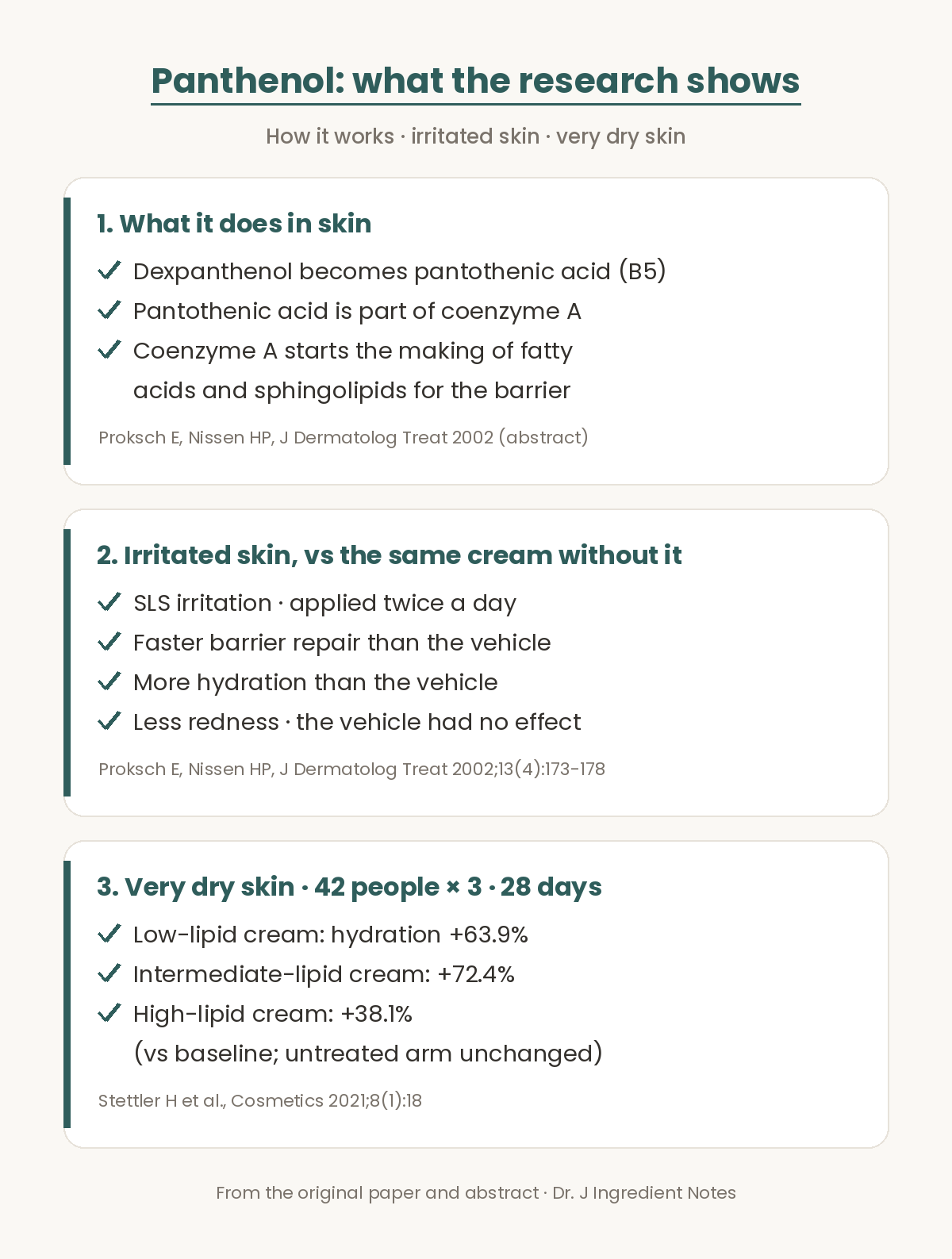
    Evidence figure on panthenol. First, in skin, dexpanthenol becomes pantothenic acid, vitamin B5, which is part of coenzyme A, and coenzyme A starts the synthesis of fatty acids and sphingolipids needed for the skin barrier. Second, on skin irritated with sodium lauryl sulphate and treated twice a day, a dexpanthenol cream repaired the barrier faster, raised hydration more and reduced redness compared with the same cream without dexpanthenol, which had no effect on redness, Proksch and Nissen, Journal of Dermatological Treatment 2002. Third, in three 28-day studies on very dry skin with 42 people each, skin hydration rose from baseline by 63.9 percent with a low-lipid cream, 72.4 percent with an intermediate-lipid cream and 38.1 percent with a high-lipid cream, while the untreated arm stayed unchanged, Stettler and colleagues, Cosmetics 2021.

    ――――――――――――――――――――――――――――

    On very dry skin – three studies, 42 people each, 28 days

    The second paper reports three parallel studies of panthenol-containing emollients that differed in how much lipid (oil) they contained: low, intermediate and high (Stettler et al., Cosmetics 2021). Participants were 18 to 70 years old and had skin that a dermatologist judged to be very dry, flaky and sensitive. Each person applied the product to one forearm once a day, about 2 mg per square centimetre, and left the other forearm untreated. Which arm got the product was decided at random.

    Emollient 1
    lowest lipid
    Emollient 2
    intermediate lipid
    Emollient 3
    highest lipid
    Participants 42 · mean age 59 42 · mean age 58 42 · mean age 57
    Skin hydration
    day 28 vs baseline
    +63.9% +72.4% +38.1%
    Water loss (TEWL)
    day 28 vs baseline
    −11.0% (significant) −5.7% (not significant) lower, not significant
    Stratum corneum lipids cholesterol +9.8% · free fatty acids +3.7% no change cholesterol +12.5% · free fatty acids +26.3%

    Three things stand out. First, hydration rose clearly with all three products. Second, on the untreated arm, hydration stayed flat – the paper reports it holding at about the same capacitance reading throughout. That makes it hard to put the rise down to the weather or to people getting used to the measurements. Third, only Emollient 1 significantly reduced water loss (TEWL); the other two moved in the right direction without reaching significance.

    So how much of this is panthenol? That’s the honest limit of this paper. The results belong to each cream as a whole: all three also contained lipids such as shea butter and squalane, and the paper does not state the panthenol concentration. The comparison was against untreated skin, not a panthenol-free cream. The study was also open-label – everyone knew what they were applying – and the products were supplied by the manufacturer. None of that makes the numbers wrong, but it tells you what kind of numbers they are.

    The intermediate-lipid product gave the largest hydration gain, while the highest-lipid product gave the smallest – a reminder that a richer cream is not automatically a more hydrating one. On tolerability, the paper reports no local or systemic adverse events related to the products over the 28 days.

    ――――――――――――――――――――――――――――

    The two studies side by side

    Proksch & Nissen 2002 Stettler et al. 2021
    Skin deliberately irritated with sodium lauryl sulphate (SLS) very dry, flaky and sensitive, as judged by a dermatologist
    Compared with the same cream without dexpanthenol (vehicle), and untreated skin the untreated opposite forearm
    How often twice a day once a day, about 2 mg/cm²
    Design vehicle-controlled (numbers of people and days not given in the abstract) randomised as to which arm was treated · open-label · three studies × 42 people · 28 days
    Key result faster barrier repair, more hydration, less roughness, less redness than vehicle hydration +38.1% to +72.4%; untreated side flat

    Each study fills the other’s gap. The 2002 trial has the right comparison – dexpanthenol against its own vehicle – but its abstract gives no numbers. The 2021 studies have clear numbers, but they describe whole products compared with untreated skin. Put together, they support a modest, specific statement: panthenol has human evidence on two fronts, recovery after irritation and hydration of very dry skin.

    ――――――――――――――――――――――――――――

    Safety – what the Cosmetic Ingredient Review panel concluded

    In the US, the Cosmetic Ingredient Review (CIR) expert panel assesses the safety of cosmetic ingredients. In 2022 it reviewed panthenol, pantothenic acid and five derivatives together. Its conclusion is one sentence: all seven are safe in cosmetics in the present practices of use and concentration described in the assessment.

    It helps to keep the two questions apart. The CIR conclusion answers “is it safe to use the way it is used now?” – not “how well does it work?”. For the second question, look to the two studies above.

    ――――――――――――――――――――――――――――

    How I use it

    ✔ When exfoliating acids or retinol leave my skin stinging, I switch to a panthenol-containing cream for a few days

    ✔ I apply it while skin is still slightly damp after cleansing, and on dry days add a cream on top

    ✔ For very dry skin I give it 28 days before judging – the length of the Stettler studies

    ――――――――――――――――――――――――――――

    What I left out, and why

    ✔ Participant numbers, duration and concentration for the 2002 trial — quoted in a review, but not in the original abstract I could read

    ✔ Wound and burn claims — in a cosmetics article they read like drug claims

    ✔ “Choose at least X%” — I found no original study comparing panthenol concentrations head-to-head on human skin

    ✔ Pairing rules with other ingredients — I found no primary study testing panthenol in specific combinations

    ――――――――――――――――――――――――――――

    Three things to check when you buy

    ✔ Where panthenol sits in the ingredient list — higher up means more of it (see the ingredient-list guide below)

    ✔ Texture — in the 28-day studies, the intermediate-lipid product gave the largest hydration gain

    ✔ Where fragrance sits — if this is the cream for your irritated days, you want fragrance low on the list or absent

    ――――――――――――――――――――――――――――

    In one line

    Panthenol is converted in skin to vitamin B5, and it has human evidence for recovery after irritation and for hydrating very dry skin. When you read a number, check first what it was compared with.

    ――――――――――――――――――――――――――――

    📌 Earlier guides

    📌 Ceramides – the cholesterol and fatty acid ratio (Ingredient Guide 4)

    📌 Hyaluronic Acid: How to Read the Molecular Weight (Ingredient Guide 6)

    📌 Retinol: Start at 0.1% (Ingredient Guide 1)

    📌 How to Read a Korean Cosmetic Ingredient List — Where the Order Stops at 1% (Ingredient Guide 14)

    About the author · Dr. J

    MS in Veterinary Medicine, PhD in Life Sciences. I worked as a researcher at the Korea Research Institute of Bioscience and Biotechnology (KRIBB) and now run Beaurea, a cosmetics manufacturing company, where I write the formulas myself. This blog reads the research papers and the regulatory documents and turns them into plain-language criteria for choosing ingredients. I don’t recommend specific products here – only criteria that apply to any product.

    📄 References

    · Proksch E, Nissen HP. Dexpanthenol enhances skin barrier repair and reduces inflammation after sodium lauryl sulphate-induced irritation. J Dermatolog Treat 2002;13(4):173-178

    · Stettler H, de Salvo R, Olsavszky R, et al. Cosmetics 2021;8(1):18

    · Scott LN, Fiume M, Bergfeld WF, et al. Safety Assessment of Panthenol, Pantothenic Acid, and Derivatives as Used in Cosmetics. Int J Toxicol 2022;41(3 Suppl):77-128

    ――――――――――――――――――――――――――――

    This article summarises published research and safety assessments. It is information, not a diagnosis or a treatment plan. If something about your skin worries you, please talk to a professional.

    — Dr. J Ingredient Notes
  • Hyaluronic Acid: How to Read the Molecular Weight – Where Low Weights Go and What High Weights Do (Ingredient Guide 6)

    Cover image for Ingredient Guide 6 on hyaluronic acid: how to read the molecular weight number, how deep low and high molecular weights reach in skin, a Raman spectroscopy study and a 76-woman 60-day cream trial. Dr. J Ingredient Notes.

    Hello, this is Dr. J.

    Ingredient Guide number six is hyaluronic acid. Once autumn arrives, a lot of people tell me their cheeks feel tight right after washing – and this is the ingredient they reach for.

    The trouble is the label. One product says low molecular weight, another says high, a third says ultra-low or prints a number like “1,000 daltons” on the front. It is hard to know what to look at. This post explains how to read that number, and then uses two studies on human skin to show what actually changes with molecular weight.

    The short version: hydration and elasticity improved with all five molecular weights tested against placebo. Where they split was wrinkle depth.

    🇰🇷 Read this in Korean: 히알루론산, 분자량 숫자 읽는 법 (성분 백과 ⑥)

    ―――――――――――――――――――――

    📄 Read the sources first

    · Essendoubi M et al., Skin Res Technol 2016;22(1):55–62 – skin penetration by molecular weight, Raman spectroscopy

    · Pavicic T et al., J Drugs Dermatol 2011;10(9):990–1000 – 0.1% creams, 76 women, 60 days, five molecular weights

    · 🏠 COSMILE Europe ingredient database – look up “Sodium Hyaluronate”

    The abstracts give the method and the placebo cream. The 2016 abstract also makes clear that the depth values come from excised skin sections, not skin on a living person.

    ―――――――――――――――――――――

    15-second summary · no sound

    ―――――――――――――――――――――

    In a hurry? Four lines

    ✔ Molecular weight is read in kilodaltons (kDa). Take a dalton figure and drop three zeros

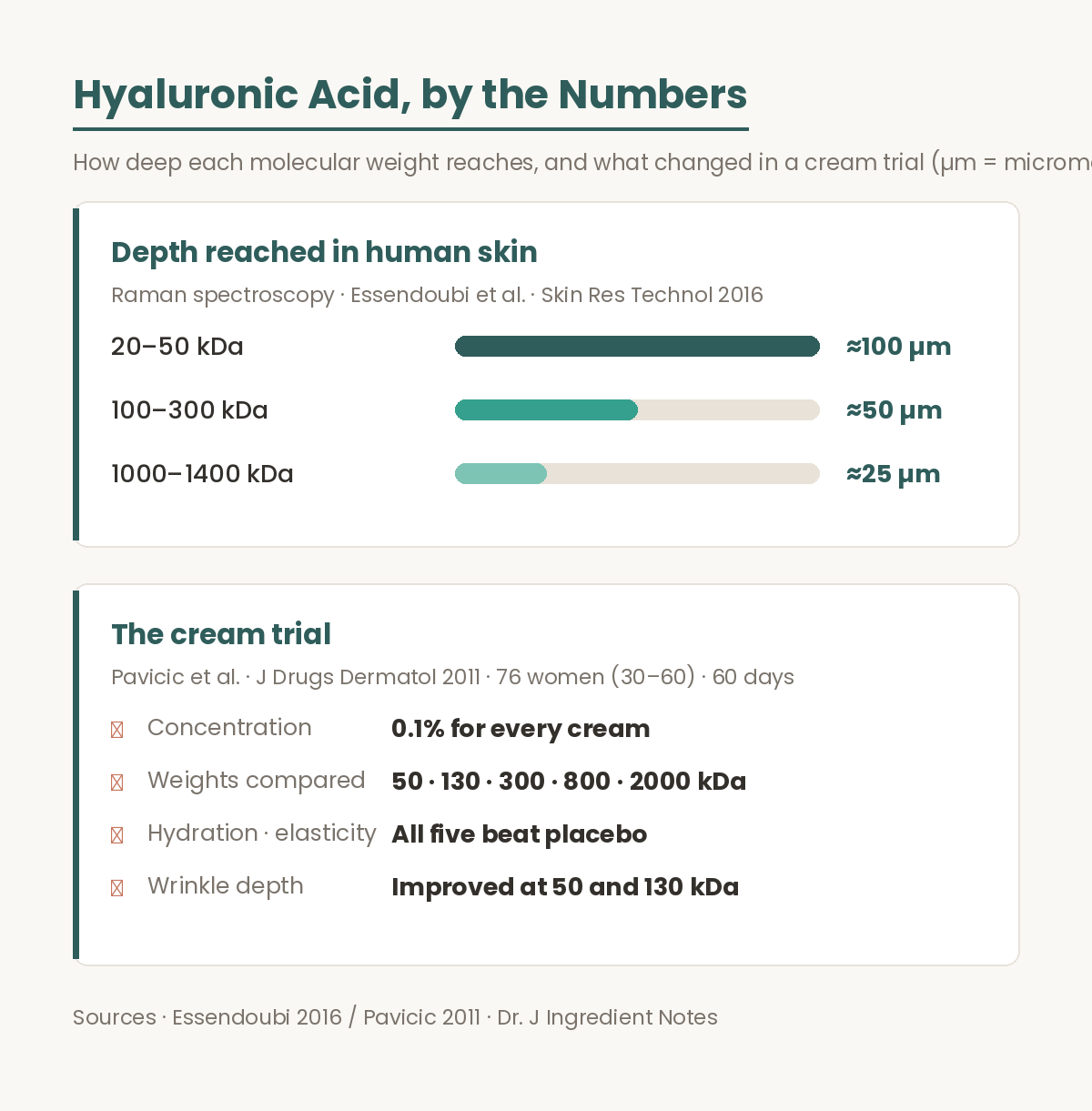
    ✔ The smaller the number, the deeper it reached – 20–50 kDa about 100 µm, while 1,000–1,400 kDa stayed in the outer layer at about 25 µm

    ✔ In a 76-woman, 60-day cream trial, hydration and elasticity improved with all five molecular weights versus placebo

    ✔ Wrinkle depth changed with 50 and 130 kDa. Low weights work at depth, high weights work on the surface

    ―――――――――――――――――――――

    What hyaluronic acid does – a place to hold water

    Hyaluronic acid is already in our skin, in the dermis. It attracts and holds water very strongly, so in cosmetics its job is hydration. On an ingredient list it appears as “Sodium Hyaluronate” or “Hyaluronic Acid”.

    What separates one product from another is the size of the molecule. Hyaluronic acid is a chain of repeating units. A short chain slips in lightly; a long chain sits on the surface and forms a water-holding layer. If ceramides are the mortar that fills the gaps between the bricks, hyaluronic acid is the wet cloth laid over the wall that holds water. Two ingredients can share the word “moisturising” and still do different jobs.

    “How far does a big molecule get?” came up in the collagen guide too. Collagen is a protein and hyaluronic acid is a sugar chain, so they are different kinds of molecule, but the rule is the same: size decides where it goes.

    ―――――――――――――――――――――

    How to read the number – daltons, kilodaltons and the word “low”

    Molecular weight is written in daltons (Da). 1,000 daltons make 1 kilodalton (kDa), so 50,000 Da is 50 kDa and 1,000,000 Da is 1,000 kDa. If a product prints daltons, drop three zeros and read it in kDa. “Low” and “high” have no fixed boundary, so the table below uses the ranges the two studies actually tested.

    What the label says Weight range How deep it reached What it does
    Low · ultra-low · oligo Below a few tens of kDa (50,000 Da = 50 kDa) Past the stratum corneum, about 100 µm (20–50 kDa) Hydration at depth · the range where wrinkle depth changed
    Medium 100–300 kDa About 50 µm Hydration · elasticity
    High Above 1,000 kDa (1,000,000 Da = 1,000 kDa) About 25 µm · stays in the stratum corneum A water-holding layer on the surface · the quick relief for tightness

    So neither “low is better” nor “high is better” is the answer. A product that lists two weights covers the deep layer and the surface at once. Which weight did what is in the two studies below.

    ―――――――――――――――――――――

    How deep did it get – the Raman spectroscopy study

    Researchers applied three molecular weights of hyaluronic acid to abdominal skin from a 44-year-old woman, cut the skin in cross-section and mapped the signal layer by layer with Raman spectroscopy. Raman reads the vibration signature of a molecule, so it can tell the applied hyaluronic acid apart from the skin’s own components and show which layer it reached – Essendoubi et al., Skin Res Technol 2016.

    ✔ 20–50 kDa – about 100 µm

    ✔ 100–300 kDa – about 50 µm

    ✔ 1,000–1,400 kDa – about 25 µm, it stayed in the stratum corneum

    The smaller the molecule, the deeper it went. One caveat: these values come from excised skin sections, from a single donor, not from skin on a living person. The direction is clear; the exact micrometre figure could differ from one person to the next. That is why the next study matters – people actually used the cream.

    Hyaluronic acid evidence summary. Depth reached in human skin measured by Raman spectroscopy: 20 to 50 kilodaltons about 100 micrometers, 100 to 300 kilodaltons about 50 micrometers, 1000 to 1400 kilodaltons about 25 micrometers, Skin Research and Technology 2016. In a 60-day cream trial with 76 women aged 30 to 60 at a fixed 0.1 percent, all five molecular weights improved hydration and elasticity versus placebo, and wrinkle depth improved with 50 and 130 kilodaltons, Journal of Drugs in Dermatology 2011.

    ―――――――――――――――――――――

    As a cream – 76 women, 60 days

    The concentration was fixed at 0.1% and only the molecular weight changed: 50, 130, 300, 800 and 2,000 kDa. 76 women aged 30–60 applied the cream to one eye area and the same cream without hyaluronic acid to the other, twice a day for 60 days. Hydration, elasticity and wrinkle depth were measured at baseline, day 30 and day 60 – Pavicic et al., J Drugs Dermatol 2011.

    Measured 50 · 130 kDa 300 · 800 · 2,000 kDa
    Hydration Significantly better than placebo Significantly better than placebo
    Elasticity (R2) Significantly better than placebo Significantly better than placebo
    Wrinkle depth Improved versus placebo – the largest reduction was in these two No clear difference

    The authors put it down to better penetration at low molecular weight. Read side by side, the two studies say this: if hydration is the goal, the number matters less; if you are hoping for something on wrinkle depth, the low numbers (50–130 kDa) are the ones with evidence behind them. The individual percentages are not in the abstract, so this post says “improved versus placebo” and leaves it there.

    ―――――――――――――――――――――

    How to use it – damp skin and one layer on top

    ✔ Apply while the skin is still damp after cleansing. It needs water to hold on to

    ✔ Then seal it with one layer – a cream or an oil. Without a seal, the water it holds heads for the air, and a dry room makes that worse

    ✔ It sits comfortably in the same routine as retinol, vitamin C or niacinamide. On nights with an active, laying it down first takes the edge off the tightness

    ✔ In the morning it goes before sunscreen. Thin textures first

    Which ingredients can share a night is in the ingredient compatibility chart.

    ―――――――――――――――――――――

    Five things to check before you buy

    ✔ Are two or more molecular weights listed? – they divide the deep layer and the surface between them

    ✔ What unit is the number in? – if daltons, drop three zeros and read kDa. A number tells you more than the word “low”

    ✔ Is it near the top of the ingredient list? – “Sodium Hyaluronate” or “Hyaluronic Acid”. The trial used 0.1%

    ✔ Is there something to seal it with? – if it is a serum, plan the cream that goes on top as part of the set

    ✔ Can you give it 60 days? – that is how long the cream trial ran. Hydration you feel at once; wrinkle depth takes time

    Save these five lines for the shop. Reading the back of the box takes five minutes.

    ―――――――――――――――――――――

    One-line summary

    🧪 Hyaluronic acid is an ingredient you choose by reading the molecular weight. Small numbers go deep, big numbers stay on top – a product with both numbers covers both, and applying it to damp skin and sealing it with one layer completes the set.

    The next Ingredient Guide is panthenol (Ingredient Guide 7). Where hyaluronic acid holds water, panthenol calms the barrier.

    📌 Earlier posts

    · Retinol: Start at 0.1% – How to Read the Concentration Numbers (Ingredient Guide 1)

    · Skincare Ingredient Compatibility Chart – 12 Ingredients, What to Layer and What to Split

    · Dull, Rough Skin? Glycolic Acid (AHA) – What the Research Shows

    · Collagen: Topical vs Oral – What the Research Says (Ingredient Guide 5)

    · Ceramides: The Three-Line Label Check (Ingredient Guide 4)

    About the author · Dr. J

    MS in Veterinary Medicine, PhD in Life Sciences. I worked as a researcher at the Korea Research Institute of Bioscience and Biotechnology (KRIBB) and now run Beaurea, a cosmetics manufacturing company, where I write the formulas myself. This blog reads the research papers and the regulatory documents and turns them into plain-language criteria for choosing ingredients. I don’t recommend specific products here – only criteria that apply to any product.

    📄 References

    · Essendoubi M, Gobinet C, Reynaud R, Angiboust JF, Manfait M, Piot O. Human skin penetration of hyaluronic acid of different molecular weights as probed by Raman spectroscopy. Skin Res Technol 2016;22(1):55–62

    · Pavicic T, Gauglitz GG, Lersch P, Schwach-Abdellaoui K, Malle B, Korting HC, Farwick M. Efficacy of cream-based novel formulations of hyaluronic acid of different molecular weights in anti-wrinkle treatment. J Drugs Dermatol 2011;10(9):990–1000

    · COSMILE Europe – INCI ingredient database

    This article summarises published research and public documents for information. It is not a diagnosis or a treatment. If you have a skin concern that worries you, please see a professional.

    — Dr. J Ingredient Notes
  • Ceramides Work Better With Company – What 4 Studies Say About the Back of the Jar (Ingredient Guide 4)

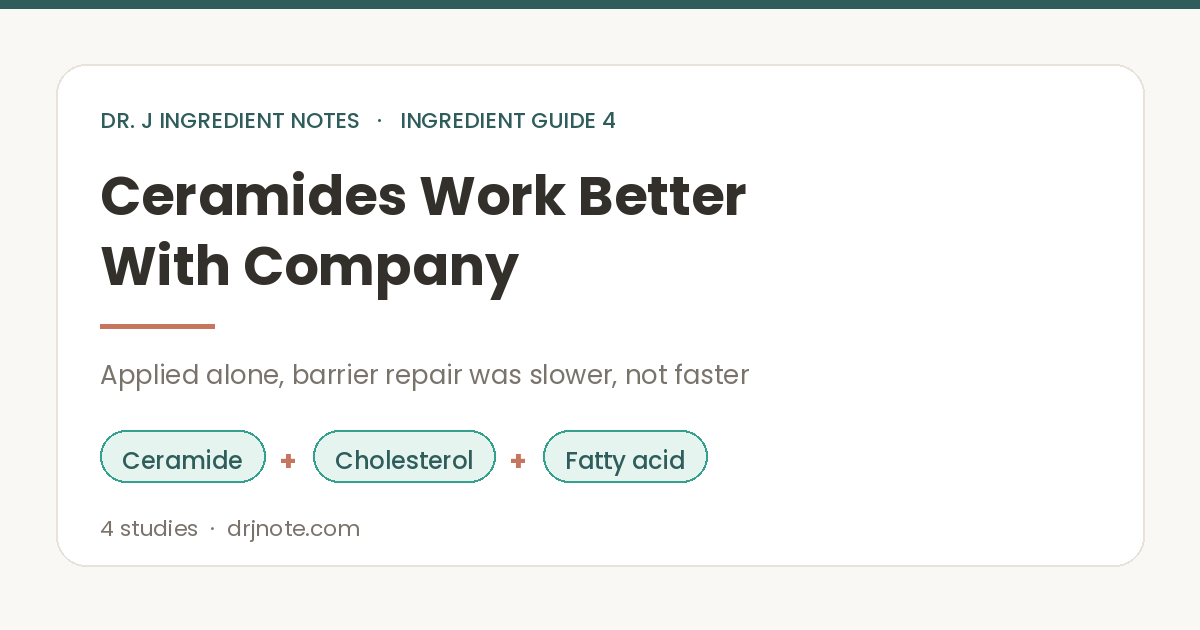
    Cover image for Ceramides Work Better With Company. Dr. J Ingredient Notes guide 4, summarising four studies showing that skin barrier repair was faster when ceramide, cholesterol and fatty acid were applied together.

    Hello, this is Dr. J.

    The fourth ingredient guide is about ceramides.

    Every year, as soon as the air turns dry, the same question arrives: which moisturiser should I be using?

    Here is the part that makes the answer interesting. In a 1996 experiment, skin treated with ceramides on their own repaired its barrier at a different speed from skin treated with ceramides alongside two other lipids. Same ingredient, opposite direction.

    Today I will follow that thread and end up at the back of the jar.

    ―――――――――――――――――――――

    📄 Read the sources first, if you prefer

    · Man MQ et al., J Invest Dermatol 1996 – barrier repair timed as the lipid ratio was varied

    · Tanno O et al., Br J Dermatol 2000 – niacinamide and ceramide synthesis

    · 🏠 COSMILE Europe INCI database – type an ingredient name from your label and read what it is

    The abstracts carry the exact ratios and time points I have left out here. Open them above if you want them.

    ―――――――――――――――――――――

    Fifteen-second summary · no sound

    ―――――――――――――――――――――

    The four lines, if you are in a hurry

    ✔ Ceramides are the lipids that fill the space between skin cells. When they run low, water leaves

    ✔ Barrier repair was faster with cholesterol and fatty acid present than with ceramides alone

    ✔ In studies of 24 children and 100 adults, water loss through the skin came down

    ✔ Niacinamide raised the skin’s own ceramide production 4.1 to 5.5 fold

    ―――――――――――――――――――――

    Why ceramides alone were slower – the 1996 ratio experiment

    Picture the outer layer of skin as a brick wall. The cells are the bricks, and the mortar filling the gaps is made of three things: ceramides, cholesterol and fatty acids. Mortar only sets when all three are mixed. Pour in as much sand as you like – without cement and water it never hardens.

    Man MQ and colleagues published the experiment in the Journal of Investigative Dermatology in 1996 (volume 106, pages 1096–1101). They disrupted the barrier deliberately, applied lipids, and timed how quickly it recovered.

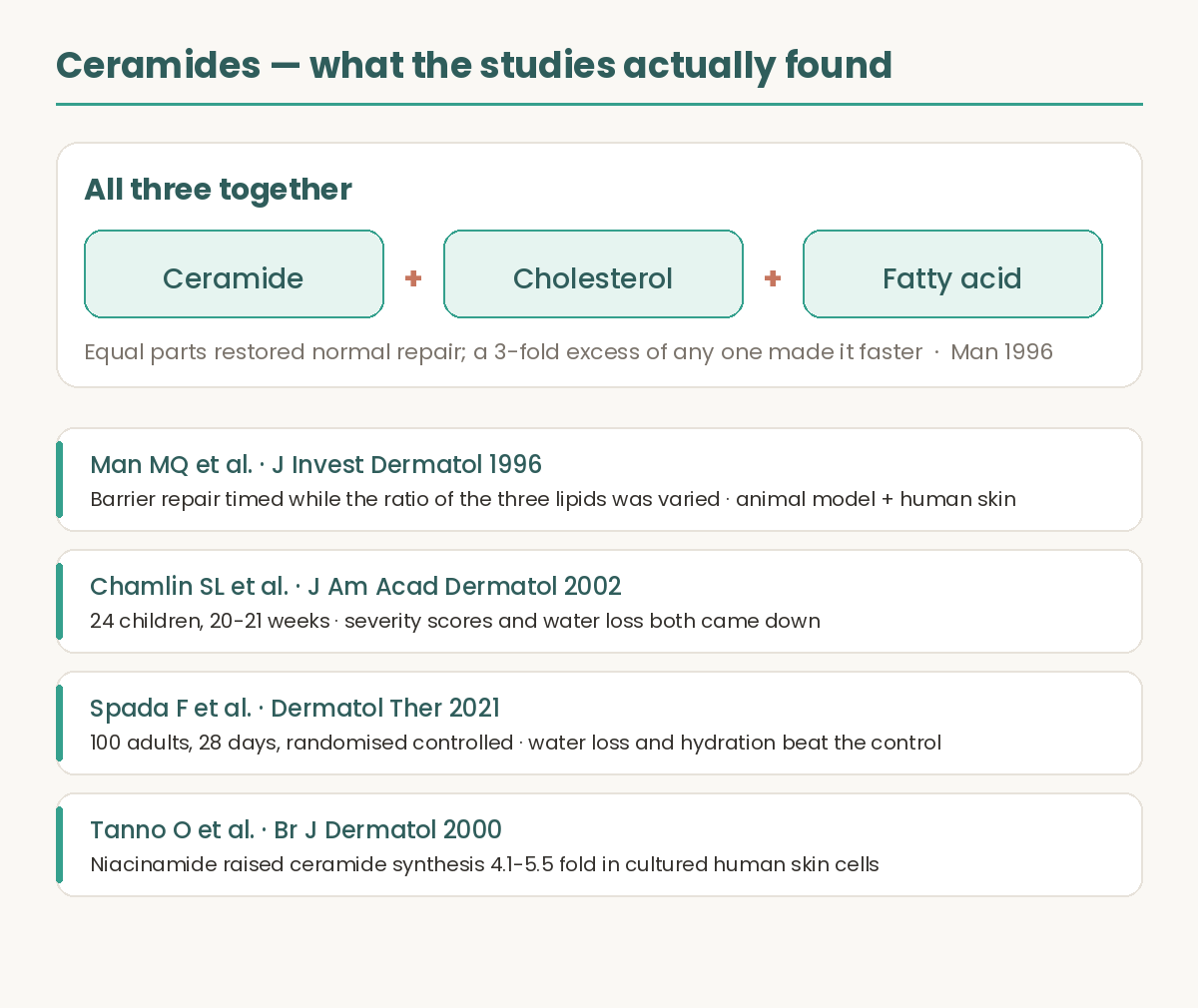
    ✔ One or two of the three lipids made recovery slower, not faster

    ✔ All three in equal parts restored normal speed, and a 3-fold excess of any one made it quicker still

    ✔ Confirmed in an animal model, and pointing the same way in disrupted human skin

    So a formula built around a single lipid is not the stronger formula. Which is why the useful question at the shelf is not whether a cream contains ceramides, but what the ceramides were formulated with.

    Evidence summary for ceramides. Shows that ceramide, cholesterol and fatty acid applied together restored normal barrier repair in a 1996 study, alongside a 24-child 20 to 21 week study, a 100-adult 28-day randomised controlled study, and a 2000 study in which niacinamide raised ceramide synthesis 4.1 to 5.5 fold.

    ―――――――――――――――――――――

    Did it hold up in people – 24 children, 100 adults

    Chamlin SL and colleagues, Journal of the American Academy of Dermatology 2002, volume 47, pages 198–208.

    Twenty-four children with atopic dermatitis added a ceramide-dominant product to their routine for 20 to 21 weeks. By week three, 22 of the 24 had lower severity scores, and water loss through the skin kept falling even after the scores had levelled off. The visible part settled first; the barrier itself carried on mending underneath.

    Spada F and colleagues, Dermatologic Therapy 2021, volume 34, e14970.

    One hundred adults were randomised for 28 days, one group using a ceramide-dominant cream and cleanser. Water loss and skin hydration both did better than in the control group, and ratings for itch and dryness were higher as well.

    The two products share one thing. Ceramides sat at the centre of the formula, with cholesterol and fatty acids beside them. You do not need the product names. The shape of the combination is the part worth carrying to the shop.

    ―――――――――――――――――――――

    Finding the names on the label – five lines that decide it

    Ceramides appear under several names. These are the five lines to look for.

    What you will see on the label Which of the three it belongs to
    Ceramide NP · AP · EOP · NG · AS The ceramides themselves. The letters describe structure, not grade
    Hydroxypalmitoyl sphinganine · Phytosphingosine Same family, listed under a different name
    Cholesterol The second ingredient in the 1996 experiment
    Stearic acid · Palmitic acid · Linoleic acid The fatty acid side. The third one
    Niacinamide Not a refill. It helps skin make its own

    The letters after a ceramide – NP, AP, EOP and the rest – describe molecular structure. They are not a quality ranking, and I have not found human studies comparing them head to head. Rather than picking between them, check whether cholesterol and a fatty acid are listed nearby.

    If a name is unfamiliar, type it into the COSMILE Europe INCI database and you will get its definition and function.

    ―――――――――――――――――――――

    Helping skin make its own – niacinamide

    Tanno O and colleagues, British Journal of Dermatology 2000, volume 143, pages 524–531.

    Cultured human skin cells given niacinamide for six days produced 4.1 to 5.5 times more ceramides. Fatty acids rose 2.3 fold and cholesterol 1.5 fold at the same time – all three mortar ingredients together.

    Applied to skin, it also raised ceramide and fatty acid levels in the outer layer and reduced water loss. That is the reason so many jars now carry both the refill and the prompt in one formula.

    How to read a niacinamide percentage is covered in Ingredient Guide 1, on retinol, where the same approach to concentration numbers applies.

    ―――――――――――――――――――――

    When to apply it – order and combinations

    ✔ Straight after cleansing, while skin is still slightly damp, is the easiest moment

    ✔ On retinol or AHA nights, put it on last. That is the night it earns its place

    ✔ There is no need to separate it from a vitamin C serum. Serum first, cream after

    ✔ With anything new, try it on the inner forearm and give it two days

    👉 If layering order gets confusing, the ingredient compatibility chart covers twelve ingredients and what to keep apart.

    ―――――――――――――――――――――

    Five things to check before you buy

    ✔ Are they together? Cholesterol and a fatty acid listed alongside the ceramides

    ✔ Where on the list? Ceramides near the front or middle rather than the very end

    ✔ Is niacinamide there? The refill and the prompt in one jar

    ✔ Does the texture suit your week? In dry months a cream or balm holds up better than a lotion

    ✔ Where does fragrance sit? High on the list is worth noticing when the barrier is already stressed

    Save these five lines and open them at the shelf. Reading the back of a jar takes about five minutes.

    ―――――――――――――――――――――

    In one line

    🧪 Ceramides look most like the research when cholesterol and a fatty acid are in the formula and niacinamide is nearby.

    The next ingredient guide is collagen – what changes between putting it on your skin and taking it by mouth.

    📌 Earlier posts

    · Skincare Ingredient Compatibility Chart – 12 ingredients, what to layer and what to split

    · Retinol: Start at 0.1% – how to read the concentration numbers

    · Not All Vitamin C Serums Work – 3 conditions the research says you need

    About the author · Dr. J

    MS in Veterinary Medicine, PhD in Life Sciences. I worked as a researcher at the Korea Research Institute of Bioscience and Biotechnology (KRIBB) and now run Beaurea, a cosmetics manufacturing company, where I write the formulas myself. This blog reads the research papers and the regulatory documents and turns them into plain-language criteria for choosing ingredients. I don’t recommend specific products here – only criteria that apply to any product.

    📄 References

    · Man MQ et al., J Invest Dermatol 1996;106(5):1096-1101

    · Chamlin SL et al., J Am Acad Dermatol 2002;47(2):198-208

    · Spada F et al., Dermatol Ther 2021;34(4):e14970

    · Tanno O et al., Br J Dermatol 2000;143(3):524-531

    · 🏠 COSMILE Europe INCI database

    Note: this article reads the research and sets out criteria for choosing an ingredient. It does not recommend a particular product. What suits you depends on your skin and on what you already use, so try anything new on the inner forearm first.


    Dr. J Ingredient Notes | Ingredient Guide 4 · Ceramides