Tag: skin barrier

  • Sensitive Skin Ingredients: The Category No Regulator Names, and Five with Human Studies

    Cover image for a guide to sensitive skin cosmetic ingredients in Korea. Korea's Regulation on Review of Functional Cosmetics, Annex 4, notifies actives in six categories: UV protection with 27 ingredients, brightening with nine, wrinkle improvement with four, hair colour change, hair removal with thioglycolic acid, and acne relief with salicylic acid at 0.5 percent. Sensitive skin is not one of them. The Ministry of Food and Drug Safety guideline on test methods for substantiating cosmetic claims sets out ten methods, and sensitive skin is not among those either; people with sensitive or hyper-reactive skin are instead screened out of those tests. In the United States there are no federal standards or definitions for the term hypoallergenic, and in the European Union the only permitted lists of ingredients are for colorants, preservatives and UV filters. Five ingredients with human studies fill the gap: ceramide, panthenol, colloidal oatmeal, licochalcone A and niacinamide. A Dr. J Ingredient Notes cover.

    🇰🇷 한국어판

    Hello, this is Dr. J. Today I want to pick five ingredients for sensitive skin the only way that is left — from studies done on people.

    One thing first, because it sets up everything else. Sensitive skin barely appears in the rules at all. Where it does appear, it is not as something to measure. It is a reason to exclude someone from a test.

    ――――――――――――――――――――――――――――

    The sources, first

    📄 Regulation on Review of Functional Cosmetics, Annex 4 (Korean Law Service)

    📄 MFDS, Guideline on Test Methods for Substantiating Cosmetic Claims (2018-03, PDF)

    📄 U.S. FDA, “Hypoallergenic Cosmetics”

    📄 Regulation (EC) No 1223/2009, Article 14

    Six categories in the Korean annex, ten methods in the guideline. Sensitive skin is in neither.

    ――――――――――――――――――――――――――――

    ――――――――――――――――――――――――――――

    Five lines, if you are in a hurry

    ✔ Korea notifies actives in six categories, and sensitive skin is not one

    ✔ The MFDS test-method guideline lists ten methods, and sensitive skin is not one either

    ✔ In those tests, sensitive skin is an exclusion criterion

    ✔ The United States wrote a definition for “hypoallergenic” in 1975 and lost it in court

    ✔ So five ingredients are picked here from human studies, weaknesses included

    ――――――――――――――――――――――――――――

    What Korea names, and what it leaves out

    Korea’s functional cosmetics system works from a notified list. Annex 4 of the Regulation on Review of Functional Cosmetics sets out the ingredient and the amount. Make a product to those numbers and you do not have to file fresh efficacy data — which is another way of saying the state has already decided what counts.

    Category What the notification sets out How to read it
    UV protection 27 ingredients with maximum amounts Names and numbers are both fixed
    Brightening Nine ingredients (arbutin 2–5%, niacinamide 2–5% and others) Same
    Wrinkle improvement Four ingredients (retinol 2,500 IU/g, adenosine 0.04% and others) Same
    Hair colour change A dyeing list split across six sub-tables Same
    Hair removal Thioglycolic acid, 3.0–4.5% as the acid, pH 7.0 to under 12.7 One ingredient
    Acne relief Salicylic acid 0.5%, in cleansing products One ingredient
    Sensitive skin Nothing There is no such category

    Acne gets one ingredient. Sensitive skin gets no category at all. So “for sensitive skin” and “low irritation” on a Korean box are not reviewed phrases.
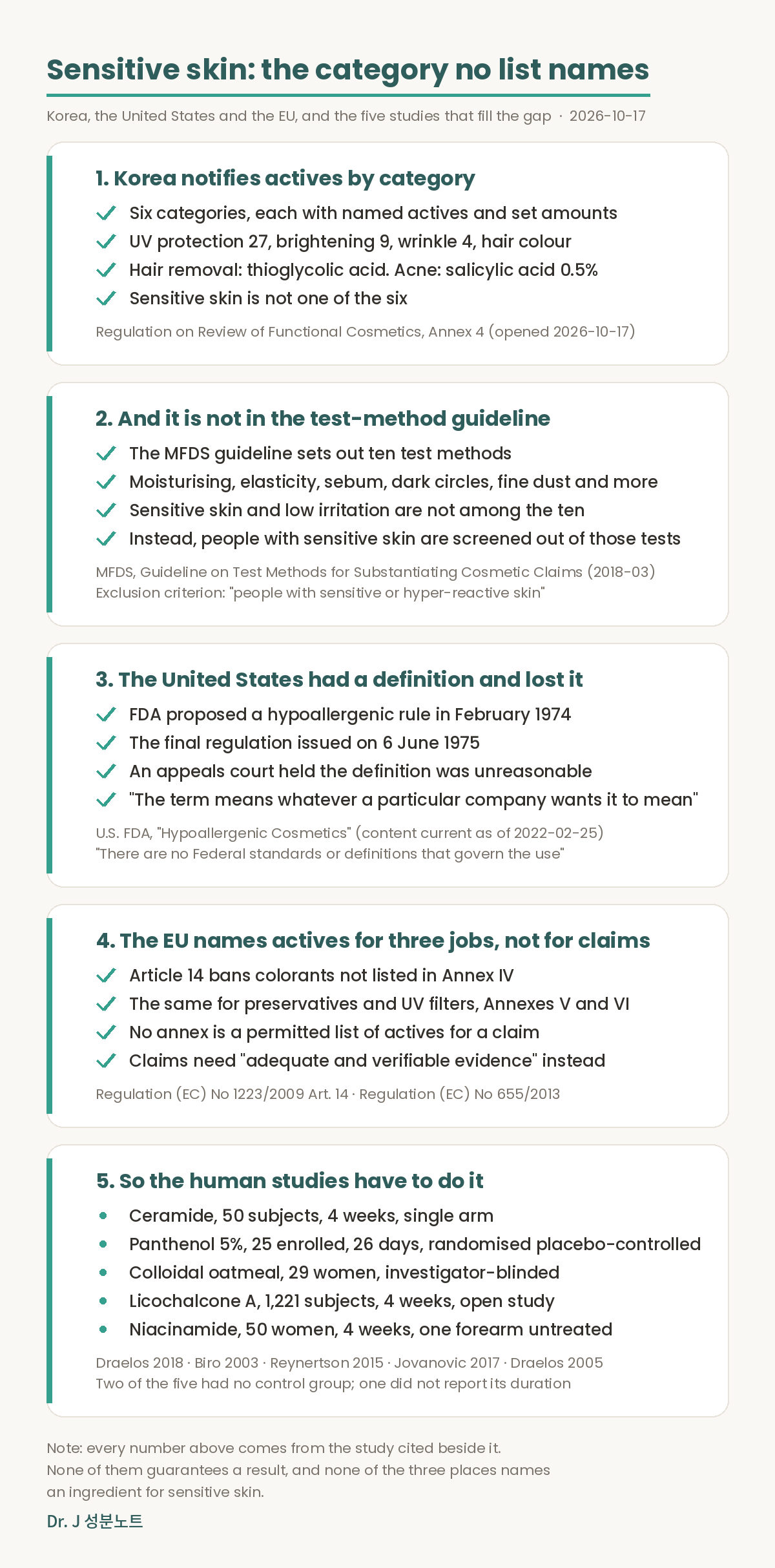
    Evidence figure on sensitive skin ingredients. First, Korea notifies actives by category. Six categories each carry named actives and set amounts: UV protection 27, brightening nine, wrinkle four, hair colour, hair removal with thioglycolic acid, and acne with salicylic acid 0.5 percent. Sensitive skin is not one of the six. The source is the Regulation on Review of Functional Cosmetics, Annex 4. Second, sensitive skin is not in the test-method guideline either. The Ministry of Food and Drug Safety guideline sets out ten test methods covering moisturising, elasticity, sebum, dark circles, fine dust and others, and sensitive skin and low irritation are not among the ten. Instead people with sensitive or hyper-reactive skin are an exclusion criterion in those tests. Third, the United States had a definition and lost it. FDA proposed a hypoallergenic rule in February 1974 and issued the final regulation on 6 June 1975, but an appeals court held the definition was unreasonable. FDA now writes that the term means whatever a particular company wants it to mean and that there are no federal standards or definitions governing its use, as of 25 February 2022. Fourth, the European Union names actives for three jobs and not for claims. Article 14 of Regulation 1223/2009 bans colorants not listed in Annex 4 and does the same for preservatives and UV filters in Annexes 5 and 6, and no annex is a permitted list of actives for a claim. Claims instead need adequate and verifiable evidence under Regulation 655/2013. Fifth, the human studies have to do the work: ceramide with 50 subjects over four weeks in a single arm, panthenol 5 percent with 25 enrolled over 26 days in a randomised placebo-controlled trial, colloidal oatmeal with 29 women investigator-blinded, licochalcone A with 1,221 subjects over four weeks in an open study, and niacinamide with 50 women over four weeks with one forearm untreated. Two of the five had no control group and one did not report its duration.

    ――――――――――――――――――――――――――――

    There is no method to measure it either

    This is the part that is specific to Korea, and it is worth knowing if you sell there. The MFDS publishes a separate guideline that tells you how to run the test behind a claim — which instrument, how long, what unit. Each claim gets its own chapter.

    Chapter Test method Added
    1 Skin moisturising 2012-05, at issue
    2 Skin elasticity 2012-05, at issue
    3 Sebum control 2012-05, at issue
    4 Temporary reduction of cellulite 2013-11
    5 Suitability for acne-prone skin 2013-11
    6 Dark circle improvement 2014-08
    7 Skin blood-flow improvement 2015-12
    8 Puffiness reduction 2015-12
    9 Paraben-free 2017-03-31
    10 Fine-dust blocking 2018-03-28
    — Sensitive skin, low irritation Not among the ten

    Moisturising is there. Sebum is there. Dark circles are there. Sensitive skin is not.

    ★ The one place “sensitive” does appear

    In the subject-selection rules for chapters 1, 2 and 3 — moisturising, elasticity and sebum — one of the exclusion criteria is “people with sensitive or hyper-reactive skin”. Chapter 5, on acne-prone skin, excludes “people whose skin is sensitive to adhesive components”.
    So in this document sensitive skin is not something you measure. It is something you screen out before you measure anything else.

    ――――――――――――――――――――――――――――

    The United States tried, and the courts said no

    The American story is the sharpest of the three, because the definition existed and then stopped existing.

    When What happened Where it stands
    February 1974 FDA proposed a regulation on the term hypoallergenic A definition was on the table
    6 June 1975 FDA issued the final regulation Manufacturers would have had to test
    On appeal The court held FDA’s definition was unreasonable The regulation fell
    Today «There are no Federal standards or definitions that govern the use» «The term means whatever a particular company wants it to mean»

    FDA’s own page puts it plainly: «There are no Federal standards or definitions that govern the use of the term “hypoallergenic.”» And then, one sentence later: «The term means whatever a particular company wants it to mean.»

    ――――――――――――――――――――――――――――

    The EU names actives for three jobs, and claims are not one of them

    It is easy to assume the EU, with its long annexes, must have a list somewhere. It does not — not for claims.

    Annex What it is What that means for a claim
    Annex II Prohibited substances A list of what cannot go in at all
    Annex III Restricted substances Conditions, not a permitted list
    Annex IV Colorants — permitted list A colorant not listed cannot be used
    Annex V Preservatives — permitted list Same
    Annex VI UV filters — permitted list Same
    For a claim No annex Evidence under Reg. 655/2013 instead of a list

    Article 14 is a list of prohibitions. Three of them work as permitted lists, because a colorant, a preservative or a UV filter that is not in its annex cannot be used. There is no fourth annex for “soothing” or “for sensitive skin”. Under Regulation (EC) No 655/2013 a claim has to rest on «adequate and verifiable evidence» instead, and the method is left to «state of the art practices».

    ――――――――――――――――――――――――――――

    So the studies have to do it

    That is the whole argument for reading the trials themselves. Here are the five, with the size, the length and the design next to each.

    Ingredient People Length Design Measured Number
    Ceramide 50 4 weeks Single arm, no control Hydration, TEWL Hydration median 50 to 80
    Panthenol 25 enrolled
    21 finished
    26 days Randomised, double-blind, placebo-controlled Hydration after irritation Better on the active side in 11, placebo in 1
    Colloidal oatmeal 29 women Not reported Investigator-blinded Dryness, scaling, roughness, itch All four improved
    Licochalcone A 1,221 4 weeks Open study, no control Redness and related scores P<0.001
    Niacinamide 50 women
    46 finished
    4 weeks One forearm untreated, investigator-blind TEWL, capacitance TEWL 2.5 vs 3.9

    The last row is worth a pause. Niacinamide sits on Korea’s brightening list at 2–5%. This study measured something else entirely — barrier. The ingredient name does not tell you what was measured.

    ――――――――――――――――――――――――――――

    And where each one is weak

    Ingredient Where it is weak How to read it
    Ceramide No control group, one site, manufacturer-funded Read what was measured, not the size of the change
    Panthenol Only one endpoint reached significance The design is the strongest of the five
    Colloidal oatmeal The abstract does not give the duration Read it without knowing how long
    Licochalcone A No control, and the product also contained trans-4-t-butylcyclohexanol The two cannot be separated here
    Niacinamide The facial figures were not tested statistically Read the forearm numbers

    Of the five, one design is clearly the strongest, and it is the smallest study. Twenty-five people, randomised, double-blind, placebo-controlled, with the irritation deliberately induced. The study with 1,221 people has no control group at all. Size and strength are not the same thing, and a box never prints either.

    ――――――――――――――――――――――――――――

    Four things to check on the box

    ✔ Look past “for sensitive skin” and check whether the five names are in the ingredient list

    ✔ The earlier a name sits in that list, the more of it is in there

    ✔ Photograph the names after “fragrance” so you can compare them later

    ✔ Try anything new on the inside of your arm for a few days first

    ――――――――――――――――――――――――――――

    One line

    No regulator in these three places names an ingredient for sensitive skin, so the studies have to. Decide first whether your issue is barrier, itch or redness, and five becomes three.

    ――――――――――――――――――――――――――――

    What I left out, and why

    ✔ Centella asiatica and madecassoside — I could not open a human study, only reviews

    ✔ “Fragrance-free is safer” — no primary source for it

    ✔ The facial figures in the niacinamide study — cheek TEWL fell, but those values were not tested statistically

    ✔ Prescription drugs and procedures — they do not belong in a cosmetics piece

    ✔ An EU rule specific to sensitive skin — I did not find one, which is not the same as saying none exists

    About the author · Dr. J

    MS in Veterinary Medicine, PhD in Life Sciences. I worked as a researcher at the Korea Research Institute of Bioscience and Biotechnology (KRIBB) and now run Beaurea, a cosmetics manufacturing company, where I write the formulas myself. This blog reads the research papers and the regulatory documents and turns them into plain-language criteria for choosing ingredients. I don’t recommend specific products here – only criteria that apply to any product.

    📌 Previously

    📌 Niacinamide: How Much Is Enough — the same ingredient, seen from the brightening side

    📌 Ceramides – cholesterol and fatty acid ratio — the first ingredient here, in full

    📌 Panthenol for Skin: What the Dexpanthenol Studies Show — the irritation side

    📌 How to Read a Korean Cosmetic Ingredient List — where to find these names on the box

    📄 References

    · Regulation on Review of Functional Cosmetics, Annex 4 (Korean Law Service, opened 2026-10-17)

    · MFDS, Guideline on Test Methods for Substantiating Cosmetic Claims (2018-03, 안내서-0353-02)

    · MFDS, Guideline on Cosmetic Labelling and Advertising (2025-08-14, 안내서-0086-07), Annex 2

    · Draelos ZD, Raymond I. J Clin Aesthet Dermatol 2018;11(5):30-32

    · Biro K, Thaçi D, Ochsendorf FR, Kaufmann R, Boehncke WH. Contact Dermatitis 2003;49(2):80-84

    · Reynertson KA et al. J Drugs Dermatol 2015;14(1):43-48 · Jovanovic Z et al. ibid. 2017;16(6):605-611

    · Draelos ZD, Ertel K, Berge C. Cutis 2005;76:135-141

    · U.S. FDA, “Hypoallergenic Cosmetics” (content current as of 2022-02-25)

    · Regulation (EC) No 1223/2009, Article 14 · Regulation (EC) No 655/2013

    ――――――――――――――――――――――――――――

    This article summarises published studies and public regulatory documents. It is information, not diagnosis or treatment. Of the five studies, two had no control group and one does not report its duration, and one was run on a product containing two actives. Those limits are set out in the tables above rather than hidden. Ingredient names and concentrations are given as criteria for choosing a product, not as a recommendation of any particular one.

    — Dr. J Ingredient Notes
  • Why Skin Dries in Autumn: Three Seasonal Studies in Korean Skin, and the Two Measures That Did Not Move (Autumn Guide 2)

    Cover image for an autumn guide to why skin dries in Korea, the second autumn guide from Dr. J Ingredient Notes. Three seasonal studies in Korean skin found that moisture and scaliness move with the season while wrinkles do not.

    🇰🇷 한국어판: 가을 피부 건조, 계절 연구가 보여 준 것 (가을 특집 2)

    Hello, this is Dr. J. Autumn is when the shelf gets rearranged — a heavier cream, a richer cleanser, something for the flaking. Before changing anything, it is worth asking a narrower question: what does the season actually change in skin, and what does it leave alone?

    Three studies measured exactly that in Korean skin, in Korea. Two followed people across the seasons; one looked at a single heated day indoors. Read together they draw a fairly clear line between the measures that move and the measures that do not.

    That line is the useful part, because it tells you which half of your routine the season is arguing with.

    ――――――――――――――――――――――――――――

    The studies, if you would rather read them first

    📄 Nam GW et al., Skin Res Technol 2015;21(1):1-8 — 89 Korean women, 13 months

    📄 Song EJ et al., Int J Cosmet Sci 2015;37(1):92-97 — 100 Korean men, summer and winter

    📄 Park EH et al., Skin Res Technol 2023;29(6):e13397 — six hours in a heated room

    All three were carried out in Korea on Korean participants. Seasonal work travels badly between climates, so that is the ground this article stands on.

    ――――――――――――――――――――――――――――

    ――――――――――――――――――――――――――――

    Five lines, if you are in a hurry

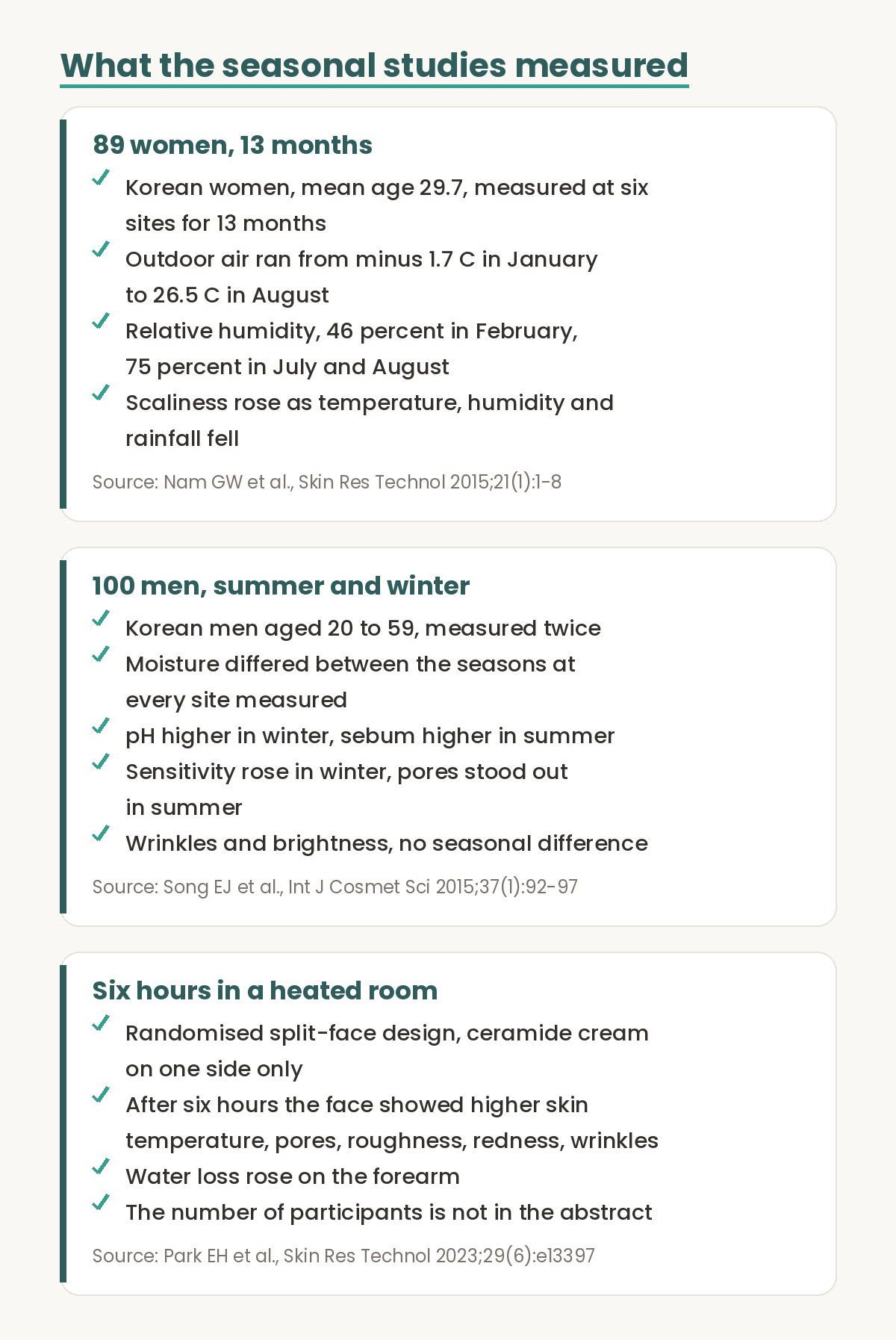
    ✔ Over 13 months, scaliness rose as temperature, humidity and rainfall fell

    ✔ Outdoor relative humidity in that period ran from 46% in February to 75% in July and August

    ✔ In 100 men measured twice, moisture differed between summer and winter at every site

    ✔ Six hours in a heated room raised facial roughness and redness, and water loss on the forearm

    ✔ Wrinkles and brightness did not change with the season — which is where this article turns

    ――――――――――――――――――――――――――――

    Three studies, three designs

    The three were built differently, and that is a strength rather than a weakness: one followed the same people for over a year, one sampled two seasons, and one watched a single day indoors.

    Study Who How long Where measured
    Nam et al. 2015
    Skin Res Technol
    89 Korean women
    mean age 29.7
    13 months, continuously Forehead, under-eye, front cheek, eye corner, side cheek, inner forearm — six sites
    Song et al. 2015
    Int J Cosmet Sci
    100 Korean men
    aged 20 to 59
    Summer and winter, once each Forehead, cheek, arm, glabella, nose wing, eye corner
    Park et al. 2023
    Skin Res Technol
    Participant number not given in the abstract Heated indoor room, over 6 hours a day Face (randomised split-face) and forearm

    ――――――――――――――――――――――――――――

    Thirteen months of measurements

    The first study tracked 89 women and set their skin measurements beside the weather of the same period — temperature, humidity, atmospheric pressure, hours of sunshine and rainfall. That is what makes it more useful than a general statement that winter is drying.

    Outdoor conditions measured Lowest Highest
    Temperature −1.7 °C in January 26.5 °C in August
    Relative humidity 46% in February 75% in July and August

    Across the year that is a span of roughly 28 degrees and 29 percentage points of humidity. And the findings followed those curves:

    ✔ Scaliness rose as temperature, humidity and rainfall fell, and moved the opposite way to atmospheric pressure and sunshine hours

    ✔ Elasticity was higher when temperatures were higher

    Autumn sits on the downslope of the humidity curve rather than at its bottom. February is the low point, but the descent begins months earlier — which is why flaking tends to arrive before deep winter does.

    ※ A correlation means the two moved together. The study did not claim that falling humidity caused the scaliness, and neither will I.

    ――――――――――――――――――――――――――――

    Summer against winter, in 100 men

    The second study measured a different population — men, a wider age range, a different design — and pointed the same way.

    Measure Seasonal difference Which season was higher
    Moisture Significant at every site Varied by site between the two seasons
    pH Yes Higher in winter
    Sebum Yes Higher in summer
    Sensitivity Yes Higher in winter
    Pores Yes More prominent in summer
    Wrinkles and brightness No No difference between the seasons

    Lay the two studies on top of each other and the season’s territory narrows to moisture, scaliness and sensitivity. Two groups differing in sex and age pointed the same way, which is worth more than either result alone.

    Chart of what three seasonal studies in Korean skin measured. First, 89 Korean women of mean age 29.7 were measured at six sites for 13 months; outdoor air ran from minus 1.7 degrees Celsius in January to 26.5 in August and relative humidity from 46 percent in February to 75 percent in July and August, and scaliness rose as temperature, humidity and rainfall fell, Nam and others, Skin Research and Technology 2015. Second, 100 Korean men aged 20 to 59 were measured in summer and in winter; moisture differed between the seasons at every site measured, pH was higher in winter and sebum higher in summer, sensitivity rose in winter and pores stood out in summer, while wrinkles and brightness showed no seasonal difference, Song and others, International Journal of Cosmetic Science 2015. Third, in a randomised split-face trial with a ceramide cream on one side only, six hours in a heated room raised facial skin temperature, pores, roughness, redness and wrinkles, and water loss rose on the forearm, with the number of participants not given in the abstract, Park and others, Skin Research and Technology 2023.

    ――――――――――――――――――――――――――――

    What the season did not change

    The most useful line in that table is the last one. Wrinkles and brightness showed no seasonal difference.

    Those are the two things people tend to report in autumn — skin looks older, skin looks duller. Measured across two seasons, neither moved. What moved was moisture, scaliness and sensitivity.

    So the shelf rearrangement sorts itself out. The water and barrier half of a routine is what the season is arguing with; the wrinkle and brightness half can carry on unchanged. Swapping a retinoid or a brightening serum because the calendar turned is answering a question the data did not ask.

    ――――――――――――――――――――――――――――

    Six hours in a heated room

    Outdoor weather is only half of it. In autumn and winter we spend the day in heated rooms, and one trial looked straight at that.

    Participants spent more than six hours a day in a heated indoor environment. The design was randomised split-face: a ceramide cream on one side of the face, nothing on the other, so each person served as their own control.

    ✔ After six hours the face showed higher skin temperature, pores, roughness, redness and wrinkles

    ✔ On the forearm, transepidermal water loss rose — the arm registers it before the face does

    ✔ The paper’s conclusion recommends a ceramide-containing cream for long winter days indoors

    ※ The number of participants is not stated in the abstract, so I have left it out rather than guess.

    ――――――――――――――――――――――――――――

    Three changes that follow from the data

    ✔ Keep out of the direct path of a heater — that is the condition the six-hour trial tested

    ✔ Apply before the skin dries after washing, and start with arms and legs, which show it first

    ✔ Choose by tightness, roughness or stinging — those are the three the season actually moved

    What you notice The measure that moved Where to look
    Tightness Moisture (Song 2015) Humectants — glycerin, hyaluronic acid
    Roughness, flaking Scaliness (Nam 2015) Keratolytic humectants — urea
    Stinging, redness Sensitivity (Song), redness (Park) Barrier lipids — ceramides, panthenol

    ――――――――――――――――――――――――――――

    Reading the numbers carefully

    ✔ Correlation is not cause. Scaliness moved against humidity; the study did not say humidity produced it

    ✔ Climate and year change the figures. 46% in February is what that study recorded in that period, not a constant

    ✔ I quoted only what the abstracts confirm. Where a detail is missing, such as the participant count in the 2023 trial, it stays missing here

    ――――――――――――――――――――――――――――

    What I left out, and why

    ✔ Indoor humidity guidance. The Korean legal databases were unreachable while this was written, so I did not quote an indoor standard. Every humidity figure here is outdoor, as measured by the studies

    ✔ The mechanism linking humidity to barrier function. That would have been a second-hand citation from a review, so it is out

    ✔ This year’s weather data. It varies by region and year; I kept to the periods the studies measured

    ✔ Product names. This blog does not recommend particular products

    ――――――――――――――――――――――――――――

    In one line

    The season moved moisture, scaliness and sensitivity, and left wrinkles and brightness alone. That is where an autumn routine has something to answer.

    Next in this series: Korea’s rules for children’s cosmetics — what a label saying “for children” sets in motion, and why the box then prints a preservative percentage (Ingredient Guide 20).

    📌 Earlier guides

    📌 Ceramides: the Cholesterol and Fatty Acid Ratio (Guide 4)

    📌 Panthenol: What the Dexpanthenol Studies Show (Guide 7)

    📌 Hyaluronic Acid: How to Read the Molecular Weight (Guide 6)

    📌 How to Read a Korean Cosmetic Ingredient List (Guide 14)

    About the author · Dr. J

    MS in Veterinary Medicine, PhD in Life Sciences. I worked as a researcher at the Korea Research Institute of Bioscience and Biotechnology (KRIBB) and now run Beaurea, a cosmetics manufacturing company, where I write the formulas myself. This blog reads the research papers and the regulatory documents and turns them into plain-language criteria for choosing ingredients. I don’t recommend specific products here – only criteria that apply to any product.

    📄 References

    · Nam GW, Baek JH, Koh JS, Hwang JK, Skin Res Technol 2015;21(1):1-8

    · Song EJ et al., Int J Cosmet Sci 2015;37(1):92-97

    · Park EH et al., Skin Res Technol 2023;29(6):e13397

    ――――――――――――――――――――――――――――

    This article summarises published research and is not a substitute for diagnosis or treatment. The figures are those confirmed in each paper’s abstract, and results shift with the climate and the period measured. If something about your skin worries you, please speak to a professional.

    — Dr. J Ingredient Notes

  • Moisturizing Ingredients for Dry Skin: What the Research Shows for Five of Them (Autumn Guide)

    Cover image for a Dr. J Ingredient Notes autumn guide on moisturizing ingredients for dry skin. Five ingredients with human studies: glycerin, urea, ceramides, panthenol and hyaluronic acid, with what each number was compared with.

    🇰🇷 한국어판: 건조한 피부 보습 성분 TOP5 – 가을에 고르는 기준

    Hello, I’m Dr. J. Autumn is when the same question arrives every year: which moisturizing ingredients actually do something for dry skin? Here are five, each with a human study attached, and each with the numbers read the way I would read them in the lab.

    This is not a ranking. The five do different jobs, and the one you want depends on what your skin does after cleansing: tightness, roughness and flaking, or stinging. Match that first and the shelf gets much smaller.

    Below: one table with all five studies side by side, then each ingredient in turn, then the part most ingredient articles skip — what each number was compared with, because “improved by 72%” and “better than placebo” are not the same claim. At the end, how Korean regulation treats these five, and why squalane is not among them.

    ――――――――――――――――――――――――――――

    📄 If you’d rather read the primary sources

    📄 Lodén et al. 2002 — glycerin 20% and urea 4% creams, 197 patients, 30 days (Acta Derm Venereol)

    📄 Spada et al. 2021 — ceramide-dominant cream and cleanser, 28-day randomized trial (Dermatol Ther)

    📄 Stettler et al. 2021 — panthenol emollients, three 28-day studies (open access)

    📄 Pavicic et al. 2011 — hyaluronic acid 0.1%, 76 women, 60 days (PubMed)

    📄 Korea — Cosmetic Safety Standards, Annex 2: ingredients with use limits (Korean)

    The Stettler paper is fully open, tables included. The Korean annex downloads as the original table.

    ――――――――――――――――――――――――――――

    ――――――――――――――――――――――――――――

    The short version

    ✔ Tight skin — humectants that hold water: glycerin, hyaluronic acid

    ✔ Rough, flaking skin — urea, capped at 10% in cosmetics sold in Korea

    ✔ Stinging after cleansing — barrier ingredients: ceramides, panthenol

    ✔ All five have human studies of one to two months

    ✔ Before trusting a percentage, ask what it was compared with (Table 2)

    ――――――――――――――――――――――――――――

    All five studies in one table

    Ingredient Study People · duration Compared with What was measured
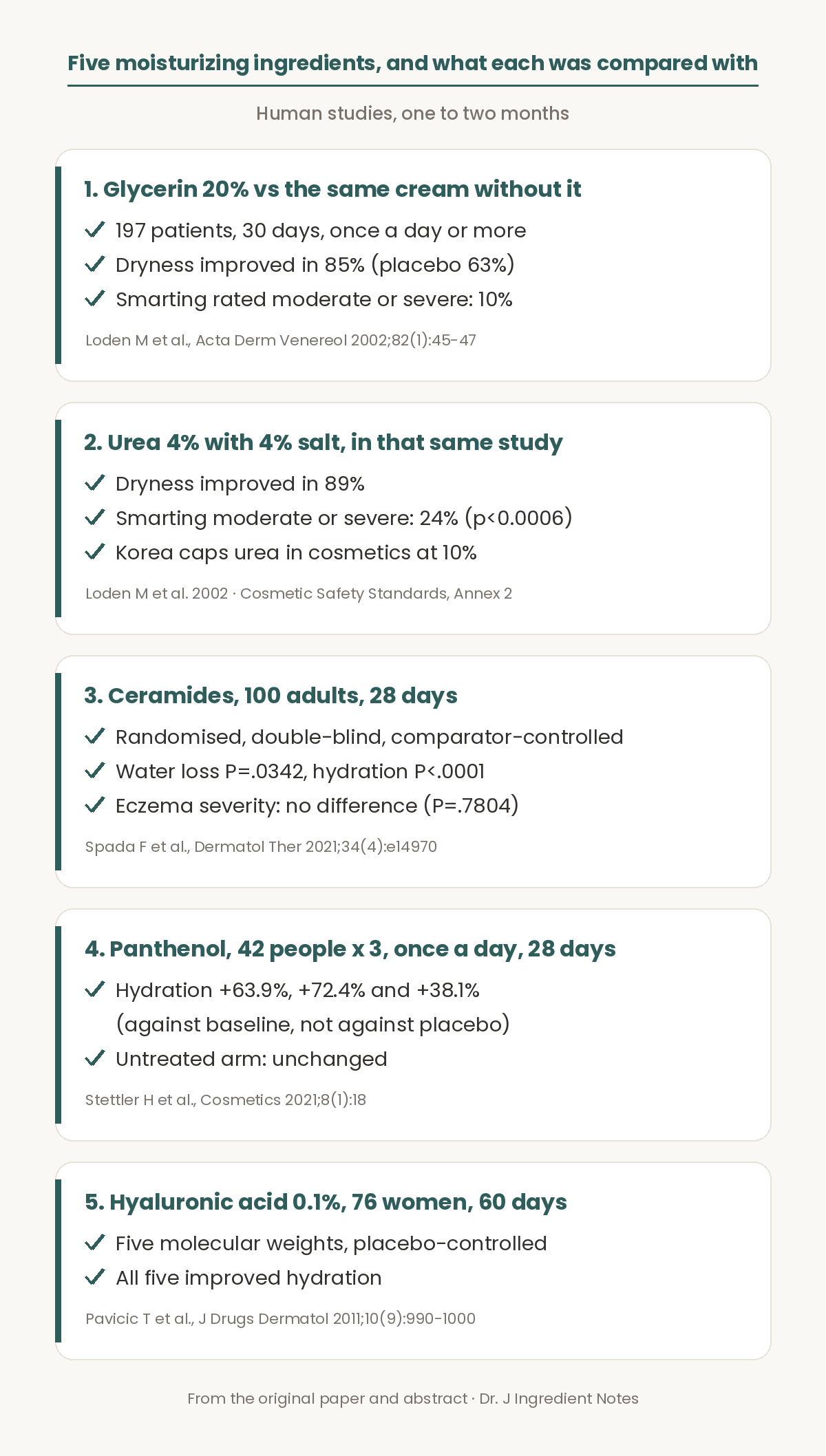
    Glycerin 20% Lodén et al. 2002 68 of 197 · 30 days the same cream without glycerin dryness improved in 85% (placebo 63%)
    Urea 4%
    with 4% sodium chloride
    Lodén et al. 2002 63 in the same study · 30 days the other creams in that study improved in 89%; smarting in 24%
    Ceramides Spada et al. 2021 100 adults (83 completed) · 28 days a comparator regimen · double-blind water loss P=.0342; hydration P<.0001
    Panthenol Stettler et al. 2021 42 people × 3 studies · 28 days the untreated opposite arm hydration +38.1% to +72.4% vs baseline
    Hyaluronic acid 0.1% Pavicic et al. 2011 76 women · 60 days placebo all five molecular weights improved hydration

    Read the “compared with” column first. It is the column that decides how much weight each number can carry, and it is the one marketing copy leaves out.

    ――――――――――――――――――――――――――――

    1 and 2. Glycerin and urea — measured in the same study

    In this trial, 197 patients with atopic dermatitis used one of three creams at least once a day for 30 days (Lodén et al., Acta Derm Venereol 2002):

    ✔ a cream with 20% glycerin — 68 people

    ✔ the same cream base without glycerin, as placebo — 66 people

    ✔ a cream with 4% urea and 4% sodium chloride — 63 people

    After 30 days, dermatologist-assessed dryness had improved in 85% of the glycerin group, 63% of the placebo group and 89% of the urea group. Taking the patients’ own assessments together with the dermatologist’s, the paper’s conclusion is that the glycerin cream and the urea-saline cream had equal effects on dryness.

    What separated them was how they felt. Smarting — that brief sting on application — was rated severe or moderate by 10% of people on the glycerin cream and 24% on the urea-saline cream (p<0.0006). For stinging, itching and dryness/irritation as separate reactions, the paper reports no differences.

    That is why I treat urea as an ingredient to choose on calm days, and why it earns its place on heels, elbows and anywhere the skin is genuinely thickened rather than simply dry.

    ※ The participants had atopic dermatitis. I am quoting the dryness and sensory results, not treating this as a treatment claim. The creams were supplied by the manufacturer (Aco Hud AB).

    Evidence figure for five moisturizing ingredients. First, in 197 patients using creams for 30 days, dermatologist-assessed dryness improved in 85 percent with 20 percent glycerin versus 63 percent with the same cream without glycerin, Loden and colleagues, Acta Dermato-Venereologica 2002. Second, in the same study, 4 percent urea with 4 percent sodium chloride improved dryness in 89 percent, but smarting was rated moderate or severe by 24 percent versus 10 percent for glycerin; Korea caps urea at 10 percent. Third, a ceramide-dominant cream and cleanser used by 100 adults with moderate eczema for 28 days reduced water loss, P equals .0342, and raised hydration, P below .0001, while eczema severity did not differ between groups, Spada and colleagues 2021. Fourth, panthenol emollients used once daily for 28 days by 42 people in each of three studies raised hydration from baseline by 38.1 to 72.4 percent while the untreated arm stayed unchanged, Stettler and colleagues 2021. Fifth, hyaluronic acid at 0.1 percent in five molecular weights used by 76 women for 60 days improved hydration versus placebo, Pavicic and colleagues 2011.

    ――――――――――――――――――――――――――――

    3. Ceramides — the barrier numbers move first

    A ceramide-dominant cream used together with a matching cleanser for 28 days, in a randomized, double-blind trial of 100 adults with moderate eczema, 83 of whom completed it (Spada et al., Dermatol Ther 2021).

    ✔ Transepidermal water loss fell compared with the comparator (P=.0342)

    ✔ Stratum corneum hydration rose compared with the comparator (P<.0001)

    ✔ Eczema severity (EASI) showed no difference between the groups (P=.7804)

    ✔ Satisfaction with itch, dryness and smoothness was higher on the ceramide regimen

    The third line is the honest one, and it is why I like this study. The barrier measurements moved; the disease score did not. A moisturizer is a moisturizer. Ceramides also work as part of a set — with cholesterol and fatty acids — which is the subject of the ceramide guide linked at the end.

    ――――――――――――――――――――――――――――

    4. Panthenol — once a day, 28 days

    Three parallel studies of panthenol-containing emollients that differed in lipid content: low, intermediate and high. Each had 42 participants applying the product to one forearm once daily for 28 days, leaving the other forearm untreated (Stettler et al., Cosmetics 2021).

    At day 28, hydration had risen from baseline by 63.9% (low lipid), 72.4% (intermediate) and 38.1% (high). On the untreated arm, hydration did not move — which is what makes the rise hard to attribute to the weather.

    Two caveats travel with those percentages: they are measured against baseline, not against a panthenol-free cream, and they belong to the whole formulation, which also contained lipids such as shea butter and squalane. The full reading of this study is in the panthenol guide.

    ――――――――――――――――――――――――――――

    5. Hyaluronic acid — five molecular weights in one study

    Creams with 0.1% hyaluronic acid at five different molecular weights, used by 76 women for 60 days against placebo (Pavicic et al., J Drugs Dermatol 2011). All five improved hydration relative to placebo.

    So on a label, what I look for is more than one molecular weight listed, rather than a single impressive-sounding number. How to read those numbers is covered in the hyaluronic acid guide.

    ――――――――――――――――――――――――――――

    How to read the numbers — the comparator decides the meaning

    The five studies did not use the same yardstick. Here is what each comparison can and cannot tell you.

    Comparator Used here by How to read the number
    The same cream minus one ingredient glycerin The closest thing to what that ingredient added
    A different product ceramides A product-versus-product result, not one ingredient
    Untreated skin panthenol The whole cream versus applying nothing
    Day 0 (baseline) the panthenol percentages Season and humidity ride along; check whether untreated skin was measured too
    Placebo hyaluronic acid Same formula, different ingredient

    The strongest design here is the same cream with one ingredient removed: formulation held constant, so the difference is attributable to the ingredient. The weakest, in this sense, is a percentage against baseline, because the season is inside that number — unless, as in the panthenol studies, untreated skin was measured alongside and stayed flat.

    ――――――――――――――――――――――――――――

    How Korea regulates these five

    One of the five appears in Annex 2 of the Cosmetic Safety Standards — the list of ingredients with use limits.

    Korea What that means on a label
    Urea listed in Annex 2 of the Cosmetic Safety Standards at 10% (CAS 57-13-6) A product sold in Korea stays at or below 10%
    Glycerin · ceramides · panthenol · hyaluronic acid not in that annex No ceiling, and no minimum either — concentration varies by product
    Brightening · anti-wrinkle ingredients listed with set amounts in Annex 4 of the functional-cosmetics review rules Moisturizing ingredients are not in that kind of table

    This is worth knowing when you compare a Korean product with one from elsewhere. Korea sets a ceiling for urea at 10%; the study above used 4%, well inside it. For the other four, there is no number in the regulation at all — no maximum, and equally no minimum, which is why the ingredient list’s order matters more than any claim on the front of the bottle.

    It is also why moisturizing ingredients are not “functional cosmetics” in the Korean sense. Brightening and anti-wrinkle ingredients have an annex listing set amounts; hydration does not work that way.

    ――――――――――――――――――――――――――――

    Why squalane is not on this list

    Squalane comes up in every autumn skincare article, so I went looking again. I could not find a study in which squalane was applied to human skin and its hydration effect compared with a placebo. What exists is work outside the body — an ex vivo study of how a squalane-based emulsion carries other compounds into skin, and a cell study of squalane and UV-related collagen effects in fibroblasts.

    That is not evidence of absence; it is a statement about what I could verify. If I find a human trial, squalane gets its own guide.

    ――――――――――――――――――――――――――――

    Five things to check on the label

    ✔ Glycerin — near the top of the ingredient list; higher means more of it

    ✔ Urea — if a percentage is printed, 10% or below, and start low

    ✔ Ceramides — cholesterol and fatty acids listed alongside them

    ✔ Panthenol — for a cream you will use on stinging days, fragrance low on the list or absent

    ✔ Hyaluronic acid — more than one molecular weight listed

    My own order is simple. If tightness comes first after cleansing, I reach for the water-binding side. If stinging comes first, I reach for the barrier side. If both, one product containing both is a reasonable place to start.

    ――――――――――――――――――――――――――――

    In one line

    Tight skin: glycerin and hyaluronic acid. Rough skin: urea. Stinging skin: ceramides and panthenol. Start from what your skin does, and read every percentage together with what it was compared against.

    ――――――――――――――――――――――――――――

    📌 Earlier guides

    📌 Ceramides – the cholesterol and fatty acid ratio (Ingredient Guide 4)

    📌 Panthenol for Skin: What the Dexpanthenol Studies Show (Ingredient Guide 7)

    📌 Hyaluronic Acid: How to Read the Molecular Weight (Ingredient Guide 6)

    📌 How to Read a Korean Cosmetic Ingredient List — Where the Order Stops at 1% (Ingredient Guide 14)

    About the author · Dr. J

    MS in Veterinary Medicine, PhD in Life Sciences. I worked as a researcher at the Korea Research Institute of Bioscience and Biotechnology (KRIBB) and now run Beaurea, a cosmetics manufacturing company, where I write the formulas myself. This blog reads the research papers and the regulatory documents and turns them into plain-language criteria for choosing ingredients. I don’t recommend specific products here – only criteria that apply to any product.

    📄 References

    · Lodén M, Andersson AC, Anderson C, et al. Acta Derm Venereol 2002;82(1):45-47

    · Spada F, Harrison IP, Barnes TM, et al. Dermatol Ther 2021;34(4):e14970

    · Stettler H, de Salvo R, Olsavszky R, et al. Cosmetics 2021;8(1):18

    · Pavicic T, Gauglitz GG, Lersch P, et al. J Drugs Dermatol 2011;10(9):990-1000

    · Korea MFDS — Regulation on Safety Standards for Cosmetics, Annex 2 (ingredients with use limits)

    ――――――――――――――――――――――――――――

    This article summarises published research and safety assessments. It is information, not a diagnosis or a treatment plan. If something about your skin worries you, please talk to a professional.

    — Dr. J Ingredient Notes

  • Panthenol for Skin: What the Dexpanthenol Studies Show (Ingredient Guide 7)

    Cover image for a Dr. J Ingredient Notes guide on panthenol, ingredient guide 7. What the research shows about panthenol for skin: a dexpanthenol cream tested against the same cream without it on irritated skin, and three 28-day studies of panthenol moisturisers on very dry skin with 42 people each.

    🇰🇷 한국어판: 판테놀 효능, 숫자로 확인된 것 (성분 백과 ⑦)

    Hello, I’m Dr. J. Today’s question is a simple one: what does panthenol actually do for skin, and how much of that has been measured in people? This is Ingredient Guide 7.

    Panthenol turns up on the back of almost every soothing cream, barrier cream and “recovery” product, and in plenty of shampoos too. It is usually described in a word or two – soothing, hydrating, vitamin B5 – and rarely with a number attached. So here is the first surprise: panthenol isn’t the thing that does the work. Skin converts it into something else first.

    Below I put two human studies side by side. One tested a dexpanthenol cream on deliberately irritated skin against the same cream without dexpanthenol. The other ran three 28-day studies of panthenol-containing moisturisers on very dry skin, 42 people each. At the end is the conclusion of the US Cosmetic Ingredient Review panel on panthenol’s safety – and a short list of claims I left out, with the reason for each.

    ――――――――――――――――――――――――――――

    📄 If you’d rather read the primary sources

    📄 Proksch & Nissen 2002 — irritated skin, dexpanthenol cream vs vehicle

    📄 Stettler et al. 2021 — three 28-day studies, 42 people each (open access)

    📄 Cosmetic Ingredient Review 2022 — safety assessment of panthenol and derivatives

    The Stettler paper is open access, including the per-product tables and the measurement methods. The Proksch paper’s abstract is public.

    ――――――――――――――――――――――――――――

    ――――――――――――――――――――――――――――

    The short version

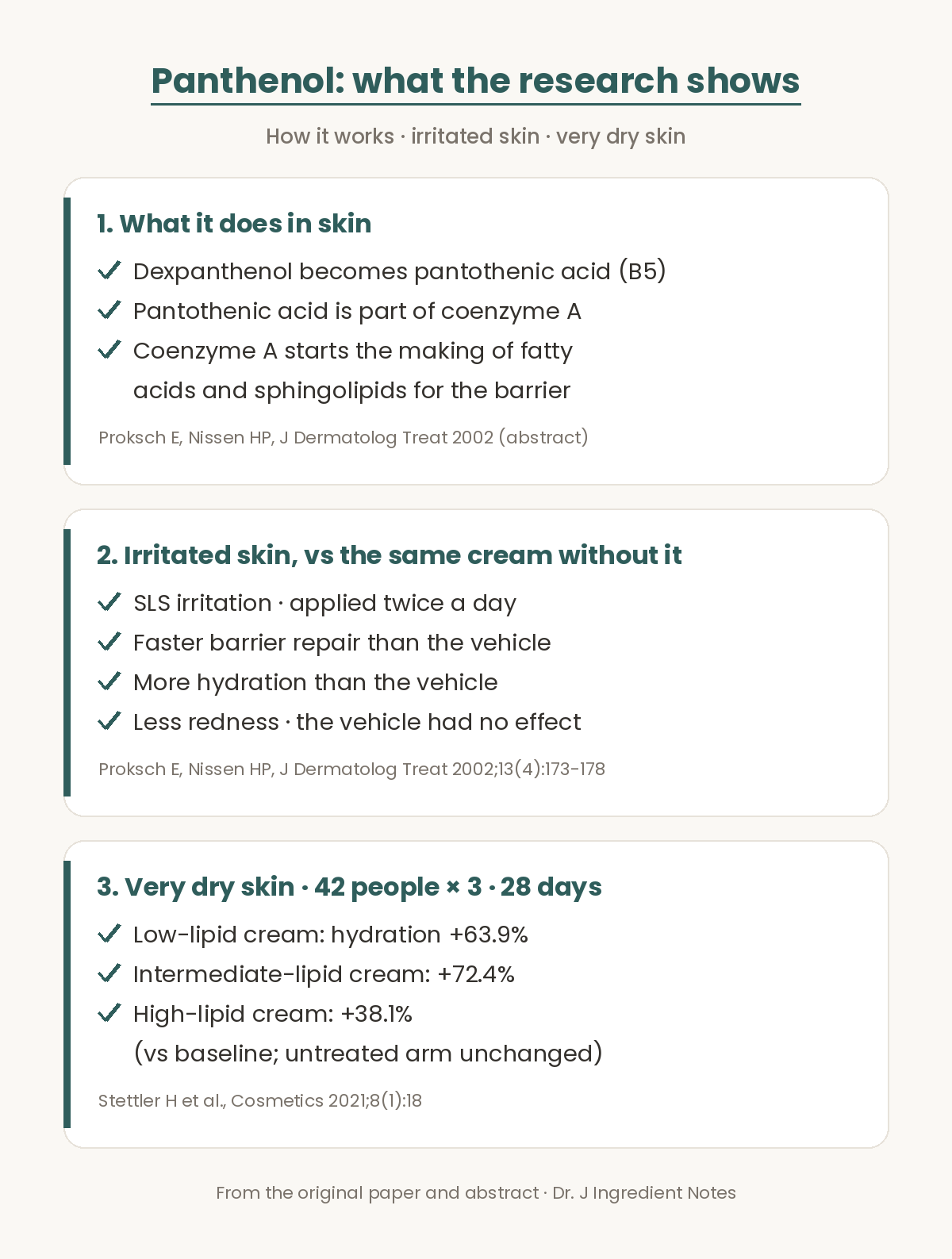
    ✔ Panthenol and dexpanthenol are names for the same family; in skin, dexpanthenol becomes pantothenic acid (vitamin B5)

    ✔ On irritated skin, a dexpanthenol cream applied twice a day repaired the barrier faster than the same cream without it

    ✔ In three 28-day studies on very dry skin (42 people each), skin hydration rose 38.1% to 72.4% from baseline

    ✔ In the same studies, hydration on the untreated arm did not move

    ✔ The US Cosmetic Ingredient Review panel concluded panthenol is safe as currently used in cosmetics

    ――――――――――――――――――――――――――――

    Panthenol vs dexpanthenol – why two names

    Ingredient lists say panthenol; studies and pharmacy ointments usually say dexpanthenol. Panthenol exists in two mirror-image forms, and the one skin converts to pantothenic acid is the D-form – dexpanthenol. That conversion is why you’ll also see it called provitamin B5.

    Why does that matter? Pantothenic acid is a building block of coenzyme A. As the Proksch & Nissen abstract explains, coenzyme A catalyses the early steps in making fatty acids and sphingolipids – lipids that are essential to the layered lipid structure of the stratum corneum and to cell membranes. That is the biological reason people expected panthenol to help a damaged barrier. The studies below are where that expectation was tested.

    Inside the bottle, panthenol has more than one job. The Cosmetic Ingredient Review report lists it as a hair-conditioning agent, a skin-conditioning agent (humectant) and a solvent. That is why the same name appears on both a conditioner and a face cream.

    ――――――――――――――――――――――――――――

    On irritated skin – dexpanthenol cream vs the same cream without it

    In this study, skin was deliberately irritated with sodium lauryl sulphate (SLS), a cleansing agent, applied in patch-test chambers. The irritated sites were then treated twice a day with either a dexpanthenol cream or the identical cream without dexpanthenol (the vehicle), and some sites were left untreated. Barrier repair, hydration, roughness and redness were measured with instruments rather than judged by eye (Proksch & Nissen, J Dermatolog Treat 2002).

    ✔ Barrier repair — significantly faster with dexpanthenol than with the vehicle or with no treatment

    ✔ Stratum corneum hydration — rose with both creams, but significantly more with dexpanthenol

    ✔ Roughness — fell with both creams, with dexpanthenol again ahead

    ✔ Redness — significantly reduced with dexpanthenol; the vehicle had no effect

    The weight of this study comes from the comparison. Any cream will add some water and oil to the skin; by testing against the same base without dexpanthenol, the study isolates what dexpanthenol itself added. On all four measures, it added something.

    ※ The abstract does not give the number of participants, the length of the study or the dexpanthenol concentration. A later review article quotes figures for this trial, but I couldn’t confirm them in the original, so I have left them out.

    Evidence figure on panthenol. First, in skin, dexpanthenol becomes pantothenic acid, vitamin B5, which is part of coenzyme A, and coenzyme A starts the synthesis of fatty acids and sphingolipids needed for the skin barrier. Second, on skin irritated with sodium lauryl sulphate and treated twice a day, a dexpanthenol cream repaired the barrier faster, raised hydration more and reduced redness compared with the same cream without dexpanthenol, which had no effect on redness, Proksch and Nissen, Journal of Dermatological Treatment 2002. Third, in three 28-day studies on very dry skin with 42 people each, skin hydration rose from baseline by 63.9 percent with a low-lipid cream, 72.4 percent with an intermediate-lipid cream and 38.1 percent with a high-lipid cream, while the untreated arm stayed unchanged, Stettler and colleagues, Cosmetics 2021.

    ――――――――――――――――――――――――――――

    On very dry skin – three studies, 42 people each, 28 days

    The second paper reports three parallel studies of panthenol-containing emollients that differed in how much lipid (oil) they contained: low, intermediate and high (Stettler et al., Cosmetics 2021). Participants were 18 to 70 years old and had skin that a dermatologist judged to be very dry, flaky and sensitive. Each person applied the product to one forearm once a day, about 2 mg per square centimetre, and left the other forearm untreated. Which arm got the product was decided at random.

    Emollient 1
    lowest lipid
    Emollient 2
    intermediate lipid
    Emollient 3
    highest lipid
    Participants 42 · mean age 59 42 · mean age 58 42 · mean age 57
    Skin hydration
    day 28 vs baseline
    +63.9% +72.4% +38.1%
    Water loss (TEWL)
    day 28 vs baseline
    −11.0% (significant) −5.7% (not significant) lower, not significant
    Stratum corneum lipids cholesterol +9.8% · free fatty acids +3.7% no change cholesterol +12.5% · free fatty acids +26.3%

    Three things stand out. First, hydration rose clearly with all three products. Second, on the untreated arm, hydration stayed flat – the paper reports it holding at about the same capacitance reading throughout. That makes it hard to put the rise down to the weather or to people getting used to the measurements. Third, only Emollient 1 significantly reduced water loss (TEWL); the other two moved in the right direction without reaching significance.

    So how much of this is panthenol? That’s the honest limit of this paper. The results belong to each cream as a whole: all three also contained lipids such as shea butter and squalane, and the paper does not state the panthenol concentration. The comparison was against untreated skin, not a panthenol-free cream. The study was also open-label – everyone knew what they were applying – and the products were supplied by the manufacturer. None of that makes the numbers wrong, but it tells you what kind of numbers they are.

    The intermediate-lipid product gave the largest hydration gain, while the highest-lipid product gave the smallest – a reminder that a richer cream is not automatically a more hydrating one. On tolerability, the paper reports no local or systemic adverse events related to the products over the 28 days.

    ――――――――――――――――――――――――――――

    The two studies side by side

    Proksch & Nissen 2002 Stettler et al. 2021
    Skin deliberately irritated with sodium lauryl sulphate (SLS) very dry, flaky and sensitive, as judged by a dermatologist
    Compared with the same cream without dexpanthenol (vehicle), and untreated skin the untreated opposite forearm
    How often twice a day once a day, about 2 mg/cm²
    Design vehicle-controlled (numbers of people and days not given in the abstract) randomised as to which arm was treated · open-label · three studies × 42 people · 28 days
    Key result faster barrier repair, more hydration, less roughness, less redness than vehicle hydration +38.1% to +72.4%; untreated side flat

    Each study fills the other’s gap. The 2002 trial has the right comparison – dexpanthenol against its own vehicle – but its abstract gives no numbers. The 2021 studies have clear numbers, but they describe whole products compared with untreated skin. Put together, they support a modest, specific statement: panthenol has human evidence on two fronts, recovery after irritation and hydration of very dry skin.

    ――――――――――――――――――――――――――――

    Safety – what the Cosmetic Ingredient Review panel concluded

    In the US, the Cosmetic Ingredient Review (CIR) expert panel assesses the safety of cosmetic ingredients. In 2022 it reviewed panthenol, pantothenic acid and five derivatives together. Its conclusion is one sentence: all seven are safe in cosmetics in the present practices of use and concentration described in the assessment.

    It helps to keep the two questions apart. The CIR conclusion answers “is it safe to use the way it is used now?” – not “how well does it work?”. For the second question, look to the two studies above.

    ――――――――――――――――――――――――――――

    How I use it

    ✔ When exfoliating acids or retinol leave my skin stinging, I switch to a panthenol-containing cream for a few days

    ✔ I apply it while skin is still slightly damp after cleansing, and on dry days add a cream on top

    ✔ For very dry skin I give it 28 days before judging – the length of the Stettler studies

    ――――――――――――――――――――――――――――

    What I left out, and why

    ✔ Participant numbers, duration and concentration for the 2002 trial — quoted in a review, but not in the original abstract I could read

    ✔ Wound and burn claims — in a cosmetics article they read like drug claims

    ✔ “Choose at least X%” — I found no original study comparing panthenol concentrations head-to-head on human skin

    ✔ Pairing rules with other ingredients — I found no primary study testing panthenol in specific combinations

    ――――――――――――――――――――――――――――

    Three things to check when you buy

    ✔ Where panthenol sits in the ingredient list — higher up means more of it (see the ingredient-list guide below)

    ✔ Texture — in the 28-day studies, the intermediate-lipid product gave the largest hydration gain

    ✔ Where fragrance sits — if this is the cream for your irritated days, you want fragrance low on the list or absent

    ――――――――――――――――――――――――――――

    In one line

    Panthenol is converted in skin to vitamin B5, and it has human evidence for recovery after irritation and for hydrating very dry skin. When you read a number, check first what it was compared with.

    ――――――――――――――――――――――――――――

    📌 Earlier guides

    📌 Ceramides – the cholesterol and fatty acid ratio (Ingredient Guide 4)

    📌 Hyaluronic Acid: How to Read the Molecular Weight (Ingredient Guide 6)

    📌 Retinol: Start at 0.1% (Ingredient Guide 1)

    📌 How to Read a Korean Cosmetic Ingredient List — Where the Order Stops at 1% (Ingredient Guide 14)

    About the author · Dr. J

    MS in Veterinary Medicine, PhD in Life Sciences. I worked as a researcher at the Korea Research Institute of Bioscience and Biotechnology (KRIBB) and now run Beaurea, a cosmetics manufacturing company, where I write the formulas myself. This blog reads the research papers and the regulatory documents and turns them into plain-language criteria for choosing ingredients. I don’t recommend specific products here – only criteria that apply to any product.

    📄 References

    · Proksch E, Nissen HP. Dexpanthenol enhances skin barrier repair and reduces inflammation after sodium lauryl sulphate-induced irritation. J Dermatolog Treat 2002;13(4):173-178

    · Stettler H, de Salvo R, Olsavszky R, et al. Cosmetics 2021;8(1):18

    · Scott LN, Fiume M, Bergfeld WF, et al. Safety Assessment of Panthenol, Pantothenic Acid, and Derivatives as Used in Cosmetics. Int J Toxicol 2022;41(3 Suppl):77-128

    ――――――――――――――――――――――――――――

    This article summarises published research and safety assessments. It is information, not a diagnosis or a treatment plan. If something about your skin worries you, please talk to a professional.

    — Dr. J Ingredient Notes

  • Ceramides Work Better With Company – What 4 Studies Say About the Back of the Jar (Ingredient Guide 4)

    Cover image for Ceramides Work Better With Company. Dr. J Ingredient Notes guide 4, summarising four studies showing that skin barrier repair was faster when ceramide, cholesterol and fatty acid were applied together.

    Hello, this is Dr. J.

    The fourth ingredient guide is about ceramides.

    Every year, as soon as the air turns dry, the same question arrives: which moisturiser should I be using?

    Here is the part that makes the answer interesting. In a 1996 experiment, skin treated with ceramides on their own repaired its barrier at a different speed from skin treated with ceramides alongside two other lipids. Same ingredient, opposite direction.

    Today I will follow that thread and end up at the back of the jar.

    ―――――――――――――――――――――

    📄 Read the sources first, if you prefer

    · Man MQ et al., J Invest Dermatol 1996 – barrier repair timed as the lipid ratio was varied

    · Tanno O et al., Br J Dermatol 2000 – niacinamide and ceramide synthesis

    · 🏠 COSMILE Europe INCI database – type an ingredient name from your label and read what it is

    The abstracts carry the exact ratios and time points I have left out here. Open them above if you want them.

    ―――――――――――――――――――――

    Fifteen-second summary · no sound

    ―――――――――――――――――――――

    The four lines, if you are in a hurry

    ✔ Ceramides are the lipids that fill the space between skin cells. When they run low, water leaves

    ✔ Barrier repair was faster with cholesterol and fatty acid present than with ceramides alone

    ✔ In studies of 24 children and 100 adults, water loss through the skin came down

    ✔ Niacinamide raised the skin’s own ceramide production 4.1 to 5.5 fold

    ―――――――――――――――――――――

    Why ceramides alone were slower – the 1996 ratio experiment

    Picture the outer layer of skin as a brick wall. The cells are the bricks, and the mortar filling the gaps is made of three things: ceramides, cholesterol and fatty acids. Mortar only sets when all three are mixed. Pour in as much sand as you like – without cement and water it never hardens.

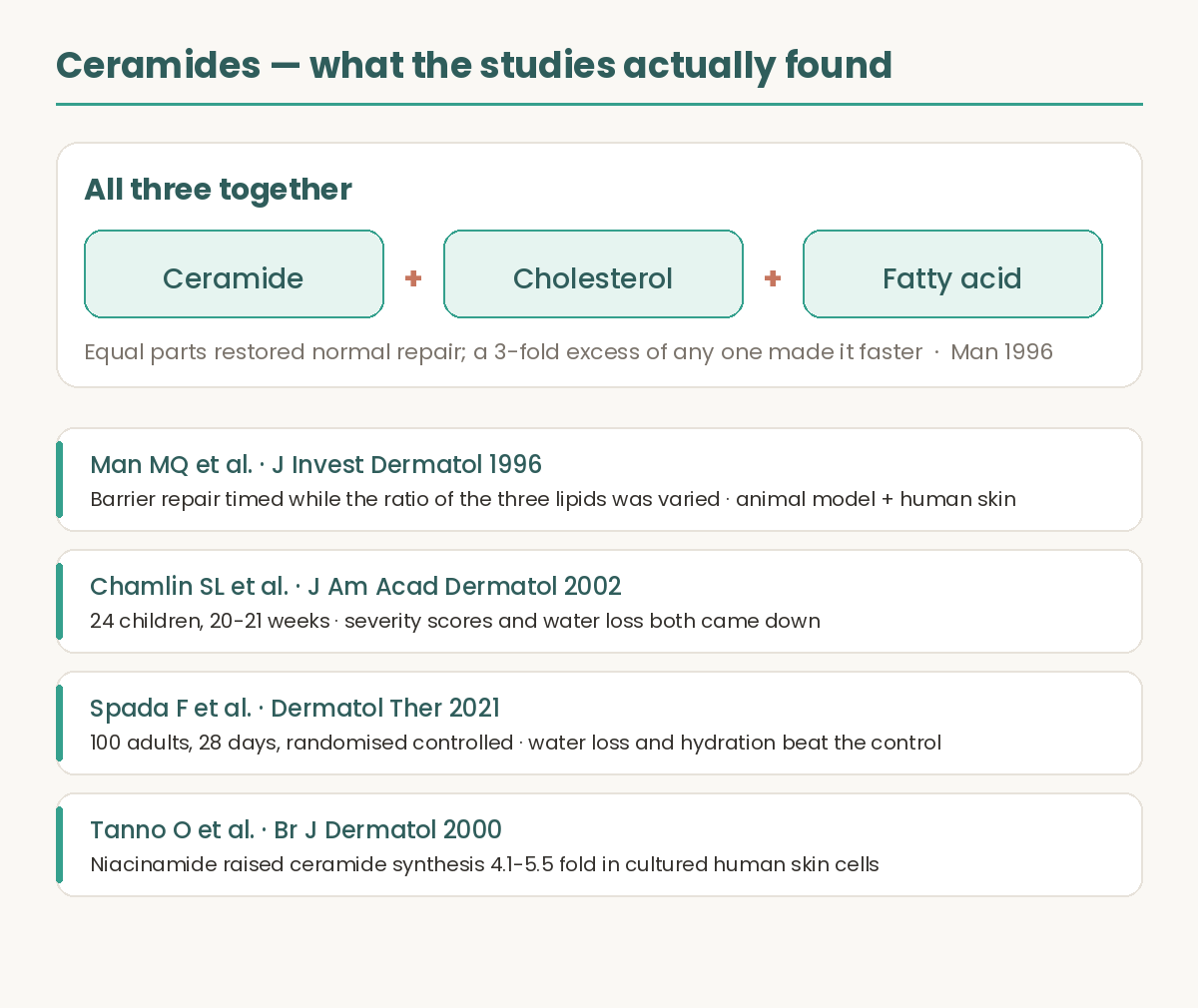
    Man MQ and colleagues published the experiment in the Journal of Investigative Dermatology in 1996 (volume 106, pages 1096–1101). They disrupted the barrier deliberately, applied lipids, and timed how quickly it recovered.

    ✔ One or two of the three lipids made recovery slower, not faster

    ✔ All three in equal parts restored normal speed, and a 3-fold excess of any one made it quicker still

    ✔ Confirmed in an animal model, and pointing the same way in disrupted human skin

    So a formula built around a single lipid is not the stronger formula. Which is why the useful question at the shelf is not whether a cream contains ceramides, but what the ceramides were formulated with.

    Evidence summary for ceramides. Shows that ceramide, cholesterol and fatty acid applied together restored normal barrier repair in a 1996 study, alongside a 24-child 20 to 21 week study, a 100-adult 28-day randomised controlled study, and a 2000 study in which niacinamide raised ceramide synthesis 4.1 to 5.5 fold.

    ―――――――――――――――――――――

    Did it hold up in people – 24 children, 100 adults

    Chamlin SL and colleagues, Journal of the American Academy of Dermatology 2002, volume 47, pages 198–208.

    Twenty-four children with atopic dermatitis added a ceramide-dominant product to their routine for 20 to 21 weeks. By week three, 22 of the 24 had lower severity scores, and water loss through the skin kept falling even after the scores had levelled off. The visible part settled first; the barrier itself carried on mending underneath.

    Spada F and colleagues, Dermatologic Therapy 2021, volume 34, e14970.

    One hundred adults were randomised for 28 days, one group using a ceramide-dominant cream and cleanser. Water loss and skin hydration both did better than in the control group, and ratings for itch and dryness were higher as well.

    The two products share one thing. Ceramides sat at the centre of the formula, with cholesterol and fatty acids beside them. You do not need the product names. The shape of the combination is the part worth carrying to the shop.

    ―――――――――――――――――――――

    Finding the names on the label – five lines that decide it

    Ceramides appear under several names. These are the five lines to look for.

    What you will see on the label Which of the three it belongs to
    Ceramide NP · AP · EOP · NG · AS The ceramides themselves. The letters describe structure, not grade
    Hydroxypalmitoyl sphinganine · Phytosphingosine Same family, listed under a different name
    Cholesterol The second ingredient in the 1996 experiment
    Stearic acid · Palmitic acid · Linoleic acid The fatty acid side. The third one
    Niacinamide Not a refill. It helps skin make its own

    The letters after a ceramide – NP, AP, EOP and the rest – describe molecular structure. They are not a quality ranking, and I have not found human studies comparing them head to head. Rather than picking between them, check whether cholesterol and a fatty acid are listed nearby.

    If a name is unfamiliar, type it into the COSMILE Europe INCI database and you will get its definition and function.

    ―――――――――――――――――――――

    Helping skin make its own – niacinamide

    Tanno O and colleagues, British Journal of Dermatology 2000, volume 143, pages 524–531.

    Cultured human skin cells given niacinamide for six days produced 4.1 to 5.5 times more ceramides. Fatty acids rose 2.3 fold and cholesterol 1.5 fold at the same time – all three mortar ingredients together.

    Applied to skin, it also raised ceramide and fatty acid levels in the outer layer and reduced water loss. That is the reason so many jars now carry both the refill and the prompt in one formula.

    How to read a niacinamide percentage is covered in Ingredient Guide 1, on retinol, where the same approach to concentration numbers applies.

    ―――――――――――――――――――――

    When to apply it – order and combinations

    ✔ Straight after cleansing, while skin is still slightly damp, is the easiest moment

    ✔ On retinol or AHA nights, put it on last. That is the night it earns its place

    ✔ There is no need to separate it from a vitamin C serum. Serum first, cream after

    ✔ With anything new, try it on the inner forearm and give it two days

    👉 If layering order gets confusing, the ingredient compatibility chart covers twelve ingredients and what to keep apart.

    ―――――――――――――――――――――

    Five things to check before you buy

    ✔ Are they together? Cholesterol and a fatty acid listed alongside the ceramides

    ✔ Where on the list? Ceramides near the front or middle rather than the very end

    ✔ Is niacinamide there? The refill and the prompt in one jar

    ✔ Does the texture suit your week? In dry months a cream or balm holds up better than a lotion

    ✔ Where does fragrance sit? High on the list is worth noticing when the barrier is already stressed

    Save these five lines and open them at the shelf. Reading the back of a jar takes about five minutes.

    ―――――――――――――――――――――

    In one line

    🧪 Ceramides look most like the research when cholesterol and a fatty acid are in the formula and niacinamide is nearby.

    The next ingredient guide is collagen – what changes between putting it on your skin and taking it by mouth.

    📌 Earlier posts

    · Skincare Ingredient Compatibility Chart – 12 ingredients, what to layer and what to split

    · Retinol: Start at 0.1% – how to read the concentration numbers

    · Not All Vitamin C Serums Work – 3 conditions the research says you need

    About the author · Dr. J

    MS in Veterinary Medicine, PhD in Life Sciences. I worked as a researcher at the Korea Research Institute of Bioscience and Biotechnology (KRIBB) and now run Beaurea, a cosmetics manufacturing company, where I write the formulas myself. This blog reads the research papers and the regulatory documents and turns them into plain-language criteria for choosing ingredients. I don’t recommend specific products here – only criteria that apply to any product.

    📄 References

    · Man MQ et al., J Invest Dermatol 1996;106(5):1096-1101

    · Chamlin SL et al., J Am Acad Dermatol 2002;47(2):198-208

    · Spada F et al., Dermatol Ther 2021;34(4):e14970

    · Tanno O et al., Br J Dermatol 2000;143(3):524-531

    · 🏠 COSMILE Europe INCI database

    Note: this article reads the research and sets out criteria for choosing an ingredient. It does not recommend a particular product. What suits you depends on your skin and on what you already use, so try anything new on the inner forearm first.


    Dr. J Ingredient Notes | Ingredient Guide 4 · Ceramides

  • Niacinamide: 5% Is Enough – What Each Concentration Has Actually Shown (Ingredient Encyclopedia 2)

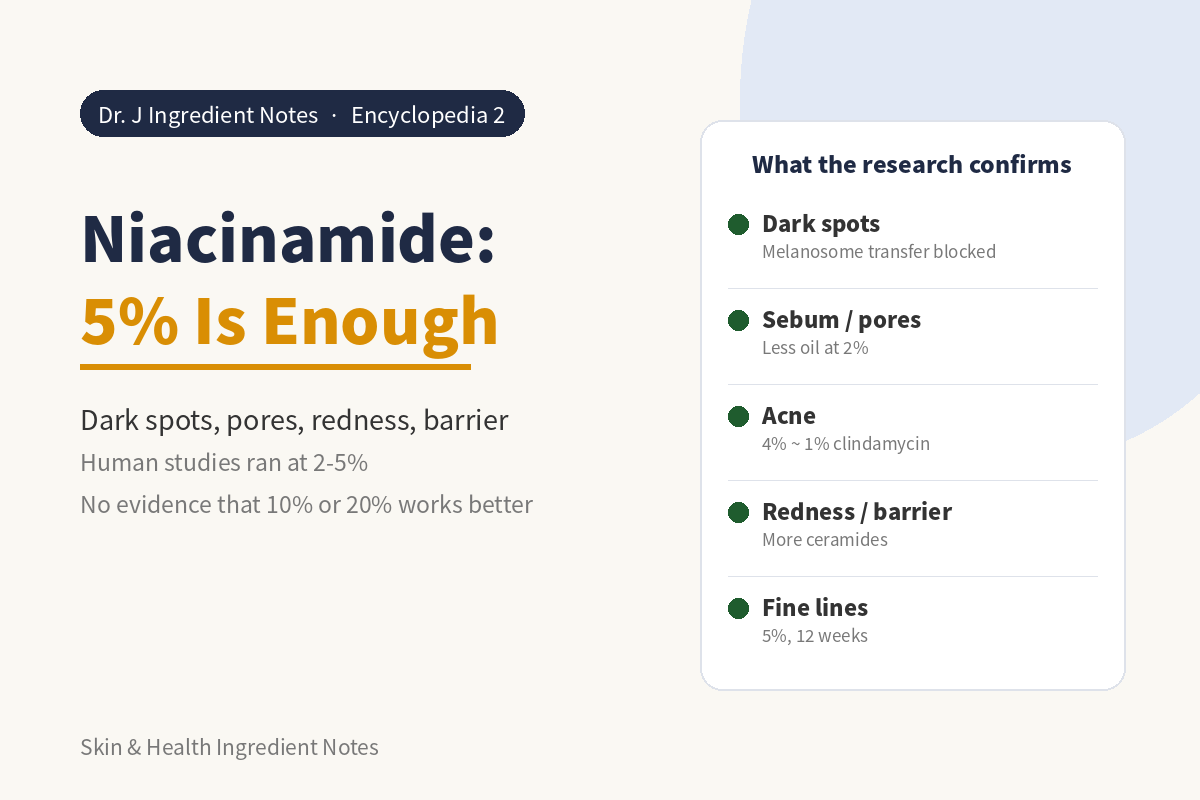
    Niacinamide: 5% is enough - human studies ran at 2-5%, Korea's whitening functional range is 2-5%, no evidence 10% or 20% works better, Dr. J Ingredient Notes cover

    🇰🇷 이 글의 한국어판 → 한국어판

    Hello, I’m Dr. J.
    In Korea you can hardly walk past a serum shelf without seeing niacinamide on the label.
    It sits in most products approved here as brightening functional cosmetics.

    The number next to it keeps changing, though: 2%, 5%, 10%, 20%.
    Does a bigger number buy you more?
    Here is what the human studies actually support.


    The short version

    ✔ Niacinamide is a form of vitamin B3. One ingredient works on dark spots, pores, acne, redness, fine lines and the skin barrier
    ✔ The human studies ran at 2-5%, and Korea’s brightening functional range is also 2-5%
    ✔ No head-to-head human study shows 10% or 20% doing more. The chance of flushing does go up
    ✔ Morning and night are both fine, and it layers with retinol, vitamin C and acids
    ✔ Expect the first change around week 4 and a clear one at 8-12 weeks. Consistency matters more than strength
     

    What the research confirms – five jobs, one ingredient

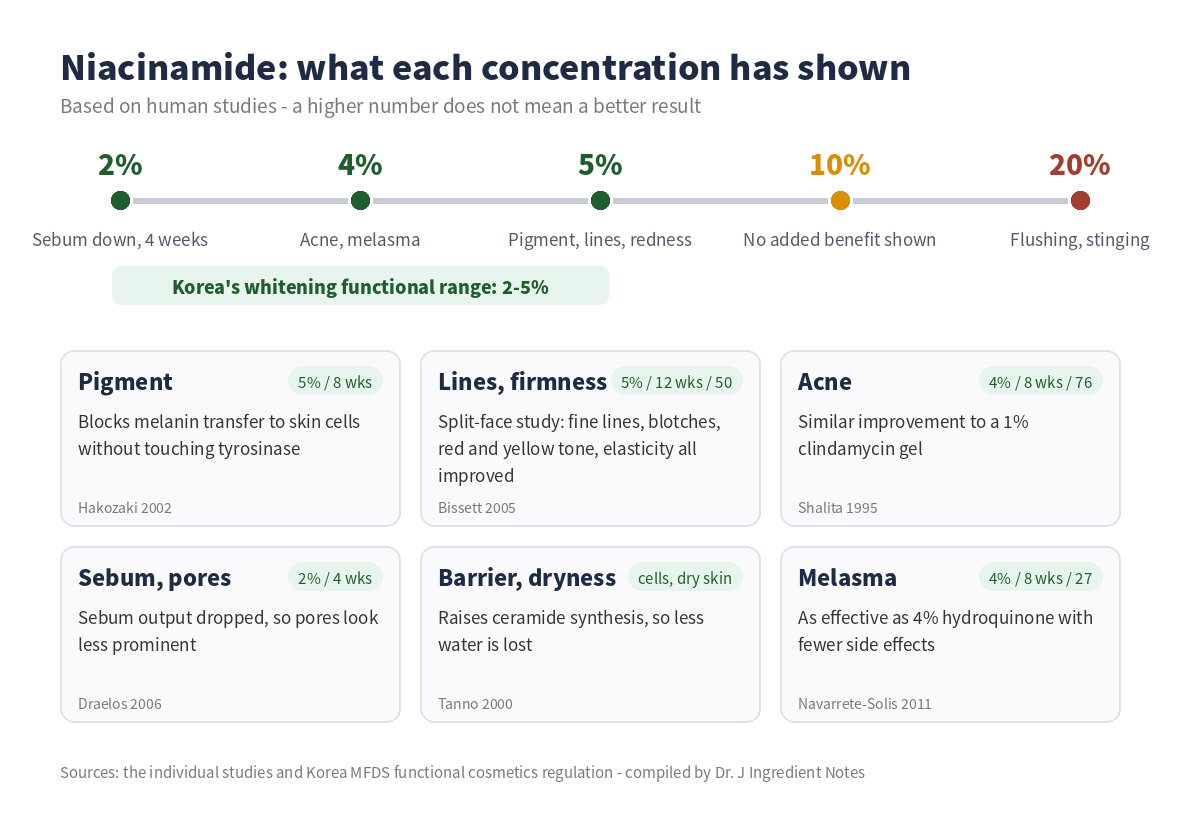
    Niacinamide by concentration - 2% less sebum (Draelos 2006), 4% acne (Shalita 1995) and melasma (Navarrete-Solis 2011), 5% pigment, lines and redness (Bissett 2005, Hakozaki 2002), 10% no added benefit, 20% flushing
    · Dark spots — it blocks the hand-off of melanin to skin cells. It leaves the pigment-making enzyme alone, which is why it is gentle. Blotches faded over 8 weeks at 5%
    · Fine lines, redness, elasticity — 50 people used 5% on one half of the face and a plain cream on the other for 12 weeks. Fine lines, blotches, red spots, sallowness and elasticity all improved
    · Acne — a 4% gel matched a 1% clindamycin (antibiotic) gel over 8 weeks in 76 people
    · Sebum and pores — 2% for 4 weeks lowered sebum output. Less oil, less prominent pores
    · Barrier and dryness — it raises ceramide synthesis, so the skin loses less water. That is why it buffers a retinol or acid routine

    There is a melasma study too.
    4% niacinamide matched 4% hydroquinone with fewer side effects (27 people, 8 weeks).


    Choosing the number: 2, 5, 10 or 20%

    · 2% — the sebum and pore studies. A sensible starting point for sensitive skin
    · 4% — the acne and melasma studies
    · 5% — pigment, fine lines and redness. This is the reference point
    · 10% — no human comparison showing it beats 5%. More people report flushing
    · 20% — it exists on shelves, the evidence does not, and stinging is common

    That warm flush some people feel comes less from niacinamide itself than from nicotinic acid left in the raw material.
    A safety review of high-purity material (CIR) found no irritation even at 10%.
    Still, nothing shows that more is better, so 5% used for a long time is the path the research supports.


    Three things to check on the label

    ✔ Is there a number? “Contains niacinamide” can mean 0.5%
    ✔ A brightening functional claim (Korea) means 2-5% is definitely in there. It does not mean high strength
    ✔ If your face flushes, drop the strength or change products. Purity differs, so two 5% products can feel different
     

    When to use it, and what it layers with

    ✔ Morning and night — it is stable in light. Apply at the serum step, moisturiser on top
    ✔ With retinol → yes. It cushions the dryness and stinging of the break-in weeks
    ✔ With vitamin C → yes. The “never together” rule traces back to a 1960s solution experiment, not to modern formulas
    ✔ With AHA or BHA → yes. Applied after an acid it helps the barrier recover
    ✔ Give it 4 weeks, then keep going to 8-12 — the pigment-transfer block reverses within days of stopping, so it is an ingredient you stay on

    🧪 Check niacinamide pairings in the ingredient checker


    One line

    Niacinamide: 5%, morning and night, 8-12 weeks.
    It covers dark spots, pores, redness and the barrier at once and gets along with everything else, which makes it a good default serum in a routine.

    ▶ Ingredient encyclopedia 1: Retinol: Start at 0.1% – How to Read the Concentration Numbers
    ▶ Ingredient encyclopedia 3: Bakuchiol vs Retinol – What a 44-Person Trial Found
    ▶ Earlier post: Skincare Ingredient Compatibility Chart – What to Layer and What to Split
    ▶ Earlier post: Not All Vitamin C Serums Work – 3 Conditions the Research Says You Need
    🇰🇷 이 글의 한국어판 → 한국어판

    About the author · Dr. J
    MS in Veterinary Medicine, PhD in Life Sciences. I worked as a researcher at the Korea Research Institute of Bioscience and Biotechnology (KRIBB) and now run Beaurea, a cosmetics manufacturing company, where I write the formulas myself. This blog reads the research papers and the regulatory documents and turns them into plain-language criteria for choosing ingredients. I don’t recommend specific products here – only criteria that apply to any product.

    References
    1. Korea MFDS, Regulation on the Review of Functional Cosmetics, Table 4 — brightening: niacinamide 2-5%
    2. Bissett DL et al. Dermatologic Surgery 2005;31:860-865 — 5%, 50 subjects, 12 weeks, split-face
    3. Hakozaki T et al. British Journal of Dermatology 2002;147:20-31 — melanosome transfer reduced 35-68%, 5% for 8 weeks
    4. Shalita AR et al. International Journal of Dermatology 1995;34:434-437 — 4% vs 1% clindamycin, 76 subjects, 8 weeks
    5. Draelos ZD et al. Journal of Cosmetic and Laser Therapy 2006;8:96-101 — 2%, sebum output
    6. Navarrete-Solís J et al. Dermatology Research and Practice 2011 — 4% vs 4% hydroquinone, 27 subjects, 8 weeks
    7. Tanno O et al. British Journal of Dermatology 2000;143:524-531 — ceramide and barrier lipid synthesis

    ※ This article is general information. Results vary with individual skin. It does not recommend or criticise any specific product. If you are being treated for a skin condition, talk to your dermatologist first. The author runs a company that manufactures and sells cosmetics.