
🇰🇷 한국어판: AHA BHA 차이 – 글리콜산과 살리실산 (성분 백과 ⑬)
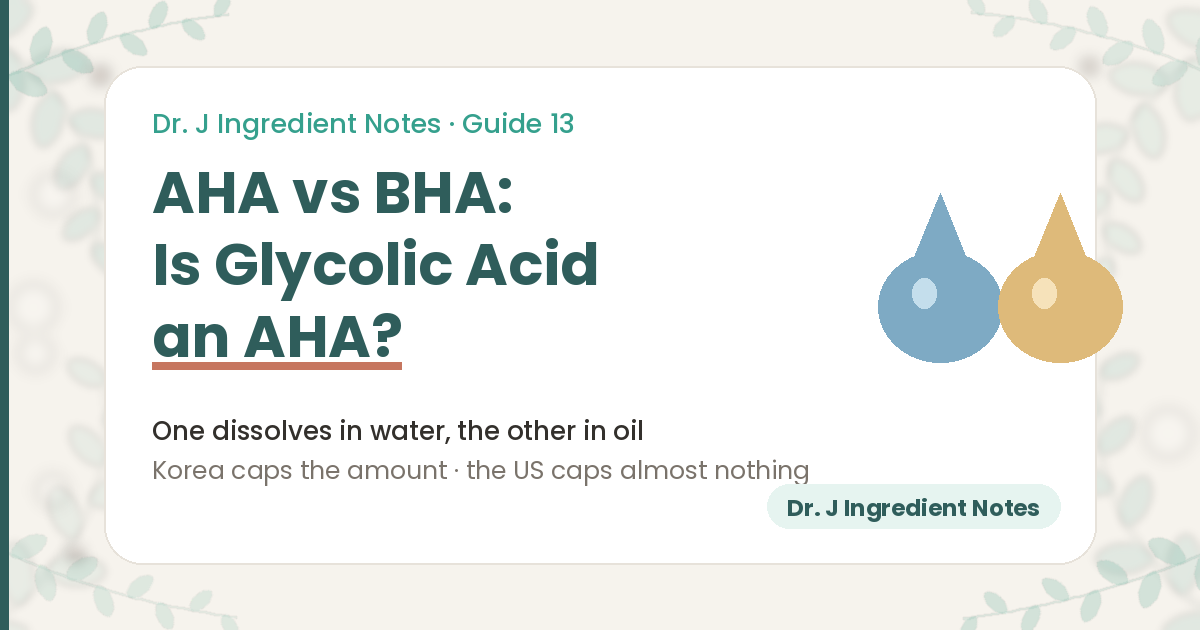
Hello, I’m Dr. J. Short answer first, because it is the question people actually type: yes, glycolic acid is an AHA — an alpha hydroxy acid, and the smallest of them. Salicylic acid is the BHA. This is Ingredient Guide 13.
The long answer is more useful. One of the two dissolves in water and one in oil, and that single property decides where each ends up on your face. It also explains something stranger: Korea and the United States regulate these two acids in almost opposite ways, and the same salicylic acid that sits in a Korean cosmetic is an over-the-counter drug in the US.
――――――――――――――――――――――――――――
📄 If you’d rather read the primary sources
📄 Korea — Enforcement Rule of the Cosmetics Act, Annex 3: precautions for AHA products (Korean)
📄 Korea — Regulation on Cosmetic Safety Standards, Annex 2: restricted ingredients (Korean)
📄 US — 21 CFR 333.310, active ingredients for topical acne drug products (eCFR)
📄 US FDA — Alpha Hydroxy Acids: the UV-sensitivity study and the Sunburn Alert wording
🏠 Korean Cosmetic Association ingredient dictionary — paste a name from your label
The two Korean annexes are the ones nobody quotes. Annex 3 holds the AHA labelling lines; Annex 2 holds the salicylic acid caps.
――――――――――――――――――――――――――――
――――――――――――――――――――――――――――
In four lines, if you’re in a hurry
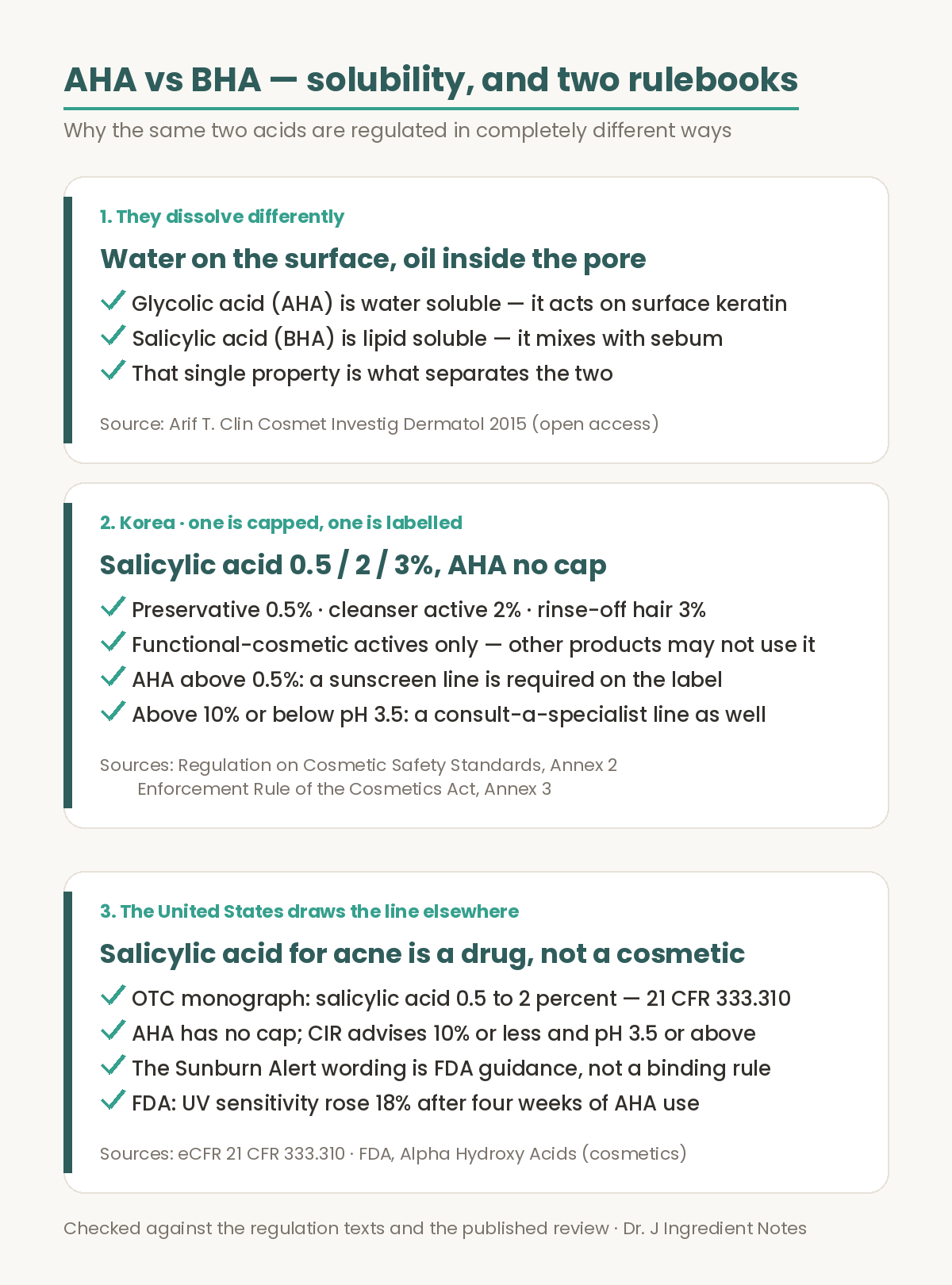
● Glycolic acid is an AHA and dissolves in water. Salicylic acid is the BHA and dissolves in oil
● So AHA works on surface keratin; BHA mixes with sebum and reaches inside the pore
● Korea caps salicylic acid — 0.5%, 2% or 3% depending on what the product is
● Korea does not cap AHA. It requires label lines instead, above 0.5% and again above 10%
――――――――――――――――――――――――――――
Is glycolic acid an AHA? Yes — and here is what that means
AHA stands for alpha hydroxy acid, and it is a family rather than one ingredient. Glycolic acid is the best known member; lactic acid and mandelic acid are AHAs too. So “AHA” and “glycolic acid” are not two competing things — one contains the other. When a label says only “contains AHA”, the useful move is to find the actual name further down the ingredient list.
BHA stands for beta hydroxy acid, and in skincare it effectively means salicylic acid. The alpha and the beta refer to where a hydroxyl group sits on the molecule, which sounds academic until you see what it does: it changes what the acid dissolves in.
A 2015 review states the difference plainly: salicylic acid is a lipid-soluble agent, in contrast with the alpha hydroxy acids, and it is miscible with the lipids of the sebaceous glands in hair follicles. Sebum is oil. So salicylic acid travels with it, into the pore. Glycolic acid, being on the water side, stays and works at the surface.
| AHA | BHA | |
|---|---|---|
| Members you’ll see | glycolic acid · lactic acid · mandelic acid | salicylic acid |
| Dissolves in | water | oil |
| Where it acts | surface keratin | mixes with sebum, inside the pore |
| Korea regulates by | no cap · mandatory label lines | a cap on the amount |
| Daytime | pair with sunscreen — the rule says so on the label | no such required line |
――――――――――――――――――――――――――――
Korea ① — salicylic acid is capped by amount
Korea keeps a list called Annex 2, ingredients requiring restrictions on use. Salicylic acid is on it, and the limit is not a single number — it changes with what the ingredient is doing in the formula.
| Used as | Limit | Product type |
|---|---|---|
| Preservative | 0.5% | listed in the preservatives table |
| Functional-cosmetic active | 2% | body-cleansing products |
| Functional-cosmetic active | 3% | rinse-off hair products |
The notes beside the numbers matter as much as the numbers. Salicylic acid may be used only as a functional-cosmetic active, not in other product types. It is also barred from products for infants, or from anything labelled as suitable for children aged 13 and under, with shampoo excepted. So when you read a percentage, read the product category next to it.
――――――――――――――――――――――――――――
Korea ② — AHA is not capped. It is labelled
AHA gets the opposite treatment. Instead of limiting how much may go in, Korea’s Enforcement Rule specifies what the label has to say. Item 11 of Annex 3 applies to any product above 0.5% AHA.
| Trigger | Required line | Exempt |
|---|---|---|
| above 0.5% | use a sunscreen alongside this product | rinse-off and hair products |
| above 0.5% | patch-test on a small area first | — |
| above 10% or pH below 3.5 | consult a specialist | — |
This gives a Korean label a property that is quietly useful: the consult-a-specialist line is a concentration signal. A brand does not have to print the percentage, but if that sentence is there, the product is either above 10% or below pH 3.5. If it is absent, the product sits under both thresholds. The label tells you what the marketing does not.
And the sunscreen line is not decorative. The FDA’s own testing found that after four weeks of AHA use, sensitivity to UV-induced redness rose by 18%. Korea wrote the warning into a rule; the US described the same finding and recommended wording. Same evidence, two different instruments.
――――――――――――――――――――――――――――
In the US, one of these is not a cosmetic at all
Here is the part that surprises people who shop across both markets. In the United States, salicylic acid for acne is not regulated as a cosmetic — it is an over-the-counter drug. The monograph at 21 CFR 333.310 lists the permitted acne actives, and one line reads exactly: “Salicylic acid, 0.5 to 2 percent.“
AHA runs the other way. The US sets no concentration limit for it in cosmetics. The industry’s Cosmetic Ingredient Review panel concluded AHA products are safe when the concentration is 10% or less and the finished product has a pH of 3.5 or greater — the same two numbers Korea uses, but as a panel conclusion rather than a rule. And the Sunburn Alert sentence comes from a 2005 guidance, which is a recommendation, not a binding requirement.
| Question | Korea | United States |
|---|---|---|
| Salicylic acid for acne is… | a functional cosmetic, capped at 2% in cleansers | an OTC drug, 0.5 to 2% under the monograph |
| AHA concentration limit | none — labelling instead | none — CIR advises 10% or less, pH 3.5 or above |
| AHA sun warning | mandatory, written into the Enforcement Rule | non-binding guidance (2005 Sunburn Alert wording) |
| Checked before launch | reviewed or reported to the MFDS | cosmetics need no FDA approval |
Neither arrangement is strictly better, and that is not the point. The practical consequence is narrower: a product bought outside Korea does not carry the Korean label lines, so the concentration signal described above simply is not there. On an imported bottle you are back to reading the brand’s own claims.
――――――――――――――――――――――――――――
Which one do you need?
| If this is the concern | Look at | On the label |
|---|---|---|
| Rough, dull surface | AHA | where glycolic or lactic acid sits, and whether the sunscreen line is there |
| Pores and sebum | BHA | salicylic acid, and whether it’s a cleanser or a hair product |
| First time with acids | the lower end | a product with no consult line sits under both thresholds |
| You want both | split them | different times of day rather than layered on the same spot |
If you use an AHA, pair it with sunscreen in the daytime. That is the one instruction both regulators agree on, and how much sunscreen actually counts is covered in the SPF and PA guide.
※ One thing I could not confirm: how far an ordinary Korean cosmetic may go in advertising “exfoliation” wording. I could not obtain the MFDS notice text. If I get it, I’ll add it here.
――――――――――――――――――――――――――――
In one line
Water-soluble means surface; oil-soluble means pore. And Korea manages salicylic acid with a number, AHA with a sentence.
Next in the series: how to read an ingredient list in order (Ingredient Guide 14).
――――――――――――――――――――――――――――
📌 Earlier guides
📌 Glycolic Acid (AHA) – What the Research Shows and How Much Is Safe
📌 Salicylic Acid (BHA): 0.5% vs 2%, Explained (Ingredient Guide 8)
📌 Sunscreen SPF and PA: How to Read the Numbers (Ingredient Guide 11)
📌 Dark Spots, Acne, Pores, Lines: Which Ingredient First
About the author · Dr. J
MS in Veterinary Medicine, PhD in Life Sciences. I worked as a researcher at the Korea Research Institute of Bioscience and Biotechnology (KRIBB) and now run Beaurea, a cosmetics manufacturing company, where I write the formulas myself. This blog reads the research papers and the regulatory documents and turns them into plain-language criteria for choosing ingredients. I don’t recommend specific products here – only criteria that apply to any product.
📄 References
· Enforcement Rule of the Cosmetics Act (Korea), Annex 3 — precautions for AHA-containing products, item 11
· Regulation on Cosmetic Safety Standards (Korea), Annex 2 — restricted ingredients, salicylic acid
· 21 CFR 333.310 — Topical acne drug products, active ingredients (US eCFR)
· U.S. FDA, Alpha Hydroxy Acids — 18% rise in UV sensitivity after four weeks; 2005 Sunburn Alert guidance; CIR conditions
· Arif T. Clin Cosmet Investig Dermatol 2015 — the review describing salicylic acid as lipid soluble and miscible with sebaceous lipids
――――――――――――――――――――――――――――
This article summarises regulatory texts and published research. It is information, not a diagnosis or a treatment plan. If something about your skin worries you, please talk to a professional.
— Dr. J Ingredient Notes
Leave a Reply