
Hello, I’m Dr. J.
Does your skin look duller than it used to, feel rough to the touch, and make foundation sit unevenly?
That’s not just age. Very often it’s because dead skin cells aren’t shedding on time.
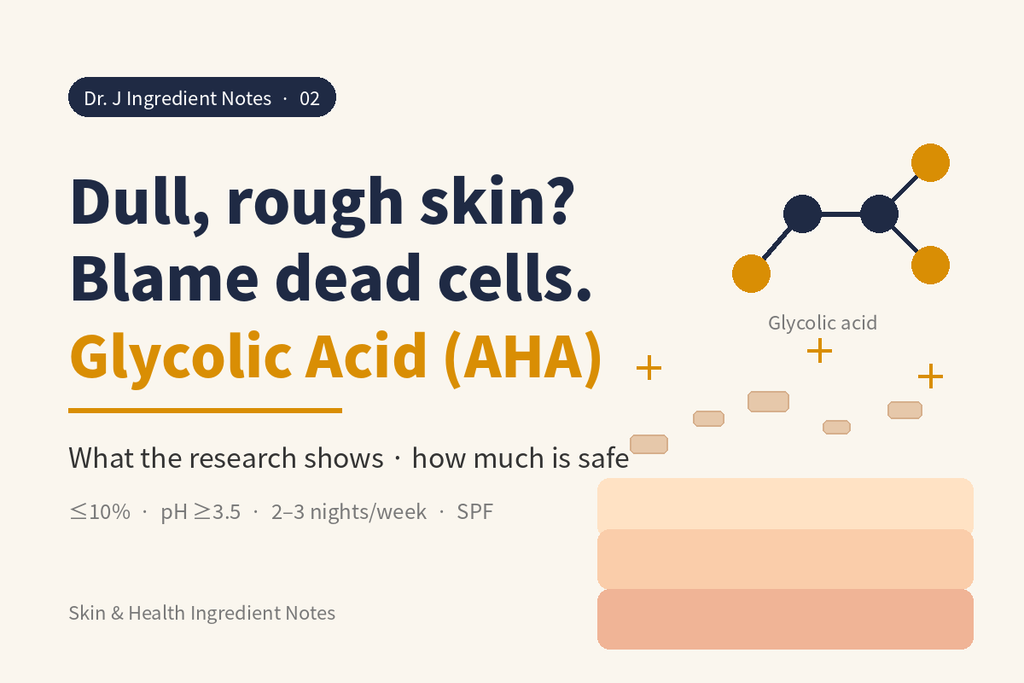
Today’s ingredient is the benchmark for exfoliation: glycolic acid – the best-studied of the AHAs (alpha hydroxy acids).
I’ll walk you through two published studies and the safety standards used in the US and Korea.
1. Why does skin get duller with age?
The outermost layer of your skin – the stratum corneum – normally renews itself about every 4 weeks.
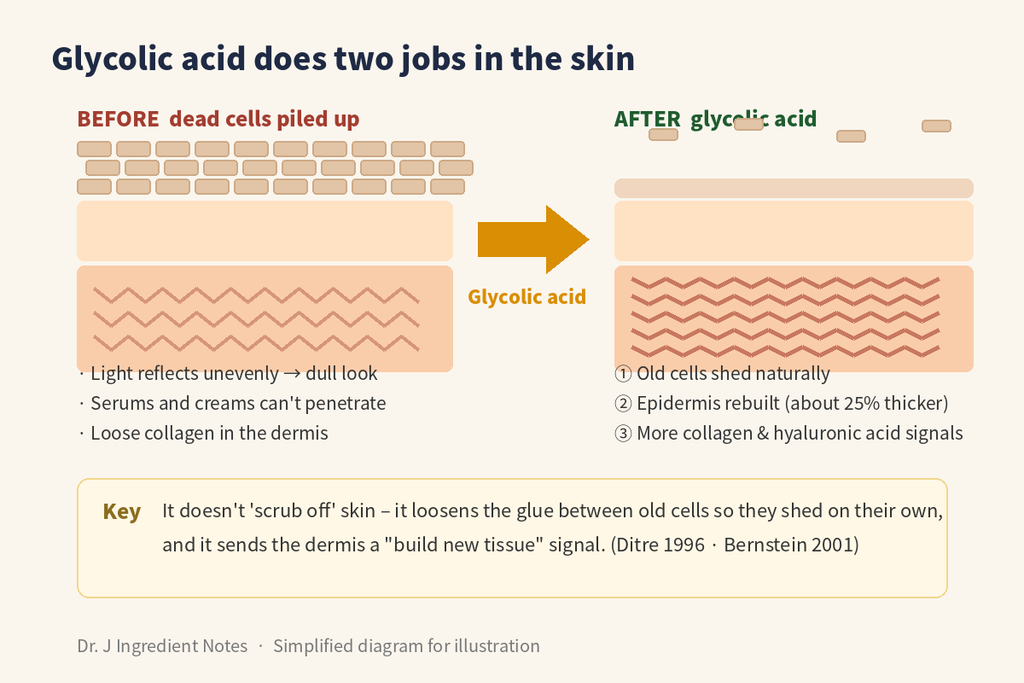
With age this cycle slows down, so old cells pile up on the surface.
· light reflects unevenly, so skin looks dull
· the surface gets bumpy, so makeup cakes and separates
· serums and creams can’t penetrate properly.
Glycolic acid loosens the “glue” holding those old cells together, so they shed naturally.
It has the smallest molecule of any AHA, which is why it penetrates well – and why it’s the most thoroughly researched.
2. What did the studies find?
Two studies show that glycolic acid is far more than a “surface scrub.”
Volunteers with sun-damaged skin applied an AHA lotion (glycolic acid and others) for about 6 months, then had skin biopsies taken.
· The epidermis became about 25% thicker (thinned skin was rebuilt)
· Denser collagen in the dermis, with healthier elastic fibers
· No signs of inflammation
Source: Ditre CM et al., Journal of the American Academy of Dermatology, 1996;34:187-195.
A 20% glycolic acid lotion was applied to the inner forearm twice a day for 3 months, with a plain lotion on the other arm for comparison.
· Higher activity of the gene that makes collagen
· More hyaluronic acid (the skin’s own water-holding molecule)
→ Glycolic acid doesn’t just clear the surface – it sends the dermis a “build new tissue” signal.
Source: Bernstein EF et al., Dermatologic Surgery, 2001;27:429-433.
The 20–25% used in these studies is professional, clinic-level strength. Products for daily home use are made at much lower concentrations – and that’s what keeps them safe. The studies show the direction of the effect, not a concentration for you to copy.
3. So how much is safe at home?
Fortunately this is well defined – and the US and Korea use the same numbers.
These are the conditions the US Cosmetic Ingredient Review (CIR) panel set for products that are “safe for consumer use.”
③ The Korean standard
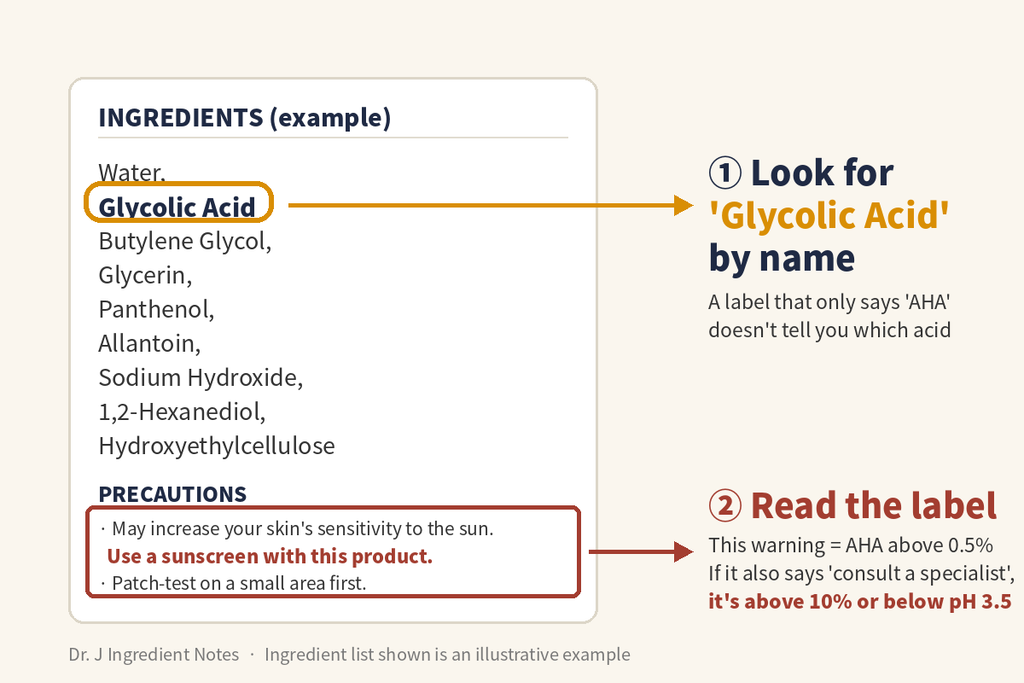
Korea’s cosmetics regulations require products above 10% or below pH 3.5 to carry a “consult a specialist” warning. Any AHA product above 0.5% must also state “use a sunscreen with this product.”
One thing I’d add as a formulator: at the same percentage, a lower pH acts more strongly, because more of the acid is in its “active” form. So don’t judge gentleness by the percentage alone. When you’re starting out, a good rule of thumb is a product whose tingle fades within 30 seconds.
4. Three things to check before you buy
✔ Start at 5–8% – 5% if you’re new, up to 8–10% once your skin is used to it
✔ Soothing ingredients alongside – panthenol, allantoin or madecassoside on the label mean less irritation
5. How to use it
· At night, after cleansing and drying, at the toner step
· Twice a week for the first 2 weeks, then up to 3 times – daily use isn’t recommended
· Not on the same night as vitamin C or retinol – the irritation adds up (e.g. glycolic acid Mon & Thu, vitamin C on other days)
· Sunscreen the next morning is a must – freshly exfoliated skin is more sun-sensitive
· If redness lasts more than a day, stop and focus on moisturizing
· Thin or sensitive skin? Lactic acid or a PHA is a gentler alternative
Glycolic acid clears old surface cells and tells the dermis to rebuild – with solid evidence behind it.
At home, stick to 10% or less · pH 3.5 or higher · 2–3 nights a week · sunscreen the next day.
Vitamin C (last article) and glycolic acid (this one) shouldn’t be used on the same night. Next time I’ll lay out a simple weekly schedule for combining them – plus retinol.
Curious about an ingredient? Leave a comment and I’ll look up the research and explain it simply.
— Dr. J (MS in Veterinary Medicine · PhD in Life Sciences · former researcher, Korea Research Institute of Bioscience & Biotechnology · founder of a cosmetics manufacturing company)
1. Ditre CM, Griffin TD, Murphy GF, et al. Effects of alpha-hydroxy acids on photoaged skin: a pilot clinical, histologic, and ultrastructural study. J Am Acad Dermatol. 1996;34(2):187-195.
2. Bernstein EF, Lee J, Brown DB, Yu R, Van Scott E. Glycolic acid treatment increases type I collagen mRNA and hyaluronic acid content of human skin. Dermatol Surg. 2001;27(5):429-433.
3. U.S. FDA, Alpha Hydroxy Acids – CIR safety conclusion (≤10%, pH ≥3.5).
4. Enforcement Rule of the Cosmetics Act (Korea), Annex 3 – precautions for products containing alpha-hydroxy acids.
※ This article is for general information only. Results vary with individual skin conditions.