Tag: BHA

  • Exfoliating Actives in Korea: No Claim Category, but a Label Rule

    Cover image for a guide to exfoliating actives in Korean cosmetics. Korea's functional cosmetics notification lists six categories and the regulator's claim substantiation guideline lists ten test methods, and neither names exfoliation. Instead the label rules do the work: a sun sensitivity warning becomes mandatory above 0.5 percent alpha hydroxy acid, and fruit acid cannot be dropped from the ingredient list even on small packages. A 22 week randomised double blind vehicle controlled trial in 74 women measured roughness, a urea 10 percent cream reduced horny layer thickness, and salicylic acid 0.5 percent is the one exfoliating active Korea notifies. Dr. J Ingredient Notes.

    🇰🇷 한국어판

    Hello, this is Dr. J. Today we are looking at exfoliating actives in Korean cosmetics, and at what the studies behind them actually measured.

    Here is the part most guides skip. Exfoliation is not a reviewed claim in Korea. It is not one of the six notified categories, and it is not one of the ten official test methods. Yet the label rules name it anyway.

    ――――――――――――――――――――――――――――

    The primary documents

    📄 Regulation on the Examination of Functional Cosmetics, Annex 4

    📄 Regulation on Safety Standards for Cosmetics, Annex 2

    📄 MFDS Guideline on Test Methods for Substantiating Cosmetic Claims (March 2018, PDF)

    📄 U.S. FDA, Alpha Hydroxy Acids

    📄 Stiller MJ et al., Arch Dermatol 1996 (22 weeks, 74 women)

    Annex 4 names six categories; the guideline names ten test methods. Exfoliation is in neither.

    ――――――――――――――――――――――――――――

    ――――――――――――――――――――――――――――

    The short version

    ✔ Korea notifies actives in six categories, and exfoliation is not one of them
    ✔ The regulator’s ten test methods do not cover it either
    ✔ Above 0.5% AHA a sun sensitivity warning becomes mandatory on the box
    ✔ Even a 10-50 mL package that shortens its ingredient list cannot drop fruit acid (AHA)
    ✔ So the useful question is what each study measured

    ――――――――――――――――――――――――――――

    1. Korea notifies actives by claim, and exfoliation is missing

    Korea runs functional cosmetics as a positive list. For each claim the notification names the ingredient and the percentage, and it also fixes the dosage form and the wording a company may print.

    Category What the notification sets How to read it
    UV protection and tanning 27 ingredients with maximum levels Both the name and the number are fixed
    Brightening Nine ingredients (arbutin 2-5%, niacinamide 2-5% and others) Same
    Wrinkle improvement Four ingredients (retinol 2,500 IU/g, adenosine 0.04% and others) Same
    Hair colour change Dye lists split across six tables Same
    Hair removal Thioglycolic acid 3.0-4.5%, pH 7.0 to below 12.7 A single ingredient
    Acne-prone skin relief Salicylic acid 0.5%, in cleansing products of soap composition One of today’s five sits here
    Exfoliation There is no category So there is nothing to be reviewed for

    The last row is the point of this article. There is no exfoliation category, so there is nothing for a company to be reviewed against, and no notified percentage to compare a product with.

    ――――――――――――――――――――――――――――

    2. There is no test method for it either

    Separately from the notification, the Ministry publishes a guideline that sets out how to measure each claim: who the subjects are, which instrument is used, and what counts as a result. It has grown one claim at a time.

    Chapter Claim Added
    1 Skin hydration 2012, at the start
    2 Skin elasticity 2012, at the start
    3 Sebum control 2012, at the start
    4 Temporary reduction of cellulite 2013
    5 Suitable for acne-prone skin 2013
    6 Dark circles 2014
    7 Skin microcirculation 2015
    8 Puffiness 2015
    9 Paraben-free 31 March 2017
    10 Fine dust protection 28 March 2018
    — Exfoliation Never added

    Ten chapters, added over six years, and exfoliation never arrived. In our earlier pieces the pattern was different each time: for sensitive skin the phrase appeared only as a subject exclusion criterion, and for sebum there was a full chapter with a Sebumeter procedure. Exfoliation is the third case — absent from both documents.
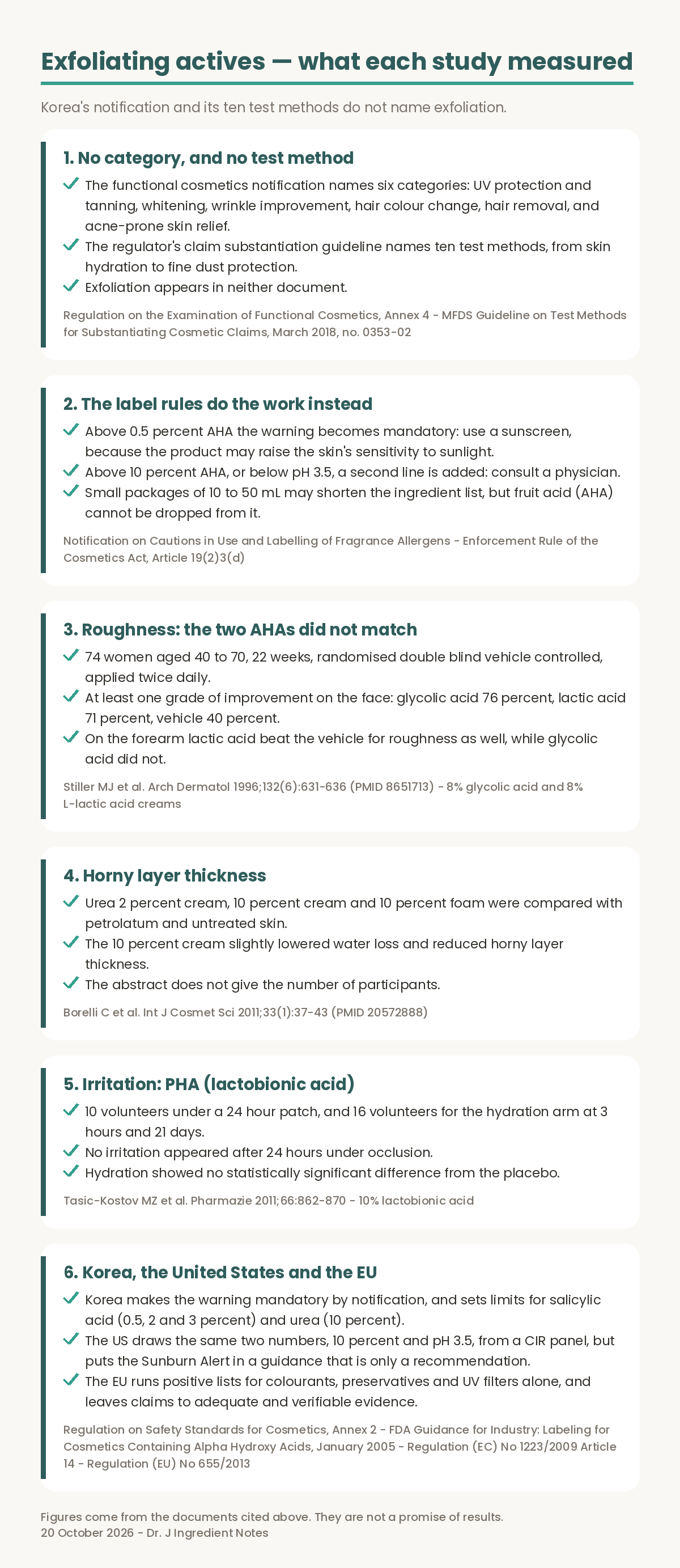
    Evidence summary for exfoliating actives in Korean cosmetics. First, Korea's functional cosmetics notification names six categories and the regulator's claim substantiation guideline names ten test methods, and exfoliation appears in neither. Second, the label rules do the work instead: above 0.5 percent alpha hydroxy acid a sun sensitivity warning becomes mandatory, above 10 percent or below pH 3.5 a line advising a physician is added, and fruit acid cannot be dropped from the ingredient list of small 10 to 50 millilitre packages. Third, in a 22 week randomised double blind vehicle controlled trial in 74 women aged 40 to 70, at least one grade of improvement on the face was seen in 76 percent for glycolic acid, 71 percent for lactic acid and 40 percent for the vehicle, and on the forearm lactic acid beat the vehicle for roughness while glycolic acid did not. Fourth, a urea 10 percent cream slightly lowered water loss and reduced horny layer thickness, although the abstract does not give the number of participants. Fifth, 10 percent lactobionic acid showed no irritation under a 24 hour patch in 10 volunteers, while hydration in 16 volunteers showed no statistically significant difference from the placebo. Sixth, Korea makes the warning mandatory by notification, the United States draws the same two numbers from a CIR panel but places the Sunburn Alert in a guidance that is only a recommendation, and the EU runs positive lists for colourants, preservatives and UV filters alone.

    ――――――――――――――――――――――――――――

    3. The label rules name it even so

    A claim category is one instrument. A label rule is another, and Korea uses the second here. Once a product passes 0.5% AHA, a notification requires fixed sentences on the box.

    When it applies What the box has to say
    AHA above 0.5% The product may increase the skin’s sensitivity to sunlight, so use a sunscreen alongside it (rinse-off and hair products are excepted).
    Same threshold Test it on a small area first and check for a skin reaction.
    AHA above 10%, or pH below 3.5 The product contains a high concentration of AHA and may cause adverse effects, so consult a physician.

    So the sunscreen sentence you find on the back of a Korean exfoliating toner is not marketing. It is text a notification requires, and its trigger is a concentration.

    The second place is the ingredient list. Small containers may shorten it, but six things stay.

    Enforcement Rule of the Cosmetics Act, Article 19(2)3 — what a small package may not drop

    A package holding more than 10 mL and up to 50 mL (or more than 10 g and up to 50 g) may omit ingredient labelling, except for:
    (a) tar colourants · (b) gold leaf · (c) the type of phosphate in shampoos and rinses
    (d) fruit acid (AHA) · (e) ingredients that produce the effect of a functional cosmetic · (f) ingredients for which the Minister has notified a blending limit
    ※ Where labelling is omitted, the company must let consumers check the full list by telephone or website, or keep a printed list at the point of sale (paragraph 5).

    An active with no claim category of its own is still named in the labelling rules. That is the shape of this subject in Korea.

    ――――――――――――――――――――――――――――

    4. Roughness: the two AHAs did not behave the same

    The cleanest cosmetic-strength trial here is old and still useful. 74 women aged 40 to 70, 22 weeks, randomised, double blind and vehicle controlled, applying 8% glycolic acid or 8% L-lactic acid twice a day to the face and outer forearms.

    On the face, at least one grade of improvement was reached by 76% on glycolic acid, 71% on lactic acid and 40% on the vehicle.

    On the forearm the two parted company. Lactic acid beat the vehicle for roughness; glycolic acid beat it for overall photodamage and sallowness but not for roughness. If you have read that the AHAs are interchangeable, this is the trial that complicates it.

    ――――――――――――――――――――――――――――

    5. Horny layer thickness: urea

    A separate study compared urea 2% cream, 10% cream and 10% foam against petrolatum and untreated skin, in healthy volunteers and in people with type I and type II diabetes.

    The 10% cream slightly lowered transepidermal water loss and reduced horny layer thickness, with no excessive occlusion from any of the products.

    Korea’s safety standards set the ceiling for urea at 10%, so the concentration the study used sits at the regulatory limit rather than below it.

    ――――――――――――――――――――――――――――

    6. The one Korea notifies: salicylic acid 0.5%

    Regulation on the Examination of Functional Cosmetics, Annex 4 — acne-prone skin relief

    Ingredient and level: salicylic acid 0.5% · Product type: cleansing products of soap composition · Forms: solution, lotion, cream
    Claim: “helps relieve acne-prone skin”
    Directions: apply an appropriate amount to the skin and rinse off immediately with water

    The directions matter as much as the percentage. What the notification covers is a rinse-off cleanser, not a leave-on treatment.

    The safety standards then split the ceiling three ways: 0.5% when used as a preservative, 2% in personal cleansing products, and 3% in rinse-off hair products — the latter two only where it is the active of a functional cosmetic.

    One more line sits with it: salicylic acid may not be used in products for infants, or in products labelled for children aged 13 or under, with shampoo excepted.

    ――――――――――――――――――――――――――――

    7. Irritation: PHA (lactobionic acid)

    Lactobionic acid at 10% was held under a 24 hour occlusive patch in 10 volunteers, with transepidermal water loss, erythema and stratum corneum hydration read afterwards. No irritation appeared.

    The hydration arm of the same paper ran in 16 volunteers over 3 hours and 21 days, and there the authors are direct: a statistically significant difference between the placebo and the sample with lactobionic acid was not observed.

    Read together, PHA is an ingredient with mildness shown rather than strength shown. That is worth separating when a product page offers it as a gentler route to the same result.

    ――――――――――――――――――――――――――――

    The five side by side

    Ingredient People Duration Design Measured Result
    Glycolic acid 8% 74, shared 22 weeks Randomised, double blind, vehicle controlled Facial grade, forearm roughness Face 76% vs vehicle 40%; no difference in roughness
    Lactic acid 8% 74, shared 22 weeks Same trial Facial grade, forearm roughness Face 71%; roughness also beat vehicle
    Urea 10% not in abstract not in abstract Compared with petrolatum and untreated skin Water loss, horny layer thickness Horny layer thickness fell
    Lactobionic acid 10% 10 and 16 24 h and 21 days Patch test and hydration arm Irritation, hydration No irritation; hydration no different from placebo
    Salicylic acid 0.5% — — Notified active — Acne-prone skin relief

    The endpoints are not interchangeable. Roughness, horny layer thickness and irritation are three different measurements, and a product page that says “clinically proven” rarely says which one it means.

    And where each study is weak

    Study Where it is weak, stated plainly
    Stiller 1996 The facial endpoint is an investigator grade, and roughness was read on the forearm. One participant withdrew for irritation and six for personal reasons.
    Borelli 2011 The abstract gives neither the number of participants nor the overall duration. Healthy volunteers and diabetic patients were studied together.
    Tasic-Kostov 2011 Hydration showed no significant difference from placebo. The irritation arm is a single 24 hour patch in 10 people.
    Salicylic acid No human trial is attached here — only the level and the directions the notification sets.

    ――――――――――――――――――――――――――――

    8. Korea, the United States and the EU — the same two numbers, different force

    No regulator here keeps a claim list for exfoliation. What differs is which instrument fills the gap.

    Korea United States European Union
    Claim-based ingredient list Six categories; exfoliation is not one None — “FDA does not have a list of approved or accepted claims for cosmetics” Permitted lists cover colourants, preservatives and UV filters (Art. 14)
    Test procedure Ten chapters; exfoliation is not one Not written down 655/2013 requires “state of the art practices”
    AHA and sunlight Mandatory label text by notification, above 0.5% Recommended Sunburn Alert, in a guidance No entry found for this
    The same two numbers Above 10%, or pH below 3.5, adds a line CIR found 10% or less and pH 3.5 or greater safe —
    Force of the document Omitting the text is a labelling breach “do not establish legally enforceable responsibilities” Common criteria bind; the method is a condition

    The striking part is the arithmetic. Korea’s notification adds the physician line above 10% AHA or below pH 3.5. In the United States, the Cosmetic Ingredient Review panel concluded that glycolic and lactic acid are safe where the concentration is 10 percent or less and the final product has a pH of 3.5 or greater. The same two numbers, drawn from the opposite side.

    What separates them is the document. Korea’s sits in a notification, so leaving the sentence off the box is a labelling breach. The United States puts its Sunburn Alert wording in a guidance issued in January 2005, and FDA states plainly that its guidances “do not establish legally enforceable responsibilities” and “should be viewed only as recommendations”.

    The EU does not run a claim-based ingredient list at all. Article 14 of Regulation (EC) No 1223/2009 keeps positive lists for colourants, preservatives and UV filters, and claims are governed instead by Regulation (EU) No 655/2013: they “shall be supported by adequate and verifiable evidence”, and that evidence “shall take into account state of the art practices”.

    For anyone exporting into Korea, the practical reading is short: there is no exfoliation dossier to file, and the compliance work sits on the label instead.

    ――――――――――――――――――――――――――――

    What to check on the box

    ✔ Ask what was measured — roughness, horny layer thickness or hydration
    ✔ A sun sensitivity sentence on the box means the product is above 0.5% AHA
    ✔ For salicylic acid, the ceiling depends on whether the product is rinsed off
    ✔ Even a small container lists fruit acid (AHA)

    ――――――――――――――――――――――――――――

    One line

    Exfoliation is not a reviewed claim in Korea; it is a labelled one. Decide which endpoint matters to you — roughness, horny layer thickness or mildness — and the list of five becomes a list of two.

    Next: five actives for skin elasticity — chapter 2 of the same guideline, and unlike exfoliation, a claim with a written test procedure.

    ――――――――――――――――――――――――――――

    What is not in this article, and why

    ✔ Peel and chemical resurfacing trials — those are procedures, not cosmetics. Only leave-on cosmetic strengths of 8 to 10% were used here
    ✔ A urea dose-ranging study (Addor et al., Surg Cosmet Dermatol) — the journal page carries no publication year, volume or pages, so it could not be cited properly
    ✔ A gluconolactone study (PMID 33769633) — Europe PMC returned 429 and PubMed a reCAPTCHA
    ✔ Enzyme and physical scrubs — no human study was found
    ✔ Whether Annex III of Regulation 1223/2009 carries entries for glycolic or lactic acid — the annex table could not be opened, so this is recorded as not found rather than as absent

    About the author · Dr. J

    MS in Veterinary Medicine, PhD in Life Sciences. I worked as a researcher at the Korea Research Institute of Bioscience and Biotechnology (KRIBB) and now run Beaurea, a cosmetics manufacturing company, where I write the formulas myself. This blog reads the research papers and the regulatory documents and turns them into plain-language criteria for choosing ingredients. I don’t recommend specific products here – only criteria that apply to any product.

    📌 Related

    📌 Acne Skincare Ingredients and Korea’s 0.5% Salicylic Acid Rule — the same salicylic acid entry, read from the acne side

    📌 Pores and Sebum: the Test Method the Regulator Wrote Down — the mirror image of today’s piece

    📌 Is Glycolic Acid an AHA? AHA vs BHA, Explained — the two acids in today’s trial

    📌 Salicylic Acid (BHA): 0.5% vs 2%, Explained — why the ceiling splits

    📄 Sources

    · Regulation on the Examination of Functional Cosmetics, Annex 4 (Korea Law Information Center, accessed 20 October 2026)

    · Regulation on Safety Standards for Cosmetics, Annex 2 (same, accessed 20 October 2026)

    · MFDS, Guideline on Test Methods for Substantiating Cosmetic Labelling and Advertising Claims (March 2018, no. 0353-02)

    · Notification on Cautions in Use and Labelling of Fragrance Allergens in Cosmetics (cross-checked on the Korea Cosmetic Association ingredient dictionary)

    · Enforcement Rule of the Cosmetics Act, Article 19 (Korea Cosmetic Association, statute page)

    · Stiller MJ, Bartolone J, Stern R, Smith S, Kollias N, Gillies R, Drake LA. Arch Dermatol 1996;132(6):631-636

    · Borelli C, Bielfeldt S, Borelli S, Schaller M, Korting HC. Int J Cosmet Sci 2011;33(1):37-43

    · Tasic-Kostov MZ, Reichl S, Lukic MZ, Jaksic IN, Savic SD. Pharmazie 2011;66:862-870

    · U.S. FDA, “Alpha Hydroxy Acids”; “Guidance for Industry: Labeling for Cosmetics Containing Alpha Hydroxy Acids” (January 2005); “Cosmetics Labeling Claims”

    · Regulation (EC) No 1223/2009, Article 14 · Regulation (EU) No 655/2013, Annex

    ――――――――――――――――――――――――――――

    This article summarises published studies and public regulatory documents; it is not medical advice. The Korean notifications and annexes were opened in the original on the day of writing, and the AHA warning wording was taken from two Korea Cosmetic Association ingredient pages that matched word for word, because the notification annex PDF could not be opened. Of the studies cited, one does not report its participant count and one endpoint showed no difference from placebo; both are stated in the tables. Ingredient names and percentages are given as criteria for choosing a product, not as a recommendation of any particular one.

    — Dr. J Ingredient Notes
  • AHA vs BHA: Is Glycolic Acid an AHA? — Water vs Oil, What Korea Caps, and Why the Same Acid Is a Drug in the US (Ingredient Guide 13)

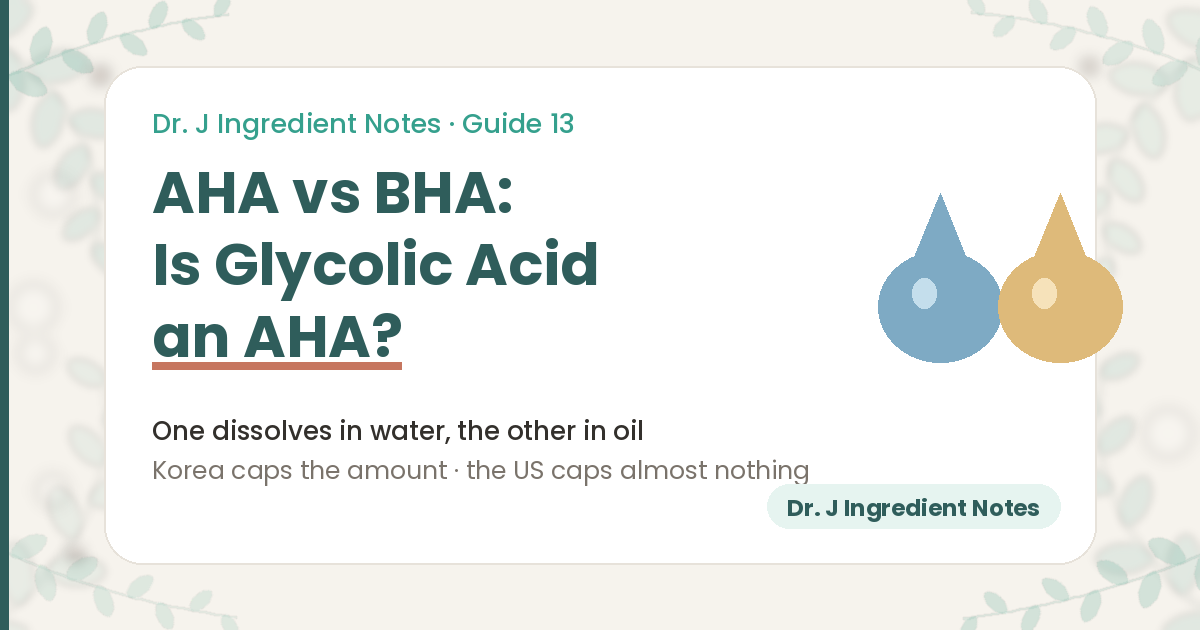
    Cover image for a Dr. J Ingredient Notes guide on AHA versus BHA, ingredient guide 13. Glycolic acid is an alpha hydroxy acid that dissolves in water and works on surface keratin, salicylic acid is a beta hydroxy acid that dissolves in oil and mixes with sebum inside the pore, and Korea and the United States regulate the two in different ways.

    🇰🇷 한국어판: AHA BHA 차이 – 글리콜산과 살리실산 (성분 백과 ⑬)

    Hello, I’m Dr. J. Short answer first, because it is the question people actually type: yes, glycolic acid is an AHA — an alpha hydroxy acid, and the smallest of them. Salicylic acid is the BHA. This is Ingredient Guide 13.

    The long answer is more useful. One of the two dissolves in water and one in oil, and that single property decides where each ends up on your face. It also explains something stranger: Korea and the United States regulate these two acids in almost opposite ways, and the same salicylic acid that sits in a Korean cosmetic is an over-the-counter drug in the US.

    ――――――――――――――――――――――――――――

    📄 If you’d rather read the primary sources

    📄 Korea — Enforcement Rule of the Cosmetics Act, Annex 3: precautions for AHA products (Korean)

    📄 Korea — Regulation on Cosmetic Safety Standards, Annex 2: restricted ingredients (Korean)

    📄 US — 21 CFR 333.310, active ingredients for topical acne drug products (eCFR)

    📄 US FDA — Alpha Hydroxy Acids: the UV-sensitivity study and the Sunburn Alert wording

    🏠 Korean Cosmetic Association ingredient dictionary — paste a name from your label

    The two Korean annexes are the ones nobody quotes. Annex 3 holds the AHA labelling lines; Annex 2 holds the salicylic acid caps.

    ――――――――――――――――――――――――――――

    ――――――――――――――――――――――――――――

    In four lines, if you’re in a hurry

    ● Glycolic acid is an AHA and dissolves in water. Salicylic acid is the BHA and dissolves in oil

    ● So AHA works on surface keratin; BHA mixes with sebum and reaches inside the pore

    ● Korea caps salicylic acid — 0.5%, 2% or 3% depending on what the product is

    ● Korea does not cap AHA. It requires label lines instead, above 0.5% and again above 10%

    ――――――――――――――――――――――――――――

    Is glycolic acid an AHA? Yes — and here is what that means

    AHA stands for alpha hydroxy acid, and it is a family rather than one ingredient. Glycolic acid is the best known member; lactic acid and mandelic acid are AHAs too. So “AHA” and “glycolic acid” are not two competing things — one contains the other. When a label says only “contains AHA”, the useful move is to find the actual name further down the ingredient list.

    BHA stands for beta hydroxy acid, and in skincare it effectively means salicylic acid. The alpha and the beta refer to where a hydroxyl group sits on the molecule, which sounds academic until you see what it does: it changes what the acid dissolves in.

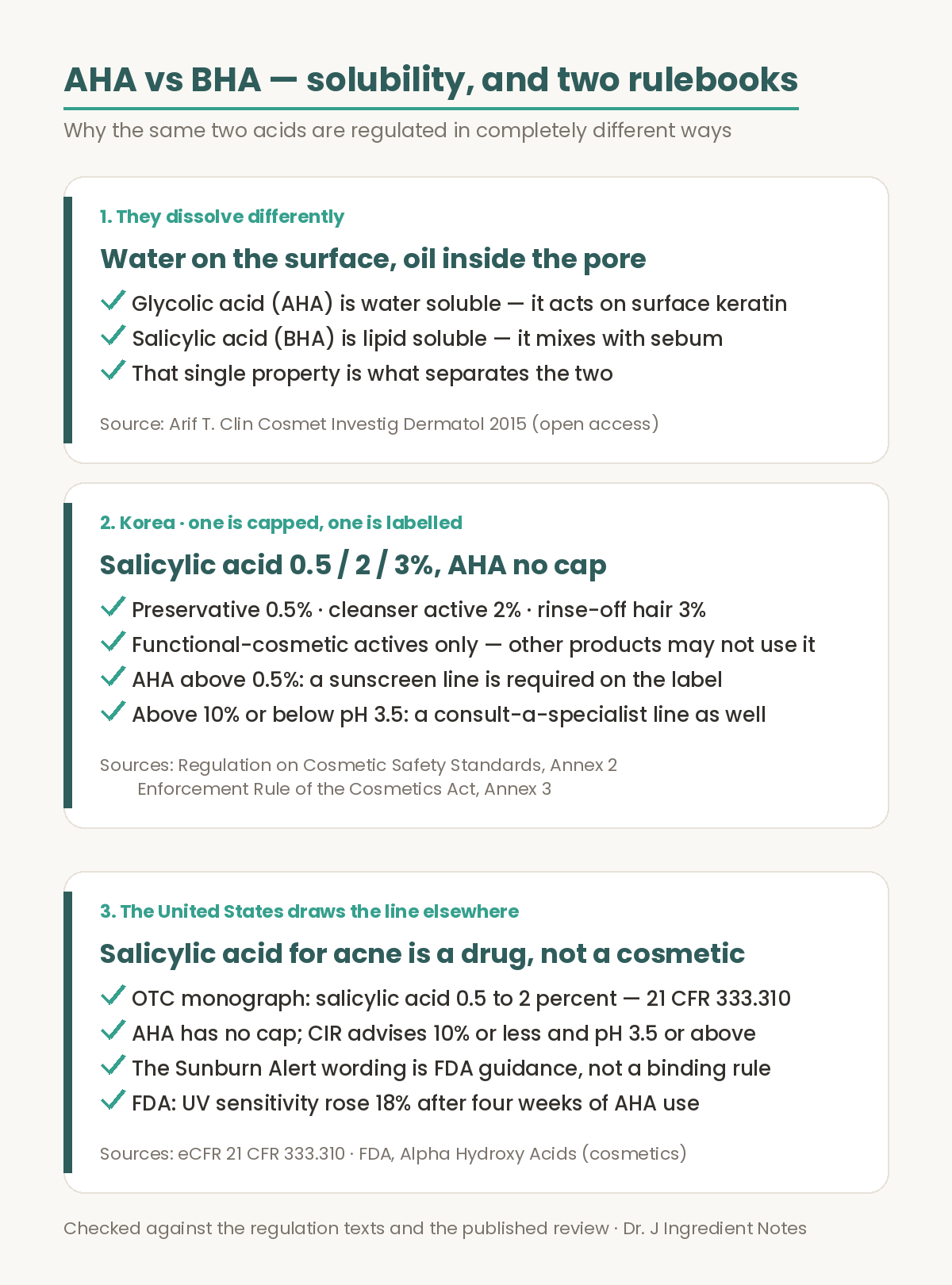
    A 2015 review states the difference plainly: salicylic acid is a lipid-soluble agent, in contrast with the alpha hydroxy acids, and it is miscible with the lipids of the sebaceous glands in hair follicles. Sebum is oil. So salicylic acid travels with it, into the pore. Glycolic acid, being on the water side, stays and works at the surface.

      AHA BHA
    Members you’ll see glycolic acid · lactic acid · mandelic acid salicylic acid
    Dissolves in water oil
    Where it acts surface keratin mixes with sebum, inside the pore
    Korea regulates by no cap · mandatory label lines a cap on the amount
    Daytime pair with sunscreen — the rule says so on the label no such required line

    Evidence figure for AHA versus BHA. First, they dissolve differently: glycolic acid, an AHA, dissolves in water and acts on surface keratin, while salicylic acid, a BHA, is lipid soluble and mixes with the lipids of the sebaceous gland inside the follicle, Arif 2015 Clinical Cosmetic and Investigational Dermatology. Second, Korea caps the amount of salicylic acid at 0.5 percent as a preservative, 2 percent as a functional-cosmetic active in cleansers and 3 percent in rinse-off hair products, while AHA has no cap and instead carries mandatory label statements above 0.5 percent and a consult-a-specialist line above 10 percent or below pH 3.5. Third, the United States treats salicylic acid for acne as an over-the-counter drug at 0.5 to 2 percent under 21 CFR 333.310, and its AHA sunburn alert is non-binding guidance, with FDA reporting an 18 percent rise in UV sensitivity after four weeks of AHA use.

    ――――――――――――――――――――――――――――

    Korea ① — salicylic acid is capped by amount

    Korea keeps a list called Annex 2, ingredients requiring restrictions on use. Salicylic acid is on it, and the limit is not a single number — it changes with what the ingredient is doing in the formula.

    Used as Limit Product type
    Preservative 0.5% listed in the preservatives table
    Functional-cosmetic active 2% body-cleansing products
    Functional-cosmetic active 3% rinse-off hair products

    The notes beside the numbers matter as much as the numbers. Salicylic acid may be used only as a functional-cosmetic active, not in other product types. It is also barred from products for infants, or from anything labelled as suitable for children aged 13 and under, with shampoo excepted. So when you read a percentage, read the product category next to it.

    ――――――――――――――――――――――――――――

    Korea ② — AHA is not capped. It is labelled

    AHA gets the opposite treatment. Instead of limiting how much may go in, Korea’s Enforcement Rule specifies what the label has to say. Item 11 of Annex 3 applies to any product above 0.5% AHA.

    Trigger Required line Exempt
    above 0.5% use a sunscreen alongside this product rinse-off and hair products
    above 0.5% patch-test on a small area first —
    above 10% or pH below 3.5 consult a specialist —

    This gives a Korean label a property that is quietly useful: the consult-a-specialist line is a concentration signal. A brand does not have to print the percentage, but if that sentence is there, the product is either above 10% or below pH 3.5. If it is absent, the product sits under both thresholds. The label tells you what the marketing does not.

    And the sunscreen line is not decorative. The FDA’s own testing found that after four weeks of AHA use, sensitivity to UV-induced redness rose by 18%. Korea wrote the warning into a rule; the US described the same finding and recommended wording. Same evidence, two different instruments.

    ――――――――――――――――――――――――――――

    In the US, one of these is not a cosmetic at all

    Here is the part that surprises people who shop across both markets. In the United States, salicylic acid for acne is not regulated as a cosmetic — it is an over-the-counter drug. The monograph at 21 CFR 333.310 lists the permitted acne actives, and one line reads exactly: “Salicylic acid, 0.5 to 2 percent.“

    AHA runs the other way. The US sets no concentration limit for it in cosmetics. The industry’s Cosmetic Ingredient Review panel concluded AHA products are safe when the concentration is 10% or less and the finished product has a pH of 3.5 or greater — the same two numbers Korea uses, but as a panel conclusion rather than a rule. And the Sunburn Alert sentence comes from a 2005 guidance, which is a recommendation, not a binding requirement.

    Question Korea United States
    Salicylic acid for acne is… a functional cosmetic, capped at 2% in cleansers an OTC drug, 0.5 to 2% under the monograph
    AHA concentration limit none — labelling instead none — CIR advises 10% or less, pH 3.5 or above
    AHA sun warning mandatory, written into the Enforcement Rule non-binding guidance (2005 Sunburn Alert wording)
    Checked before launch reviewed or reported to the MFDS cosmetics need no FDA approval

    Neither arrangement is strictly better, and that is not the point. The practical consequence is narrower: a product bought outside Korea does not carry the Korean label lines, so the concentration signal described above simply is not there. On an imported bottle you are back to reading the brand’s own claims.

    ――――――――――――――――――――――――――――

    Which one do you need?

    If this is the concern Look at On the label
    Rough, dull surface AHA where glycolic or lactic acid sits, and whether the sunscreen line is there
    Pores and sebum BHA salicylic acid, and whether it’s a cleanser or a hair product
    First time with acids the lower end a product with no consult line sits under both thresholds
    You want both split them different times of day rather than layered on the same spot

    If you use an AHA, pair it with sunscreen in the daytime. That is the one instruction both regulators agree on, and how much sunscreen actually counts is covered in the SPF and PA guide.

    ※ One thing I could not confirm: how far an ordinary Korean cosmetic may go in advertising “exfoliation” wording. I could not obtain the MFDS notice text. If I get it, I’ll add it here.

    ――――――――――――――――――――――――――――

    In one line

    Water-soluble means surface; oil-soluble means pore. And Korea manages salicylic acid with a number, AHA with a sentence.

    Next in the series: how to read an ingredient list in order (Ingredient Guide 14).

    ――――――――――――――――――――――――――――

    📌 Earlier guides

    📌 Glycolic Acid (AHA) – What the Research Shows and How Much Is Safe

    📌 Salicylic Acid (BHA): 0.5% vs 2%, Explained (Ingredient Guide 8)

    📌 Sunscreen SPF and PA: How to Read the Numbers (Ingredient Guide 11)

    📌 Dark Spots, Acne, Pores, Lines: Which Ingredient First

    About the author · Dr. J

    MS in Veterinary Medicine, PhD in Life Sciences. I worked as a researcher at the Korea Research Institute of Bioscience and Biotechnology (KRIBB) and now run Beaurea, a cosmetics manufacturing company, where I write the formulas myself. This blog reads the research papers and the regulatory documents and turns them into plain-language criteria for choosing ingredients. I don’t recommend specific products here – only criteria that apply to any product.

    📄 References

    · Enforcement Rule of the Cosmetics Act (Korea), Annex 3 — precautions for AHA-containing products, item 11

    · Regulation on Cosmetic Safety Standards (Korea), Annex 2 — restricted ingredients, salicylic acid

    · 21 CFR 333.310 — Topical acne drug products, active ingredients (US eCFR)

    · U.S. FDA, Alpha Hydroxy Acids — 18% rise in UV sensitivity after four weeks; 2005 Sunburn Alert guidance; CIR conditions

    · Arif T. Clin Cosmet Investig Dermatol 2015 — the review describing salicylic acid as lipid soluble and miscible with sebaceous lipids

    ――――――――――――――――――――――――――――

    This article summarises regulatory texts and published research. It is information, not a diagnosis or a treatment plan. If something about your skin worries you, please talk to a professional.

    — Dr. J Ingredient Notes

  • Salicylic Acid (BHA): 0.5% vs 2%, Explained – Why the Label Numbers Differ (Ingredient Guide 8)

    Cover image for Ingredient Guide 8 on salicylic acid (BHA): how to read the 0.5 percent, 2 percent and 3 percent limits on Korean cosmetic labels, and what an 8-week trial in 30 people with acne found. Dr. J Ingredient Notes.

    Hello, this is Dr. J.

    Ingredient Guide number eight is salicylic acid – the ingredient most labels shorten to BHA.

    If you shop for acne or pore products, you will see this name often. What you will also see is that the number on the back changes from product to product: 2% on one cleanser, 0.5% on a toner, 3% on a scalp product.

    Here is the surprising part. In Korea, salicylic acid does not have one limit. The same ingredient is capped at 0.5%, 2% or 3% depending on what it is used for. This post explains how to read those numbers, and then walks through two 8-week trials.

    🇰🇷 Read this in Korean: 살리실산 BHA, 0.5%와 2% 읽는 법 (성분 백과 ⑧)

    ―――――――――――――――――――――

    📄 Read the sources first

    · Korea MFDS, Regulation on Cosmetic Safety Standards, Annex 2 – restricted ingredients (Korean)

    · Bilal H et al., Pharmaceuticals 2023 – 30 people with acne, 2% gel, 8 weeks (open access)

    · Li S et al., J Cosmet Dermatol 2023 – randomized trial of a salicylic acid serum, 8 weeks

    · Arif T, Clin Cosmet Investig Dermatol 2015 – review (open access)

    · 🏠 COSMILE Europe INCI database – type the name exactly as it appears on the label

    Annex 2 lists the limit for each product category on one line, with a note about children’s products. Salicylic acid appears in two tables – preservatives and other restricted ingredients – so check both.

    ―――――――――――――――――――――

    15-second summary · no sound

    ―――――――――――――――――――――

    The four lines, if you are in a hurry

    ✔ Salicylic acid is lipid-soluble, so it mixes with sebum. That is where it parts ways with water-soluble AHAs

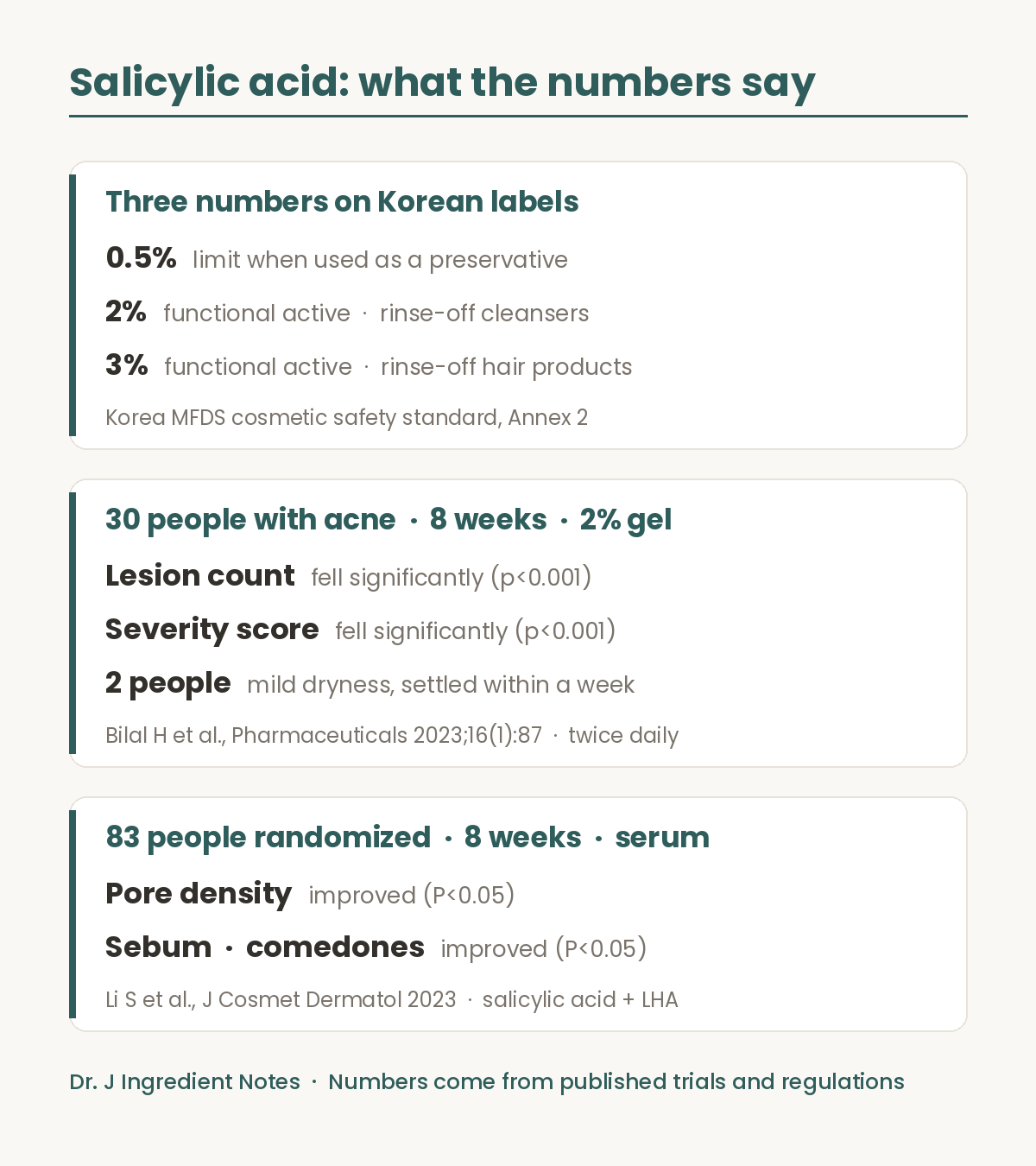
    ✔ The 0.5% · 2% · 3% on Korean labels are not strength levels – they are use categories: preservative, rinse-off cleanser active, rinse-off hair-product active

    ✔ 30 people with acne used a 2% gel twice daily for 8 weeks: lesion counts and severity scores fell significantly

    ✔ In a randomized trial, 83 people completed 8 weeks of a salicylic acid serum: pore density, sebum and comedones improved

    ―――――――――――――――――――――

    Lipid-soluble – where BHA parts ways with AHA

    Salicylic acid is a beta hydroxy acid, BHA. The name looks like glycolic acid (AHA), which I covered in Guide 2, but the two behave differently.

    ✔ Glycolic acid dissolves in water – it works at the skin surface

    ✔ Salicylic acid dissolves in oil – it mixes with sebum and reaches into the pore

    A 2015 review puts it this way: salicylic acid, unlike the alpha hydroxy acids, is a lipid-soluble agent, miscible with the lipids of the epidermis and with the sebaceous-gland lipids inside hair follicles. That is why it comes up for comedone-prone skin. The review also places its calming, anti-inflammatory action in the 0.5–5% range – Arif T, 2015.

    So the question is less “AHA or BHA, which is better?” and more “is my concern at the surface, or in the pore?” Dullness and rough texture have the AHA evidence; sebum and comedones have the BHA evidence.

    ―――――――――――――――――――――

    How to read the numbers – 0.5%, 2% and 3% are use categories

    A higher number does not mean a stronger product. Korea’s cosmetic safety standard (Annex 2) sets a separate limit for each use. I read the Korean text and keep the categories as written; other markets set their own limits.

    Number on the label Used as Product type
    0.5% Preservative Limit in the preservatives table
    2% Active in a “functional cosmetic” Rinse-off cleansers for the body and face
    3% Active in a “functional cosmetic” Rinse-off hair products

    The same table adds two notes.

    ✔ Not permitted in products for infants, or in products labeled as suitable for children aged 13 and under (shampoo excepted)

    ✔ The 2% and 3% limits apply only when the product has been reviewed as a functional cosmetic; other products may not use it as an active

    “Functional cosmetic” is a Korean regulatory category – a product whose specific claim, such as “soothes acne-prone skin,” has been reviewed by the MFDS. That is why 2% in Korea almost always appears on a rinse-off cleanser with that claim. The small numbers on leave-on toners and serums are either within the preservative limit or belong to a related ingredient with a different name – see the next table.

    ―――――――――――――――――――――

    Finding it on the ingredient list – four names in the salicylic family

    Name on the list (INCI) What it is
    Salicylic Acid The ingredient itself. The limits above apply to this name
    Capryloyl Salicylic Acid (LHA) Salicylic acid with a fatty-acid tail attached. It was paired with salicylic acid in the 83-person serum trial
    Betaine Salicylate Salicylic acid combined with betaine. Common in leave-on products, especially Korean ones
    Salix Alba (Willow) Bark Extract A plant extract. Not salicylic acid itself, so it sits outside the limits above

    A different name means a different limit and a different body of research. Read the numbers in this post against the Salicylic Acid line only.

    Salicylic acid evidence summary. Three numbers on Korean labels - 0.5 percent as a preservative, 2 percent as a functional active in rinse-off cleansers, 3 percent in rinse-off hair products, from the Korean cosmetic safety standard Annex 2. What the research found - 30 people with acne used a 2 percent gel twice daily for 8 weeks and lesion counts and severity scores fell significantly, Pharmaceuticals 2023. In a randomized trial 83 people completed 8 weeks of a salicylic acid plus LHA serum and pore density, sebum and comedones improved, Journal of Cosmetic Dermatology 2023.

    ―――――――――――――――――――――

    What the research found – 30 people for 8 weeks, 83 people for 8 weeks

    First, 30 people with acne. Thirty acne patients – 12 men and 18 women, average age 22 – used a 2% salicylic acid gel twice daily for 8 weeks, alongside a control group of 10. Total lesion counts and the Global Acne Grading System (GAGS) score fell significantly (p<0.001). Two people had mild dryness and flaking that settled within a week – Bilal et al., Pharmaceuticals 2023. The paper is open access, so the tables are one click away above.

    Second, 93 people randomized. A serum containing salicylic acid and lipohydroxy acid was tested over 8 weeks; 93 people were randomized and 83 completed. One group used the serum, the other added a mask. Both groups improved on acne severity, skin-tone evenness, pore density, pigmentation, sebum output, comedones and hydration (P<0.05); the mask group did slightly better on closed comedones and acne severity. No adverse events were reported – Li et al., J Cosmet Dermatol 2023.

    Study People · duration What was used What was found
    Bilal 2023 30 · 8 weeks 2% gel, twice daily Lesion count and severity score fell (p<0.001)
    Li 2023 93 randomized · 83 completed · 8 weeks Salicylic acid + LHA serum (± mask) Pore density, sebum, comedones improved (P<0.05)
    Arif 2015 Review — Lipid-soluble; calming action in the 0.5–5% range

    Both trials ran for 8 weeks. It is not an ingredient to judge after a few days. And with 30 and 83 participants, both are real but small – I would not stretch them to “works for everyone.” This post stays with cosmetic use and leaves professional peel studies aside.

    ―――――――――――――――――――――

    How to use it – order and pairing

    ✔ Start at 2–3 nights a week. If skin feels dry or stings, cut back

    ✔ A rinse-off product goes in the cleansing step; a leave-on product goes right after cleansing, followed by moisturizer

    ✔ On nights you use glycolic acid (AHA) or retinol, alternate the days. Do not stack all three in one evening

    ✔ Soothing and barrier ingredients – niacinamide, ceramides, panthenol – can sit in the same routine

    ✔ Wear sunscreen the next morning

    ✔ If you are pregnant or sensitive to aspirin, ask a professional before starting

    The ingredient compatibility chart shows which pairs can share a night and which should be split.

    ―――――――――――――――――――――

    Five things to check before you buy

    ✔ Is it rinse-off or leave-on? – that is where the limits split

    ✔ Is the name “Salicylic Acid,” or one of the related names? – check the four-name table above

    ✔ Where does it sit on the ingredient list? – higher means more. Ingredients at 1% or below may be listed in any order, so a low position is not unusual

    ✔ Is there a percentage on the front? – if not, the list order is your only clue

    ✔ Is the product labeled for children 13 and under? – in Korea it cannot contain salicylic acid (shampoo excepted)

    Save these five lines for the store. Reading the back takes about five minutes.

    ―――――――――――――――――――――

    In one line

    🧪 Salicylic acid works because it is lipid-soluble. The number on the label tells you the use, not the strength – and two 8-week trials show what it did for lesions, pores and sebum.

    Next in the Ingredient Guide: tranexamic acid (Guide 9) – the name that keeps coming up for dark spots.

    📌 Earlier posts

    · Dull, Rough Skin? Glycolic Acid (AHA) – What the Research Shows and How Much Is Safe

    · Retinol: Start at 0.1% – How to Read the Concentration Numbers (Ingredient Guide 1)

    · Skincare Ingredient Compatibility Chart – 12 Ingredients, What to Layer and What to Split

    About the author · Dr. J

    MS in Veterinary Medicine, PhD in Life Sciences. I worked as a researcher at the Korea Research Institute of Bioscience and Biotechnology (KRIBB) and now run Beaurea, a cosmetics manufacturing company, where I write the formulas myself. This blog reads the research papers and the regulatory documents and turns them into plain-language criteria for choosing ingredients. I don’t recommend specific products here – only criteria that apply to any product.

    📄 References

    · Korea MFDS, Regulation on Cosmetic Safety Standards, Annex 2 – Salicylic Acid and its salts

    · Bilal H et al., Pharmaceuticals 2023;16(1):87 – 2% salicylic acid gel, 30 people, 8 weeks

    · Li S et al., J Cosmet Dermatol 2023 – randomized trial of a salicylic acid/LHA serum, 93 randomized, 83 completed, 8 weeks

    · Arif T, Clin Cosmet Investig Dermatol 2015;8:455-461 – review

    This post summarizes published research and public documents for information only. It is not a substitute for diagnosis or treatment. If you have a concern, please consult a professional.

    — Dr. J Ingredient Notes