
🇰🇷 이 글의 한국어판 → 한국어판
Hello, I’m Dr. J.
In Korea you can hardly walk past a serum shelf without seeing niacinamide on the label.
It sits in most products approved here as brightening functional cosmetics.
The number next to it keeps changing, though: 2%, 5%, 10%, 20%.
Does a bigger number buy you more?
Here is what the human studies actually support.
The short version
✔ The human studies ran at 2-5%, and Korea’s brightening functional range is also 2-5%
✔ No head-to-head human study shows 10% or 20% doing more. The chance of flushing does go up
✔ Morning and night are both fine, and it layers with retinol, vitamin C and acids
✔ Expect the first change around week 4 and a clear one at 8-12 weeks. Consistency matters more than strength
What the research confirms – five jobs, one ingredient
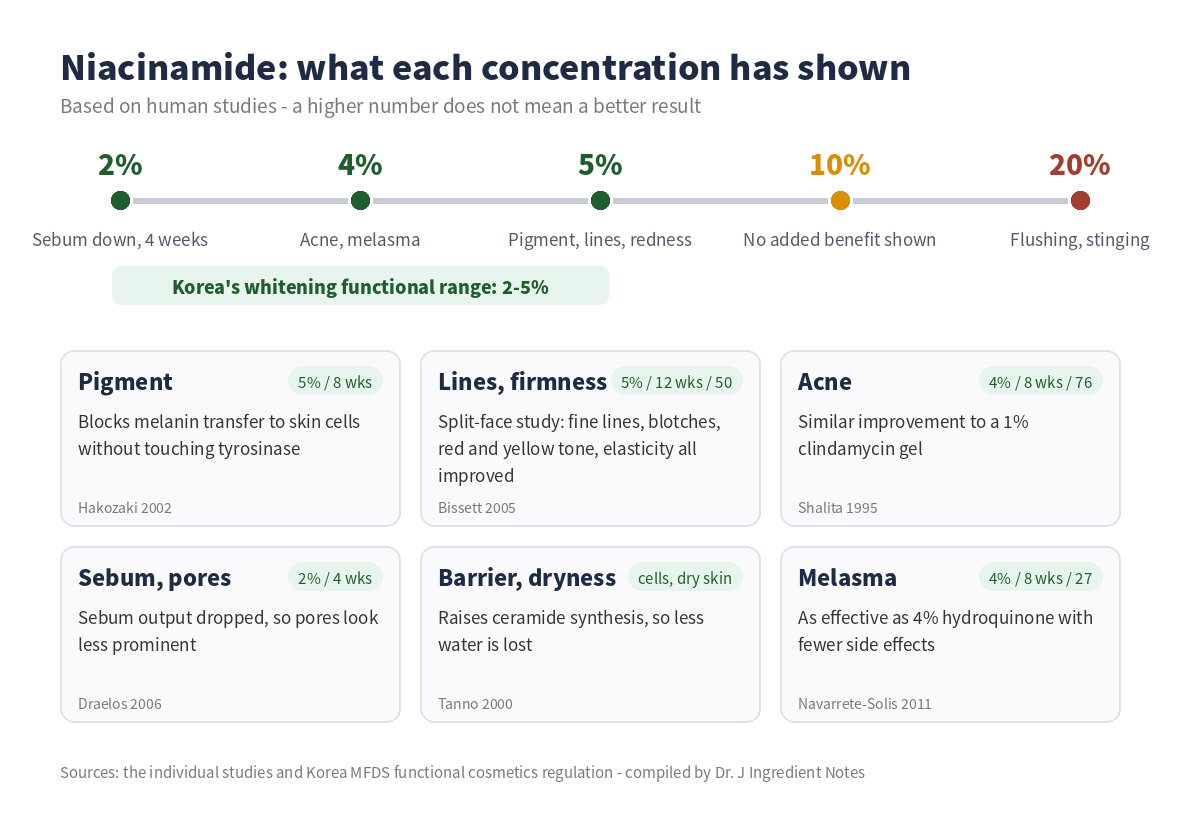
· Fine lines, redness, elasticity — 50 people used 5% on one half of the face and a plain cream on the other for 12 weeks. Fine lines, blotches, red spots, sallowness and elasticity all improved
· Acne — a 4% gel matched a 1% clindamycin (antibiotic) gel over 8 weeks in 76 people
· Sebum and pores — 2% for 4 weeks lowered sebum output. Less oil, less prominent pores
· Barrier and dryness — it raises ceramide synthesis, so the skin loses less water. That is why it buffers a retinol or acid routine
There is a melasma study too.
4% niacinamide matched 4% hydroquinone with fewer side effects (27 people, 8 weeks).
Choosing the number: 2, 5, 10 or 20%
· 4% — the acne and melasma studies
· 5% — pigment, fine lines and redness. This is the reference point
· 10% — no human comparison showing it beats 5%. More people report flushing
· 20% — it exists on shelves, the evidence does not, and stinging is common
That warm flush some people feel comes less from niacinamide itself than from nicotinic acid left in the raw material.
A safety review of high-purity material (CIR) found no irritation even at 10%.
Still, nothing shows that more is better, so 5% used for a long time is the path the research supports.
Three things to check on the label
✔ A brightening functional claim (Korea) means 2-5% is definitely in there. It does not mean high strength
✔ If your face flushes, drop the strength or change products. Purity differs, so two 5% products can feel different
When to use it, and what it layers with
✔ With retinol → yes. It cushions the dryness and stinging of the break-in weeks
✔ With vitamin C → yes. The “never together” rule traces back to a 1960s solution experiment, not to modern formulas
✔ With AHA or BHA → yes. Applied after an acid it helps the barrier recover
✔ Give it 4 weeks, then keep going to 8-12 — the pigment-transfer block reverses within days of stopping, so it is an ingredient you stay on
🧪 Check niacinamide pairings in the ingredient checker
One line
It covers dark spots, pores, redness and the barrier at once and gets along with everything else, which makes it a good default serum in a routine.
▶ Ingredient encyclopedia 1: Retinol: Start at 0.1% – How to Read the Concentration Numbers
▶ Ingredient encyclopedia 3: Bakuchiol vs Retinol – What a 44-Person Trial Found
▶ Earlier post: Skincare Ingredient Compatibility Chart – What to Layer and What to Split
▶ Earlier post: Not All Vitamin C Serums Work – 3 Conditions the Research Says You Need
🇰🇷 이 글의 한국어판 → 한국어판
MS in Veterinary Medicine, PhD in Life Sciences. I worked as a researcher at the Korea Research Institute of Bioscience and Biotechnology (KRIBB) and now run Beaurea, a cosmetics manufacturing company, where I write the formulas myself. This blog reads the research papers and the regulatory documents and turns them into plain-language criteria for choosing ingredients. I don’t recommend specific products here – only criteria that apply to any product.
References
1. Korea MFDS, Regulation on the Review of Functional Cosmetics, Table 4 — brightening: niacinamide 2-5%
2. Bissett DL et al. Dermatologic Surgery 2005;31:860-865 — 5%, 50 subjects, 12 weeks, split-face
3. Hakozaki T et al. British Journal of Dermatology 2002;147:20-31 — melanosome transfer reduced 35-68%, 5% for 8 weeks
4. Shalita AR et al. International Journal of Dermatology 1995;34:434-437 — 4% vs 1% clindamycin, 76 subjects, 8 weeks
5. Draelos ZD et al. Journal of Cosmetic and Laser Therapy 2006;8:96-101 — 2%, sebum output
6. Navarrete-Solís J et al. Dermatology Research and Practice 2011 — 4% vs 4% hydroquinone, 27 subjects, 8 weeks
7. Tanno O et al. British Journal of Dermatology 2000;143:524-531 — ceramide and barrier lipid synthesis
※ This article is general information. Results vary with individual skin. It does not recommend or criticise any specific product. If you are being treated for a skin condition, talk to your dermatologist first. The author runs a company that manufactures and sells cosmetics.
Leave a Reply