Tag: ingredient guide

  • Korea’s Natural Origin Index: The 95% Line, and the Disclaimer That Must Sit Beside the Number (Ingredient Guide 28)

    Cover image for an article on the natural origin index printed on Korean cosmetic packaging. A 2025 industry guide from the Korea Cosmetic Association defines a natural cosmetic as one whose natural and natural-origin content reaches 95 percent of the finished product by weight, calculated under the ISO 16128-2 guideline, and an organic cosmetic as one with organic content of 10 percent or more while natural content stays at 95 percent or more. A product below the threshold may not call an ingredient natural on the pack, but it may print the index itself when the calculation basis is shown. The Korean Ministry of Food and Drug Safety guideline then requires the words Not a natural cosmetic beside that index, while ISO 16128 states that it does not address product communication, human safety or environmental safety. Dr. J Ingredient Notes.

    🇰🇷 한국어판

    Hello, this is Dr. J. Today we read the natural origin index printed on Korean cosmetic packaging — what that number counts, and why the words “Not a natural cosmetic” so often sit right beside it.

    Two things surprise most people. In Korea, “natural cosmetic” is no longer defined in the law. And a product that misses the threshold can still print the index — the rules opened that door on purpose.

    ――――――――――――――――――――――――――――

    The primary sources

    📄 Guide on Labelling and Advertising of Natural and Organic Cosmetics (Korea Cosmetic Association, PDF, Korean)

    📄 Guideline on Labelling and Advertising of Cosmetics (MFDS, 14 Aug 2025, PDF, Korean)

    📄 ISO 16128-2:2017 (abstract)

    📄 U.S. FDA, “‘Organic’ Cosmetics”

    The Korean documents carry the thresholds and the disclaimer wording; the ISO abstract carries the sentence that limits the standard itself.

    ――――――――――――――――――――――――――――

    ――――――――――――――――――――――――――――

    Five lines if you are in a hurry

    ✔ Korea deleted the legal definition of natural and organic cosmetics on 1 August 2025

    ✔ The thresholds now live in a 2025 industry guide: natural 95%, organic 10% plus natural 95%

    ✔ A product below the line may still print the index — with the calculation basis shown

    ✔ Beside that index the front panel carries “Not a natural cosmetic”

    ✔ ISO 16128 states that it does not address labelling, human safety or environmental safety

    ――――――――――――――――――――――――――――

    The definition left the statute book in August 2025

    Until 2025, Korean cosmetics law defined natural cosmetics and organic cosmetics and ran a government certification scheme for them. An amendment that took effect on 1 August 2025 deleted those definitions and the certification provisions together.

    What filled the gap is not another statute. It is a guide published in 2025 by the Korea Cosmetic Association — more precisely by the advertising advisory committee of the self-regulatory review body for cosmetic labelling and advertising. The guide describes itself as setting out the minimum requirements for businesses that want to use these words.

    ※ The repeal itself, and the certification scheme that disappeared with it, were covered in Ingredient Guide 18. This article is about the number that is printed on packs now.

    ――――――――――――――――――――――――――――

    What the guide counts — 95% and 10%

    What the guide says (translated) How to read it
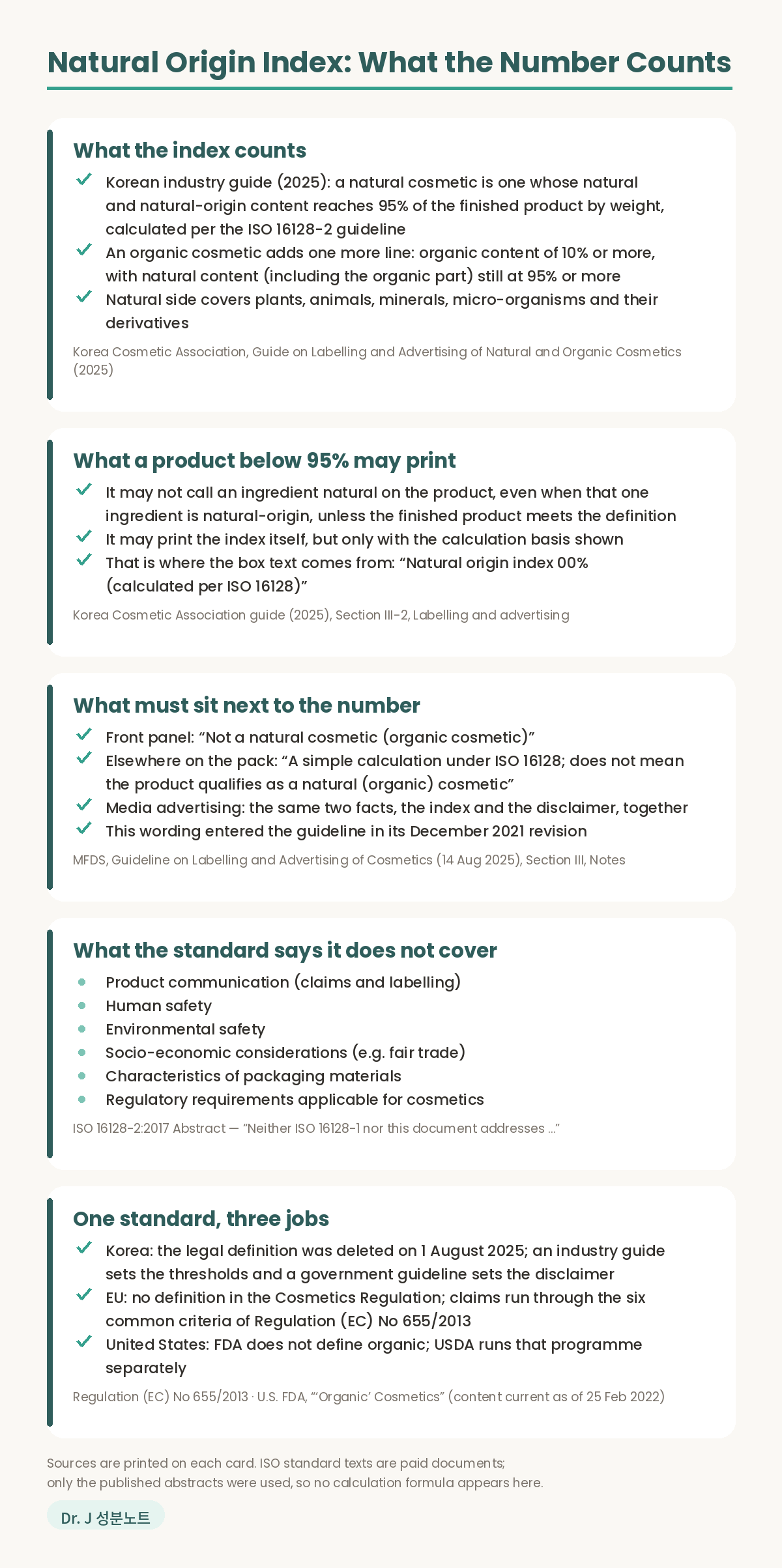
    Natural cosmetic A product whose natural and natural-origin content reaches 95% or more of the finished product by weight, calculated under the ISO 16128-2 guideline The unit is the finished product, not an ingredient. Everything in the bottle is weighed
    Organic cosmetic Organic and organic-origin content of 10% or more of the finished product, with natural content — the organic part included — still at 95% or more Both lines must hold. Organic is a branch of natural here, not an alternative route
    What sits on the natural side Plants and animals, minerals and micro-organisms, and ingredients derived from them Not plants alone. Mineral and fermentation-derived materials belong here too
    The calculation ISO 16128-1 (definitions for ingredients) · ISO 16128-2 (criteria for ingredients and products) A two-part international standard, borrowed as the arithmetic

    Evidence graphic on the natural origin index. First, what the index counts: the Korea Cosmetic Association guide of 2025 sets natural content at 95 percent of the finished product by weight under ISO 16128-2, and organic content at 10 percent or more with natural content still at 95 percent or more, counting plants, animals, minerals, micro-organisms and their derivatives. Second, what a product below 95 percent may print: it may not call an ingredient natural on the product, but it may print the index with the calculation basis shown, which is where the wording natural origin index 00 percent calculated per ISO 16128 comes from. Third, what must sit next to the number: the front panel carries Not a natural cosmetic, elsewhere on the pack a line saying the figure is a simple calculation under ISO 16128 and does not mean the product qualifies, and media advertising carries both facts together; this wording entered the guideline in its December 2021 revision. Fourth, what the standard says it does not cover: product communication, human safety, environmental safety, socio-economic considerations, packaging materials and regulatory requirements. Fifth, one standard and three jobs: Korea deleted the legal definition on 1 August 2025 and an industry guide now sets the thresholds, the European Union has no definition in its cosmetics regulation and runs claims through the six common criteria of Regulation 655 of 2013, and in the United States the FDA does not define organic while the USDA runs that programme separately.

    ――――――――――――――――――――――――――――

    The guide’s scope reaches products that print only an index

    This is the clause most summaries skip. The guide does not govern only products that call themselves natural. It also covers products that intend to print nothing but an ISO 16128 index.

    Section of the guide What it sets out
    I. Purpose To give consumers correct information and to set out the minimum requirements for businesses that label and advertise these words
    II. Scope Products labelled or advertised as natural or organic cosmetics, and products that calculate and print a natural or organic (origin) index under the ISO 16128 guideline
    III. Criteria 1. Definitions · 2. Labelling and advertising · 3. Substantiation
    Substantiation A product that labels or advertises these words must be able to substantiate that it meets the criteria

    ――――――――――――――――――――――――――――

    Blocked, then opened — the two sentences that explain the pack

    Section III-2 of the guide places a prohibition and an exception side by side. Read apart, each one misleads; read together, they explain what you see on the shelf.

    What the guide says (translated) In practice
    The prohibition Where the finished product does not meet the definition, the product may not directly label or advertise an ingredient as a natural (origin) or organic (origin) ingredient — even if that particular ingredient is one One natural ingredient does not let the product speak of natural ingredients
    The exception However, where a natural (origin) or organic (origin) index calculated under the ISO 16128 guideline is presented clearly, together with the basis of the calculation, labelling and advertising by index is permitted The number may be spoken. The calculation basis is the price of admission
    The result on the pack “Natural (origin) index 00% (calculated per ISO 16128)” Exactly the string you find on Korean packaging

    So “natural cosmetic” and “natural origin index” are two different claims. The first belongs to finished products above 95%; the second belongs to any product willing to show its arithmetic.

    ――――――――――――――――――――――――――――

    What the MFDS guideline adds — the four permitted wordings

    The Korean Ministry of Food and Drug Safety publishes a Guideline on Labelling and Advertising of Cosmetics (version of 14 August 2025). Its Annex 2, the table of claims that require substantiation, carries a dedicated row: “3. Content concerning ISO natural and organic index labelling and advertising.”

    Permitted wording (as printed in the guideline) Substantiation required
    Natural index 00% (ISO 16128 calculation applied) Substantiated by evidence relating to that finished product
    “In this case it is also necessary to indicate that the figure is calculated under the ISO 16128 guideline, together with wording that prevents consumer misunderstanding.”
    Natural origin index 00% (ISO 16128 calculation applied) same row
    Organic index 00% (ISO 16128 calculation applied) same row
    Organic origin index 00% (ISO 16128 calculation applied) same row

    ※ A footnote in the same annex defines the standard plainly: ISO 16128 is a method (guideline) for obtaining a calculated value for natural and organic content in cosmetics.

    ――――――――――――――――――――――――――――

    Why “Not a natural cosmetic” sits beside the number

    The guideline’s Section III, Notes is where this article’s hinge lies. When an ISO natural or organic index is labelled or advertised, the guideline says the following ways of writing it are to be followed to reduce consumer misunderstanding.

    Where What must appear alongside (translated)
    ① Front panel “Not a natural cosmetic (organic cosmetic)”
    ② Elsewhere on the pack “A simple calculation result under ISO 16128; does not mean the product falls under ‘natural cosmetic (organic cosmetic)’”
    ③ Media advertising “Natural index 00% (a figure calculated under the ISO 16128 guideline). However, this figure does not mean the product qualifies as a natural (organic) cosmetic”

    That small print on the front of the box is not a brand being modest. It is wording the guideline supplies, and the revision history shows when it arrived: the 30 December 2021 edition, recorded as “ISO natural and organic index labelling and advertising method established.”

    ――――――――――――――――――――――――――――

    A prohibition with its own proviso

    Annex 1 of the same guideline lists expressions that may not be used. One line reads:

    MFDS guideline, Annex 1 — expressions that may not be used

    Expressions relating to “natural (Natural)” or “organic (organic)” on a product that does not conform to the Guide on Labelling and Advertising of Natural and Organic Cosmetics (Korea Cosmetic Association).
    Note — businesses wishing to use natural or organic expressions need appropriate supporting documents · “provided that expressions falling under Annex 2, item 3 are excluded.”

    The last clause carries the weight. The prohibition arrives with its exception attached. A product outside the thresholds cannot say “natural”, yet the index wording of Annex 2 item 3 is carved out of that ban — the same architecture as the guide’s “blocked, then opened” pair above.

    ――――――――――――――――――――――――――――

    What the number does not count — six items, named by the standard itself

    The ISO 16128-2 abstract contains one sentence that keeps this whole subject honest.

    ISO 16128-2:2017, abstract

    “Neither ISO 16128-1 nor this document addresses product communication (e.g. claims and labelling), human safety, environmental safety, socio-economic considerations (e.g. fair trade), characteristics of packaging materials or regulatory requirements applicable for cosmetics.”

    The index counts where ingredients came from. Whether a formula is gentle, whether it suits your skin, whether the packaging is sound — none of that is the standard’s business, and it says so.

    Which leaves a gap, and the gap is the interesting part: a standard that refuses to speak about labelling is being used for labelling. Each market has filled that silence differently.

    ――――――――――――――――――――――――――――

    One standard, three jobs — Korea, the EU and the United States

    Korea European Union United States
    Legal definition of natural / organic Deleted on 1 August 2025. The thresholds now sit in a 2025 industry guide No definition in the Cosmetics Regulation FDA does not define it — “The term ‘organic’ is not defined in either of these laws or the regulations that FDA enforces under their authority.”
    Where the criteria live Korea Cosmetic Association guide — natural 95% · organic 10% plus natural 95% Regulation (EC) No 655/2013 and its six common criteria: legal compliance, truthfulness, evidential support, honesty, fairness, informed decision-making For organic, the USDA National Organic Program — “The USDA requirements for the use of the term ‘organic’ are separate from the laws and regulations that FDA enforces for cosmetics.”
    Status of ISO 16128 Named in the guide and the guideline as the calculation method Not named in the Regulation Not named
    What must accompany an index “Not a natural cosmetic (organic cosmetic)” on the front panel No set wording; the claim must clear the common criteria — “If it is claimed on the product that it contains a specific ingredient, the ingredient shall be deliberately present.” No set wording
    Relationship to safety Neither the guide nor the guideline is a safety standard The common criteria govern advertising, not safety FDA — “An ingredient’s source does not determine its safety.”

    ※ The six common criteria are the headings of the Annex to Regulation (EC) No 655/2013, applicable since 11 July 2013. Note what all three jurisdictions share: none of them treats a high natural index as a statement about safety.

    ――――――――――――――――――――――――――――

    Four things to check on the box

    ✔ Look for a percentage next to the word “natural”, not the word alone

    ✔ Look for “calculated per ISO 16128” — the calculation basis is a condition, not decoration

    ✔ If you see “Not a natural cosmetic”, that is an index claim — the line is required, not a confession

    ✔ Judge gentleness from the ingredient list and concentrations, not from the index

    ――――――――――――――――――――――――――――

    In one line

    The natural origin index counts where ingredients came from; it does not measure how gentle a product is. Above 95% a product may be called a natural cosmetic; below it, the figure may still be printed with its calculation shown — and the words “Not a natural cosmetic” go with it.

    What is not in this article, and why

    ✔ The calculation formula itself — ISO standards are paid documents. Only the published abstracts were read

    ✔ The ingredient categories of ISO 16128-1 — same reason; the standard text was not opened

    ✔ Article and clause numbers of the Enforcement Rule — Korea’s national law portal was unreachable on the day of writing, so no provision numbers are cited

    ✔ The approval date of the industry guide — the PDF yields only the year (2025)

    ✔ Certification bodies and marks — none appear in the guide’s text, so none are named here

    ✔ Claims that natural or organic means gentler — no primary source supports them. The ISO sentence above says the standard does not address human safety, which is the honest version of that question

    ――――――――――――――――――――――――――――

    📌 Earlier articles

    📌 How to Read a Korean Cosmetic Ingredient List (Ingredient Guide 14) — checking by name rather than by index

    📌 Bakuchiol vs Retinol (Ingredient Guide 3) — the plant-derived side

    📌 Collagen: Topical vs Oral (Ingredient Guide 5) — the animal-derived side

    📌 Salicylic Acid (BHA): 0.5% vs 2% (Ingredient Guide 8) — who decides a number

    About the author · Dr. J

    MS in Veterinary Medicine, PhD in Life Sciences. I worked as a researcher at the Korea Research Institute of Bioscience and Biotechnology (KRIBB) and now run Beaurea, a cosmetics manufacturing company, where I write the formulas myself. This blog reads the research papers and the regulatory documents and turns them into plain-language criteria for choosing ingredients. I don’t recommend specific products here – only criteria that apply to any product.

    📄 References

    · Korea Cosmetic Association, Guide on Labelling and Advertising of Natural and Organic Cosmetics (established 2025)

    · Ministry of Food and Drug Safety, Guideline on Labelling and Advertising of Cosmetics, guidance no. 0086-07 (14 August 2025) — Annex 1 · Annex 2 item 3 · Section III Notes

    · ISO 16128-1:2016 · ISO 16128-2:2017 (abstracts)

    · Cosmetics Act of Korea, Act No. 20767 (in force 1 August 2025) — deletion of the natural and organic definitions and certification provisions

    · Regulation (EC) No 655/2013 laying down common criteria for the justification of claims used in relation to cosmetic products

    · U.S. FDA, “‘Organic’ Cosmetics” (content current as of 25 February 2022)

    ――――――――――――――――――――――――――――

    This article summarises guidance documents and standard abstracts and is not a substitute for diagnosis or treatment. Passages from the Korean guide and guideline are my translation of the Korean originals; the ISO and FDA sentences are quoted in their published English. Korea’s national law portal was unreachable on the day of writing, so statutory provisions were not re-opened, and ISO standard texts are paid documents, so only the published abstracts were used.

    — Dr. J Ingredient Notes
  • Bakuchiol vs Retinol: What a 44-Person, 12-Week Trial Actually Found (Ingredient Encyclopedia 3)

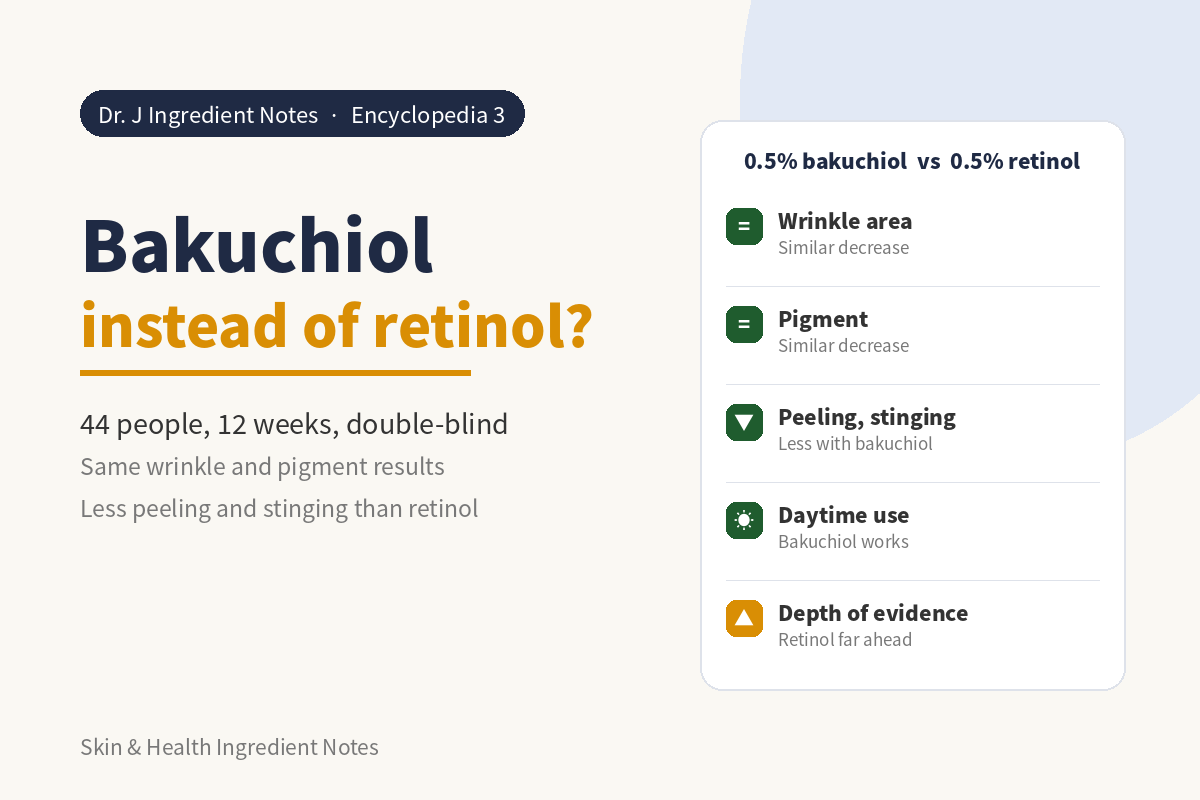
    Bakuchiol instead of retinol - 44 people, 12 weeks, double-blind: 0.5% bakuchiol twice daily matched 0.5% retinol on wrinkles and pigment with less peeling and stinging, Dr. J Ingredient Notes cover

    🇰🇷 이 글의 한국어판 → 한국어판

    Hello, I’m Dr. J.
    After writing the retinol piece I was left with two questions I had not answered.
    “What if I’m trying to conceive but still want an anti-ageing active?” and “What if retinol just stings too much?”

    The same name comes up both times: bakuchiol.
    Setting the marketing copy aside, here is what the human comparison studies actually found.


    The short version

    ✔ Bakuchiol is a compound from the seeds of a plant, Psoralea corylifolia. Its structure is nothing like retinol, yet it sends similar signals to skin cells
    ✔ 44 people, 12 weeks, double-blind — 0.5% bakuchiol twice a day vs 0.5% retinol once a day. No difference in wrinkle area or pigment
    ✔ Peeling and stinging were more common in the retinol group. That is the case for sensitive skin
    ✔ It is stable in light, so it works in the morning too, and because it is not a vitamin A derivative it comes up as a pregnancy option. Direct safety data is thin, so ask your doctor first
    ✔ Retinol has far more research behind it. If retinol is working for you, there is no reason to switch
     

    Where bakuchiol comes from

    It is isolated from the seeds of Psoralea corylifolia, known in Korean herbal medicine as bogolji.
    A 2014 study compared gene expression in skin cells and found a pattern close to retinol’s. That is where the label “a retinol-like functional compound” came from.
    It does not appear to work through retinoic acid receptors the way retinol does. That difference is where both the irritation story and the pregnancy story start.


    What three studies show – and where they stop

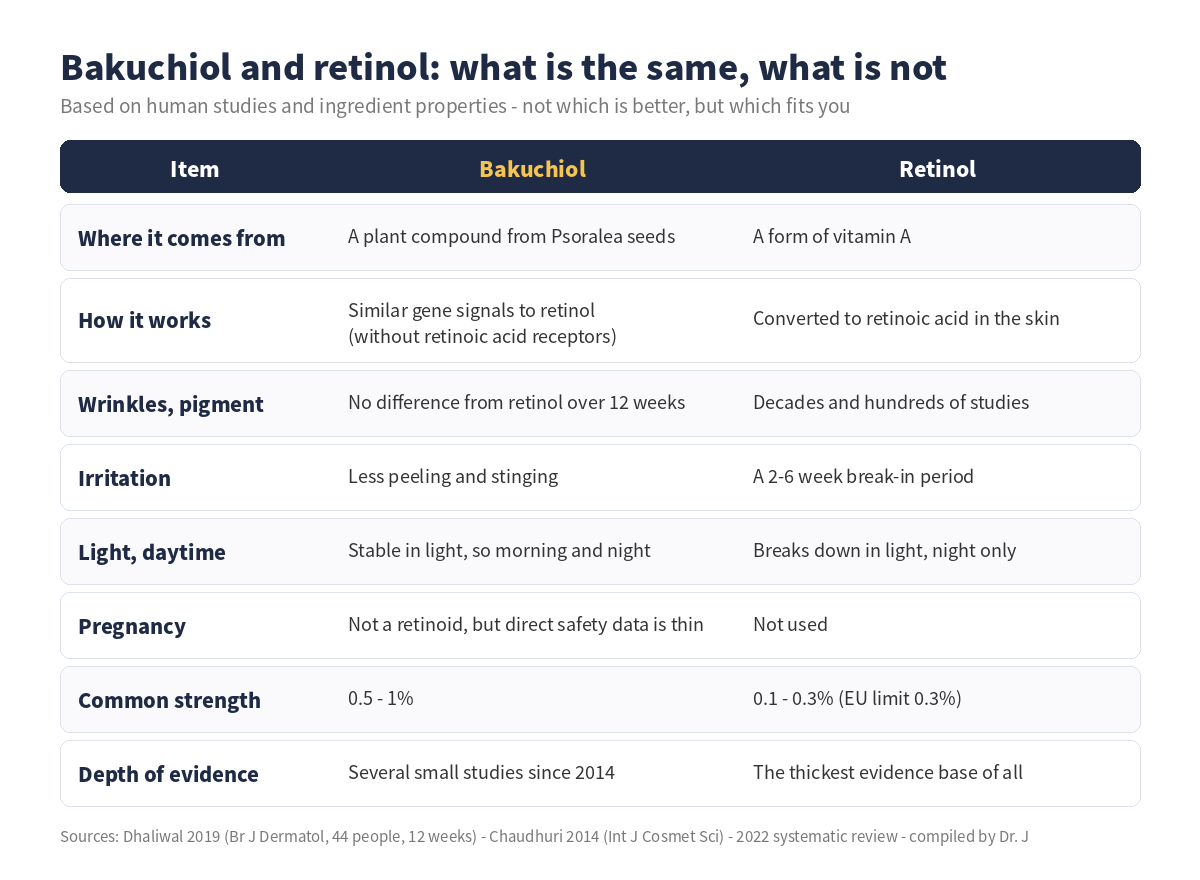
    Bakuchiol versus retinol comparison table - origin, mechanism, wrinkle and pigment results, irritation, daytime use, pregnancy, common strength and depth of evidence
    · 2014, the first clinical work — 0.5% bakuchiol for 12 weeks improved fine lines, pigment and elasticity. It was run by the ingredient supplier, so read it as supporting rather than decisive
    · 2019, head-to-head with retinol — 44 people, double-blind, published in the British Journal of Dermatology. Wrinkle area and pigment fell to a similar degree in both groups, and the retinol group reported more peeling and stinging
    · 2022, systematic review — seven studies from 2014 to 2021 (16 to 103 people, 0.05-1%). The results were consistent, with two reports of allergic contact dermatitis

    So the confirmed range is: over 12 weeks it works about as well as retinol, with less irritation.
    Studies running a year or longer, and large ones, still exist only on the retinol side.


    Who it suits

    ✔ Anyone who never got through retinol’s break-in period — the same direction of benefit without the peeling and stinging
    ✔ Trying to conceive, pregnant or breastfeeding — an option while vitamin A derivatives are off the table. Check with your doctor before you start
    ✔ Anyone who wants an anti-ageing active in the morning — it is stable in light, so it fits a daytime routine
    ✔ Anyone pairing it with retinol — there is evidence that bakuchiol slows retinol’s oxidation, and some products put both in one formula

    On the other hand, if retinol is already working for you, stay with it.
    There is no reason to trade away decades of research.


    How to choose it and how to use it

    ✔ Look for “bakuchiol” on the ingredient list — the studies used purified bakuchiol. If the list only says “Psoralea corylifolia seed oil or extract” you cannot know the strength, and the whole-plant material carries compounds that react to light, so purified material is the safer choice
    ✔ 0.5 to 1% — the comparison study used 0.5%. Pick a product that prints the number
    ✔ Twice a day — that is what the study did. At the serum step, morning and night
    ✔ Patch test on the inner arm first — contact dermatitis is rare but reported
    ✔ Give it 12 weeks — that is the period with evidence behind it. Sunscreen during the day
     

    One line

    Bakuchiol is retinol for people retinol does not suit.
    Over 12 weeks the results were similar and the irritation was lower. For pregnancy planning, sensitive skin or daytime use it can be the first choice; if retinol is working for you, stay where you are.

    ▶ Ingredient encyclopedia 1: Retinol: Start at 0.1% – How to Read the Concentration Numbers
    ▶ Ingredient encyclopedia 2: Niacinamide: 5% Is Enough
    ▶ Earlier post: Skincare Ingredient Compatibility Chart – What to Layer and What to Split
    ▶ Earlier post: Dull, Rough Skin? Glycolic Acid (AHA) – What the Research Shows
    🇰🇷 이 글의 한국어판 → 한국어판

    About the author · Dr. J
    MS in Veterinary Medicine, PhD in Life Sciences. I worked as a researcher at the Korea Research Institute of Bioscience and Biotechnology (KRIBB) and now run Beaurea, a cosmetics manufacturing company, where I write the formulas myself. This blog reads the research papers and the regulatory documents and turns them into plain-language criteria for choosing ingredients. I don’t recommend specific products here – only criteria that apply to any product.

    References
    1. Dhaliwal S et al. British Journal of Dermatology 2019;180(2):289-296 — 44 subjects, 12 weeks, double-blind. 0.5% bakuchiol twice daily vs 0.5% retinol once daily; no statistical difference in wrinkle area or pigmentation, more peeling and stinging in the retinol group
    2. Chaudhuri RK, Bojanowski K. International Journal of Cosmetic Science 2014;36(3):221-230 — gene expression profiling, 0.5% for 12 weeks, retinol stabilisation
    3. Applications of bakuchiol in dermatology: Systematic review of the literature (2022) — seven studies 2014-2021, 16-103 subjects, 0.05-1%; two cases of allergic contact dermatitis; direct pregnancy safety data lacking

    ※ This article is general information. Results vary with individual skin. It does not recommend or criticise any specific product. If you are pregnant, breastfeeding or being treated for a skin condition, talk to your doctor first. The author runs a company that manufactures and sells cosmetics.

  • Niacinamide: 5% Is Enough – What Each Concentration Has Actually Shown (Ingredient Encyclopedia 2)

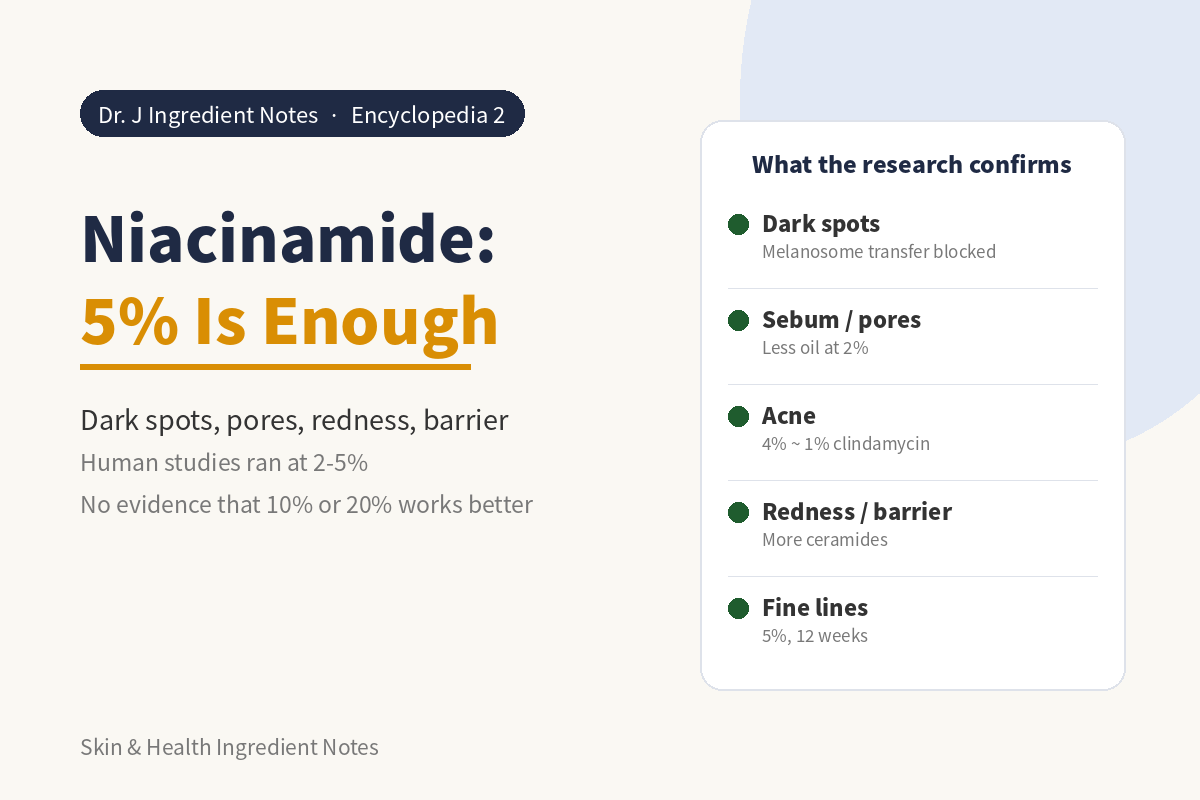
    Niacinamide: 5% is enough - human studies ran at 2-5%, Korea's whitening functional range is 2-5%, no evidence 10% or 20% works better, Dr. J Ingredient Notes cover

    🇰🇷 이 글의 한국어판 → 한국어판

    Hello, I’m Dr. J.
    In Korea you can hardly walk past a serum shelf without seeing niacinamide on the label.
    It sits in most products approved here as brightening functional cosmetics.

    The number next to it keeps changing, though: 2%, 5%, 10%, 20%.
    Does a bigger number buy you more?
    Here is what the human studies actually support.


    The short version

    ✔ Niacinamide is a form of vitamin B3. One ingredient works on dark spots, pores, acne, redness, fine lines and the skin barrier
    ✔ The human studies ran at 2-5%, and Korea’s brightening functional range is also 2-5%
    ✔ No head-to-head human study shows 10% or 20% doing more. The chance of flushing does go up
    ✔ Morning and night are both fine, and it layers with retinol, vitamin C and acids
    ✔ Expect the first change around week 4 and a clear one at 8-12 weeks. Consistency matters more than strength
     

    What the research confirms – five jobs, one ingredient

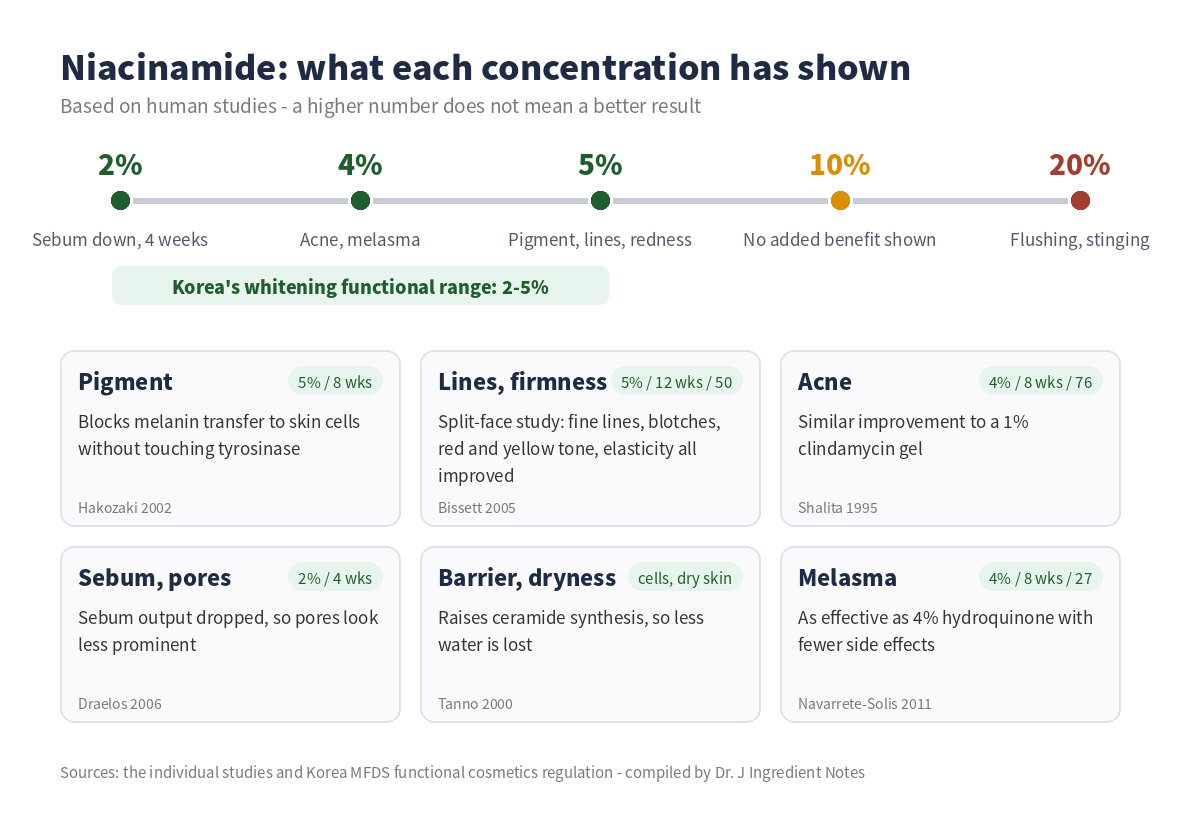
    Niacinamide by concentration - 2% less sebum (Draelos 2006), 4% acne (Shalita 1995) and melasma (Navarrete-Solis 2011), 5% pigment, lines and redness (Bissett 2005, Hakozaki 2002), 10% no added benefit, 20% flushing
    · Dark spots — it blocks the hand-off of melanin to skin cells. It leaves the pigment-making enzyme alone, which is why it is gentle. Blotches faded over 8 weeks at 5%
    · Fine lines, redness, elasticity — 50 people used 5% on one half of the face and a plain cream on the other for 12 weeks. Fine lines, blotches, red spots, sallowness and elasticity all improved
    · Acne — a 4% gel matched a 1% clindamycin (antibiotic) gel over 8 weeks in 76 people
    · Sebum and pores — 2% for 4 weeks lowered sebum output. Less oil, less prominent pores
    · Barrier and dryness — it raises ceramide synthesis, so the skin loses less water. That is why it buffers a retinol or acid routine

    There is a melasma study too.
    4% niacinamide matched 4% hydroquinone with fewer side effects (27 people, 8 weeks).


    Choosing the number: 2, 5, 10 or 20%

    · 2% — the sebum and pore studies. A sensible starting point for sensitive skin
    · 4% — the acne and melasma studies
    · 5% — pigment, fine lines and redness. This is the reference point
    · 10% — no human comparison showing it beats 5%. More people report flushing
    · 20% — it exists on shelves, the evidence does not, and stinging is common

    That warm flush some people feel comes less from niacinamide itself than from nicotinic acid left in the raw material.
    A safety review of high-purity material (CIR) found no irritation even at 10%.
    Still, nothing shows that more is better, so 5% used for a long time is the path the research supports.


    Three things to check on the label

    ✔ Is there a number? “Contains niacinamide” can mean 0.5%
    ✔ A brightening functional claim (Korea) means 2-5% is definitely in there. It does not mean high strength
    ✔ If your face flushes, drop the strength or change products. Purity differs, so two 5% products can feel different
     

    When to use it, and what it layers with

    ✔ Morning and night — it is stable in light. Apply at the serum step, moisturiser on top
    ✔ With retinol → yes. It cushions the dryness and stinging of the break-in weeks
    ✔ With vitamin C → yes. The “never together” rule traces back to a 1960s solution experiment, not to modern formulas
    ✔ With AHA or BHA → yes. Applied after an acid it helps the barrier recover
    ✔ Give it 4 weeks, then keep going to 8-12 — the pigment-transfer block reverses within days of stopping, so it is an ingredient you stay on

    🧪 Check niacinamide pairings in the ingredient checker


    One line

    Niacinamide: 5%, morning and night, 8-12 weeks.
    It covers dark spots, pores, redness and the barrier at once and gets along with everything else, which makes it a good default serum in a routine.

    ▶ Ingredient encyclopedia 1: Retinol: Start at 0.1% – How to Read the Concentration Numbers
    ▶ Ingredient encyclopedia 3: Bakuchiol vs Retinol – What a 44-Person Trial Found
    ▶ Earlier post: Skincare Ingredient Compatibility Chart – What to Layer and What to Split
    ▶ Earlier post: Not All Vitamin C Serums Work – 3 Conditions the Research Says You Need
    🇰🇷 이 글의 한국어판 → 한국어판

    About the author · Dr. J
    MS in Veterinary Medicine, PhD in Life Sciences. I worked as a researcher at the Korea Research Institute of Bioscience and Biotechnology (KRIBB) and now run Beaurea, a cosmetics manufacturing company, where I write the formulas myself. This blog reads the research papers and the regulatory documents and turns them into plain-language criteria for choosing ingredients. I don’t recommend specific products here – only criteria that apply to any product.

    References
    1. Korea MFDS, Regulation on the Review of Functional Cosmetics, Table 4 — brightening: niacinamide 2-5%
    2. Bissett DL et al. Dermatologic Surgery 2005;31:860-865 — 5%, 50 subjects, 12 weeks, split-face
    3. Hakozaki T et al. British Journal of Dermatology 2002;147:20-31 — melanosome transfer reduced 35-68%, 5% for 8 weeks
    4. Shalita AR et al. International Journal of Dermatology 1995;34:434-437 — 4% vs 1% clindamycin, 76 subjects, 8 weeks
    5. Draelos ZD et al. Journal of Cosmetic and Laser Therapy 2006;8:96-101 — 2%, sebum output
    6. Navarrete-Solís J et al. Dermatology Research and Practice 2011 — 4% vs 4% hydroquinone, 27 subjects, 8 weeks
    7. Tanno O et al. British Journal of Dermatology 2000;143:524-531 — ceramide and barrier lipid synthesis

    ※ This article is general information. Results vary with individual skin. It does not recommend or criticise any specific product. If you are being treated for a skin condition, talk to your dermatologist first. The author runs a company that manufactures and sells cosmetics.