
🇰🇷 한국어판
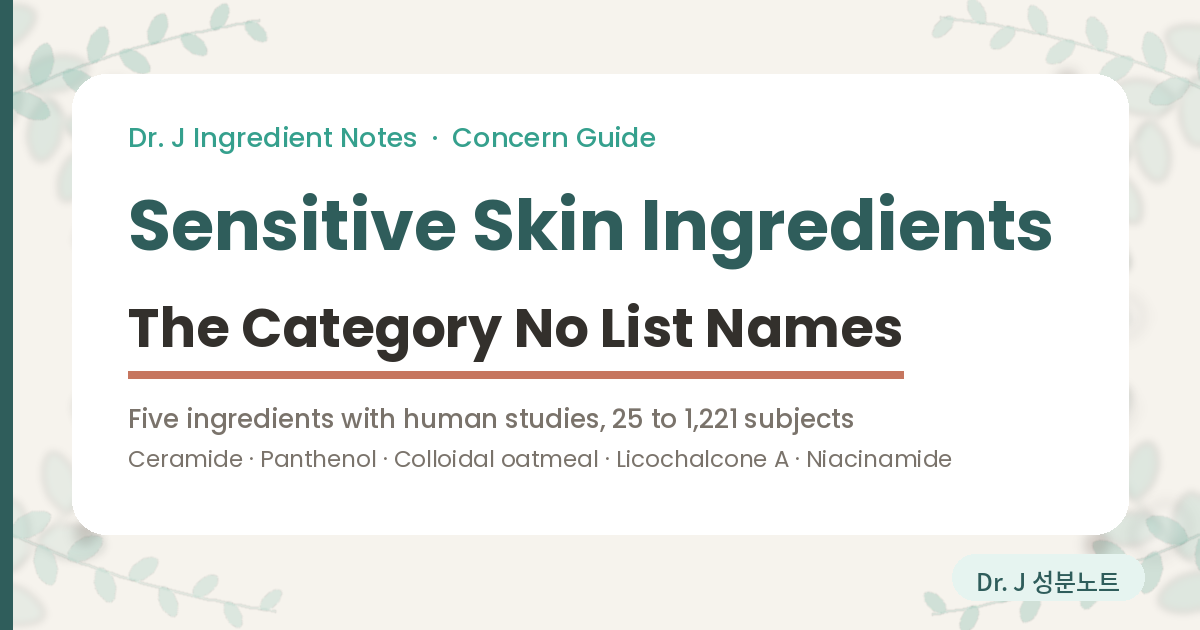
Hello, this is Dr. J. Today I want to pick five ingredients for sensitive skin the only way that is left — from studies done on people.
One thing first, because it sets up everything else. Sensitive skin barely appears in the rules at all. Where it does appear, it is not as something to measure. It is a reason to exclude someone from a test.
――――――――――――――――――――――――――――
The sources, first
📄 Regulation on Review of Functional Cosmetics, Annex 4 (Korean Law Service)
📄 MFDS, Guideline on Test Methods for Substantiating Cosmetic Claims (2018-03, PDF)
📄 U.S. FDA, “Hypoallergenic Cosmetics”
📄 Regulation (EC) No 1223/2009, Article 14
Six categories in the Korean annex, ten methods in the guideline. Sensitive skin is in neither.
――――――――――――――――――――――――――――
――――――――――――――――――――――――――――
Five lines, if you are in a hurry
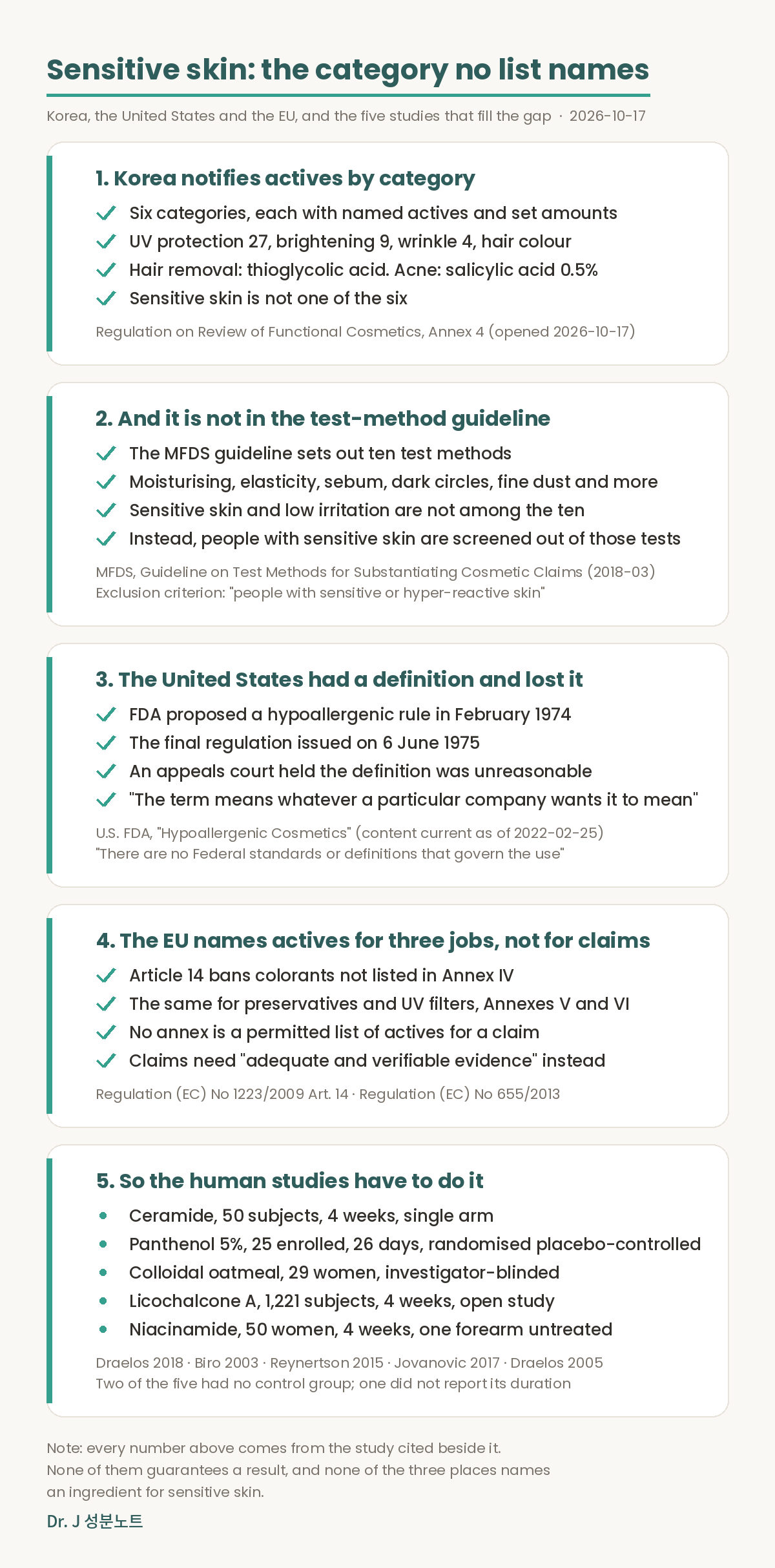
✔ Korea notifies actives in six categories, and sensitive skin is not one
✔ The MFDS test-method guideline lists ten methods, and sensitive skin is not one either
✔ In those tests, sensitive skin is an exclusion criterion
✔ The United States wrote a definition for “hypoallergenic” in 1975 and lost it in court
✔ So five ingredients are picked here from human studies, weaknesses included
――――――――――――――――――――――――――――
What Korea names, and what it leaves out
Korea’s functional cosmetics system works from a notified list. Annex 4 of the Regulation on Review of Functional Cosmetics sets out the ingredient and the amount. Make a product to those numbers and you do not have to file fresh efficacy data — which is another way of saying the state has already decided what counts.
| Category | What the notification sets out | How to read it |
|---|---|---|
| UV protection | 27 ingredients with maximum amounts | Names and numbers are both fixed |
| Brightening | Nine ingredients (arbutin 2–5%, niacinamide 2–5% and others) | Same |
| Wrinkle improvement | Four ingredients (retinol 2,500 IU/g, adenosine 0.04% and others) | Same |
| Hair colour change | A dyeing list split across six sub-tables | Same |
| Hair removal | Thioglycolic acid, 3.0–4.5% as the acid, pH 7.0 to under 12.7 | One ingredient |
| Acne relief | Salicylic acid 0.5%, in cleansing products | One ingredient |
| Sensitive skin | Nothing | There is no such category |
Acne gets one ingredient. Sensitive skin gets no category at all. So “for sensitive skin” and “low irritation” on a Korean box are not reviewed phrases.
――――――――――――――――――――――――――――
There is no method to measure it either
This is the part that is specific to Korea, and it is worth knowing if you sell there. The MFDS publishes a separate guideline that tells you how to run the test behind a claim — which instrument, how long, what unit. Each claim gets its own chapter.
| Chapter | Test method | Added |
|---|---|---|
| 1 | Skin moisturising | 2012-05, at issue |
| 2 | Skin elasticity | 2012-05, at issue |
| 3 | Sebum control | 2012-05, at issue |
| 4 | Temporary reduction of cellulite | 2013-11 |
| 5 | Suitability for acne-prone skin | 2013-11 |
| 6 | Dark circle improvement | 2014-08 |
| 7 | Skin blood-flow improvement | 2015-12 |
| 8 | Puffiness reduction | 2015-12 |
| 9 | Paraben-free | 2017-03-31 |
| 10 | Fine-dust blocking | 2018-03-28 |
| — | Sensitive skin, low irritation | Not among the ten |
Moisturising is there. Sebum is there. Dark circles are there. Sensitive skin is not.
★ The one place “sensitive” does appear
In the subject-selection rules for chapters 1, 2 and 3 — moisturising, elasticity and sebum — one of the exclusion criteria is “people with sensitive or hyper-reactive skin”. Chapter 5, on acne-prone skin, excludes “people whose skin is sensitive to adhesive components”.
So in this document sensitive skin is not something you measure. It is something you screen out before you measure anything else.
――――――――――――――――――――――――――――
The United States tried, and the courts said no
The American story is the sharpest of the three, because the definition existed and then stopped existing.
| When | What happened | Where it stands |
|---|---|---|
| February 1974 | FDA proposed a regulation on the term hypoallergenic | A definition was on the table |
| 6 June 1975 | FDA issued the final regulation | Manufacturers would have had to test |
| On appeal | The court held FDA’s definition was unreasonable | The regulation fell |
| Today | «There are no Federal standards or definitions that govern the use» | «The term means whatever a particular company wants it to mean» |
FDA’s own page puts it plainly: «There are no Federal standards or definitions that govern the use of the term “hypoallergenic.”» And then, one sentence later: «The term means whatever a particular company wants it to mean.»
――――――――――――――――――――――――――――
The EU names actives for three jobs, and claims are not one of them
It is easy to assume the EU, with its long annexes, must have a list somewhere. It does not — not for claims.
| Annex | What it is | What that means for a claim |
|---|---|---|
| Annex II | Prohibited substances | A list of what cannot go in at all |
| Annex III | Restricted substances | Conditions, not a permitted list |
| Annex IV | Colorants — permitted list | A colorant not listed cannot be used |
| Annex V | Preservatives — permitted list | Same |
| Annex VI | UV filters — permitted list | Same |
| For a claim | No annex | Evidence under Reg. 655/2013 instead of a list |
Article 14 is a list of prohibitions. Three of them work as permitted lists, because a colorant, a preservative or a UV filter that is not in its annex cannot be used. There is no fourth annex for “soothing” or “for sensitive skin”. Under Regulation (EC) No 655/2013 a claim has to rest on «adequate and verifiable evidence» instead, and the method is left to «state of the art practices».
――――――――――――――――――――――――――――
So the studies have to do it
That is the whole argument for reading the trials themselves. Here are the five, with the size, the length and the design next to each.
| Ingredient | People | Length | Design | Measured | Number |
|---|---|---|---|---|---|
| Ceramide | 50 | 4 weeks | Single arm, no control | Hydration, TEWL | Hydration median 50 to 80 |
| Panthenol | 25 enrolled 21 finished |
26 days | Randomised, double-blind, placebo-controlled | Hydration after irritation | Better on the active side in 11, placebo in 1 |
| Colloidal oatmeal | 29 women | Not reported | Investigator-blinded | Dryness, scaling, roughness, itch | All four improved |
| Licochalcone A | 1,221 | 4 weeks | Open study, no control | Redness and related scores | P<0.001 |
| Niacinamide | 50 women 46 finished |
4 weeks | One forearm untreated, investigator-blind | TEWL, capacitance | TEWL 2.5 vs 3.9 |
The last row is worth a pause. Niacinamide sits on Korea’s brightening list at 2–5%. This study measured something else entirely — barrier. The ingredient name does not tell you what was measured.
――――――――――――――――――――――――――――
And where each one is weak
| Ingredient | Where it is weak | How to read it |
|---|---|---|
| Ceramide | No control group, one site, manufacturer-funded | Read what was measured, not the size of the change |
| Panthenol | Only one endpoint reached significance | The design is the strongest of the five |
| Colloidal oatmeal | The abstract does not give the duration | Read it without knowing how long |
| Licochalcone A | No control, and the product also contained trans-4-t-butylcyclohexanol | The two cannot be separated here |
| Niacinamide | The facial figures were not tested statistically | Read the forearm numbers |
Of the five, one design is clearly the strongest, and it is the smallest study. Twenty-five people, randomised, double-blind, placebo-controlled, with the irritation deliberately induced. The study with 1,221 people has no control group at all. Size and strength are not the same thing, and a box never prints either.
――――――――――――――――――――――――――――
Four things to check on the box
✔ Look past “for sensitive skin” and check whether the five names are in the ingredient list
✔ The earlier a name sits in that list, the more of it is in there
✔ Photograph the names after “fragrance” so you can compare them later
✔ Try anything new on the inside of your arm for a few days first
――――――――――――――――――――――――――――
One line
No regulator in these three places names an ingredient for sensitive skin, so the studies have to. Decide first whether your issue is barrier, itch or redness, and five becomes three.
――――――――――――――――――――――――――――
What I left out, and why
✔ Centella asiatica and madecassoside — I could not open a human study, only reviews
✔ “Fragrance-free is safer” — no primary source for it
✔ The facial figures in the niacinamide study — cheek TEWL fell, but those values were not tested statistically
✔ Prescription drugs and procedures — they do not belong in a cosmetics piece
✔ An EU rule specific to sensitive skin — I did not find one, which is not the same as saying none exists
About the author · Dr. J
MS in Veterinary Medicine, PhD in Life Sciences. I worked as a researcher at the Korea Research Institute of Bioscience and Biotechnology (KRIBB) and now run Beaurea, a cosmetics manufacturing company, where I write the formulas myself. This blog reads the research papers and the regulatory documents and turns them into plain-language criteria for choosing ingredients. I don’t recommend specific products here – only criteria that apply to any product.
📌 Previously
📌 Niacinamide: How Much Is Enough — the same ingredient, seen from the brightening side
📌 Ceramides – cholesterol and fatty acid ratio — the first ingredient here, in full
📌 Panthenol for Skin: What the Dexpanthenol Studies Show — the irritation side
📌 How to Read a Korean Cosmetic Ingredient List — where to find these names on the box
📄 References
· Regulation on Review of Functional Cosmetics, Annex 4 (Korean Law Service, opened 2026-10-17)
· MFDS, Guideline on Test Methods for Substantiating Cosmetic Claims (2018-03, 안내서-0353-02)
· MFDS, Guideline on Cosmetic Labelling and Advertising (2025-08-14, 안내서-0086-07), Annex 2
· Draelos ZD, Raymond I. J Clin Aesthet Dermatol 2018;11(5):30-32
· Biro K, Thaçi D, Ochsendorf FR, Kaufmann R, Boehncke WH. Contact Dermatitis 2003;49(2):80-84
· Reynertson KA et al. J Drugs Dermatol 2015;14(1):43-48 · Jovanovic Z et al. ibid. 2017;16(6):605-611
· Draelos ZD, Ertel K, Berge C. Cutis 2005;76:135-141
· U.S. FDA, “Hypoallergenic Cosmetics” (content current as of 2022-02-25)
· Regulation (EC) No 1223/2009, Article 14 · Regulation (EC) No 655/2013
――――――――――――――――――――――――――――
This article summarises published studies and public regulatory documents. It is information, not diagnosis or treatment. Of the five studies, two had no control group and one does not report its duration, and one was run on a product containing two actives. Those limits are set out in the tables above rather than hidden. Ingredient names and concentrations are given as criteria for choosing a product, not as a recommendation of any particular one.
— Dr. J Ingredient Notes
Leave a Reply