Tag: sensitive skin

  • Sensitive Skin Ingredients: The Category No Regulator Names, and Five with Human Studies

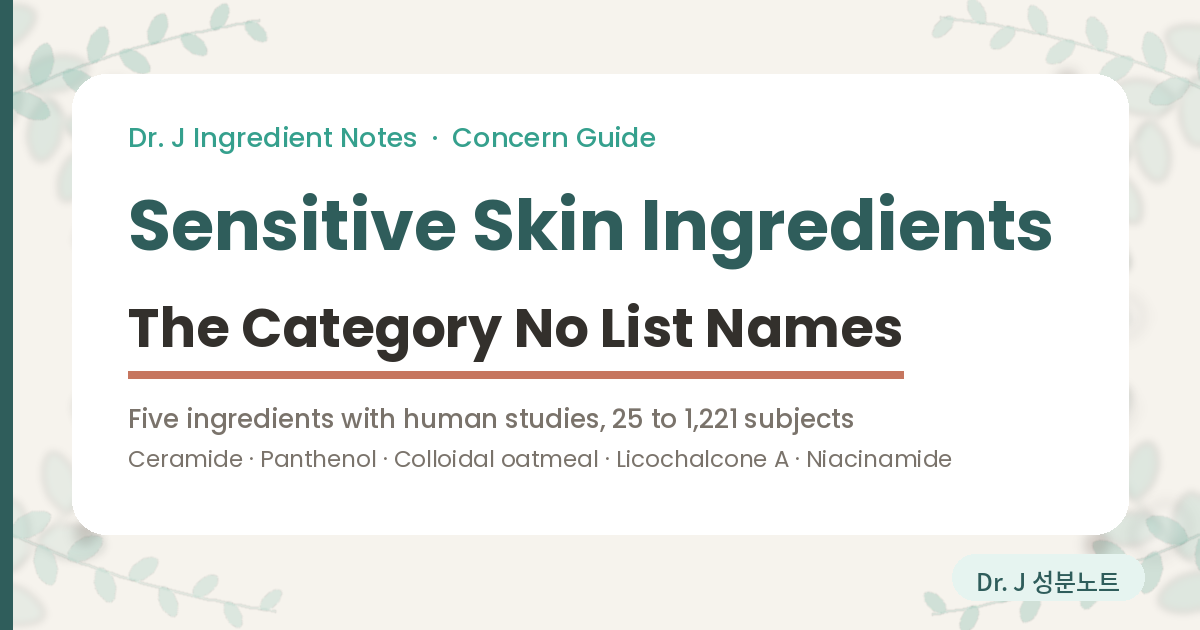
    Cover image for a guide to sensitive skin cosmetic ingredients in Korea. Korea's Regulation on Review of Functional Cosmetics, Annex 4, notifies actives in six categories: UV protection with 27 ingredients, brightening with nine, wrinkle improvement with four, hair colour change, hair removal with thioglycolic acid, and acne relief with salicylic acid at 0.5 percent. Sensitive skin is not one of them. The Ministry of Food and Drug Safety guideline on test methods for substantiating cosmetic claims sets out ten methods, and sensitive skin is not among those either; people with sensitive or hyper-reactive skin are instead screened out of those tests. In the United States there are no federal standards or definitions for the term hypoallergenic, and in the European Union the only permitted lists of ingredients are for colorants, preservatives and UV filters. Five ingredients with human studies fill the gap: ceramide, panthenol, colloidal oatmeal, licochalcone A and niacinamide. A Dr. J Ingredient Notes cover.

    🇰🇷 한국어판

    Hello, this is Dr. J. Today I want to pick five ingredients for sensitive skin the only way that is left — from studies done on people.

    One thing first, because it sets up everything else. Sensitive skin barely appears in the rules at all. Where it does appear, it is not as something to measure. It is a reason to exclude someone from a test.

    ――――――――――――――――――――――――――――

    The sources, first

    📄 Regulation on Review of Functional Cosmetics, Annex 4 (Korean Law Service)

    📄 MFDS, Guideline on Test Methods for Substantiating Cosmetic Claims (2018-03, PDF)

    📄 U.S. FDA, “Hypoallergenic Cosmetics”

    📄 Regulation (EC) No 1223/2009, Article 14

    Six categories in the Korean annex, ten methods in the guideline. Sensitive skin is in neither.

    ――――――――――――――――――――――――――――

    ――――――――――――――――――――――――――――

    Five lines, if you are in a hurry

    ✔ Korea notifies actives in six categories, and sensitive skin is not one

    ✔ The MFDS test-method guideline lists ten methods, and sensitive skin is not one either

    ✔ In those tests, sensitive skin is an exclusion criterion

    ✔ The United States wrote a definition for “hypoallergenic” in 1975 and lost it in court

    ✔ So five ingredients are picked here from human studies, weaknesses included

    ――――――――――――――――――――――――――――

    What Korea names, and what it leaves out

    Korea’s functional cosmetics system works from a notified list. Annex 4 of the Regulation on Review of Functional Cosmetics sets out the ingredient and the amount. Make a product to those numbers and you do not have to file fresh efficacy data — which is another way of saying the state has already decided what counts.

    Category What the notification sets out How to read it
    UV protection 27 ingredients with maximum amounts Names and numbers are both fixed
    Brightening Nine ingredients (arbutin 2–5%, niacinamide 2–5% and others) Same
    Wrinkle improvement Four ingredients (retinol 2,500 IU/g, adenosine 0.04% and others) Same
    Hair colour change A dyeing list split across six sub-tables Same
    Hair removal Thioglycolic acid, 3.0–4.5% as the acid, pH 7.0 to under 12.7 One ingredient
    Acne relief Salicylic acid 0.5%, in cleansing products One ingredient
    Sensitive skin Nothing There is no such category

    Acne gets one ingredient. Sensitive skin gets no category at all. So “for sensitive skin” and “low irritation” on a Korean box are not reviewed phrases.
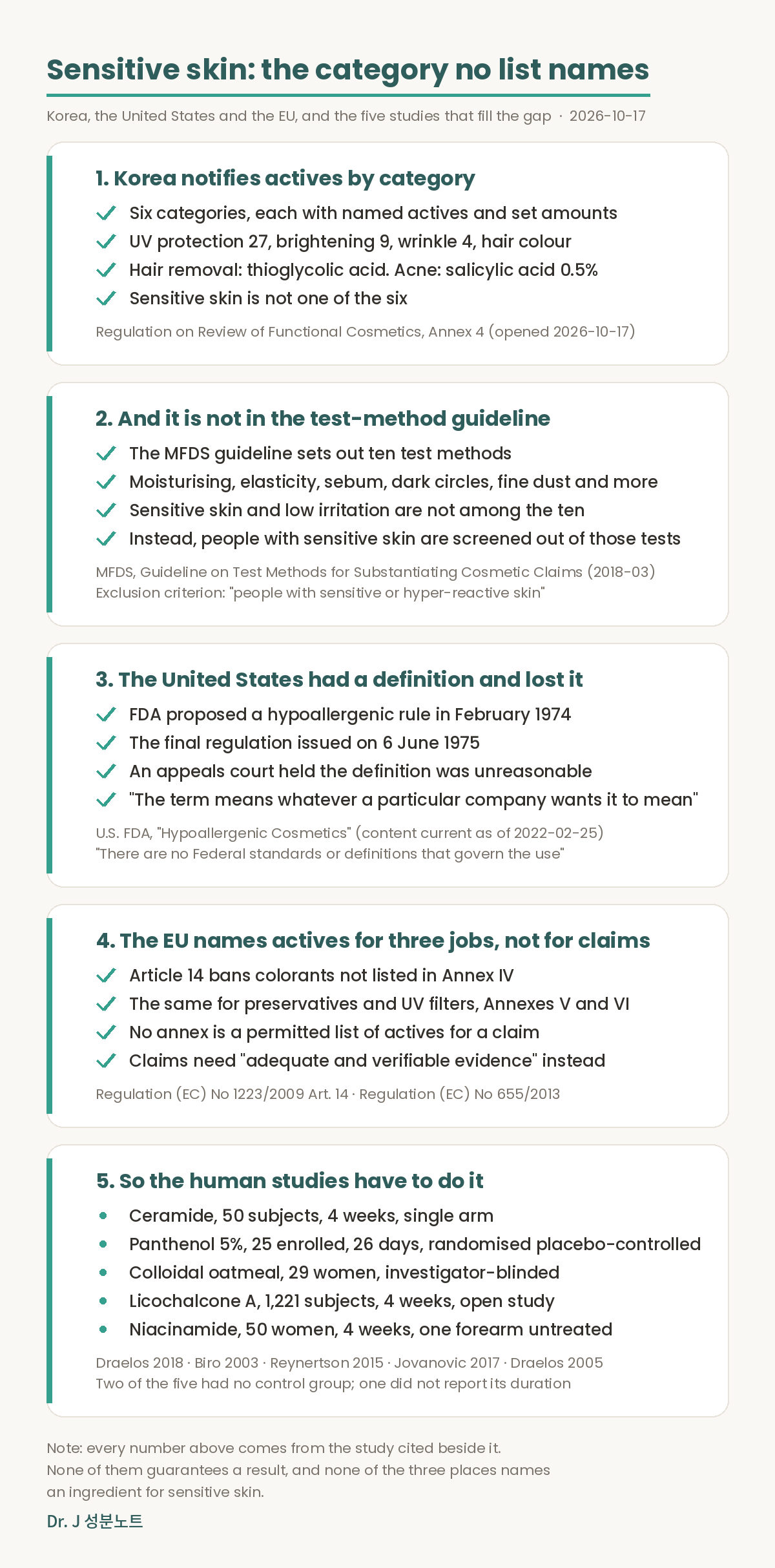
    Evidence figure on sensitive skin ingredients. First, Korea notifies actives by category. Six categories each carry named actives and set amounts: UV protection 27, brightening nine, wrinkle four, hair colour, hair removal with thioglycolic acid, and acne with salicylic acid 0.5 percent. Sensitive skin is not one of the six. The source is the Regulation on Review of Functional Cosmetics, Annex 4. Second, sensitive skin is not in the test-method guideline either. The Ministry of Food and Drug Safety guideline sets out ten test methods covering moisturising, elasticity, sebum, dark circles, fine dust and others, and sensitive skin and low irritation are not among the ten. Instead people with sensitive or hyper-reactive skin are an exclusion criterion in those tests. Third, the United States had a definition and lost it. FDA proposed a hypoallergenic rule in February 1974 and issued the final regulation on 6 June 1975, but an appeals court held the definition was unreasonable. FDA now writes that the term means whatever a particular company wants it to mean and that there are no federal standards or definitions governing its use, as of 25 February 2022. Fourth, the European Union names actives for three jobs and not for claims. Article 14 of Regulation 1223/2009 bans colorants not listed in Annex 4 and does the same for preservatives and UV filters in Annexes 5 and 6, and no annex is a permitted list of actives for a claim. Claims instead need adequate and verifiable evidence under Regulation 655/2013. Fifth, the human studies have to do the work: ceramide with 50 subjects over four weeks in a single arm, panthenol 5 percent with 25 enrolled over 26 days in a randomised placebo-controlled trial, colloidal oatmeal with 29 women investigator-blinded, licochalcone A with 1,221 subjects over four weeks in an open study, and niacinamide with 50 women over four weeks with one forearm untreated. Two of the five had no control group and one did not report its duration.

    ――――――――――――――――――――――――――――

    There is no method to measure it either

    This is the part that is specific to Korea, and it is worth knowing if you sell there. The MFDS publishes a separate guideline that tells you how to run the test behind a claim — which instrument, how long, what unit. Each claim gets its own chapter.

    Chapter Test method Added
    1 Skin moisturising 2012-05, at issue
    2 Skin elasticity 2012-05, at issue
    3 Sebum control 2012-05, at issue
    4 Temporary reduction of cellulite 2013-11
    5 Suitability for acne-prone skin 2013-11
    6 Dark circle improvement 2014-08
    7 Skin blood-flow improvement 2015-12
    8 Puffiness reduction 2015-12
    9 Paraben-free 2017-03-31
    10 Fine-dust blocking 2018-03-28
    — Sensitive skin, low irritation Not among the ten

    Moisturising is there. Sebum is there. Dark circles are there. Sensitive skin is not.

    ★ The one place “sensitive” does appear

    In the subject-selection rules for chapters 1, 2 and 3 — moisturising, elasticity and sebum — one of the exclusion criteria is “people with sensitive or hyper-reactive skin”. Chapter 5, on acne-prone skin, excludes “people whose skin is sensitive to adhesive components”.
    So in this document sensitive skin is not something you measure. It is something you screen out before you measure anything else.

    ――――――――――――――――――――――――――――

    The United States tried, and the courts said no

    The American story is the sharpest of the three, because the definition existed and then stopped existing.

    When What happened Where it stands
    February 1974 FDA proposed a regulation on the term hypoallergenic A definition was on the table
    6 June 1975 FDA issued the final regulation Manufacturers would have had to test
    On appeal The court held FDA’s definition was unreasonable The regulation fell
    Today «There are no Federal standards or definitions that govern the use» «The term means whatever a particular company wants it to mean»

    FDA’s own page puts it plainly: «There are no Federal standards or definitions that govern the use of the term “hypoallergenic.”» And then, one sentence later: «The term means whatever a particular company wants it to mean.»

    ――――――――――――――――――――――――――――

    The EU names actives for three jobs, and claims are not one of them

    It is easy to assume the EU, with its long annexes, must have a list somewhere. It does not — not for claims.

    Annex What it is What that means for a claim
    Annex II Prohibited substances A list of what cannot go in at all
    Annex III Restricted substances Conditions, not a permitted list
    Annex IV Colorants — permitted list A colorant not listed cannot be used
    Annex V Preservatives — permitted list Same
    Annex VI UV filters — permitted list Same
    For a claim No annex Evidence under Reg. 655/2013 instead of a list

    Article 14 is a list of prohibitions. Three of them work as permitted lists, because a colorant, a preservative or a UV filter that is not in its annex cannot be used. There is no fourth annex for “soothing” or “for sensitive skin”. Under Regulation (EC) No 655/2013 a claim has to rest on «adequate and verifiable evidence» instead, and the method is left to «state of the art practices».

    ――――――――――――――――――――――――――――

    So the studies have to do it

    That is the whole argument for reading the trials themselves. Here are the five, with the size, the length and the design next to each.

    Ingredient People Length Design Measured Number
    Ceramide 50 4 weeks Single arm, no control Hydration, TEWL Hydration median 50 to 80
    Panthenol 25 enrolled
    21 finished
    26 days Randomised, double-blind, placebo-controlled Hydration after irritation Better on the active side in 11, placebo in 1
    Colloidal oatmeal 29 women Not reported Investigator-blinded Dryness, scaling, roughness, itch All four improved
    Licochalcone A 1,221 4 weeks Open study, no control Redness and related scores P<0.001
    Niacinamide 50 women
    46 finished
    4 weeks One forearm untreated, investigator-blind TEWL, capacitance TEWL 2.5 vs 3.9

    The last row is worth a pause. Niacinamide sits on Korea’s brightening list at 2–5%. This study measured something else entirely — barrier. The ingredient name does not tell you what was measured.

    ――――――――――――――――――――――――――――

    And where each one is weak

    Ingredient Where it is weak How to read it
    Ceramide No control group, one site, manufacturer-funded Read what was measured, not the size of the change
    Panthenol Only one endpoint reached significance The design is the strongest of the five
    Colloidal oatmeal The abstract does not give the duration Read it without knowing how long
    Licochalcone A No control, and the product also contained trans-4-t-butylcyclohexanol The two cannot be separated here
    Niacinamide The facial figures were not tested statistically Read the forearm numbers

    Of the five, one design is clearly the strongest, and it is the smallest study. Twenty-five people, randomised, double-blind, placebo-controlled, with the irritation deliberately induced. The study with 1,221 people has no control group at all. Size and strength are not the same thing, and a box never prints either.

    ――――――――――――――――――――――――――――

    Four things to check on the box

    ✔ Look past “for sensitive skin” and check whether the five names are in the ingredient list

    ✔ The earlier a name sits in that list, the more of it is in there

    ✔ Photograph the names after “fragrance” so you can compare them later

    ✔ Try anything new on the inside of your arm for a few days first

    ――――――――――――――――――――――――――――

    One line

    No regulator in these three places names an ingredient for sensitive skin, so the studies have to. Decide first whether your issue is barrier, itch or redness, and five becomes three.

    ――――――――――――――――――――――――――――

    What I left out, and why

    ✔ Centella asiatica and madecassoside — I could not open a human study, only reviews

    ✔ “Fragrance-free is safer” — no primary source for it

    ✔ The facial figures in the niacinamide study — cheek TEWL fell, but those values were not tested statistically

    ✔ Prescription drugs and procedures — they do not belong in a cosmetics piece

    ✔ An EU rule specific to sensitive skin — I did not find one, which is not the same as saying none exists

    About the author · Dr. J

    MS in Veterinary Medicine, PhD in Life Sciences. I worked as a researcher at the Korea Research Institute of Bioscience and Biotechnology (KRIBB) and now run Beaurea, a cosmetics manufacturing company, where I write the formulas myself. This blog reads the research papers and the regulatory documents and turns them into plain-language criteria for choosing ingredients. I don’t recommend specific products here – only criteria that apply to any product.

    📌 Previously

    📌 Niacinamide: How Much Is Enough — the same ingredient, seen from the brightening side

    📌 Ceramides – cholesterol and fatty acid ratio — the first ingredient here, in full

    📌 Panthenol for Skin: What the Dexpanthenol Studies Show — the irritation side

    📌 How to Read a Korean Cosmetic Ingredient List — where to find these names on the box

    📄 References

    · Regulation on Review of Functional Cosmetics, Annex 4 (Korean Law Service, opened 2026-10-17)

    · MFDS, Guideline on Test Methods for Substantiating Cosmetic Claims (2018-03, 안내서-0353-02)

    · MFDS, Guideline on Cosmetic Labelling and Advertising (2025-08-14, 안내서-0086-07), Annex 2

    · Draelos ZD, Raymond I. J Clin Aesthet Dermatol 2018;11(5):30-32

    · Biro K, Thaçi D, Ochsendorf FR, Kaufmann R, Boehncke WH. Contact Dermatitis 2003;49(2):80-84

    · Reynertson KA et al. J Drugs Dermatol 2015;14(1):43-48 · Jovanovic Z et al. ibid. 2017;16(6):605-611

    · Draelos ZD, Ertel K, Berge C. Cutis 2005;76:135-141

    · U.S. FDA, “Hypoallergenic Cosmetics” (content current as of 2022-02-25)

    · Regulation (EC) No 1223/2009, Article 14 · Regulation (EC) No 655/2013

    ――――――――――――――――――――――――――――

    This article summarises published studies and public regulatory documents. It is information, not diagnosis or treatment. Of the five studies, two had no control group and one does not report its duration, and one was run on a product containing two actives. Those limits are set out in the tables above rather than hidden. Ingredient names and concentrations are given as criteria for choosing a product, not as a recommendation of any particular one.

    — Dr. J Ingredient Notes
  • Panthenol for Skin: What the Dexpanthenol Studies Show (Ingredient Guide 7)

    Cover image for a Dr. J Ingredient Notes guide on panthenol, ingredient guide 7. What the research shows about panthenol for skin: a dexpanthenol cream tested against the same cream without it on irritated skin, and three 28-day studies of panthenol moisturisers on very dry skin with 42 people each.

    🇰🇷 한국어판: 판테놀 효능, 숫자로 확인된 것 (성분 백과 ⑦)

    Hello, I’m Dr. J. Today’s question is a simple one: what does panthenol actually do for skin, and how much of that has been measured in people? This is Ingredient Guide 7.

    Panthenol turns up on the back of almost every soothing cream, barrier cream and “recovery” product, and in plenty of shampoos too. It is usually described in a word or two – soothing, hydrating, vitamin B5 – and rarely with a number attached. So here is the first surprise: panthenol isn’t the thing that does the work. Skin converts it into something else first.

    Below I put two human studies side by side. One tested a dexpanthenol cream on deliberately irritated skin against the same cream without dexpanthenol. The other ran three 28-day studies of panthenol-containing moisturisers on very dry skin, 42 people each. At the end is the conclusion of the US Cosmetic Ingredient Review panel on panthenol’s safety – and a short list of claims I left out, with the reason for each.

    ――――――――――――――――――――――――――――

    📄 If you’d rather read the primary sources

    📄 Proksch & Nissen 2002 — irritated skin, dexpanthenol cream vs vehicle

    📄 Stettler et al. 2021 — three 28-day studies, 42 people each (open access)

    📄 Cosmetic Ingredient Review 2022 — safety assessment of panthenol and derivatives

    The Stettler paper is open access, including the per-product tables and the measurement methods. The Proksch paper’s abstract is public.

    ――――――――――――――――――――――――――――

    ――――――――――――――――――――――――――――

    The short version

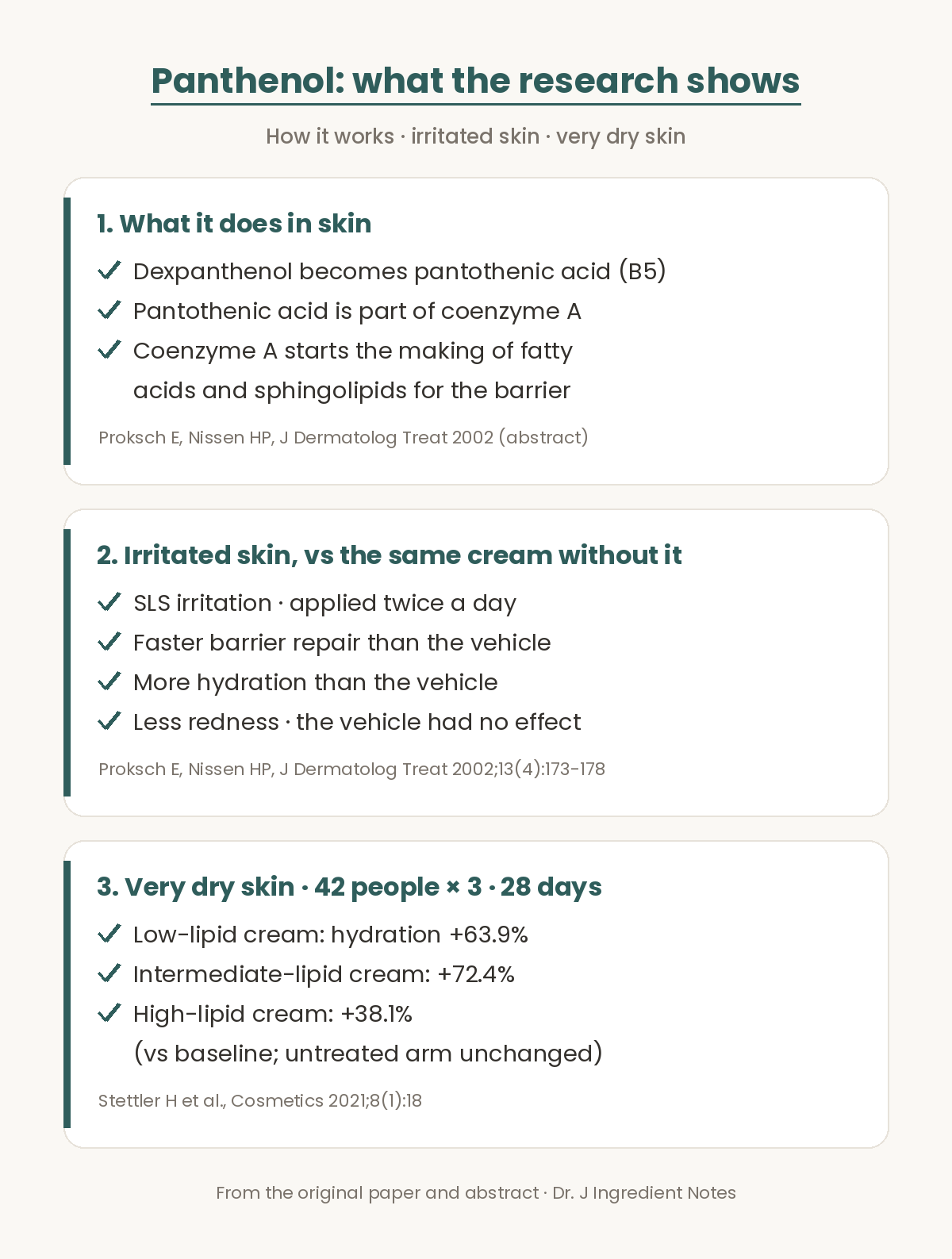
    ✔ Panthenol and dexpanthenol are names for the same family; in skin, dexpanthenol becomes pantothenic acid (vitamin B5)

    ✔ On irritated skin, a dexpanthenol cream applied twice a day repaired the barrier faster than the same cream without it

    ✔ In three 28-day studies on very dry skin (42 people each), skin hydration rose 38.1% to 72.4% from baseline

    ✔ In the same studies, hydration on the untreated arm did not move

    ✔ The US Cosmetic Ingredient Review panel concluded panthenol is safe as currently used in cosmetics

    ――――――――――――――――――――――――――――

    Panthenol vs dexpanthenol – why two names

    Ingredient lists say panthenol; studies and pharmacy ointments usually say dexpanthenol. Panthenol exists in two mirror-image forms, and the one skin converts to pantothenic acid is the D-form – dexpanthenol. That conversion is why you’ll also see it called provitamin B5.

    Why does that matter? Pantothenic acid is a building block of coenzyme A. As the Proksch & Nissen abstract explains, coenzyme A catalyses the early steps in making fatty acids and sphingolipids – lipids that are essential to the layered lipid structure of the stratum corneum and to cell membranes. That is the biological reason people expected panthenol to help a damaged barrier. The studies below are where that expectation was tested.

    Inside the bottle, panthenol has more than one job. The Cosmetic Ingredient Review report lists it as a hair-conditioning agent, a skin-conditioning agent (humectant) and a solvent. That is why the same name appears on both a conditioner and a face cream.

    ――――――――――――――――――――――――――――

    On irritated skin – dexpanthenol cream vs the same cream without it

    In this study, skin was deliberately irritated with sodium lauryl sulphate (SLS), a cleansing agent, applied in patch-test chambers. The irritated sites were then treated twice a day with either a dexpanthenol cream or the identical cream without dexpanthenol (the vehicle), and some sites were left untreated. Barrier repair, hydration, roughness and redness were measured with instruments rather than judged by eye (Proksch & Nissen, J Dermatolog Treat 2002).

    ✔ Barrier repair — significantly faster with dexpanthenol than with the vehicle or with no treatment

    ✔ Stratum corneum hydration — rose with both creams, but significantly more with dexpanthenol

    ✔ Roughness — fell with both creams, with dexpanthenol again ahead

    ✔ Redness — significantly reduced with dexpanthenol; the vehicle had no effect

    The weight of this study comes from the comparison. Any cream will add some water and oil to the skin; by testing against the same base without dexpanthenol, the study isolates what dexpanthenol itself added. On all four measures, it added something.

    ※ The abstract does not give the number of participants, the length of the study or the dexpanthenol concentration. A later review article quotes figures for this trial, but I couldn’t confirm them in the original, so I have left them out.

    Evidence figure on panthenol. First, in skin, dexpanthenol becomes pantothenic acid, vitamin B5, which is part of coenzyme A, and coenzyme A starts the synthesis of fatty acids and sphingolipids needed for the skin barrier. Second, on skin irritated with sodium lauryl sulphate and treated twice a day, a dexpanthenol cream repaired the barrier faster, raised hydration more and reduced redness compared with the same cream without dexpanthenol, which had no effect on redness, Proksch and Nissen, Journal of Dermatological Treatment 2002. Third, in three 28-day studies on very dry skin with 42 people each, skin hydration rose from baseline by 63.9 percent with a low-lipid cream, 72.4 percent with an intermediate-lipid cream and 38.1 percent with a high-lipid cream, while the untreated arm stayed unchanged, Stettler and colleagues, Cosmetics 2021.

    ――――――――――――――――――――――――――――

    On very dry skin – three studies, 42 people each, 28 days

    The second paper reports three parallel studies of panthenol-containing emollients that differed in how much lipid (oil) they contained: low, intermediate and high (Stettler et al., Cosmetics 2021). Participants were 18 to 70 years old and had skin that a dermatologist judged to be very dry, flaky and sensitive. Each person applied the product to one forearm once a day, about 2 mg per square centimetre, and left the other forearm untreated. Which arm got the product was decided at random.

    Emollient 1
    lowest lipid
    Emollient 2
    intermediate lipid
    Emollient 3
    highest lipid
    Participants 42 · mean age 59 42 · mean age 58 42 · mean age 57
    Skin hydration
    day 28 vs baseline
    +63.9% +72.4% +38.1%
    Water loss (TEWL)
    day 28 vs baseline
    −11.0% (significant) −5.7% (not significant) lower, not significant
    Stratum corneum lipids cholesterol +9.8% · free fatty acids +3.7% no change cholesterol +12.5% · free fatty acids +26.3%

    Three things stand out. First, hydration rose clearly with all three products. Second, on the untreated arm, hydration stayed flat – the paper reports it holding at about the same capacitance reading throughout. That makes it hard to put the rise down to the weather or to people getting used to the measurements. Third, only Emollient 1 significantly reduced water loss (TEWL); the other two moved in the right direction without reaching significance.

    So how much of this is panthenol? That’s the honest limit of this paper. The results belong to each cream as a whole: all three also contained lipids such as shea butter and squalane, and the paper does not state the panthenol concentration. The comparison was against untreated skin, not a panthenol-free cream. The study was also open-label – everyone knew what they were applying – and the products were supplied by the manufacturer. None of that makes the numbers wrong, but it tells you what kind of numbers they are.

    The intermediate-lipid product gave the largest hydration gain, while the highest-lipid product gave the smallest – a reminder that a richer cream is not automatically a more hydrating one. On tolerability, the paper reports no local or systemic adverse events related to the products over the 28 days.

    ――――――――――――――――――――――――――――

    The two studies side by side

    Proksch & Nissen 2002 Stettler et al. 2021
    Skin deliberately irritated with sodium lauryl sulphate (SLS) very dry, flaky and sensitive, as judged by a dermatologist
    Compared with the same cream without dexpanthenol (vehicle), and untreated skin the untreated opposite forearm
    How often twice a day once a day, about 2 mg/cm²
    Design vehicle-controlled (numbers of people and days not given in the abstract) randomised as to which arm was treated · open-label · three studies × 42 people · 28 days
    Key result faster barrier repair, more hydration, less roughness, less redness than vehicle hydration +38.1% to +72.4%; untreated side flat

    Each study fills the other’s gap. The 2002 trial has the right comparison – dexpanthenol against its own vehicle – but its abstract gives no numbers. The 2021 studies have clear numbers, but they describe whole products compared with untreated skin. Put together, they support a modest, specific statement: panthenol has human evidence on two fronts, recovery after irritation and hydration of very dry skin.

    ――――――――――――――――――――――――――――

    Safety – what the Cosmetic Ingredient Review panel concluded

    In the US, the Cosmetic Ingredient Review (CIR) expert panel assesses the safety of cosmetic ingredients. In 2022 it reviewed panthenol, pantothenic acid and five derivatives together. Its conclusion is one sentence: all seven are safe in cosmetics in the present practices of use and concentration described in the assessment.

    It helps to keep the two questions apart. The CIR conclusion answers “is it safe to use the way it is used now?” – not “how well does it work?”. For the second question, look to the two studies above.

    ――――――――――――――――――――――――――――

    How I use it

    ✔ When exfoliating acids or retinol leave my skin stinging, I switch to a panthenol-containing cream for a few days

    ✔ I apply it while skin is still slightly damp after cleansing, and on dry days add a cream on top

    ✔ For very dry skin I give it 28 days before judging – the length of the Stettler studies

    ――――――――――――――――――――――――――――

    What I left out, and why

    ✔ Participant numbers, duration and concentration for the 2002 trial — quoted in a review, but not in the original abstract I could read

    ✔ Wound and burn claims — in a cosmetics article they read like drug claims

    ✔ “Choose at least X%” — I found no original study comparing panthenol concentrations head-to-head on human skin

    ✔ Pairing rules with other ingredients — I found no primary study testing panthenol in specific combinations

    ――――――――――――――――――――――――――――

    Three things to check when you buy

    ✔ Where panthenol sits in the ingredient list — higher up means more of it (see the ingredient-list guide below)

    ✔ Texture — in the 28-day studies, the intermediate-lipid product gave the largest hydration gain

    ✔ Where fragrance sits — if this is the cream for your irritated days, you want fragrance low on the list or absent

    ――――――――――――――――――――――――――――

    In one line

    Panthenol is converted in skin to vitamin B5, and it has human evidence for recovery after irritation and for hydrating very dry skin. When you read a number, check first what it was compared with.

    ――――――――――――――――――――――――――――

    📌 Earlier guides

    📌 Ceramides – the cholesterol and fatty acid ratio (Ingredient Guide 4)

    📌 Hyaluronic Acid: How to Read the Molecular Weight (Ingredient Guide 6)

    📌 Retinol: Start at 0.1% (Ingredient Guide 1)

    📌 How to Read a Korean Cosmetic Ingredient List — Where the Order Stops at 1% (Ingredient Guide 14)

    About the author · Dr. J

    MS in Veterinary Medicine, PhD in Life Sciences. I worked as a researcher at the Korea Research Institute of Bioscience and Biotechnology (KRIBB) and now run Beaurea, a cosmetics manufacturing company, where I write the formulas myself. This blog reads the research papers and the regulatory documents and turns them into plain-language criteria for choosing ingredients. I don’t recommend specific products here – only criteria that apply to any product.

    📄 References

    · Proksch E, Nissen HP. Dexpanthenol enhances skin barrier repair and reduces inflammation after sodium lauryl sulphate-induced irritation. J Dermatolog Treat 2002;13(4):173-178

    · Stettler H, de Salvo R, Olsavszky R, et al. Cosmetics 2021;8(1):18

    · Scott LN, Fiume M, Bergfeld WF, et al. Safety Assessment of Panthenol, Pantothenic Acid, and Derivatives as Used in Cosmetics. Int J Toxicol 2022;41(3 Suppl):77-128

    ――――――――――――――――――――――――――――

    This article summarises published research and safety assessments. It is information, not a diagnosis or a treatment plan. If something about your skin worries you, please talk to a professional.

    — Dr. J Ingredient Notes

  • Bakuchiol vs Retinol: What a 44-Person, 12-Week Trial Actually Found (Ingredient Encyclopedia 3)

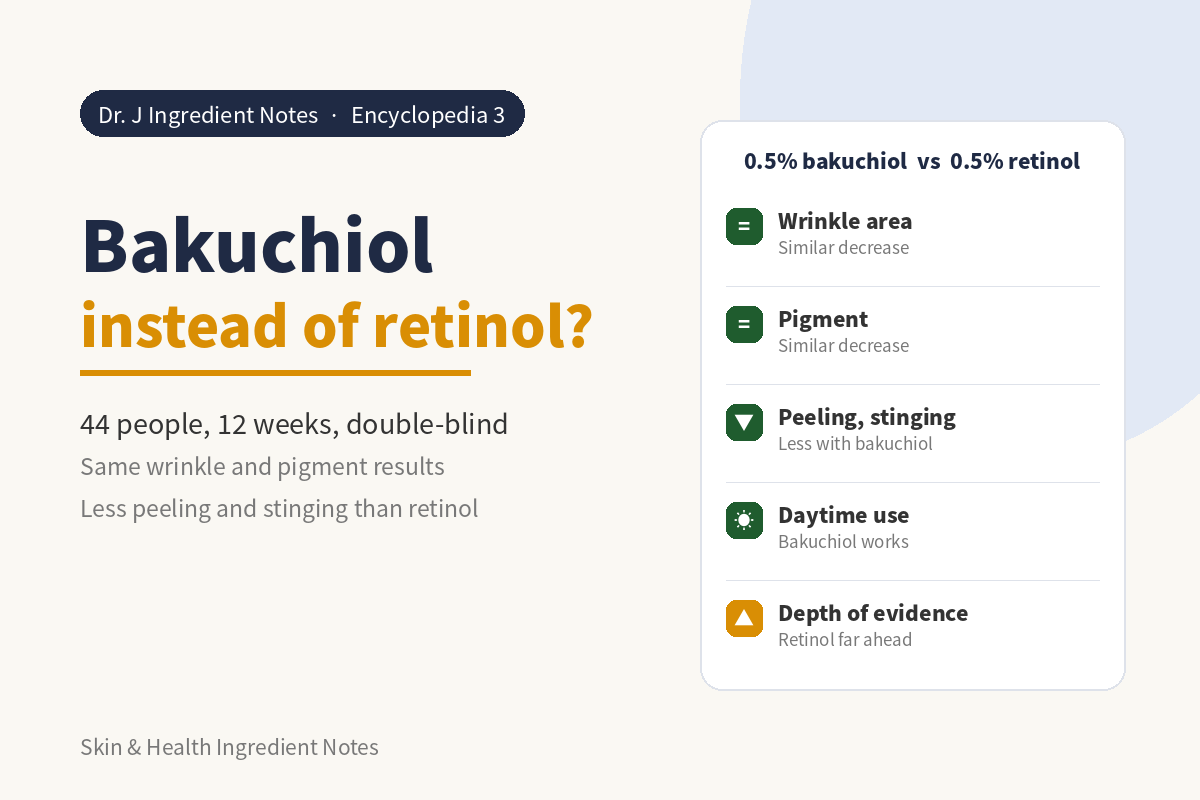
    Bakuchiol instead of retinol - 44 people, 12 weeks, double-blind: 0.5% bakuchiol twice daily matched 0.5% retinol on wrinkles and pigment with less peeling and stinging, Dr. J Ingredient Notes cover

    🇰🇷 이 글의 한국어판 → 한국어판

    Hello, I’m Dr. J.
    After writing the retinol piece I was left with two questions I had not answered.
    “What if I’m trying to conceive but still want an anti-ageing active?” and “What if retinol just stings too much?”

    The same name comes up both times: bakuchiol.
    Setting the marketing copy aside, here is what the human comparison studies actually found.


    The short version

    ✔ Bakuchiol is a compound from the seeds of a plant, Psoralea corylifolia. Its structure is nothing like retinol, yet it sends similar signals to skin cells
    ✔ 44 people, 12 weeks, double-blind — 0.5% bakuchiol twice a day vs 0.5% retinol once a day. No difference in wrinkle area or pigment
    ✔ Peeling and stinging were more common in the retinol group. That is the case for sensitive skin
    ✔ It is stable in light, so it works in the morning too, and because it is not a vitamin A derivative it comes up as a pregnancy option. Direct safety data is thin, so ask your doctor first
    ✔ Retinol has far more research behind it. If retinol is working for you, there is no reason to switch
     

    Where bakuchiol comes from

    It is isolated from the seeds of Psoralea corylifolia, known in Korean herbal medicine as bogolji.
    A 2014 study compared gene expression in skin cells and found a pattern close to retinol’s. That is where the label “a retinol-like functional compound” came from.
    It does not appear to work through retinoic acid receptors the way retinol does. That difference is where both the irritation story and the pregnancy story start.


    What three studies show – and where they stop

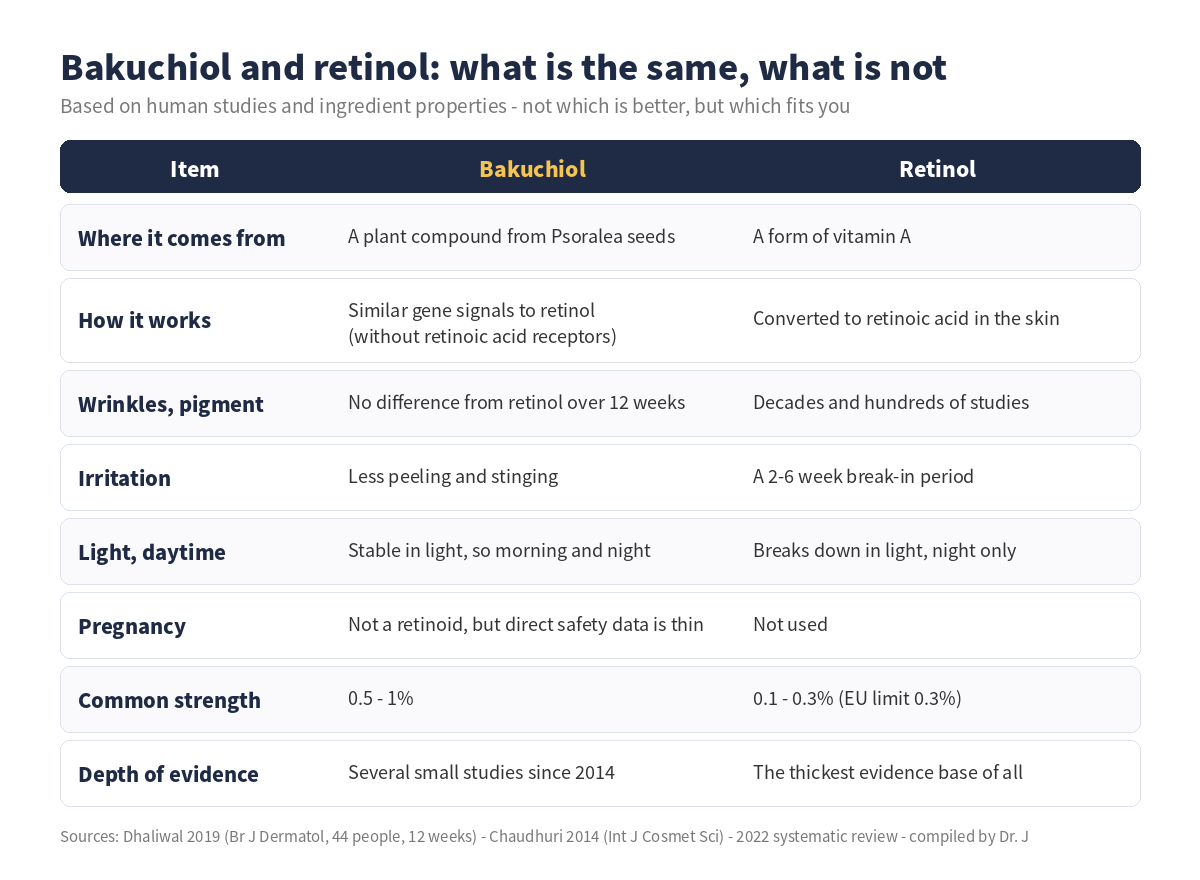
    Bakuchiol versus retinol comparison table - origin, mechanism, wrinkle and pigment results, irritation, daytime use, pregnancy, common strength and depth of evidence
    · 2014, the first clinical work — 0.5% bakuchiol for 12 weeks improved fine lines, pigment and elasticity. It was run by the ingredient supplier, so read it as supporting rather than decisive
    · 2019, head-to-head with retinol — 44 people, double-blind, published in the British Journal of Dermatology. Wrinkle area and pigment fell to a similar degree in both groups, and the retinol group reported more peeling and stinging
    · 2022, systematic review — seven studies from 2014 to 2021 (16 to 103 people, 0.05-1%). The results were consistent, with two reports of allergic contact dermatitis

    So the confirmed range is: over 12 weeks it works about as well as retinol, with less irritation.
    Studies running a year or longer, and large ones, still exist only on the retinol side.


    Who it suits

    ✔ Anyone who never got through retinol’s break-in period — the same direction of benefit without the peeling and stinging
    ✔ Trying to conceive, pregnant or breastfeeding — an option while vitamin A derivatives are off the table. Check with your doctor before you start
    ✔ Anyone who wants an anti-ageing active in the morning — it is stable in light, so it fits a daytime routine
    ✔ Anyone pairing it with retinol — there is evidence that bakuchiol slows retinol’s oxidation, and some products put both in one formula

    On the other hand, if retinol is already working for you, stay with it.
    There is no reason to trade away decades of research.


    How to choose it and how to use it

    ✔ Look for “bakuchiol” on the ingredient list — the studies used purified bakuchiol. If the list only says “Psoralea corylifolia seed oil or extract” you cannot know the strength, and the whole-plant material carries compounds that react to light, so purified material is the safer choice
    ✔ 0.5 to 1% — the comparison study used 0.5%. Pick a product that prints the number
    ✔ Twice a day — that is what the study did. At the serum step, morning and night
    ✔ Patch test on the inner arm first — contact dermatitis is rare but reported
    ✔ Give it 12 weeks — that is the period with evidence behind it. Sunscreen during the day
     

    One line

    Bakuchiol is retinol for people retinol does not suit.
    Over 12 weeks the results were similar and the irritation was lower. For pregnancy planning, sensitive skin or daytime use it can be the first choice; if retinol is working for you, stay where you are.

    ▶ Ingredient encyclopedia 1: Retinol: Start at 0.1% – How to Read the Concentration Numbers
    ▶ Ingredient encyclopedia 2: Niacinamide: 5% Is Enough
    ▶ Earlier post: Skincare Ingredient Compatibility Chart – What to Layer and What to Split
    ▶ Earlier post: Dull, Rough Skin? Glycolic Acid (AHA) – What the Research Shows
    🇰🇷 이 글의 한국어판 → 한국어판

    About the author · Dr. J
    MS in Veterinary Medicine, PhD in Life Sciences. I worked as a researcher at the Korea Research Institute of Bioscience and Biotechnology (KRIBB) and now run Beaurea, a cosmetics manufacturing company, where I write the formulas myself. This blog reads the research papers and the regulatory documents and turns them into plain-language criteria for choosing ingredients. I don’t recommend specific products here – only criteria that apply to any product.

    References
    1. Dhaliwal S et al. British Journal of Dermatology 2019;180(2):289-296 — 44 subjects, 12 weeks, double-blind. 0.5% bakuchiol twice daily vs 0.5% retinol once daily; no statistical difference in wrinkle area or pigmentation, more peeling and stinging in the retinol group
    2. Chaudhuri RK, Bojanowski K. International Journal of Cosmetic Science 2014;36(3):221-230 — gene expression profiling, 0.5% for 12 weeks, retinol stabilisation
    3. Applications of bakuchiol in dermatology: Systematic review of the literature (2022) — seven studies 2014-2021, 16-103 subjects, 0.05-1%; two cases of allergic contact dermatitis; direct pregnancy safety data lacking

    ※ This article is general information. Results vary with individual skin. It does not recommend or criticise any specific product. If you are pregnant, breastfeeding or being treated for a skin condition, talk to your doctor first. The author runs a company that manufactures and sells cosmetics.