
🇰🇷 이 글의 한국어판 → 한국어판
Hello, I’m Dr. J.
After writing the retinol piece I was left with two questions I had not answered.
“What if I’m trying to conceive but still want an anti-ageing active?” and “What if retinol just stings too much?”
The same name comes up both times: bakuchiol.
Setting the marketing copy aside, here is what the human comparison studies actually found.
The short version
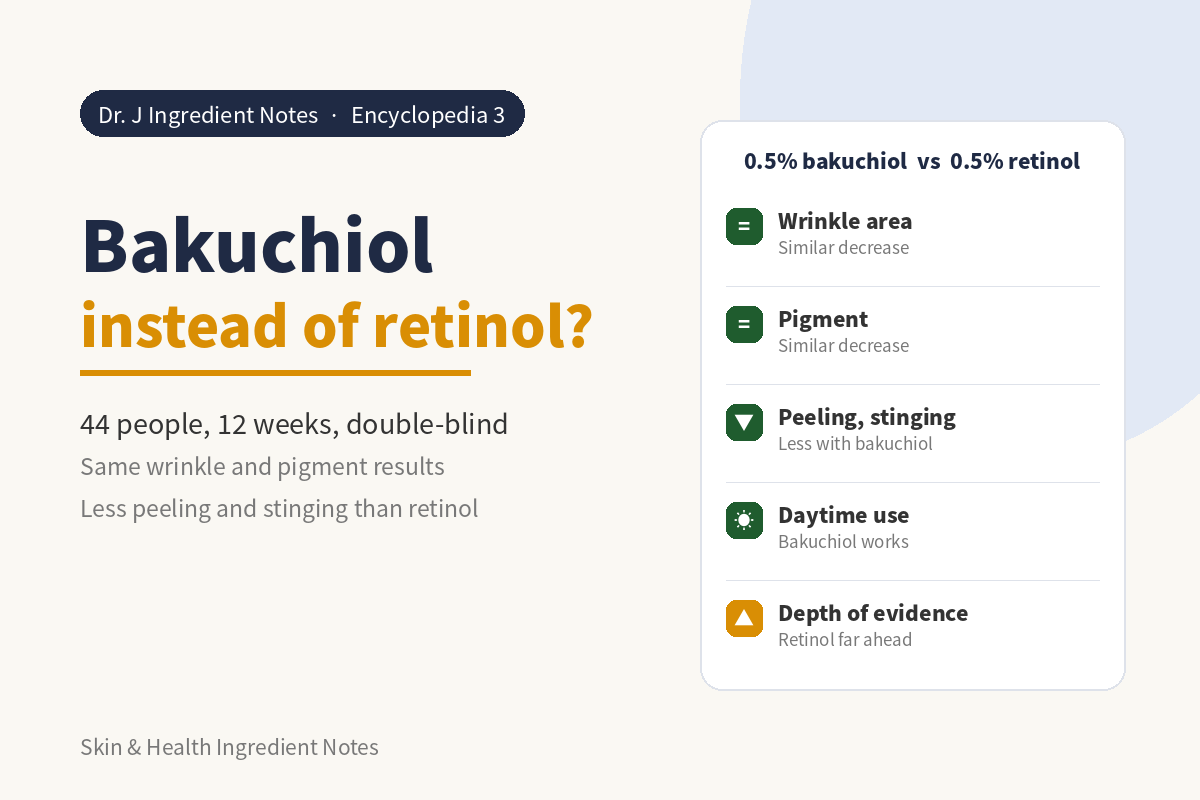
✔ 44 people, 12 weeks, double-blind — 0.5% bakuchiol twice a day vs 0.5% retinol once a day. No difference in wrinkle area or pigment
✔ Peeling and stinging were more common in the retinol group. That is the case for sensitive skin
✔ It is stable in light, so it works in the morning too, and because it is not a vitamin A derivative it comes up as a pregnancy option. Direct safety data is thin, so ask your doctor first
✔ Retinol has far more research behind it. If retinol is working for you, there is no reason to switch
Where bakuchiol comes from
It is isolated from the seeds of Psoralea corylifolia, known in Korean herbal medicine as bogolji.
A 2014 study compared gene expression in skin cells and found a pattern close to retinol’s. That is where the label “a retinol-like functional compound” came from.
It does not appear to work through retinoic acid receptors the way retinol does. That difference is where both the irritation story and the pregnancy story start.
What three studies show – and where they stop
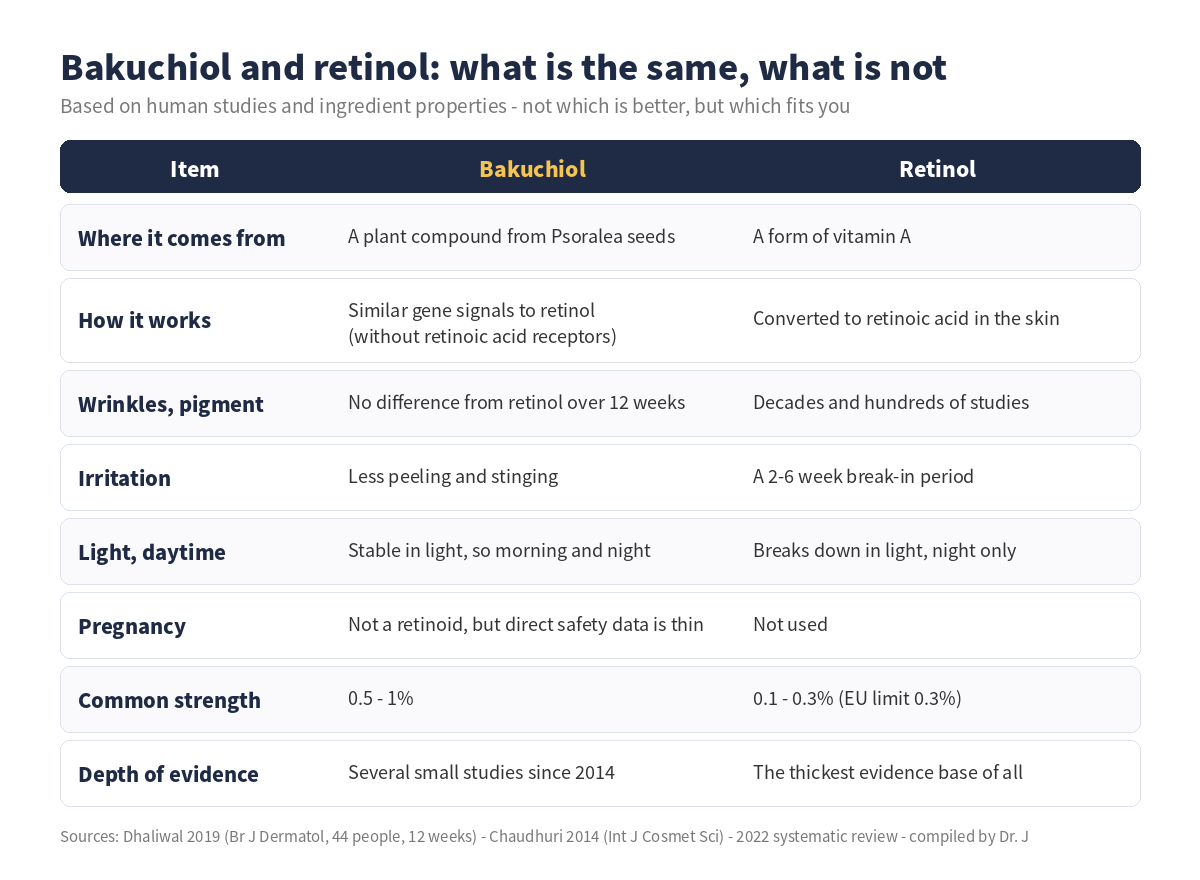
· 2019, head-to-head with retinol — 44 people, double-blind, published in the British Journal of Dermatology. Wrinkle area and pigment fell to a similar degree in both groups, and the retinol group reported more peeling and stinging
· 2022, systematic review — seven studies from 2014 to 2021 (16 to 103 people, 0.05-1%). The results were consistent, with two reports of allergic contact dermatitis
So the confirmed range is: over 12 weeks it works about as well as retinol, with less irritation.
Studies running a year or longer, and large ones, still exist only on the retinol side.
Who it suits
✔ Trying to conceive, pregnant or breastfeeding — an option while vitamin A derivatives are off the table. Check with your doctor before you start
✔ Anyone who wants an anti-ageing active in the morning — it is stable in light, so it fits a daytime routine
✔ Anyone pairing it with retinol — there is evidence that bakuchiol slows retinol’s oxidation, and some products put both in one formula
On the other hand, if retinol is already working for you, stay with it.
There is no reason to trade away decades of research.
How to choose it and how to use it
✔ 0.5 to 1% — the comparison study used 0.5%. Pick a product that prints the number
✔ Twice a day — that is what the study did. At the serum step, morning and night
✔ Patch test on the inner arm first — contact dermatitis is rare but reported
✔ Give it 12 weeks — that is the period with evidence behind it. Sunscreen during the day
One line
Over 12 weeks the results were similar and the irritation was lower. For pregnancy planning, sensitive skin or daytime use it can be the first choice; if retinol is working for you, stay where you are.
▶ Ingredient encyclopedia 1: Retinol: Start at 0.1% – How to Read the Concentration Numbers
▶ Ingredient encyclopedia 2: Niacinamide: 5% Is Enough
▶ Earlier post: Skincare Ingredient Compatibility Chart – What to Layer and What to Split
▶ Earlier post: Dull, Rough Skin? Glycolic Acid (AHA) – What the Research Shows
🇰🇷 이 글의 한국어판 → 한국어판
MS in Veterinary Medicine, PhD in Life Sciences. I worked as a researcher at the Korea Research Institute of Bioscience and Biotechnology (KRIBB) and now run Beaurea, a cosmetics manufacturing company, where I write the formulas myself. This blog reads the research papers and the regulatory documents and turns them into plain-language criteria for choosing ingredients. I don’t recommend specific products here – only criteria that apply to any product.
References
1. Dhaliwal S et al. British Journal of Dermatology 2019;180(2):289-296 — 44 subjects, 12 weeks, double-blind. 0.5% bakuchiol twice daily vs 0.5% retinol once daily; no statistical difference in wrinkle area or pigmentation, more peeling and stinging in the retinol group
2. Chaudhuri RK, Bojanowski K. International Journal of Cosmetic Science 2014;36(3):221-230 — gene expression profiling, 0.5% for 12 weeks, retinol stabilisation
3. Applications of bakuchiol in dermatology: Systematic review of the literature (2022) — seven studies 2014-2021, 16-103 subjects, 0.05-1%; two cases of allergic contact dermatitis; direct pregnancy safety data lacking
※ This article is general information. Results vary with individual skin. It does not recommend or criticise any specific product. If you are pregnant, breastfeeding or being treated for a skin condition, talk to your doctor first. The author runs a company that manufactures and sells cosmetics.
Leave a Reply