Tag: pores

  • Pores and Sebum in Korean Cosmetics: Five Ingredients, and the Test Method the Regulator Wrote Down

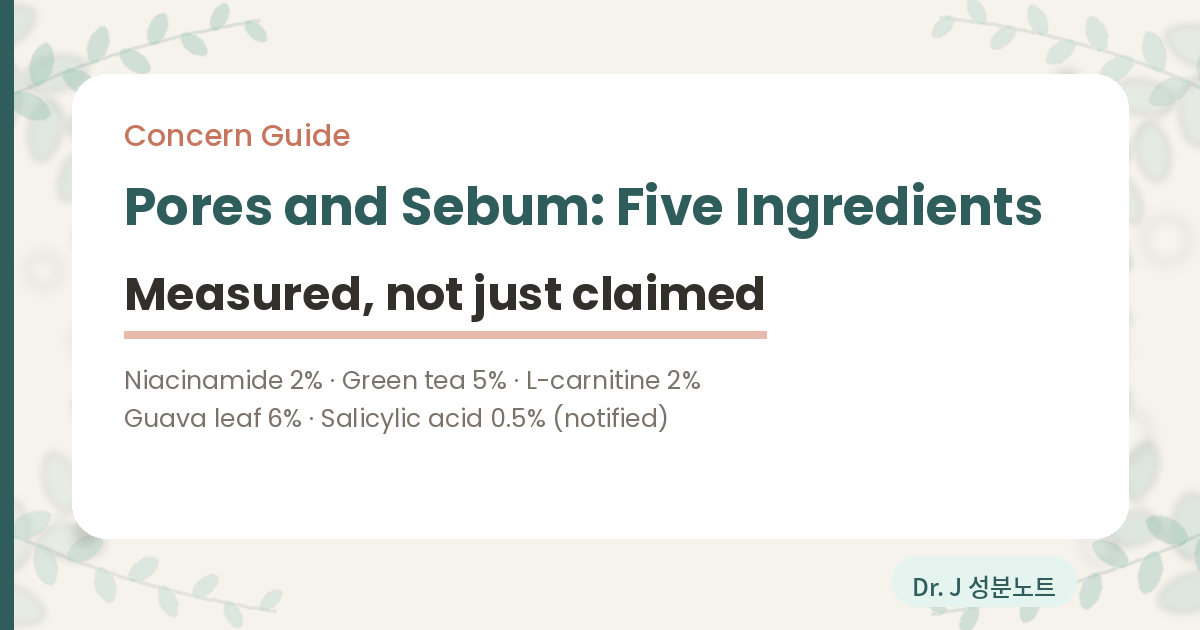
    Cover image for an article on pore and sebum claims in Korean cosmetics. Korea's functional cosmetic notice fixes ingredients and percentages for whitening with nine entries, wrinkles with four and acne with one, and it has no pore or sebum entry at all. A separate guideline from the Ministry of Food and Drug Safety, the Guideline on Test Methods for Substantiating Cosmetic Labelling and Advertising issued in March 2018, sets out ten claim types, and chapter three is sebum secretion control. A Sebumeter tape is pressed on the skin for thirty seconds and read as sebum per unit area in micrograms per square centimetre, with casual sebum level and sebum excretion rate measured separately. Pores are not among the ten. The five ingredients chosen here are niacinamide at two percent, green tea at five percent, L-carnitine at two percent, guava leaf at six percent and salicylic acid at zero point five percent, which is the notified acne ingredient. Cover image for Dr. J Ingredient Notes.

    🇰🇷 한국어판

    Hello, this is Dr. J. Today we look at the five ingredients worth knowing for oily skin and visible pores — chosen, in every case, from a human study that actually measured sebum.

    Here is the surprise. In Korea, “pores” is not one of the claims the regulator has written a test method for. “Sebum secretion control” is — down to the instrument, the number of seconds and the unit.

    ――――――――――――――――――――――――――――

    The primary sources

    📄 MFDS, Guideline on Test Methods for Substantiating Cosmetic Labelling and Advertising (March 2018, PDF, Korean)

    📄 Green tea, split-face study (Hippokratia 2013;17(1):64-67)

    📄 L-carnitine and EGCG (J Cosmet Dermatol 2023)

    📄 Regulation (EC) No 655/2013, common criteria

    Chapter 3 of the Korean guideline sets out the sebum procedure itself — the device, the thirty seconds, the unit, and the two values that are measured separately.

    ――――――――――――――――――――――――――――

    ――――――――――――――――――――――――――――

    In five lines

    ✔ Korea’s functional-cosmetic notice has no pore or sebum entry

    ✔ Yet a separate guideline sets out how sebum is measured — chapter 3 of ten

    ✔ Three ingredients here have measured sebum numbers

    ✔ One more study measured the nose and the forehead apart

    ✔ What the studies measured is sebum, not pore size

    ――――――――――――――――――――――――――――

    What Korea’s notified list does fix

    Korea’s Regulation on Functional Cosmetic Review carries an annex that fixes ingredient names and percentages. Formulate to that line and you are excused from filing fresh efficacy data — which also means the state has drawn the boundary of each claim.

    Claim What the annex fixes How to read it
    Whitening Nine ingredients with percentages (arbutin 2–5%, niacinamide 2–5%, and others) Both the name and the number are set
    Wrinkle improvement Four ingredients (retinol 2,500 IU/g, adenosine 0.04%, and others) The same
    Acne-prone skin relief One ingredient — salicylic acid 0.5% This is where blocked pores lead
    Pores and sebum No entry at all “Pore minimising” and “sebum control” have not been reviewed as claims

    That is not a ban. It means no authority has signed off on the wording. The same gap appeared in our piece on sensitive skin — but with pores and sebum there is a second document to open.

    ――――――――――――――――――――――――――――

    The claim without a method, and the claim with one

    The Ministry of Food and Drug Safety publishes a separate guidance document, the Guideline on Test Methods for Substantiating Cosmetic Labelling and Advertising (March 2018, guidance 0353-02). It gives each claim type its own chapter. There are ten.

    Chapter Claim Chapter Claim
    1 Skin moisturisation 6 Dark circle improvement
    2 Skin elasticity improvement 7 Skin blood circulation
    3 Sebum secretion control 8 Puffiness relief
    4 Temporary cellulite reduction 9 Paraben-free
    5 Suitable for acne-prone skin 10 Fine-dust protection

    Pores are not among the ten. The word appears once, in a footnote to chapter 5 that defines a comedo as a small sac formed when the opening of a sebaceous gland is blocked.

    ――――――――――――――――――――――――――――

    What chapter 3 actually says

    “A Sebumeter® is used. When the Sebumeter®, fitted with a special opaque plastic tape, is pressed on the skin with slight pressure for 30 seconds to collect sebum, the increase in the transparency of the tape is turned into a figure shown on the device, and that figure represents the amount of sebum per unit area (µg/cm²) collected.” — our translation of the Korean guideline, chapter 3

    What As the guideline sets it
    Device Sebumeter® — reads how far an opaque tape turns transparent
    Time 30 seconds of slight pressure on the skin
    Unit Sebum per unit area, µg/cm²
    Casual sebum level Measured as soon as the volunteer arrives, without washing — what has pooled on the skin
    Sebum excretion rate (SER) Measured after everyone washes with the same cleanser — how fast sebum returns
    Schedule A fixed body site, measured before and after application of the test material

    The split matters. “There is a lot of oil sitting there” and “oil comes back quickly” are different statements, and most of the studies below measured the second one.
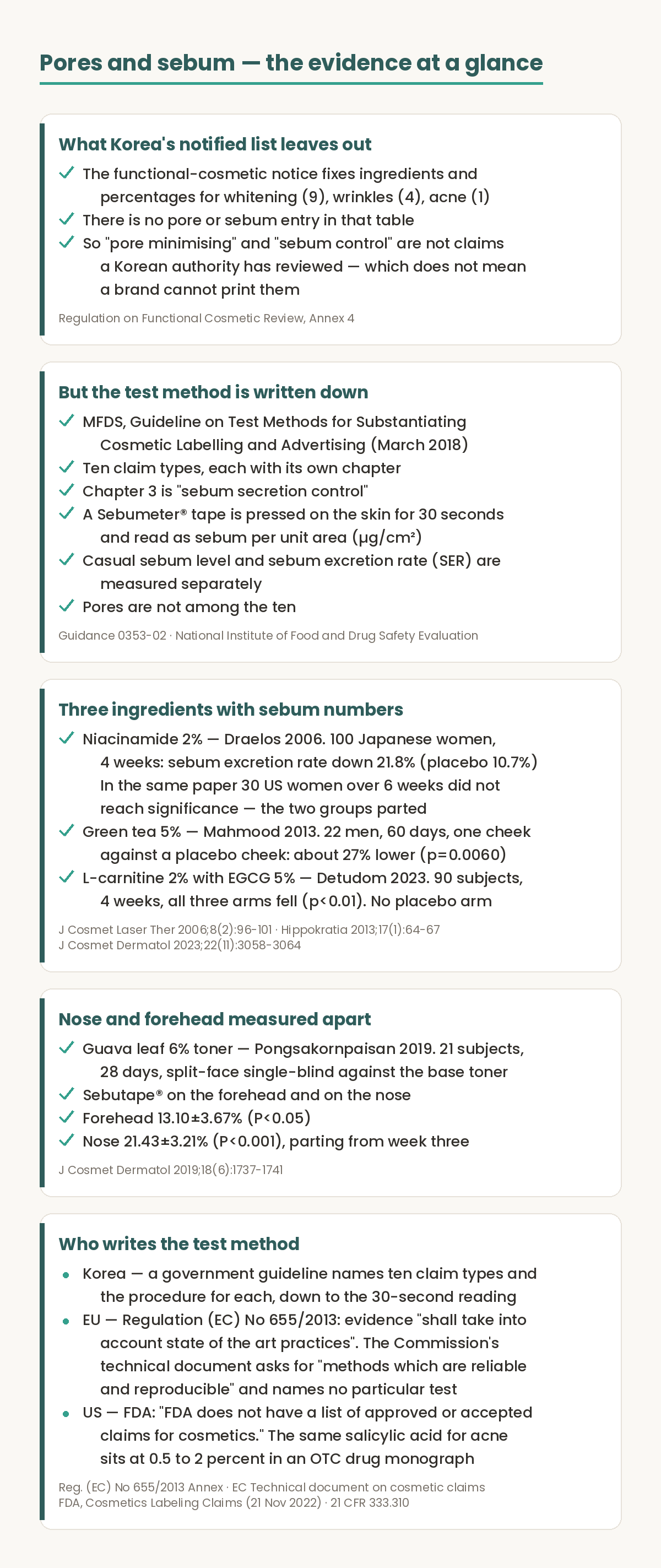
    Evidence summary for an article on pore and sebum claims in Korean cosmetics, in five cards. First, what Korea's notified list leaves out: the functional cosmetic notice fixes ingredients and percentages for whitening with nine entries, wrinkles with four and acne with one, there is no pore or sebum entry in that table, and so pore minimising and sebum control are not claims a Korean authority has reviewed, which does not mean a brand cannot print them. Second, the test method is written down: the Ministry of Food and Drug Safety guideline on test methods for substantiating cosmetic labelling and advertising, issued March 2018 as guidance 0353-02 by the National Institute of Food and Drug Safety Evaluation, sets out ten claim types each with its own chapter, chapter three is sebum secretion control, a Sebumeter tape is pressed on the skin for thirty seconds and read as sebum per unit area in micrograms per square centimetre, casual sebum level and sebum excretion rate are measured separately, and pores are not among the ten. Third, three ingredients with sebum numbers: niacinamide two percent in Draelos 2006, where one hundred Japanese women over four weeks showed sebum excretion rate down twenty one point eight percent against ten point seven percent on placebo, while in the same paper thirty United States women over six weeks did not reach significance, so the two groups parted; green tea five percent in Mahmood 2013, where twenty two men over sixty days applied the product to one cheek against a placebo cheek and sebum was about twenty seven percent lower with a p value of zero point zero zero six zero; and L-carnitine two percent with epigallocatechin gallate five percent in Detudom 2023, where ninety subjects over four weeks showed falls in all three arms with p below zero point zero one, although there was no placebo arm. Fourth, nose and forehead measured apart: a guava leaf six percent toner in Pongsakornpaisan 2019, with twenty one subjects over twenty eight days in a split face single blind comparison against the base toner, measured with Sebutape on the forehead and on the nose, giving forehead thirteen point one zero plus or minus three point six seven percent with P below zero point zero five and nose twenty one point four three plus or minus three point two one percent with P below zero point zero zero one, parting from week three. Fifth, who writes the test method: in Korea a government guideline names ten claim types and the procedure for each, down to the thirty second reading; in the European Union, Regulation (EC) No 655/2013 says evidence shall take into account state of the art practices, and the Commission's technical document on cosmetic claims asks for methods which are reliable and reproducible while naming no particular test; in the United States the Food and Drug Administration states that it does not have a list of approved or accepted claims for cosmetics, and the same salicylic acid for acne sits at zero point five to two percent in an over the counter drug monograph. All statements come from the sources named on each card.

    ――――――――――――――――――――――――――――

    Five ingredients in one table — including where each is weak

    Ingredient Study People · duration Compared with What was measured Where it is weak
    Niacinamide 2% Draelos 2006
    J Cosmet Laser Ther 8(2)
    100 Japanese women · 4 weeks
    30 US women · 6 weeks
    Placebo Sebum excretion rate down 21.8% (placebo 10.7%)
    At 2 weeks 21.3% (placebo 8.6%)
    The two groups parted — the US arm did not reach significance
    Green tea 5% Mahmood 2013
    Hippokratia 17(1)
    22 men (22–28) · 60 days One cheek against a placebo cheek About 27% lower (p=0.0060)
    Sebumeter SM 815
    22 men, and the raw µg/cm² values appear only in the figures
    L-carnitine 2%
    EGCG 5%
    Detudom 2023
    J Cosmet Dermatol 22(11)
    90 subjects, three arms · 4 weeks The three active arms against each other All three arms fell (p<0.01)
    The combination beat L-carnitine alone (p=0.009)
    No placebo arm · age and sex are not in the abstract
    Guava leaf 6% Pongsakornpaisan 2019
    J Cosmet Dermatol 18(6)
    21 subjects · 28 days Half the face against the base toner (single-blind) Sebutape®
    Forehead 13.10±3.67% (P<0.05) · nose 21.43±3.21% (P<0.001)
    The nose parted from week three
    21 subjects, and the abstract alone does not settle whether the percentages are against baseline or between arms
    Salicylic acid 0.5% Korean notice, Annex 4 — — The notified ingredient for acne-prone skin relief Regulatory ground, not a sebum measurement

    Read the table across and the yardstick appears. Numbers of people, duration and comparator give the same percentage a different weight.

    ――――――――――――――――――――――――――――

    The one ingredient Korea fixed by notice

    Item As the notice sets it
    Ingredient and level Salicylic acid 0.5%
    Form Solution · lotion · cream
    Claim “Helps relieve acne-prone skin”
    Directions Apply an appropriate amount and rinse off thoroughly with water straight away
    Age restriction
    Safety standards, Annex 2
    0.5% as salicylic acid, not for use in products for infants or products specifically labelled as usable by children aged 13 or under (shampoo excepted)

    Note the rinse-off in the directions. The form Korea reviewed is not a leave-on product. In the United States the same acid for acne is not a cosmetic ingredient at all — see the next table.

    ――――――――――――――――――――――――――――

    Who writes the test method — Korea, the EU and the US

    Korea EU United States
    List of claims For functional cosmetics the notice fixes ingredient and percentage; other claims appear on a separate substantiation list Not a list but six common criteria (Reg. (EC) No 655/2013) “FDA does not have a list of approved or accepted claims for cosmetics.“
    Test method Written out claim by claim — ten chapters, chapter 3 being sebum secretion control (Sebumeter® · 30 seconds · µg/cm²) Evidence “shall take into account state of the art practices“. The Commission’s technical document asks for “methods which are reliable and reproducible” and names no particular test No prescribed method. Labelling, including claims, “must be truthful and not misleading“
    Salicylic acid for acne A cosmetic — notified functional ingredient at 0.5% Handled inside the cosmetics regulation An OTC drug — 21 CFR 333.310 sets it at 0.5 to 2 percent
    Pores Neither in the notice nor among the ten test methods We found nothing set aside for it The same

    Put the three side by side and the axis is clear. Korea writes down what to measure and how; the EU sets a condition — reliable, reproducible, state of the art — and leaves the method to the field; the United States keeps no approved list at all. The clearest illustration is that the same salicylic acid is a cosmetic ingredient in Seoul and a drug ingredient in Washington.

    For a brand selling into Korea, that has a practical edge: the procedure your sebum claim will be read against is a public document, and it is specific enough to design a study from.

    ――――――――――――――――――――――――――――

    Four things to check on the box

    ✔ “Pore minimising” is not a reviewed claim — look for the number and the source

    ✔ What the studies measured is sebum, not pore diameter

    ✔ Check how many people and for how long — 21 and 100 are not the same weight

    ✔ Check whether there was a placebo arm — in one of these studies there was not

    ――――――――――――――――――――――――――――

    One line

    Pores have no measuring stick yet; sebum has one. Start with the side that carries numbers.

    ――――――――――――――――――――――――――――

    What I did not use, and why

    ✔ Trials that measured pore size — none of the human cosmetic studies I opened measured pores directly

    ✔ Procedures — randomised trials of botulinum toxin or microneedling for pores belong to a different article

    ✔ Retinol and pores — I opened two retinol trials; neither abstract reported a pore endpoint, and one compared against a prescription drug

    ✔ Folk claims — “pores never shrink once enlarged”, “cold water closes pores”: no primary source

    ✔ A fresh reading of the niacinamide paper — the literature databases were rate-limited on the day of writing, so the figures come from an earlier piece in which the full text was read

    About the author · Dr. J

    MS in Veterinary Medicine, PhD in Life Sciences. I worked as a researcher at the Korea Research Institute of Bioscience and Biotechnology (KRIBB) and now run Beaurea, a cosmetics manufacturing company, where I write the formulas myself. This blog reads the research papers and the regulatory documents and turns them into plain-language criteria for choosing ingredients. I don’t recommend specific products here – only criteria that apply to any product.

    📌 Related posts

    📌 Niacinamide: How Much Is Enough (Ingredient Guide 2) — the first ingredient here

    📌 Salicylic Acid (BHA): 0.5% vs 2%, Explained (Guide 8) — the notified 0.5% in full

    📌 AHA vs BHA: Is Glycolic Acid an AHA? (Guide 13) — the blocked-keratin side

    📌 How to Read a Korean Cosmetic Ingredient List (Guide 14) — finding the names on the pack

    📄 Sources

    · MFDS, Guideline on Test Methods for Substantiating Cosmetic Labelling and Advertising (civil-petition guidance 0353-02, March 2018), chapter 3

    · Regulation on Functional Cosmetic Review, Annex 4 · Regulation on Safety Standards for Cosmetics, Annex 2

    · Draelos ZD, Matsubara A, Smiles K. J Cosmet Laser Ther 2006;8(2):96-101

    · Mahmood T, Akhtar N, Moldovan C. Hippokratia 2013;17(1):64-67

    · Detudom P et al. J Cosmet Dermatol 2023;22(11):3058-3064 · Pongsakornpaisan P et al. ibid. 2019;18(6):1737-1741

    · Regulation (EC) No 655/2013, Annex (common criteria) · European Commission, Technical document on cosmetic claims

    · U.S. FDA, “Cosmetics Labeling Claims” (current as of 21 November 2022) · 21 CFR 333.310

    ――――――――――――――――――――――――――――

    This article summarises published studies and regulatory documents and is not a substitute for diagnosis or treatment. The Korean legal database was unavailable on the day of writing, so the notice figures come from earlier pieces in which the originals were read, and the niacinamide paper was not reopened. Translations of the Korean guideline are mine. Ingredient names and concentrations are given as criteria for choosing a product, not as a recommendation of any particular one.

    — Dr. J Ingredient Notes
  • Salicylic Acid (BHA): 0.5% vs 2%, Explained – Why the Label Numbers Differ (Ingredient Guide 8)

    Cover image for Ingredient Guide 8 on salicylic acid (BHA): how to read the 0.5 percent, 2 percent and 3 percent limits on Korean cosmetic labels, and what an 8-week trial in 30 people with acne found. Dr. J Ingredient Notes.

    Hello, this is Dr. J.

    Ingredient Guide number eight is salicylic acid – the ingredient most labels shorten to BHA.

    If you shop for acne or pore products, you will see this name often. What you will also see is that the number on the back changes from product to product: 2% on one cleanser, 0.5% on a toner, 3% on a scalp product.

    Here is the surprising part. In Korea, salicylic acid does not have one limit. The same ingredient is capped at 0.5%, 2% or 3% depending on what it is used for. This post explains how to read those numbers, and then walks through two 8-week trials.

    🇰🇷 Read this in Korean: 살리실산 BHA, 0.5%와 2% 읽는 법 (성분 백과 ⑧)

    ―――――――――――――――――――――

    📄 Read the sources first

    · Korea MFDS, Regulation on Cosmetic Safety Standards, Annex 2 – restricted ingredients (Korean)

    · Bilal H et al., Pharmaceuticals 2023 – 30 people with acne, 2% gel, 8 weeks (open access)

    · Li S et al., J Cosmet Dermatol 2023 – randomized trial of a salicylic acid serum, 8 weeks

    · Arif T, Clin Cosmet Investig Dermatol 2015 – review (open access)

    · 🏠 COSMILE Europe INCI database – type the name exactly as it appears on the label

    Annex 2 lists the limit for each product category on one line, with a note about children’s products. Salicylic acid appears in two tables – preservatives and other restricted ingredients – so check both.

    ―――――――――――――――――――――

    15-second summary · no sound

    ―――――――――――――――――――――

    The four lines, if you are in a hurry

    ✔ Salicylic acid is lipid-soluble, so it mixes with sebum. That is where it parts ways with water-soluble AHAs

    ✔ The 0.5% · 2% · 3% on Korean labels are not strength levels – they are use categories: preservative, rinse-off cleanser active, rinse-off hair-product active

    ✔ 30 people with acne used a 2% gel twice daily for 8 weeks: lesion counts and severity scores fell significantly

    ✔ In a randomized trial, 83 people completed 8 weeks of a salicylic acid serum: pore density, sebum and comedones improved

    ―――――――――――――――――――――

    Lipid-soluble – where BHA parts ways with AHA

    Salicylic acid is a beta hydroxy acid, BHA. The name looks like glycolic acid (AHA), which I covered in Guide 2, but the two behave differently.

    ✔ Glycolic acid dissolves in water – it works at the skin surface

    ✔ Salicylic acid dissolves in oil – it mixes with sebum and reaches into the pore

    A 2015 review puts it this way: salicylic acid, unlike the alpha hydroxy acids, is a lipid-soluble agent, miscible with the lipids of the epidermis and with the sebaceous-gland lipids inside hair follicles. That is why it comes up for comedone-prone skin. The review also places its calming, anti-inflammatory action in the 0.5–5% range – Arif T, 2015.

    So the question is less “AHA or BHA, which is better?” and more “is my concern at the surface, or in the pore?” Dullness and rough texture have the AHA evidence; sebum and comedones have the BHA evidence.

    ―――――――――――――――――――――

    How to read the numbers – 0.5%, 2% and 3% are use categories

    A higher number does not mean a stronger product. Korea’s cosmetic safety standard (Annex 2) sets a separate limit for each use. I read the Korean text and keep the categories as written; other markets set their own limits.

    Number on the label Used as Product type
    0.5% Preservative Limit in the preservatives table
    2% Active in a “functional cosmetic” Rinse-off cleansers for the body and face
    3% Active in a “functional cosmetic” Rinse-off hair products

    The same table adds two notes.

    ✔ Not permitted in products for infants, or in products labeled as suitable for children aged 13 and under (shampoo excepted)

    ✔ The 2% and 3% limits apply only when the product has been reviewed as a functional cosmetic; other products may not use it as an active

    “Functional cosmetic” is a Korean regulatory category – a product whose specific claim, such as “soothes acne-prone skin,” has been reviewed by the MFDS. That is why 2% in Korea almost always appears on a rinse-off cleanser with that claim. The small numbers on leave-on toners and serums are either within the preservative limit or belong to a related ingredient with a different name – see the next table.

    ―――――――――――――――――――――

    Finding it on the ingredient list – four names in the salicylic family

    Name on the list (INCI) What it is
    Salicylic Acid The ingredient itself. The limits above apply to this name
    Capryloyl Salicylic Acid (LHA) Salicylic acid with a fatty-acid tail attached. It was paired with salicylic acid in the 83-person serum trial
    Betaine Salicylate Salicylic acid combined with betaine. Common in leave-on products, especially Korean ones
    Salix Alba (Willow) Bark Extract A plant extract. Not salicylic acid itself, so it sits outside the limits above

    A different name means a different limit and a different body of research. Read the numbers in this post against the Salicylic Acid line only.

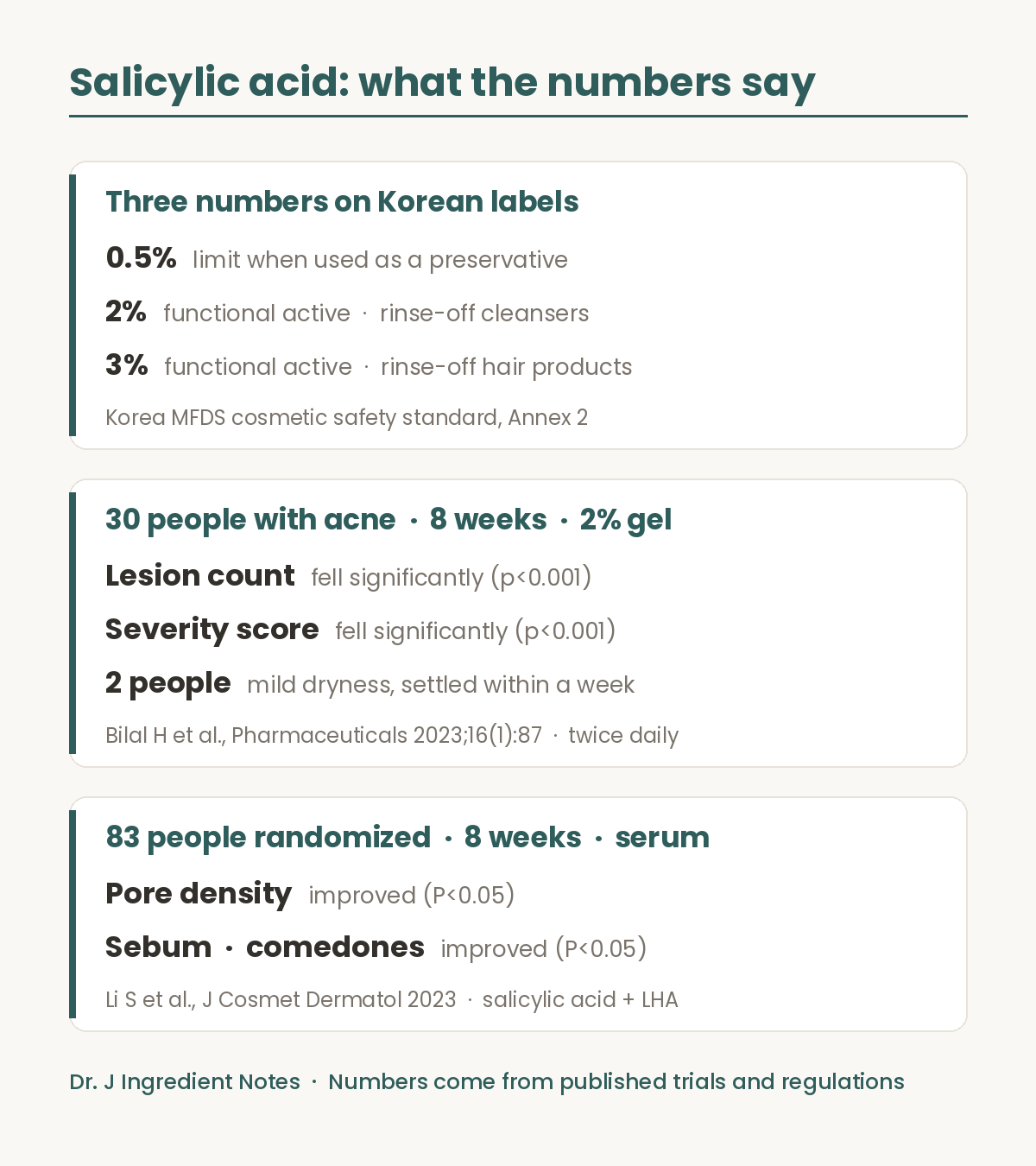
    Salicylic acid evidence summary. Three numbers on Korean labels - 0.5 percent as a preservative, 2 percent as a functional active in rinse-off cleansers, 3 percent in rinse-off hair products, from the Korean cosmetic safety standard Annex 2. What the research found - 30 people with acne used a 2 percent gel twice daily for 8 weeks and lesion counts and severity scores fell significantly, Pharmaceuticals 2023. In a randomized trial 83 people completed 8 weeks of a salicylic acid plus LHA serum and pore density, sebum and comedones improved, Journal of Cosmetic Dermatology 2023.

    ―――――――――――――――――――――

    What the research found – 30 people for 8 weeks, 83 people for 8 weeks

    First, 30 people with acne. Thirty acne patients – 12 men and 18 women, average age 22 – used a 2% salicylic acid gel twice daily for 8 weeks, alongside a control group of 10. Total lesion counts and the Global Acne Grading System (GAGS) score fell significantly (p<0.001). Two people had mild dryness and flaking that settled within a week – Bilal et al., Pharmaceuticals 2023. The paper is open access, so the tables are one click away above.

    Second, 93 people randomized. A serum containing salicylic acid and lipohydroxy acid was tested over 8 weeks; 93 people were randomized and 83 completed. One group used the serum, the other added a mask. Both groups improved on acne severity, skin-tone evenness, pore density, pigmentation, sebum output, comedones and hydration (P<0.05); the mask group did slightly better on closed comedones and acne severity. No adverse events were reported – Li et al., J Cosmet Dermatol 2023.

    Study People · duration What was used What was found
    Bilal 2023 30 · 8 weeks 2% gel, twice daily Lesion count and severity score fell (p<0.001)
    Li 2023 93 randomized · 83 completed · 8 weeks Salicylic acid + LHA serum (± mask) Pore density, sebum, comedones improved (P<0.05)
    Arif 2015 Review — Lipid-soluble; calming action in the 0.5–5% range

    Both trials ran for 8 weeks. It is not an ingredient to judge after a few days. And with 30 and 83 participants, both are real but small – I would not stretch them to “works for everyone.” This post stays with cosmetic use and leaves professional peel studies aside.

    ―――――――――――――――――――――

    How to use it – order and pairing

    ✔ Start at 2–3 nights a week. If skin feels dry or stings, cut back

    ✔ A rinse-off product goes in the cleansing step; a leave-on product goes right after cleansing, followed by moisturizer

    ✔ On nights you use glycolic acid (AHA) or retinol, alternate the days. Do not stack all three in one evening

    ✔ Soothing and barrier ingredients – niacinamide, ceramides, panthenol – can sit in the same routine

    ✔ Wear sunscreen the next morning

    ✔ If you are pregnant or sensitive to aspirin, ask a professional before starting

    The ingredient compatibility chart shows which pairs can share a night and which should be split.

    ―――――――――――――――――――――

    Five things to check before you buy

    ✔ Is it rinse-off or leave-on? – that is where the limits split

    ✔ Is the name “Salicylic Acid,” or one of the related names? – check the four-name table above

    ✔ Where does it sit on the ingredient list? – higher means more. Ingredients at 1% or below may be listed in any order, so a low position is not unusual

    ✔ Is there a percentage on the front? – if not, the list order is your only clue

    ✔ Is the product labeled for children 13 and under? – in Korea it cannot contain salicylic acid (shampoo excepted)

    Save these five lines for the store. Reading the back takes about five minutes.

    ―――――――――――――――――――――

    In one line

    🧪 Salicylic acid works because it is lipid-soluble. The number on the label tells you the use, not the strength – and two 8-week trials show what it did for lesions, pores and sebum.

    Next in the Ingredient Guide: tranexamic acid (Guide 9) – the name that keeps coming up for dark spots.

    📌 Earlier posts

    · Dull, Rough Skin? Glycolic Acid (AHA) – What the Research Shows and How Much Is Safe

    · Retinol: Start at 0.1% – How to Read the Concentration Numbers (Ingredient Guide 1)

    · Skincare Ingredient Compatibility Chart – 12 Ingredients, What to Layer and What to Split

    About the author · Dr. J

    MS in Veterinary Medicine, PhD in Life Sciences. I worked as a researcher at the Korea Research Institute of Bioscience and Biotechnology (KRIBB) and now run Beaurea, a cosmetics manufacturing company, where I write the formulas myself. This blog reads the research papers and the regulatory documents and turns them into plain-language criteria for choosing ingredients. I don’t recommend specific products here – only criteria that apply to any product.

    📄 References

    · Korea MFDS, Regulation on Cosmetic Safety Standards, Annex 2 – Salicylic Acid and its salts

    · Bilal H et al., Pharmaceuticals 2023;16(1):87 – 2% salicylic acid gel, 30 people, 8 weeks

    · Li S et al., J Cosmet Dermatol 2023 – randomized trial of a salicylic acid/LHA serum, 93 randomized, 83 completed, 8 weeks

    · Arif T, Clin Cosmet Investig Dermatol 2015;8:455-461 – review

    This post summarizes published research and public documents for information only. It is not a substitute for diagnosis or treatment. If you have a concern, please consult a professional.

    — Dr. J Ingredient Notes