Tag: korea cosmetics regulation

  • Vegan Cosmetics in Korea: The Three Requirements an Industry Guide Set, and the One Line a Korean Label Cannot Print (Ingredient Guide 21)

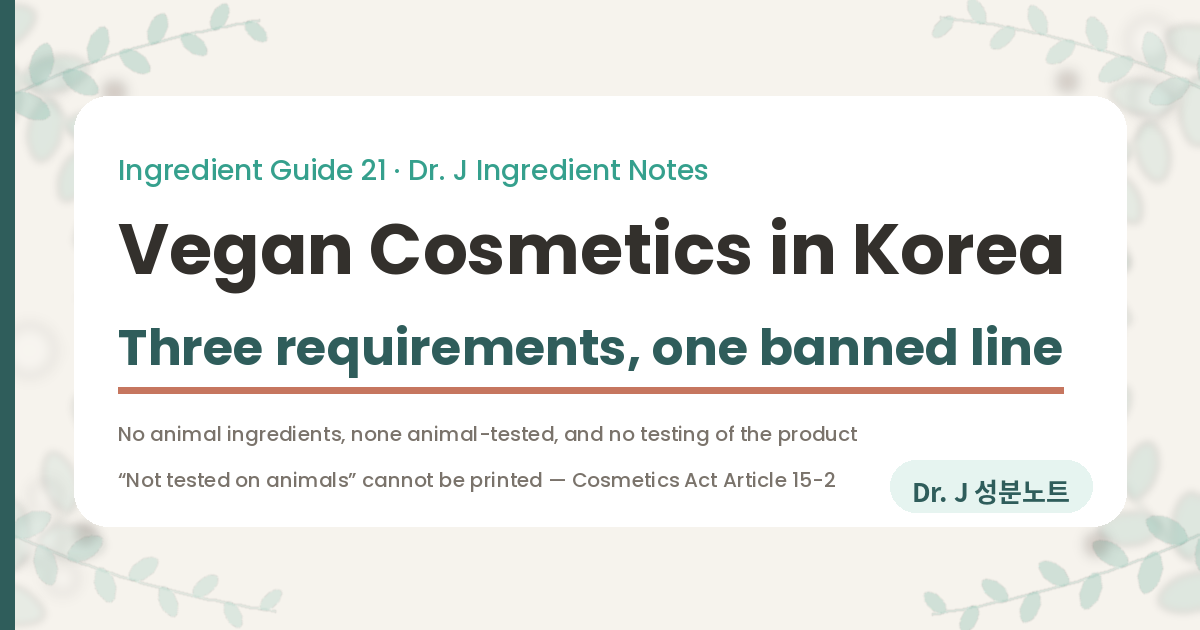
    Cover image for a Dr. J Ingredient Notes article on vegan cosmetics in Korea. It shows the title Vegan Cosmetics in Korea, the line three requirements and one banned line, the three requirements set by a 2025 industry guide from the Korea Cosmetic Association, and a note that the phrase not tested on animals cannot be printed on a Korean label because Article 15-2 of the Cosmetics Act already bans selling animal-tested cosmetics.

    🇰🇷 한국어판 읽기

    Hello, this is Dr. J. A Korean cosmetic box that says vegan almost never says “not tested on animals” beside it. Shoppers read the gap as a gap. It is not one — it is a rule.

    Here is the part most summaries skip. No statute anywhere defines the word “vegan” for cosmetics — not in Korea, not in the EU, not in the United States. What differs between the three is what fills that empty space, and what a label is allowed to print next to the word.

    ――――――――――――――――――――――――――――

    Primary sources

    📄 Guide to Vegan Labelling and Advertising of Cosmetics, 2025 (Korea Cosmetic Association, PDF, Korean)

    📄 Cosmetics Act Article 15-2 (Korean Law Information Center)

    📄 Regulation (EU) No 655/2013, common criteria for cosmetic claims (EUR-Lex)

    📄 “Cruelty Free”/“Not Tested on Animals” (U.S. FDA)

    The Korean guide runs to a few pages and has three chapters: purpose, scope, and criteria. The EU regulation carries the six common criteria in its Annex.

    ――――――――――――――――――――――――――――

    ――――――――――――――――――――――――――――

    The five lines, if you are in a hurry

    ✔ “Vegan” is not defined in Korean law — a 2025 industry guide sets the requirements

    ✔ A product must meet all three: no animal ingredient, none animal-tested, and no testing of the finished product

    ✔ Ingredients processed with micro-organisms are allowed — fermentation does not break a vegan claim

    ✔ Share a production line with a non-vegan batch and you wash it thoroughly first

    ✔ A Korean label cannot print “not tested on animals” — the sale is already banned, so the claim would mislead

    ――――――――――――――――――――――――――――

    The word is not in the statute — a 2025 industry guide fills the gap

    Search the Korean Cosmetics Act for “vegan” and nothing comes back. The text that does define it was issued in 2025 by the advertising advisory committee of the self-regulatory review body run by the Korea Cosmetic Association. The guide says of itself that it exists to give advertisers “the minimum requirements for making a vegan claim.”

    Its scope is a single line: “This guide applies to cosmetics that are labelled or advertised as vegan.” A product that does not make the claim is outside it.

    What the guide requires What it means on a shelf
    1 A cosmetic that contains no ingredient of animal origin The ingredient side. Honey, beeswax and lanolin are the familiar examples
    2 A cosmetic that contains no ingredient tested on animals under the Cosmetics Act The ingredient’s history, which never appears on the ingredient list
    3 A cosmetic not itself tested on animals under the Cosmetics Act The finished product, not only its parts
    All “A cosmetic that satisfies all of the requirements below” Miss one and the word may not be printed

    ※ The clause numbers inside the guide do not survive text extraction from the PDF, so this article names the chapters rather than the subparagraphs.

    ――――――――――――――――――――――――――――

    Ingredients, manufacturing, substantiation — the three chapters that follow

    After the definition the guide sets out how to keep to it. The second line below is the one that surprises formulators.

    Chapter The guide’s wording Reading
    Ingredient standard “Ingredients of animal origin and ingredients that have been tested on animals shall not be used. An ingredient that has been processed with micro-organisms not derived from animals (bacteria, yeasts, fungi and the like) may be used.” A fermented ingredient does not break a vegan claim. Using a micro-organism is not the same as using an animal
    Manufacturing and control “Ingredients of animal origin shall be kept from entering a vegan product during manufacture. For example, where a vegan and a non-vegan product are made on the same equipment, machines, equipment, tools and contact surfaces shall be washed thoroughly before the vegan product is made.” A dedicated line is not required. Cleaning is accepted in its place
    Substantiation “A cosmetic labelled or advertised as vegan shall be able to substantiate that it meets the criteria.” Making the claim means holding the file. It runs on the same track as Article 14 of the Cosmetics Act

    The guide cites, as its legal footing, Articles 10, 13 and 14 of the Cosmetics Act with Articles 19, 22 and 23 of the Enforcement Rule and its Annex 5 — and Article 15-2. The guide itself carries no penalty; those provisions do.

    ――――――――――――――――――――――――――――

    What may be said, and what may not

    Two of the four rows below are the ones a brand entering Korea tends to get wrong.

    Situation What the guide sets On the box
    The finished product meets the criteria It may be labelled and advertised as vegan The word describes one finished product
    Only some ingredients meet them “A product may not be labelled or advertised as a vegan cosmetic on the basis of particular ingredients alone, rather than the finished product, even where those ingredients meet the criteria.” “Made with vegan ingredients” and “vegan cosmetic” are different claims
    “Not tested on animals” “Although the distribution and sale of cosmetics tested on animals … is prohibited, wording such as ‘not tested on animals’, which could lead consumers to believe that animal-tested cosmetics are also on the market, may not be used.” Its absence is not an omission — the phrase is not permitted
    Certification marks The guide carries no rule on certifying bodies or marks A mark tells you whose standard was met, which you check separately

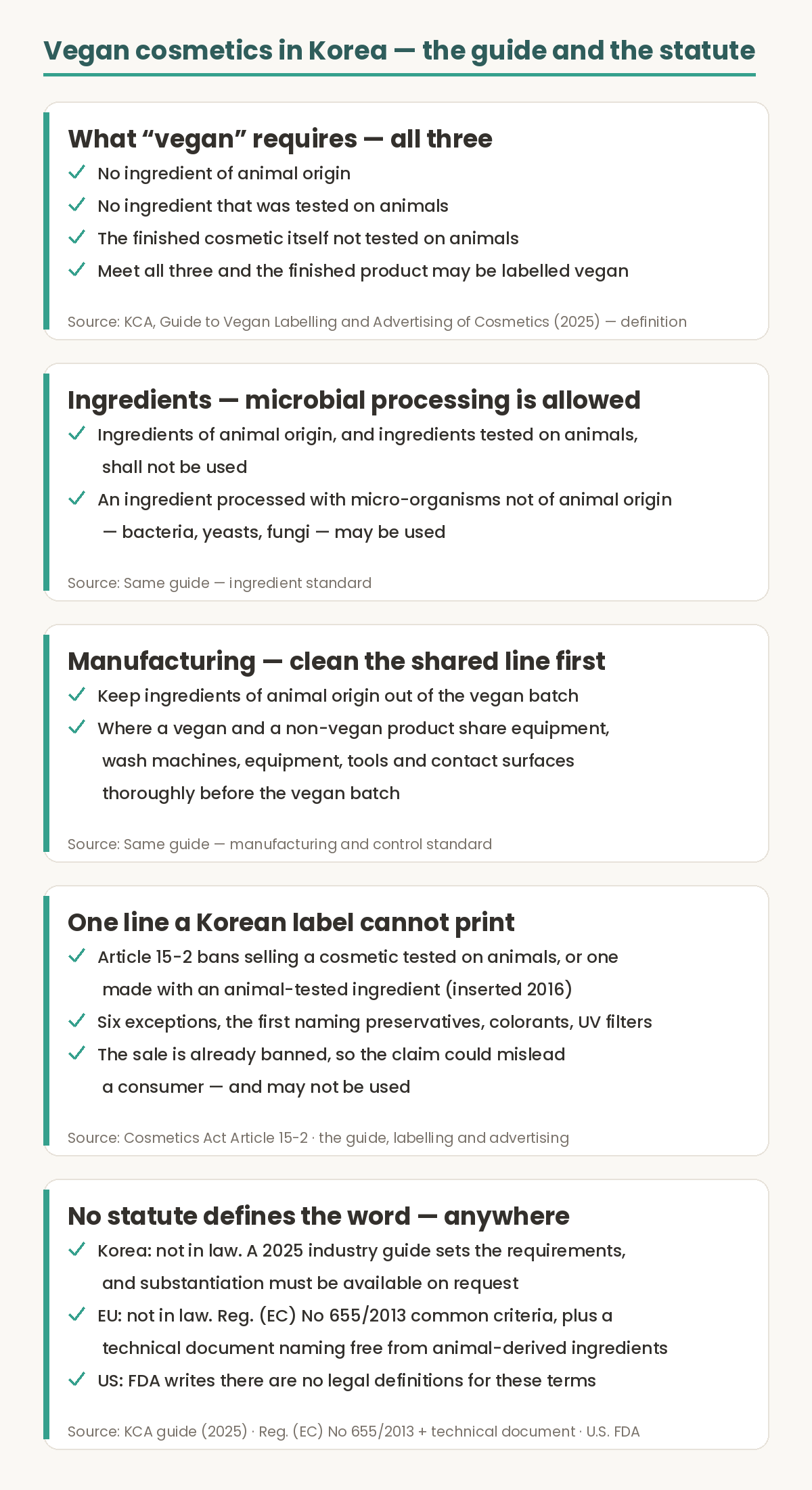
    Evidence figure on vegan cosmetics in Korea, in five parts. First, what vegan requires: all three of no ingredient of animal origin, no ingredient tested on animals, and the finished cosmetic itself not tested on animals; meet all three and the finished product may be labelled vegan. The source is the Korea Cosmetic Association Guide to Vegan Labelling and Advertising of Cosmetics, issued in 2025. Second, the ingredient standard: ingredients of animal origin and ingredients tested on animals shall not be used, while an ingredient processed with micro-organisms not derived from animals, that is bacteria, yeasts or fungi, may be used. Third, the manufacturing and control standard: keep ingredients of animal origin out of the vegan batch, and where a vegan and a non-vegan product share equipment, wash machines, equipment, tools and contact surfaces thoroughly before the vegan batch. Fourth, one line a Korean label cannot print: Article 15-2 of the Cosmetics Act bans distributing or selling a cosmetic tested on animals or one made with an animal-tested ingredient, inserted in 2016, with six exceptions, the first of which names preservatives, colorants and ultraviolet filters; because the sale is already banned, a not-tested-on-animals claim could mislead a consumer and so may not be used. Fifth, no statute defines the word anywhere: in Korea it is not in law and a 2025 industry guide sets the requirements with substantiation available on request, in the European Union it is not in law and Regulation 655 of 2013 sets common criteria alongside a technical document naming free from animal-derived ingredients, and in the United States the Food and Drug Administration writes that there are no legal definitions for these terms.

    ――――――――――――――――――――――――――――

    The statute behind the banned line — Cosmetics Act Article 15-2

    The reason the phrase is off-limits sits in the statute. Korea already bans the sale, so printing the claim would suggest that products without it are the tested ones.

    Paragraph The provision Reading
    (1), main text “A cosmetics responsible distributor or a customised cosmetics seller shall not distribute or sell a cosmetic on which animal testing under Article 2(1) of the Laboratory Animal Act has been conducted, or a cosmetic manufactured (including contract manufacture) or imported using an ingredient on which animal testing has been conducted.” What is blocked is selling. “Including contract manufacture” sits in brackets, and imports are in the same sentence
    (1), proviso “Provided, that this shall not apply in any of the following cases” (amended 13 Mar 2018, 17 Aug 2021) Six exceptions follow (next table)
    (2) “The Minister of Food and Drug Safety shall endeavour to develop alternative test methods and shall take the measures necessary for cosmetics responsible distributors and others to use them.” The duty that pairs with the ban, and the provision that narrows exception 2
    Inserted [This Article Newly Inserted on 3 February 2016] Reported as in force from 4 February 2017; we could not open the addendum itself

    The six exceptions, as the statute words them:

    No. The provision In short
    1 Where necessary to designate standards of use for ingredients requiring particular restriction — preservatives, colorants, ultraviolet filters and the like under Article 8(2) — or to carry out a risk assessment under Article 8(3) of ingredients raising public-health concerns Safety work. Three ingredient classes are named
    2 Where animal testing is necessary because no alternative test method exists (an alternative test method being a method that uses no animals, or that reduces the number of animals used or lessens their pain, recognised as such by the Minister of Food and Drug Safety) Nothing else will do. The definition sits inside the provision
    3 Where animal testing is required by the law of the country of export The receiving market demands it
    4 Where animal testing is required for product development by the law of the country of import The sourcing market demands it
    5 Where an ingredient developed through animal testing under another statute is used in manufacturing a cosmetic A pharmaceutical-track ingredient, for instance
    6 Other cases, designated by the Minister of Food and Drug Safety, where an alternative test is impracticable Room left for a ministry notice

    The penalty is an administrative fine of up to KRW 1 million under Article 40(1)7. Translations of the Korean provisions here are ours.

    ――――――――――――――――――――――――――――

    Korea, the EU and the United States — one word, three situations

    Set the three side by side and the pattern is clear. None of them defines the word. What differs is what stands in for a definition, and whether the adjacent claim is allowed.

    Korea European Union United States
    Is “vegan” defined in law? No. A 2025 industry guide sets three requirements No. Regulation (EU) No 655/2013 sets six common criteria for every claim No. FDA: “there are no legal definitions for these terms”
    What fills the gap A self-regulatory guide, plus a substantiation file Criterion 6, informed decision-making, and a technical document listing “‘free from animal-derived ingredients’, e.g. in products intended for vegans” among acceptable claims Nothing. The claim is left to the company
    “Not tested on animals” May not be printed — Article 15-2 already bans the sale Permitted if the six criteria are met; Regulation (EC) No 1223/2009 Article 18 bans the testing itself Unrestricted. FDA notes firms “may rely on raw material suppliers or contract laboratories to perform any animal testing necessary”
    Who holds the evidence The advertiser — “shall be able to substantiate” The responsible person, in the product information file (Article 2 of 655/2013) The company, by whatever means it chooses

    For a brand, the practical reading is that Korea regulates the words around the claim rather than the claim itself. A pack artwork that pairs “vegan” with “not tested on animals” passes in the EU and the United States and fails in Korea — and the Korean reason is not that the statement is false, but that it is already true of everything on the shelf.

    The EU technical document is worth one caution. It carries the line “IT IS NOT A EUROPEAN COMMISSION DOCUMENT” and is dated as a version of 3 July 2017, agreed by a sub-working group. It is guidance on how to apply the six criteria, not a statute.

    ――――――――――――――――――――――――――――

    Four things to check on a Korean box

    ✔ Next to “vegan”, look for which standard or certifier is named

    ✔ “Made with vegan ingredients” is not the same claim as “vegan cosmetic”

    ✔ A missing “not tested on animals” is not a missing feature — the phrase is not allowed

    ✔ Whether a product is gentle is a question of ingredients and concentrations, read separately

    ――――――――――――――――――――――――――――

    In one line

    No statute defines “vegan” for cosmetics, and in Korea a 2025 industry guide sets three requirements that must all be met. No ingredient of animal origin, none tested on animals, and no testing of the finished product — with fermented ingredients expressly allowed, and one neighbouring phrase expressly forbidden.

    What we left out, and why

    ✔ The guide’s subparagraph numbers — they do not survive text extraction from the PDF, so we name the chapters instead

    ✔ Any vegan certifier or mark — the guide names none, and we verified none as a primary source, so we name none either

    ✔ A list of animal-derived ingredients — the guide carries no such table; honey, beeswax and lanolin appear here as commonly cited examples

    ✔ The commencement date of Article 15-2 — the law portal does not return addenda, so 4 February 2017 rests on press reports

    ✔ Any vegan entry in the MFDS labelling guidance — the 14 August 2025 guidance lists natural and organic wording among restricted expressions, but nothing on vegan or animal testing

    ✔ Claims that vegan products are gentler — no primary source, so not written

    ――――――――――――――――――――――――――――

    📌 Earlier guides

    📌 How to Read a Korean Cosmetic Ingredient List (Guide 14) — where the ingredient names are checked

    📌 Collagen: Topical vs Oral (Guide 5) — an ingredient that comes from an animal

    📌 Bakuchiol vs Retinol — the 44-person trial (Guide 3) — an ingredient that comes from a plant

    📌 Sunscreen SPF and PA: How to Read the Numbers (Guide 11) — one of the three classes named in exception 1

    About the author · Dr. J

    MS in Veterinary Medicine, PhD in Life Sciences. I worked as a researcher at the Korea Research Institute of Bioscience and Biotechnology (KRIBB) and now run Beaurea, a cosmetics manufacturing company, where I write the formulas myself. This blog reads the research papers and the regulatory documents and turns them into plain-language criteria for choosing ingredients. I don’t recommend specific products here – only criteria that apply to any product.

    📄 Sources

    · Korea Cosmetic Association, Guide to Vegan (VEGAN) Labelling and Advertising of Cosmetics (issued 2025), by the advertising advisory committee of the self-regulatory review body for cosmetic labelling and advertising

    · Cosmetics Act of Korea, Article 15-2(1) and (2), Article 40(1)7, Article 8(2) and (3), Articles 10, 13 and 14

    · Laboratory Animal Act, Article 2(1)

    · Ministry of Food and Drug Safety, Guidance on the Management of Cosmetic Labelling and Advertising (14 August 2025)

    · Regulation (EU) No 655/2013, common criteria, Annex points 1–6

    · European sub-working group on claims, Technical document on cosmetic claims, Annex III (version of 3 July 2017)

    · Regulation (EC) No 1223/2009, Article 18

    · U.S. FDA, “Cruelty Free”/“Not Tested on Animals” (content current as of 25 February 2022)

    ――――――――――――――――――――――――――――

    This article summarises an industry guide and statutes for general information and is not a substitute for diagnosis or treatment. On the day it was written the Korean law portal was unreachable, so Article 15-2 was taken verbatim from a statute mirror and the commencement date from press reports. Translations of the Korean provisions and of the guide are ours; the subparagraph numbers inside the guide do not survive text extraction from the PDF, so chapters are named instead.

    — Dr. J Ingredient Notes
  • Korea Bans the Sale of Animal-Tested Cosmetics: The Six Exceptions, and the One Line a Korean Label Cannot Print (Ingredient Guide 23)

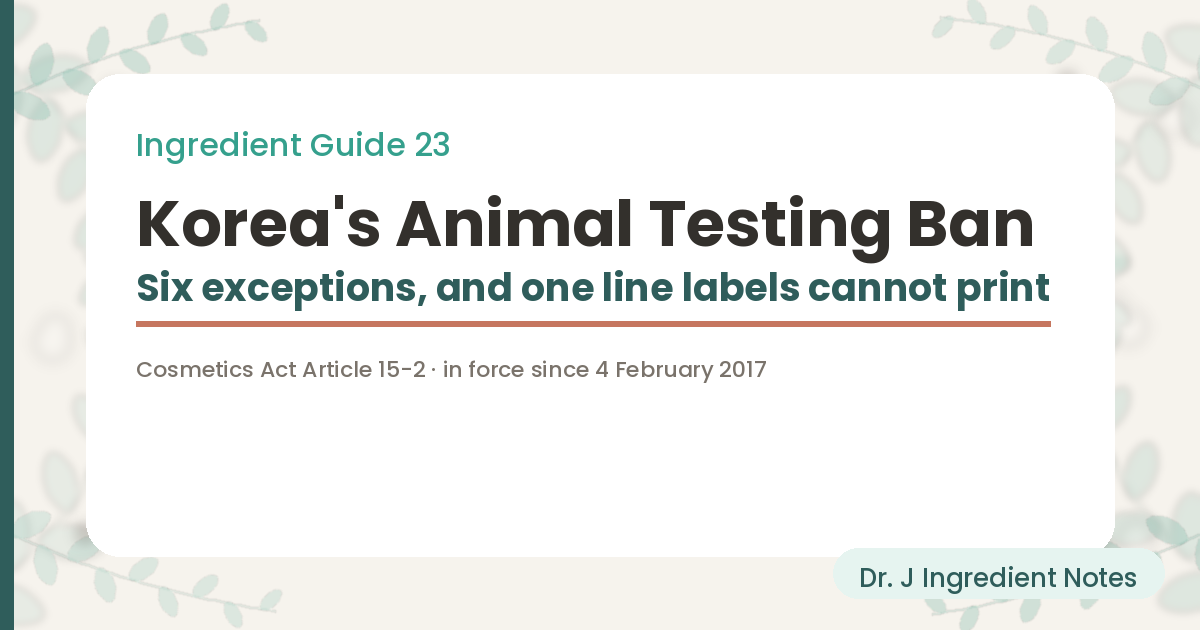
    Cover image for a Dr. J Ingredient Notes article on Korea's ban on selling animal-tested cosmetics. It shows the title Korea's Animal Testing Ban, the line six exceptions and one line labels cannot print, and a reference to Cosmetics Act Article 15-2, in force since 4 February 2017.

    🇰🇷 한국어판 읽기

    Hello, this is Dr. J. Korea has banned animal-tested cosmetics since 2017 — and yet you will almost never see “not tested on animals” printed on a Korean box. Those two facts are connected, and the connection is written down.

    Here is the part most summaries skip. What the statute blocks is selling, not testing.

    ――――――――――――――――――――――――――――

    Primary sources

    📄 Cosmetics Act Article 15-2 (Korean Law Information Center)

    📄 Laboratory Animal Act Article 2, Korean and English (KLRI)

    📄 Regulation (EC) No 1223/2009, Article 18 (EUR-Lex)

    📄 Animal Testing & Cosmetics (U.S. FDA)

    The Korean article carries the six exceptions one subparagraph at a time, and the KLRI page gives the Laboratory Animal Act definition in Korean and English side by side.

    ――――――――――――――――――――――――――――

    ――――――――――――――――――――――――――――

    The five lines, if you are in a hurry

    ✔ Selling animal-tested cosmetics has been banned in Korea since 4 February 2017

    ✔ The word manufacture carries (including contract manufacture), and imports sit in the same sentence

    ✔ The article lists six exceptions

    ✔ The penalty is an administrative fine of up to KRW 1 million

    ✔ That is why a Korean label cannot say “not tested on animals”

    ――――――――――――――――――――――――――――

    What the article actually says

    Article 15-2 has two paragraphs. Most English write-ups quote the first and stop; the second is the one that explains where the policy is going.

    Paragraph Text What it does
    15-2(1), main clause A responsible cosmetics distributor or a custom cosmetics seller shall not distribute or sell a cosmetic for which animal testing, as defined in Article 2(1) of the Laboratory Animal Act, has been carried out, or a cosmetic manufactured (including contract manufacture) or imported using an ingredient on which animal testing has been carried out. The prohibited act is distribution and sale. Running a test inside Korea is not itself the offence. Contract manufacture and imports are written into the same sentence, which closes the two obvious ways around it
    15-2(1), proviso Provided, that this shall not apply in any of the following cases. The six exceptions follow (table below)
    15-2(2) The Minister of Food and Drug Safety shall endeavour to develop alternative test methods and shall take the measures necessary for responsible cosmetics distributors and others to use them. The duty that pairs with the ban. Exception 2 opens whenever no validated alternative exists, so the second paragraph puts the job of narrowing that gap on the regulator

    The article was newly inserted on 3 February 2016 and took effect on 4 February 2017.

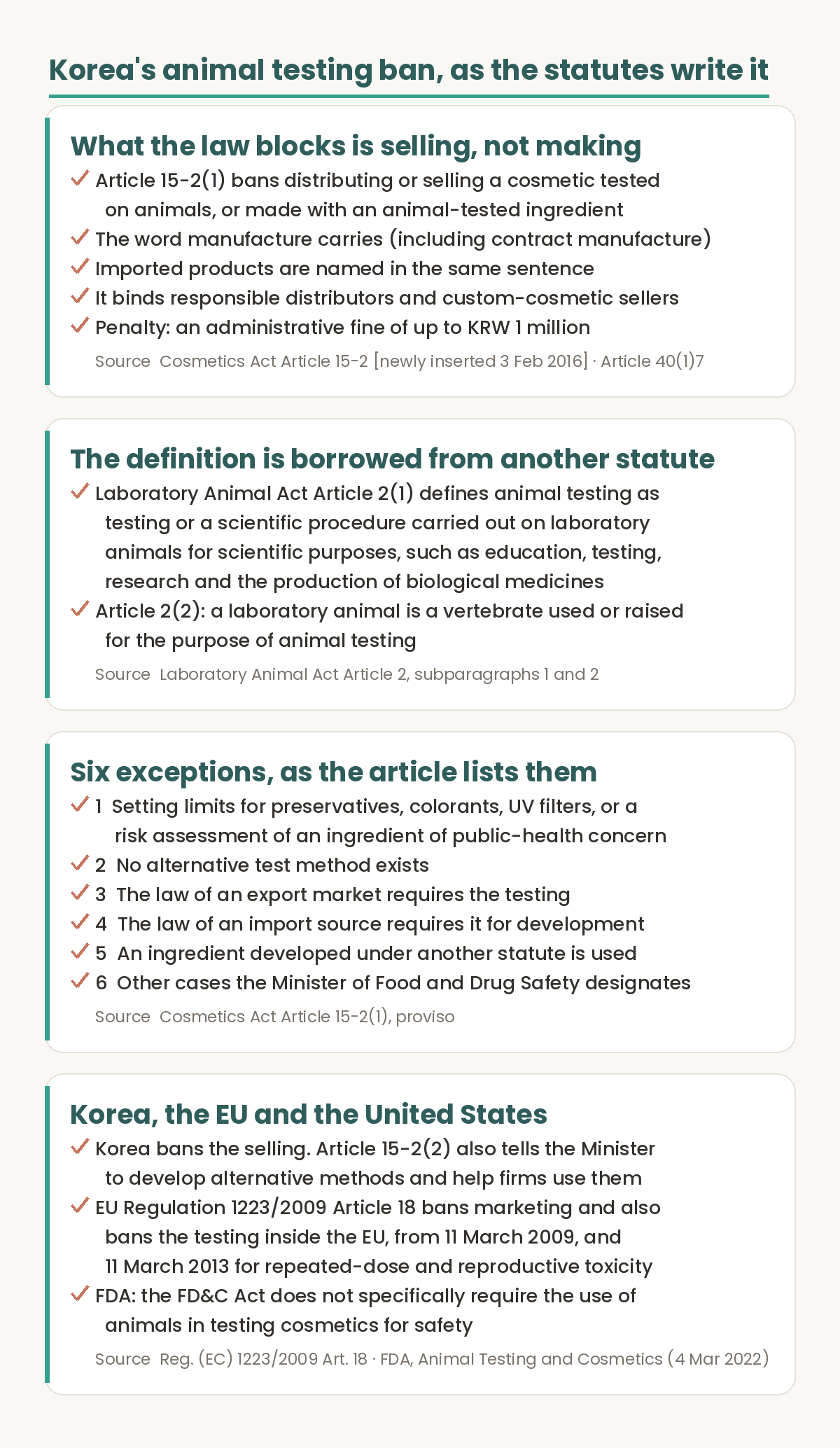
    Evidence figure on Korea's cosmetic animal testing ban. First, Article 15-2 paragraph 1 bans distributing or selling a cosmetic tested on animals or made with an animal-tested ingredient, the word manufacture carries the phrase including contract manufacture, imported products are named in the same sentence, the duty binds responsible distributors and custom cosmetic sellers, and the penalty is an administrative fine of up to one million Korean won. Second, the definition of animal testing is borrowed from the Laboratory Animal Act Article 2, which defines it as testing or a scientific procedure carried out on laboratory animals for scientific purposes, and defines a laboratory animal as a vertebrate used or raised for animal testing. Third, the article lists six exceptions, covering limits for preservatives, colorants and ultraviolet filters or a risk assessment, the absence of an alternative test method, the law of an export market, the law of an import source, an ingredient developed under another statute, and other cases the Minister of Food and Drug Safety designates. Fourth, a comparison of Korea, the European Union and the United States, where Regulation 1223/2009 Article 18 bans marketing and also testing inside the EU from 11 March 2009 and 11 March 2013, and the United States Food and Drug Administration states that the Federal Food, Drug, and Cosmetic Act does not specifically require the use of animals in testing cosmetics for safety.

    ――――――――――――――――――――――――――――

    The six exceptions, one subparagraph at a time

    No. As the article lists it In plain words
    1 Where it is necessary to designate use limits for ingredients that require particular restriction on use, such as preservatives, colorants and ultraviolet filters, or to carry out a risk assessment of a cosmetic ingredient raising a public-health concern Testing done to set a limit, not to launch a product. Korea sets numerical limits for these three groups by notice
    2 Where animal testing is necessary because no alternative test method exists The gap that paragraph (2) is meant to close
    3 Where animal testing is required under the law of an importing country for the purpose of exporting cosmetics A market Korea sells into demands it
    4 Where animal testing is required for product development under the law of the country from which the product is to be imported A market Korea buys from demands it at the development stage
    5 Where an ingredient developed through animal testing under another statute is used in manufacturing cosmetics Pharmaceutical and other statutes require testing; that ingredient can still be used
    6 Other cases prescribed by the Minister of Food and Drug Safety where it is difficult to carry out a test that can replace animal testing A notice fills this in. We could not open that notice and say so below

    Exception 1 is worth a second look. Preservatives, colorants and ultraviolet filters are named in the statute itself — the three groups whose limits Korea fixes by notice. The space kept open is the space for safety work.

    ――――――――――――――――――――――――――――

    Who is bound, and what happens

    Korea Source
    Who is bound Responsible cosmetics distributors; custom cosmetics sellers Article 15-2(1)
    What is prohibited Distributing or selling the finished cosmetic, or one made with an animal-tested ingredient, including by contract manufacture or import Article 15-2(1)
    Penalty An administrative fine of up to KRW 1 million Cosmetics Act Article 40(1)7
    Inserted 3 February 2016 [Newly inserted 3 Feb 2016]
    In force 4 February 2017 ⚠ the addendum text was not available; confirmed from two Korean newspapers

    An administrative fine is a small number next to the cost of a recall or a relabelling, but it is not the whole pressure. A product that cannot be lawfully distributed is a product retailers will not take.

    ――――――――――――――――――――――――――――

    The definition is borrowed from another statute

    The Cosmetics Act does not define animal testing itself. It reaches into the Laboratory Animal Act, Article 2(1), which reads in the official English rendering:

    “The term animal testing means testing conducted for laboratory animals or the scientific procedure for scientific purposes, such as education, testing, research and production of biological medicines or such.”

    And Article 2(2): “The term laboratory animal means vertebrate used or raised for the purpose of animal testing.”

    Because the definition is borrowed, the scope is borrowed too — the line is drawn at vertebrates.

    ――――――――――――――――――――――――――――

    Why no Korean label says “not tested on animals”

    The Korea Cosmetic Association publishes a vegan labelling guide (2025) through the industry’s self-regulatory advertising body. It allows the word vegan under three conditions and blocks one phrase outright.

    What the guide sets Content Can it go on the box?
    Vegan, condition 1 The product contains no ingredient of animal origin Vegan ⭕ where the conditions are met and can be substantiated
    Vegan, condition 2 It contains no ingredient on which animal testing has been carried out under the Cosmetics Act same
    Vegan, condition 3 No animal testing has been carried out on the product under the Cosmetics Act same
    Blocked phrase “Animal testing not conducted” and similar wording ❌ — because the sale of animal-tested cosmetics is already prohibited, the phrase could lead a consumer to believe such products are otherwise on the shelf

    So the absence of the phrase is not a gap in the product. It is a consequence of the ban being universal. If every product on the shelf has to meet the same rule, advertising compliance as a feature is treated as misleading.

    One thing we could not settle: whether the term cruelty-free itself is governed anywhere. The MFDS labelling and advertising guidance (14 August 2025) does not list animal-testing wording among its prohibited expressions.

    ――――――――――――――――――――――――――――

    Korea, the EU and the United States

    This is the part that is hard to find in English. All three jurisdictions are moving the same way, and all three grip a different part of the chain.

    Korea European Union United States
    Instrument Cosmetics Act Article 15-2 Regulation (EC) No 1223/2009, Article 18 No federal prohibition
    What is prohibited Distribution and sale of the product Marketing the product, and performing the test within the EU Neither required nor prohibited
    Dates Inserted 3 Feb 2016, in force 4 Feb 2017 11 March 2009; 11 March 2013 for repeated-dose toxicity, reproductive toxicity and toxicokinetics —
    Testing inside the territory Not the object of the article Prohibited for finished products and for ingredients Not addressed
    Who proves safety The business operator The responsible person “It remains the responsibility of the manufacturer to substantiate the safety” (FDA)
    On alternatives The Minister shall endeavour to develop alternative methods and help firms use them (15-2(2)) Validated alternative methods replace the listed tests “FDA supports the development and use of alternatives to whole-animal testing”

    Put plainly: the EU went as far as “do not run the test”, Korea stopped at “do not sell the result”, and the United States has drawn no federal line at all. The FDA’s own page says the “FD&C Act does not specifically require the use of animals in testing cosmetics for safety” — it does not require it, which is not the same as forbidding it.

    For a brand, the practical reading is that Korea is a sales-side jurisdiction. A dossier assembled with animal data for another market does not become acceptable because the testing happened abroad; the product carrying that data is what cannot be distributed here. Exceptions 3 and 4 exist precisely because other markets sometimes demand the opposite.

    ――――――――――――――――――――――――――――

    Four things to check on a Korean box

    ✔ A missing “not tested on animals” line is not a missing feature — the phrase is not allowed

    ✔ If the box says vegan, look for what standard it followed

    ✔ Imported products sit under the same article — being foreign changes nothing

    ✔ Whether a product is gentle is a question of ingredients and concentrations, read separately

    ――――――――――――――――――――――――――――

    In one line

    An animal-tested cosmetic already cannot be sold in Korea. The reason the claim is missing from the label is that the claim is not permitted. The exceptions number six, and the first one names preservatives, colorants and ultraviolet filters.

    What we left out, and why

    ✔ The notice under exception 6 — we could not locate the ministry notice that fills it in

    ✔ The addendum fixing the commencement date — the law portal does not return addenda, so 4 February 2017 rests on two Korean newspapers rather than the statute book

    ✔ Any standard for the term “cruelty-free” — not found in the MFDS guidance, and we name no private certifier because we verified none

    ✔ Korean adoption of specific OECD alternative test guidelines — trade-press reports only

    ✔ Paragraph (2) was taken verbatim from a statute mirror; the law portal was unreachable on the day this was written

    ✔ Claims that animal-free products are gentler — no primary source, so not written

    ――――――――――――――――――――――――――――

    📌 Earlier guides

    📌 Salicylic Acid (BHA): 0.5% vs 2%, Explained (Guide 8) — the preservative named in exception 1

    📌 Sunscreen SPF and PA: How to Read the Numbers (Guide 11) — the UV filter side

    📌 Bakuchiol vs Retinol — the 44-person trial (Guide 3) — an ingredient that comes from a plant

    📌 How to Read a Korean Cosmetic Ingredient List (Guide 14) — where to check the names

    About the author · Dr. J

    MS in Veterinary Medicine, PhD in Life Sciences. I worked as a researcher at the Korea Research Institute of Bioscience and Biotechnology (KRIBB) and now run Beaurea, a cosmetics manufacturing company, where I write the formulas myself. This blog reads the research papers and the regulatory documents and turns them into plain-language criteria for choosing ingredients. I don’t recommend specific products here – only criteria that apply to any product.

    📄 Sources

    · Cosmetics Act of Korea, Article 15-2 (Act No. 20901, amended 1 Apr 2025, in force 2 Apr 2026) and Article 40(1)7

    · Laboratory Animal Act, Article 2, subparagraphs 1 and 2 (Korea Legislation Research Institute, Korean–English)

    · Korea Cosmetic Association, Guide to Vegan Labelling and Advertising of Cosmetics (2025)

    · Regulation (EC) No 1223/2009, Article 18

    · U.S. FDA, Animal Testing & Cosmetics (content current as of 4 March 2022)

    ――――――――――――――――――――――――――――

    This article summarises statutes and an industry guide for general information and is not a substitute for diagnosis or treatment. On the day it was written the Korean law portal was unreachable, so paragraph (2) of Article 15-2 was taken from a statute mirror and the commencement date from two newspapers; translations of the Korean provisions are ours except where the Korea Legislation Research Institute’s English text is quoted.

    — Dr. J Ingredient Notes

  • Korea’s 25 Fragrance Allergens: When a Name Has to Leave the Word Fragrance (Ingredient Guide 26)

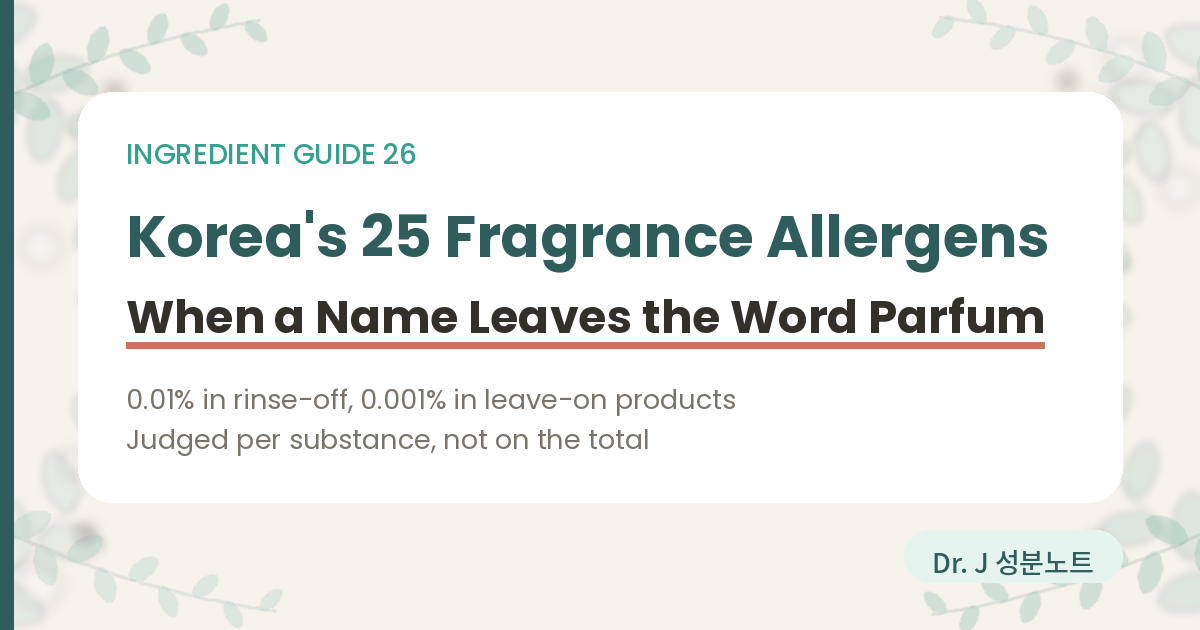
    Cover image for a Dr. J Ingredient Notes article on fragrance allergen labelling in Korea. The Cosmetics Act requires every ingredient to be listed on the package, and the Enforcement Rule allows a perfuming agent to be written as the single word fragrance. When the perfuming agent contains one of the 25 fragrance allergens named in a ministry notice, that word is not enough and the substance must be named. The thresholds are above 0.01 percent in rinse-off products and above 0.001 percent in leave-on products, judged for each substance rather than on the total.

    🇰🇷 한국어판

    Hello, this is Dr. J. Today: Korea’s 25 fragrance allergens, and the rule that decides when one of them stops hiding inside the word fragrance and gets a name of its own on the box.

    Start with the thing most guides skip. A long tail of unfamiliar names after fragrance does not mean the product is heavily perfumed. It means something in the perfume crossed a labelling threshold. The names are not a leak. They are the rule working.

    ――――――――――――――――――――――――――――

    Primary sources first

    📄 Cosmetics Act Article 10 (Korea Cosmetic Association)

    📄 Annex 2, fragrance allergens (Korean Law Information Center)

    📄 Labelling Q&A (Korea Cosmetic Association)

    📄 Regulation (EU) 2023/1545 (EUR-Lex)

    ――――――――――――――――――――――――――――

    ――――――――――――――――――――――――――――

    Five lines, if you are in a hurry

    ✔ A perfuming agent may be written as the single word fragrance

    ✔ But if it contains one of the listed 25, that substance must be named

    ✔ Thresholds: above 0.01% in rinse-off, above 0.001% in leave-on products

    ✔ Judged per substance, never on the sum of them

    ✔ The EU uses the same two figures — and its list is getting much longer

    ――――――――――――――――――――――――――――

    Why a name leaves the word fragrance — a rule in three tiers

    Korean guides usually explain the third tier alone, which makes the rule look arbitrary. It is not. It is a principle, an exception, and a proviso inside the exception.

    Tier What it says Source
    Principle The package lists every ingredient used in manufacturing Cosmetics Act Art. 10(1), item 3
    Exception A perfuming agent may be written as the single word fragrance Enforcement Rule Annex 4 (labelling standards and methods)
    Proviso If the perfuming agent contains a fragrance allergen listed by the ministry, the single word is not enough and the substance must be named Same Annex 4 · MFDS notice Annex 2

    A fragrance is not one ingredient but dozens blended together, which is why the middle tier exists at all. The proviso has applied to products manufactured or imported since 1 January 2020.

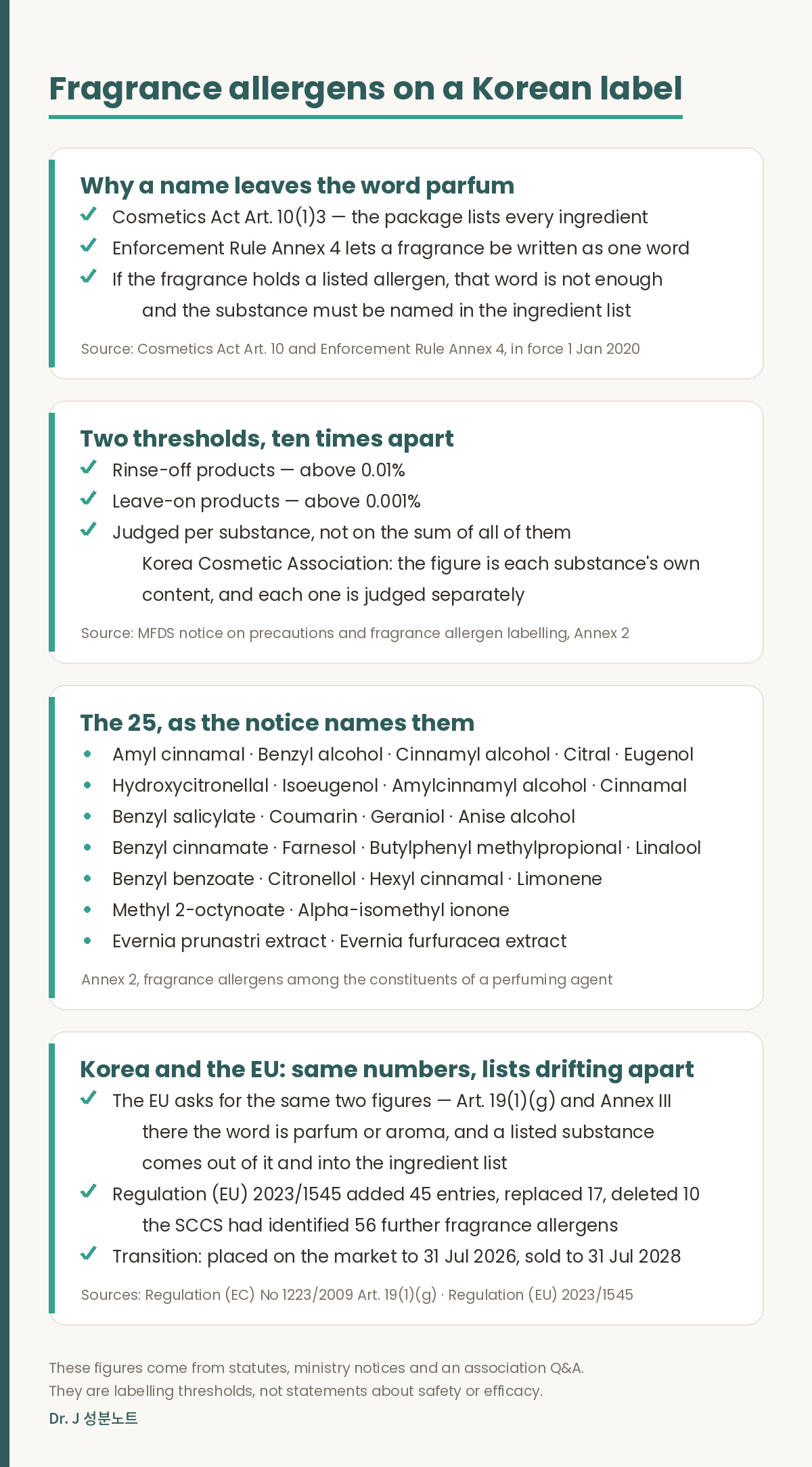
    Evidence figure for an article on fragrance allergen labelling in Korea. First, Cosmetics Act Article 10 paragraph 1 item 3 requires the package to list every ingredient used, Enforcement Rule Annex 4 allows a perfuming agent to be written as one word, and a listed allergen inside that perfuming agent must be named separately; the rule has been in force since 1 January 2020. Second, there are two thresholds ten times apart: above 0.01 percent in rinse-off products and above 0.001 percent in leave-on products, judged per substance rather than on the sum, as the Korea Cosmetic Association question and answer states. Third, the 25 substances are amyl cinnamal, benzyl alcohol, cinnamyl alcohol, citral, eugenol, hydroxycitronellal, isoeugenol, amylcinnamyl alcohol, benzyl salicylate, cinnamal, coumarin, geraniol, anise alcohol, benzyl cinnamate, farnesol, butylphenyl methylpropional, linalool, benzyl benzoate, citronellol, hexyl cinnamal, limonene, methyl 2-octynoate, alpha-isomethyl ionone, evernia prunastri extract and evernia furfuracea extract. Fourth, Korea and the European Union use the same two figures but their lists are drifting apart: the EU works through Article 19 paragraph 1 point g and Annex III of Regulation 1223/2009, and Regulation 2023/1545 added 45 entries, replaced 17 and deleted 10 after the scientific committee identified 56 further fragrance allergens, with a transition until 31 July 2026 for placing on the market and 31 July 2028 for sale.

    ――――――――――――――――――――――――――――

    Two thresholds, ten times apart

    ✔ Rinse-off products — above 0.01%

    ✔ Leave-on products — above 0.001%

    The leave-on figure is ten times lower because the product stays on the skin. That is why perfumes, mists and body lotions carry longer allergen tails than a body wash does.

    One point is easy to get wrong: the figures are not a combined total. The Korea Cosmetic Association’s Q&A puts it plainly — the figure refers to the content of each individual substance, and each is judged on its own. Five allergens at low levels are five separate decisions, not one sum.

    The denominator is the net content of the product. In a 250 g body lotion, 0.05 g of limonene is about 0.02% — over the line, so limonene is named.

    ――――――――――――――――――――――――――――

    The 25, as the notice names them

    # #
    1  Amyl cinnamal 2  Benzyl alcohol
    3  Cinnamyl alcohol 4  Citral
    5  Eugenol 6  Hydroxycitronellal
    7  Isoeugenol 8  Amylcinnamyl alcohol
    9  Benzyl salicylate 10  Cinnamal
    11  Coumarin 12  Geraniol
    13  Anise alcohol 14  Benzyl cinnamate
    15  Farnesol 16  Butylphenyl methylpropional
    17  Linalool 18  Benzyl benzoate
    19  Citronellol 20  Hexyl cinnamal
    21  Limonene 22  Methyl 2-octynoate
    23  Alpha-isomethyl ionone 24  Evernia prunastri (oak moss) extract
    25  Evernia furfuracea (tree moss) extract

    Entries 24 and 25 are not single molecules but botanical extracts. The notice sets no order or format for where the names go; the association recommends following the ordinary ingredient-list method, and the ministry has said that pulling allergens out into a separate block of their own is not appropriate, because it suggests those substances alone are a problem.

    ――――――――――――――――――――――――――――

    When nothing is named

    Situation Why What follows
    Below the threshold Under 0.01% / 0.001% there is no duty to name The substance can be present and still invisible on the box
    Small packages Net content of 10–50 mL (g) leaves no room The listing may be omitted, but the information must be findable on the company’s website
    Online listings — The ingredient list shown on a sales page must carry the allergens too
    Raw material reporting — Allergens that appear on the label are included in the annual raw material report

    So an absent name does not mean an absent substance — and a present name does not mean a bad one. It means a threshold was crossed and the rule asked for daylight.

    There is Korean market data on how this plays out. The Seoul Institute of Health and Environment tested 106 fragranced cosmetics on sale in the city — 85 leave-on (perfume, body mist, body cream, hand cream) and 21 rinse-off (body wash) — screening for 23 of the allergens by GC-MS. One body mist failed the coumarin labelling requirement and was referred for administrative action; the other 105 complied. Measured levels ran from not detected up to about 1.5%.

    ――――――――――――――――――――――――――――

    Korea and the EU: the same two numbers, lists drifting apart

    This is the part worth knowing if you buy Korean products abroad, or sell them there.

    Korea European Union
    Legal basis Cosmetics Act Art. 10 · Enforcement Rule Annex 4 · MFDS notice Annex 2 Regulation (EC) No 1223/2009 Art. 19(1)(g) · Annex III
    The single word fragrance 「Perfume and aromatic compositions and their raw materials shall be referred to by the terms ‘parfum’ or ‘aroma’」
    What comes out of it the 25 substances in Annex 2 「the presence of substances, the mention of which is required under the column ‘Other’ in Annex III」
    Thresholds above 0.01% rinse-off · above 0.001% leave-on the same — 「0,01 % in rinse-off products」 · 「0,001 % in leave-on products」
    Most recent change Annex 2 still stands as amended on 16 December 2019 Regulation (EU) 2023/1545 added 45 entries to Annex III, replaced 17 and deleted 10, after the SCCS identified 56 further fragrance allergens
    Transition — non-compliant products may be placed on the market until 31 July 2026 and sold until 31 July 2028

    Read that last row together with the one above it. From August 2026, the same formula will need a longer allergen list in Brussels than it needs in Seoul. A short tail on a Korean box is not a cleaner perfume, and a long tail on a European one is not a heavier one. The two lists are simply different lengths, and only one of them has just grown.

    The EU also folded in prehaptens and prohaptens — substances that become allergens after air oxidation or metabolism on the skin — and grouped similar substances under shared names to make the labels readable. Korea’s notice has not taken that step.

    ――――――――――――――――――――――――――――

    What to check on the box

    ✔ Look at the tail end of the ingredient list, around the word fragrance

    ✔ A leave-on product showing more names than a rinse-off one is the rule working, not a warning

    ✔ If a scent has stung before, write down that one name and compare boxes

    ✔ On a small bottle with no names, check the brand’s own website listing

    ――――――――――――――――――――――――――――

    In one line

    A name after the word fragrance is not something that slipped out — it is something the rule pulled out. The thresholds are 0.01% and 0.001%, and each substance is judged on its own.

    What I left out, and why

    ✔ CAS numbers for the 25 — the Korean Law Information Center was unreachable the day this was written, so Annex 2 itself could not be opened. The names are taken from two trade publications that match character for character; the numbers are omitted rather than guessed

    ✔ Verbatim text of Enforcement Rule Annex 4 — same reason: the substance of the provision is given, but not in quotation marks

    ✔ The EU’s own list of substances — Annex III tables do not come through in the consolidated text. Only the entry counts stated by the amending regulation are given

    ✔ The current Korean status of butylphenyl methylpropional (Lilial) — the EU moved it to the prohibited annex in 2022. Korea’s prohibited-ingredient annex could not be opened, so whether it may still be used here is not stated either way

    ✔ Prevalence figures for individual allergens — no primary studies were opened for this article, so none are quoted

    ――――――――――――――――――――――――――――

    📌 Earlier guides

    📌 How to Read a Korean Cosmetic Ingredient List (Ingredient Guide 14) — where the order stops at 1%

    📌 Ceramides: cholesterol and fatty acid ratio (Ingredient Guide 4)

    📌 Panthenol: What the Dexpanthenol Studies Show (Ingredient Guide 7)

    📌 Skin Concern Ingredient Map

    About the author · Dr. J

    MS in Veterinary Medicine, PhD in Life Sciences. I worked as a researcher at the Korea Research Institute of Bioscience and Biotechnology (KRIBB) and now run Beaurea, a cosmetics manufacturing company, where I write the formulas myself. This blog reads the research papers and the regulatory documents and turns them into plain-language criteria for choosing ingredients. I don’t recommend specific products here – only criteria that apply to any product.

    📄 Sources

    · Cosmetics Act (Korea), Article 10 · Enforcement Rule, Annex 4 (labelling standards and methods)

    · MFDS notice, Precautions for Use of Cosmetics and Labelling of Fragrance Allergens, Annex 2

    · Korea Cosmetic Association, ingredient dictionary Q&A on allergen labelling

    · MFDS guidance on labelling fragrance allergens (via trade press reporting)

    · Seoul Institute of Health and Environment, survey of 106 fragranced cosmetics

    · Regulation (EC) No 1223/2009, Article 19(1)(g) · Regulation (EU) 2023/1545

    ――――――――――――――――――――――――――――

    This article summarises statutes and ministry notices and is not a substitute for diagnosis or treatment. The Korean Law Information Center was unreachable the day it was written, so the 25 names were cross-checked against an association Q&A and two trade publications, and CAS numbers and verbatim provisions were left out. EU material is taken from the current public text on EUR-Lex.

    — Dr. J Ingredient Notes

  • Cosmetic Color Additives in Korea: Why a Colorant Not on the List Cannot Go in the Bottle (Ingredient Guide 24)

    Cover image for a Dr. J Ingredient Notes article on cosmetic colorants in Korea. It explains that the Cosmetics Act has the ministry set use standards for colorants by notice, so only colorants written in Annex 1 of the notice may be used, and that the restriction column decides where each colorant may be used rather than how much of it.

    🇰🇷 한국어판 보기

    Hello, this is Dr. J. Today we are reading Korea’s cosmetic colorant rules — which colorants a product may contain, and which it may not.

    Here is the part that surprises people. Korea does not regulate colorants by banning the dangerous ones. It writes down the ones you may use, and everything outside that list is off the table. The United States and the European Union work the same way.

    ――――――――――――――――――――――――――――

    The sources, first

    📄 Cosmetics Act Article 8 (Korea Cosmetic Association)

    📄 Types and Standards of Cosmetic Colorants, MFDS Notice No. 2023-61

    📄 Annex 1 — Cosmetic colorants (to Article 3)

    📄 Color Additives and Cosmetics (U.S. FDA) · 21 CFR Part 74, Subpart C

    📄 Regulation (EC) No 1223/2009, Article 14 (EUR-Lex)

    Annex 1 gives every colorant a number, a name, a CI number, a restriction and a remark. Look your product’s colorant up there and the answer to «where may this colour be used» is one line long.

    ――――――――――――――――――――――――――――

    In short, five lines

    ✔ A colorant that is not on the list cannot be used — this is a permitted list, not a ban list

    ✔ The notice in force is Types and Standards of Cosmetic Colorants (MFDS Notice No. 2023-61)

    ✔ Annex 1 has four columns: number, colorant, use restriction, remarks

    ✔ The restriction column decides where a colour may be used, not how much of it

    ✔ Red No. 2 and Red No. 102 may not go into products labelled for children

    ――――――――――――――――――――――――――――

    A permitted list, not a ban list

    There are two ways to regulate what goes into a cosmetic. You can name the materials that must stay out, or you can name the materials that may go in. Korea’s Cosmetics Act does both — and colorants belong to the second kind.

    Paragraph What it sets The text
    Article 8(1) A list of raw materials that cannot be used The Minister of Food and Drug Safety shall designate and give public notice of raw materials that cannot be used in manufacturing cosmetics
    Article 8(2) Use standards for preservatives, colorants and UV filters For raw materials that need particular restrictions on use, such as preservatives, colorants and ultraviolet blocking agents, the Minister shall designate and give public notice of their use standards

    Paragraph 1 is the ban list. Paragraph 2 is the permitted list, and colorants are named in it, next to preservatives and ultraviolet filters. The consequence is simple: a colour that has not been written into the notice cannot be used in a cosmetic, even though no rule says it is dangerous.

    Read the other way round, every colorant name printed on a Korean cosmetic box has already been through that door.

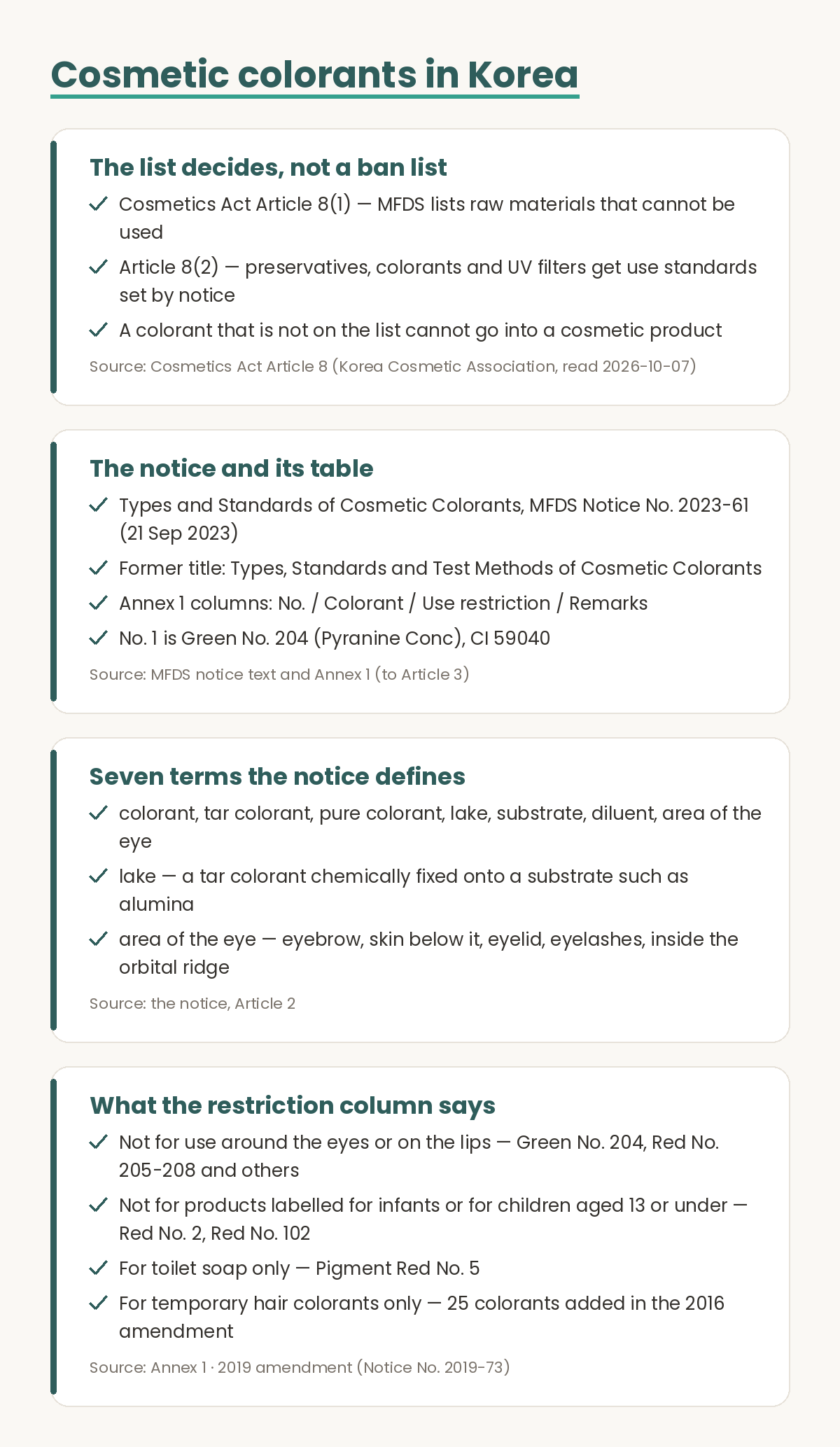
    Evidence figure on cosmetic colorants in Korea. First, Cosmetics Act Article 8 paragraph 1 has the ministry list raw materials that cannot be used, and paragraph 2 has it set use standards for preservatives, colorants and ultraviolet filters by notice, so a colorant that is not on the list cannot go into a cosmetic product. Second, the notice is Types and Standards of Cosmetic Colorants, MFDS Notice No. 2023-61 of 21 September 2023, formerly titled Types, Standards and Test Methods of Cosmetic Colorants, and its Annex 1 table has four columns, number, colorant, use restriction and remarks, with number one being Green No. 204 Pyranine Conc, CI 59040. Third, Article 2 of the notice defines seven terms: colorant, tar colorant, pure colorant, lake, substrate, diluent and area of the eye. A lake is a tar colorant chemically fixed onto a substrate such as alumina, and the area of the eye covers the eyebrow, the skin below it, the eyelid and eyelashes and the area inside the orbital ridge. Fourth, the restriction column carries entries such as not for use around the eyes or on the lips, not for products labelled for infants or children aged 13 or under which applies to Red No. 2 and Red No. 102, for toilet soap only which applies to Pigment Red No. 5, and for temporary hair colorants only, a condition attached to 25 colorants added in the 2016 amendment.

    ――――――――――――――――――――――――――――

    Seven terms, and the two that matter at the shelf

    The notice is called Types and Standards of Cosmetic Colorants (MFDS Notice No. 2023-61, 21 September 2023). Its former title was Types, Standards and Test Methods of Cosmetic Colorants — worth knowing, because a good deal of what is written online still cites the old name. Article 2 defines seven terms.

    Term How the notice defines it
    colorant an ingredient whose main purpose is to give colour to a cosmetic or to the skin
    tar colorant a colorant derived from coal tar or its intermediates, or obtained by organic synthesis, together with its lakes, salts and mixtures with diluents
    pure colorant the colorant itself, without intermediates, diluents or substrates
    lake a tar colorant fixed onto a substrate by chemical bonding — an aluminium lake when the substrate is aluminium
    substrate the material a pure colorant is spread onto when a lake is made — alumina, titanium dioxide and the like
    diluent a material mixed in to make a colorant easier to handle. It may not be a raw material that cosmetics cannot use
    area of the eye the eyebrow, the skin below the eyebrow, the eyelid and the eyelashes, and the area inside the orbital ridge

    Two of them show up on labels.

    Lake. A water-soluble colorant fixed onto a powder so that it stays where it is put. On an ingredient list it reads «Red No. 202 Aluminum Lake». The same colour index number behaves differently once it is a lake, which is why colour cosmetics carry the word so often.

    Area of the eye. The notice draws the boundary itself: the eyebrow, the skin below it, the eyelid and the eyelashes, and the area inside the orbital ridge. Eyeshadow, eyeliner, mascara and eye cream are all inside it. So a colorant marked «not for use around the eyes» can still colour a lipstick or a blusher — it simply cannot go near the eye.

    ――――――――――――――――――――――――――――

    What the restriction column decides

    If you only read one column of Annex 1, read this one. It is not about concentration — it is about place of use, and it comes in four shapes.

    What the restriction column says Which colorants Where it came from
    Not for use around the eyes or on the lips Green No. 204 · Green No. 401 · Orange No. 206 · Orange No. 207 · Purple No. 401 · Red No. 205-208 · Red No. 219 · Red No. 225 · Red No. 405, among others Annex 1, restriction column
    Not for products for infants, or for products labelled as usable by children aged 13 or under Red No. 2 (Amaranth) · Red No. 102 (New Coccine) The 2019 amendment (Notice No. 2019-73) widened this from infant products alone
    For toilet soap only Pigment Red No. 5 Same 2019 amendment, in force from 31 December 2019
    For temporary hair colorants only basic, HC and disperse series colorants 25 colorants entered on this condition in the 2016 amendment

    Two reds make the point. Red No. 2 and Red No. 102 are permitted colorants in Korea; they simply cannot go into a product that is labelled as usable by children aged 13 or under. Before the 2019 amendment the bar covered infant products alone.

    This is the same construction we met in the children’s cosmetics guide: the rule starts at the label, not at the ingredient. Print «for children» on the box and this line attaches to the product.

    ――――――――――――――――――――――――――――

    Four amendments in ten years

    Notice When What changed
    No. 2016-49 24 June 2016 Tar colorants and other colorants were brought into one notice, and 25 colorants for temporary hair colorants were added
    No. 2019-73 2019 Red No. 2 and Red No. 102 were barred from products labelled for children aged 13 or under; Pigment Red No. 5 became toilet-soap only (stock made or imported before the date had two years to sell through)
    No. 2020-64 20 July 2020 Toilet soap moved from industrial goods into cosmetics, so colorants usable in toilet soap were added
    No. 2023-61 21 Sep 2023 The notice in force today. Its title settled as Types and Standards of Cosmetic Colorants

    The 2016 amendment was the structural one. Until then tar colorants had a notice of their own; bringing tar colorants and the rest into a single table is what produced the Annex 1 we read today.

    ――――――――――――――――――――――――――――

    Korea, the United States and the EU: one method, three lists

    The FDA states it plainly: «All color additives used in cosmetics (or any other FDA-regulated product) must be approved by FDA.» The EU Cosmetics Regulation does the same job in Article 14(1), which bars «colorants other than those listed in Annex IV». Three jurisdictions, three lists, one method.

    Korea United States European Union
    Method Use the colorants written in Annex 1 of the MFDS notice Use the colorants on the FDA list — 29 exempt from certification (21 CFR 73), 36 subject to it (21 CFR 74) Use the colorants listed in Annex IV
    A colorant off the list Cannot be used (Cosmetics Act Article 8(2)) «failure to meet U.S. color additive requirements causes a cosmetic to be adulterated» «colorants other than those listed in Annex IV… » may not be present (Article 14(1)(c)(i))
    Around the eye The notice defines «area of the eye» and writes the limit into each colorant’s row The permitted-colorant table carries a separate «Eye Area» column Written into the conditions of use in Annex IV
    Batch testing None Synthetic organic colors are certified batch by batch: «All batches… shall be certified in accordance with regulations in part 80» None
    Hair dye Colorants for temporary hair colorants sit inside the same list Coal-tar hair dyes are the stated exception Hair colorants fall outside Annex IV (Article 14(2))

    Two differences are worth carrying with you.

    The eye is treated as its own place everywhere. The FDA defines the area of the eye as «the area enclosed within the circumference of the supra-orbital ridge and the infra-orbital ridge, including the eyebrow, the skin below the eyebrow, the eyelids and the eyelashes, and conjunctival sac of the eye» — the same boundary Korea’s notice draws, in almost the same words. And where a colour is cleared for that area, the US regulation says so in the colorant’s own section: «FD&C Blue No. 1 may be safely used for coloring cosmetics generally, including cosmetics intended for use in the area of the eye».

    Batch certification exists only in the United States. Synthetic organic colors must be submitted to FDA lot by lot — «All batches… shall be certified in accordance with regulations in part 80 of this chapter» — while colors drawn from mineral, plant or animal sources are exempt. Korea and the EU have no equivalent step. If you have wondered why an imported product’s colorant line sometimes carries an extra designation, this is one of the reasons.

    ――――――――――――――――――――――――――――

    What to check on the box

    ✔ Colorants sit near the end of the ingredient list, as «colour No. N» or a CI number

    ✔ «Aluminum Lake» means the colour has been fixed so that it does not bleed

    ✔ On a product labelled for children, look for Red No. 2 and Red No. 102

    ✔ Eyeshadow, mascara and eye cream are all «area of the eye» products

    ✔ How deep the colour looks is a question of amount; whether it may be there at all is a question of the list

    A long row of colorant names is not a warning sign. Being named at all means the colour is on the list. What is worth checking is not how many there are, but whether this colour belongs in this kind of product.

    ――――――――――――――――――――――――――――

    What I left out, and why

    ✔ The full Annex 1 table. Korea’s national law portal did not open on the day this was written, so I kept to the shapes of the restriction column and the colorants named in them

    ✔ How many colorants are on the list. The 2016 amendment carried 127; three amendments have followed, so today’s count may differ and I did not print a number

    ✔ Safety debates about tar colorants. I could not open primary sources. What the notice settles is where a colour may be used, and that is the scope of this article

    ✔ The notice’s entry-into-force date and review deadline. I saw them on a mirror but not in the original, so they are not here

    ――――――――――――――――――――――――――――

    One line

    A colorant is used where the list says it may be used. Next to the colour’s name on the back of the box, the place it is allowed to go has already been decided.

    Next in this series: cosmetic preservatives — parabens, phenoxyethanol, and how to read the limits on the back label.

    ――――――――――――――――――――――――――――

    📌 Related

    📌 How to Read a Korean Cosmetic Ingredient List (Ingredient Guide 14) — where colorant names appear

    📌 Salicylic Acid (BHA): 0.5% vs 2%, Explained (Ingredient Guide 8) — the preservative named beside colorants in Article 8(2)

    📌 Sunscreen SPF and PA: How to Read the Numbers (Ingredient Guide 11) — the third material in the same paragraph

    📌 AHA vs BHA: Is Glycolic Acid an AHA? (Ingredient Guide 13)

    About the author · Dr. J

    MS in Veterinary Medicine, PhD in Life Sciences. I worked as a researcher at the Korea Research Institute of Bioscience and Biotechnology (KRIBB) and now run Beaurea, a cosmetics manufacturing company, where I write the formulas myself. This blog reads the research papers and the regulatory documents and turns them into plain-language criteria for choosing ingredients. I don’t recommend specific products here – only criteria that apply to any product.

    📄 References

    · Cosmetics Act (Korea), Article 8 — Safety standards for cosmetics

    · Types and Standards of Cosmetic Colorants, MFDS Notice No. 2023-61 (21 September 2023), Articles 2, 3, 5 and Annexes 1 and 2

    · Types, Standards and Test Methods of Cosmetic Colorants, Notice No. 2016-49 (24 June 2016) and its partial amendment draft

    · Notice No. 2019-73 as reported by Cosmorning, 3 September 2019 · Notice No. 2020-64 per the Korea Cosmetic Association

    · U.S. FDA, Color Additives and Cosmetics · Color Additives Permitted for Use in Cosmetics · 21 CFR Parts 73, 74 and 80

    · Regulation (EC) No 1223/2009, Article 14 and Annex IV

    ――――――――――――――――――――――――――――

    This article summarises statutes and administrative notices and is not a substitute for diagnosis or treatment. The full Annex 1 table could not be retrieved on the day of writing; the restriction wording and the colorants named here were confirmed against the notice text and the 2016 amendment draft. US and EU material is quoted from the current public versions published by those authorities.

    — Dr. J Ingredient Notes

  • Functional Cosmetics in Korea: The 11 Categories, the Notified Ingredients, and What the Label Certifies (Ingredient Guide 16)

    Cover image for a guide to functional cosmetics in Korea, explaining the eleven categories set by the Cosmetics Act and its Enforcement Rule and what the words on the package certify. Ingredient Guide 16 from Dr. J Ingredient Notes.

    🇰🇷 한국어판: 기능성화장품 뜻과 종류 11가지 – 무엇을 보증하나

    Hello, this is Dr. J. If you have ever turned over a Korean cream and seen the words 기능성화장품 — functional cosmetics — this post is about what that line actually certifies.

    It is not a marketing word. It is a legal category, with a fixed list of eleven things a product is allowed to be, a fixed set of ingredients and amounts, and a fixed sentence the package has to carry. Once you know where the line comes from, the shelf reads differently.

    There is one more reason this is worth reading if you are outside Korea. The EU forbids exactly what Korea requires. Under EU rules, a cosmetic label may not claim that an authority approved it. In Korea, that approval is the label. Same bottle, two opposite drawers — the table further down sets them side by side.

    ――――――――――――――――――――――――――――

    📄 The original documents

    📄 Regulation on the Review of Functional Cosmetics, Annex 4 (Korean)

    📄 Enforcement Rule of the Cosmetics Act, Annex 4 — labelling standards (Korean)

    📄 21 CFR 333.310 — US acne treatment active ingredients

    📄 Commission Regulation (EU) No 655/2013 — common criteria for cosmetic claims

    📄 Regulation (EC) No 1223/2009 on cosmetic products

    🏠 FDA — Is It a Cosmetic, a Drug, or Both?

    The two Korean links download the annex tables themselves. They give the ingredient, the amount, the permitted form, the claim wording and the directions for use, one line each.

    ――――――――――――――――――――――――――――

    ――――――――――――――――――――――――――――

    The short version

    ✔ The Act names five groups; the Enforcement Rule splits them into eleven categories

    ✔ Build a product to a notified ingredient at a notified amount and you file a report instead of a full review

    ✔ Annex 4 lists 9 whitening ingredients, 4 for wrinkles, 29 UV filters and one for acne

    ✔ The package carries the words and the reviewed claim, in type at least as large

    ✔ Hair loss, acne, barrier and stretch marks also carry “not a drug”

    ――――――――――――――――――――――――――――

    Five groups in the Act, eleven categories in the Rule

    Article 2(2) of the Cosmetics Act defines functional cosmetics as products falling under one of five items, “as prescribed by Ordinance of the Prime Minister”. That ordinance is the Enforcement Rule, and its Article 2 is where the list becomes eleven.

    Cosmetics Act, Article 2(2) Enforcement Rule, Article 2 — the eleven categories
    a. Helps whiten the skin 1. Prevents melanin from settling, so freckles and dark spots are held back
    2. Lightens melanin that has already settled
    b. Helps improve wrinkles 3. Firms the skin so wrinkles are eased or improved
    c. Helps tan the skin evenly, or protects it from UV 4. Shields from sunlight for an even tan
    5. Blocks or scatters UV to protect the skin
    d. Helps change, remove or nourish hair colour 6. Changes hair colour, or bleaches and strips it
    7. Removes body hair (physical removal excluded)
    e. Helps prevent or improve dryness, cracking, falling out or keratinization caused by weakened skin or hair function 8. Eases hair loss symptoms (coating and other physical methods excluded)
    9. Eases acne-prone skin (cleansing products)
    10. Restores barrier function so itching improves
    11. Improves the red lines of stretch marks

    Read the table left to right and one thing stands out. Four categories came out of a single item — item e. Hair loss, acne, barrier repair and stretch marks all sit under a sentence about dryness, cracking, falling out and keratinization. Those same four are the ones that must carry the “not a drug” sentence, which we will get to.

    Anything outside these eleven cannot be sold as a functional cosmetic. A Korean pack may still shout about pores or firmness in large type — that is ordinary advertising copy, not this category.

    ――――――――――――――――――――――――――――

    A review, or a report

    Article 4(1) of the Act: “A cosmetics manufacturer, a cosmetics responsible distributor, or a university or research institute prescribed by Ordinance of the Prime Minister that intends to sell a product recognised as a functional cosmetic shall, for each item, either undergo a review by the Minister of Food and Drug Safety as to safety and efficacy, or submit a report to the Minister.”

    The review route asks for a good deal. Article 4 of the Regulation on the Review of Functional Cosmetics sets out what has to be filed:

    ✔ Origin and development history

    ✔ Safety — single-dose toxicity, skin irritation, sensitisation, photo-toxicity, human patch testing

    ✔ Efficacy or function — efficacy testing, human application testing, hair-dye efficacy testing

    ✔ Supporting data for the SPF, water resistance and PA figures

    ✔ Specifications and test methods, with samples

    The report route replaces all of that in three situations: the ingredient, amount, claim, directions, specifications and test methods are already notified; the product is identical in every one of those respects to something already reviewed; or it mixes a reviewed product with a notified one. Article 6 of the same Regulation is the hinge — meet Annex 4 and the data requirement falls away.

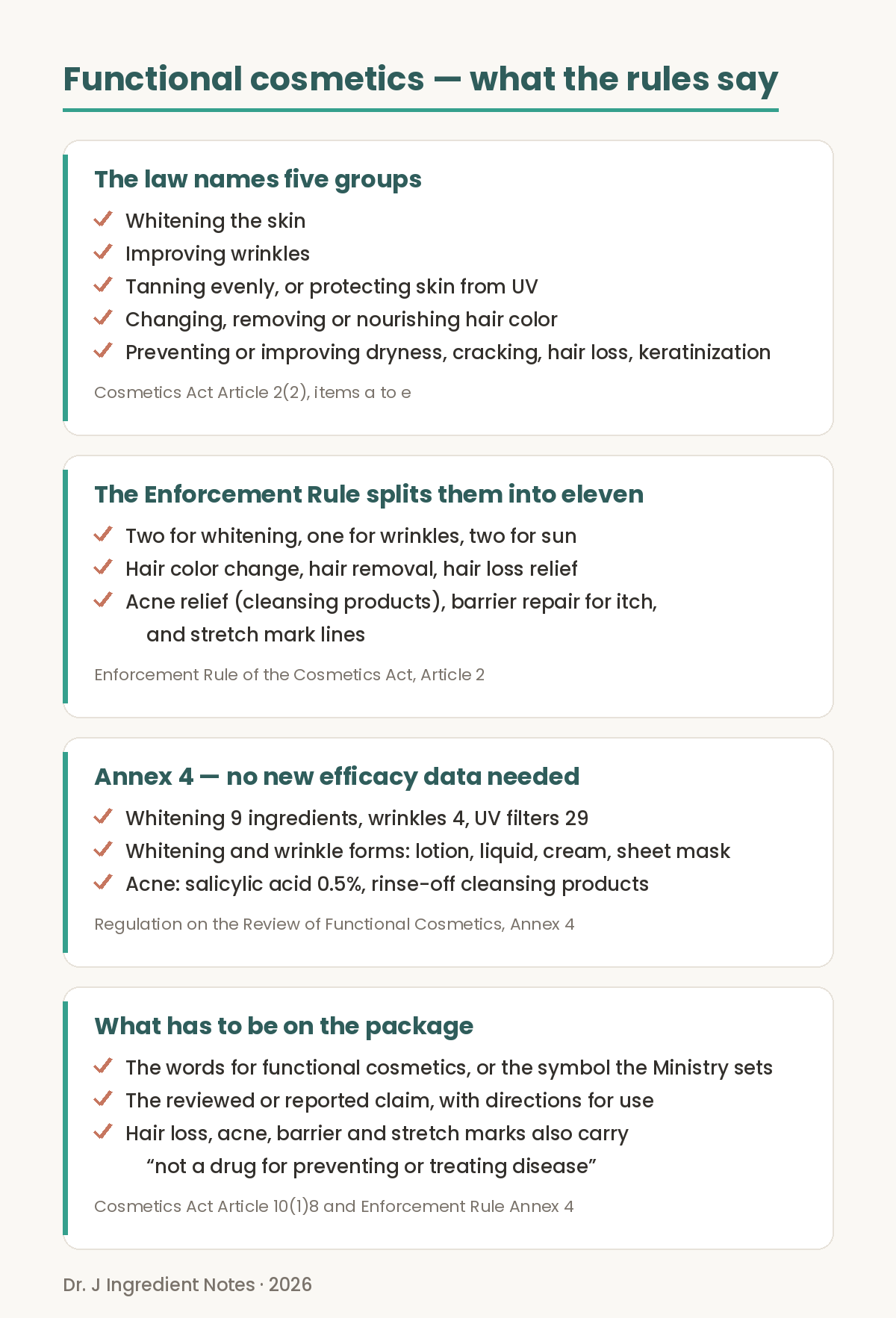
    Evidence card image summarising Korea's rules on functional cosmetics. First, the Cosmetics Act Article 2(2) names five groups: whitening, wrinkle improvement, tanning or UV protection, hair colour change, removal or nourishment, and preventing or improving dryness, cracking, hair loss and keratinization. Second, Article 2 of the Enforcement Rule splits them into eleven categories including acne relief in cleansing products, barrier repair for itch and stretch mark lines. Third, Annex 4 of the Regulation on the Review of Functional Cosmetics lists nine whitening ingredients, four wrinkle ingredients and twenty-nine UV filters, with lotion, liquid, cream and sheet mask as the permitted forms, and salicylic acid 0.5 percent for acne in rinse-off cleansing products. Fourth, the package must carry the words for functional cosmetics or the official symbol, the reviewed or reported claim with directions for use, and for hair loss, acne, barrier and stretch marks the sentence that it is not a drug for preventing or treating disease.

    ――――――――――――――――――――――――――――

    Annex 4 — read its title slowly

    The table is called “Types of functional cosmetics for which data submission is omitted”. So the amounts in it are not ceilings, and they are not “the dose that works best”. They are the amounts at which you no longer have to prove anything new.

    Group in Annex 4 Ingredients Forms and product type Claim wording
    Even tanning · UV protection 29 filters with maximum levels
    benzophenone-3 5% · zinc oxide 25% · titanium dioxide 25% and others
    Lotion, cream and oil; basic and colour make-up product types Carried by the SPF and PA figures
    Skin whitening 9 ingredients Lotion, liquid, cream and sheet mask “Helps whiten the skin”
    Wrinkle improvement 4 ingredients Lotion, liquid, cream and sheet mask “Helps improve skin wrinkles”
    Hair colour change Dyes, bleaches and strippers Set out by form in the table Dyeing, bleaching, stripping
    Hair removal As listed in the table Liquid, cream, lotion, aerosol “Depilation (removal of body hair)”
    Acne-prone skin relief Salicylic acid 0.5% — the only one listed Cleansing product type (soap-based); liquid, lotion, cream “Helps ease acne-prone skin”
    Directions: “rinse off immediately with water”

    The acne row is the one people misread. The directions column says “rinse off immediately with water”, and the product type is a cleansing preparation. That is why so many Korean products with an acne functional claim are face washes rather than leave-on serums.

    Notice also what is not in Annex 4: hair loss, barrier repair and stretch marks. No ingredient has been notified for those three, so a product claiming them goes down the review route. How those individual reviews are decided in practice is something I could not open a source for, so I will leave it there.

    ――――――――――――――――――――――――――――

    The nine and the four, by name

    This is the table to hold against a back label. If one of these names appears and the front says functional cosmetic, the product was most likely built to the notified amount and reported.

    Whitening (9) Amount Wrinkle improvement (4) Amount
    Broussonetia extract 2% Retinol 2,500 IU/g
    Arbutin 2–5% Retinyl palmitate 10,000 IU/g
    Ethyl ascorbyl ether 1–2% Adenosine 0.04%
    Oil-soluble licorice extract 0.05% Polyethoxylated retinamide 0.05–0.2%
    Ascorbyl glucoside 2% — —
    Magnesium ascorbyl phosphate 3% — —
    Niacinamide 2–5% — —
    Alpha-bisabolol 0.5% — —
    Ascorbyl tetraisopalmitate 2% — —

    Both groups also have fixed forms: lotion, liquid, cream and sheet mask. The claim wording is fixed too, and so are the directions (“apply an appropriate amount evenly to the skin”; sheet masks are removed after 10 to 20 minutes).

    That form restriction has a practical edge. The same ingredient at the same percentage in an essence or ampoule falls outside the table, and the product has to be reviewed rather than reported.

    ――――――――――――――――――――――――――――

    Korea, the United States and the EU — three different drawers

    If you buy Korean skincare from abroad, this is the part worth keeping. The same tube can be a state-reviewed “functional cosmetic” in Seoul, an ordinary cosmetic in Paris, and, depending on what the label says, a drug in the United States.

    Korea United States European Union
    Is there a category for this? Yes — “functional cosmetics”, defined in the Cosmetics Act No. A product that claims to affect the structure or function of the body becomes a drug under the FD&C Act No. Everything is a cosmetic product under Regulation 1223/2009
    Who checks before it is sold? MFDS review, or a report, product by product (Act Article 4) No premarket approval for cosmetics. OTC drugs may follow a monograph instead A responsible person must be designated (Art. 4) and the product notified to the Commission (Art. 13)
    Where do the numbers come from? Annex 4 — whitening 9, wrinkles 4, UV filters 29, acne salicylic acid 0.5% Monograph ranges — for acne, salicylic acid 0.5 to 2% (21 CFR 333.310) The Annexes restrict what may be used; they do not set amounts for efficacy
    May the label say a public authority approved it? Yes — the words on the pack are exactly that There is no approval to point to Not allowed. “Claims that indicate that the product has been authorised or approved by a competent authority within the Union shall not be allowed” (Reg. 655/2013)
    What else must the label carry? The reviewed claim with directions; four categories add “not a drug for preventing or treating disease” A Drug Facts panel when the product is an OTC drug Claims must be legal, truthful, evidenced, honest, fair and clear (the six common criteria)

    The last two rows are where the systems genuinely collide. The EU’s common criteria open with this: “Claims that indicate that the product has been authorised or approved by a competent authority within the Union shall not be allowed.” The whole point of the Korean line is the opposite — it tells you the Ministry looked at it.

    The US draws its line somewhere else again. FDA’s own wording is that cosmetics are “intended to be rubbed, poured, sprinkled, or sprayed on… for cleansing, beautifying, promoting attractiveness, or altering the appearance”, while a drug is “intended to affect the structure or any function of the body”. Claim the second thing and the product changes category. FDA also notes that “cosmeceutical” has no meaning under the law.

    So a Korean whitening cream with adenosine at 0.04% is not “approved” anywhere else — the category it belongs to simply does not exist outside Korea. That is worth knowing before you read too much into the words.

    ――――――――――――――――――――――――――――

    What has to be on the package

    ✔ The words 기능성화장품, or the symbol the Minister designates — Act Article 10(1)8

    ✔ The claim and the directions that were reviewed or reported

    ✔ For hair loss, acne, barrier and stretch marks: “not a drug for the prevention or treatment of disease”

    ✔ For products labelled for infants (3 and under) or children (4 to 13): the preservative content

    The placement is fixed as well. Annex 4 of the Enforcement Rule says the sentence goes directly beneath the words 기능성화장품, in type at least as large. So if you can see the words but not the claim, look again just under them.

    ――――――――――――――――――――――――――――

    How I read the label after that

    I treat the line as an answer to one question: which of the eleven, and did it clear the procedure for that one? It is a good answer, and it is a narrow one.

    It does not tell you how much the product will do. The notified amount is the amount that lets a company skip new data, not the amount chosen for the strongest result. So the next thing I look at is the amount and the form.

    For wrinkles, is adenosine there at 0.04%? For whitening, is arbutin or niacinamide in the 2–5% band? And where does that name sit in the ingredient list? Remember that below 1% the order stops meaning anything (Ingredient Guide 14).

    ――――――――――――――――――――――――――――

    Five things to check when buying

    ✔ Is what you want one of the eleven — whitening, wrinkles, sun, and so on

    ✔ Does the claim directly under the words match it

    ✔ Is a notified ingredient in the list — adenosine 0.04%, arbutin 2–5%

    ✔ Is the form lotion, liquid, cream or sheet mask (for whitening and wrinkles)

    ✔ For sun care, are the SPF and PA figures printed alongside

    ――――――――――――――――――――――――――――

    One line

    “Functional cosmetic” means the product cleared a review or a report for one of eleven named claims. Read the sentence under the words first; then read the amount and the form.

    Next up: expiry dates and period-after-opening — the two dates on a Korean package, and what the open-jar symbol means (Ingredient Guide 17).

    ――――――――――――――――――――――――――――

    📌 Earlier posts

    📌 Arbutin vs Alpha-Arbutin: What Korea’s 2–5% Means (Ingredient Guide 15)

    📌 Adenosine 0.04%: Who Decided That Number (Ingredient Guide 12)

    📌 How to Read a Korean Cosmetic Ingredient List (Ingredient Guide 14)

    📌 Sunscreen SPF and PA: How to Read the Numbers (Ingredient Guide 11)

    📌 Niacinamide: How Much Is Enough (Ingredient Guide 2)

    About the author · Dr. J

    MS in Veterinary Medicine, PhD in Life Sciences. I worked as a researcher at the Korea Research Institute of Bioscience and Biotechnology (KRIBB) and now run Beaurea, a cosmetics manufacturing company, where I write the formulas myself. This blog reads the research papers and the regulatory documents and turns them into plain-language criteria for choosing ingredients. I don’t recommend specific products here – only criteria that apply to any product.

    📄 Sources

    · Cosmetics Act (Korea), Articles 2(2), 4 and 10(1)8

    · Enforcement Rule of the Cosmetics Act, Articles 2, 9 and 10, and Annex 4 (labelling standards)

    · Regulation on the Review of Functional Cosmetics (MFDS Notice No. 2023-61), Articles 4 and 6, Annex 4

    · 21 CFR 333.310 — Acne treatment active ingredients (eCFR)

    · Regulation (EC) No 1223/2009, Articles 4, 13 and 20

    · Commission Regulation (EU) No 655/2013, Annex — common criteria

    · US FDA, “Is It a Cosmetic, a Drug, or Both? (Or Is It Soap?)”

    ――――――――――――――――――――――――――――

    This post summarises statutes and regulatory notices and is not a substitute for diagnosis or treatment. If something about your skin worries you, please talk to a professional.

    — Dr. J Ingredient Notes