
🇰🇷 한국어판: 여드름 화장품 성분 다섯 – 고시가 정한 0.5%와 사람 대상 연구 네 편
Hello, this is Dr. J. Today we look at acne skincare ingredients — and only at what a regulation or a human trial actually says about them.
An acne aisle in Korea will show you twenty ingredient names. Exactly one of them is listed in the country’s functional cosmetics notice for acne. For the other four in this article, I opened the trials one by one.
This is also a good article for reading a Korean label from outside Korea, because the Korean rule and the American rule treat the same molecule in two different ways. Salicylic acid is a cosmetic ingredient here and an over-the-counter drug there, and the concentration ranges are different too. There is a table for that below.
――――――――――――――――――――――――――――
📄 The sources, first
📄 Korea — Functional Cosmetics Review notice, Annex 4 (the acne row is here)
📄 Korea — Cosmetic Safety Standard, Annex 2 (restricted raw materials)
📄 United States — 21 CFR 333.310, acne active ingredients
📄 Abels 2011 — glycolic acid 10% cream, 120 people, 90 days
📄 Draelos 2006 — niacinamide 2% and facial sebum production
📄 Enshaieh 2007 — tea tree oil 5% gel, 60 people, 45 days
📄 Yoon 2013 — green tea EGCG, 35 people, 8 weeks, split-face
The two Korean annexes download as plain text from those links, with the dosage form and the wash-off instruction written out line by line.
――――――――――――――――――――――――――――
――――――――――――――――――――――――――――
In a hurry? Five lines
✔ Korea lists one acne ingredient: salicylic acid at 0.5%
✔ That product is rinsed off right after use, by the notice’s own wording
✔ The United States treats the same acid as an OTC drug at 0.5 to 2%
✔ For leave-on cosmetics, glycolic acid has a 90-day placebo-controlled trial
✔ Niacinamide was measured on sebum, not lesions, and two studies split
――――――――――――――――――――――――――――
Five ingredients in one table, with what each was compared against
| Ingredient | Source | People · length | Compared with | What was found |
|---|---|---|---|---|
| Salicylic acid 0.5% rinse-off |
Korean notice, Annex 4 | — | Not a trial — a notice | The one ingredient listed for acne-prone skin |
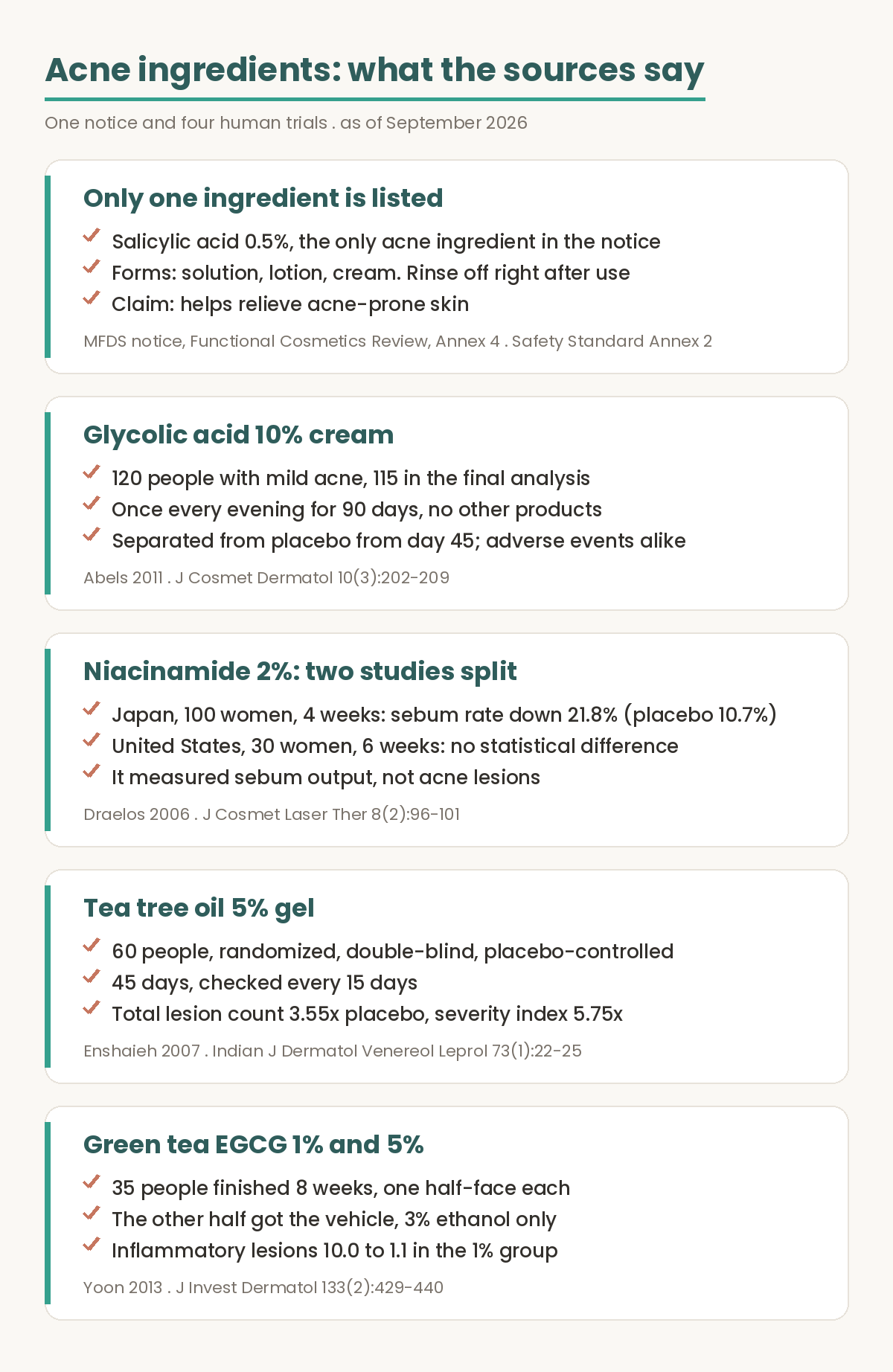
| Glycolic acid (AHA) 10% | Abels 2011 | 120 enrolled, 115 analysed · 90 days | Placebo cream, double-blind | Split from placebo from day 45; adverse events alike |
| Niacinamide 2% | Draelos 2006 | Japan 100, 4 weeks / US 30, 6 weeks | Placebo moisturizer | Japan: sebum rate down 21.8% (placebo 10.7%). US: no significant difference |
| Tea tree oil 5% | Enshaieh 2007 | 60 people · 45 days | Placebo gel, double-blind | Total lesion count 3.55x placebo; severity index 5.75x |
| Green tea EGCG 1% / 5% | Yoon 2013 | 35 finished · 8 weeks | The other half of the same face (3% ethanol vehicle) | Inflammatory lesions 10.0 to 1.1 in the 1% group |
The column worth reading twice is «compared with». Two products can both say «improved» and mean very different things, depending on what sat on the other side of the comparison.
――――――――――――――――――――――――――――
Korea and the United States: the same acid, two systems
| Korea | United States | |
|---|---|---|
| What salicylic acid is for acne | A functional cosmetic ingredient | An OTC drug active ingredient |
| Where it is written | Functional Cosmetics Review notice, Annex 4 | 21 CFR 333.310, acne monograph |
| Concentration | 0.5%, one figure | 0.5 to 2%, a range |
| How it is used | Applied, then rinsed off right away | Leave-on products are covered too |
| Wording on the pack | 「Helps relieve acne-prone skin」 | Drug Facts label, «for the treatment of acne» |
| Other listed actives | None for acne | Benzoyl peroxide 2.5–10%, sulfur 3–10%, resorcinol 2% with sulfur |
This is the part that surprises people who read Korean labels from abroad. In Korea, a product that carries the acne functional cosmetic claim is, by the notice’s own wording, a product you wash off right away — which is why so many of them are cleansers. In the United States, the same molecule sits in 21 CFR 333.310 as an acne drug active, at 0.5 to 2 percent, and leave-on products are ordinary there.
So «Korean acne cleanser with 0.5% salicylic acid» and «American 2% BHA leave-on» are not the same category of product wearing different labels. They are two regulatory systems that decided to file the same ingredient in different drawers.
――――――――――――――――――――――――――――
What Korea’s notice actually says
Annex 4 of the Functional Cosmetics Review notice is a list of the cases where a company does not have to submit new efficacy data. Whitening has nine ingredients on that list, wrinkle improvement has four, and acne has one:
✔ Ingredient and amount — salicylic acid 0.5%
✔ Dosage forms — solution, lotion, cream
✔ Claim — «helps relieve acne-prone skin»
✔ Directions — «take an appropriate amount, apply to the skin, then rinse off with water right away»
There is a second Korean line worth knowing, in the Cosmetic Safety Standard, Annex 2: salicylic acid is capped at 0.5% and may not be used in products for infants, or in products labelled as suitable for children aged 13 or under — shampoos excepted. If you are buying for a younger teenager, that is the line to check.
――――――――――――――――――――――――――――
A leave-on option with a trial behind it: glycolic acid 10%, 90 days
Abels and colleagues, 2011. 120 people with mild acne (Leeds 0.25–1, mean age 21±5.8) were randomised; 115 made the final analysis. They applied a 10% glycolic acid oil-in-water emulsion once every evening for 90 days, as monotherapy, with cleansing standardised.
The treated group separated from placebo from day 45 at the 5% significance level, and the difference held to day 90. Adverse events did not differ significantly between the groups.
Two things are useful here. First, this is a cream you leave on, not a peel — I keep peeling and dermabrasion studies out of cosmetic articles. Second, day 45 is a reasonable answer to «how long before I judge it». Two weeks is not.
――――――――――――――――――――――――――――
Niacinamide 2%: read what it actually measured
Draelos, Matsubara and Smiles, 2006, ran two studies in two countries. In Japan, 100 women over 4 weeks: the sebum excretion rate fell 21.8% against 10.7% for placebo (at 2 weeks, 21.3% against 8.6%).
In the United States, 30 Caucasian women over 6 weeks: casual sebum levels trended down but only reached p=0.055, and the sebum excretion rate did not reach statistical significance.
«Niacinamide reduces oil» is repeated everywhere. The paper says two more things that rarely travel with it: it measured sebum output rather than acne lesions, and the two populations did not agree. Both belong in the sentence.
Why not a niacinamide acne trial instead? Because most of them compare it with clindamycin gel, a prescription antibiotic. I do not line cosmetics up against prescription drugs in these articles, so I used the sebum study and said so.
――――――――――――――――――――――――――――
Two with placebo-controlled trials: tea tree oil and green tea
Tea tree: Enshaieh and colleagues, 2007. 60 people with mild to moderate acne, randomised double-blind, 30 per group, 45 days with checks every 15 days. Improvement in total lesion count was 3.55 times that of placebo, and in the acne severity index 5.75 times. Side effects were comparable and tolerable in both groups.
Green tea: Yoon and colleagues, 2013. Thirty-seven enrolled, 35 finished 8 weeks. A randomly allocated half of each face received 1% (17 people) or 5% (18 people) EGCG solution twice daily; the other half received the vehicle, 3% ethanol only.
In the 1% group, inflammatory lesions went from 10.0±3.1 to 1.1±0.5 and non-inflammatory lesions from 53.8±19.8 to 15.6±6.2. A split-face design removes a great deal of person-to-person noise, which is what makes a 35-person study worth reading.
――――――――――――――――――――――――――――
How to read «it improved»
| Compared with | How to read it | In this article |
|---|---|---|
| The same product minus the ingredient | Only that ingredient is left to explain the difference — the cleanest comparison | Glycolic acid, tea tree, niacinamide |
| The other half of the same face | Everything that differs between people is held still; the two halves can still influence each other | Green tea EGCG |
| The starting point (before and after) | The season and the person’s routine move too, so this alone is weak | Where an abstract gives no placebo figure |
| A notice | Not the size of an effect — the right to make a claim | Salicylic acid 0.5% |
――――――――――――――――――――――――――――
What I left out, and why
✔ Trials against prescription drugs — most niacinamide acne trials compare it with clindamycin gel. A cosmetic article should not be read as putting a cream next to a prescription
✔ Peels and dermabrasion — salicylic and glycolic acid both have large peel literatures. That is a procedure, not a product on a shelf
✔ Bakuchiol — there is an acne study, but I could not confirm from the source whether it was placebo-controlled, so it waits
✔ Mechanism — how salicylic acid loosens keratin, or what EGCG does inside a cell, needs review articles I could not open today
Writing down what was left out is the point of the exercise: it shows you the rule I used, so you can apply the same rule to the next ingredient someone recommends.
――――――――――――――――――――――――――――
So where do you look?
✔ Breakouts often — start from a rinse-off product with salicylic acid 0.5%
✔ You want something you leave on — glycolic acid, and give it 45 days
✔ Oiliness is the complaint — niacinamide, knowing it was measured on sebum
✔ You want the gentler end — tea tree and green tea both have placebo-controlled trials
✔ Buying for a young teenager — check the Annex 2 age line
✔ Do not stack all five at once — one at a time, in the evening
I read the claim and the trial as two separate things. A functional cosmetic claim in Korea means a listed ingredient at a listed amount; it does not tell you the size of the effect. What comes next is whether that ingredient has a human trial, and what sat on the other side of the comparison.
――――――――――――――――――――――――――――
One line
Korea lists exactly one acne ingredient — salicylic acid 0.5%, rinsed off — and the other four earn their place from placebo-controlled trials. Read the claim and the trial side by side.
Next: five ingredients for dark spots, starting from the nine on Korea’s whitening list.
――――――――――――――――――――――――――――
📌 Previously
📌 Salicylic Acid (BHA): 0.5% vs 2%, Explained
📌 AHA vs BHA: Is Glycolic Acid an AHA?
📌 Niacinamide: How Much Is Enough
📌 How to Read a Korean Cosmetic Ingredient List
📌 Skin Concern Ingredient Map
About the author · Dr. J
MS in Veterinary Medicine, PhD in Life Sciences. I worked as a researcher at the Korea Research Institute of Bioscience and Biotechnology (KRIBB) and now run Beaurea, a cosmetics manufacturing company, where I write the formulas myself. This blog reads the research papers and the regulatory documents and turns them into plain-language criteria for choosing ingredients. I don’t recommend specific products here – only criteria that apply to any product.
📄 References
· Korea MFDS, Regulation on the Review of Functional Cosmetics, Annex 4
· Korea MFDS, Regulation on Safety Standards for Cosmetics, Annex 2
· 21 CFR 333.310 — Acne active ingredients (US FDA OTC monograph)
· Abels C, Kaszuba A, Michalak I et al., J Cosmet Dermatol 2011;10(3):202-209
· Draelos ZD, Matsubara A, Smiles K, J Cosmet Laser Ther 2006;8(2):96-101
· Enshaieh S, Jooya A, Siadat AH et al., Indian J Dermatol Venereol Leprol 2007;73(1):22-25
· Yoon JY, Kwon HH, Min SU et al., J Invest Dermatol 2013;133(2):429-440
――――――――――――――――――――――――――――
This article summarises published regulations and research for information only; it does not replace diagnosis or treatment. If a skin problem persists, please see a professional.
— Dr. J Ingredient Notes