🇰🇷 한국어판: 기능성화장품 뜻과 종류 11가지 – 무엇을 보증하나
Hello, this is Dr. J. If you have ever turned over a Korean cream and seen the words 기능성화장품 — functional cosmetics — this post is about what that line actually certifies.
It is not a marketing word. It is a legal category, with a fixed list of eleven things a product is allowed to be, a fixed set of ingredients and amounts, and a fixed sentence the package has to carry. Once you know where the line comes from, the shelf reads differently.
There is one more reason this is worth reading if you are outside Korea. The EU forbids exactly what Korea requires. Under EU rules, a cosmetic label may not claim that an authority approved it. In Korea, that approval is the label. Same bottle, two opposite drawers — the table further down sets them side by side.
――――――――――――――――――――――――――――
📄 The original documents
📄 Regulation on the Review of Functional Cosmetics, Annex 4 (Korean)
📄 Enforcement Rule of the Cosmetics Act, Annex 4 — labelling standards (Korean)
📄 21 CFR 333.310 — US acne treatment active ingredients
📄 Commission Regulation (EU) No 655/2013 — common criteria for cosmetic claims
📄 Regulation (EC) No 1223/2009 on cosmetic products
🏠 FDA — Is It a Cosmetic, a Drug, or Both?
The two Korean links download the annex tables themselves. They give the ingredient, the amount, the permitted form, the claim wording and the directions for use, one line each.
――――――――――――――――――――――――――――
――――――――――――――――――――――――――――
The short version
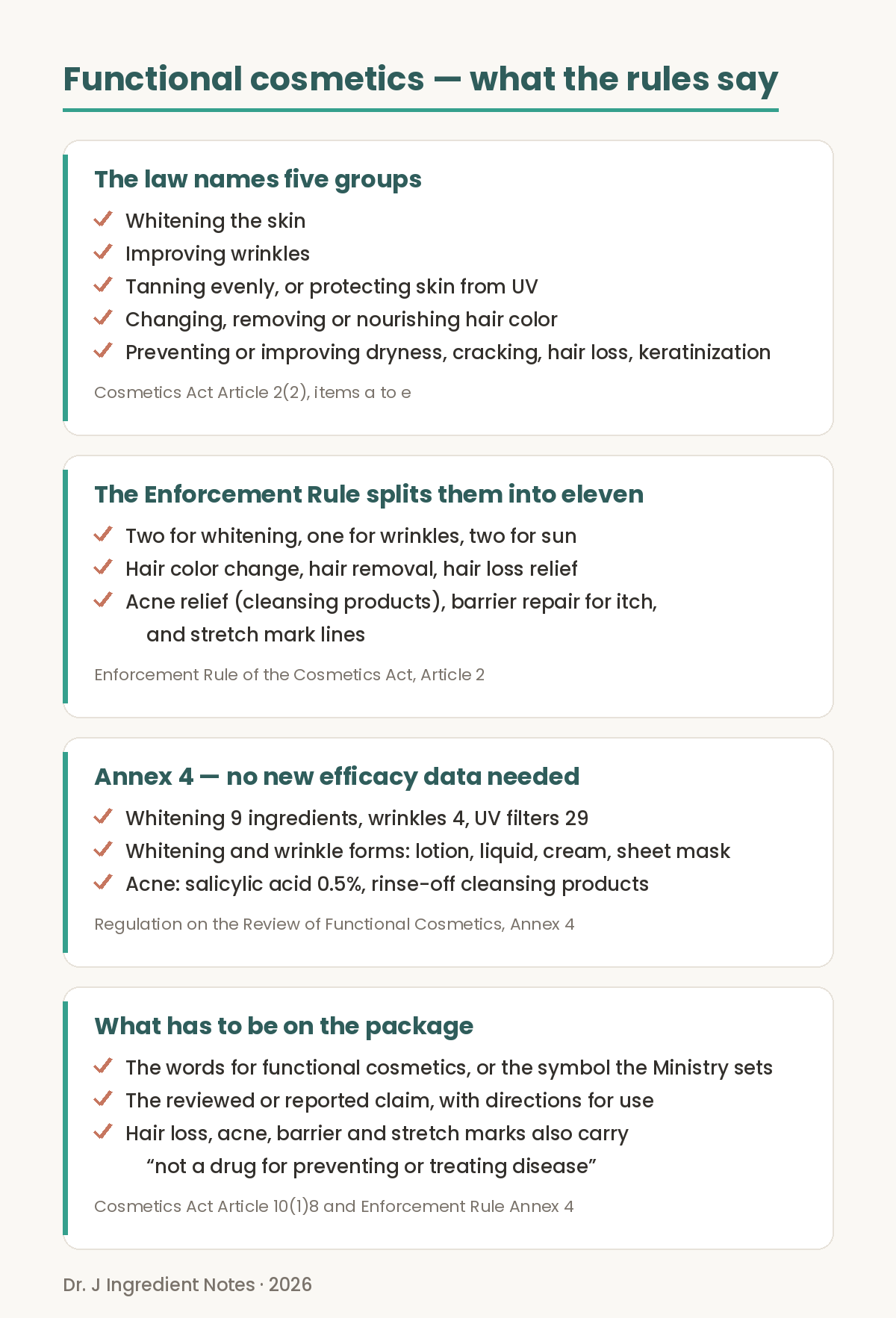
✔ The Act names five groups; the Enforcement Rule splits them into eleven categories
✔ Build a product to a notified ingredient at a notified amount and you file a report instead of a full review
✔ Annex 4 lists 9 whitening ingredients, 4 for wrinkles, 29 UV filters and one for acne
✔ The package carries the words and the reviewed claim, in type at least as large
✔ Hair loss, acne, barrier and stretch marks also carry “not a drug”
――――――――――――――――――――――――――――
Five groups in the Act, eleven categories in the Rule
Article 2(2) of the Cosmetics Act defines functional cosmetics as products falling under one of five items, “as prescribed by Ordinance of the Prime Minister”. That ordinance is the Enforcement Rule, and its Article 2 is where the list becomes eleven.
| Cosmetics Act, Article 2(2) | Enforcement Rule, Article 2 — the eleven categories |
|---|---|
| a. Helps whiten the skin | 1. Prevents melanin from settling, so freckles and dark spots are held back 2. Lightens melanin that has already settled |
| b. Helps improve wrinkles | 3. Firms the skin so wrinkles are eased or improved |
| c. Helps tan the skin evenly, or protects it from UV | 4. Shields from sunlight for an even tan 5. Blocks or scatters UV to protect the skin |
| d. Helps change, remove or nourish hair colour | 6. Changes hair colour, or bleaches and strips it 7. Removes body hair (physical removal excluded) |
| e. Helps prevent or improve dryness, cracking, falling out or keratinization caused by weakened skin or hair function | 8. Eases hair loss symptoms (coating and other physical methods excluded) 9. Eases acne-prone skin (cleansing products) 10. Restores barrier function so itching improves 11. Improves the red lines of stretch marks |
Read the table left to right and one thing stands out. Four categories came out of a single item — item e. Hair loss, acne, barrier repair and stretch marks all sit under a sentence about dryness, cracking, falling out and keratinization. Those same four are the ones that must carry the “not a drug” sentence, which we will get to.
Anything outside these eleven cannot be sold as a functional cosmetic. A Korean pack may still shout about pores or firmness in large type — that is ordinary advertising copy, not this category.
――――――――――――――――――――――――――――
A review, or a report
Article 4(1) of the Act: “A cosmetics manufacturer, a cosmetics responsible distributor, or a university or research institute prescribed by Ordinance of the Prime Minister that intends to sell a product recognised as a functional cosmetic shall, for each item, either undergo a review by the Minister of Food and Drug Safety as to safety and efficacy, or submit a report to the Minister.”
The review route asks for a good deal. Article 4 of the Regulation on the Review of Functional Cosmetics sets out what has to be filed:
✔ Origin and development history
✔ Safety — single-dose toxicity, skin irritation, sensitisation, photo-toxicity, human patch testing
✔ Efficacy or function — efficacy testing, human application testing, hair-dye efficacy testing
✔ Supporting data for the SPF, water resistance and PA figures
✔ Specifications and test methods, with samples
The report route replaces all of that in three situations: the ingredient, amount, claim, directions, specifications and test methods are already notified; the product is identical in every one of those respects to something already reviewed; or it mixes a reviewed product with a notified one. Article 6 of the same Regulation is the hinge — meet Annex 4 and the data requirement falls away.
――――――――――――――――――――――――――――
Annex 4 — read its title slowly
The table is called “Types of functional cosmetics for which data submission is omitted”. So the amounts in it are not ceilings, and they are not “the dose that works best”. They are the amounts at which you no longer have to prove anything new.
| Group in Annex 4 | Ingredients | Forms and product type | Claim wording |
|---|---|---|---|
| Even tanning · UV protection | 29 filters with maximum levels benzophenone-3 5% · zinc oxide 25% · titanium dioxide 25% and others |
Lotion, cream and oil; basic and colour make-up product types | Carried by the SPF and PA figures |
| Skin whitening | 9 ingredients | Lotion, liquid, cream and sheet mask | “Helps whiten the skin” |
| Wrinkle improvement | 4 ingredients | Lotion, liquid, cream and sheet mask | “Helps improve skin wrinkles” |
| Hair colour change | Dyes, bleaches and strippers | Set out by form in the table | Dyeing, bleaching, stripping |
| Hair removal | As listed in the table | Liquid, cream, lotion, aerosol | “Depilation (removal of body hair)” |
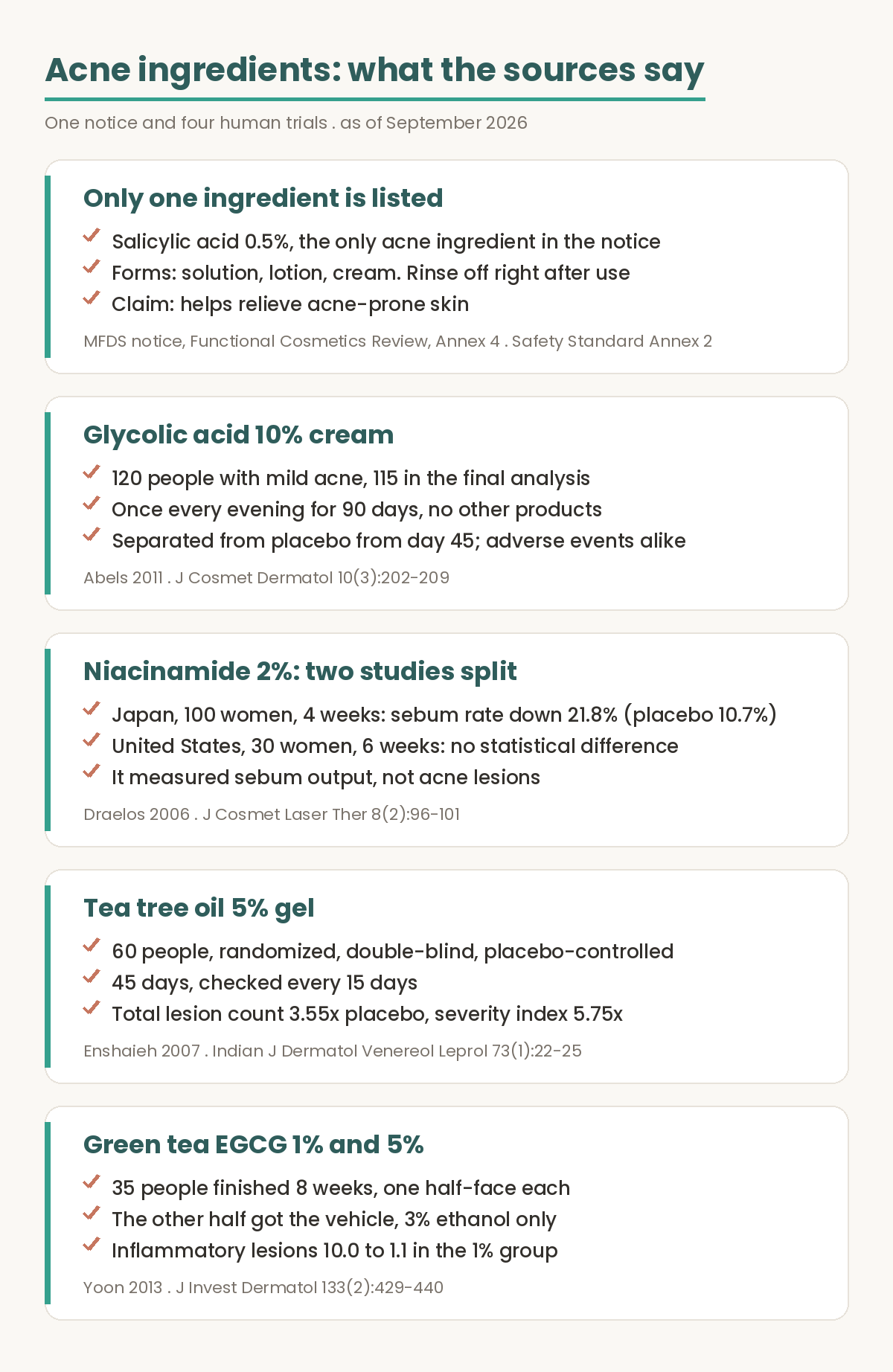
| Acne-prone skin relief | Salicylic acid 0.5% — the only one listed | Cleansing product type (soap-based); liquid, lotion, cream | “Helps ease acne-prone skin” Directions: “rinse off immediately with water” |
The acne row is the one people misread. The directions column says “rinse off immediately with water”, and the product type is a cleansing preparation. That is why so many Korean products with an acne functional claim are face washes rather than leave-on serums.
Notice also what is not in Annex 4: hair loss, barrier repair and stretch marks. No ingredient has been notified for those three, so a product claiming them goes down the review route. How those individual reviews are decided in practice is something I could not open a source for, so I will leave it there.
――――――――――――――――――――――――――――
The nine and the four, by name
This is the table to hold against a back label. If one of these names appears and the front says functional cosmetic, the product was most likely built to the notified amount and reported.
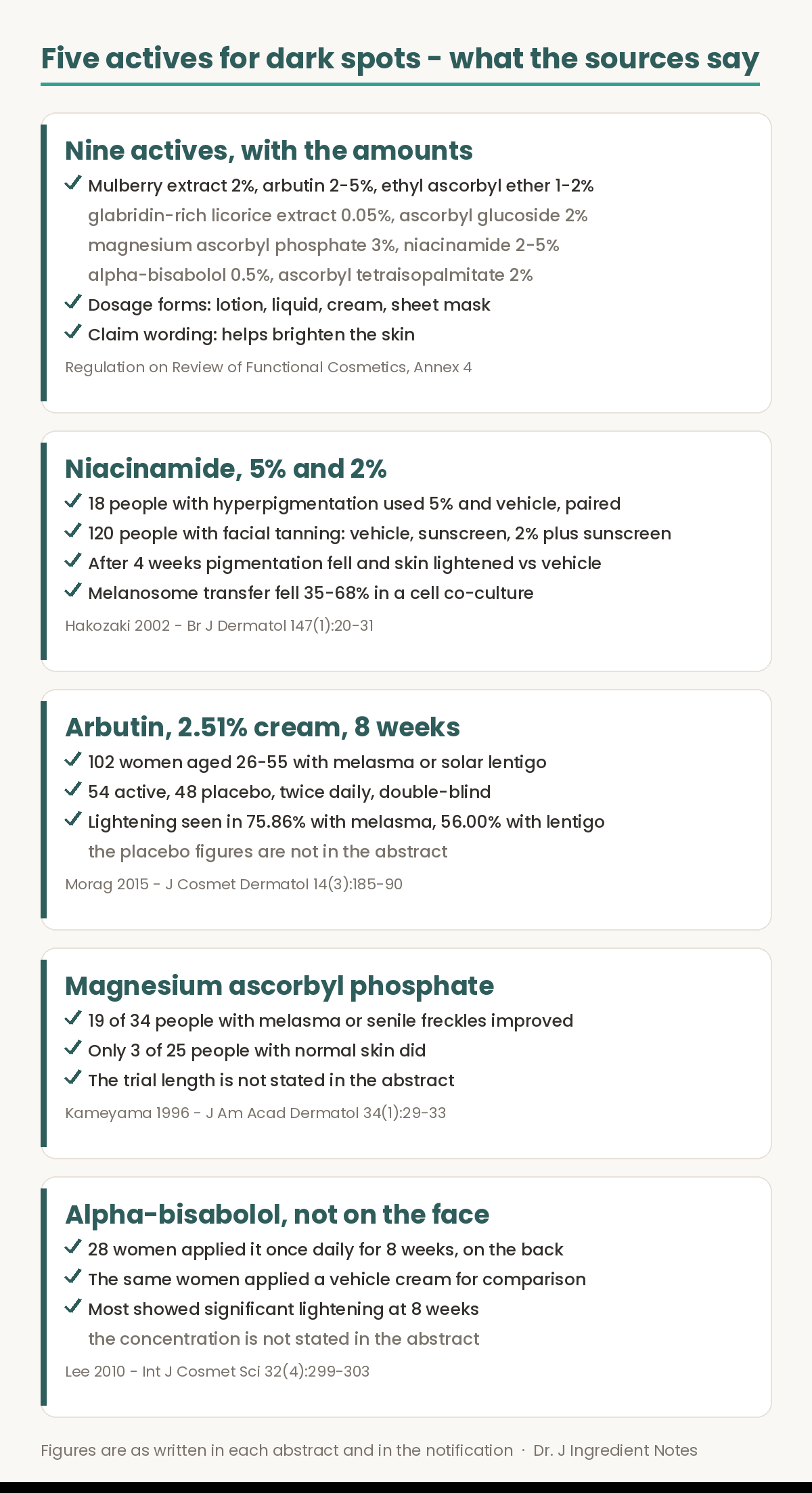
| Whitening (9) | Amount | Wrinkle improvement (4) | Amount |
|---|---|---|---|
| Broussonetia extract | 2% | Retinol | 2,500 IU/g |
| Arbutin | 2–5% | Retinyl palmitate | 10,000 IU/g |
| Ethyl ascorbyl ether | 1–2% | Adenosine | 0.04% |
| Oil-soluble licorice extract | 0.05% | Polyethoxylated retinamide | 0.05–0.2% |
| Ascorbyl glucoside | 2% | — | — |
| Magnesium ascorbyl phosphate | 3% | — | — |
| Niacinamide | 2–5% | — | — |
| Alpha-bisabolol | 0.5% | — | — |
| Ascorbyl tetraisopalmitate | 2% | — | — |
Both groups also have fixed forms: lotion, liquid, cream and sheet mask. The claim wording is fixed too, and so are the directions (“apply an appropriate amount evenly to the skin”; sheet masks are removed after 10 to 20 minutes).
That form restriction has a practical edge. The same ingredient at the same percentage in an essence or ampoule falls outside the table, and the product has to be reviewed rather than reported.
――――――――――――――――――――――――――――
Korea, the United States and the EU — three different drawers
If you buy Korean skincare from abroad, this is the part worth keeping. The same tube can be a state-reviewed “functional cosmetic” in Seoul, an ordinary cosmetic in Paris, and, depending on what the label says, a drug in the United States.
| Korea | United States | European Union | |
|---|---|---|---|
| Is there a category for this? | Yes — “functional cosmetics”, defined in the Cosmetics Act | No. A product that claims to affect the structure or function of the body becomes a drug under the FD&C Act | No. Everything is a cosmetic product under Regulation 1223/2009 |
| Who checks before it is sold? | MFDS review, or a report, product by product (Act Article 4) | No premarket approval for cosmetics. OTC drugs may follow a monograph instead | A responsible person must be designated (Art. 4) and the product notified to the Commission (Art. 13) |
| Where do the numbers come from? | Annex 4 — whitening 9, wrinkles 4, UV filters 29, acne salicylic acid 0.5% | Monograph ranges — for acne, salicylic acid 0.5 to 2% (21 CFR 333.310) | The Annexes restrict what may be used; they do not set amounts for efficacy |
| May the label say a public authority approved it? | Yes — the words on the pack are exactly that | There is no approval to point to | Not allowed. “Claims that indicate that the product has been authorised or approved by a competent authority within the Union shall not be allowed” (Reg. 655/2013) |
| What else must the label carry? | The reviewed claim with directions; four categories add “not a drug for preventing or treating disease” | A Drug Facts panel when the product is an OTC drug | Claims must be legal, truthful, evidenced, honest, fair and clear (the six common criteria) |
The last two rows are where the systems genuinely collide. The EU’s common criteria open with this: “Claims that indicate that the product has been authorised or approved by a competent authority within the Union shall not be allowed.” The whole point of the Korean line is the opposite — it tells you the Ministry looked at it.
The US draws its line somewhere else again. FDA’s own wording is that cosmetics are “intended to be rubbed, poured, sprinkled, or sprayed on… for cleansing, beautifying, promoting attractiveness, or altering the appearance”, while a drug is “intended to affect the structure or any function of the body”. Claim the second thing and the product changes category. FDA also notes that “cosmeceutical” has no meaning under the law.
So a Korean whitening cream with adenosine at 0.04% is not “approved” anywhere else — the category it belongs to simply does not exist outside Korea. That is worth knowing before you read too much into the words.
――――――――――――――――――――――――――――
What has to be on the package
✔ The words 기능성화장품, or the symbol the Minister designates — Act Article 10(1)8
✔ The claim and the directions that were reviewed or reported
✔ For hair loss, acne, barrier and stretch marks: “not a drug for the prevention or treatment of disease”
✔ For products labelled for infants (3 and under) or children (4 to 13): the preservative content
The placement is fixed as well. Annex 4 of the Enforcement Rule says the sentence goes directly beneath the words 기능성화장품, in type at least as large. So if you can see the words but not the claim, look again just under them.
――――――――――――――――――――――――――――
How I read the label after that
I treat the line as an answer to one question: which of the eleven, and did it clear the procedure for that one? It is a good answer, and it is a narrow one.
It does not tell you how much the product will do. The notified amount is the amount that lets a company skip new data, not the amount chosen for the strongest result. So the next thing I look at is the amount and the form.
For wrinkles, is adenosine there at 0.04%? For whitening, is arbutin or niacinamide in the 2–5% band? And where does that name sit in the ingredient list? Remember that below 1% the order stops meaning anything (Ingredient Guide 14).
――――――――――――――――――――――――――――
Five things to check when buying
✔ Is what you want one of the eleven — whitening, wrinkles, sun, and so on
✔ Does the claim directly under the words match it
✔ Is a notified ingredient in the list — adenosine 0.04%, arbutin 2–5%
✔ Is the form lotion, liquid, cream or sheet mask (for whitening and wrinkles)
✔ For sun care, are the SPF and PA figures printed alongside
――――――――――――――――――――――――――――
One line
“Functional cosmetic” means the product cleared a review or a report for one of eleven named claims. Read the sentence under the words first; then read the amount and the form.
Next up: expiry dates and period-after-opening — the two dates on a Korean package, and what the open-jar symbol means (Ingredient Guide 17).
――――――――――――――――――――――――――――
📌 Earlier posts
📌 Arbutin vs Alpha-Arbutin: What Korea’s 2–5% Means (Ingredient Guide 15)
📌 Adenosine 0.04%: Who Decided That Number (Ingredient Guide 12)
📌 How to Read a Korean Cosmetic Ingredient List (Ingredient Guide 14)
📌 Sunscreen SPF and PA: How to Read the Numbers (Ingredient Guide 11)
📌 Niacinamide: How Much Is Enough (Ingredient Guide 2)
About the author · Dr. J
MS in Veterinary Medicine, PhD in Life Sciences. I worked as a researcher at the Korea Research Institute of Bioscience and Biotechnology (KRIBB) and now run Beaurea, a cosmetics manufacturing company, where I write the formulas myself. This blog reads the research papers and the regulatory documents and turns them into plain-language criteria for choosing ingredients. I don’t recommend specific products here – only criteria that apply to any product.
📄 Sources
· Cosmetics Act (Korea), Articles 2(2), 4 and 10(1)8
· Enforcement Rule of the Cosmetics Act, Articles 2, 9 and 10, and Annex 4 (labelling standards)
· Regulation on the Review of Functional Cosmetics (MFDS Notice No. 2023-61), Articles 4 and 6, Annex 4
· 21 CFR 333.310 — Acne treatment active ingredients (eCFR)
· Regulation (EC) No 1223/2009, Articles 4, 13 and 20
· Commission Regulation (EU) No 655/2013, Annex — common criteria
· US FDA, “Is It a Cosmetic, a Drug, or Both? (Or Is It Soap?)”
――――――――――――――――――――――――――――
This post summarises statutes and regulatory notices and is not a substitute for diagnosis or treatment. If something about your skin worries you, please talk to a professional.
— Dr. J Ingredient Notes