Tag: cosmetic labelling

  • Korea Bans the Sale of Animal-Tested Cosmetics: The Six Exceptions, and the One Line a Korean Label Cannot Print (Ingredient Guide 23)

    Cover image for a Dr. J Ingredient Notes article on Korea's ban on selling animal-tested cosmetics. It shows the title Korea's Animal Testing Ban, the line six exceptions and one line labels cannot print, and a reference to Cosmetics Act Article 15-2, in force since 4 February 2017.

    🇰🇷 한국어판 읽기

    Hello, this is Dr. J. Korea has banned animal-tested cosmetics since 2017 — and yet you will almost never see “not tested on animals” printed on a Korean box. Those two facts are connected, and the connection is written down.

    Here is the part most summaries skip. What the statute blocks is selling, not testing.

    ――――――――――――――――――――――――――――

    Primary sources

    📄 Cosmetics Act Article 15-2 (Korean Law Information Center)

    📄 Laboratory Animal Act Article 2, Korean and English (KLRI)

    📄 Regulation (EC) No 1223/2009, Article 18 (EUR-Lex)

    📄 Animal Testing & Cosmetics (U.S. FDA)

    The Korean article carries the six exceptions one subparagraph at a time, and the KLRI page gives the Laboratory Animal Act definition in Korean and English side by side.

    ――――――――――――――――――――――――――――

    ――――――――――――――――――――――――――――

    The five lines, if you are in a hurry

    ✔ Selling animal-tested cosmetics has been banned in Korea since 4 February 2017

    ✔ The word manufacture carries (including contract manufacture), and imports sit in the same sentence

    ✔ The article lists six exceptions

    ✔ The penalty is an administrative fine of up to KRW 1 million

    ✔ That is why a Korean label cannot say “not tested on animals”

    ――――――――――――――――――――――――――――

    What the article actually says

    Article 15-2 has two paragraphs. Most English write-ups quote the first and stop; the second is the one that explains where the policy is going.

    Paragraph Text What it does
    15-2(1), main clause A responsible cosmetics distributor or a custom cosmetics seller shall not distribute or sell a cosmetic for which animal testing, as defined in Article 2(1) of the Laboratory Animal Act, has been carried out, or a cosmetic manufactured (including contract manufacture) or imported using an ingredient on which animal testing has been carried out. The prohibited act is distribution and sale. Running a test inside Korea is not itself the offence. Contract manufacture and imports are written into the same sentence, which closes the two obvious ways around it
    15-2(1), proviso Provided, that this shall not apply in any of the following cases. The six exceptions follow (table below)
    15-2(2) The Minister of Food and Drug Safety shall endeavour to develop alternative test methods and shall take the measures necessary for responsible cosmetics distributors and others to use them. The duty that pairs with the ban. Exception 2 opens whenever no validated alternative exists, so the second paragraph puts the job of narrowing that gap on the regulator

    The article was newly inserted on 3 February 2016 and took effect on 4 February 2017.
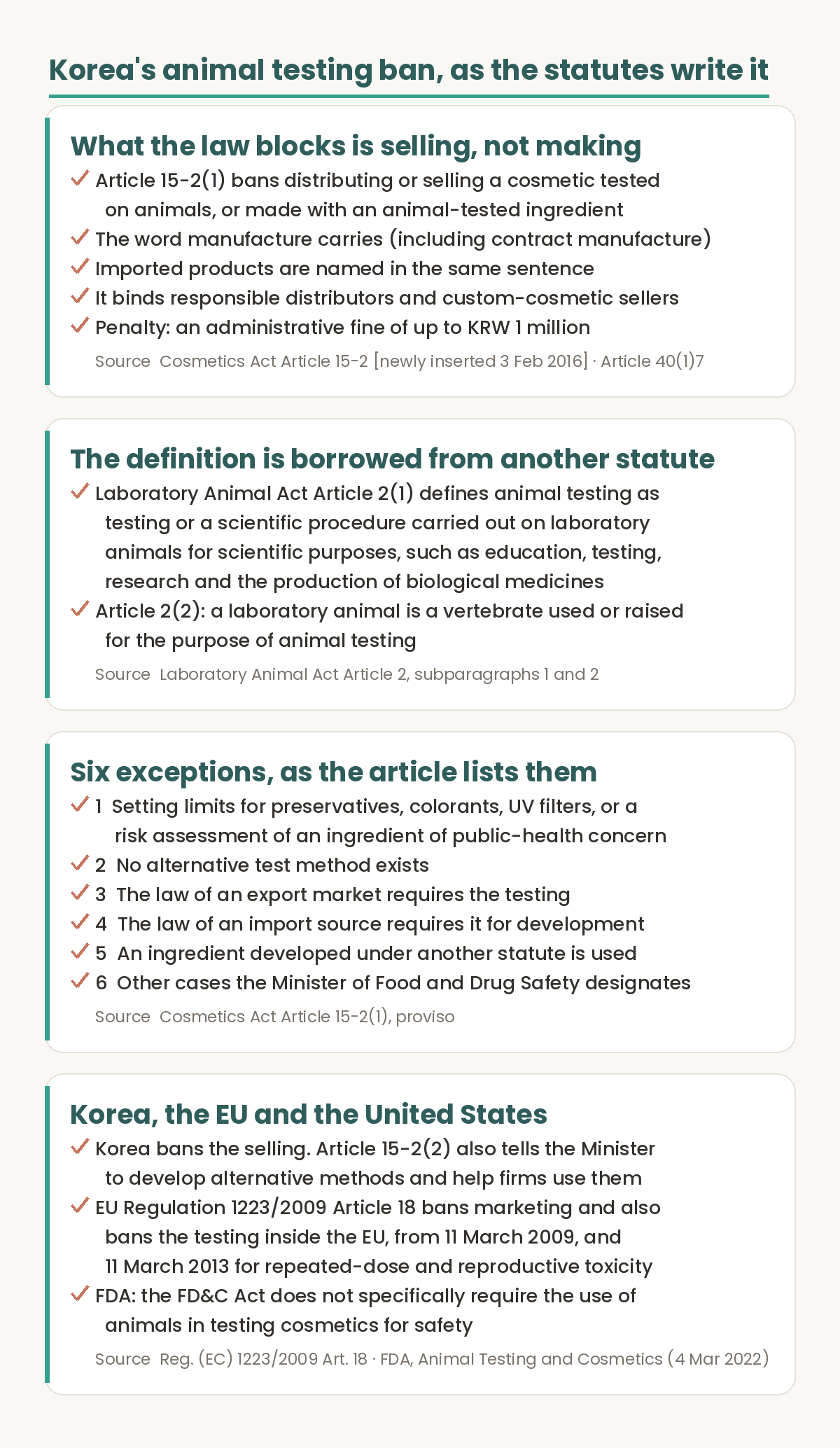
    Evidence figure on Korea's cosmetic animal testing ban. First, Article 15-2 paragraph 1 bans distributing or selling a cosmetic tested on animals or made with an animal-tested ingredient, the word manufacture carries the phrase including contract manufacture, imported products are named in the same sentence, the duty binds responsible distributors and custom cosmetic sellers, and the penalty is an administrative fine of up to one million Korean won. Second, the definition of animal testing is borrowed from the Laboratory Animal Act Article 2, which defines it as testing or a scientific procedure carried out on laboratory animals for scientific purposes, and defines a laboratory animal as a vertebrate used or raised for animal testing. Third, the article lists six exceptions, covering limits for preservatives, colorants and ultraviolet filters or a risk assessment, the absence of an alternative test method, the law of an export market, the law of an import source, an ingredient developed under another statute, and other cases the Minister of Food and Drug Safety designates. Fourth, a comparison of Korea, the European Union and the United States, where Regulation 1223/2009 Article 18 bans marketing and also testing inside the EU from 11 March 2009 and 11 March 2013, and the United States Food and Drug Administration states that the Federal Food, Drug, and Cosmetic Act does not specifically require the use of animals in testing cosmetics for safety.

    ――――――――――――――――――――――――――――

    The six exceptions, one subparagraph at a time

    No. As the article lists it In plain words
    1 Where it is necessary to designate use limits for ingredients that require particular restriction on use, such as preservatives, colorants and ultraviolet filters, or to carry out a risk assessment of a cosmetic ingredient raising a public-health concern Testing done to set a limit, not to launch a product. Korea sets numerical limits for these three groups by notice
    2 Where animal testing is necessary because no alternative test method exists The gap that paragraph (2) is meant to close
    3 Where animal testing is required under the law of an importing country for the purpose of exporting cosmetics A market Korea sells into demands it
    4 Where animal testing is required for product development under the law of the country from which the product is to be imported A market Korea buys from demands it at the development stage
    5 Where an ingredient developed through animal testing under another statute is used in manufacturing cosmetics Pharmaceutical and other statutes require testing; that ingredient can still be used
    6 Other cases prescribed by the Minister of Food and Drug Safety where it is difficult to carry out a test that can replace animal testing A notice fills this in. We could not open that notice and say so below

    Exception 1 is worth a second look. Preservatives, colorants and ultraviolet filters are named in the statute itself — the three groups whose limits Korea fixes by notice. The space kept open is the space for safety work.

    ――――――――――――――――――――――――――――

    Who is bound, and what happens

    Korea Source
    Who is bound Responsible cosmetics distributors; custom cosmetics sellers Article 15-2(1)
    What is prohibited Distributing or selling the finished cosmetic, or one made with an animal-tested ingredient, including by contract manufacture or import Article 15-2(1)
    Penalty An administrative fine of up to KRW 1 million Cosmetics Act Article 40(1)7
    Inserted 3 February 2016 [Newly inserted 3 Feb 2016]
    In force 4 February 2017 ⚠ the addendum text was not available; confirmed from two Korean newspapers

    An administrative fine is a small number next to the cost of a recall or a relabelling, but it is not the whole pressure. A product that cannot be lawfully distributed is a product retailers will not take.

    ――――――――――――――――――――――――――――

    The definition is borrowed from another statute

    The Cosmetics Act does not define animal testing itself. It reaches into the Laboratory Animal Act, Article 2(1), which reads in the official English rendering:

    “The term animal testing means testing conducted for laboratory animals or the scientific procedure for scientific purposes, such as education, testing, research and production of biological medicines or such.”

    And Article 2(2): “The term laboratory animal means vertebrate used or raised for the purpose of animal testing.”

    Because the definition is borrowed, the scope is borrowed too — the line is drawn at vertebrates.

    ――――――――――――――――――――――――――――

    Why no Korean label says “not tested on animals”

    The Korea Cosmetic Association publishes a vegan labelling guide (2025) through the industry’s self-regulatory advertising body. It allows the word vegan under three conditions and blocks one phrase outright.

    What the guide sets Content Can it go on the box?
    Vegan, condition 1 The product contains no ingredient of animal origin Vegan ⭕ where the conditions are met and can be substantiated
    Vegan, condition 2 It contains no ingredient on which animal testing has been carried out under the Cosmetics Act same
    Vegan, condition 3 No animal testing has been carried out on the product under the Cosmetics Act same
    Blocked phrase “Animal testing not conducted” and similar wording ❌ — because the sale of animal-tested cosmetics is already prohibited, the phrase could lead a consumer to believe such products are otherwise on the shelf

    So the absence of the phrase is not a gap in the product. It is a consequence of the ban being universal. If every product on the shelf has to meet the same rule, advertising compliance as a feature is treated as misleading.

    One thing we could not settle: whether the term cruelty-free itself is governed anywhere. The MFDS labelling and advertising guidance (14 August 2025) does not list animal-testing wording among its prohibited expressions.

    ――――――――――――――――――――――――――――

    Korea, the EU and the United States

    This is the part that is hard to find in English. All three jurisdictions are moving the same way, and all three grip a different part of the chain.

    Korea European Union United States
    Instrument Cosmetics Act Article 15-2 Regulation (EC) No 1223/2009, Article 18 No federal prohibition
    What is prohibited Distribution and sale of the product Marketing the product, and performing the test within the EU Neither required nor prohibited
    Dates Inserted 3 Feb 2016, in force 4 Feb 2017 11 March 2009; 11 March 2013 for repeated-dose toxicity, reproductive toxicity and toxicokinetics —
    Testing inside the territory Not the object of the article Prohibited for finished products and for ingredients Not addressed
    Who proves safety The business operator The responsible person “It remains the responsibility of the manufacturer to substantiate the safety” (FDA)
    On alternatives The Minister shall endeavour to develop alternative methods and help firms use them (15-2(2)) Validated alternative methods replace the listed tests “FDA supports the development and use of alternatives to whole-animal testing”

    Put plainly: the EU went as far as “do not run the test”, Korea stopped at “do not sell the result”, and the United States has drawn no federal line at all. The FDA’s own page says the “FD&C Act does not specifically require the use of animals in testing cosmetics for safety” — it does not require it, which is not the same as forbidding it.

    For a brand, the practical reading is that Korea is a sales-side jurisdiction. A dossier assembled with animal data for another market does not become acceptable because the testing happened abroad; the product carrying that data is what cannot be distributed here. Exceptions 3 and 4 exist precisely because other markets sometimes demand the opposite.

    ――――――――――――――――――――――――――――

    Four things to check on a Korean box

    ✔ A missing “not tested on animals” line is not a missing feature — the phrase is not allowed

    ✔ If the box says vegan, look for what standard it followed

    ✔ Imported products sit under the same article — being foreign changes nothing

    ✔ Whether a product is gentle is a question of ingredients and concentrations, read separately

    ――――――――――――――――――――――――――――

    In one line

    An animal-tested cosmetic already cannot be sold in Korea. The reason the claim is missing from the label is that the claim is not permitted. The exceptions number six, and the first one names preservatives, colorants and ultraviolet filters.

    What we left out, and why

    ✔ The notice under exception 6 — we could not locate the ministry notice that fills it in

    ✔ The addendum fixing the commencement date — the law portal does not return addenda, so 4 February 2017 rests on two Korean newspapers rather than the statute book

    ✔ Any standard for the term “cruelty-free” — not found in the MFDS guidance, and we name no private certifier because we verified none

    ✔ Korean adoption of specific OECD alternative test guidelines — trade-press reports only

    ✔ Paragraph (2) was taken verbatim from a statute mirror; the law portal was unreachable on the day this was written

    ✔ Claims that animal-free products are gentler — no primary source, so not written

    ――――――――――――――――――――――――――――

    📌 Earlier guides

    📌 Salicylic Acid (BHA): 0.5% vs 2%, Explained (Guide 8) — the preservative named in exception 1

    📌 Sunscreen SPF and PA: How to Read the Numbers (Guide 11) — the UV filter side

    📌 Bakuchiol vs Retinol — the 44-person trial (Guide 3) — an ingredient that comes from a plant

    📌 How to Read a Korean Cosmetic Ingredient List (Guide 14) — where to check the names

    About the author · Dr. J

    MS in Veterinary Medicine, PhD in Life Sciences. I worked as a researcher at the Korea Research Institute of Bioscience and Biotechnology (KRIBB) and now run Beaurea, a cosmetics manufacturing company, where I write the formulas myself. This blog reads the research papers and the regulatory documents and turns them into plain-language criteria for choosing ingredients. I don’t recommend specific products here – only criteria that apply to any product.

    📄 Sources

    · Cosmetics Act of Korea, Article 15-2 (Act No. 20901, amended 1 Apr 2025, in force 2 Apr 2026) and Article 40(1)7

    · Laboratory Animal Act, Article 2, subparagraphs 1 and 2 (Korea Legislation Research Institute, Korean–English)

    · Korea Cosmetic Association, Guide to Vegan Labelling and Advertising of Cosmetics (2025)

    · Regulation (EC) No 1223/2009, Article 18

    · U.S. FDA, Animal Testing & Cosmetics (content current as of 4 March 2022)

    ――――――――――――――――――――――――――――

    This article summarises statutes and an industry guide for general information and is not a substitute for diagnosis or treatment. On the day it was written the Korean law portal was unreachable, so paragraph (2) of Article 15-2 was taken from a statute mirror and the commencement date from two newspapers; translations of the Korean provisions are ours except where the Korea Legislation Research Institute’s English text is quoted.

    — Dr. J Ingredient Notes
  • Korea Abolished Its Organic Cosmetic Certification: What the 95% and 10% Thresholds Mean Now, and Who Checks Them (Ingredient Guide 18)

    Cover image for a guide to organic and natural cosmetic claims in Korea. Natural cosmetics require 95 percent natural or natural-derived content and organic cosmetics 10 percent organic content, and the government certification scheme ended on 1 August 2025. Dr. J Ingredient Notes, Ingredient Guide 18.

    🇰🇷 한국어판: 유기농 화장품 기준 – 95%와 10%, 그리고 2025년 8월 폐지된 식약처 인증

    Hello, this is Dr. J. If you have been reading about Korean organic cosmetics, almost everything in English still describes a government certification mark. That scheme no longer exists.

    It ended on 1 August 2025. The two definitions left the Cosmetics Act, the certification articles were deleted, and the notification that held the standard was repealed on the same day.

    The thresholds themselves did not change — natural 95%, organic 10%. What changed is who measures them and who checks. This guide walks the regulation, the repeal notices and the industry guide that replaced them, and ends with how the same question is handled in the United States.

    ――――――――――――――――――――――――――――

    Read the sources first

    📄 Guide on Labelling and Advertising of Natural and Organic Cosmetics (2025, Korean)

    📄 Repeal of the standard — MFDS Notice 2025-49

    📄 Repeal of the certifying-body rules — Notice 2025-48

    📄 ISO 16128-2:2017 — the index calculation

    📄 FDA — “Organic” Cosmetics — how the United States handles the word

    The Korean-language sources are linked as they stand; the figures below are read from those originals.

    ――――――――――――――――――――――――――――

    ――――――――――――――――――――――――――――

    The five-line version

    ✓ A natural cosmetic needs 95% natural or natural-derived content

    ✓ An organic cosmetic needs 10% organic, plus 95% natural including that share

    ✓ Korea’s government certification ended on 1 August 2025

    ✓ Certificates issued before then run to their expiry

    ✓ ISO 16128 and written substantiation now carry the claim

    ――――――――――――――――――――――――――――

    The two thresholds

    Start with what is being claimed. The numbers are unchanged from the repealed notification; the method moved to ISO 16128.

    Natural cosmetic Organic cosmetic
    Natural (or derived) content 95% or more 95% or more, including the organic share
    Organic (or derived) content No separate threshold 10% or more
    How it is measured By weight, ISO 16128-2 By weight, ISO 16128-2
    What counts as natural ISO 16128-1 definitions ISO 16128-1 definitions

    A point worth sitting with: an organic cosmetic can be 10-something per cent organic. That is not a shortcut. It is where the line was drawn, and the remaining 85 per cent or so still has to be natural or natural-derived.

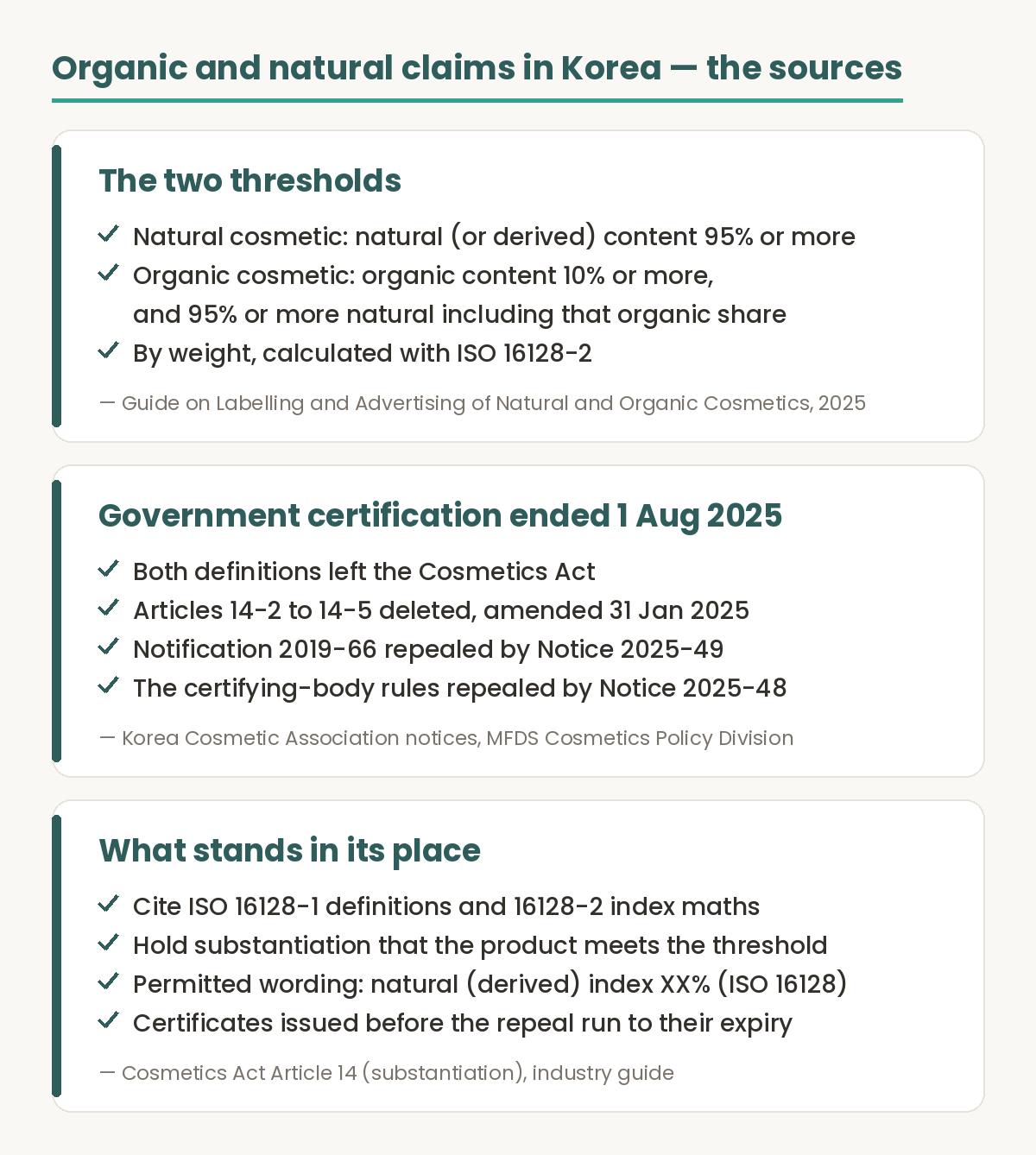
    Evidence figure on organic and natural cosmetic claims in Korea. First, the two thresholds: a natural cosmetic needs 95 percent or more natural or natural-derived content, an organic cosmetic needs 10 percent or more organic content plus 95 percent or more natural content including that organic share, measured by weight and calculated with ISO 16128-2, from the Guide on Labelling and Advertising of Natural and Organic Cosmetics, 2025. Second, government certification ended on 1 August 2025: both definitions left the Cosmetics Act, Articles 14-2 to 14-5 were deleted in the amendment of 31 January 2025, Notification 2019-66 was repealed by Notice 2025-49 and the certifying-body rules by Notice 2025-48, per Korea Cosmetic Association notices and the MFDS Cosmetics Policy Division. Third, what stands in its place: cite the ISO 16128-1 definitions and the 16128-2 index calculation, hold substantiation that the product meets the threshold, use permitted wording such as natural derived index of a given percentage calculated with ISO 16128, and certificates issued before the repeal run to their expiry, under Article 14 of the Cosmetics Act and the industry guide.

    ――――――――――――――――――――――――――――

    What was removed, and when

    What went Instrument Date
    The definitions of natural and organic cosmetics, Cosmetics Act Article 2 Act No. 20767 amended 31 Jan 2025
    Articles 14-2 to 14-5 — certification, validity, certification mark, accredited bodies same Act amended 31 Jan 2025
    Article 13(1)3 and parts of the penalty articles same Act amended 31 Jan 2025
    Notification 2019-66, the standard for natural and organic cosmetics Repeal Notice 2025-49 1 Aug 2025
    The rules on designating certifying bodies Repeal Notice 2025-48 1 Aug 2025

    The Act was amended on 31 January 2025 and the two repeal notices took effect on 1 August 2025. Both notices were posted, with the ministry’s covering document, by the Korea Cosmetic Association.

    The stated reason was to remove duplicate certification. Private schemes were already doing the work, so the government stepped out of it.

    ――――――――――――――――――――――――――――

    Old certificates are still running

    A repeal does not void what was already issued. Certificates remain valid until they expire, and the old validity period was three years.

    So a Korean shelf right now holds two kinds of product: ones carrying the old government mark, and ones labelled against the industry guide with no mark at all. Neither is better by definition — the guarantor is different, and that is the thing to notice.

    ――――――――――――――――――――――――――――

    Before and after, side by side

    Before — Notification 2019-66 Now — industry guide, 2025
    Who set it Ministry of Food and Drug Safety Self-regulatory body for cosmetic labelling and advertising, at the Korea Cosmetic Association
    Natural content 95% or more 95% or more
    Organic content 10% or more 10% or more
    Synthetic ingredients allowed Up to 5%, of which petrochemical moiety 2% or less No such list — ISO 16128 calculation takes its place
    Manufacturing processes Permitted processes listed as physical, chemical and biological Not listed in the guide
    Who checks A certifying body designated by the ministry The company, holding substantiation on file

    The thresholds did not move. The checking did.

    One consequence is easy to miss. The repealed notification carried a 5% cap on synthetic ingredients, with the petrochemical moiety held to 2%, and a list of permitted manufacturing processes. The industry guide has no such list — the ISO 16128 calculation stands in for it. If you find those older figures quoted as current Korean rules, they are out of date.

    ――――――――――――――――――――――――――――

    What carries the claim now

    Two things. The ISO 16128 pair, and substantiation.

    ISO 16128-1:2016 defines which ingredients count as natural, derived natural, organic or derived organic. ISO 16128-2:2017 sets out how to calculate the indexes. The 95 and the 10 are outputs of that calculation.

    The guide also fixes the permitted wording. What a company may print is a phrase of the form “natural (derived) index XX% (calculated under ISO 16128)” — the claim carries its own method. What it may not print, when the product misses the threshold, is a line like “contains natural ingredient X” leaning on a single component.

    And the evidence has to exist on paper:

    Cosmetics Act, Article 14 (Substantiation of labelling and advertising)

    (1) A business operator or seller shall be able to substantiate matters of fact in its own labelling or advertising.

    (3) … shall submit the substantiating material to the Minister of Food and Drug Safety within 15 days of the request.

    Paragraph (4) requires the ministry to order the labelling or advertising stopped if the material is not filed in time and the claim continues. Certification is gone; the checking is not.

    ――――――――――――――――――――――――――――

    Article 13 did not go away

    The definitions and the certification articles were deleted. The prohibition on misleading claims was not.

    Cosmetics Act, Article 13(1) — prohibited labelling and advertising

    1. Labelling or advertising likely to be mistaken for a medicine

    2. … likely to be mistaken for a functional cosmetic when it is not

    3. Deleted <31 Jan 2025>

    5. Any other labelling or advertising likely to deceive consumers or cause them to be mistaken, contrary to fact

    Item 3 was the natural-and-organic provision. Item 5 now covers that ground. The MFDS labelling and advertising guidance of 14 August 2025 also lists, among prohibited expressions, natural or organic wording on a product that does not meet the industry guide.

    ――――――――――――――――――――――――――――

    The private route: COSMOS

    With the state out of it, the scheme most visible on Korean packaging is COSMOS — a non-profit standard built by five European organisations: BDIH (Germany), Cosmebio and Ecocert (France), ICEA (Italy) and the Soil Association (United Kingdom).

    Finished products carry COSMOS ORGANIC or COSMOS NATURAL; raw materials are COSMOS CERTIFIED or COSMOS APPROVED. In Korea the certifying bodies are KTR (Korea Testing & Research Institute) and Control Union Korea.

    A company holding one of these may print it alongside the index wording. It is worth knowing, though, that this is a private guarantee, not a government one.

    ※ The organic-content percentages behind each COSMOS grade were not stated on the public overview page, so they are not quoted here.

    ――――――――――――――――――――――――――――

    Korea and the United States, side by side

    The word “organic” is handled very differently in the two markets, and a Korean product sold in the US runs into the second column.

    Korea United States
    Is there a government definition? There was one in the Cosmetics Act. It was deleted on 31 January 2025 No. FDA says the term is not defined in the laws it enforces
    Who certifies Nobody, since 1 August 2025. Private schemes such as COSMOS continue USDA under the National Organic Program, for agricultural ingredients
    What sets the threshold An industry guide citing ISO 16128-1 and -2 — natural 95%, organic 10% NOP rules for the organic claim; FDA rules still apply to labelling and safety
    What the company must hold Substantiation, due within 15 days of a request (Cosmetics Act Art. 14) Certification records for the NOP claim

    The FDA’s position is blunt: “The term ‘organic’ is not defined in either of these laws or the regulations that FDA enforces.” The definition and the certification sit with the USDA’s National Organic Program, which certifies agricultural ingredients. And a cosmetic bearing an organic claim “must comply with both USDA regulations for the organic claim and FDA regulations for labeling and safety requirements.”

    So the two countries arrived at a similar place from opposite directions. The United States never defined the word for cosmetics. Korea defined it, certified it for years, then handed the measuring to an international standard and the checking to the companies themselves.

    ――――――――――――――――――――――――――――

    What ISO 16128-2 does not cover

    One caution, and it is in the standard’s own scope. ISO 16128-2 is a method for calculating indexes. The overview states that it does not address:

    ✓ Product labelling

    ✓ Human safety

    ✓ Environmental safety

    ✓ Fair trade and other regulatory requirements

    So a high natural index is not a gentleness rating. It counts how much of the formula came from nature, which is a different question from how your skin will respond. For reactive skin, the ingredient list is the more useful page.

    ――――――――――――――――――――――――――――

    What to check on the box

    ✓ Whether a number and a method sit beside the words “natural” or “organic”

    ✓ Whether the wording follows the “natural (derived) index XX% (ISO 16128)” form

    ✓ Whether a private scheme such as COSMOS is named, together with its certifier

    ✓ If a Korean government mark is shown, whether the product’s certificate is still inside its term

    “Contains natural ingredients”, with no number and no scheme, tells you nothing about how much. Turn the box over and read the ingredient list instead — the front of it answers the question faster.

    ――――――――――――――――――――――――――――

    What I left out, and why

    ✓ The repealed notification’s process annex — no longer in force; it appears only in the before-and-after table

    ✓ How many products had been certified, and any revocations — I could not open a primary source

    ✓ The ISO 16128 formulas and the treatment of water — the standard itself is paywalled, so this stops at “a method for calculating indexes”

    ✓ Per-grade organic percentages for COSMOS — not stated on the public overview

    ✓ “Natural means gentle” — no primary source, and it sits against what the ISO scope says

    ――――――――――――――――――――――――――――

    One line

    Natural 95%, organic 10% — and in Korea you now read the wording rather than look for a mark.

    Substantiation came up more than once above. What a cosmetic advertisement may and may not say in Korea is set out in its own guide (Ingredient Guide 19).

    ――――――――――――――――――――――――――――

    📌 Previous guides

    📌 How to Read a Korean Cosmetic Ingredient List (Guide 14) — where to look when there is no index

    📌 Arbutin vs Alpha-Arbutin: What Korea’s 2–5% Means (Guide 15) — another number fixed by notification

    📌 Sunscreen SPF and PA: How to Read the Numbers (Guide 11)

    📌 Skin Concern Ingredient Map

    About the author · Dr. J

    MS in Veterinary Medicine, PhD in Life Sciences. I worked as a researcher at the Korea Research Institute of Bioscience and Biotechnology (KRIBB) and now run Beaurea, a cosmetics manufacturing company, where I write the formulas myself. This blog reads the research papers and the regulatory documents and turns them into plain-language criteria for choosing ingredients. I don’t recommend specific products here – only criteria that apply to any product.

    📄 References

    · Self-Regulatory Body for Cosmetic Labelling and Advertising, Guide on Labelling and Advertising of Natural and Organic Cosmetics, 2025

    · MFDS Repeal Notices 2025-49 and 2025-48, effective 1 August 2025

    · Cosmetics Act (Act No. 20767, amended 31 January 2025), Articles 13 and 14

    · ISO 16128-1:2016 and ISO 16128-2:2017

    · U.S. FDA, “‘Organic’ Cosmetics”, page updated 25 February 2022

    · COSMOS-standard AISBL, public overview

    ――――――――――――――――――――――――――――

    This article summarises statutes, notices and published guidance, and does not recommend a particular product. Rules change; please check the originals before relying on any of it for a decision.

    — Dr. J Ingredient Notes

  • Children’s Cosmetics in Korea: What the Label Triggers, and Why the Box Prints a Preservative Percentage (Ingredient Guide 20)

    Cover image for a guide to Korea's rules for children's cosmetics, Ingredient Guide 20 from Dr. J Ingredient Notes. Infants are three years of age and under and children are four to thirteen, and once a product says so on the label three rules follow.

    🇰🇷 한국어판: 어린이 화장품 기준 – 「어린이용」이라 적으면 따라오는 것, 그리고 상자의 보존제 함량

    Hello, this is Dr. J. Today I want to read Korea’s rules for children’s cosmetics straight from the statute, because one of them changes what is printed on the box.

    Most countries regulate what may go into a product for a child. Korea does that too, but it adds something unusual: once a product says it is for children, the outer package has to carry the amount of preservative in it, as a number, separate from the ingredient list. I have not found that requirement anywhere else.

    And the trigger is not the formula. It is the label. That is the part worth understanding first, so let me start there.

    ――――――――――――――――――――――――――――

    The sources, if you would rather read them first

    📄 Korea Ministry of Government Legislation — cosmetics for infants and children — the age brackets and the three documents

    📄 Safety Standards for Cosmetics, Annex 2 — the entries that carry an age condition

    📄 Commission Regulation (EU) No 1004/2014 — parabens and the nappy area

    📄 US FDA — Summary of Cosmetics Labeling Requirements — what a US label has to carry

    The Korean annexes open as attachment files, so the text comes up directly rather than through a search form.

    ――――――――――――――――――――――――――――

    ――――――――――――――――――――――――――――

    Five lines, if you are in a hurry

    ✔ Korean law splits the two groups by age — an infant is 3 and under, a child is 4 to 13

    ✔ The rules attach the moment the package, the product name or an advertisement says the product is for them

    ✔ Three safety documents must be written and kept, for a year past the expiry date or three years past the manufacturing date

    ✔ The outer package gains one line — the content of the preservatives, printed apart from the ingredient list

    ✔ Salicylic acid and iodopropynyl butylcarbamate step out of products labelled for under-13s

    ――――――――――――――――――――――――――――

    Two age groups, written into the statute

    Article 4-2 of the Cosmetics Act and Article 10-2 of its Enforcement Rule define the two groups by age. An infant is three years of age and under. A child is four to thirteen.

    The upper bound is worth noticing. Thirteen takes in primary-school age, so a lotion or a lip balm marketed to a nine-year-old sits inside the same rules as a baby lotion. In several other markets the special category stops at three.

    ――――――――――――――――――――――――――――

    The rule starts at the label, not at the formula

    This is the part that surprises people. The obligations do not attach because of what is in the bottle. They attach because of what the company says about who it is for.

    Where What makes the rules attach
    Packaging The inner or outer package states, specifically, that the product may be used by an infant or a child
    Product name The name of the cosmetic itself carries a reference to infants or children — the name alone is enough
    Advertising Newspapers, broadcast, magazines, the internet, posters and signboards, video or film, stating it specifically

    So a very mild formula with no such wording stays outside the rules, and an ordinary formula with the wording falls inside them. The word the statute uses is “specifically”: a vague impression that a child might use it is not the test — naming the group is.

    ※ This is why the phrase on the front of a Korean box is a regulatory statement rather than a marketing flourish.

    ――――――――――――――――――――――――――――

    Three documents, and how long they are kept

    Once that wording is used, the responsible distributor has to prepare and keep product-specific safety documentation. Enforcement Rule Article 10-3 lists three items and sets the retention period.

    Document Content Kept until
    ① Product and method A description of the product and of how it is manufactured Products labelled with an expiry date — one year after the expiry date of the last batch made or imported

    Products labelled with a period after opening — three years after the manufacturing date of the last batch
    ② Safety assessment A safety assessment of the cosmetic product
    ③ Evidence of effect Evidence for the efficacy or effect claimed for the product

    The retention clock keeps running after the product has left the shelves — a year past the expiry date of the final batch. Failure to prepare or keep the documents carries up to one year of imprisonment or a fine of up to ten million won, and a company can be fined alongside the individual.

    ※ A shopper cannot ask to see this file. What is useful to know is that the phrase “for children” on a Korean box has a dossier sitting behind it.

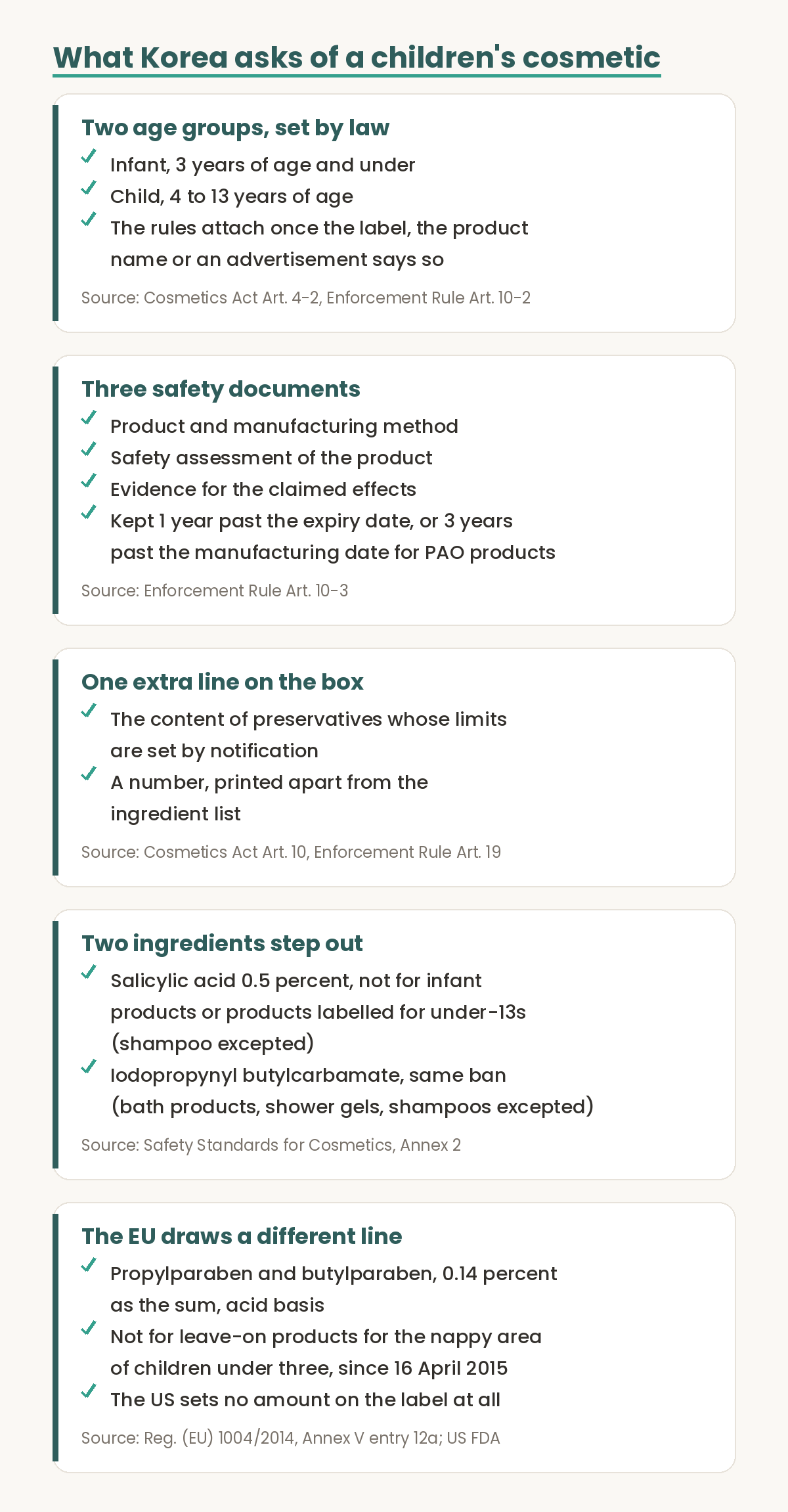
    Chart of what Korea asks of a children's cosmetic. First, two age groups set by law: an infant is three years of age and under, a child is four to thirteen, and the rules attach once the label, the product name or an advertisement says so, under Cosmetics Act Article 4-2 and Enforcement Rule Article 10-2. Second, three safety documents: the product and its manufacturing method, a safety assessment of the product, and evidence for the claimed effects, kept one year past the expiry date or three years past the manufacturing date for products labelled with a period after opening, under Enforcement Rule Article 10-3. Third, one extra line on the box: the content of preservatives whose limits are set by notification, printed as a number apart from the ingredient list, under Cosmetics Act Article 10 and Enforcement Rule Article 19. Fourth, two ingredients step out: salicylic acid at 0.5 percent is not allowed in infant products or products labelled for under-thirteens, shampoo excepted, and iodopropynyl butylcarbamate carries the same ban with bath products, shower gels and shampoos excepted, under Annex 2 of the Safety Standards for Cosmetics. Fifth, the European Union draws a different line: propylparaben and butylparaben are capped at 0.14 percent as the sum on an acid basis and are not for leave-on products for the nappy area of children under three since 16 April 2015, under Regulation 1004/2014 Annex V entry 12a, while the United States sets no amount on the label at all.

    ――――――――――――――――――――――――――――

    One extra line on the box — the preservative content

    Here is the part a shopper can actually see. Where a product is labelled or advertised specifically for infants or children, the outer package must carry “the content of preservatives among the raw materials whose standards of use are designated and published”.

    Compare that with the ordinary ingredient list. Ingredients are listed in order of how much is present, and in Korea anything at or below 1% may be listed in any order. No amounts appear. On a children’s product, the preservatives come back with a number attached — “phenoxyethanol 0.4%”, printed in its own line.

    Two things follow from that line. First, its presence tells you the product is formally labelled for children. Second, it tells you which preservative is in there and how much. If no preservative is used, there is nothing to declare and the line is simply absent.

    ※ The basis is Article 10 of the Act with Article 19 of the Enforcement Rule. Look for it beside the ingredient list, not inside it.

    ――――――――――――――――――――――――――――

    Two ingredients that step out

    Annex 2 of the Safety Standards for Cosmetics sets a maximum for each restricted raw material. Two of those entries carry an age condition, and I opened both.

    Ingredient Limit Age condition
    Salicylic acid and its salts 0.5% as salicylic acid Not to be used in products for infants, or in products labelled specifically as usable by children aged 13 or under
    (shampoo excepted)
    Iodopropynyl butylcarbamate (IPBC) 0.02% rinse-off · 0.01% leave-on · 0.0075% in deodorants The same prohibition
    (bath products, shower gels and shampoos excepted)

    Read the two columns together. 0.5% is the adult ceiling; in a children’s product the ingredient is not permitted at all, not permitted at a lower level. The exceptions in brackets follow the same logic in reverse — products that are rinsed off are treated differently from products that stay on the skin.

    ――――――――――――――――――――――――――――

    Fragrance allergens: 25 names, the same thresholds

    If a Korean ingredient list ends with limonene, linalool, citronellol and a few more, those are the fragrance allergens that must be named separately rather than hidden inside “fragrance”. There are 25 of them.

    The thresholds are above 0.01% in rinse-off products and above 0.001% in leave-on products. They are not lowered for children’s products — the annex carries no age clause at all.

    ※ A long tail of names is disclosure, not concealment. For a child who reacts to fragrance, that tail is the part of the label worth reading.

    ――――――――――――――――――――――――――――

    Korea, the EU and the US, side by side

    Three regulators, three different places to put the line. Korea hangs its rules on the label, the EU writes age into individual ingredient entries, and the US asks for no amounts on the label at all.

    Where What applies to a children’s product Source
    Korea Infant 3 and under, child 4 to 13. Label or advertise it as such and three safety documents follow, plus the preservative content printed on the package Cosmetics Act Art. 4-2, Art. 10
    Enforcement Rule Art. 10-2, 10-3, 19
    European Union Propylparaben and butylparaben capped at 0.14% as the sum (as acid), and “not to be used in leave-on products designed for application on the nappy area of children under three years of age”; such products carry “Do not use on the nappy area” Reg. (EU) No 1004/2014
    Annex V entry 12a, applying from 16 April 2015
    United States “The ingredients must be declared in descending order of predominance”, and “color additives and ingredients present at one percent or less may be declared without regard for predominance”. No amount has to be shown US FDA, Summary of Cosmetics Labeling Requirements

    The contrast worth taking away is the middle column of the first row. A Korean children’s box tells you how much preservative is in the product. A European or American one does not, however carefully it is labelled otherwise.

    ――――――――――――――――――――――――――――

    What to check on the box

    ✔ Does the package say, in so many words, that it is for children? That is what puts it inside these rules

    ✔ Is there a preservative line separate from the ingredient list, and which preservative is named

    ✔ If salicylic acid appears, is the product one that gets rinsed off

    ✔ For a child who reacts to scent, read the names after “fragrance”

    ✔ Is the expiry date on the container itself, which survives after the box is thrown away

    ※ A printed line is easier to verify than a claim such as “no preservatives”. Choose on what is written.

    ――――――――――――――――――――――――――――

    What I left out, and why

    ✔ Whether Korea restricts parabens by age. The EU does. In the extract of Annex 2 I was able to open, the paraben entries carried no age condition — but I could not confirm the full entry, so I am not claiming Korea has no such rule

    ✔ The sub-paragraph numbers for the preservative-content requirement. Different official sources number it differently, so I cite the Act’s Article 10 with Article 19 of the Enforcement Rule and stop there

    ✔ “Baby products should be fragrance-free and preservative-free.” There is no primary source for that as a rule, and removing preservatives moves the microbiological question elsewhere rather than removing it

    ✔ Product names. This blog does not recommend particular products

    ――――――――――――――――――――――――――――

    In one line

    In Korea, the rules for a children’s cosmetic begin with the words on the label, not with the formula inside. Say it, and a dossier follows — and the box gains a line telling you how much preservative is in there.

    Next in this series: what a “vegan” claim on a cosmetic certifies, which in Korea runs through an industry self-review rather than a government mark — a companion to the organic and natural guide (Ingredient Guide 21).

    📌 Earlier guides

    📌 How to Read a Korean Cosmetic Ingredient List (Guide 14)

    📌 Salicylic Acid (BHA): 0.5% vs 2%, Explained (Guide 8)

    📌 Ceramides: the Cholesterol and Fatty Acid Ratio (Guide 4)

    📌 Niacinamide: How Much Is Enough (Guide 2)

    About the author · Dr. J

    MS in Veterinary Medicine, PhD in Life Sciences. I worked as a researcher at the Korea Research Institute of Bioscience and Biotechnology (KRIBB) and now run Beaurea, a cosmetics manufacturing company, where I write the formulas myself. This blog reads the research papers and the regulatory documents and turns them into plain-language criteria for choosing ingredients. I don’t recommend specific products here – only criteria that apply to any product.

    📄 References

    · Cosmetics Act of Korea, Articles 4-2 and 10

    · Enforcement Rule of the Cosmetics Act, Articles 10-2, 10-3 and 19

    · Safety Standards for Cosmetics, Annex 2 (restricted raw materials)

    · Notification on precautions and fragrance allergen labelling, Annex 2 (25 substances)

    · Commission Regulation (EU) No 1004/2014, Annex Ⅴ entry 12a

    · U.S. FDA, Summary of Cosmetics Labeling Requirements

    ――――――――――――――――――――――――――――

    This article summarises public statutes and regulatory documents and is not a substitute for diagnosis or treatment. Quoted sentences are as they appear in the law and the notifications, and labelling practice varies between products. If a child’s skin reacts, stop using the product and speak to a professional.

    — Dr. J Ingredient Notes

  • Cosmetic Expiration Dates in Korea: What 12M Means and Why a Jar Carries Two Dates (Ingredient Guide 17)

    Cover image for a guide to cosmetic expiration dates and the 12M period-after-opening symbol in Korea, Ingredient Guide 17 from Dr. J Ingredient Notes, explaining why a Korean jar carries two dates.

    🇰🇷 한국어판: 화장품 사용기한과 개봉 후 사용기간 – 통에 적힌 날짜 두 개, 그리고 12M의 뜻

    Hello, this is Dr. J. Today we are reading the dates printed on a cosmetic package — the expiration date, the period after opening, and the little open-jar symbol with 12M next to it.

    Here is the part that surprises people who compare labels across countries. Korea requires one of those dates on every cosmetic, on the jar itself as well as on the box. The EU asks for a date too, with its own switch at 30 months. And in the United States, by the FDA’s own words, no law requires an expiration date on a cosmetic at all. Same product, three different labels.

    So this guide does two things: it reads the Korean rule line by line, and it puts the three regimes in one table at the end.

    ――――――――――――――――――――――――――――

    Primary sources

    📄 Enforcement Rule of the Cosmetics Act, Annex 4 — Labelling standards and methods for cosmetic packaging (Korean)

    📄 Regulation (EC) No 1223/2009, Article 19 — Labelling

    📄 U.S. FDA — Shelf Life and Expiration Dating of Cosmetics

    📄 21 CFR 211.137 — Expiration dating (for drug products, including U.S. sunscreens)

    The Korean annex opens as an attachment file, and it spells out which words have to sit next to the numbers. That is the part almost no English-language guide quotes.

    ――――――――――――――――――――――――――――

    ――――――――――――――――――――――――――――

    The short version, in five lines

    ✔ Korean law defines the expiration date as a minimum period, not a cliff edge

    ✔ The box carries ten items; the jar itself carries four, and a date is one of them

    ✔ If a product shows a period after opening, the manufacturing date must sit beside it

    ✔ 12M comes from the EU rule, which switches to the open-jar symbol above 30 months

    ✔ The United States requires neither — shelf life there is the manufacturer’s responsibility

    ――――――――――――――――――――――――――――

    What the law calls it — a “minimum period”

    Article 2(5) of Korea’s Cosmetics Act defines the term. In our translation of the Korean text, an expiration date is the minimum period, counted from the date of manufacture, during which the product — stored under appropriate conditions — keeps its own characteristics and can be used safely by the consumer.

    Two words in that sentence do the work.

    Minimum. The date is a floor, not a ceiling. It is the point the manufacturer has tested to and will stand behind, which is a different statement from “unusable on the next day”.

    Appropriate conditions. The promise is conditional, and the condition is written into the definition itself. A jar that spent a July in a parked car has left the premise the date was built on. That is why storage belongs in the same thought as the number.

    ――――――――――――――――――――――――――――

    Two layers of packaging, two lists

    Korean law separates the inner container — the jar, tube or bottle the product actually touches — from the outer packaging that holds it. Each carries its own list.

    Where What must appear Source
    Outer packaging
    the box
    1. Product name 2. Name and address of the responsible business 3. All ingredients used 4. Volume or weight 5. Batch number 6. Expiration date or period after opening 7. Price 8. Functional-cosmetic marking 9. Precautions for use 10. Other items set by Presidential Decree Cosmetics Act Art. 10(1)
    Inner container
    the jar itself
    1. Product name 2. Name of the responsible business 3. Batch number 4. Expiration date or period after opening
    with the manufacturing date when the period after opening is used
    Cosmetics Act Art. 10(2) · Enforcement Rule Art. 19(6)

    The practical consequence sits in the second row. Throw the box away and the date is still with you. The ingredient list and the price go out with the carton; the name, the company, the batch number and the date stay on the jar by law.

    If you cannot find a date on a Korean product, turn the jar over. It is usually on the base or crimped into the seam of a tube, and it can be faint on dark packaging.

    ――――――――――――――――――――――――――――

    How the dates must be written — Annex 4, items 5 and 6

    The annex does not stop at “put a date on it”. It fixes the wording. Translated from the Korean text:

    ✔ Expiration date — the words “expiration date” or “until”, together with a year, month and day, written so a consumer can read it easily

    ✔ If only a year and month are given, they must not run past the actual expiration date

    ✔ Period after opening — the words “period after opening” plus “NN months”, or a symbol together with the period

    ✔ The batch number must be easy to tell apart from the date, and where a period after opening is used, the manufacturing date printed alongside it must also be distinguishable

    That last clause is the key to the whole article. A product labelled with a period after opening carries a manufacturing date as well. If you have ever wondered why a Korean jar shows two dates, this is the reason — and the rule even says they have to be told apart at a glance.

    The year-and-month clause is worth keeping too. A product good until 12 March 2027 may be printed as 2027.03, but not as 2027.04. A shortened date rounds down, never up.

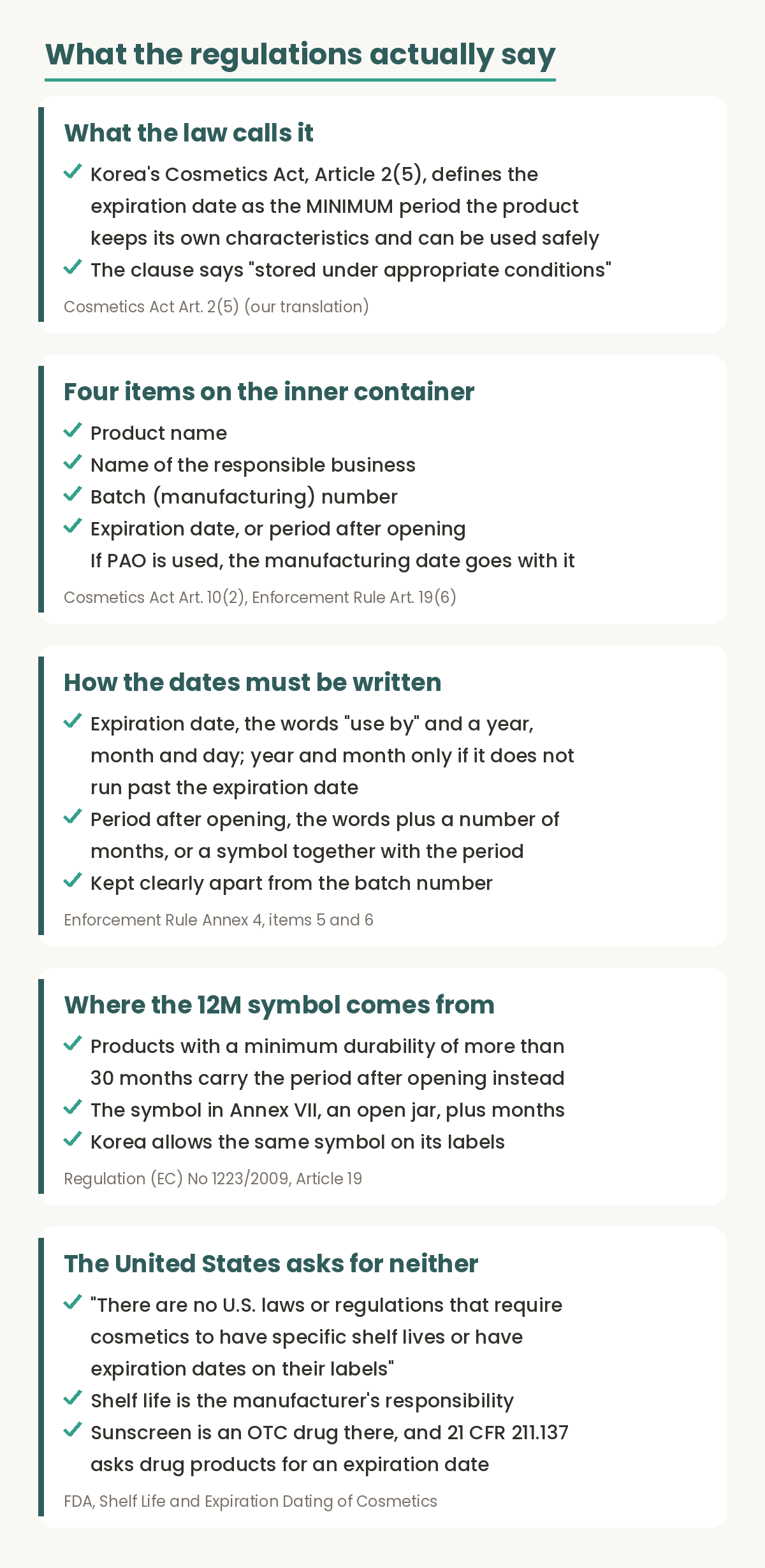
    Chart of what the regulations say about cosmetic dates. First, Korea's Cosmetics Act Article 2(5) defines the expiration date as the minimum period the product keeps its characteristics and can be used safely when stored under appropriate conditions. Second, four items must appear on the inner container: product name, responsible business name, batch number, and the expiration date or period after opening, with the manufacturing date added when the period after opening is used, under Article 10(2) and Enforcement Rule Article 19(6). Third, Enforcement Rule Annex 4 items 5 and 6 set how the dates are written, including the words plus a year, month and day, the period after opening in months or as a symbol, and separation from the batch number. Fourth, EU Regulation 1223/2009 Article 19 puts the period after opening on products lasting more than 30 months, using the open jar symbol of Annex VII. Fifth, the United States FDA states that no U.S. laws or regulations require cosmetics to have expiration dates, while sunscreen is an over-the-counter drug there and 21 CFR 211.137 asks drug products for an expiration date.

    ――――――――――――――――――――――――――――

    Three dates, side by side

    The numbers on the back are answering different questions. Put them in one table and they stop competing.

    Which date What it states Counted from When it appears
    Manufacturing date the day it was made — alongside a period after opening
    Expiration date the minimum period of safe use the date of manufacture on its own; no manufacturing date needed
    Period after opening how long it keeps once opened the day you opened it as “NN months”, or as the symbol

    The third row is where the symbol earns its keep — and where it fails. 12M runs from the day you opened the jar, not from the day it was made. Nobody but you knows that day, so the number only works if you record it.

    ――――――――――――――――――――――――――――

    Where 12M comes from — the EU’s 30-month switch

    The open-jar drawing with 12M beside it comes from European law. Article 19 of Regulation (EC) No 1223/2009 asks for a date of minimum durability, and then says that where that durability is more than 30 months, the label instead gives the period for which the product is safe to use after opening, shown with the symbol in Annex VII followed by the time in months or years.

    Read that backwards and the symbol says something reassuring. A jar marked 12M is a product judged to last more than 30 months unopened. The 12 is about what happens after you break the seal, not a short shelf life.

    Korea permits the same symbol, which is why you see it on Korean packaging as well. The difference is that Korea makes one of the two compulsory and ties the period after opening to a manufacturing date; the EU treats the two as alternatives decided by that 30-month line.

    ――――――――――――――――――――――――――――

    Korea, the EU and the United States in one table

    Where What the label must carry Source
    Korea An expiration date or a period after opening, always — on the box and on the jar. Choosing the period after opening adds the manufacturing date Cosmetics Act Art. 10 · Enforcement Rule Annex 4
    European Union A date of minimum durability; above 30 months, the period after opening with the Annex VII symbol instead Regulation (EC) No 1223/2009, Art. 19
    United States Neither. “There are no U.S. laws or regulations that require cosmetics to have specific shelf lives or have expiration dates on their labels.” Sunscreen, however, is an OTC drug there FDA · 21 CFR 211.137

    The FDA page does not leave it at “not required”. It adds that “FDA considers determining a product’s shelf life to be part of the manufacturer’s responsibility”. The obligation exists; what differs is whether the answer has to be printed where a shopper can read it. Korea and the EU say yes. The United States leaves it to the company.

    One more wrinkle for anyone comparing sunscreens across borders. In the United States a sunscreen is regulated as an over-the-counter drug, and 21 CFR 211.137(a) requires a drug product to “bear an expiration date determined by appropriate stability testing”. So the same bottle can arrive dated in one market and undated in another — because of how the product is classified, not because of what is inside it. We read the SPF and PA numbers on those labels in Guide 11.

    ――――――――――――――――――――――――――――

    What I left out, and why

    ✔ The test schedule behind the months — Korea’s MFDS publishes a stability-testing guideline covering long-term, accelerated and stress testing, but I could not open the document itself, so no durations or intervals are quoted here

    ✔ “Throw it out N months after opening” — the regulations set how the period is written, not a fixed number per product type

    ✔ Reading a manufacturing date out of a batch code — the coding is each company’s own, so there is nothing general to teach

    ✔ Mascara advice — the FDA page notes that manufacturers usually suggest replacing mascara after a few months; that is a manufacturer recommendation, not a rule, and I have left it as such

    ✔ Claims about what happens chemically after the date — that needs product-level data I do not have

    ――――――――――――――――――――――――――――

    Five things to check

    ✔ Is there a date on the jar itself, not just the box

    ✔ If there are two, which one is the manufacturing date — it travels with a period after opening

    ✔ Does the open-jar symbol say 6M or 12M, and is the clock started from your opening day

    ✔ If only a year and month are printed, treat the end of that month as the line

    ✔ Is the product stored somewhere close to “appropriate conditions” — a drawer beats a bathroom shelf

    I read these dates less as “use it by then” and more as “start counting here”. The manufacturing date marks the making, 12M marks the opening, and the expiration date is a separate finish line. Three clocks, three starting points.

    Which leaves one habit worth building: write the opening date on the base of the jar. On a product labelled 12M, that small sticker is what turns the symbol into a number you can actually use.

    ――――――――――――――――――――――――――――

    In one line

    The date on a Korean jar is a minimum period, and a product labelled with a period after opening carries a manufacturing date beside it. Check the jar before the box, and write down the day you opened it.

    Next in this series: the five ingredients to look for in acne-prone skin, starting with the 0.5% salicylic acid that Korea’s notification fixes in place.

    📌 Related guides

    📌 How to Read a Korean Cosmetic Ingredient List (Guide 14)

    📌 Sunscreen SPF and PA: How to Read the Numbers (Guide 11)

    📌 Arbutin vs Alpha-Arbutin: What Korea’s 2–5% Means (Guide 15)

    📌 Ceramides: Cholesterol and Fatty Acid Ratio (Guide 4)

    About the author · Dr. J

    MS in Veterinary Medicine, PhD in Life Sciences. I worked as a researcher at the Korea Research Institute of Bioscience and Biotechnology (KRIBB) and now run Beaurea, a cosmetics manufacturing company, where I write the formulas myself. This blog reads the research papers and the regulatory documents and turns them into plain-language criteria for choosing ingredients. I don’t recommend specific products here – only criteria that apply to any product.

    📄 References

    · Cosmetics Act (Korea), Articles 2(5) and 10 — definitions and labelling

    · Enforcement Rule of the Cosmetics Act, Article 19 and Annex 4 — labelling standards and methods

    · Regulation (EC) No 1223/2009, Article 19 and Annex VII

    · U.S. FDA, Shelf Life and Expiration Dating of Cosmetics (page updated 25 February 2022)

    · 21 CFR 211.137 — Expiration dating

    ――――――――――――――――――――――――――――

    This article summarises public regulations. It is information, not a diagnosis or a treatment plan. Quoted passages are as written in each source, translations from the Korean text are ours, and labelling practice varies from product to product. If a product looks or smells changed, stop using it and speak with a professional.

    — Dr. J Ingredient Notes