
🇰🇷 한국어판
Hello, this is Dr. J. Today we look at the five ingredients worth knowing for oily skin and visible pores — chosen, in every case, from a human study that actually measured sebum.
Here is the surprise. In Korea, “pores” is not one of the claims the regulator has written a test method for. “Sebum secretion control” is — down to the instrument, the number of seconds and the unit.
――――――――――――――――――――――――――――
The primary sources
📄 MFDS, Guideline on Test Methods for Substantiating Cosmetic Labelling and Advertising (March 2018, PDF, Korean)
📄 Green tea, split-face study (Hippokratia 2013;17(1):64-67)
📄 L-carnitine and EGCG (J Cosmet Dermatol 2023)
📄 Regulation (EC) No 655/2013, common criteria
Chapter 3 of the Korean guideline sets out the sebum procedure itself — the device, the thirty seconds, the unit, and the two values that are measured separately.
――――――――――――――――――――――――――――
――――――――――――――――――――――――――――
In five lines
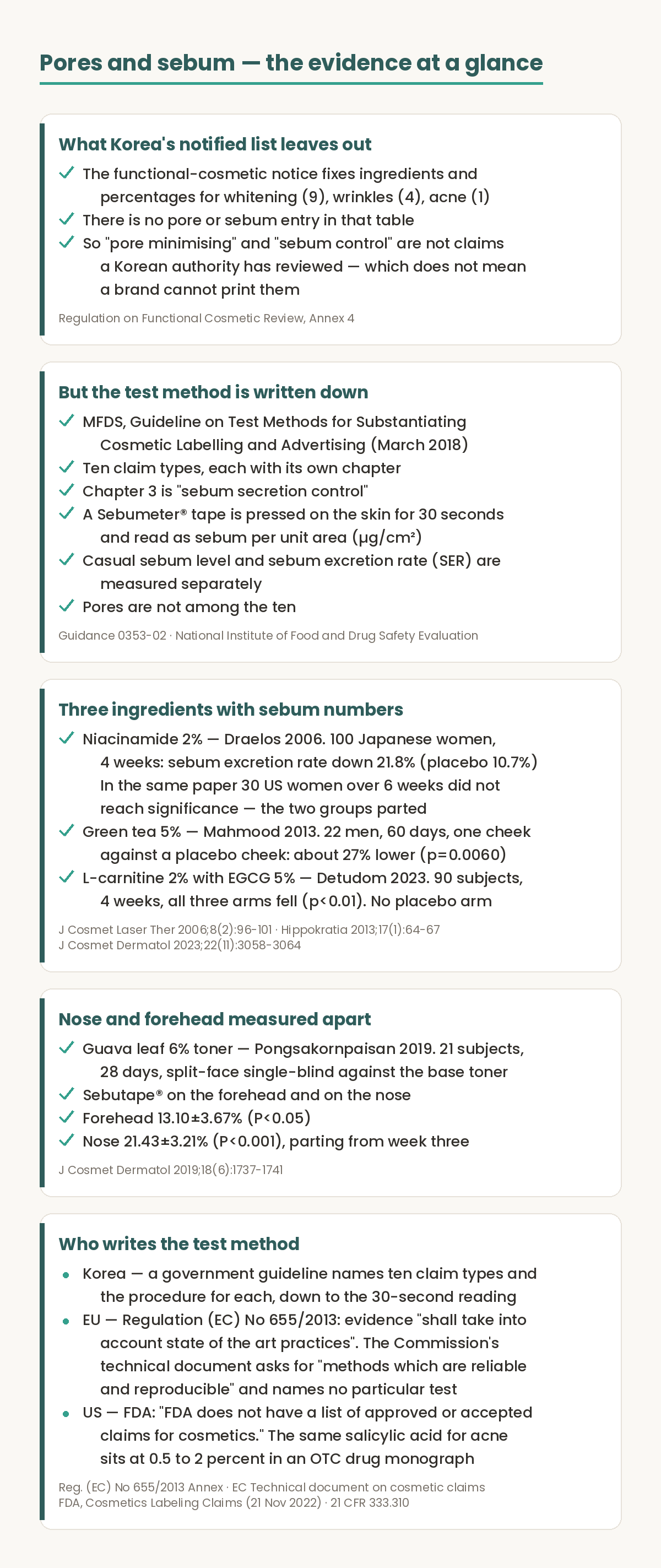
✔ Korea’s functional-cosmetic notice has no pore or sebum entry
✔ Yet a separate guideline sets out how sebum is measured — chapter 3 of ten
✔ Three ingredients here have measured sebum numbers
✔ One more study measured the nose and the forehead apart
✔ What the studies measured is sebum, not pore size
――――――――――――――――――――――――――――
What Korea’s notified list does fix
Korea’s Regulation on Functional Cosmetic Review carries an annex that fixes ingredient names and percentages. Formulate to that line and you are excused from filing fresh efficacy data — which also means the state has drawn the boundary of each claim.
| Claim | What the annex fixes | How to read it |
|---|---|---|
| Whitening | Nine ingredients with percentages (arbutin 2–5%, niacinamide 2–5%, and others) | Both the name and the number are set |
| Wrinkle improvement | Four ingredients (retinol 2,500 IU/g, adenosine 0.04%, and others) | The same |
| Acne-prone skin relief | One ingredient — salicylic acid 0.5% | This is where blocked pores lead |
| Pores and sebum | No entry at all | “Pore minimising” and “sebum control” have not been reviewed as claims |
That is not a ban. It means no authority has signed off on the wording. The same gap appeared in our piece on sensitive skin — but with pores and sebum there is a second document to open.
――――――――――――――――――――――――――――
The claim without a method, and the claim with one
The Ministry of Food and Drug Safety publishes a separate guidance document, the Guideline on Test Methods for Substantiating Cosmetic Labelling and Advertising (March 2018, guidance 0353-02). It gives each claim type its own chapter. There are ten.
| Chapter | Claim | Chapter | Claim |
|---|---|---|---|
| 1 | Skin moisturisation | 6 | Dark circle improvement |
| 2 | Skin elasticity improvement | 7 | Skin blood circulation |
| 3 | Sebum secretion control | 8 | Puffiness relief |
| 4 | Temporary cellulite reduction | 9 | Paraben-free |
| 5 | Suitable for acne-prone skin | 10 | Fine-dust protection |
Pores are not among the ten. The word appears once, in a footnote to chapter 5 that defines a comedo as a small sac formed when the opening of a sebaceous gland is blocked.
――――――――――――――――――――――――――――
What chapter 3 actually says
“A Sebumeter® is used. When the Sebumeter®, fitted with a special opaque plastic tape, is pressed on the skin with slight pressure for 30 seconds to collect sebum, the increase in the transparency of the tape is turned into a figure shown on the device, and that figure represents the amount of sebum per unit area (µg/cm²) collected.” — our translation of the Korean guideline, chapter 3
| What | As the guideline sets it |
|---|---|
| Device | Sebumeter® — reads how far an opaque tape turns transparent |
| Time | 30 seconds of slight pressure on the skin |
| Unit | Sebum per unit area, µg/cm² |
| Casual sebum level | Measured as soon as the volunteer arrives, without washing — what has pooled on the skin |
| Sebum excretion rate (SER) | Measured after everyone washes with the same cleanser — how fast sebum returns |
| Schedule | A fixed body site, measured before and after application of the test material |
The split matters. “There is a lot of oil sitting there” and “oil comes back quickly” are different statements, and most of the studies below measured the second one.
――――――――――――――――――――――――――――
Five ingredients in one table — including where each is weak
| Ingredient | Study | People · duration | Compared with | What was measured | Where it is weak |
|---|---|---|---|---|---|
| Niacinamide 2% | Draelos 2006 J Cosmet Laser Ther 8(2) |
100 Japanese women · 4 weeks 30 US women · 6 weeks |
Placebo | Sebum excretion rate down 21.8% (placebo 10.7%) At 2 weeks 21.3% (placebo 8.6%) |
The two groups parted — the US arm did not reach significance |
| Green tea 5% | Mahmood 2013 Hippokratia 17(1) |
22 men (22–28) · 60 days | One cheek against a placebo cheek | About 27% lower (p=0.0060) Sebumeter SM 815 |
22 men, and the raw µg/cm² values appear only in the figures |
| L-carnitine 2% EGCG 5% |
Detudom 2023 J Cosmet Dermatol 22(11) |
90 subjects, three arms · 4 weeks | The three active arms against each other | All three arms fell (p<0.01) The combination beat L-carnitine alone (p=0.009) |
No placebo arm · age and sex are not in the abstract |
| Guava leaf 6% | Pongsakornpaisan 2019 J Cosmet Dermatol 18(6) |
21 subjects · 28 days | Half the face against the base toner (single-blind) | Sebutape® Forehead 13.10±3.67% (P<0.05) · nose 21.43±3.21% (P<0.001) The nose parted from week three |
21 subjects, and the abstract alone does not settle whether the percentages are against baseline or between arms |
| Salicylic acid 0.5% | Korean notice, Annex 4 | — | — | The notified ingredient for acne-prone skin relief | Regulatory ground, not a sebum measurement |
Read the table across and the yardstick appears. Numbers of people, duration and comparator give the same percentage a different weight.
――――――――――――――――――――――――――――
The one ingredient Korea fixed by notice
| Item | As the notice sets it |
|---|---|
| Ingredient and level | Salicylic acid 0.5% |
| Form | Solution · lotion · cream |
| Claim | “Helps relieve acne-prone skin” |
| Directions | Apply an appropriate amount and rinse off thoroughly with water straight away |
| Age restriction Safety standards, Annex 2 |
0.5% as salicylic acid, not for use in products for infants or products specifically labelled as usable by children aged 13 or under (shampoo excepted) |
Note the rinse-off in the directions. The form Korea reviewed is not a leave-on product. In the United States the same acid for acne is not a cosmetic ingredient at all — see the next table.
――――――――――――――――――――――――――――
Who writes the test method — Korea, the EU and the US
| Korea | EU | United States | |
|---|---|---|---|
| List of claims | For functional cosmetics the notice fixes ingredient and percentage; other claims appear on a separate substantiation list | Not a list but six common criteria (Reg. (EC) No 655/2013) | “FDA does not have a list of approved or accepted claims for cosmetics.“ |
| Test method | Written out claim by claim — ten chapters, chapter 3 being sebum secretion control (Sebumeter® · 30 seconds · µg/cm²) | Evidence “shall take into account state of the art practices“. The Commission’s technical document asks for “methods which are reliable and reproducible” and names no particular test | No prescribed method. Labelling, including claims, “must be truthful and not misleading“ |
| Salicylic acid for acne | A cosmetic — notified functional ingredient at 0.5% | Handled inside the cosmetics regulation | An OTC drug — 21 CFR 333.310 sets it at 0.5 to 2 percent |
| Pores | Neither in the notice nor among the ten test methods | We found nothing set aside for it | The same |
Put the three side by side and the axis is clear. Korea writes down what to measure and how; the EU sets a condition — reliable, reproducible, state of the art — and leaves the method to the field; the United States keeps no approved list at all. The clearest illustration is that the same salicylic acid is a cosmetic ingredient in Seoul and a drug ingredient in Washington.
For a brand selling into Korea, that has a practical edge: the procedure your sebum claim will be read against is a public document, and it is specific enough to design a study from.
――――――――――――――――――――――――――――
Four things to check on the box
✔ “Pore minimising” is not a reviewed claim — look for the number and the source
✔ What the studies measured is sebum, not pore diameter
✔ Check how many people and for how long — 21 and 100 are not the same weight
✔ Check whether there was a placebo arm — in one of these studies there was not
――――――――――――――――――――――――――――
One line
Pores have no measuring stick yet; sebum has one. Start with the side that carries numbers.
――――――――――――――――――――――――――――
What I did not use, and why
✔ Trials that measured pore size — none of the human cosmetic studies I opened measured pores directly
✔ Procedures — randomised trials of botulinum toxin or microneedling for pores belong to a different article
✔ Retinol and pores — I opened two retinol trials; neither abstract reported a pore endpoint, and one compared against a prescription drug
✔ Folk claims — “pores never shrink once enlarged”, “cold water closes pores”: no primary source
✔ A fresh reading of the niacinamide paper — the literature databases were rate-limited on the day of writing, so the figures come from an earlier piece in which the full text was read
About the author · Dr. J
MS in Veterinary Medicine, PhD in Life Sciences. I worked as a researcher at the Korea Research Institute of Bioscience and Biotechnology (KRIBB) and now run Beaurea, a cosmetics manufacturing company, where I write the formulas myself. This blog reads the research papers and the regulatory documents and turns them into plain-language criteria for choosing ingredients. I don’t recommend specific products here – only criteria that apply to any product.
📌 Related posts
📌 Niacinamide: How Much Is Enough (Ingredient Guide 2) — the first ingredient here
📌 Salicylic Acid (BHA): 0.5% vs 2%, Explained (Guide 8) — the notified 0.5% in full
📌 AHA vs BHA: Is Glycolic Acid an AHA? (Guide 13) — the blocked-keratin side
📌 How to Read a Korean Cosmetic Ingredient List (Guide 14) — finding the names on the pack
📄 Sources
· MFDS, Guideline on Test Methods for Substantiating Cosmetic Labelling and Advertising (civil-petition guidance 0353-02, March 2018), chapter 3
· Regulation on Functional Cosmetic Review, Annex 4 · Regulation on Safety Standards for Cosmetics, Annex 2
· Draelos ZD, Matsubara A, Smiles K. J Cosmet Laser Ther 2006;8(2):96-101
· Mahmood T, Akhtar N, Moldovan C. Hippokratia 2013;17(1):64-67
· Detudom P et al. J Cosmet Dermatol 2023;22(11):3058-3064 · Pongsakornpaisan P et al. ibid. 2019;18(6):1737-1741
· Regulation (EC) No 655/2013, Annex (common criteria) · European Commission, Technical document on cosmetic claims
· U.S. FDA, “Cosmetics Labeling Claims” (current as of 21 November 2022) · 21 CFR 333.310
――――――――――――――――――――――――――――
This article summarises published studies and regulatory documents and is not a substitute for diagnosis or treatment. The Korean legal database was unavailable on the day of writing, so the notice figures come from earlier pieces in which the originals were read, and the niacinamide paper was not reopened. Translations of the Korean guideline are mine. Ingredient names and concentrations are given as criteria for choosing a product, not as a recommendation of any particular one.
— Dr. J Ingredient Notes