
🇰🇷 이 글의 한국어판 → Korean version (한국어)
Hello, I’m Dr. J. I formulate skincare products in Korea.
In part one I explained why so many PDRN (“salmon DNA”) ads get flagged in Korea, and how the clinic injection and the jar on your shelf are different products. Writing it left me with a question of my own: “So what can a PDRN cream actually do?”
I went and read every human study on topical PDRN I could find. The short answer: in the studies, hydration and skin texture changed within two to four weeks. The longer answer is that the PDRN in those studies had specific features – and a product only earns those results if it matches them. That’s what this post is about: how to choose one that does.
One disclosure first, as always: my company makes PDRN products too. So this is not a post about which product to buy. It’s a set of criteria you can hold up against any product – including ours – and every criterion comes from the studies, not from me.
The three-line version
✔ The studies used 0.1–1% PDRN (1,000–10,000 ppm). Inside that range, a product has “as much as the research”
✔ Companion humectants and barrier ingredients are what make the hydration last, and calm, honest label language is the mark of a brand that knows the rules
1. What the research found for topical PDRN
Three human studies on topical PDRN came out in 2025–2026. They’re small – 10 to 31 people each – but they point the same way, and that consistency is what matters.
· 4 weeks: better elasticity around the eyes, and faster recovery of moisture loss after irritation – 10 volunteers (IJMS, Dec 2025)
· 4 weeks: eye-area fine lines and skin thickness improved more than with retinol – 31 women, split-face (PLOS ONE 2026, run by a cosmetics company)
So there’s good reason to try one if this sounds like you: skin that is dry and sensitive and wants hydration without irritation; skin recovering from a laser or a peel; or, past 50, texture that has turned rough and dull. The study participants were mostly women from their mid-30s to around 60.
In one line, the changes the research saw were hydration, smoother texture, comfort, and elasticity around the eyes. How much of that you see depends a great deal on the product. The PDRN in these studies had specific features, and a product needs the same ones to deliver the same result. Those features are the five conditions below.
2. Condition 1 · Molecular size – does the product say it was made smaller?
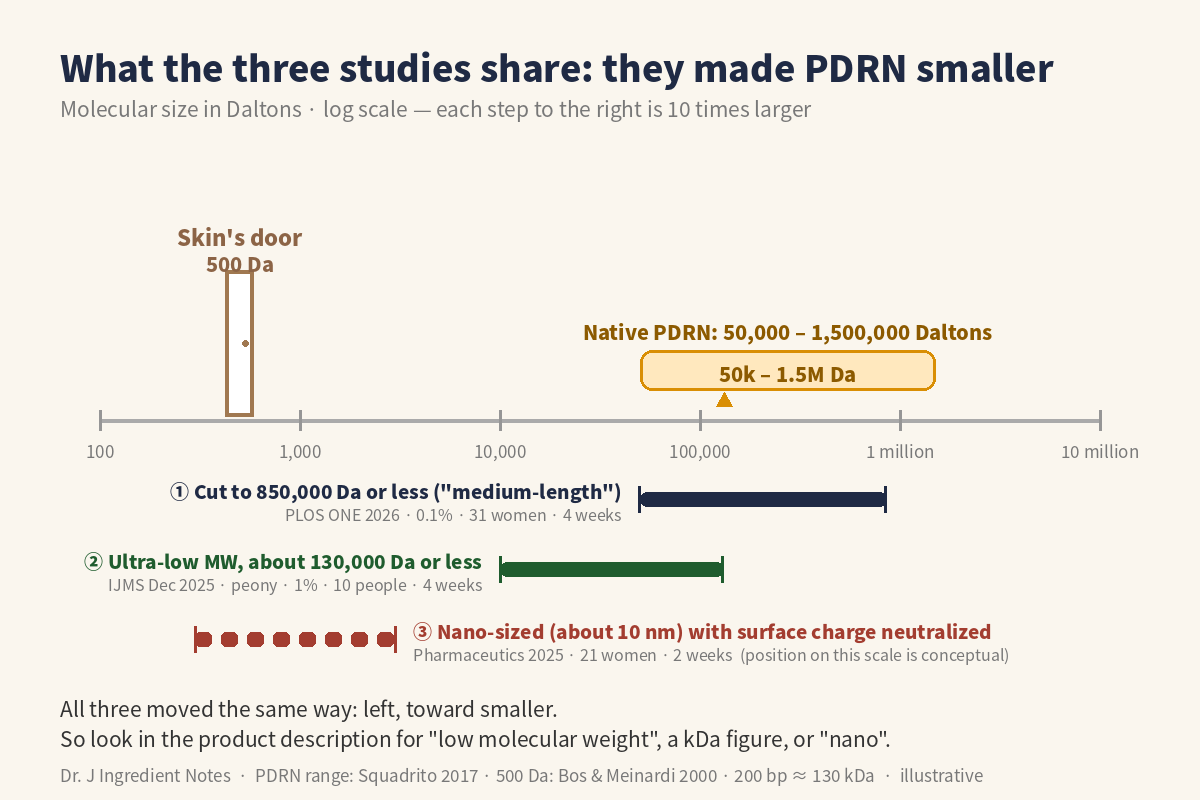
Native PDRN is big: 50,000 to 1,500,000 Daltons. Skin lets molecules through on their own only up to about 500 Daltons, so PDRN left at its natural size mostly works at the surface. Now line up the three studies that showed results, and one thing jumps out: all three made the PDRN smaller.
| Study | What they did to the PDRN | Concentration · people · duration |
|---|---|---|
| PLOS ONE 2026 | Cut to 850,000 Da or less (“medium-length”) | 0.1% · 31 · 4 weeks |
| IJMS, Dec 2025 | Ultra-low molecular weight (about 130,000 Da or less), peony-derived | 1% · 10 · 4 weeks |
| Pharmaceutics 2025 | Nano-sized to about 10 nm, surface charge neutralized | not disclosed · 21 · 2 weeks |
Any mention of size or delivery – “low molecular weight,” a molecular-weight figure in kDa, “nano,” “liposome” – is a good sign. It tells you the brand knows that size is the point.
One thing worth knowing: on the ingredient list, PDRN appears as “Sodium DNA” (or “Hydrolyzed DNA”), and that name reads the same whether the molecule was cut small or not. So size information lives in the product description, not the ingredient list.
3. Condition 2 · Concentration – is it in the range the studies used?
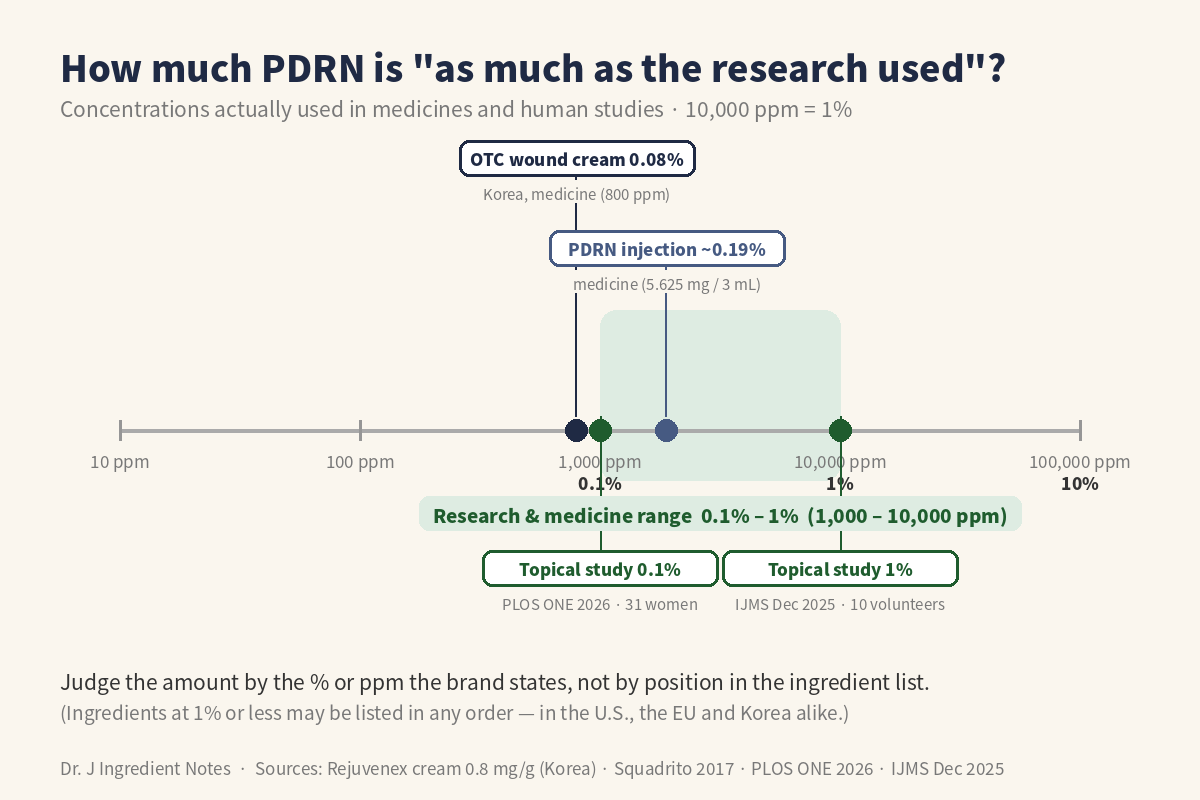
Every brand says it has “a lot.” You need a yardstick, and there are three good ones.
· The PDRN injection used in clinics (a medicine): about 0.19% (1,900 ppm)
· The two topical studies that disclosed a dose: 0.1% (1,000 ppm) and 1% (10,000 ppm)
So anything between 0.1% and 1% – 1,000 to 10,000 ppm – contains as much PDRN as the medicines and the studies did. The conversion is easy: 10,000 ppm = 1%, and 1,000 ppm = 0.1%. Korean brands often print ppm; Western brands, when they disclose at all, tend to use percent.
Read the number the brand states – a % or ppm on the product page – rather than guessing from the ingredient list. In the U.S., the EU and Korea alike, only ingredients above 1% have to be listed in descending order; anything at 1% or less can go in any order. So a 1% PDRN – the same amount one of the studies used – can quite legitimately sit near the end of the list. If a brand states no number at all, it’s fair to ask them.
4. Condition 3 · Source and purity – salmon, plant, or just “extract”?
PDRN is traditionally extracted from the milt (reproductive cells) of salmon or trout, and a properly made raw material has its proteins removed and is purified to over 95%. That is the grade used in medicines and the one with the most research behind it, so think of it as the default choice.
Lately, plant-derived PDRN has appeared too – from peony root, microalgae or yeast. The IJMS study in the table used peony PDRN. It isn’t the same molecule as salmon PDRN – it’s plant DNA cut into small pieces – but it showed improvements in elasticity and moisture recovery over four weeks, and it’s a good option if you’d rather avoid animal-derived ingredients.
· Only a salmon extract – “Salmon Milt Extract,” “Salmon Egg Extract” or similar – with no Sodium DNA → a salmon-derived extract, not PDRN as such
· Fish allergy → purified PDRN has had its proteins removed, so a direct link is unlikely; still, patch-test on the inner arm for two days before using it on your face
5. Condition 4 · Companion ingredients – the supporting cast that makes hydration last
As someone who formulates, this is the one I most want to say: a good PDRN cream doesn’t work with PDRN alone. DNA is a large, water-loving molecule – it holds moisture at the skin’s surface and forms a thin film – but what makes that hydration last is the humectants and barrier ingredients alongside it. That’s why the products with a strong rest-of-the-list are the ones people actually stay happy with.
· Soothing: centella asiatica, madecassoside, allantoin – look for these if you want it for post-procedure or sensitive skin
· If your skin is reactive: skip products with fragrance or essential oils high in the list, or alcohol (alcohol denat.) near the top
6. Condition 5 · Label language – the calm brand is usually the trustworthy one
As I covered in part one, a cosmetic cannot say “regenerates” or “treats” – not in Korea, not in the U.S. So a product that says hydrates, smooths, soothes and stops there is very often made by a brand that knows the rules. In my experience, the quiet label is frequently the better product.
· “Regenerates” – skin regeneration, regenerating cream or ampoule
· “At-home Rejuran,” “instead of injections” – borrowing a clinic treatment’s name
· “Boosts collagen by X%,” “absorbs into the dermis” – things a cream can’t demonstrate
7. Use it the way the studies did
· All three studies looked at once or twice a day for two to four weeks. Give it that long, and watch for hydration, texture and glow
· If you use it in the morning, sunscreen is non-negotiable – UV protection is what protects the value of every ingredient you put on (earlier post on sunscreen ingredients)
· After a laser or a peel, your clinic’s instructions come first
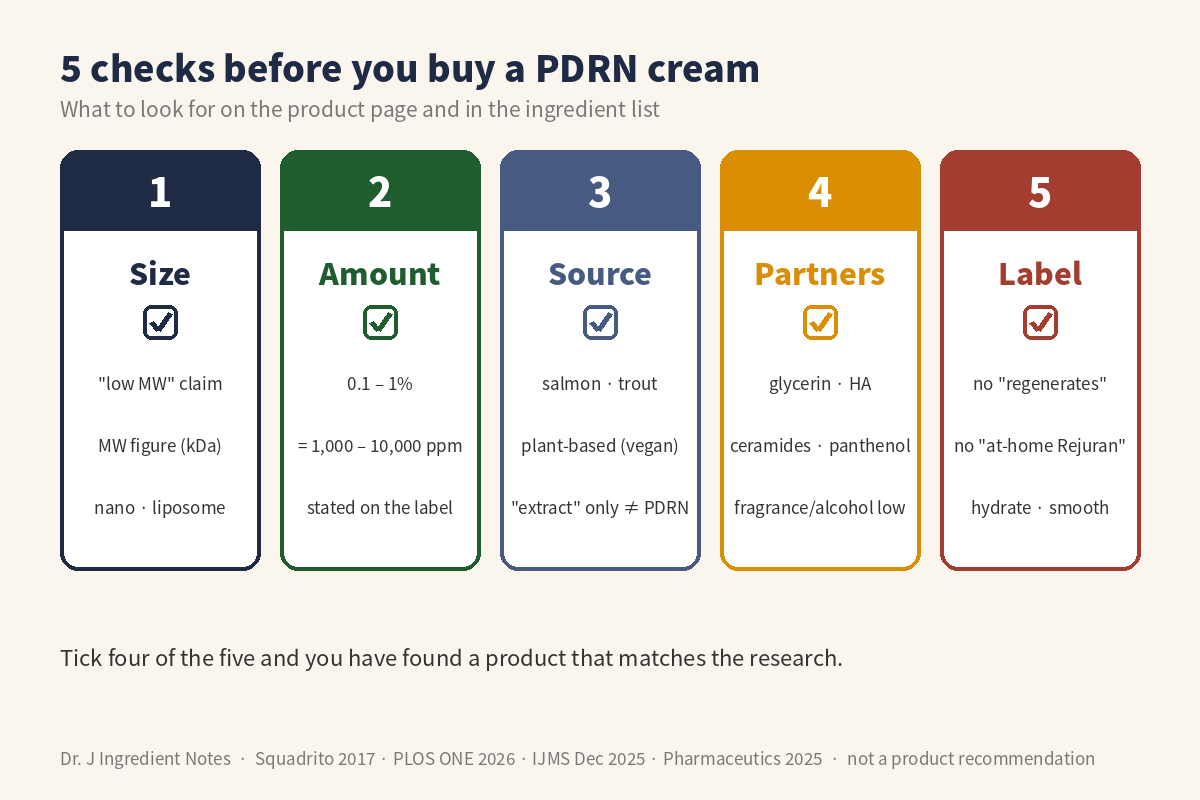
☐ Size – does the product mention “low molecular weight,” a kDa figure, nano or liposome?
☐ Concentration – is it between 0.1% and 1% (1,000–10,000 ppm)?
☐ Source – salmon or trout (the default), or plant-based (the vegan option); “extract” alone isn’t PDRN
☐ Companions – are hydrating, barrier and soothing ingredients high in the list?
☐ Label – does it say hydrate, smooth, soothe – without “regenerates,” “at-home Rejuran” or “instead of injections”?
Choose a PDRN cream by three questions: was it made smaller, does it contain as much as the research, and is the rest of the formula good?
When all three line up, the two-to-four-week change the studies saw is a reasonable thing to expect on your own skin.
▶ Korean version of this post (한국어판): PDRN 크림, 제대로 고르는 5가지 조건 – 논문 세 편이 가리키는 방향
▶ Part one: PDRN (Salmon DNA) Skincare: What a Korean Bio PhD Wants You to Know
▶ Earlier: Korea Just Put a “Not for the Whole Body” Warning on Oxybenzone Sunscreens
Next time: retinol. “Can I start retinol in my 50s?” – concentration, how to begin, and the combinations to avoid.
Curious about an ingredient? Leave a comment and I’ll look up the research and explain it simply.
— Dr. J (MS in Veterinary Medicine · PhD in Life Sciences · former researcher, Korea Research Institute of Bioscience & Biotechnology · founder of a cosmetics manufacturing company)
1. Squadrito F et al. “Pharmacological Activity and Clinical Use of PDRN.” Frontiers in Pharmacology 2017;8:224 – PDRN 50–1,500 kDa (most abundant around 132 kDa), salmon/trout origin, purity above 95%, injectable 5.625 mg/3 mL.
2. Bos JD, Meinardi MM. “The 500 Dalton rule for the skin penetration of chemical compounds and drugs.” Experimental Dermatology 2000;9:165-169.
3. Ye R et al. “Topical medium-length PDRN enhances dermal extracellular matrix repair in photodamaged skin.” PLOS ONE 2026;21(7):e0350905 – PDRN of 850 kDa or less at 0.1%, 31 women, 4-week split-face vs retinol (cosmetics-company study).
4. “Anti-Aging Efficacy of Low-Molecular-Weight Polydeoxyribonucleotide Derived from Paeonia lactiflora.” International Journal of Molecular Sciences 2026;27(1):220 (published Dec 2025) – peony PDRN under 200 bp (about 130 kDa), 1%, 10 volunteers, 4 weeks, eye-area elasticity +4.25% (ingredient-supplier study).
5. “Plasma-Engineered PDRN: Surface Charge Neutralization and Nanosizing Enhance Uptake and Regeneration Potential.” Pharmaceutics 2025;17(9):1136 – nano-sized PDRN of about 10 nm, 21 Korean women (mean age 58), 2 weeks, reduced roughness and increased gloss (university–industry study).
6. Korea Pharmaceutical Information Center – Rejuvenex Cream (PDRN sodium 0.8 mg/g, OTC; indication: wounds and tissue nutrition).
7. Korea Cosmetic Association ingredient dictionary – Sodium DNA, function: skin conditioning. U.S. FDA, 21 CFR 701.3 – ingredients at 1% or less may be listed in any order after those above 1%.
※ This article is general information about cosmetic ingredients, not medical advice. Results vary with individual skin. It does not recommend or criticize any specific product. The author runs a company that manufactures PDRN-containing cosmetics.
Leave a Reply