Category: Uncategorized

  • Dark Circles in Korea: A 0-5 Grade Scale in the Test Guideline, and No Claim Category in the Notified List (Skin Concern Series)

    Cover image for an article on dark circle ingredients in Korea. Annex 4 of the functional cosmetics notification lists six claim categories and the word dark circle does not appear in it; the nearest box is whitening with nine actives. Chapter 6 of the Korean MFDS guideline on test methods for substantiating claims instead writes down the procedure: the test site is the dark-circle area under the eye, melanin index is read with a Mexameter MX18 and lightness L star with a Chromameter CR-400, and at least twenty valid data sets are required. Dr. J Ingredient Notes.

    🇰🇷 한국어판

    Hello, this is Dr. J. Today I want to look at dark circle ingredients the way Korean regulators look at them — and at what the human studies actually moved.

    Two things surprised me. The word “dark circle” does not appear in Annex 4, the table that fixes actives and levels for notified functional cosmetics. And yet the Korean regulator wrote down how to measure one, down to a 0-5 grade scale that two experts apply by eye.

    ――――――――――――――――――――――――――――

    Primary sources

    📄 MFDS, Guideline on Test Methods for Substantiating Cosmetic Claims (Mar 2018, PDF, Korean)

    📄 Regulation on Functional Cosmetics Review, Annex 4 (Korea Law Service)

    📄 Phytonadione, retinol and vitamins C and E, 8 weeks (J Cosmet Dermatol 2004)

    📄 Vitamin C on dark circles, 6 months, split face (Skin Res Technol 2009)

    📄 U.S. FDA, Cosmetics Labeling Claims

    The guideline covers ten claims. Chapter 6 is dark circle relief.

    ――――――――――――――――――――――――――――

    ――――――――――――――――――――――――――――

    Five lines, if you are in a hurry

    ● Annex 4 has six claim categories and dark circles is not one of them

    ● The nearest box is whitening, with nine notified actives — the pigment side

    ● Chapter 6 of the test guideline writes down how to measure the area under the eye

    ● It names the instruments and attaches a 0-5 expert grade scale

    ● But in the two eye-area studies, what moved was the vascular reading, not pigment

    ――――――――――――――――――――――――――――

    There is no box for it — Annex 4 and its six categories

    Annex 4 of the Regulation on Functional Cosmetics Review lists, for each claim category, the actives and the levels that let a manufacturer skip submitting new efficacy data. It is a shortcut list, not a safety list.

    There are six categories. I opened the original today and searched it: the word “dark circle” is not in the table.

    Category in Annex 4 What the notification fixes How to read it
    UV protection / tanning Actives and maximum levels Both the name and the number are set
    Whitening Nine actives (arbutin 2-5%, niacinamide 2-5%, and others) The nearest box to today’s topic
    Wrinkle improvement Four actives (retinol 2,500 IU/g, adenosine 0.04%, and others) The subject of the previous article
    Hair colour change Dyeing, bleaching and de-dyeing actives Hair, not skin
    Hair removal Thioglycolic acid and others Depilatories
    Acne-prone skin relief Salicylic acid 0.5% Covered in an earlier article
    Dark circles — There is no such category

    The nearest box is whitening, with nine actives

    Pigment is one of the reasons the under-eye area looks dark, and pigment is what the whitening box covers.

    Notified whitening actives (nine) Level
    Broussonetia extract 2%
    Arbutin 2-5%
    Ethyl ascorbyl ether 1-2%
    Oil-soluble licorice extract 0.05%
    Ascorbyl glucoside 2%
    Magnesium ascorbyl phosphate 3%
    Niacinamide 2-5%
    Alpha-bisabolol 0.5%
    Ascorbyl tetraisopalmitate 2%

    Two names in this table come back later in this article: ascorbyl glucoside and niacinamide.

    ――――――――――――――――――――――――――――

    What exists instead — Chapter 6 of the test guideline

    The MFDS guideline on test methods for substantiating claims (March 2018, document no. 0353-02) sets out how to test ten advertising claims. Chapter 6 is dark circle relief, and it was added in August 2014.

    Chapter Claim When it was added
    Ch. 1-3 Skin moisturising · Skin elasticity · Sebum control May 2012, original
    Ch. 4-5 Temporary cellulite reduction · Suitability for acne-prone skin Nov 2013
    Ch. 6 Dark circle relief Aug 2014 (B2-2014-4-003)
    Ch. 7-8 Blood circulation · Puffiness relief Dec 2015
    Ch. 9 Paraben-free 31 Mar 2017
    Ch. 10 Fine-dust protection 28 Mar 2018

    Chapter 6 — what is measured (the guideline’s own wording)

    1. “Melanin content of the skin is measured and the change in melanin index is evaluated.”
    2. “The L* value of the pigmented site is measured and the change is evaluated.”
    3. “The whole face is photographed at a fixed angle and distance, and Red, Green and Blue values are obtained with image analysis software to derive a quasi L* value.”
    4. “Two or more experts closely observe the dark-circle area and grade it according to the dark circle grade (Grade 0-5) in Table 1.”

    Chapter 6 — how it is run and how it is judged

    “The test site shall be the dark-circle area under the eye.”
    “The number of subjects shall be 20 or more so that statistical comparison is possible, securing valid data.”
    “Adults aged 20 or over shall be selected …”
    “After cleansing, subjects rest for 30 minutes under controlled conditions (20-24 °C, 40-60% RH) before measurement.”
    “Repeated measures ANOVA is evaluated for statistical significance at the 95% confidence interval (p<0.05).”
    “If one or more of the evaluation indices shows relief of dark circles after use of the test material, the product is judged to help relieve dark circles.”
    The study length is “recommended to be about 8 weeks”, and application follows the product’s own directions.

    Read closely, the judgement is on the permissive side: if one or more of the four indices improves, the product is judged to help.

    ――――――――――――――――――――――――――――

    The part that surprised me — a 0-5 grade scale for a shadow

    Chapter 6 attaches a table that two or more experts use to grade the area by eye. Here it is in full.

    Grade What the guideline writes (translated from the Korean text)
    0 No dark circle is perceived
    1 A faint purplish shadow in the inner lower eyelid, judged a dark circle because the colour deepens when the skin is pulled
    2 A purplish shadow clearly visible without pulling the skin, or mild pigmentation, or both together
    3 A deep purplish shadow, or moderate pigmentation in part of the area, or both together
    4 Uniform, strong pigmentation overall, sometimes seen above and below the eye at the same time
    5 Uniform and very strong pigmentation seen above and below the eye at the same time

    Grade 1 is the interesting one: the shadow counts as a dark circle because the colour deepens when the skin is pulled. Pull the skin and it darkens, and you are closer to a shadow; stays the same, and you are closer to pigment.

    Grades 4 and 5 say “above and below the eye at the same time”. Even within one claim, the scale looks at different places as it climbs.
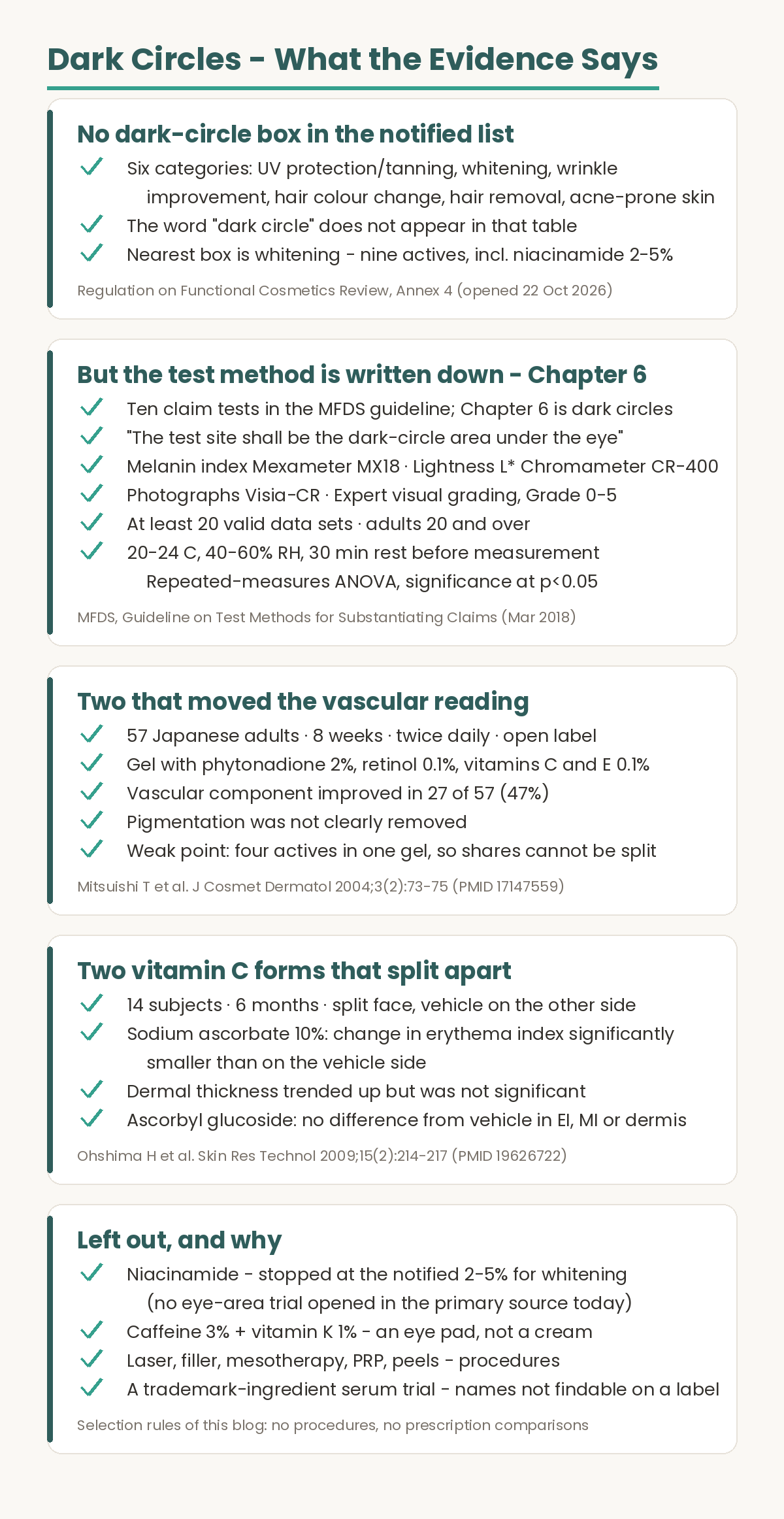
    Evidence summary for dark circle ingredients. First, there is no dark-circle box in the notified list: the six categories are UV protection and tanning, whitening, wrinkle improvement, hair colour change, hair removal and acne-prone skin, and the nearest box is whitening with nine actives including niacinamide at two to five percent. Second, the test method is written down in Chapter 6 of the MFDS guideline, with the test site under the eye, melanin index by Mexameter MX18, lightness L star by Chromameter CR-400, photographs by Visia-CR, expert visual grading from zero to five, at least twenty valid data sets, adults aged twenty and over, twenty to twenty-four degrees and forty to sixty percent humidity with thirty minutes of rest, and repeated measures analysis of variance at p below 0.05. Third, two actives moved the vascular reading: in fifty-seven Japanese adults over eight weeks, an open-label gel with phytonadione two percent, retinol zero point one percent and vitamins C and E improved the vascular component in twenty-seven of fifty-seven, that is forty-seven percent, while pigmentation was not clearly removed. Fourth, two vitamin C forms split apart: in fourteen subjects over six months with a split-face vehicle control, sodium ascorbate ten percent showed a significantly smaller change in erythema index than the vehicle side, while ascorbyl glucoside showed no difference from vehicle in erythema, melanin or dermal thickness. Fifth, what was left out and why: niacinamide stopped at the notified two to five percent because no eye-area trial could be opened, a caffeine and vitamin K study used an eye pad rather than a cream, laser, filler, mesotherapy and peels are procedures, and a trademark-ingredient serum trial names ingredients that cannot be found on a label.

    ――――――――――――――――――――――――――――

    Two that moved the vascular reading — vitamin K and retinol

    57 Japanese adults with infraorbital dark circles and lower-eyelid wrinkles applied a gel twice daily for 8 weeks — the same length Chapter 6 recommends.

    The gel contained phytonadione (vitamin K1) 2%, retinol 0.1% and vitamins C and E at 0.1%.

    After 8 weeks the vascular component improved in 27 of the 57 (47%), and wrinkles decreased in some subjects. Pigmentation was not clearly removed.

    The weak points belong here too: the study was open label, and with four actives in one gel the shares cannot be separated.

    ――――――――――――――――――――――――――――

    Two vitamin C forms that split apart

    14 subjects with dark circles applied sodium ascorbate 10% under one eye and the vehicle under the other for 6 months.

    On the sodium ascorbate side, the change in erythema index was significantly smaller than on the vehicle side. Dermal thickness trended upward but did not reach significance.

    In the same study, ascorbyl glucoside showed no difference from vehicle in erythema index, melanin index or dermal thickness.

    They are both vitamin C derivatives, and ascorbyl glucoside is one of the nine notified whitening actives, at 2%. Being on the notified list and moving a number under the eye are two different things.

    ――――――――――――――――――――――――――――

    The one the notified list puts on the pigment side — niacinamide

    Niacinamide 2-5% sits in the whitening box, so a Korean product can carry a reviewed whitening claim with it.

    I could not open an eye-area trial for it as a primary source today, so this article stops at the notified level rather than implying more.

    ――――――――――――――――――――――――――――

    The five in one table

    Ingredient People and time Design What was measured Result
    Vitamin K (phytonadione 2%) 57 Japanese adults · 8 weeks Open label · twice daily Vascular score, pigmentation, wrinkles Vascular score improved in 27 (47%)
    Retinol 0.1% Same study In the same gel Same measures Wrinkles decreased in some subjects
    Sodium ascorbate 10% 14 subjects · 6 months Split face · vehicle control Erythema index, melanin index, dermis Change in EI significantly smaller than vehicle
    Ascorbyl glucoside Same study Same design Same measures No difference from vehicle
    Niacinamide 2-5% — — — Notified level for whitening, nothing more here

    Where each study is weak

    Ingredient Where it is weak
    Vitamin K and retinol Open label, with no placebo arm in the abstract. Four actives sat in one gel, so the shares cannot be separated. Pigmentation was not clearly removed
    Sodium ascorbate Only 14 subjects. No p value in the abstract, and the dermal thickening was not significant
    Ascorbyl glucoside Its concentration is not given in the abstract. The null result itself is clear
    Niacinamide No eye-area trial could be opened as a primary source today, so this article stops at the notified level

    ――――――――――――――――――――――――――――

    Korea, the United States and the EU

    None of the three keeps a list of actives for dark circles. What differs is whether the regulator writes down how to measure it.

    What a dark circle claim rests on Who writes the test method
    Korea No box in the notified list. The claim is substantiated afterwards (Cosmetics Act Art. 14) The government does — Chapter 6 names the instruments, the room conditions and a 0-5 expert grade scale
    United States There is no list of approved claims at all — “FDA does not have a list of approved or accepted claims for cosmetics” Nobody. The agency also states it has no authority to approve claims before marketing
    EU The six common criteria of Regulation (EU) No 655/2013 Nobody — only the conditions: “adequate and verifiable evidence” and “state of the art practices”

    For an exporter the practical line is short: in Seoul the question is how you measured it, in Brussels and Washington the question is what evidence you hold. Korea is unusual in writing the instruments, the room conditions and a grading table into a public document for a claim it does not pre-review.

    ――――――――――――――――――――――――――――

    Five things to check on a label

    ✔ Ask first what is dark — pigment, visible vessels, or a shadow

    ✔ In front of a mirror, pull the skin gently: if the colour deepens, you are closer to the shadow side (that is Grade 1’s own wording)

    ✔ A whitening functional claim means one of the nine notified actives, on the pigment side

    ✔ A “dark circle” claim is substantiated, not pre-reviewed — the procedure lives in Chapter 6

    ✔ Where an advertisement shows a number, look for how many people, how many weeks, and which index

    ――――――――――――――――――――――――――――

    One line

    Korea wrote the ruler and the grading table, but never opened a box for the claim — and the two eye-area studies moved the vascular reading rather than the pigment one.

    ――――――――――――――――――――――――――――

    What I left out, and why

    ✔ A caffeine 3% and vitamin K 1% study (Adv Biomed Res 2015, 11 women, 4 weeks) — the product was an eye pad, not a cream, and the report carries no figures or p values

    ✔ Laser, filler, mesotherapy, PRP and peels — procedures. On this topic they fill most of the search results

    ✔ A single-arm serum trial (J Clin Aesthet Dermatol 2022, 85 completers, 3 months, melanin index down 12.29%, p<0.05) — the only study here that measured melanin under the eye directly, but its actives are trade names that a reader cannot find on an ingredient list, there was no placebo arm, and the manufacturer funded it

    ✔ Mechanism paragraphs (vascular permeability, haemoglobin breakdown, melanosome transfer) — I did not open a primary review, so I did not write them

    ✔ Folk wisdom — “dark circles come from lack of sleep” and “tapping helps” have no primary source here

    About the author · Dr. J

    MS in Veterinary Medicine, PhD in Life Sciences. I worked as a researcher at the Korea Research Institute of Bioscience and Biotechnology (KRIBB) and now run Beaurea, a cosmetics manufacturing company, where I write the formulas myself. This blog reads the research papers and the regulatory documents and turns them into plain-language criteria for choosing ingredients. I don’t recommend specific products here – only criteria that apply to any product.

    📌 Related reading

    📌 Firmness actives in Korea: wrinkle is notified, elasticity is substantiated — Chapter 2 of the same guideline

    📌 Pores and sebum: the test method the regulator wrote down — Chapter 3 of the same guideline

    📌 Niacinamide: how much is enough — the notified 2-5% in detail

    📌 Not all vitamin C serums work — the two forms that split apart today

    📌 Retinol: start at 0.1% — the concentration that sat in today’s gel

    📄 References

    · Regulation on Functional Cosmetics Review, Annex 4 (Korea Law Service, accessed 22 Oct 2026)

    · Ministry of Food and Drug Safety, Guideline on Test Methods for Substantiating Cosmetic Labelling and Advertising Claims (civil petitioner guide, Mar 2018, no. 0353-02), Chapter 6

    · Mitsuishi T, Shimoda T, Mitsui Y, Kuriyama Y, Kawana S. J Cosmet Dermatol 2004;3(2):73-75

    · Ohshima H, Mizukoshi K, Oyobikawa M, Matsumoto K, Takiwaki H, Kanto H, Itoh M. Skin Res Technol 2009;15(2):214-217

    · U.S. FDA, “Cosmetics Labeling Claims” (content current as of 21 Nov 2022) · Regulation (EU) No 655/2013 · Regulation (EC) No 1223/2009 Art. 14

    ――――――――――――――――――――――――――――

    This article summarises published research and Korean regulatory documents; it is information, not diagnosis or treatment. Annex 4 and Chapter 6 were read in the original today, and the quoted Korean passages are my translation of that text. Of the two eye-area studies, one was open label with four actives in a single gel and the other had 14 subjects and no p value in the abstract — both facts are in the tables above. Ingredient names and levels are written as criteria for choosing a product, not as a recommendation of any particular one.

    — Dr. J Ingredient Notes
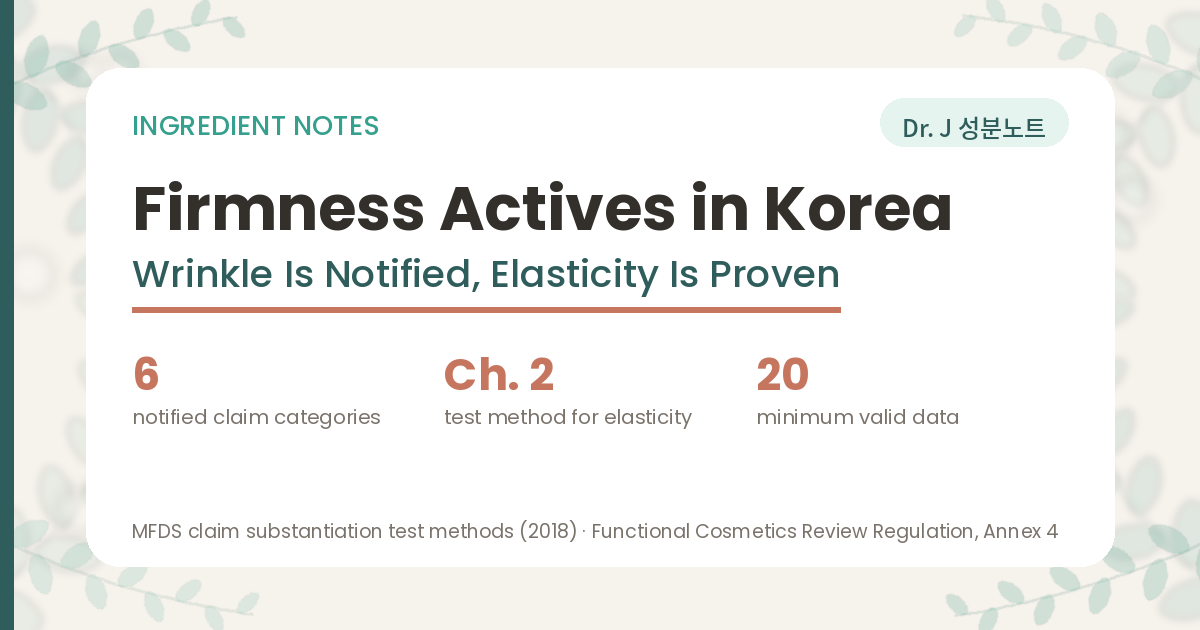
  • Firmness Actives in Korea: Wrinkle Is Notified, Elasticity Is Substantiated

    Cover image for a guide to firmness and elasticity actives in Korean cosmetics. Korea's functional cosmetics notification lists six claim categories, and the wrinkle category names four actives: retinol 2,500 IU per gram, retinyl palmitate 10,000 IU per gram, adenosine 0.04 percent and polyethoxylated retinamide 0.05 to 0.2 percent. The word elasticity does not appear in that table. Instead Chapter 2 of the regulator's claim substantiation guideline writes down how to measure it, with a Cutometer or Dermaflex applying negative pressure and at least 20 valid data sets. Dr. J Ingredient Notes.

    🇰🇷 한국어판

    Hello, this is Dr. J. Today, five actives people reach for when they want firmer skin — chosen by what the human studies actually measured.

    Start with the odd part. In Korea, the regulator reviews “wrinkle improvement” and names the actives for it. It does not use the word elasticity anywhere in that table. Instead it wrote down how to measure elasticity, in a different document.

    ――――――――――――――――――――――――――――

    Primary sources

    📄 Functional Cosmetics Review Regulation, Annex 4 (Korea Law Service)

    📄 MFDS, Guideline on test methods for claim substantiation (March 2018, PDF, Korean)

    📄 Hyaluronic acid, 8-week study (J Clin Aesthet Dermatol 2014)

    📄 0.4% retinol, 24-week trial (Arch Dermatol 2007)

    Annex 4 holds six claim categories. The guideline holds ten test methods. Elasticity appears in the second document only.

    ――――――――――――――――――――――――――――

    ――――――――――――――――――――――――――――

    The short version

    ● Korea notifies six claim categories, and wrinkle improvement names four actives
    ● The word elasticity is not in that table
    ● Chapter 2 of the substantiation guideline is “Skin elasticity improvement”
    ● A Cutometer® or Dermaflex® applies negative pressure and measures the return
    ● So the test to apply to a product is: what did the study measure?

    ――――――――――――――――――――――――――――

    How Korea splits one face into two boxes

    Korean cosmetics law carves out a class called functional cosmetics. For each claim in that class the regulator publishes an annex that names the active and the percentage, and a product built to those numbers is spared from filing new efficacy data. Annex 4 is that table.

    Category What the annex sets Reading
    UV protection and tanning Actives and maximum percentages Both the name and the number are fixed
    Whitening Nine actives (arbutin 2–5%, niacinamide 2–5%, and others) Same
    Wrinkle improvement Four actives (retinol 2,500 IU/g, adenosine 0.04%, and others) The box next to today’s subject
    Hair colour change A list of dye actives Same
    Hair removal Thioglycolic acid 3.0–4.5% A single active
    Acne relief Salicylic acid 0.5% Same
    Firmness / elasticity No category at all Not a claim the regulator reviews

    The wrinkle box, in full

    Active Percentage Reading
    Retinol 2,500 IU/g One of the few set in international units
    Retinyl palmitate 10,000 IU/g A larger number than retinol
    Adenosine 0.04% The smallest percentage of the four
    Polyethoxylated retinamide 0.05–0.2% Written as a range

    Annex 4, wrinkle entry — as written

    Dosage forms: “limited to lotions, solutions, creams and impregnated masks”
    Claim: “helps improve skin wrinkles”
    Directions: “apply an appropriate amount evenly to the skin; or apply the product to the skin, remove the support after 10–20 minutes and spread the remaining product evenly (impregnated masks only)”

    Even the sentence a brand may print is fixed. Elasticity is in none of those cells.

    ――――――――――――――――――――――――――――

    What exists instead: a written test method

    The second document is a civil petitioner guideline published by the Ministry of Food and Drug Safety in March 2018. It sets out how to substantiate ten claims that fall outside the functional class.

    Chapter Claim Added
    Ch. 1 Skin moisturisation 2012.5 (original)
    Ch. 2 Skin elasticity improvement 2012.5 (original)
    Ch. 3 Sebum control 2012.5 (original)
    Ch. 4 Temporary cellulite reduction 2013.11
    Ch. 5 Suitable for acne-prone skin 2013.11
    Ch. 6 Dark circle relief 2014.8
    Ch. 7 Improved skin blood flow 2015.12
    Ch. 8 Puffiness relief 2015.12
    Ch. 9 Paraben-free 2017.3.31
    Ch. 10 Fine dust protection 2018.3.28

    Chapter 2, Skin elasticity improvement — the guideline’s own sentences

    “This is a test in which a Cutometer® or Dermaflex® applies negative pressure to the skin and measures the degree to which it returns to its original state”
    “The number of subjects shall provide at least 20 sets of valid data so that statistical comparison is possible”
    “from among adult men and women aged 20 or over”
    “The test site shall be the whole face, including the eye area (the measurement site)”

    The conditions are written down as well: no air movement or direct sunlight, 20–24 °C and 40–60% relative humidity, 30 minutes of acclimatisation before measurement, a significance level of 0.05, and non-parametric tests as the default when an arm holds 30 subjects or fewer.

    ⚠ What Chapter 2 does not contain is as telling. There is no list of permitted wordings and no pass mark, and no parameter is named — R2, R5 and R7 appear nowhere. The state writes the procedure and leaves the threshold open.

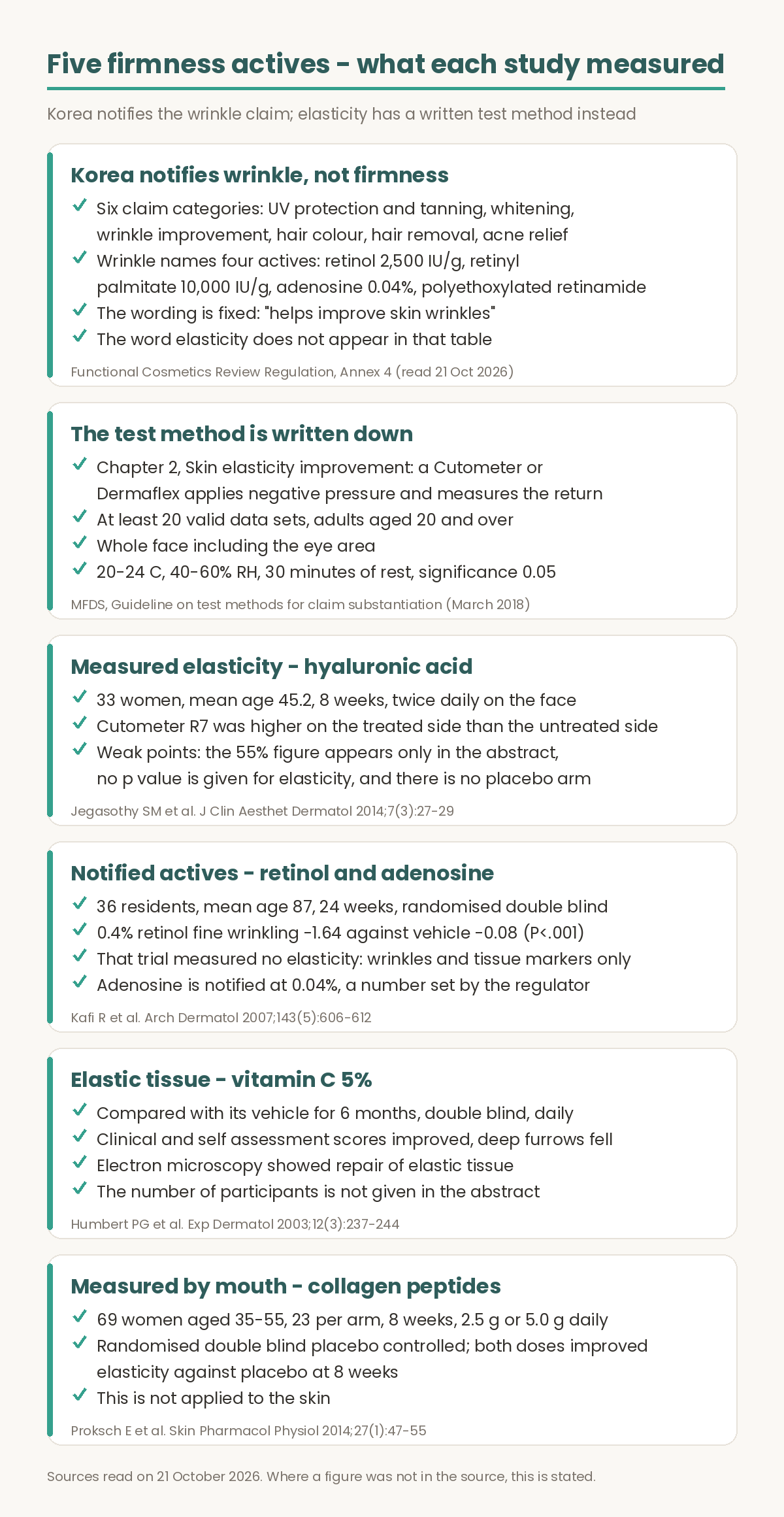
    Evidence summary for five firmness actives. First, Korea notifies wrinkle, not firmness: the six categories are UV protection and tanning, whitening, wrinkle improvement, hair colour change, hair removal and acne relief, and the wrinkle category names four actives with set percentages, while the word elasticity is absent. Second, the test method is written down in Chapter 2 of the claim substantiation guideline: a Cutometer or Dermaflex applies negative pressure and measures how far the skin returns, with at least 20 valid data sets, adults aged 20 and over, the whole face including the eye area, 20 to 24 degrees Celsius and 40 to 60 percent relative humidity, 30 minutes of rest before measurement and a significance level of 0.05. Third, hyaluronic acid measured elasticity directly in 33 women of mean age 45.2 over 8 weeks, where the Cutometer R7 value was higher on the treated side, although the 55 percent figure appears only in the abstract, no p value is given for elasticity and there is no placebo arm. Fourth, retinol and adenosine are the notified actives: a 24 week randomised double blind vehicle controlled trial in 36 residents of mean age 87 found a fine wrinkling change of minus 1.64 against minus 0.08 for vehicle with P below 0.001, and that trial measured no elasticity. Fifth, vitamin C 5 percent was compared with its vehicle for 6 months and electron microscopy showed repair of elastic tissue, but the number of participants is not in the abstract. Sixth, collagen peptides were measured by mouth, not on the skin: 69 women aged 35 to 55 took 2.5 or 5.0 grams daily for 8 weeks and both doses improved elasticity against placebo.

    ――――――――――――――――――――――――――――

    One study measured elasticity directly — hyaluronic acid

    33 women, mean age 45.2 ± 3.9, over 8 weeks at a contract institute in Hamburg. A low molecular weight hyaluronic acid lotion, serum and cream were applied twice a day to the whole face, with measurements at baseline and on days 15, 29 and 57.

    Elasticity was read with a Cutometer, and the treated side rose significantly above the untreated side. Moisture, roughness and erythema were measured too; the only p value printed in the body of the paper belongs to erythema.

    The weak points belong in the same paragraph. The “up to 55%” figure lives in the abstract and is not carried into the text, no p value is given for elasticity, and there is no placebo arm — the comparison is with an untreated area. The concentration of the product is not disclosed either.

    ――――――――――――――――――――――――――――

    Two are notified actives — retinol and adenosine

    The retinol trial measured wrinkles. 36 residents of two long-term care facilities, mean age 87, were followed for 24 weeks in a randomised, double-blind, vehicle-controlled design: 0.4% retinol lotion on one arm, its vehicle on the other, up to three times a week.

    Fine wrinkling scores changed by −1.64 (95% CI −2.06 to −1.22) with retinol against −0.08 (−0.17 to 0.01) with vehicle, P<.001. In biopsy subsets, glycosaminoglycan expression rose (P=.02) and procollagen I staining increased (P=.049).

    That trial measured no elasticity. It measured wrinkle scores and tissue markers. Adenosine, meanwhile, carries a number the regulator chose: 0.04%, set in Annex 4, not by the brand.

    ――――――――――――――――――――――――――――

    One looked at the fibres — vitamin C 5%

    A 5% ascorbic acid cream was compared with its own excipient for 6 months, double-blind, applied daily, with assessments at baseline, 3 months and 6 months and biopsies at the end.

    Global scores from both the dermatologist and the volunteer improved against control, the density of the skin microrelief rose and deep furrows fell. Electron microscopy showed repair of elastic tissue, consistent with the clinical and surface findings.

    Two limits: the number of participants is not stated in the abstract (healthy female volunteers with photoaged skin is as far as it goes), and what this study saw is tissue, not an elasticity reading.

    ――――――――――――――――――――――――――――

    One was measured by mouth — collagen peptides

    69 women aged 35–55, 23 per arm, took 2.5 g or 5.0 g of collagen hydrolysate or placebo once daily for 8 weeks, with a 4-week follow-up after the supplement stopped.

    Both doses improved skin elasticity against placebo at 8 weeks, and four weeks after stopping, elasticity remained significantly higher in the older women. Hydration and transepidermal water loss moved in subgroup analysis but not significantly.

    This one is not applied to the skin. It belongs on a different shelf from the jar, and the exact figures, p values and the instrument used sit behind a paywall this piece could not open.

    ――――――――――――――――――――――――――――

    The five in one table

    Active Subjects Duration Design Measured Result
    Hyaluronic acid 33 8 weeks Treated vs untreated area Elasticity Significantly higher on the treated side
    Retinol 0.4% 36 24 weeks Randomised, double-blind, vehicle Wrinkles, tissue −1.64 vs −0.08 (P<.001)
    Adenosine 0.04% — — Set by Annex 4 — Notified for wrinkle improvement
    Vitamin C 5% not in abstract 6 months Double-blind, vehicle Elastic tissue Repair on electron microscopy
    Collagen peptides 69 8 weeks Randomised, double-blind, placebo Elasticity (oral) Both doses above placebo

    And where each one is weak

    Active What this study cannot say
    Hyaluronic acid The 55% figure is abstract-only; no p value for elasticity and no placebo arm; the concentration is undisclosed
    Retinol It did not measure elasticity. The cohort is also a mean age of 87 in residential care, which does not transfer cleanly to younger skin
    Adenosine What the regulator approved is wrinkle improvement, not an elasticity figure
    Vitamin C No participant count in the abstract, and it looked at tissue rather than an elasticity reading
    Collagen peptides Not a topical result. The numbers, p values and instrument could not be verified in the full text

    ――――――――――――――――――――――――――――

    Korea, the United States and the EU — reviewed names and proven names

    Korea United States EU
    Ingredient list per claim Annex 4 of the functional cosmetics regulation — actives and percentages for six claims None Positive lists cover colorants, preservatives and UV filters only (Regulation 1223/2009, Art. 14)
    “Wrinkle” Reviewed or notified before sale as a functional claim No approved list of claims Handled as a claim, under the common criteria
    “Elasticity” Chapter 2 writes down the measuring procedure No procedure written by the regulator The six common criteria demand evidence
    In their words “a Cutometer® or Dermaflex® applies negative pressure to the skin…” “FDA does not have a list of approved or accepted claims for cosmetics” “adequate and verifiable evidence” · “state of the art practices” (655/2013)
    When it is checked Functional claims before sale; elasticity when asked No pre-market approval for cosmetics No pre-market approval; the evidence must exist

    Lined up, the Korean position is unusual in a specific way. One face, two boxes. The claim closest to firmness — wrinkles — is handled by ingredient, in advance. Firmness itself is handled by procedure, afterwards. Neither the United States nor the EU keeps the first box for this kind of claim at all, which is why an exporter reads the two sentences in opposite order: in Seoul the first question is which active and what percentage, and in Brussels or Washington it is what evidence is on file.

    ――――――――――――――――――――――――――――

    What was left out, and why

    ✔ The niacinamide elasticity trial (Bissett et al., Dermatol Surg 2005) — the abstract could not be opened at a primary source today. Europe PMC returned 429 on all three attempts and Wiley, the journal’s own full text and Semantic Scholar all errored
    ✔ Injected hyaluronic acid (mesotherapy) — a procedure, not a cosmetic
    ✔ Lasers, radiofrequency and thread lifts — same reason
    ✔ Madecassoside — the primary sources found were reviews
    ✔ A green tea study (Chiu 2005) — oral and topical treatment were given together, so neither arm can be read alone
    ✔ A pass mark for Chapter 2 — the guideline does not set one

    About the author · Dr. J

    MS in Veterinary Medicine, PhD in Life Sciences. I worked as a researcher at the Korea Research Institute of Bioscience and Biotechnology (KRIBB) and now run Beaurea, a cosmetics manufacturing company, where I write the formulas myself. This blog reads the research papers and the regulatory documents and turns them into plain-language criteria for choosing ingredients. I don’t recommend specific products here – only criteria that apply to any product.

    📌 Related

    📌 Adenosine 0.04%: who decided that number — the box next door, wrinkle improvement

    📌 Hyaluronic acid: how to read the molecular weight — the one active here that measured elasticity

    📌 Collagen: topical vs oral — the longer version of the oral section

    📌 Pores and sebum: the test method the regulator wrote down — Chapter 3 of the same guideline

    📄 References

    · Functional Cosmetics Review Regulation, Annex 4 (Korea Law Service, read 21 October 2026)

    · MFDS, Guideline on test methods for the substantiation of cosmetic labelling and advertising (civil petitioner guideline, March 2018), Chapter 2

    · Jegasothy SM, Zabolotniaia V, Bielfeldt S. J Clin Aesthet Dermatol 2014;7(3):27-29

    · Kafi R, Kwak HSR, Schumacher WE, Cho S, Hanft VN, Hamilton TA, King AL, Neal JD, Varani J, Fisher GJ, Voorhees JJ, Kang S. Arch Dermatol 2007;143(5):606-612

    · Humbert PG, Haftek M, Creidi P, Lapière C, Nusgens B, Richard A, Schmitt D, Rougier A, Zahouani H. Exp Dermatol 2003;12(3):237-244

    · Proksch E, Segger D, Degwert J, Schunck M, Zague V, Oesser S. Skin Pharmacol Physiol 2014;27(1):47-55

    · U.S. FDA, “Cosmetics Labeling Claims” (content current as of 21 November 2022)

    · Commission Regulation (EU) No 655/2013, common criteria · Regulation (EC) No 1223/2009, Article 14

    ――――――――――――――――――――――――――――

    This article summarises published research and public regulatory documents; it is not medical advice. Annex 4 and Chapter 2 of the substantiation guideline were read at source on 21 October 2026, and the Korean documents are quoted here in translation. Of the four studies, one does not state its participant count, one measured no elasticity at all, and one was taken by mouth. Those facts are in the tables. Ingredient names and percentages are given as criteria for reading a product, not as a recommendation of any product.

    — Dr. J Ingredient Notes

  • Fragrance on a Korean Cosmetic Label: The One Word That Needs No Permission, and the One That Does (Ingredient Guide 30)

    Cover image for a guide to how Korean cosmetic labels write fragrance. Article 10 of the Cosmetics Act requires every ingredient used in manufacture to be listed on the package. Annex 4 of the Enforcement Rule then says a fragrance material may be written as the single word fragrance, unless it contains one of the 25 allergens the Minister of Food and Drug Safety has notified, in which case the name itself must be written. The neighbouring item of the same annex is different: to hide any other ingredient a company must submit supporting data to the Minister and, if the Minister accepts that disclosure would seriously harm a legitimate interest, the label may read Other Ingredients. One word needs no permission; the other one does. Dr. J Ingredient Notes cover image.

    🇰🇷 한국어판 (Korean version)

    Hello, this is Dr. J. Today I want to read one entry of a Korean labelling annex line by line, because it answers a question people ask in every market: why does the back of the box say only “fragrance”?

    Here is the part that surprised me. In Korea, “fragrance” is a word you may use without asking anyone. The item sitting immediately beside it in the same annex is the opposite: to hide any other ingredient you have to file supporting data and be told yes.

    ――――――――――――――――――――――――――――

    The provisions, if you want them first

    📄 Enforcement Rule of the Cosmetics Act, Annex 4 (labelling standards and method)

    📄 Cosmetics Act Article 10 and Enforcement Rule Article 19 (Korea Cosmetic Association)

    📄 Regulation (EC) No 1223/2009, Articles 19 and 21

    📄 21 CFR 720.8 — trade secret exemption procedure (eCFR)

    The Korean texts are quoted from the attachment file published by the National Law Information Centre. The English wording below is my own rendering of the Korean; where a phrase matters I give it in quotation marks and name the item it comes from.

    ――――――――――――――――――――――――――――

    ――――――――――――――――――――――――――――

    In five lines

    ✔ The rule is every ingredient used in manufacture — Cosmetics Act Article 10
    ✔ A fragrance material may be written as one word — Annex 4, item 3(e)
    ✔ If a notified allergen is in it, the substance is named instead — the proviso to the same item
    ✔ To hide any other ingredient you file data and wait for acceptance — item 3(g)
    ✔ The EU and the US also use one word — ‘parfum’ / ‘aroma’, and ‘fragrance’

    ――――――――――――――――――――――――――――

    The rule — ten items, and the third one is the list

    Article 10(1) of the Cosmetics Act sets out what a cosmetic package has to carry. There are ten items; the third is where today’s question starts.

    No. What Article 10(1) requires Note
    1 The name of the cosmetic
    2 The trade name and address of the business operator
    3 Every ingredient used in the manufacture of the cosmetic ★ today’s provision
    4 The volume or weight of the contents
    5 The batch number also on the primary container
    6 The use-by date or period after opening also on the primary container (Guide 17)
    7 The price
    8 The words or mark for a functional cosmetic Guide 16
    9 Precautions for use
    10 Anything else the Prime Minister’s Ordinance prescribes Enforcement Rule Article 19(4)

    Article 10(2) names four items that must appear on the primary container — the tube or jar itself: the name, the trade name, the batch number and the use-by date or period after opening. The ingredient list is not among them. It belongs to the outer box, which is why a bare tube often carries no ingredients at all.

    ――――――――――――――――――――――――――――

    Seven items inside one entry — Annex 4 read line by line

    How the ingredients are written is settled by Annex 4 of the Enforcement Rule. Entry 3, “ingredients used in the manufacture of the cosmetic”, holds seven items, (a) to (g). Most articles quote only one of them. Here they all are.

    Item What the provision says What it means in practice
    (a) “The letters shall be at least 5 points in size.” The small print on the back has a floor under it
    (b) “They shall be written in order of decreasing content used in the manufacture of the cosmetic.” With a carve-out: ingredients at 1% or less, fragrance materials and colour materials need not follow the order
    (c) “For a blended raw material, the name of each individual blended ingredient shall be written.” A compound raw material is unpacked into its parts
    (d) “Where a different colour material is used for each shade in colour cosmetics, eye cosmetics, hair dyes or nail products, all the colour materials used may be written together after the mark ‘± or +/-’.” That ± on the back of a lipstick (Guide 24)
    (e) “A fragrance material may be indicated as ‘fragrance’.” ★ today’s one word
    (f) “An ingredient used for the purpose of adjusting pH may be written as the product of the neutralisation reaction instead of the ingredient itself.” What came out is written, not what went in
    (g) “… where it would seriously harm the legitimate interest …, the manufacturer or seller shall submit supporting data …, and where the Minister recognises it, <Other Ingredients> may be written.” ★ today’s neighbouring door

    Four of the seven — (d), (e), (f) and (g) — let the label say something other than the plain ingredient name. Only one of the four asks permission.

    ――――――――――――――――――――――――――――

    The exception is a single sentence

    Enforcement Rule of the Cosmetics Act, Annex 4, entry 3, item (e)

    “A fragrance material may be indicated as ‘fragrance’. However, where the constituents of the fragrance material include an allergen notified by the Minister of Food and Drug Safety, it may not be indicated as fragrance and the name of that substance shall be written.”

    The first sentence is the permission; the second takes part of it back. A fragrance accord is often dozens of materials, and the way they are combined is the house’s own formula. The provision covers that whole area with one word.

    What matters for today is what the sentence does not contain. There is no application, no dossier, no decision. The provision opens the door by itself — and that is exactly where item (g) parts company with it.

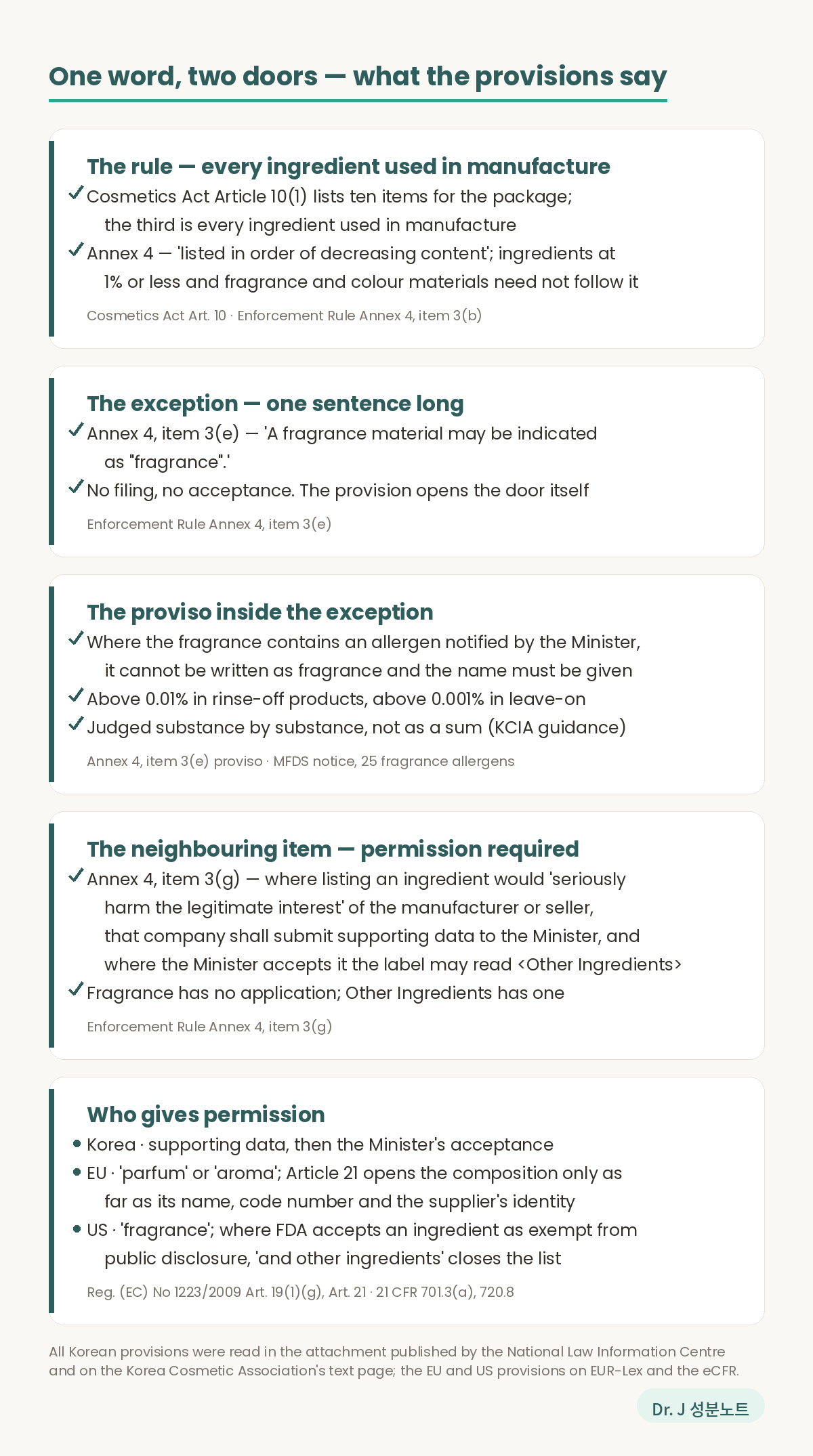
    Evidence card image for the guide to fragrance labelling in Korea. First, the rule. Article 10 paragraph 1 of the Cosmetics Act lists ten items that must appear on a cosmetic package, the third of which is every ingredient used in manufacture, and Annex 4 orders them by decreasing content, except that ingredients at one percent or less and fragrance and colour materials need not follow that order. Second, the exception, which is a single sentence: a fragrance material may be indicated as fragrance. Third, the proviso inside the exception: if the fragrance contains an allergen notified by the Minister of Food and Drug Safety it cannot be written as fragrance and the name of that substance must be written, above 0.01 percent in rinse-off products and above 0.001 percent in leave-on products, judged substance by substance rather than as a sum. Fourth, the neighbouring item. Where listing an ingredient would seriously harm the legitimate interest of the manufacturer or seller, that company must submit supporting data to the Minister, and where the Minister accepts it the label may say Other Ingredients. Fifth, other countries. The European Union writes parfum or aroma under Article 19 of Regulation 1223 of 2009, and the United States writes fragrance under 21 CFR 701.3, with the phrase and other ingredients at the end of the list where the Food and Drug Administration has accepted an ingredient as exempt from public disclosure. All provisions were read in the original texts.

    ――――――――――――――――――――――――――――

    The proviso — when the name has to appear

    Once the proviso bites, “fragrance” is no longer available for that substance and the name itself goes on the label. Korea has notified 25 such substances, and two thresholds decide when they surface.

    Threshold Note
    Rinse-off products above 0.01% body wash, shampoo
    Leave-on products above 0.001% perfume, mist, cream — ten times stricter
    Summed or separate? Separate Korea Cosmetic Association guidance: the figure “refers to the content of each individual substance, so whether to label is judged substance by substance”
    No name on the box does not mean it is absent it may sit under the threshold, or the pack may be small enough to omit
    A name on the box does not mean the product is harsh it means the substance crossed the line and was disclosed

    This is why a perfume or a mist tends to show names like limonene and linalool while a rinse-off product does not. The full list of 25 and the notice behind it are in Ingredient Guide 26.

    ――――――――――――――――――――――――――――

    ★ The neighbouring item — where permission is required

    Item (g) of the same entry is a different road altogether. It is not limited to fragrance: it reaches any ingredient required by Article 10(1)3. What it adds is a condition.

    Enforcement Rule of the Cosmetics Act, Annex 4, entry 3, item (g)

    “Where writing an ingredient under Article 10(1)3 of the Act would seriously harm the legitimate interest of the manufacturer or the seller, the manufacturer or the seller shall submit the supporting data to the Minister of Food and Drug Safety, and where the Minister recognises that the legitimate interest would be harmed, it may be written as <Other Ingredients>.”

    Put the two side by side and the difference is easy to see.

    ‘Fragrance’ — item (e) ‘Other Ingredients’ — item (g)
    Whose permission Nobody’s The Minister of Food and Drug Safety
    What is filed Nothing Supporting data
    What it covers Fragrance materials — scent only Any ingredient under Article 10(1)3 — not limited to scent
    Is there a proviso Yes — the 25 notified allergens None in the text; the acceptance does that work
    What appears on the label fragrance <Other Ingredients>

    So if you ever meet <Other Ingredients> on a Korean box, it is not a gap in the list. It is a line that was argued for and granted. “Fragrance”, by contrast, was there for the taking.

    ⚠ One oddity worth flagging: item (g) still uses the term “manufacturing and selling business operator”, which the Act itself replaced some years ago with “cosmetics responsible distributor”. I could not establish when the annex was last amended, so I have quoted it as it stands.

    ――――――――――――――――――――――――――――

    And some ingredients are not written at all

    “Fragrance” and “Other Ingredients” both rename something. Article 19(2) of the Enforcement Rule does something else again: it lets certain ingredients be left off.

    No. What the provision says Note
    1 “An ingredient that is removed during the manufacturing process and does not remain in the final product” It is not in the product, so it is not on the label
    2 “An incidental ingredient contained in the raw material itself, such as a stabiliser or a preservative, present in a quantity smaller than that which produces its effect” Carried in with a raw material
    3 For packaging of a cosmetic “exceeding 10 millilitres and not exceeding 50 millilitres, or exceeding 10 grams and not exceeding 50 grams”, ingredients other than those listed The exceptions still appear: tar colours, gold leaf, the phosphates in shampoo and rinse, fruit acids (AHA), the efficacy ingredient of a functional cosmetic, and any raw material for which a blending limit has been notified

    Article 19(5) then requires a way back to the full list: either “a telephone number or website address shall be written on the packaging so that consumers can immediately check all the ingredients”, or “printed matter such as a booklet carrying all the ingredients shall be kept at the point of sale at all times”.

    That is why a 30 mL travel size can carry a startlingly short list. It is an abbreviation with a published key, not a secret.

    ――――――――――――――――――――――――――――

    Who gives permission — Korea, the EU and the United States

    Writing scent as one word is not a Korean peculiarity. All three systems do it. What differs is the door next to it.

    Korea EU United States
    The word on the label “fragrance” (Annex 4, item 3(e)) ‘parfum’ or ‘aroma’ — “Perfume and aromatic compositions and their raw materials shall be referred to by the terms ‘parfum’ or ‘aroma’.” (Art. 19(1)(g)) ‘fragrance’ — “except that fragrance or flavor may be listed as fragrance or flavor.” (21 CFR 701.3(a))
    When a name must surface 25 notified allergens above 0.01% / 0.001% Substances whose mention is required under the “Other” column of Annex III (same article) I did not find an equivalent provision while writing this
    Hiding any other ingredient Supporting data → the Minister’s recognition → <Other Ingredients> (item 3(g)) I did not find a labelling omission procedure in the body of the Regulation Where FDA accepts an ingredient as exempt from public disclosure, “the phrase ‘and other ingredients’ may be used at the end of the ingredient declaration” (701.3(a); procedure at § 720.8)
    Order of the list Decreasing content; 1% or less, fragrance and colour materials are free of it “Ingredients in concentrations of less than 1 % may be listed in any order after those in concentrations of more than 1 %.” Ingredients at 1% or less, and colour additives, may be listed without respect to order
    How far disclosure goes The list on the pack; omitted ingredients via phone, website or an in-store booklet Article 21 — “Without prejudice to the protection, in particular, of commercial secrecy …”, and for a fragrance composition the public gets the name and code number of the composition and the identity of the supplier § 720.8(a) describes data “submitted voluntarily to the Food and Drug Administration”

    Read across the last two rows and the axis appears. Every one of the three lets scent be one word; what separates them is who has to say yes before anything else can be hidden. Korea routes it through the Minister, the United States through an FDA acceptance tied to a voluntary filing programme, and the EU handles the same pressure not at the label at all but at the edge of public access — the composition is disclosed as a name, a code number and a supplier.

    For a brand selling into Korea there is a practical consequence. The fragrance word is free, and the other door is paperwork. If a formula depends on keeping one non-fragrance ingredient off the list, that is a filing to plan for, not a labelling style to choose.

    ――――――――――――――――――――――――――――

    Four things to check on the box

    ✔ Find the single word “fragrance” near the end of the list
    ✔ If unfamiliar names sit beside it, they are among the 25 — disclosed because they crossed a threshold
    ✔ An absent name does not mean an absent substance — it may be under the threshold, or the pack may be small
    ✔ <Other Ingredients> means a filing was made and accepted

    ――――――――――――――――――――――――――――

    One line

    “Fragrance” is not a secret kept; it is a bundle the rule allows. “Other Ingredients” is a bundle someone had to ask for. If a particular scent material has bothered your skin before, write the name down and read for it — the 25 are there precisely so that you can.

    ――――――――――――――――――――――――――――

    What I did not write, and why

    ✔ The names and CAS numbers of the 25 allergens — they are already set out in Ingredient Guide 26, so I linked rather than repeated
    ✔ A product that actually carries <Other Ingredients> — I found no example, so I have described the road and stopped there
    ✔ Whether the EU retains a confidentiality route for the label — I did not find one in the body of Regulation 1223/2009, and I could not open the corresponding provision of the former Directive, so I am not claiming that none exists
    ✔ The full text of 21 CFR § 720.8 — I read paragraph (a) and did not read (b) to (g)
    ✔ The amendment history of Annex 4 — which would explain the superseded term in item (g)
    ✔ Claims that “more fragrance names means harsher” — no primary source supports that reading

    About the author · Dr. J

    MS in Veterinary Medicine, PhD in Life Sciences. I worked as a researcher at the Korea Research Institute of Bioscience and Biotechnology (KRIBB) and now run Beaurea, a cosmetics manufacturing company, where I write the formulas myself. This blog reads the research papers and the regulatory documents and turns them into plain-language criteria for choosing ingredients. I don’t recommend specific products here – only criteria that apply to any product.

    📌 Related posts

    📌 Korea’s 25 Fragrance Allergens (Ingredient Guide 26) — the proviso in full, with the list

    📌 How to Read a Korean Cosmetic Ingredient List (Guide 14) — where the order stops at 1%

    📌 Cosmetic Color Additives in Korea (Guide 24) — the neighbouring item, and that ± mark

    📌 Preservative Limits in Korean Cosmetics (Guide 25) — another place where one grouped name carries many substances

    📄 References

    · Cosmetics Act (Korea), Article 10 — paragraph 1, items 1 to 10; paragraph 2, the primary container
    · Enforcement Rule of the Cosmetics Act, Article 19 (paragraphs 2 and 5) and Annex 4, entry 3, items (a) to (g)
    · Notice on precautions for use and labelling of fragrance allergens, Annex 2 · Korea Cosmetic Association ingredient dictionary Q&A
    · Regulation (EC) No 1223/2009, Article 19(1)(g) and Article 21
    · 21 CFR 701.3(a) and 21 CFR 720.8(a)

    ――――――――――――――――――――――――――――

    This article summarises statutes and notices and does not replace diagnosis or treatment. The Korean provisions were opened on the day of writing in the attachment published by the National Law Information Centre and on the Korea Cosmetic Association’s text page; the EU and US provisions on EUR-Lex and the eCFR. Item 3(g) is quoted with the superseded term it still carries. English renderings of the Korean text are mine and are offered for reading, not as an official translation.

    — Dr. J Ingredient Notes

  • Pores and Sebum in Korean Cosmetics: Five Ingredients, and the Test Method the Regulator Wrote Down

    Cover image for an article on pore and sebum claims in Korean cosmetics. Korea's functional cosmetic notice fixes ingredients and percentages for whitening with nine entries, wrinkles with four and acne with one, and it has no pore or sebum entry at all. A separate guideline from the Ministry of Food and Drug Safety, the Guideline on Test Methods for Substantiating Cosmetic Labelling and Advertising issued in March 2018, sets out ten claim types, and chapter three is sebum secretion control. A Sebumeter tape is pressed on the skin for thirty seconds and read as sebum per unit area in micrograms per square centimetre, with casual sebum level and sebum excretion rate measured separately. Pores are not among the ten. The five ingredients chosen here are niacinamide at two percent, green tea at five percent, L-carnitine at two percent, guava leaf at six percent and salicylic acid at zero point five percent, which is the notified acne ingredient. Cover image for Dr. J Ingredient Notes.

    🇰🇷 한국어판

    Hello, this is Dr. J. Today we look at the five ingredients worth knowing for oily skin and visible pores — chosen, in every case, from a human study that actually measured sebum.

    Here is the surprise. In Korea, “pores” is not one of the claims the regulator has written a test method for. “Sebum secretion control” is — down to the instrument, the number of seconds and the unit.

    ――――――――――――――――――――――――――――

    The primary sources

    📄 MFDS, Guideline on Test Methods for Substantiating Cosmetic Labelling and Advertising (March 2018, PDF, Korean)

    📄 Green tea, split-face study (Hippokratia 2013;17(1):64-67)

    📄 L-carnitine and EGCG (J Cosmet Dermatol 2023)

    📄 Regulation (EC) No 655/2013, common criteria

    Chapter 3 of the Korean guideline sets out the sebum procedure itself — the device, the thirty seconds, the unit, and the two values that are measured separately.

    ――――――――――――――――――――――――――――

    ――――――――――――――――――――――――――――

    In five lines

    ✔ Korea’s functional-cosmetic notice has no pore or sebum entry

    ✔ Yet a separate guideline sets out how sebum is measured — chapter 3 of ten

    ✔ Three ingredients here have measured sebum numbers

    ✔ One more study measured the nose and the forehead apart

    ✔ What the studies measured is sebum, not pore size

    ――――――――――――――――――――――――――――

    What Korea’s notified list does fix

    Korea’s Regulation on Functional Cosmetic Review carries an annex that fixes ingredient names and percentages. Formulate to that line and you are excused from filing fresh efficacy data — which also means the state has drawn the boundary of each claim.

    Claim What the annex fixes How to read it
    Whitening Nine ingredients with percentages (arbutin 2–5%, niacinamide 2–5%, and others) Both the name and the number are set
    Wrinkle improvement Four ingredients (retinol 2,500 IU/g, adenosine 0.04%, and others) The same
    Acne-prone skin relief One ingredient — salicylic acid 0.5% This is where blocked pores lead
    Pores and sebum No entry at all “Pore minimising” and “sebum control” have not been reviewed as claims

    That is not a ban. It means no authority has signed off on the wording. The same gap appeared in our piece on sensitive skin — but with pores and sebum there is a second document to open.

    ――――――――――――――――――――――――――――

    The claim without a method, and the claim with one

    The Ministry of Food and Drug Safety publishes a separate guidance document, the Guideline on Test Methods for Substantiating Cosmetic Labelling and Advertising (March 2018, guidance 0353-02). It gives each claim type its own chapter. There are ten.

    Chapter Claim Chapter Claim
    1 Skin moisturisation 6 Dark circle improvement
    2 Skin elasticity improvement 7 Skin blood circulation
    3 Sebum secretion control 8 Puffiness relief
    4 Temporary cellulite reduction 9 Paraben-free
    5 Suitable for acne-prone skin 10 Fine-dust protection

    Pores are not among the ten. The word appears once, in a footnote to chapter 5 that defines a comedo as a small sac formed when the opening of a sebaceous gland is blocked.

    ――――――――――――――――――――――――――――

    What chapter 3 actually says

    “A Sebumeter® is used. When the Sebumeter®, fitted with a special opaque plastic tape, is pressed on the skin with slight pressure for 30 seconds to collect sebum, the increase in the transparency of the tape is turned into a figure shown on the device, and that figure represents the amount of sebum per unit area (µg/cm²) collected.” — our translation of the Korean guideline, chapter 3

    What As the guideline sets it
    Device Sebumeter® — reads how far an opaque tape turns transparent
    Time 30 seconds of slight pressure on the skin
    Unit Sebum per unit area, µg/cm²
    Casual sebum level Measured as soon as the volunteer arrives, without washing — what has pooled on the skin
    Sebum excretion rate (SER) Measured after everyone washes with the same cleanser — how fast sebum returns
    Schedule A fixed body site, measured before and after application of the test material

    The split matters. “There is a lot of oil sitting there” and “oil comes back quickly” are different statements, and most of the studies below measured the second one.

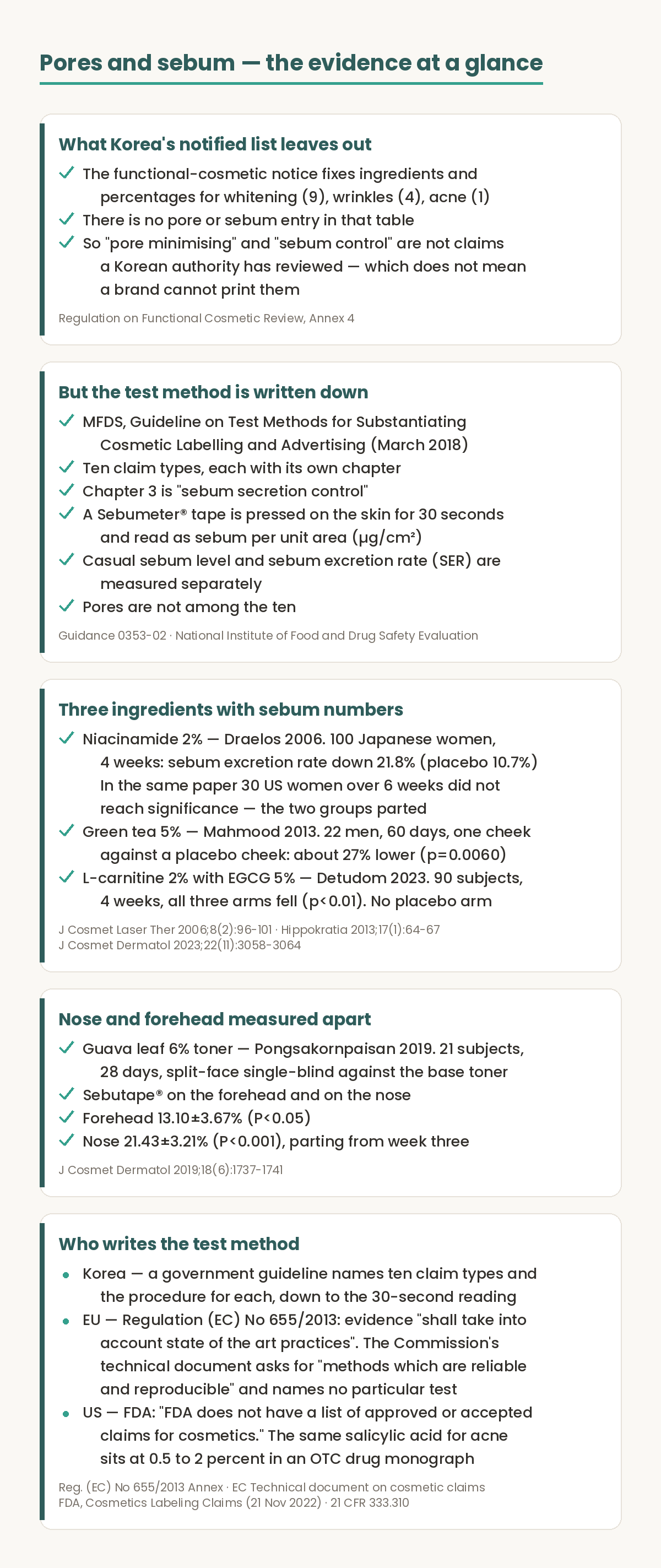
    Evidence summary for an article on pore and sebum claims in Korean cosmetics, in five cards. First, what Korea's notified list leaves out: the functional cosmetic notice fixes ingredients and percentages for whitening with nine entries, wrinkles with four and acne with one, there is no pore or sebum entry in that table, and so pore minimising and sebum control are not claims a Korean authority has reviewed, which does not mean a brand cannot print them. Second, the test method is written down: the Ministry of Food and Drug Safety guideline on test methods for substantiating cosmetic labelling and advertising, issued March 2018 as guidance 0353-02 by the National Institute of Food and Drug Safety Evaluation, sets out ten claim types each with its own chapter, chapter three is sebum secretion control, a Sebumeter tape is pressed on the skin for thirty seconds and read as sebum per unit area in micrograms per square centimetre, casual sebum level and sebum excretion rate are measured separately, and pores are not among the ten. Third, three ingredients with sebum numbers: niacinamide two percent in Draelos 2006, where one hundred Japanese women over four weeks showed sebum excretion rate down twenty one point eight percent against ten point seven percent on placebo, while in the same paper thirty United States women over six weeks did not reach significance, so the two groups parted; green tea five percent in Mahmood 2013, where twenty two men over sixty days applied the product to one cheek against a placebo cheek and sebum was about twenty seven percent lower with a p value of zero point zero zero six zero; and L-carnitine two percent with epigallocatechin gallate five percent in Detudom 2023, where ninety subjects over four weeks showed falls in all three arms with p below zero point zero one, although there was no placebo arm. Fourth, nose and forehead measured apart: a guava leaf six percent toner in Pongsakornpaisan 2019, with twenty one subjects over twenty eight days in a split face single blind comparison against the base toner, measured with Sebutape on the forehead and on the nose, giving forehead thirteen point one zero plus or minus three point six seven percent with P below zero point zero five and nose twenty one point four three plus or minus three point two one percent with P below zero point zero zero one, parting from week three. Fifth, who writes the test method: in Korea a government guideline names ten claim types and the procedure for each, down to the thirty second reading; in the European Union, Regulation (EC) No 655/2013 says evidence shall take into account state of the art practices, and the Commission's technical document on cosmetic claims asks for methods which are reliable and reproducible while naming no particular test; in the United States the Food and Drug Administration states that it does not have a list of approved or accepted claims for cosmetics, and the same salicylic acid for acne sits at zero point five to two percent in an over the counter drug monograph. All statements come from the sources named on each card.

    ――――――――――――――――――――――――――――

    Five ingredients in one table — including where each is weak

    Ingredient Study People · duration Compared with What was measured Where it is weak
    Niacinamide 2% Draelos 2006
    J Cosmet Laser Ther 8(2)
    100 Japanese women · 4 weeks
    30 US women · 6 weeks
    Placebo Sebum excretion rate down 21.8% (placebo 10.7%)
    At 2 weeks 21.3% (placebo 8.6%)
    The two groups parted — the US arm did not reach significance
    Green tea 5% Mahmood 2013
    Hippokratia 17(1)
    22 men (22–28) · 60 days One cheek against a placebo cheek About 27% lower (p=0.0060)
    Sebumeter SM 815
    22 men, and the raw µg/cm² values appear only in the figures
    L-carnitine 2%
    EGCG 5%
    Detudom 2023
    J Cosmet Dermatol 22(11)
    90 subjects, three arms · 4 weeks The three active arms against each other All three arms fell (p<0.01)
    The combination beat L-carnitine alone (p=0.009)
    No placebo arm · age and sex are not in the abstract
    Guava leaf 6% Pongsakornpaisan 2019
    J Cosmet Dermatol 18(6)
    21 subjects · 28 days Half the face against the base toner (single-blind) Sebutape®
    Forehead 13.10±3.67% (P<0.05) · nose 21.43±3.21% (P<0.001)
    The nose parted from week three
    21 subjects, and the abstract alone does not settle whether the percentages are against baseline or between arms
    Salicylic acid 0.5% Korean notice, Annex 4 — — The notified ingredient for acne-prone skin relief Regulatory ground, not a sebum measurement

    Read the table across and the yardstick appears. Numbers of people, duration and comparator give the same percentage a different weight.

    ――――――――――――――――――――――――――――

    The one ingredient Korea fixed by notice

    Item As the notice sets it
    Ingredient and level Salicylic acid 0.5%
    Form Solution · lotion · cream
    Claim “Helps relieve acne-prone skin”
    Directions Apply an appropriate amount and rinse off thoroughly with water straight away
    Age restriction
    Safety standards, Annex 2
    0.5% as salicylic acid, not for use in products for infants or products specifically labelled as usable by children aged 13 or under (shampoo excepted)

    Note the rinse-off in the directions. The form Korea reviewed is not a leave-on product. In the United States the same acid for acne is not a cosmetic ingredient at all — see the next table.

    ――――――――――――――――――――――――――――

    Who writes the test method — Korea, the EU and the US

    Korea EU United States
    List of claims For functional cosmetics the notice fixes ingredient and percentage; other claims appear on a separate substantiation list Not a list but six common criteria (Reg. (EC) No 655/2013) “FDA does not have a list of approved or accepted claims for cosmetics.“
    Test method Written out claim by claim — ten chapters, chapter 3 being sebum secretion control (Sebumeter® · 30 seconds · µg/cm²) Evidence “shall take into account state of the art practices“. The Commission’s technical document asks for “methods which are reliable and reproducible” and names no particular test No prescribed method. Labelling, including claims, “must be truthful and not misleading“
    Salicylic acid for acne A cosmetic — notified functional ingredient at 0.5% Handled inside the cosmetics regulation An OTC drug — 21 CFR 333.310 sets it at 0.5 to 2 percent
    Pores Neither in the notice nor among the ten test methods We found nothing set aside for it The same

    Put the three side by side and the axis is clear. Korea writes down what to measure and how; the EU sets a condition — reliable, reproducible, state of the art — and leaves the method to the field; the United States keeps no approved list at all. The clearest illustration is that the same salicylic acid is a cosmetic ingredient in Seoul and a drug ingredient in Washington.

    For a brand selling into Korea, that has a practical edge: the procedure your sebum claim will be read against is a public document, and it is specific enough to design a study from.

    ――――――――――――――――――――――――――――

    Four things to check on the box

    ✔ “Pore minimising” is not a reviewed claim — look for the number and the source

    ✔ What the studies measured is sebum, not pore diameter

    ✔ Check how many people and for how long — 21 and 100 are not the same weight

    ✔ Check whether there was a placebo arm — in one of these studies there was not

    ――――――――――――――――――――――――――――

    One line

    Pores have no measuring stick yet; sebum has one. Start with the side that carries numbers.

    ――――――――――――――――――――――――――――

    What I did not use, and why

    ✔ Trials that measured pore size — none of the human cosmetic studies I opened measured pores directly

    ✔ Procedures — randomised trials of botulinum toxin or microneedling for pores belong to a different article

    ✔ Retinol and pores — I opened two retinol trials; neither abstract reported a pore endpoint, and one compared against a prescription drug

    ✔ Folk claims — “pores never shrink once enlarged”, “cold water closes pores”: no primary source

    ✔ A fresh reading of the niacinamide paper — the literature databases were rate-limited on the day of writing, so the figures come from an earlier piece in which the full text was read

    About the author · Dr. J

    MS in Veterinary Medicine, PhD in Life Sciences. I worked as a researcher at the Korea Research Institute of Bioscience and Biotechnology (KRIBB) and now run Beaurea, a cosmetics manufacturing company, where I write the formulas myself. This blog reads the research papers and the regulatory documents and turns them into plain-language criteria for choosing ingredients. I don’t recommend specific products here – only criteria that apply to any product.

    📌 Related posts

    📌 Niacinamide: How Much Is Enough (Ingredient Guide 2) — the first ingredient here

    📌 Salicylic Acid (BHA): 0.5% vs 2%, Explained (Guide 8) — the notified 0.5% in full

    📌 AHA vs BHA: Is Glycolic Acid an AHA? (Guide 13) — the blocked-keratin side

    📌 How to Read a Korean Cosmetic Ingredient List (Guide 14) — finding the names on the pack

    📄 Sources

    · MFDS, Guideline on Test Methods for Substantiating Cosmetic Labelling and Advertising (civil-petition guidance 0353-02, March 2018), chapter 3

    · Regulation on Functional Cosmetic Review, Annex 4 · Regulation on Safety Standards for Cosmetics, Annex 2

    · Draelos ZD, Matsubara A, Smiles K. J Cosmet Laser Ther 2006;8(2):96-101

    · Mahmood T, Akhtar N, Moldovan C. Hippokratia 2013;17(1):64-67

    · Detudom P et al. J Cosmet Dermatol 2023;22(11):3058-3064 · Pongsakornpaisan P et al. ibid. 2019;18(6):1737-1741

    · Regulation (EC) No 655/2013, Annex (common criteria) · European Commission, Technical document on cosmetic claims

    · U.S. FDA, “Cosmetics Labeling Claims” (current as of 21 November 2022) · 21 CFR 333.310

    ――――――――――――――――――――――――――――

    This article summarises published studies and regulatory documents and is not a substitute for diagnosis or treatment. The Korean legal database was unavailable on the day of writing, so the notice figures come from earlier pieces in which the originals were read, and the niacinamide paper was not reopened. Translations of the Korean guideline are mine. Ingredient names and concentrations are given as criteria for choosing a product, not as a recommendation of any particular one.

    — Dr. J Ingredient Notes
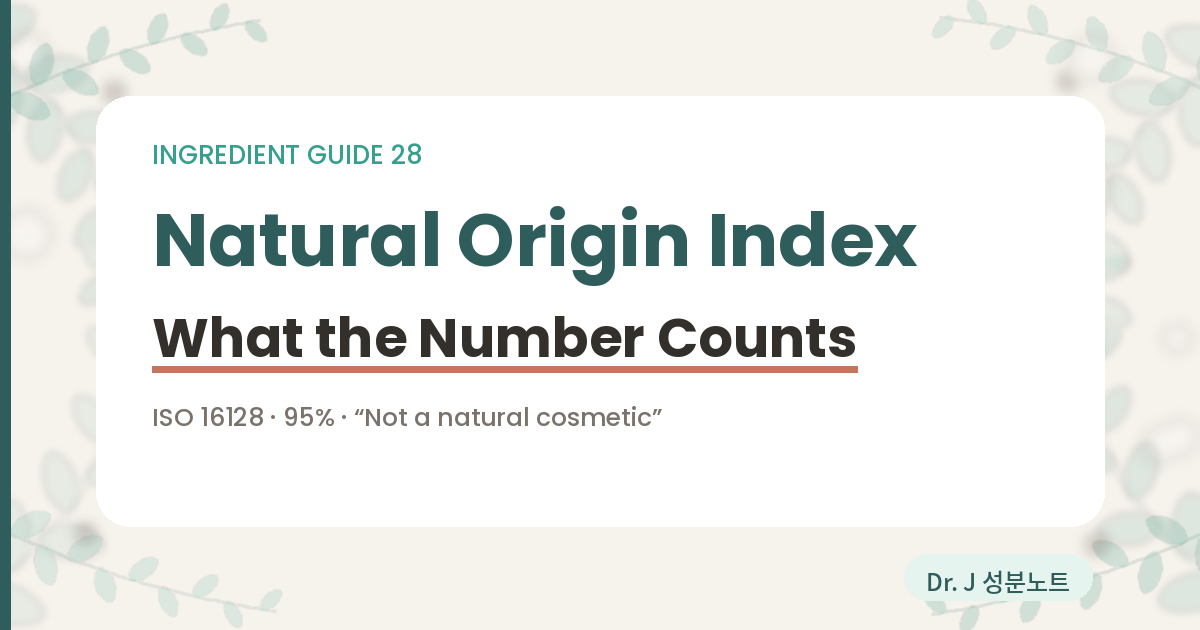
  • Korea’s Natural Origin Index: The 95% Line, and the Disclaimer That Must Sit Beside the Number (Ingredient Guide 28)

    Cover image for an article on the natural origin index printed on Korean cosmetic packaging. A 2025 industry guide from the Korea Cosmetic Association defines a natural cosmetic as one whose natural and natural-origin content reaches 95 percent of the finished product by weight, calculated under the ISO 16128-2 guideline, and an organic cosmetic as one with organic content of 10 percent or more while natural content stays at 95 percent or more. A product below the threshold may not call an ingredient natural on the pack, but it may print the index itself when the calculation basis is shown. The Korean Ministry of Food and Drug Safety guideline then requires the words Not a natural cosmetic beside that index, while ISO 16128 states that it does not address product communication, human safety or environmental safety. Dr. J Ingredient Notes.

    🇰🇷 한국어판

    Hello, this is Dr. J. Today we read the natural origin index printed on Korean cosmetic packaging — what that number counts, and why the words “Not a natural cosmetic” so often sit right beside it.

    Two things surprise most people. In Korea, “natural cosmetic” is no longer defined in the law. And a product that misses the threshold can still print the index — the rules opened that door on purpose.

    ――――――――――――――――――――――――――――

    The primary sources

    📄 Guide on Labelling and Advertising of Natural and Organic Cosmetics (Korea Cosmetic Association, PDF, Korean)

    📄 Guideline on Labelling and Advertising of Cosmetics (MFDS, 14 Aug 2025, PDF, Korean)

    📄 ISO 16128-2:2017 (abstract)

    📄 U.S. FDA, “‘Organic’ Cosmetics”

    The Korean documents carry the thresholds and the disclaimer wording; the ISO abstract carries the sentence that limits the standard itself.

    ――――――――――――――――――――――――――――

    ――――――――――――――――――――――――――――

    Five lines if you are in a hurry

    ✔ Korea deleted the legal definition of natural and organic cosmetics on 1 August 2025

    ✔ The thresholds now live in a 2025 industry guide: natural 95%, organic 10% plus natural 95%

    ✔ A product below the line may still print the index — with the calculation basis shown

    ✔ Beside that index the front panel carries “Not a natural cosmetic”

    ✔ ISO 16128 states that it does not address labelling, human safety or environmental safety

    ――――――――――――――――――――――――――――

    The definition left the statute book in August 2025

    Until 2025, Korean cosmetics law defined natural cosmetics and organic cosmetics and ran a government certification scheme for them. An amendment that took effect on 1 August 2025 deleted those definitions and the certification provisions together.

    What filled the gap is not another statute. It is a guide published in 2025 by the Korea Cosmetic Association — more precisely by the advertising advisory committee of the self-regulatory review body for cosmetic labelling and advertising. The guide describes itself as setting out the minimum requirements for businesses that want to use these words.

    ※ The repeal itself, and the certification scheme that disappeared with it, were covered in Ingredient Guide 18. This article is about the number that is printed on packs now.

    ――――――――――――――――――――――――――――

    What the guide counts — 95% and 10%

    What the guide says (translated) How to read it
    Natural cosmetic A product whose natural and natural-origin content reaches 95% or more of the finished product by weight, calculated under the ISO 16128-2 guideline The unit is the finished product, not an ingredient. Everything in the bottle is weighed
    Organic cosmetic Organic and organic-origin content of 10% or more of the finished product, with natural content — the organic part included — still at 95% or more Both lines must hold. Organic is a branch of natural here, not an alternative route
    What sits on the natural side Plants and animals, minerals and micro-organisms, and ingredients derived from them Not plants alone. Mineral and fermentation-derived materials belong here too
    The calculation ISO 16128-1 (definitions for ingredients) · ISO 16128-2 (criteria for ingredients and products) A two-part international standard, borrowed as the arithmetic

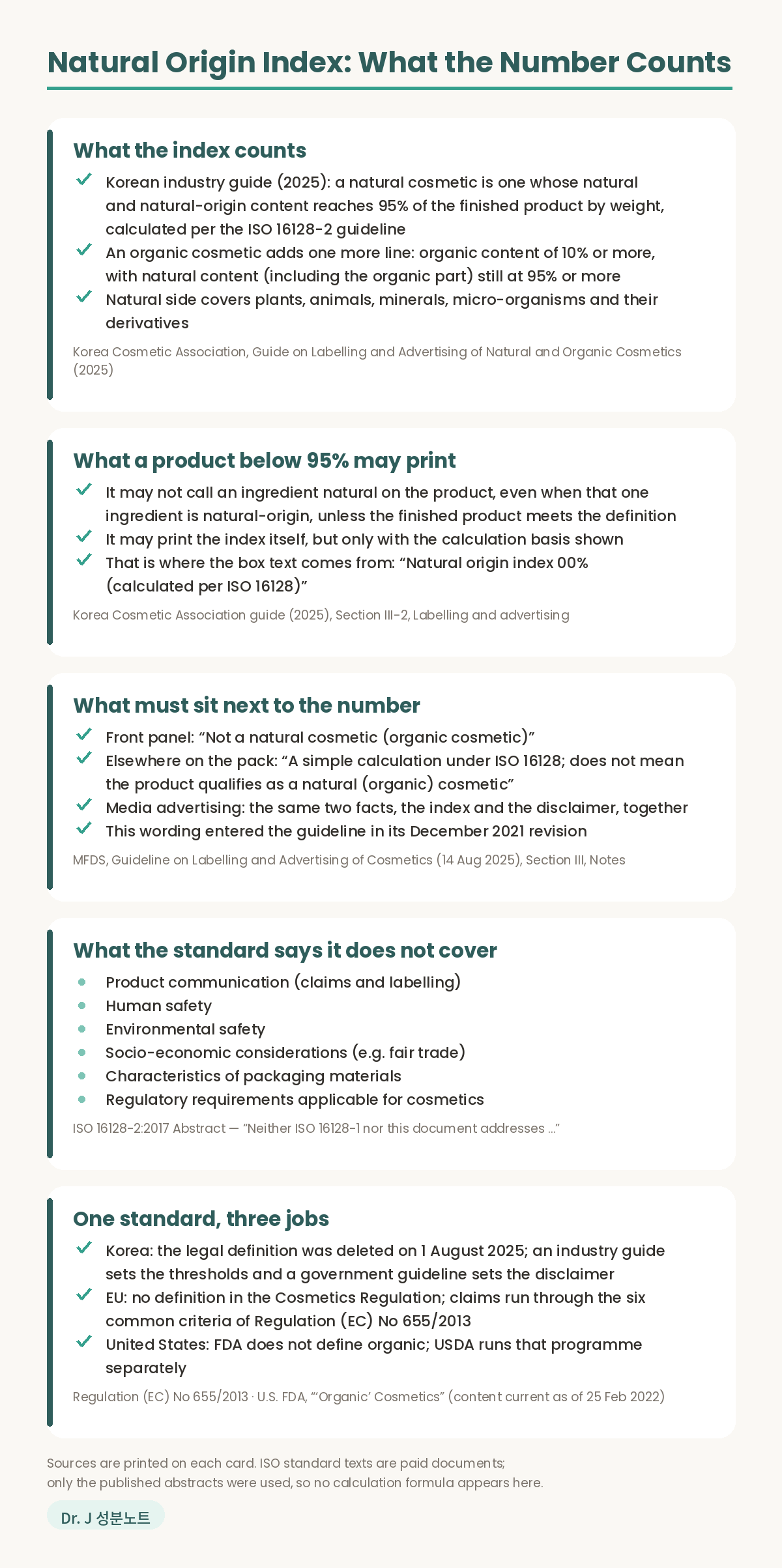
    Evidence graphic on the natural origin index. First, what the index counts: the Korea Cosmetic Association guide of 2025 sets natural content at 95 percent of the finished product by weight under ISO 16128-2, and organic content at 10 percent or more with natural content still at 95 percent or more, counting plants, animals, minerals, micro-organisms and their derivatives. Second, what a product below 95 percent may print: it may not call an ingredient natural on the product, but it may print the index with the calculation basis shown, which is where the wording natural origin index 00 percent calculated per ISO 16128 comes from. Third, what must sit next to the number: the front panel carries Not a natural cosmetic, elsewhere on the pack a line saying the figure is a simple calculation under ISO 16128 and does not mean the product qualifies, and media advertising carries both facts together; this wording entered the guideline in its December 2021 revision. Fourth, what the standard says it does not cover: product communication, human safety, environmental safety, socio-economic considerations, packaging materials and regulatory requirements. Fifth, one standard and three jobs: Korea deleted the legal definition on 1 August 2025 and an industry guide now sets the thresholds, the European Union has no definition in its cosmetics regulation and runs claims through the six common criteria of Regulation 655 of 2013, and in the United States the FDA does not define organic while the USDA runs that programme separately.

    ――――――――――――――――――――――――――――

    The guide’s scope reaches products that print only an index

    This is the clause most summaries skip. The guide does not govern only products that call themselves natural. It also covers products that intend to print nothing but an ISO 16128 index.

    Section of the guide What it sets out
    I. Purpose To give consumers correct information and to set out the minimum requirements for businesses that label and advertise these words
    II. Scope Products labelled or advertised as natural or organic cosmetics, and products that calculate and print a natural or organic (origin) index under the ISO 16128 guideline
    III. Criteria 1. Definitions · 2. Labelling and advertising · 3. Substantiation
    Substantiation A product that labels or advertises these words must be able to substantiate that it meets the criteria

    ――――――――――――――――――――――――――――

    Blocked, then opened — the two sentences that explain the pack

    Section III-2 of the guide places a prohibition and an exception side by side. Read apart, each one misleads; read together, they explain what you see on the shelf.

    What the guide says (translated) In practice
    The prohibition Where the finished product does not meet the definition, the product may not directly label or advertise an ingredient as a natural (origin) or organic (origin) ingredient — even if that particular ingredient is one One natural ingredient does not let the product speak of natural ingredients
    The exception However, where a natural (origin) or organic (origin) index calculated under the ISO 16128 guideline is presented clearly, together with the basis of the calculation, labelling and advertising by index is permitted The number may be spoken. The calculation basis is the price of admission
    The result on the pack “Natural (origin) index 00% (calculated per ISO 16128)” Exactly the string you find on Korean packaging

    So “natural cosmetic” and “natural origin index” are two different claims. The first belongs to finished products above 95%; the second belongs to any product willing to show its arithmetic.

    ――――――――――――――――――――――――――――

    What the MFDS guideline adds — the four permitted wordings

    The Korean Ministry of Food and Drug Safety publishes a Guideline on Labelling and Advertising of Cosmetics (version of 14 August 2025). Its Annex 2, the table of claims that require substantiation, carries a dedicated row: “3. Content concerning ISO natural and organic index labelling and advertising.”

    Permitted wording (as printed in the guideline) Substantiation required
    Natural index 00% (ISO 16128 calculation applied) Substantiated by evidence relating to that finished product
    “In this case it is also necessary to indicate that the figure is calculated under the ISO 16128 guideline, together with wording that prevents consumer misunderstanding.”
    Natural origin index 00% (ISO 16128 calculation applied) same row
    Organic index 00% (ISO 16128 calculation applied) same row
    Organic origin index 00% (ISO 16128 calculation applied) same row

    ※ A footnote in the same annex defines the standard plainly: ISO 16128 is a method (guideline) for obtaining a calculated value for natural and organic content in cosmetics.

    ――――――――――――――――――――――――――――

    Why “Not a natural cosmetic” sits beside the number

    The guideline’s Section III, Notes is where this article’s hinge lies. When an ISO natural or organic index is labelled or advertised, the guideline says the following ways of writing it are to be followed to reduce consumer misunderstanding.

    Where What must appear alongside (translated)
    ① Front panel “Not a natural cosmetic (organic cosmetic)”
    ② Elsewhere on the pack “A simple calculation result under ISO 16128; does not mean the product falls under ‘natural cosmetic (organic cosmetic)’”
    ③ Media advertising “Natural index 00% (a figure calculated under the ISO 16128 guideline). However, this figure does not mean the product qualifies as a natural (organic) cosmetic”

    That small print on the front of the box is not a brand being modest. It is wording the guideline supplies, and the revision history shows when it arrived: the 30 December 2021 edition, recorded as “ISO natural and organic index labelling and advertising method established.”

    ――――――――――――――――――――――――――――

    A prohibition with its own proviso

    Annex 1 of the same guideline lists expressions that may not be used. One line reads:

    MFDS guideline, Annex 1 — expressions that may not be used

    Expressions relating to “natural (Natural)” or “organic (organic)” on a product that does not conform to the Guide on Labelling and Advertising of Natural and Organic Cosmetics (Korea Cosmetic Association).
    Note — businesses wishing to use natural or organic expressions need appropriate supporting documents · “provided that expressions falling under Annex 2, item 3 are excluded.”

    The last clause carries the weight. The prohibition arrives with its exception attached. A product outside the thresholds cannot say “natural”, yet the index wording of Annex 2 item 3 is carved out of that ban — the same architecture as the guide’s “blocked, then opened” pair above.

    ――――――――――――――――――――――――――――

    What the number does not count — six items, named by the standard itself

    The ISO 16128-2 abstract contains one sentence that keeps this whole subject honest.

    ISO 16128-2:2017, abstract

    “Neither ISO 16128-1 nor this document addresses product communication (e.g. claims and labelling), human safety, environmental safety, socio-economic considerations (e.g. fair trade), characteristics of packaging materials or regulatory requirements applicable for cosmetics.”

    The index counts where ingredients came from. Whether a formula is gentle, whether it suits your skin, whether the packaging is sound — none of that is the standard’s business, and it says so.

    Which leaves a gap, and the gap is the interesting part: a standard that refuses to speak about labelling is being used for labelling. Each market has filled that silence differently.

    ――――――――――――――――――――――――――――

    One standard, three jobs — Korea, the EU and the United States

    Korea European Union United States
    Legal definition of natural / organic Deleted on 1 August 2025. The thresholds now sit in a 2025 industry guide No definition in the Cosmetics Regulation FDA does not define it — “The term ‘organic’ is not defined in either of these laws or the regulations that FDA enforces under their authority.”
    Where the criteria live Korea Cosmetic Association guide — natural 95% · organic 10% plus natural 95% Regulation (EC) No 655/2013 and its six common criteria: legal compliance, truthfulness, evidential support, honesty, fairness, informed decision-making For organic, the USDA National Organic Program — “The USDA requirements for the use of the term ‘organic’ are separate from the laws and regulations that FDA enforces for cosmetics.”
    Status of ISO 16128 Named in the guide and the guideline as the calculation method Not named in the Regulation Not named
    What must accompany an index “Not a natural cosmetic (organic cosmetic)” on the front panel No set wording; the claim must clear the common criteria — “If it is claimed on the product that it contains a specific ingredient, the ingredient shall be deliberately present.” No set wording
    Relationship to safety Neither the guide nor the guideline is a safety standard The common criteria govern advertising, not safety FDA — “An ingredient’s source does not determine its safety.”

    ※ The six common criteria are the headings of the Annex to Regulation (EC) No 655/2013, applicable since 11 July 2013. Note what all three jurisdictions share: none of them treats a high natural index as a statement about safety.

    ――――――――――――――――――――――――――――

    Four things to check on the box

    ✔ Look for a percentage next to the word “natural”, not the word alone

    ✔ Look for “calculated per ISO 16128” — the calculation basis is a condition, not decoration

    ✔ If you see “Not a natural cosmetic”, that is an index claim — the line is required, not a confession

    ✔ Judge gentleness from the ingredient list and concentrations, not from the index

    ――――――――――――――――――――――――――――

    In one line

    The natural origin index counts where ingredients came from; it does not measure how gentle a product is. Above 95% a product may be called a natural cosmetic; below it, the figure may still be printed with its calculation shown — and the words “Not a natural cosmetic” go with it.

    What is not in this article, and why

    ✔ The calculation formula itself — ISO standards are paid documents. Only the published abstracts were read

    ✔ The ingredient categories of ISO 16128-1 — same reason; the standard text was not opened

    ✔ Article and clause numbers of the Enforcement Rule — Korea’s national law portal was unreachable on the day of writing, so no provision numbers are cited

    ✔ The approval date of the industry guide — the PDF yields only the year (2025)

    ✔ Certification bodies and marks — none appear in the guide’s text, so none are named here

    ✔ Claims that natural or organic means gentler — no primary source supports them. The ISO sentence above says the standard does not address human safety, which is the honest version of that question

    ――――――――――――――――――――――――――――

    📌 Earlier articles

    📌 How to Read a Korean Cosmetic Ingredient List (Ingredient Guide 14) — checking by name rather than by index

    📌 Bakuchiol vs Retinol (Ingredient Guide 3) — the plant-derived side

    📌 Collagen: Topical vs Oral (Ingredient Guide 5) — the animal-derived side

    📌 Salicylic Acid (BHA): 0.5% vs 2% (Ingredient Guide 8) — who decides a number

    About the author · Dr. J

    MS in Veterinary Medicine, PhD in Life Sciences. I worked as a researcher at the Korea Research Institute of Bioscience and Biotechnology (KRIBB) and now run Beaurea, a cosmetics manufacturing company, where I write the formulas myself. This blog reads the research papers and the regulatory documents and turns them into plain-language criteria for choosing ingredients. I don’t recommend specific products here – only criteria that apply to any product.

    📄 References

    · Korea Cosmetic Association, Guide on Labelling and Advertising of Natural and Organic Cosmetics (established 2025)

    · Ministry of Food and Drug Safety, Guideline on Labelling and Advertising of Cosmetics, guidance no. 0086-07 (14 August 2025) — Annex 1 · Annex 2 item 3 · Section III Notes

    · ISO 16128-1:2016 · ISO 16128-2:2017 (abstracts)

    · Cosmetics Act of Korea, Act No. 20767 (in force 1 August 2025) — deletion of the natural and organic definitions and certification provisions

    · Regulation (EC) No 655/2013 laying down common criteria for the justification of claims used in relation to cosmetic products

    · U.S. FDA, “‘Organic’ Cosmetics” (content current as of 25 February 2022)

    ――――――――――――――――――――――――――――

    This article summarises guidance documents and standard abstracts and is not a substitute for diagnosis or treatment. Passages from the Korean guide and guideline are my translation of the Korean originals; the ISO and FDA sentences are quoted in their published English. Korea’s national law portal was unreachable on the day of writing, so statutory provisions were not re-opened, and ISO standard texts are paid documents, so only the published abstracts were used.

    — Dr. J Ingredient Notes
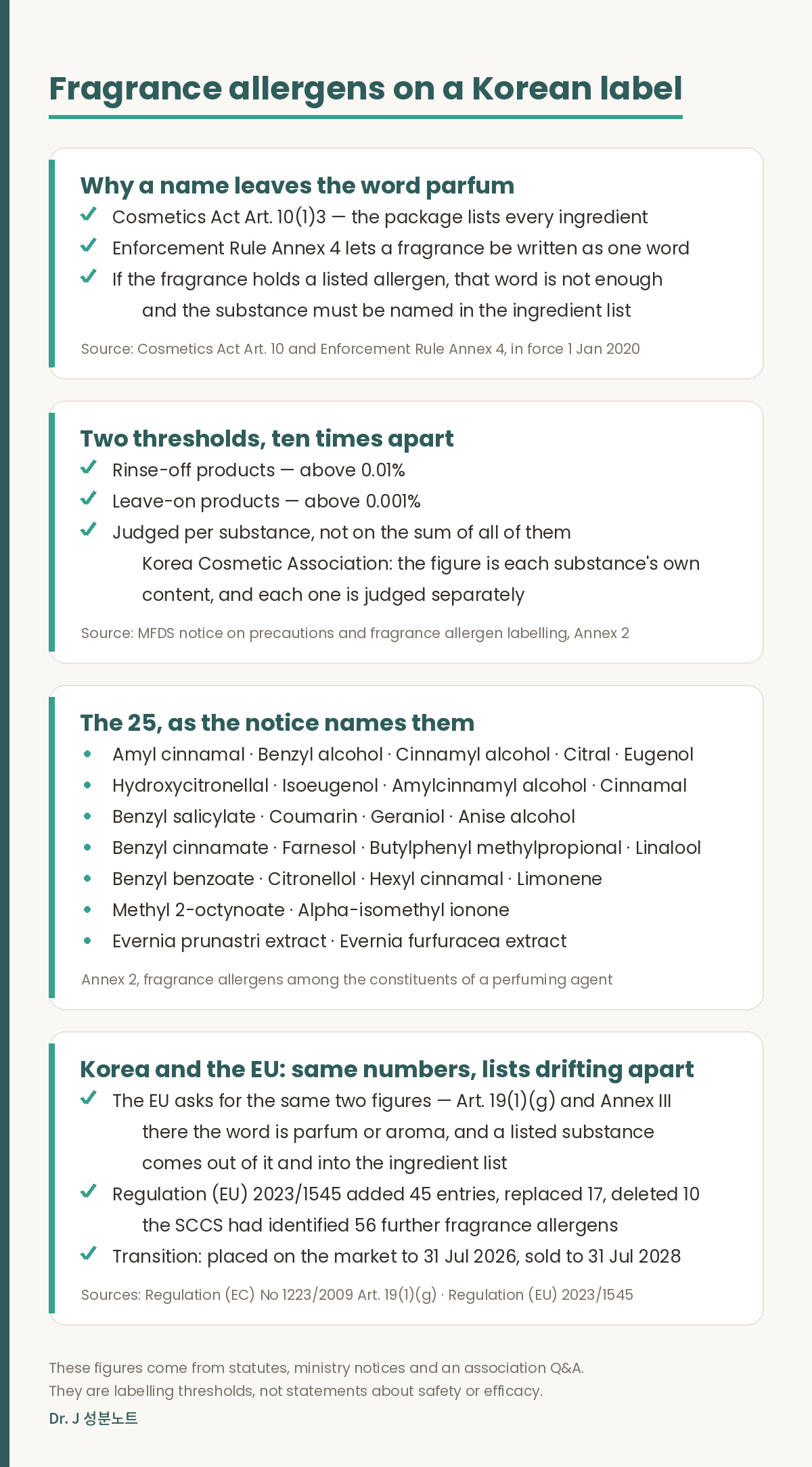
  • Vegan Cosmetics in Korea: The Three Requirements an Industry Guide Set, and the One Line a Korean Label Cannot Print (Ingredient Guide 21)

    Cover image for a Dr. J Ingredient Notes article on vegan cosmetics in Korea. It shows the title Vegan Cosmetics in Korea, the line three requirements and one banned line, the three requirements set by a 2025 industry guide from the Korea Cosmetic Association, and a note that the phrase not tested on animals cannot be printed on a Korean label because Article 15-2 of the Cosmetics Act already bans selling animal-tested cosmetics.

    🇰🇷 한국어판 읽기

    Hello, this is Dr. J. A Korean cosmetic box that says vegan almost never says “not tested on animals” beside it. Shoppers read the gap as a gap. It is not one — it is a rule.

    Here is the part most summaries skip. No statute anywhere defines the word “vegan” for cosmetics — not in Korea, not in the EU, not in the United States. What differs between the three is what fills that empty space, and what a label is allowed to print next to the word.

    ――――――――――――――――――――――――――――

    Primary sources

    📄 Guide to Vegan Labelling and Advertising of Cosmetics, 2025 (Korea Cosmetic Association, PDF, Korean)

    📄 Cosmetics Act Article 15-2 (Korean Law Information Center)

    📄 Regulation (EU) No 655/2013, common criteria for cosmetic claims (EUR-Lex)

    📄 “Cruelty Free”/“Not Tested on Animals” (U.S. FDA)

    The Korean guide runs to a few pages and has three chapters: purpose, scope, and criteria. The EU regulation carries the six common criteria in its Annex.

    ――――――――――――――――――――――――――――

    ――――――――――――――――――――――――――――

    The five lines, if you are in a hurry

    ✔ “Vegan” is not defined in Korean law — a 2025 industry guide sets the requirements

    ✔ A product must meet all three: no animal ingredient, none animal-tested, and no testing of the finished product

    ✔ Ingredients processed with micro-organisms are allowed — fermentation does not break a vegan claim

    ✔ Share a production line with a non-vegan batch and you wash it thoroughly first

    ✔ A Korean label cannot print “not tested on animals” — the sale is already banned, so the claim would mislead

    ――――――――――――――――――――――――――――

    The word is not in the statute — a 2025 industry guide fills the gap

    Search the Korean Cosmetics Act for “vegan” and nothing comes back. The text that does define it was issued in 2025 by the advertising advisory committee of the self-regulatory review body run by the Korea Cosmetic Association. The guide says of itself that it exists to give advertisers “the minimum requirements for making a vegan claim.”

    Its scope is a single line: “This guide applies to cosmetics that are labelled or advertised as vegan.” A product that does not make the claim is outside it.

    What the guide requires What it means on a shelf
    1 A cosmetic that contains no ingredient of animal origin The ingredient side. Honey, beeswax and lanolin are the familiar examples
    2 A cosmetic that contains no ingredient tested on animals under the Cosmetics Act The ingredient’s history, which never appears on the ingredient list
    3 A cosmetic not itself tested on animals under the Cosmetics Act The finished product, not only its parts
    All “A cosmetic that satisfies all of the requirements below” Miss one and the word may not be printed

    ※ The clause numbers inside the guide do not survive text extraction from the PDF, so this article names the chapters rather than the subparagraphs.

    ――――――――――――――――――――――――――――

    Ingredients, manufacturing, substantiation — the three chapters that follow

    After the definition the guide sets out how to keep to it. The second line below is the one that surprises formulators.

    Chapter The guide’s wording Reading
    Ingredient standard “Ingredients of animal origin and ingredients that have been tested on animals shall not be used. An ingredient that has been processed with micro-organisms not derived from animals (bacteria, yeasts, fungi and the like) may be used.” A fermented ingredient does not break a vegan claim. Using a micro-organism is not the same as using an animal
    Manufacturing and control “Ingredients of animal origin shall be kept from entering a vegan product during manufacture. For example, where a vegan and a non-vegan product are made on the same equipment, machines, equipment, tools and contact surfaces shall be washed thoroughly before the vegan product is made.” A dedicated line is not required. Cleaning is accepted in its place
    Substantiation “A cosmetic labelled or advertised as vegan shall be able to substantiate that it meets the criteria.” Making the claim means holding the file. It runs on the same track as Article 14 of the Cosmetics Act

    The guide cites, as its legal footing, Articles 10, 13 and 14 of the Cosmetics Act with Articles 19, 22 and 23 of the Enforcement Rule and its Annex 5 — and Article 15-2. The guide itself carries no penalty; those provisions do.

    ――――――――――――――――――――――――――――

    What may be said, and what may not

    Two of the four rows below are the ones a brand entering Korea tends to get wrong.

    Situation What the guide sets On the box
    The finished product meets the criteria It may be labelled and advertised as vegan The word describes one finished product
    Only some ingredients meet them “A product may not be labelled or advertised as a vegan cosmetic on the basis of particular ingredients alone, rather than the finished product, even where those ingredients meet the criteria.” “Made with vegan ingredients” and “vegan cosmetic” are different claims
    “Not tested on animals” “Although the distribution and sale of cosmetics tested on animals … is prohibited, wording such as ‘not tested on animals’, which could lead consumers to believe that animal-tested cosmetics are also on the market, may not be used.” Its absence is not an omission — the phrase is not permitted
    Certification marks The guide carries no rule on certifying bodies or marks A mark tells you whose standard was met, which you check separately

    Evidence figure on vegan cosmetics in Korea, in five parts. First, what vegan requires: all three of no ingredient of animal origin, no ingredient tested on animals, and the finished cosmetic itself not tested on animals; meet all three and the finished product may be labelled vegan. The source is the Korea Cosmetic Association Guide to Vegan Labelling and Advertising of Cosmetics, issued in 2025. Second, the ingredient standard: ingredients of animal origin and ingredients tested on animals shall not be used, while an ingredient processed with micro-organisms not derived from animals, that is bacteria, yeasts or fungi, may be used. Third, the manufacturing and control standard: keep ingredients of animal origin out of the vegan batch, and where a vegan and a non-vegan product share equipment, wash machines, equipment, tools and contact surfaces thoroughly before the vegan batch. Fourth, one line a Korean label cannot print: Article 15-2 of the Cosmetics Act bans distributing or selling a cosmetic tested on animals or one made with an animal-tested ingredient, inserted in 2016, with six exceptions, the first of which names preservatives, colorants and ultraviolet filters; because the sale is already banned, a not-tested-on-animals claim could mislead a consumer and so may not be used. Fifth, no statute defines the word anywhere: in Korea it is not in law and a 2025 industry guide sets the requirements with substantiation available on request, in the European Union it is not in law and Regulation 655 of 2013 sets common criteria alongside a technical document naming free from animal-derived ingredients, and in the United States the Food and Drug Administration writes that there are no legal definitions for these terms.

    ――――――――――――――――――――――――――――

    The statute behind the banned line — Cosmetics Act Article 15-2

    The reason the phrase is off-limits sits in the statute. Korea already bans the sale, so printing the claim would suggest that products without it are the tested ones.

    Paragraph The provision Reading
    (1), main text “A cosmetics responsible distributor or a customised cosmetics seller shall not distribute or sell a cosmetic on which animal testing under Article 2(1) of the Laboratory Animal Act has been conducted, or a cosmetic manufactured (including contract manufacture) or imported using an ingredient on which animal testing has been conducted.” What is blocked is selling. “Including contract manufacture” sits in brackets, and imports are in the same sentence
    (1), proviso “Provided, that this shall not apply in any of the following cases” (amended 13 Mar 2018, 17 Aug 2021) Six exceptions follow (next table)
    (2) “The Minister of Food and Drug Safety shall endeavour to develop alternative test methods and shall take the measures necessary for cosmetics responsible distributors and others to use them.” The duty that pairs with the ban, and the provision that narrows exception 2
    Inserted [This Article Newly Inserted on 3 February 2016] Reported as in force from 4 February 2017; we could not open the addendum itself

    The six exceptions, as the statute words them:

    No. The provision In short
    1 Where necessary to designate standards of use for ingredients requiring particular restriction — preservatives, colorants, ultraviolet filters and the like under Article 8(2) — or to carry out a risk assessment under Article 8(3) of ingredients raising public-health concerns Safety work. Three ingredient classes are named
    2 Where animal testing is necessary because no alternative test method exists (an alternative test method being a method that uses no animals, or that reduces the number of animals used or lessens their pain, recognised as such by the Minister of Food and Drug Safety) Nothing else will do. The definition sits inside the provision
    3 Where animal testing is required by the law of the country of export The receiving market demands it
    4 Where animal testing is required for product development by the law of the country of import The sourcing market demands it
    5 Where an ingredient developed through animal testing under another statute is used in manufacturing a cosmetic A pharmaceutical-track ingredient, for instance
    6 Other cases, designated by the Minister of Food and Drug Safety, where an alternative test is impracticable Room left for a ministry notice

    The penalty is an administrative fine of up to KRW 1 million under Article 40(1)7. Translations of the Korean provisions here are ours.

    ――――――――――――――――――――――――――――

    Korea, the EU and the United States — one word, three situations

    Set the three side by side and the pattern is clear. None of them defines the word. What differs is what stands in for a definition, and whether the adjacent claim is allowed.

    Korea European Union United States
    Is “vegan” defined in law? No. A 2025 industry guide sets three requirements No. Regulation (EU) No 655/2013 sets six common criteria for every claim No. FDA: “there are no legal definitions for these terms”
    What fills the gap A self-regulatory guide, plus a substantiation file Criterion 6, informed decision-making, and a technical document listing “‘free from animal-derived ingredients’, e.g. in products intended for vegans” among acceptable claims Nothing. The claim is left to the company
    “Not tested on animals” May not be printed — Article 15-2 already bans the sale Permitted if the six criteria are met; Regulation (EC) No 1223/2009 Article 18 bans the testing itself Unrestricted. FDA notes firms “may rely on raw material suppliers or contract laboratories to perform any animal testing necessary”
    Who holds the evidence The advertiser — “shall be able to substantiate” The responsible person, in the product information file (Article 2 of 655/2013) The company, by whatever means it chooses

    For a brand, the practical reading is that Korea regulates the words around the claim rather than the claim itself. A pack artwork that pairs “vegan” with “not tested on animals” passes in the EU and the United States and fails in Korea — and the Korean reason is not that the statement is false, but that it is already true of everything on the shelf.

    The EU technical document is worth one caution. It carries the line “IT IS NOT A EUROPEAN COMMISSION DOCUMENT” and is dated as a version of 3 July 2017, agreed by a sub-working group. It is guidance on how to apply the six criteria, not a statute.

    ――――――――――――――――――――――――――――

    Four things to check on a Korean box

    ✔ Next to “vegan”, look for which standard or certifier is named

    ✔ “Made with vegan ingredients” is not the same claim as “vegan cosmetic”

    ✔ A missing “not tested on animals” is not a missing feature — the phrase is not allowed

    ✔ Whether a product is gentle is a question of ingredients and concentrations, read separately

    ――――――――――――――――――――――――――――

    In one line

    No statute defines “vegan” for cosmetics, and in Korea a 2025 industry guide sets three requirements that must all be met. No ingredient of animal origin, none tested on animals, and no testing of the finished product — with fermented ingredients expressly allowed, and one neighbouring phrase expressly forbidden.

    What we left out, and why

    ✔ The guide’s subparagraph numbers — they do not survive text extraction from the PDF, so we name the chapters instead

    ✔ Any vegan certifier or mark — the guide names none, and we verified none as a primary source, so we name none either

    ✔ A list of animal-derived ingredients — the guide carries no such table; honey, beeswax and lanolin appear here as commonly cited examples

    ✔ The commencement date of Article 15-2 — the law portal does not return addenda, so 4 February 2017 rests on press reports

    ✔ Any vegan entry in the MFDS labelling guidance — the 14 August 2025 guidance lists natural and organic wording among restricted expressions, but nothing on vegan or animal testing

    ✔ Claims that vegan products are gentler — no primary source, so not written

    ――――――――――――――――――――――――――――

    📌 Earlier guides

    📌 How to Read a Korean Cosmetic Ingredient List (Guide 14) — where the ingredient names are checked

    📌 Collagen: Topical vs Oral (Guide 5) — an ingredient that comes from an animal

    📌 Bakuchiol vs Retinol — the 44-person trial (Guide 3) — an ingredient that comes from a plant

    📌 Sunscreen SPF and PA: How to Read the Numbers (Guide 11) — one of the three classes named in exception 1

    About the author · Dr. J

    MS in Veterinary Medicine, PhD in Life Sciences. I worked as a researcher at the Korea Research Institute of Bioscience and Biotechnology (KRIBB) and now run Beaurea, a cosmetics manufacturing company, where I write the formulas myself. This blog reads the research papers and the regulatory documents and turns them into plain-language criteria for choosing ingredients. I don’t recommend specific products here – only criteria that apply to any product.

    📄 Sources

    · Korea Cosmetic Association, Guide to Vegan (VEGAN) Labelling and Advertising of Cosmetics (issued 2025), by the advertising advisory committee of the self-regulatory review body for cosmetic labelling and advertising

    · Cosmetics Act of Korea, Article 15-2(1) and (2), Article 40(1)7, Article 8(2) and (3), Articles 10, 13 and 14

    · Laboratory Animal Act, Article 2(1)

    · Ministry of Food and Drug Safety, Guidance on the Management of Cosmetic Labelling and Advertising (14 August 2025)

    · Regulation (EU) No 655/2013, common criteria, Annex points 1–6

    · European sub-working group on claims, Technical document on cosmetic claims, Annex III (version of 3 July 2017)

    · Regulation (EC) No 1223/2009, Article 18

    · U.S. FDA, “Cruelty Free”/“Not Tested on Animals” (content current as of 25 February 2022)

    ――――――――――――――――――――――――――――

    This article summarises an industry guide and statutes for general information and is not a substitute for diagnosis or treatment. On the day it was written the Korean law portal was unreachable, so Article 15-2 was taken verbatim from a statute mirror and the commencement date from press reports. Translations of the Korean provisions and of the guide are ours; the subparagraph numbers inside the guide do not survive text extraction from the PDF, so chapters are named instead.

    — Dr. J Ingredient Notes
  • Korea Bans the Sale of Animal-Tested Cosmetics: The Six Exceptions, and the One Line a Korean Label Cannot Print (Ingredient Guide 23)

    Cover image for a Dr. J Ingredient Notes article on Korea's ban on selling animal-tested cosmetics. It shows the title Korea's Animal Testing Ban, the line six exceptions and one line labels cannot print, and a reference to Cosmetics Act Article 15-2, in force since 4 February 2017.

    🇰🇷 한국어판 읽기

    Hello, this is Dr. J. Korea has banned animal-tested cosmetics since 2017 — and yet you will almost never see “not tested on animals” printed on a Korean box. Those two facts are connected, and the connection is written down.

    Here is the part most summaries skip. What the statute blocks is selling, not testing.

    ――――――――――――――――――――――――――――

    Primary sources

    📄 Cosmetics Act Article 15-2 (Korean Law Information Center)

    📄 Laboratory Animal Act Article 2, Korean and English (KLRI)

    📄 Regulation (EC) No 1223/2009, Article 18 (EUR-Lex)

    📄 Animal Testing & Cosmetics (U.S. FDA)

    The Korean article carries the six exceptions one subparagraph at a time, and the KLRI page gives the Laboratory Animal Act definition in Korean and English side by side.

    ――――――――――――――――――――――――――――

    ――――――――――――――――――――――――――――

    The five lines, if you are in a hurry

    ✔ Selling animal-tested cosmetics has been banned in Korea since 4 February 2017

    ✔ The word manufacture carries (including contract manufacture), and imports sit in the same sentence

    ✔ The article lists six exceptions

    ✔ The penalty is an administrative fine of up to KRW 1 million

    ✔ That is why a Korean label cannot say “not tested on animals”

    ――――――――――――――――――――――――――――

    What the article actually says

    Article 15-2 has two paragraphs. Most English write-ups quote the first and stop; the second is the one that explains where the policy is going.

    Paragraph Text What it does
    15-2(1), main clause A responsible cosmetics distributor or a custom cosmetics seller shall not distribute or sell a cosmetic for which animal testing, as defined in Article 2(1) of the Laboratory Animal Act, has been carried out, or a cosmetic manufactured (including contract manufacture) or imported using an ingredient on which animal testing has been carried out. The prohibited act is distribution and sale. Running a test inside Korea is not itself the offence. Contract manufacture and imports are written into the same sentence, which closes the two obvious ways around it
    15-2(1), proviso Provided, that this shall not apply in any of the following cases. The six exceptions follow (table below)
    15-2(2) The Minister of Food and Drug Safety shall endeavour to develop alternative test methods and shall take the measures necessary for responsible cosmetics distributors and others to use them. The duty that pairs with the ban. Exception 2 opens whenever no validated alternative exists, so the second paragraph puts the job of narrowing that gap on the regulator

    The article was newly inserted on 3 February 2016 and took effect on 4 February 2017.

    Evidence figure on Korea's cosmetic animal testing ban. First, Article 15-2 paragraph 1 bans distributing or selling a cosmetic tested on animals or made with an animal-tested ingredient, the word manufacture carries the phrase including contract manufacture, imported products are named in the same sentence, the duty binds responsible distributors and custom cosmetic sellers, and the penalty is an administrative fine of up to one million Korean won. Second, the definition of animal testing is borrowed from the Laboratory Animal Act Article 2, which defines it as testing or a scientific procedure carried out on laboratory animals for scientific purposes, and defines a laboratory animal as a vertebrate used or raised for animal testing. Third, the article lists six exceptions, covering limits for preservatives, colorants and ultraviolet filters or a risk assessment, the absence of an alternative test method, the law of an export market, the law of an import source, an ingredient developed under another statute, and other cases the Minister of Food and Drug Safety designates. Fourth, a comparison of Korea, the European Union and the United States, where Regulation 1223/2009 Article 18 bans marketing and also testing inside the EU from 11 March 2009 and 11 March 2013, and the United States Food and Drug Administration states that the Federal Food, Drug, and Cosmetic Act does not specifically require the use of animals in testing cosmetics for safety.

    ――――――――――――――――――――――――――――

    The six exceptions, one subparagraph at a time

    No. As the article lists it In plain words
    1 Where it is necessary to designate use limits for ingredients that require particular restriction on use, such as preservatives, colorants and ultraviolet filters, or to carry out a risk assessment of a cosmetic ingredient raising a public-health concern Testing done to set a limit, not to launch a product. Korea sets numerical limits for these three groups by notice
    2 Where animal testing is necessary because no alternative test method exists The gap that paragraph (2) is meant to close
    3 Where animal testing is required under the law of an importing country for the purpose of exporting cosmetics A market Korea sells into demands it
    4 Where animal testing is required for product development under the law of the country from which the product is to be imported A market Korea buys from demands it at the development stage
    5 Where an ingredient developed through animal testing under another statute is used in manufacturing cosmetics Pharmaceutical and other statutes require testing; that ingredient can still be used
    6 Other cases prescribed by the Minister of Food and Drug Safety where it is difficult to carry out a test that can replace animal testing A notice fills this in. We could not open that notice and say so below

    Exception 1 is worth a second look. Preservatives, colorants and ultraviolet filters are named in the statute itself — the three groups whose limits Korea fixes by notice. The space kept open is the space for safety work.

    ――――――――――――――――――――――――――――

    Who is bound, and what happens

    Korea Source
    Who is bound Responsible cosmetics distributors; custom cosmetics sellers Article 15-2(1)
    What is prohibited Distributing or selling the finished cosmetic, or one made with an animal-tested ingredient, including by contract manufacture or import Article 15-2(1)
    Penalty An administrative fine of up to KRW 1 million Cosmetics Act Article 40(1)7
    Inserted 3 February 2016 [Newly inserted 3 Feb 2016]
    In force 4 February 2017 ⚠ the addendum text was not available; confirmed from two Korean newspapers

    An administrative fine is a small number next to the cost of a recall or a relabelling, but it is not the whole pressure. A product that cannot be lawfully distributed is a product retailers will not take.

    ――――――――――――――――――――――――――――

    The definition is borrowed from another statute

    The Cosmetics Act does not define animal testing itself. It reaches into the Laboratory Animal Act, Article 2(1), which reads in the official English rendering:

    “The term animal testing means testing conducted for laboratory animals or the scientific procedure for scientific purposes, such as education, testing, research and production of biological medicines or such.”

    And Article 2(2): “The term laboratory animal means vertebrate used or raised for the purpose of animal testing.”

    Because the definition is borrowed, the scope is borrowed too — the line is drawn at vertebrates.

    ――――――――――――――――――――――――――――

    Why no Korean label says “not tested on animals”

    The Korea Cosmetic Association publishes a vegan labelling guide (2025) through the industry’s self-regulatory advertising body. It allows the word vegan under three conditions and blocks one phrase outright.

    What the guide sets Content Can it go on the box?
    Vegan, condition 1 The product contains no ingredient of animal origin Vegan ⭕ where the conditions are met and can be substantiated
    Vegan, condition 2 It contains no ingredient on which animal testing has been carried out under the Cosmetics Act same
    Vegan, condition 3 No animal testing has been carried out on the product under the Cosmetics Act same
    Blocked phrase “Animal testing not conducted” and similar wording ❌ — because the sale of animal-tested cosmetics is already prohibited, the phrase could lead a consumer to believe such products are otherwise on the shelf

    So the absence of the phrase is not a gap in the product. It is a consequence of the ban being universal. If every product on the shelf has to meet the same rule, advertising compliance as a feature is treated as misleading.

    One thing we could not settle: whether the term cruelty-free itself is governed anywhere. The MFDS labelling and advertising guidance (14 August 2025) does not list animal-testing wording among its prohibited expressions.

    ――――――――――――――――――――――――――――

    Korea, the EU and the United States

    This is the part that is hard to find in English. All three jurisdictions are moving the same way, and all three grip a different part of the chain.

    Korea European Union United States
    Instrument Cosmetics Act Article 15-2 Regulation (EC) No 1223/2009, Article 18 No federal prohibition
    What is prohibited Distribution and sale of the product Marketing the product, and performing the test within the EU Neither required nor prohibited
    Dates Inserted 3 Feb 2016, in force 4 Feb 2017 11 March 2009; 11 March 2013 for repeated-dose toxicity, reproductive toxicity and toxicokinetics —
    Testing inside the territory Not the object of the article Prohibited for finished products and for ingredients Not addressed
    Who proves safety The business operator The responsible person “It remains the responsibility of the manufacturer to substantiate the safety” (FDA)
    On alternatives The Minister shall endeavour to develop alternative methods and help firms use them (15-2(2)) Validated alternative methods replace the listed tests “FDA supports the development and use of alternatives to whole-animal testing”

    Put plainly: the EU went as far as “do not run the test”, Korea stopped at “do not sell the result”, and the United States has drawn no federal line at all. The FDA’s own page says the “FD&C Act does not specifically require the use of animals in testing cosmetics for safety” — it does not require it, which is not the same as forbidding it.

    For a brand, the practical reading is that Korea is a sales-side jurisdiction. A dossier assembled with animal data for another market does not become acceptable because the testing happened abroad; the product carrying that data is what cannot be distributed here. Exceptions 3 and 4 exist precisely because other markets sometimes demand the opposite.

    ――――――――――――――――――――――――――――

    Four things to check on a Korean box

    ✔ A missing “not tested on animals” line is not a missing feature — the phrase is not allowed

    ✔ If the box says vegan, look for what standard it followed

    ✔ Imported products sit under the same article — being foreign changes nothing

    ✔ Whether a product is gentle is a question of ingredients and concentrations, read separately

    ――――――――――――――――――――――――――――

    In one line

    An animal-tested cosmetic already cannot be sold in Korea. The reason the claim is missing from the label is that the claim is not permitted. The exceptions number six, and the first one names preservatives, colorants and ultraviolet filters.

    What we left out, and why

    ✔ The notice under exception 6 — we could not locate the ministry notice that fills it in

    ✔ The addendum fixing the commencement date — the law portal does not return addenda, so 4 February 2017 rests on two Korean newspapers rather than the statute book

    ✔ Any standard for the term “cruelty-free” — not found in the MFDS guidance, and we name no private certifier because we verified none

    ✔ Korean adoption of specific OECD alternative test guidelines — trade-press reports only

    ✔ Paragraph (2) was taken verbatim from a statute mirror; the law portal was unreachable on the day this was written

    ✔ Claims that animal-free products are gentler — no primary source, so not written

    ――――――――――――――――――――――――――――

    📌 Earlier guides

    📌 Salicylic Acid (BHA): 0.5% vs 2%, Explained (Guide 8) — the preservative named in exception 1

    📌 Sunscreen SPF and PA: How to Read the Numbers (Guide 11) — the UV filter side

    📌 Bakuchiol vs Retinol — the 44-person trial (Guide 3) — an ingredient that comes from a plant

    📌 How to Read a Korean Cosmetic Ingredient List (Guide 14) — where to check the names

    About the author · Dr. J

    MS in Veterinary Medicine, PhD in Life Sciences. I worked as a researcher at the Korea Research Institute of Bioscience and Biotechnology (KRIBB) and now run Beaurea, a cosmetics manufacturing company, where I write the formulas myself. This blog reads the research papers and the regulatory documents and turns them into plain-language criteria for choosing ingredients. I don’t recommend specific products here – only criteria that apply to any product.

    📄 Sources

    · Cosmetics Act of Korea, Article 15-2 (Act No. 20901, amended 1 Apr 2025, in force 2 Apr 2026) and Article 40(1)7

    · Laboratory Animal Act, Article 2, subparagraphs 1 and 2 (Korea Legislation Research Institute, Korean–English)

    · Korea Cosmetic Association, Guide to Vegan Labelling and Advertising of Cosmetics (2025)

    · Regulation (EC) No 1223/2009, Article 18

    · U.S. FDA, Animal Testing & Cosmetics (content current as of 4 March 2022)

    ――――――――――――――――――――――――――――

    This article summarises statutes and an industry guide for general information and is not a substitute for diagnosis or treatment. On the day it was written the Korean law portal was unreachable, so paragraph (2) of Article 15-2 was taken from a statute mirror and the commencement date from two newspapers; translations of the Korean provisions are ours except where the Korea Legislation Research Institute’s English text is quoted.

    — Dr. J Ingredient Notes
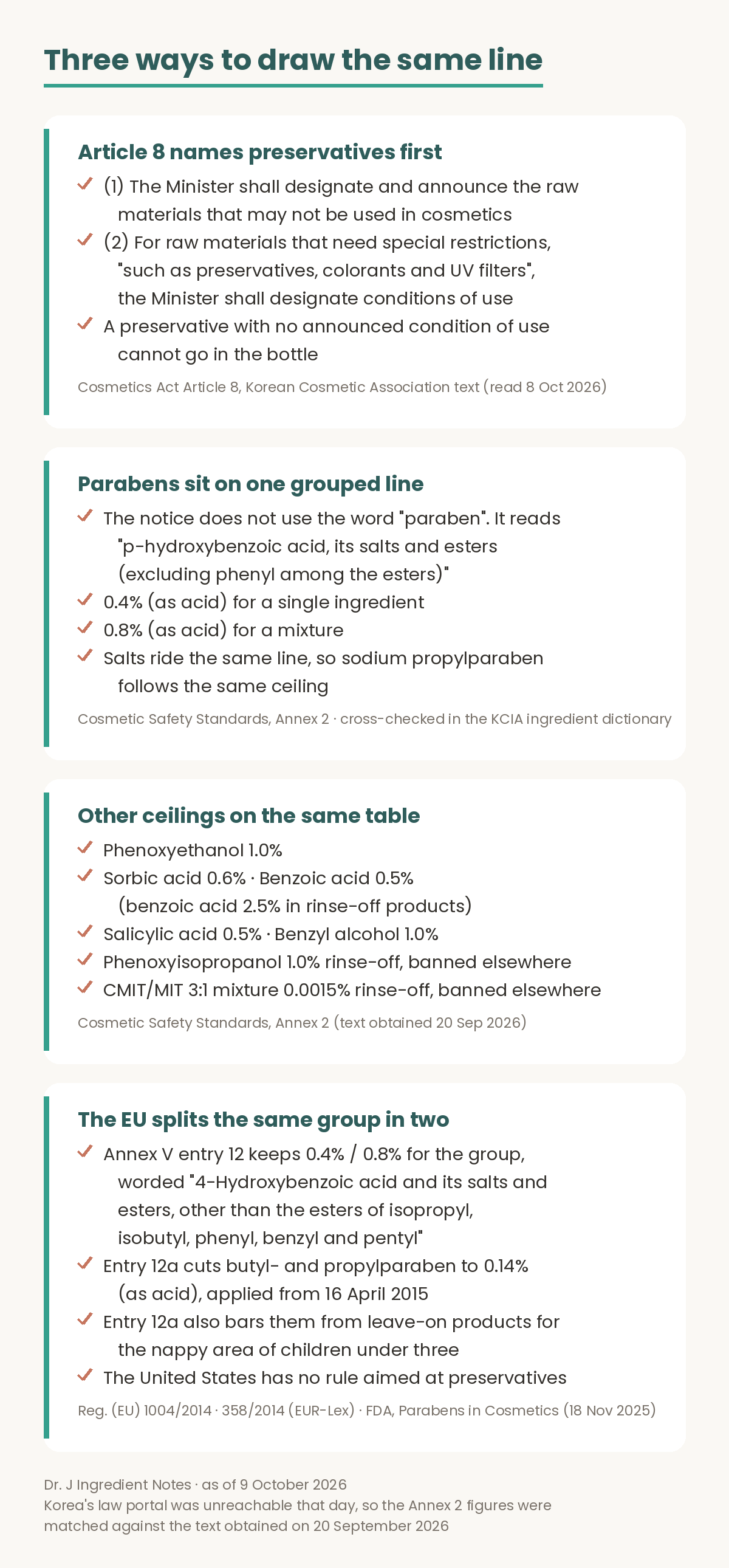
  • Korea’s 25 Fragrance Allergens: When a Name Has to Leave the Word Fragrance (Ingredient Guide 26)

    Cover image for a Dr. J Ingredient Notes article on fragrance allergen labelling in Korea. The Cosmetics Act requires every ingredient to be listed on the package, and the Enforcement Rule allows a perfuming agent to be written as the single word fragrance. When the perfuming agent contains one of the 25 fragrance allergens named in a ministry notice, that word is not enough and the substance must be named. The thresholds are above 0.01 percent in rinse-off products and above 0.001 percent in leave-on products, judged for each substance rather than on the total.

    🇰🇷 한국어판

    Hello, this is Dr. J. Today: Korea’s 25 fragrance allergens, and the rule that decides when one of them stops hiding inside the word fragrance and gets a name of its own on the box.

    Start with the thing most guides skip. A long tail of unfamiliar names after fragrance does not mean the product is heavily perfumed. It means something in the perfume crossed a labelling threshold. The names are not a leak. They are the rule working.

    ――――――――――――――――――――――――――――

    Primary sources first

    📄 Cosmetics Act Article 10 (Korea Cosmetic Association)

    📄 Annex 2, fragrance allergens (Korean Law Information Center)

    📄 Labelling Q&A (Korea Cosmetic Association)

    📄 Regulation (EU) 2023/1545 (EUR-Lex)

    ――――――――――――――――――――――――――――

    ――――――――――――――――――――――――――――

    Five lines, if you are in a hurry

    ✔ A perfuming agent may be written as the single word fragrance

    ✔ But if it contains one of the listed 25, that substance must be named

    ✔ Thresholds: above 0.01% in rinse-off, above 0.001% in leave-on products

    ✔ Judged per substance, never on the sum of them

    ✔ The EU uses the same two figures — and its list is getting much longer

    ――――――――――――――――――――――――――――

    Why a name leaves the word fragrance — a rule in three tiers

    Korean guides usually explain the third tier alone, which makes the rule look arbitrary. It is not. It is a principle, an exception, and a proviso inside the exception.

    Tier What it says Source
    Principle The package lists every ingredient used in manufacturing Cosmetics Act Art. 10(1), item 3
    Exception A perfuming agent may be written as the single word fragrance Enforcement Rule Annex 4 (labelling standards and methods)
    Proviso If the perfuming agent contains a fragrance allergen listed by the ministry, the single word is not enough and the substance must be named Same Annex 4 · MFDS notice Annex 2

    A fragrance is not one ingredient but dozens blended together, which is why the middle tier exists at all. The proviso has applied to products manufactured or imported since 1 January 2020.

    Evidence figure for an article on fragrance allergen labelling in Korea. First, Cosmetics Act Article 10 paragraph 1 item 3 requires the package to list every ingredient used, Enforcement Rule Annex 4 allows a perfuming agent to be written as one word, and a listed allergen inside that perfuming agent must be named separately; the rule has been in force since 1 January 2020. Second, there are two thresholds ten times apart: above 0.01 percent in rinse-off products and above 0.001 percent in leave-on products, judged per substance rather than on the sum, as the Korea Cosmetic Association question and answer states. Third, the 25 substances are amyl cinnamal, benzyl alcohol, cinnamyl alcohol, citral, eugenol, hydroxycitronellal, isoeugenol, amylcinnamyl alcohol, benzyl salicylate, cinnamal, coumarin, geraniol, anise alcohol, benzyl cinnamate, farnesol, butylphenyl methylpropional, linalool, benzyl benzoate, citronellol, hexyl cinnamal, limonene, methyl 2-octynoate, alpha-isomethyl ionone, evernia prunastri extract and evernia furfuracea extract. Fourth, Korea and the European Union use the same two figures but their lists are drifting apart: the EU works through Article 19 paragraph 1 point g and Annex III of Regulation 1223/2009, and Regulation 2023/1545 added 45 entries, replaced 17 and deleted 10 after the scientific committee identified 56 further fragrance allergens, with a transition until 31 July 2026 for placing on the market and 31 July 2028 for sale.

    ――――――――――――――――――――――――――――

    Two thresholds, ten times apart

    ✔ Rinse-off products — above 0.01%

    ✔ Leave-on products — above 0.001%

    The leave-on figure is ten times lower because the product stays on the skin. That is why perfumes, mists and body lotions carry longer allergen tails than a body wash does.

    One point is easy to get wrong: the figures are not a combined total. The Korea Cosmetic Association’s Q&A puts it plainly — the figure refers to the content of each individual substance, and each is judged on its own. Five allergens at low levels are five separate decisions, not one sum.

    The denominator is the net content of the product. In a 250 g body lotion, 0.05 g of limonene is about 0.02% — over the line, so limonene is named.

    ――――――――――――――――――――――――――――

    The 25, as the notice names them

    # #
    1  Amyl cinnamal 2  Benzyl alcohol
    3  Cinnamyl alcohol 4  Citral
    5  Eugenol 6  Hydroxycitronellal
    7  Isoeugenol 8  Amylcinnamyl alcohol
    9  Benzyl salicylate 10  Cinnamal
    11  Coumarin 12  Geraniol
    13  Anise alcohol 14  Benzyl cinnamate
    15  Farnesol 16  Butylphenyl methylpropional
    17  Linalool 18  Benzyl benzoate
    19  Citronellol 20  Hexyl cinnamal
    21  Limonene 22  Methyl 2-octynoate
    23  Alpha-isomethyl ionone 24  Evernia prunastri (oak moss) extract
    25  Evernia furfuracea (tree moss) extract

    Entries 24 and 25 are not single molecules but botanical extracts. The notice sets no order or format for where the names go; the association recommends following the ordinary ingredient-list method, and the ministry has said that pulling allergens out into a separate block of their own is not appropriate, because it suggests those substances alone are a problem.

    ――――――――――――――――――――――――――――

    When nothing is named

    Situation Why What follows
    Below the threshold Under 0.01% / 0.001% there is no duty to name The substance can be present and still invisible on the box
    Small packages Net content of 10–50 mL (g) leaves no room The listing may be omitted, but the information must be findable on the company’s website
    Online listings — The ingredient list shown on a sales page must carry the allergens too
    Raw material reporting — Allergens that appear on the label are included in the annual raw material report

    So an absent name does not mean an absent substance — and a present name does not mean a bad one. It means a threshold was crossed and the rule asked for daylight.

    There is Korean market data on how this plays out. The Seoul Institute of Health and Environment tested 106 fragranced cosmetics on sale in the city — 85 leave-on (perfume, body mist, body cream, hand cream) and 21 rinse-off (body wash) — screening for 23 of the allergens by GC-MS. One body mist failed the coumarin labelling requirement and was referred for administrative action; the other 105 complied. Measured levels ran from not detected up to about 1.5%.

    ――――――――――――――――――――――――――――

    Korea and the EU: the same two numbers, lists drifting apart

    This is the part worth knowing if you buy Korean products abroad, or sell them there.

    Korea European Union
    Legal basis Cosmetics Act Art. 10 · Enforcement Rule Annex 4 · MFDS notice Annex 2 Regulation (EC) No 1223/2009 Art. 19(1)(g) · Annex III
    The single word fragrance 「Perfume and aromatic compositions and their raw materials shall be referred to by the terms ‘parfum’ or ‘aroma’」
    What comes out of it the 25 substances in Annex 2 「the presence of substances, the mention of which is required under the column ‘Other’ in Annex III」
    Thresholds above 0.01% rinse-off · above 0.001% leave-on the same — 「0,01 % in rinse-off products」 · 「0,001 % in leave-on products」
    Most recent change Annex 2 still stands as amended on 16 December 2019 Regulation (EU) 2023/1545 added 45 entries to Annex III, replaced 17 and deleted 10, after the SCCS identified 56 further fragrance allergens
    Transition — non-compliant products may be placed on the market until 31 July 2026 and sold until 31 July 2028

    Read that last row together with the one above it. From August 2026, the same formula will need a longer allergen list in Brussels than it needs in Seoul. A short tail on a Korean box is not a cleaner perfume, and a long tail on a European one is not a heavier one. The two lists are simply different lengths, and only one of them has just grown.

    The EU also folded in prehaptens and prohaptens — substances that become allergens after air oxidation or metabolism on the skin — and grouped similar substances under shared names to make the labels readable. Korea’s notice has not taken that step.

    ――――――――――――――――――――――――――――

    What to check on the box

    ✔ Look at the tail end of the ingredient list, around the word fragrance

    ✔ A leave-on product showing more names than a rinse-off one is the rule working, not a warning

    ✔ If a scent has stung before, write down that one name and compare boxes

    ✔ On a small bottle with no names, check the brand’s own website listing

    ――――――――――――――――――――――――――――

    In one line

    A name after the word fragrance is not something that slipped out — it is something the rule pulled out. The thresholds are 0.01% and 0.001%, and each substance is judged on its own.

    What I left out, and why

    ✔ CAS numbers for the 25 — the Korean Law Information Center was unreachable the day this was written, so Annex 2 itself could not be opened. The names are taken from two trade publications that match character for character; the numbers are omitted rather than guessed

    ✔ Verbatim text of Enforcement Rule Annex 4 — same reason: the substance of the provision is given, but not in quotation marks

    ✔ The EU’s own list of substances — Annex III tables do not come through in the consolidated text. Only the entry counts stated by the amending regulation are given

    ✔ The current Korean status of butylphenyl methylpropional (Lilial) — the EU moved it to the prohibited annex in 2022. Korea’s prohibited-ingredient annex could not be opened, so whether it may still be used here is not stated either way

    ✔ Prevalence figures for individual allergens — no primary studies were opened for this article, so none are quoted

    ――――――――――――――――――――――――――――

    📌 Earlier guides

    📌 How to Read a Korean Cosmetic Ingredient List (Ingredient Guide 14) — where the order stops at 1%

    📌 Ceramides: cholesterol and fatty acid ratio (Ingredient Guide 4)

    📌 Panthenol: What the Dexpanthenol Studies Show (Ingredient Guide 7)

    📌 Skin Concern Ingredient Map

    About the author · Dr. J

    MS in Veterinary Medicine, PhD in Life Sciences. I worked as a researcher at the Korea Research Institute of Bioscience and Biotechnology (KRIBB) and now run Beaurea, a cosmetics manufacturing company, where I write the formulas myself. This blog reads the research papers and the regulatory documents and turns them into plain-language criteria for choosing ingredients. I don’t recommend specific products here – only criteria that apply to any product.

    📄 Sources

    · Cosmetics Act (Korea), Article 10 · Enforcement Rule, Annex 4 (labelling standards and methods)

    · MFDS notice, Precautions for Use of Cosmetics and Labelling of Fragrance Allergens, Annex 2

    · Korea Cosmetic Association, ingredient dictionary Q&A on allergen labelling

    · MFDS guidance on labelling fragrance allergens (via trade press reporting)

    · Seoul Institute of Health and Environment, survey of 106 fragranced cosmetics

    · Regulation (EC) No 1223/2009, Article 19(1)(g) · Regulation (EU) 2023/1545

    ――――――――――――――――――――――――――――

    This article summarises statutes and ministry notices and is not a substitute for diagnosis or treatment. The Korean Law Information Center was unreachable the day it was written, so the 25 names were cross-checked against an association Q&A and two trade publications, and CAS numbers and verbatim provisions were left out. EU material is taken from the current public text on EUR-Lex.

    — Dr. J Ingredient Notes

  • Preservative Limits in Korean Cosmetics: Why Parabens Sit on One Grouped Line, and How the EU Splits It in Two (Ingredient Guide 25)

    Cover image for an article on preservative limits in Korean cosmetics. Article 8 of the Cosmetics Act has the Minister of Food and Drug Safety designate conditions of use for raw materials that need special restrictions, such as preservatives, colorants and UV filters, so a preservative works from an allowed list. Annex 2 of the Cosmetic Safety Standards sets parabens at 0.4 percent as acid for a single ingredient and 0.8 percent for a mixture, and phenoxyethanol at 1.0 percent.

    🇰🇷 국문판 (Korean version)

    Hello, this is Dr. J. Today we are reading the preservative limits in Korean cosmetics — the numbers behind parabens and phenoxyethanol.

    Here is the part that surprises people first. The Korean notice never uses the word “paraben.” Several parabens sit on one grouped line, and the salts ride that line too.

    ――――――――――――――――――――――――――――

    The primary sources

    📄 Cosmetics Act Article 8 (Korea Cosmetic Association)

    📄 Annex 2, raw materials needing restricted use (Korea Law Information Center)

    📄 KCIA ingredient dictionary — ethylparaben

    📄 Commission Regulation (EU) No 1004/2014 · No 358/2014

    📄 Parabens in Cosmetics (U.S. FDA)

    Annex 2 gives each preservative a line of its own: the name, the ceiling, and the condition attached. Find the preservative on your label in that table and you can read off how much is allowed and in which kind of product.

    ――――――――――――――――――――――――――――

    If you are in a hurry — five lines

    ✔ Preservatives work from an allowed list, the way colorants do

    ✔ The paraben line reads 0.4% single, 0.8% mixture (as acid)

    ✔ Phenoxyethanol is 1.0%

    ✔ The EU cuts butyl- and propylparaben to 0.14% inside the same group

    ✔ The United States has no rule aimed at preservatives

    ――――――――――――――――――――――――――――

    Article 8 names preservatives first

    Korea’s Cosmetics Act splits raw materials into two kinds. Some may never be used. Others may be used under conditions.

    Paragraph What it does Text
    Article 8 (1) Designates the raw materials that may not be used “The Minister of Food and Drug Safety shall designate and announce the raw materials that may not be used in the manufacture of cosmetics.”
    Article 8 (2) Sets conditions of use for preservatives, colorants and UV filters For raw materials that need special restrictions, “such as preservatives, colorants and ultraviolet blocking agents”, the Minister shall designate and announce the conditions of use, and a preservative, colorant or UV filter whose conditions of use have not been announced may not be used.
    Article 8 (5) Reviews those conditions periodically The Minister shall periodically review the safety of the announced conditions of use, and may change them according to the result.

    Of the three named in paragraph (2) — preservatives, colorants and UV filters — preservatives come first. And the paragraph closes by barring anything outside the announced list. So a preservative in Korea works from an allowed list, not a banned one: a substance with no announced condition of use cannot go in the bottle at all.

    Paragraph (5) adds one more layer. The ceilings are reviewed periodically and may be changed. That is exactly what happened in Europe, twice, to the same group of parabens — these numbers are reviewed values, not fixed ones.

    Evidence figure on preservative limits in Korean cosmetics. First, Article 8 of the Cosmetics Act names preservatives first among the raw materials that need special restrictions, and a preservative with no announced condition of use cannot be used. Second, the Korean notice does not use the word paraben; it reads p-hydroxybenzoic acid, its salts and esters, excluding phenyl among the esters, at 0.4 percent as acid for a single ingredient and 0.8 percent for a mixture, and salts such as sodium propylparaben follow the same ceiling. Third, other ceilings on the same table are phenoxyethanol 1.0 percent, sorbic acid 0.6 percent, benzoic acid 0.5 percent and 2.5 percent in rinse-off products, salicylic acid 0.5 percent, benzyl alcohol 1.0 percent, phenoxyisopropanol 1.0 percent in rinse-off products only, and the CMIT MIT three to one mixture at 0.0015 percent in rinse-off products only. Fourth, the European Union splits the same group in two: Annex V entry 12 keeps 0.4 and 0.8 percent, entry 12a cuts butylparaben and propylparaben to 0.14 percent as acid from 16 April 2015 and bars them from leave-on products for the nappy area of children under three, while the United States has no rule aimed at preservatives.

    ――――――――――――――――――――――――――――

    Parabens sit on one grouped line

    Open the preservative table in Annex 2 and the word “paraben” is not there. This is what you find instead.

    How the notice writes it What that one line covers Limit
    “p-hydroxybenzoic acid, its salts and esters
    (excluding phenyl among the esters)”
    The esters — methyl-, ethyl-, propyl-, butylparaben
    The salts — sodium methylparaben, sodium propylparaben
    The acid itself
    0.4% (as acid) for a single ingredient
    0.8% (as acid) for a mixture
    What the bracket takes out Phenyl, among the esters Not on this line

    One group name carries three things at once: the acid itself, the esters, and the salts. So when you see sodium propylparaben on a Korean label, it is not a different substance that slipped past the rule — it is the same line and the same ceiling.

    The bracket takes out one ester: phenyl. Europe takes out five. That difference is the next table.

    You can see the grouping for yourself in the Korea Cosmetic Association’s ingredient dictionary: open ethylparaben and sodium propylparaben separately and both carry the same notice name and the same figures.

    ――――――――――――――――――――――――――――

    The rest of the preservative table — the conditions matter as much as the numbers

    A preservative line is rarely a number on its own. Most of them also say which kind of product the substance may go into.

    Preservative Limit Condition attached
    p-hydroxybenzoic acid, its salts and esters (parabens) 0.4% single · 0.8% mixture As acid · phenyl ester excluded
    Phenoxyethanol 1.0% —
    Sorbic acid 0.6% —
    Benzoic acid 0.5% 2.5% in rinse-off products
    Salicylic acid 0.5% Not for products for infants, or labelled as usable by children aged 13 or under (shampoo excepted)
    Benzyl alcohol 1.0% 10% as a solvent in hair dyes
    Phenoxyisopropanol 1.0% Rinse-off products only · banned in all others
    CMIT / MIT mixture 0.0015% As a 3:1 mixture · rinse-off only · banned in all others
    MIT alone 0.0015% Rinse-off only · not to be combined with the mixture above · banned in all others

    Three shapes show up. A plain ceiling (phenoxyethanol, sorbic acid). A ceiling that changes with the product (benzoic acid). And a ceiling that comes with a product type attached (phenoxyisopropanol, the isothiazolinones) — for those, “rinse-off only” is the whole point of the line.

    Salicylic acid carries an age condition: it is not for products for infants, or for products labelled as usable by children aged 13 or under, with shampoo excepted. That is the same rule that shapes Korea’s children’s cosmetics regime (Ingredient Guide 20).

    ――――――――――――――――――――――――――――

    The EU splits the same group in two

    Entry 12 of Annex V to Regulation (EC) No 1223/2009 opens with almost the same sentence as the Korean notice: “4-Hydroxybenzoic acid and its salts and esters, other than the esters of isopropyl, isobutyl, phenyl, benzyl and pentyl”. Same grouping habit, same 0,4% / 0,8%.

    What differs is whether the group gets divided again.

    Korea European Union United States
    How parabens are written One grouped line — “p-hydroxybenzoic acid, its salts and esters (excluding phenyl among the esters)” Two entries — Annex V 12 and 12a No list of its own
    Limit 0.4% single · 0.8% mixture (as acid) 12 keeps 0,4% / 0,8%
    12a sets butyl- and propylparaben at 0,14% (as acid)
    No figure set
    Esters barred outright Phenyl Isopropyl, isobutyl, phenyl, benzyl and pentyl — five (Reg. 358/2014, applied 30 Oct 2014) —
    Age or body-area condition None on the paraben line 12a — “Not to be used in leave-on products designed for application on the nappy area of children under three years of age” (Reg. 1004/2014, applied 16 Apr 2015) —
    Shape of the rule A preservative needs announced conditions of use before it can be used A preservative has to be listed in the annex FDA — “FDA doesn’t have special rules that apply only to preservatives in cosmetics.”

    Europe moved in two steps. From 30 October 2014, five esters were moved out of entry 12 and into the banned annex (Regulation 358/2014) — and that regulation states in its recitals that “measures on propylparaben and butylparaben are under preparation”. From 16 April 2015, those two were cut to 0,14% and given the nappy-area condition (Regulation 1004/2014).

    The regulation also explains where 0,14% comes from. The SCCS figure was 0,19% expressed as esters; because entry 12 is written “as acid”, the Commission converted it to 0,14% as acid so the two entries could be read together. The science did not change between those numbers — the unit did.

    The United States draws no such line. FDA states plainly that it “doesn’t have special rules that apply only to preservatives in cosmetics”, and that cosmetic ingredients other than color additives do not need FDA approval before going on the market.

    ――――――――――――――――――――――――――――

    One substance, three ways of drawing the line

    Korea European Union United States
    Allowed list, by notice under Article 8 (2) Allowed list, Annex V No preservative-specific rule
    Parabens grouped on one line, salts included Same group, split into 12 and 12a Methyl-, propyl-, butyl- and ethylparaben named as the most common, with no limit set
    Conditions attach product types (rinse-off only) and ages (salicylic acid) Conditions attach product types, body areas and ages Safety rests on the manufacturer; FDA may act on a marketed product

    This is the part worth carrying away. A Korean label and a European label can show the same preservative at the same percentage and still sit under different rules — and a U.S. label sits under none written for preservatives at all. The number on the back of the bottle does not tell you which system you are reading.

    ――――――――――――――――――――――――――――

    What to check on the box

    ✔ Preservative names sit near the end of the ingredient list, around the 1% mark

    ✔ For parabens, read methyl-, ethyl-, propyl-, butyl- and the salt names such as sodium methylparaben

    ✔ Some ceilings apply to rinse-off products only, so check whether the product stays on the skin

    ✔ On products labelled for children, Korean packaging prints the preservative content as its own line

    ✔ A ceiling is the upper bound, not the amount in the jar — two different things

    ――――――――――――――――――――――――――――

    What I left out, and why

    ✔ The notice number and effective date — Korea’s law portal was unreachable on the day this was written, so I could not confirm the current number of the Cosmetic Safety Standards. Only the article numbers and the annex name are given here

    ✔ The full Annex 2 preservative table — same reason. The figures above come from the text obtained on 20 September 2026, cross-checked in the KCIA ingredient dictionary

    ✔ The paraben safety debate — I did not open the review papers or the opinions themselves. What the EU changed, and what FDA says, is the range of this article

    ✔ The EU figure for phenoxyethanol — a secondary source gives 1.0%, but I could not obtain the annex table itself, so it is not in the comparison

    ――――――――――――――――――――――――――――

    In one line

    A preservative is used from a list, within the stated ceiling, in the stated kind of product. Where that line gets drawn is what changes between countries.

    Next: the 25 fragrance allergens — why those names are printed separately on the box.

    ――――――――――――――――――――――――――――

    📌 Related reading

    📌 How to Read a Korean Cosmetic Ingredient List (Ingredient Guide 14) — where preservative names sit

    📌 Salicylic Acid (BHA): 0.5% vs 2% (Ingredient Guide 8) — a preservative on the same annex

    📌 Sunscreen SPF and PA (Ingredient Guide 11) — the third material named in Article 8 (2)

    📌 AHA vs BHA: Is Glycolic Acid an AHA? (Ingredient Guide 13)

    About the author · Dr. J

    MS in Veterinary Medicine, PhD in Life Sciences. I worked as a researcher at the Korea Research Institute of Bioscience and Biotechnology (KRIBB) and now run Beaurea, a cosmetics manufacturing company, where I write the formulas myself. This blog reads the research papers and the regulatory documents and turns them into plain-language criteria for choosing ingredients. I don’t recommend specific products here – only criteria that apply to any product.

    📄 Sources

    · Cosmetics Act of Korea, Article 8 — paragraphs (1), (2) and (5)

    · Regulation on Cosmetic Safety Standards, Annex 2 (raw materials needing restricted use), preservatives

    · Korea Cosmetic Association ingredient dictionary — ethylparaben, sodium propylparaben, phenoxyisopropanol, methylisothiazolinone, methylchloroisothiazolinone

    · Commission Regulation (EU) No 1004/2014 and No 358/2014 (EUR-Lex) · Regulation (EC) No 1223/2009, Annex V entry 12

    · U.S. FDA, Parabens in Cosmetics (updated 18 November 2025)

    ――――――――――――――――――――――――――――

    This article summarises statutes and official notices and is not a substitute for diagnosis or treatment. Korea’s law portal was unreachable on the day of writing, so the Annex 2 figures were matched against text obtained earlier and cross-checked in the Korea Cosmetic Association ingredient dictionary; the current notice number is not stated. EU and U.S. material is taken from each authority’s current public text.

    — Dr. J Ingredient Notes