
Hello, I’m Dr. J.
As someone who formulates skincare products, this is the question I hear most often:
“Do vitamin C serums actually work? And which one should I buy?”
The answer is “Yes – but only under certain conditions.”
Today I’ll skip the marketing language and walk you through what two published studies actually found – in plain terms.
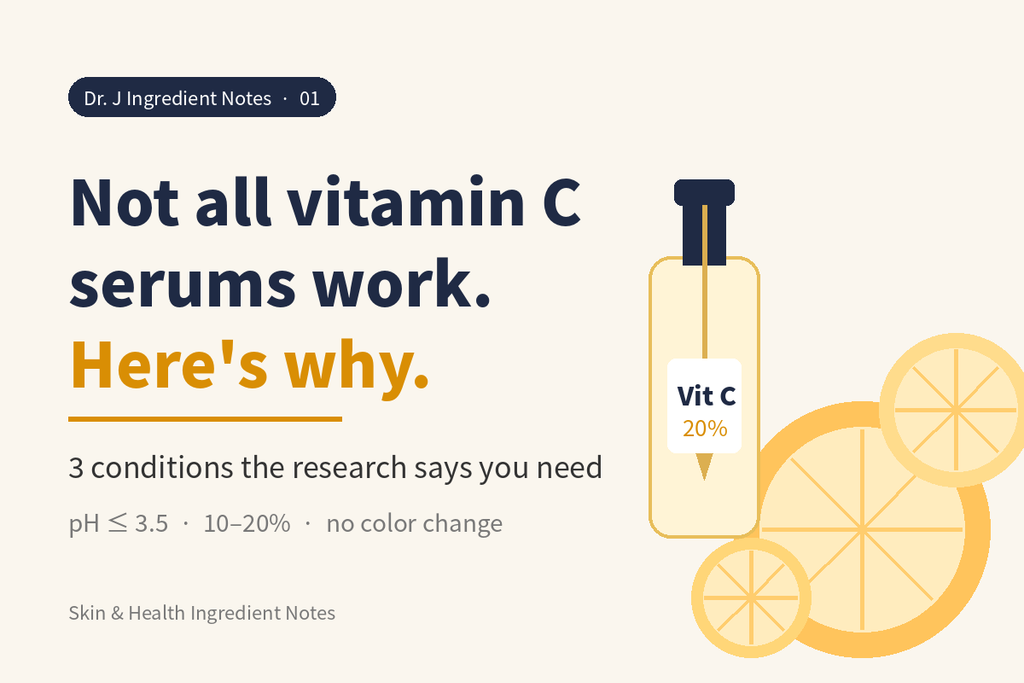
1. What does vitamin C do in your skin?
Vitamin C (its proper name is L-ascorbic acid) does three jobs in the skin.
② Defends against sun damage — a powerful antioxidant that slows skin aging.
③ Fades dark spots — it interrupts the process that produces melanin pigment.
The problem: skin loses vitamin C as we age.
That’s why applying it topically matters more after 50.
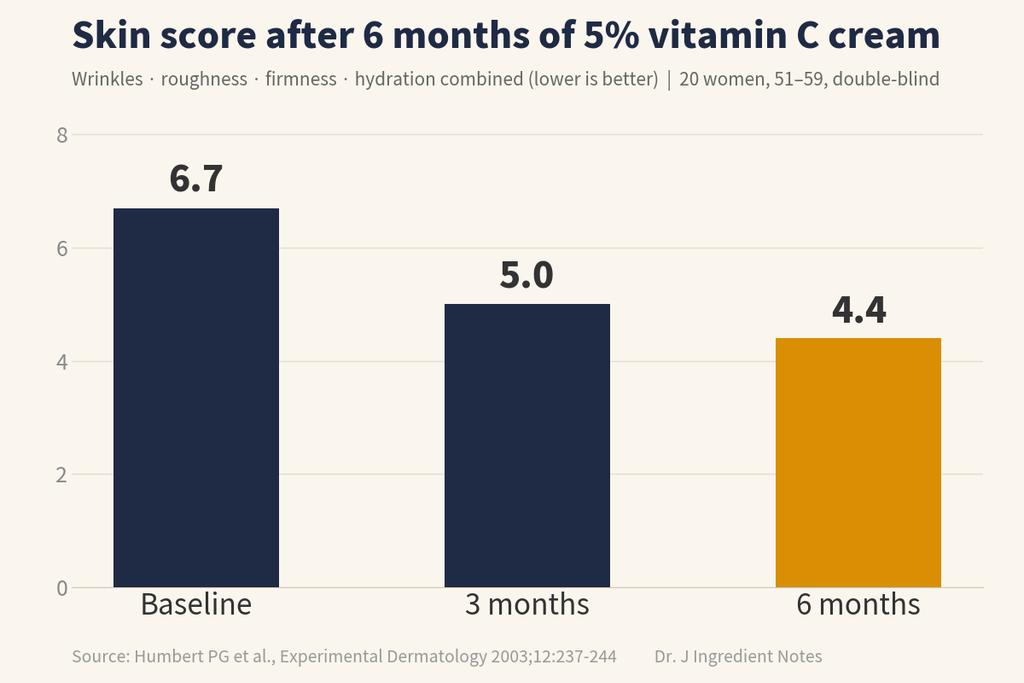
2. A 6-month study in 20 women in their 50s
A French research team asked 20 women aged 51 to 59 to apply a 5% vitamin C cream to one side of the face and a placebo cream to the other, every day for 6 months. Neither the women nor the doctors knew which side was which – a double-blind trial.
· The overall skin score (wrinkles, roughness, firmness) improved from 6.7 to 4.4 (lower is better)
· Deep wrinkles were reduced and skin texture became smoother
· Biopsies showed more healthy elastic fibers in the treated skin
Source: Humbert PG et al., Experimental Dermatology, 2003;12:237-244.
3. But not just any vitamin C will do
Dr. Sheldon Pinnell’s team at Duke University tested the conditions under which vitamin C actually gets into the skin. The findings were very clear.
② 20% is the ceiling — higher concentrations actually absorbed less.
③ Skin levels saturate after 3 days of daily use, then stay elevated for about 4 days.
④ “Stabilized” derivatives (such as magnesium ascorbyl phosphate) did not raise vitamin C levels in the skin.
Source: Pinnell SR et al., Dermatologic Surgery, 2001;27:137-142.
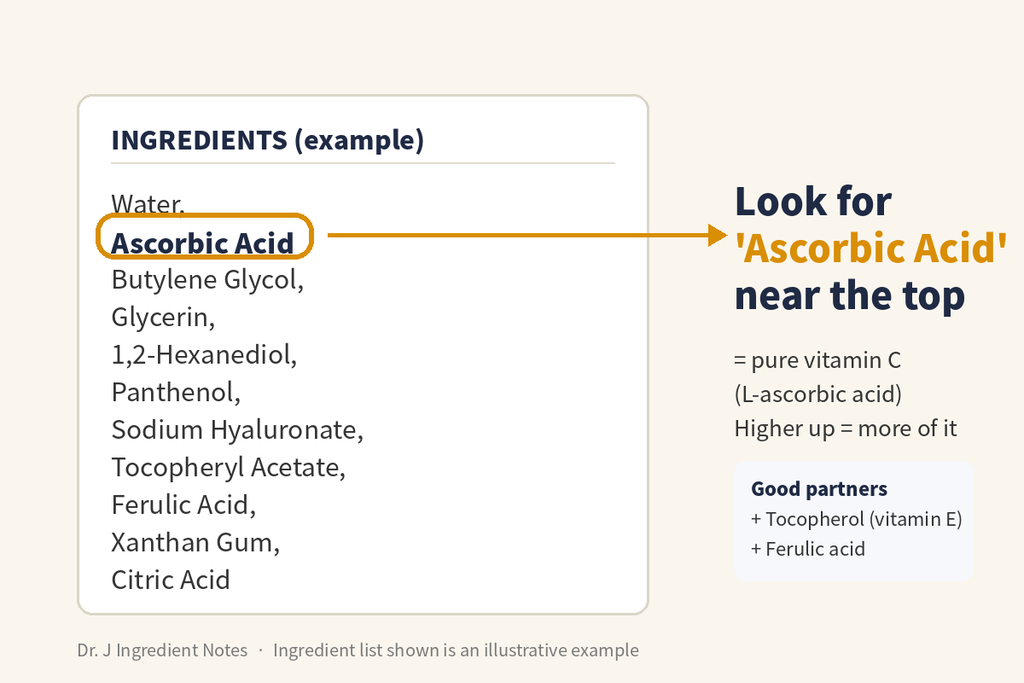
From a formulator’s point of view, here’s the catch: pure vitamin C oxidizes easily when exposed to water and air. If your serum has turned yellow or brown, much of its power is already gone. That’s why many products use more stable derivatives. As the study shows, the pure form wins on absorption – but the two simply have different trade-offs; neither is “bad.”
4. Three things to check before you buy
✔ Concentration between 10% and 20% (start at 10% if you’re new to it)
✔ Dark or opaque bottle, in a size you’ll finish within 3 months of opening
5. How to use it
· In the morning, after cleansing and toner – 2 to 3 drops
· Follow with sunscreen – the two protect better together
· A slight tingle at first is normal. If redness lasts more than a few days, drop to a lower concentration
· Using retinol too? Keep it simple: vitamin C in the morning, retinol at night
Vitamin C is one of the few ingredients with 6-month clinical evidence in skin over 50.
But you only get that benefit with the pure form · the right concentration · a serum that hasn’t changed color.
Next time, I’ll cover which ingredients pair well with vitamin C – and which combinations to avoid.
Curious about an ingredient? Leave a comment and I’ll look up the research and explain it simply.
— Dr. J (MS in Veterinary Medicine · PhD in Life Sciences · former researcher, Korea Research Institute of Bioscience & Biotechnology · founder of a cosmetics manufacturing company)
1. Humbert PG, Haftek M, Creidi P, et al. Topical ascorbic acid on photoaged skin. Clinical, topographical and ultrastructural evaluation: double-blind study vs. placebo. Experimental Dermatology. 2003;12(3):237-244.
2. Pinnell SR, Yang H, Omar M, et al. Topical L-ascorbic acid: percutaneous absorption studies. Dermatologic Surgery. 2001;27(2):137-142.
※ This article is for general information only. Results vary with individual skin conditions.
Leave a Reply