
🇰🇷 이 글의 한국어판 → Korean version (한국어)
Hello, I’m Dr. J. I formulate skincare products in Korea.
Whenever I publish an ingredient post, the question that comes back most often – in comments and messages – is this one: “Can I use X together with Y?” Retinol and vitamin C. Niacinamide and vitamin C. AHA and retinol. And if you’ve searched for the answer, you probably found a different one on every site.
So today I’ve put all 66 pairings of 12 common ingredients into one chart. You can read the chart on its own, and below it there’s an interactive checker: pick two ingredients and the answer appears. But first, a short section on what “they don’t go together” actually means – because once you know that, you can judge pairs that aren’t in the chart yourself. There are only three reasons.
In a hurry? These six lines
✔ Niacinamide + vitamin C → good. The “never mix them” rule came from old lab conditions, not from skin
✔ Retinol + vitamin C → fine together (there’s a study), but beginners find vitamin C in the AM, retinol at night easier
✔ Retinol + AHA/BHA → not on the same night. Exfoliation plus retinol doubles the irritation. Alternate nights
✔ Benzoyl peroxide + retinol or vitamin C → never at the same time. Benzoyl peroxide is an oxidizer and breaks the other one down. Split AM/PM
✔ Hyaluronic acid, ceramides, panthenol, PDRN → the “soothing team,” compatible with everything. Keep them next to anything that stings
Pick two ingredients – compatibility checker
+
※ Vitamin C here means pure L-ascorbic acid (derivatives are gentler). General guidance – a product’s concentration and formula can change the answer.
1. A bad pairing is always one of three things
There’s a lot of talk about ingredient combinations, but from a formulator’s chair, “don’t use them together” only ever has three reasons behind it. Remember these three and you’re set.
· Second, one destroys the other. This is the case where ingredients really do “fight,” and in skincare it’s rare. The main culprit is benzoyl peroxide: a strong oxidizer that breaks down oxidation-sensitive ingredients like retinoids and vitamin C. In one study, prescription tretinoin combined with benzoyl peroxide and exposed to light lost more than half its content in 2 hours and 95% in 24. For pairs like this, keep the timing clearly apart
· Third, the pH is different. The reason you’ll see most often online – and an exaggerated one. Pure vitamin C is stable below pH 3.5 and niacinamide prefers near-neutral, so the story went that the two cancel each other out. But that finding came from 1960s experiments that boiled the mixture at high heat for a long time; in the few minutes a room-temperature formula sits on your skin, it isn’t a problem. That’s why so many current products put both in one bottle
Keep these three in mind as you read the chart: green means none of the three apply, yellow means watch the first (irritation), and red means the first is severe or the second (oxidation) applies.
2. The compatibility chart – 12 ingredients × 66 pairs
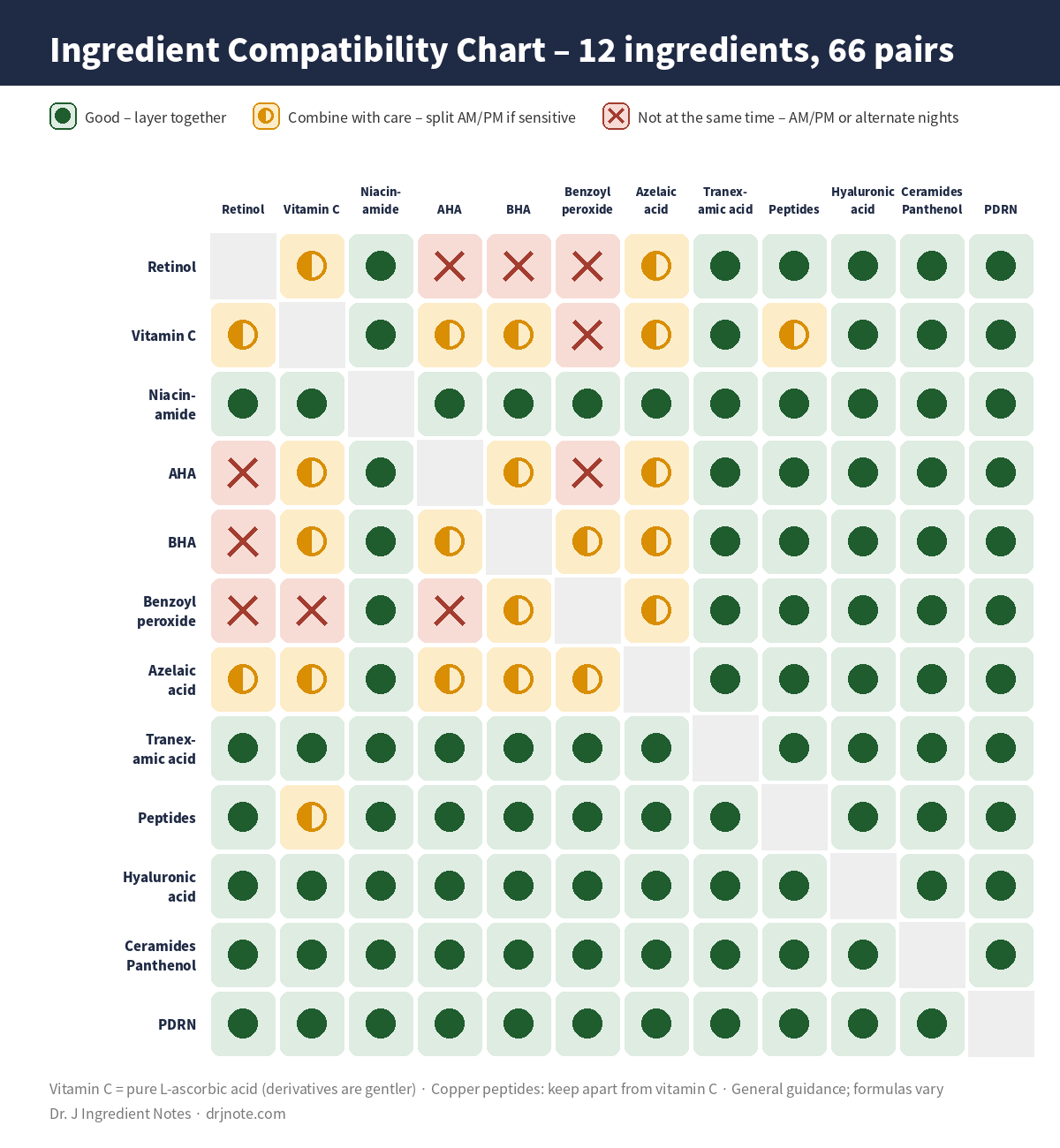
● Yellow – can be combined, watch the irritation. Resilient skin can use both together; sensitive skin should split them between morning and evening
✕ Red – not at the same time. Keep them clearly apart: morning/night, or different days
Two notes on reading the chart. Vitamin C here means pure L-ascorbic acid. The derivatives (ascorbyl glucoside, 3-O-ethyl ascorbic acid and so on) are much gentler, and most of the yellow cells turn green with them. And among peptides, copper peptides are the one exception where splitting from vitamin C is the safer choice: vitamin C can reduce the copper and both may lose activity. The research on that is thin, but it’s a rule that costs you nothing to follow.
3. The 10 most-asked pairs, with the evidence
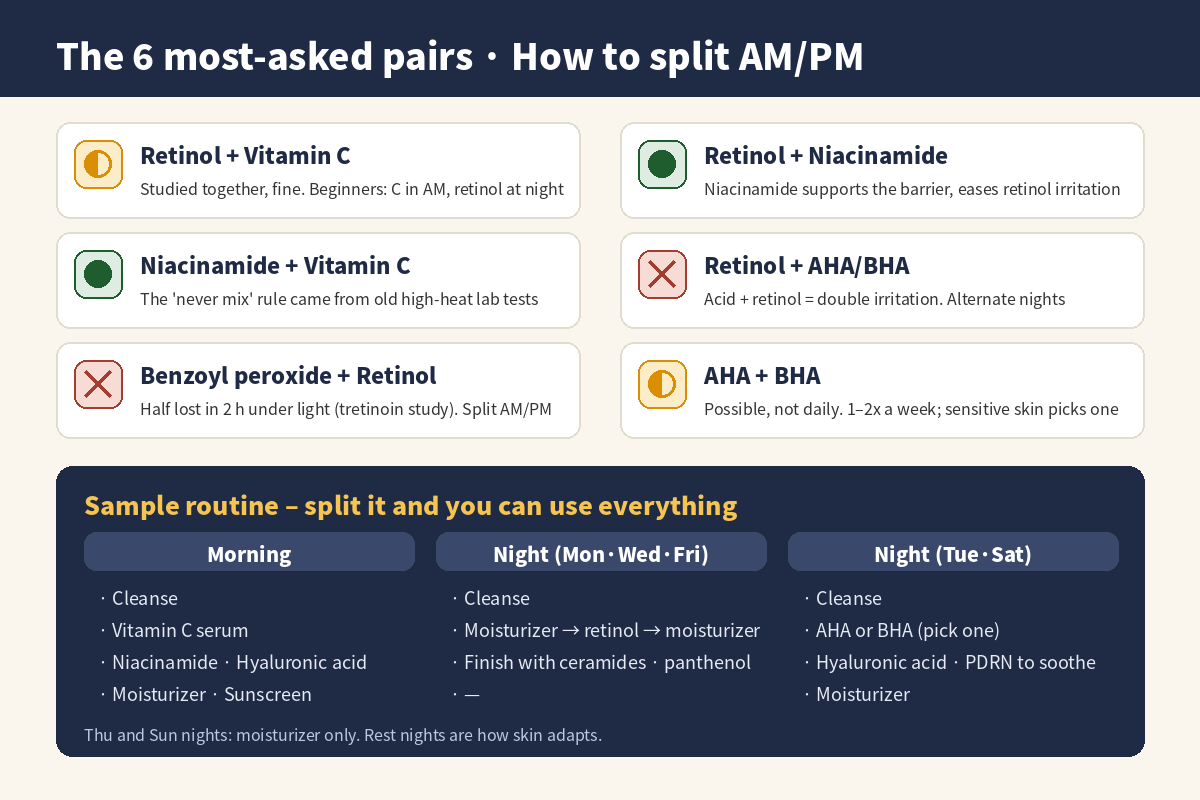
1. Retinol + vitamin C → ● fine together; beginners, split them. A 3-month study that applied 0.07% retinol together with 3.5% vitamin C found improvements in epidermal thickness. “Never use them together” is simply not true. Both can sting, though, so vitamin C in the morning and retinol at night is the easy way in.
2. Retinol + niacinamide → ● good. Niacinamide increases ceramide synthesis – ceramides being the building blocks of the skin barrier – and cushions retinol’s dryness and tingling. That’s why so many products combine them in one bottle.
3. Niacinamide + vitamin C → ● good. As explained in section 1, the conflict is a myth. Korea’s list of officially recognized brightening ingredients puts niacinamide (2–5%) and vitamin C derivatives side by side. If uneven tone is your concern, using both is actually a plus.
4. Retinol + AHA/BHA → ✕ not on the same night. AHAs (glycolic, lactic) and BHA (salicylic acid) exfoliate; retinol speeds up cell turnover. Together, a thin, tight feeling and redness come quickly. Acids on Tue/Sat, retinol on Mon/Wed/Fri, for example.
5. AHA + BHA → ● possible, but not every day. Plenty of products contain both. Used daily, though, the barrier breaks down. Keep it to once or twice a week, and if you’re sensitive pick one.
6. Benzoyl peroxide + retinol → ✕ split AM/PM. The degradation study above is the reason. If you’re on an acne routine, benzoyl peroxide in the morning and retinol at night lets you keep both.
7. Benzoyl peroxide + vitamin C → ✕ split AM/PM. Vitamin C is an antioxidant, benzoyl peroxide an oxidizer. Put them together and the vitamin C is used up first.
8. Vitamin C + AHA/BHA → ● watch the irritation. All three are acidic, so pH is not the issue – overlapping sting is. Resilient skin can combine them; if you’re sensitive, vitamin C in the morning and acids at night.
9. Tranexamic acid + niacinamide or vitamin C → ● good. The three block pigment through different pathways, which is why they’re combined in brightening routines. Tranexamic acid is also very low-irritation.
10. Hyaluronic acid, ceramides, panthenol, PDRN + anything → ● good. These four are the “soothing team.” On the days you use something that stings (retinol, acids, benzoyl peroxide), applying them before and after makes adjusting much easier. The PDRN I covered last time belongs to this team.
4. How to split – a sample AM/PM routine and layering order
“Split them” can sound vague, so here is one example. You don’t have to follow it exactly – the only rule to keep is one irritating active per day.
| Morning | Night (Mon · Wed · Fri) | Night (Tue · Sat) |
|---|---|---|
| Cleanse → vitamin C → niacinamide · hyaluronic acid → moisturizer → sunscreen | Cleanse → moisturizer → retinol → moisturizer → ceramides · panthenol | Cleanse → AHA or BHA (pick one) → hyaluronic acid · PDRN → moisturizer |
✔ Layer thin to thick. Watery serums first, creams last. About a minute between layers reduces overlap
✔ Add new actives one at a time, two weeks apart. That way, if something goes wrong, you know what caused it
✔ If you use benzoyl peroxide for acne, give it the morning slot and skip retinol and vitamin C that night
The one-line takeaway
One irritating active per day, benzoyl peroxide on its own, the soothing team always welcome. With those three lines you can judge any pair that isn’t in the chart.
▶ Korean version of this post (한국어판): 화장품 성분 궁합표 – 12가지 성분, 같이 써도 되는 것과 시간을 나눌 것
▶ See also: Retinol: Start at 0.1% – How to Read the Concentration Numbers and Get Through the First 4 Weeks (Ingredient Encyclopedia #1)
▶ Earlier: Not All Vitamin C Serums Work – 3 Conditions the Research Says You Need
▶ Earlier: Dull, Rough Skin? Glycolic Acid (AHA) – What the Research Shows and How Much Is Safe
▶ Earlier: How to Choose a PDRN Cream – 5 Conditions from the Research
I’ll keep this chart updated as new research comes out. If there’s a pair you don’t see here, leave a comment. Next in the Ingredient Encyclopedia: niacinamide.
MS in Veterinary Medicine, PhD in Life Sciences. I worked as a researcher at the Korea Research Institute of Bioscience and Biotechnology (KRIBB) and now run Beaurea, a cosmetics manufacturing company, where I write the formulas myself. This blog reads the research papers and the regulatory documents and turns them into plain-language criteria for choosing ingredients. I don’t recommend specific products here – only criteria that apply to any product.
1. Seité S et al. “Histological evaluation of a topically applied retinol-vitamin C combination.” Skin Pharmacology and Physiology 2005;18(2):81-87 – 0.07% retinol + 3.5% vitamin C for 3 months, increased epidermal thickness.
2. Martin B et al. “Chemical stability of adapalene and tretinoin when combined with benzoyl peroxide in presence and in absence of visible light and ultraviolet radiation.” British Journal of Dermatology 1998;139(Suppl 52):8-11 – tretinoin + benzoyl peroxide under light: over 50% degraded at 2 h, 95% at 24 h.
3. Tanno O et al. “Nicotinamide increases biosynthesis of ceramides as well as other stratum corneum lipids to improve the epidermal permeability barrier.” British Journal of Dermatology 2000;143(3):524-531.
4. Milosheska D, Roškar R. “Use of Retinoids in Topical Antiaging Treatments: A Focused Review of Clinical Evidence for Conventional and Nanoformulations.” Advances in Therapy 2022;39(12):5351-5375 – dose-dependent retinoid irritation; start low, pair with moisturizers.
5. Korea Ministry of Food and Drug Safety, Regulation on the Review of Functional Cosmetics, Annex 4 – recognized brightening ingredients: niacinamide 2–5%, ascorbyl glucoside 2%, 3-O-ethyl ascorbic acid 1–2%, magnesium ascorbyl phosphate 3%, ascorbyl tetraisopalmitate 2%, among others.
6. The niacinamide–vitamin C “conflict” traces to 1960s experiments under prolonged high heat (formation of nicotinic acid); the general view in dermatology and cosmetic science today is that it does not apply to room-temperature formulas.
※ This chart is general guidance and can vary with a product’s concentration, formula and pH. Results vary with individual skin. It does not recommend or criticize any specific product. If you are being treated for a skin condition, talk to a dermatologist before use. The author runs a company that manufactures and sells cosmetics.
Leave a Reply