
🇰🇷 한국어판
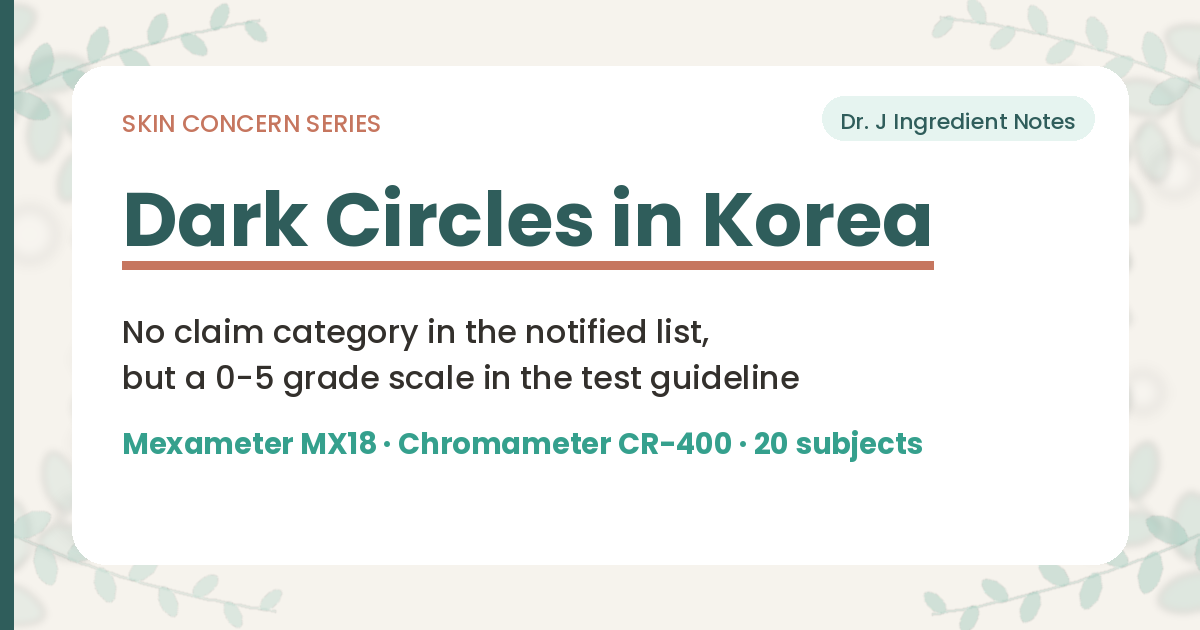
Hello, this is Dr. J. Today I want to look at dark circle ingredients the way Korean regulators look at them — and at what the human studies actually moved.
Two things surprised me. The word “dark circle” does not appear in Annex 4, the table that fixes actives and levels for notified functional cosmetics. And yet the Korean regulator wrote down how to measure one, down to a 0-5 grade scale that two experts apply by eye.
――――――――――――――――――――――――――――
Primary sources
📄 MFDS, Guideline on Test Methods for Substantiating Cosmetic Claims (Mar 2018, PDF, Korean)
📄 Regulation on Functional Cosmetics Review, Annex 4 (Korea Law Service)
📄 Phytonadione, retinol and vitamins C and E, 8 weeks (J Cosmet Dermatol 2004)
📄 Vitamin C on dark circles, 6 months, split face (Skin Res Technol 2009)
📄 U.S. FDA, Cosmetics Labeling Claims
The guideline covers ten claims. Chapter 6 is dark circle relief.
――――――――――――――――――――――――――――
――――――――――――――――――――――――――――
Five lines, if you are in a hurry
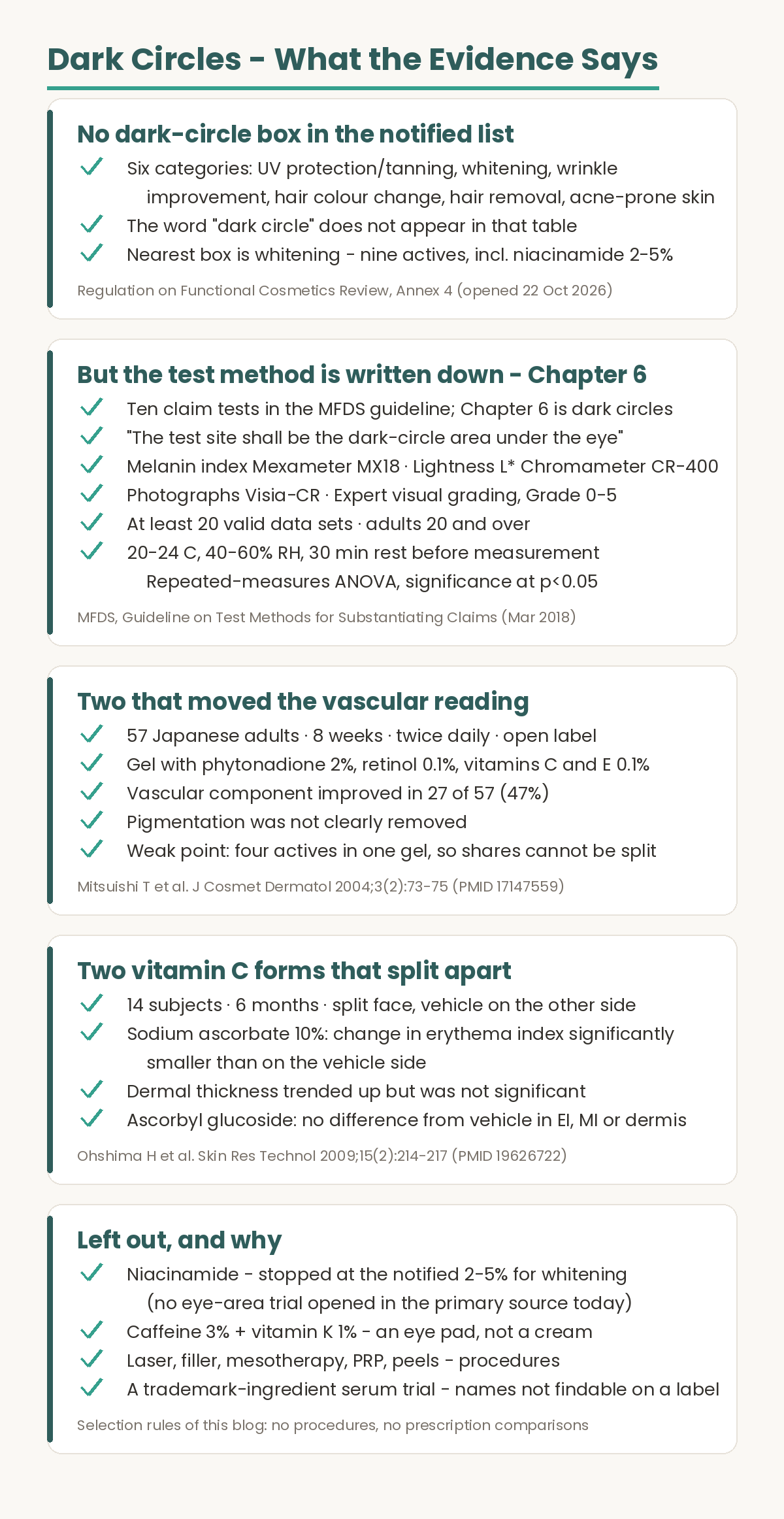
● Annex 4 has six claim categories and dark circles is not one of them
● The nearest box is whitening, with nine notified actives — the pigment side
● Chapter 6 of the test guideline writes down how to measure the area under the eye
● It names the instruments and attaches a 0-5 expert grade scale
● But in the two eye-area studies, what moved was the vascular reading, not pigment
――――――――――――――――――――――――――――
There is no box for it — Annex 4 and its six categories
Annex 4 of the Regulation on Functional Cosmetics Review lists, for each claim category, the actives and the levels that let a manufacturer skip submitting new efficacy data. It is a shortcut list, not a safety list.
There are six categories. I opened the original today and searched it: the word “dark circle” is not in the table.
| Category in Annex 4 | What the notification fixes | How to read it |
|---|---|---|
| UV protection / tanning | Actives and maximum levels | Both the name and the number are set |
| Whitening | Nine actives (arbutin 2-5%, niacinamide 2-5%, and others) | The nearest box to today’s topic |
| Wrinkle improvement | Four actives (retinol 2,500 IU/g, adenosine 0.04%, and others) | The subject of the previous article |
| Hair colour change | Dyeing, bleaching and de-dyeing actives | Hair, not skin |
| Hair removal | Thioglycolic acid and others | Depilatories |
| Acne-prone skin relief | Salicylic acid 0.5% | Covered in an earlier article |
| Dark circles | — | There is no such category |
The nearest box is whitening, with nine actives
Pigment is one of the reasons the under-eye area looks dark, and pigment is what the whitening box covers.
| Notified whitening actives (nine) | Level |
|---|---|
| Broussonetia extract | 2% |
| Arbutin | 2-5% |
| Ethyl ascorbyl ether | 1-2% |
| Oil-soluble licorice extract | 0.05% |
| Ascorbyl glucoside | 2% |
| Magnesium ascorbyl phosphate | 3% |
| Niacinamide | 2-5% |
| Alpha-bisabolol | 0.5% |
| Ascorbyl tetraisopalmitate | 2% |
Two names in this table come back later in this article: ascorbyl glucoside and niacinamide.
――――――――――――――――――――――――――――
What exists instead — Chapter 6 of the test guideline
The MFDS guideline on test methods for substantiating claims (March 2018, document no. 0353-02) sets out how to test ten advertising claims. Chapter 6 is dark circle relief, and it was added in August 2014.
| Chapter | Claim | When it was added |
|---|---|---|
| Ch. 1-3 | Skin moisturising · Skin elasticity · Sebum control | May 2012, original |
| Ch. 4-5 | Temporary cellulite reduction · Suitability for acne-prone skin | Nov 2013 |
| Ch. 6 | Dark circle relief | Aug 2014 (B2-2014-4-003) |
| Ch. 7-8 | Blood circulation · Puffiness relief | Dec 2015 |
| Ch. 9 | Paraben-free | 31 Mar 2017 |
| Ch. 10 | Fine-dust protection | 28 Mar 2018 |
Chapter 6 — what is measured (the guideline’s own wording)
1. “Melanin content of the skin is measured and the change in melanin index is evaluated.”
2. “The L* value of the pigmented site is measured and the change is evaluated.”
3. “The whole face is photographed at a fixed angle and distance, and Red, Green and Blue values are obtained with image analysis software to derive a quasi L* value.”
4. “Two or more experts closely observe the dark-circle area and grade it according to the dark circle grade (Grade 0-5) in Table 1.”
Chapter 6 — how it is run and how it is judged
“The test site shall be the dark-circle area under the eye.”
“The number of subjects shall be 20 or more so that statistical comparison is possible, securing valid data.”
“Adults aged 20 or over shall be selected …”
“After cleansing, subjects rest for 30 minutes under controlled conditions (20-24 °C, 40-60% RH) before measurement.”
“Repeated measures ANOVA is evaluated for statistical significance at the 95% confidence interval (p<0.05).”
“If one or more of the evaluation indices shows relief of dark circles after use of the test material, the product is judged to help relieve dark circles.”
The study length is “recommended to be about 8 weeks”, and application follows the product’s own directions.
Read closely, the judgement is on the permissive side: if one or more of the four indices improves, the product is judged to help.
――――――――――――――――――――――――――――
The part that surprised me — a 0-5 grade scale for a shadow
Chapter 6 attaches a table that two or more experts use to grade the area by eye. Here it is in full.
| Grade | What the guideline writes (translated from the Korean text) |
|---|---|
| 0 | No dark circle is perceived |
| 1 | A faint purplish shadow in the inner lower eyelid, judged a dark circle because the colour deepens when the skin is pulled |
| 2 | A purplish shadow clearly visible without pulling the skin, or mild pigmentation, or both together |
| 3 | A deep purplish shadow, or moderate pigmentation in part of the area, or both together |
| 4 | Uniform, strong pigmentation overall, sometimes seen above and below the eye at the same time |
| 5 | Uniform and very strong pigmentation seen above and below the eye at the same time |
Grade 1 is the interesting one: the shadow counts as a dark circle because the colour deepens when the skin is pulled. Pull the skin and it darkens, and you are closer to a shadow; stays the same, and you are closer to pigment.
Grades 4 and 5 say “above and below the eye at the same time”. Even within one claim, the scale looks at different places as it climbs.
――――――――――――――――――――――――――――
Two that moved the vascular reading — vitamin K and retinol
57 Japanese adults with infraorbital dark circles and lower-eyelid wrinkles applied a gel twice daily for 8 weeks — the same length Chapter 6 recommends.
The gel contained phytonadione (vitamin K1) 2%, retinol 0.1% and vitamins C and E at 0.1%.
After 8 weeks the vascular component improved in 27 of the 57 (47%), and wrinkles decreased in some subjects. Pigmentation was not clearly removed.
The weak points belong here too: the study was open label, and with four actives in one gel the shares cannot be separated.
――――――――――――――――――――――――――――
Two vitamin C forms that split apart
14 subjects with dark circles applied sodium ascorbate 10% under one eye and the vehicle under the other for 6 months.
On the sodium ascorbate side, the change in erythema index was significantly smaller than on the vehicle side. Dermal thickness trended upward but did not reach significance.
In the same study, ascorbyl glucoside showed no difference from vehicle in erythema index, melanin index or dermal thickness.
They are both vitamin C derivatives, and ascorbyl glucoside is one of the nine notified whitening actives, at 2%. Being on the notified list and moving a number under the eye are two different things.
――――――――――――――――――――――――――――
The one the notified list puts on the pigment side — niacinamide
Niacinamide 2-5% sits in the whitening box, so a Korean product can carry a reviewed whitening claim with it.
I could not open an eye-area trial for it as a primary source today, so this article stops at the notified level rather than implying more.
――――――――――――――――――――――――――――
The five in one table
| Ingredient | People and time | Design | What was measured | Result |
|---|---|---|---|---|
| Vitamin K (phytonadione 2%) | 57 Japanese adults · 8 weeks | Open label · twice daily | Vascular score, pigmentation, wrinkles | Vascular score improved in 27 (47%) |
| Retinol 0.1% | Same study | In the same gel | Same measures | Wrinkles decreased in some subjects |
| Sodium ascorbate 10% | 14 subjects · 6 months | Split face · vehicle control | Erythema index, melanin index, dermis | Change in EI significantly smaller than vehicle |
| Ascorbyl glucoside | Same study | Same design | Same measures | No difference from vehicle |
| Niacinamide 2-5% | — | — | — | Notified level for whitening, nothing more here |
Where each study is weak
| Ingredient | Where it is weak |
|---|---|
| Vitamin K and retinol | Open label, with no placebo arm in the abstract. Four actives sat in one gel, so the shares cannot be separated. Pigmentation was not clearly removed |
| Sodium ascorbate | Only 14 subjects. No p value in the abstract, and the dermal thickening was not significant |
| Ascorbyl glucoside | Its concentration is not given in the abstract. The null result itself is clear |
| Niacinamide | No eye-area trial could be opened as a primary source today, so this article stops at the notified level |
――――――――――――――――――――――――――――
Korea, the United States and the EU
None of the three keeps a list of actives for dark circles. What differs is whether the regulator writes down how to measure it.
| What a dark circle claim rests on | Who writes the test method | |
|---|---|---|
| Korea | No box in the notified list. The claim is substantiated afterwards (Cosmetics Act Art. 14) | The government does — Chapter 6 names the instruments, the room conditions and a 0-5 expert grade scale |
| United States | There is no list of approved claims at all — “FDA does not have a list of approved or accepted claims for cosmetics” | Nobody. The agency also states it has no authority to approve claims before marketing |
| EU | The six common criteria of Regulation (EU) No 655/2013 | Nobody — only the conditions: “adequate and verifiable evidence” and “state of the art practices” |
For an exporter the practical line is short: in Seoul the question is how you measured it, in Brussels and Washington the question is what evidence you hold. Korea is unusual in writing the instruments, the room conditions and a grading table into a public document for a claim it does not pre-review.
――――――――――――――――――――――――――――
Five things to check on a label
✔ Ask first what is dark — pigment, visible vessels, or a shadow
✔ In front of a mirror, pull the skin gently: if the colour deepens, you are closer to the shadow side (that is Grade 1’s own wording)
✔ A whitening functional claim means one of the nine notified actives, on the pigment side
✔ A “dark circle” claim is substantiated, not pre-reviewed — the procedure lives in Chapter 6
✔ Where an advertisement shows a number, look for how many people, how many weeks, and which index
――――――――――――――――――――――――――――
One line
Korea wrote the ruler and the grading table, but never opened a box for the claim — and the two eye-area studies moved the vascular reading rather than the pigment one.
――――――――――――――――――――――――――――
What I left out, and why
✔ A caffeine 3% and vitamin K 1% study (Adv Biomed Res 2015, 11 women, 4 weeks) — the product was an eye pad, not a cream, and the report carries no figures or p values
✔ Laser, filler, mesotherapy, PRP and peels — procedures. On this topic they fill most of the search results
✔ A single-arm serum trial (J Clin Aesthet Dermatol 2022, 85 completers, 3 months, melanin index down 12.29%, p<0.05) — the only study here that measured melanin under the eye directly, but its actives are trade names that a reader cannot find on an ingredient list, there was no placebo arm, and the manufacturer funded it
✔ Mechanism paragraphs (vascular permeability, haemoglobin breakdown, melanosome transfer) — I did not open a primary review, so I did not write them
✔ Folk wisdom — “dark circles come from lack of sleep” and “tapping helps” have no primary source here
About the author · Dr. J
MS in Veterinary Medicine, PhD in Life Sciences. I worked as a researcher at the Korea Research Institute of Bioscience and Biotechnology (KRIBB) and now run Beaurea, a cosmetics manufacturing company, where I write the formulas myself. This blog reads the research papers and the regulatory documents and turns them into plain-language criteria for choosing ingredients. I don’t recommend specific products here – only criteria that apply to any product.
📌 Related reading
📌 Firmness actives in Korea: wrinkle is notified, elasticity is substantiated — Chapter 2 of the same guideline
📌 Pores and sebum: the test method the regulator wrote down — Chapter 3 of the same guideline
📌 Niacinamide: how much is enough — the notified 2-5% in detail
📌 Not all vitamin C serums work — the two forms that split apart today
📌 Retinol: start at 0.1% — the concentration that sat in today’s gel
📄 References
· Regulation on Functional Cosmetics Review, Annex 4 (Korea Law Service, accessed 22 Oct 2026)
· Ministry of Food and Drug Safety, Guideline on Test Methods for Substantiating Cosmetic Labelling and Advertising Claims (civil petitioner guide, Mar 2018, no. 0353-02), Chapter 6
· Mitsuishi T, Shimoda T, Mitsui Y, Kuriyama Y, Kawana S. J Cosmet Dermatol 2004;3(2):73-75
· Ohshima H, Mizukoshi K, Oyobikawa M, Matsumoto K, Takiwaki H, Kanto H, Itoh M. Skin Res Technol 2009;15(2):214-217
· U.S. FDA, “Cosmetics Labeling Claims” (content current as of 21 Nov 2022) · Regulation (EU) No 655/2013 · Regulation (EC) No 1223/2009 Art. 14
――――――――――――――――――――――――――――
This article summarises published research and Korean regulatory documents; it is information, not diagnosis or treatment. Annex 4 and Chapter 6 were read in the original today, and the quoted Korean passages are my translation of that text. Of the two eye-area studies, one was open label with four actives in a single gel and the other had 14 subjects and no p value in the abstract — both facts are in the tables above. Ingredient names and levels are written as criteria for choosing a product, not as a recommendation of any particular one.
— Dr. J Ingredient Notes