
🇰🇷 한국어판: 화장품 사용기한과 개봉 후 사용기간 – 통에 적힌 날짜 두 개, 그리고 12M의 뜻
Hello, this is Dr. J. Today we are reading the dates printed on a cosmetic package — the expiration date, the period after opening, and the little open-jar symbol with 12M next to it.
Here is the part that surprises people who compare labels across countries. Korea requires one of those dates on every cosmetic, on the jar itself as well as on the box. The EU asks for a date too, with its own switch at 30 months. And in the United States, by the FDA’s own words, no law requires an expiration date on a cosmetic at all. Same product, three different labels.
So this guide does two things: it reads the Korean rule line by line, and it puts the three regimes in one table at the end.
――――――――――――――――――――――――――――
Primary sources
📄 Enforcement Rule of the Cosmetics Act, Annex 4 — Labelling standards and methods for cosmetic packaging (Korean)
📄 Regulation (EC) No 1223/2009, Article 19 — Labelling
📄 U.S. FDA — Shelf Life and Expiration Dating of Cosmetics
📄 21 CFR 211.137 — Expiration dating (for drug products, including U.S. sunscreens)
The Korean annex opens as an attachment file, and it spells out which words have to sit next to the numbers. That is the part almost no English-language guide quotes.
――――――――――――――――――――――――――――
――――――――――――――――――――――――――――
The short version, in five lines
✔ Korean law defines the expiration date as a minimum period, not a cliff edge
✔ The box carries ten items; the jar itself carries four, and a date is one of them
✔ If a product shows a period after opening, the manufacturing date must sit beside it
✔ 12M comes from the EU rule, which switches to the open-jar symbol above 30 months
✔ The United States requires neither — shelf life there is the manufacturer’s responsibility
――――――――――――――――――――――――――――
What the law calls it — a “minimum period”
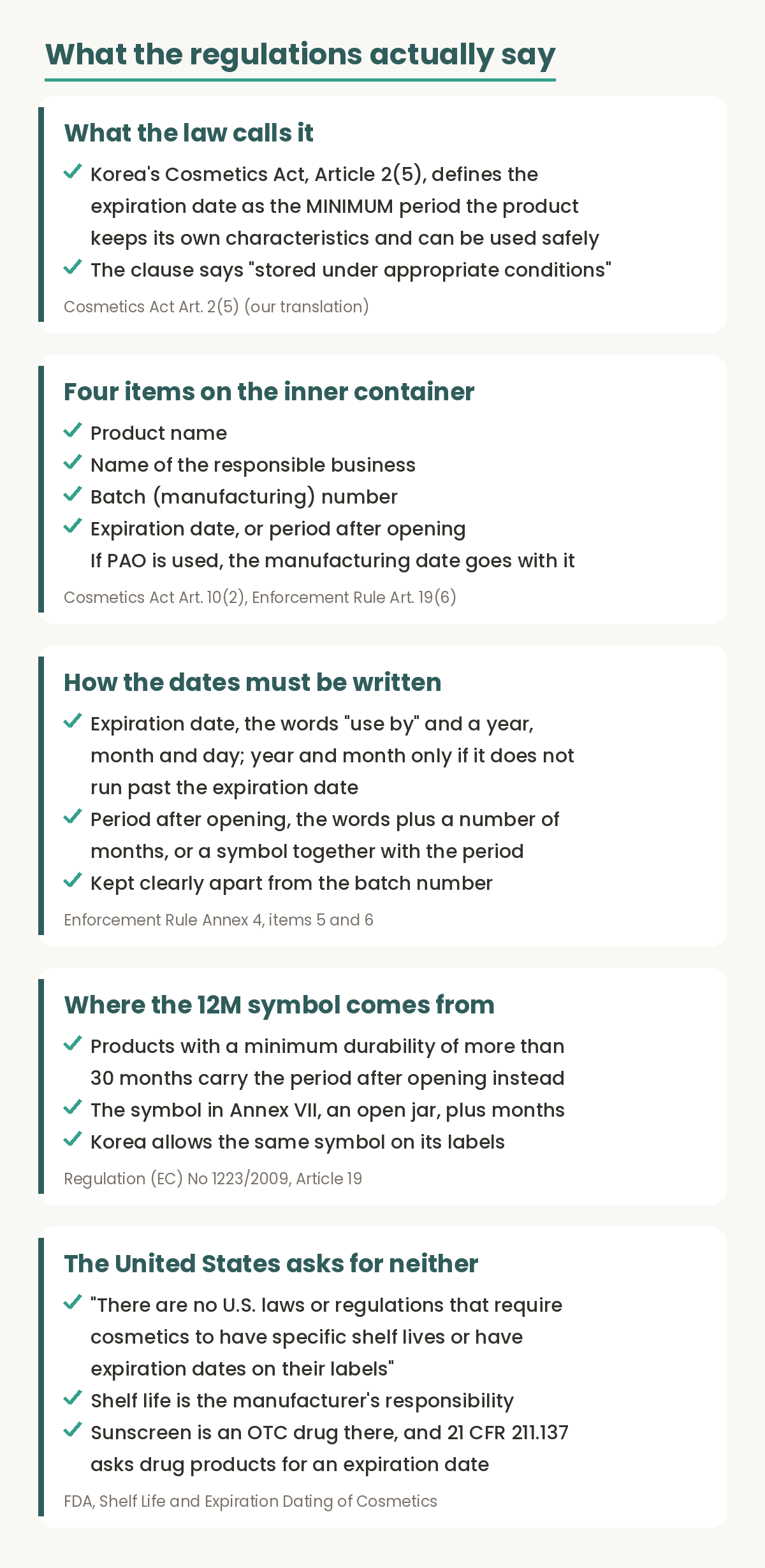
Article 2(5) of Korea’s Cosmetics Act defines the term. In our translation of the Korean text, an expiration date is the minimum period, counted from the date of manufacture, during which the product — stored under appropriate conditions — keeps its own characteristics and can be used safely by the consumer.
Two words in that sentence do the work.
Minimum. The date is a floor, not a ceiling. It is the point the manufacturer has tested to and will stand behind, which is a different statement from “unusable on the next day”.
Appropriate conditions. The promise is conditional, and the condition is written into the definition itself. A jar that spent a July in a parked car has left the premise the date was built on. That is why storage belongs in the same thought as the number.
――――――――――――――――――――――――――――
Two layers of packaging, two lists
Korean law separates the inner container — the jar, tube or bottle the product actually touches — from the outer packaging that holds it. Each carries its own list.
| Where | What must appear | Source |
|---|---|---|
| Outer packaging the box |
1. Product name 2. Name and address of the responsible business 3. All ingredients used 4. Volume or weight 5. Batch number 6. Expiration date or period after opening 7. Price 8. Functional-cosmetic marking 9. Precautions for use 10. Other items set by Presidential Decree | Cosmetics Act Art. 10(1) |
| Inner container the jar itself |
1. Product name 2. Name of the responsible business 3. Batch number 4. Expiration date or period after opening with the manufacturing date when the period after opening is used |
Cosmetics Act Art. 10(2) · Enforcement Rule Art. 19(6) |
The practical consequence sits in the second row. Throw the box away and the date is still with you. The ingredient list and the price go out with the carton; the name, the company, the batch number and the date stay on the jar by law.
If you cannot find a date on a Korean product, turn the jar over. It is usually on the base or crimped into the seam of a tube, and it can be faint on dark packaging.
――――――――――――――――――――――――――――
How the dates must be written — Annex 4, items 5 and 6
The annex does not stop at “put a date on it”. It fixes the wording. Translated from the Korean text:
✔ Expiration date — the words “expiration date” or “until”, together with a year, month and day, written so a consumer can read it easily
✔ If only a year and month are given, they must not run past the actual expiration date
✔ Period after opening — the words “period after opening” plus “NN months”, or a symbol together with the period
✔ The batch number must be easy to tell apart from the date, and where a period after opening is used, the manufacturing date printed alongside it must also be distinguishable
That last clause is the key to the whole article. A product labelled with a period after opening carries a manufacturing date as well. If you have ever wondered why a Korean jar shows two dates, this is the reason — and the rule even says they have to be told apart at a glance.
The year-and-month clause is worth keeping too. A product good until 12 March 2027 may be printed as 2027.03, but not as 2027.04. A shortened date rounds down, never up.
――――――――――――――――――――――――――――
Three dates, side by side
The numbers on the back are answering different questions. Put them in one table and they stop competing.
| Which date | What it states | Counted from | When it appears |
|---|---|---|---|
| Manufacturing date | the day it was made | — | alongside a period after opening |
| Expiration date | the minimum period of safe use | the date of manufacture | on its own; no manufacturing date needed |
| Period after opening | how long it keeps once opened | the day you opened it | as “NN months”, or as the symbol |
The third row is where the symbol earns its keep — and where it fails. 12M runs from the day you opened the jar, not from the day it was made. Nobody but you knows that day, so the number only works if you record it.
――――――――――――――――――――――――――――
Where 12M comes from — the EU’s 30-month switch
The open-jar drawing with 12M beside it comes from European law. Article 19 of Regulation (EC) No 1223/2009 asks for a date of minimum durability, and then says that where that durability is more than 30 months, the label instead gives the period for which the product is safe to use after opening, shown with the symbol in Annex VII followed by the time in months or years.
Read that backwards and the symbol says something reassuring. A jar marked 12M is a product judged to last more than 30 months unopened. The 12 is about what happens after you break the seal, not a short shelf life.
Korea permits the same symbol, which is why you see it on Korean packaging as well. The difference is that Korea makes one of the two compulsory and ties the period after opening to a manufacturing date; the EU treats the two as alternatives decided by that 30-month line.
――――――――――――――――――――――――――――
Korea, the EU and the United States in one table
| Where | What the label must carry | Source |
|---|---|---|
| Korea | An expiration date or a period after opening, always — on the box and on the jar. Choosing the period after opening adds the manufacturing date | Cosmetics Act Art. 10 · Enforcement Rule Annex 4 |
| European Union | A date of minimum durability; above 30 months, the period after opening with the Annex VII symbol instead | Regulation (EC) No 1223/2009, Art. 19 |
| United States | Neither. “There are no U.S. laws or regulations that require cosmetics to have specific shelf lives or have expiration dates on their labels.” Sunscreen, however, is an OTC drug there | FDA · 21 CFR 211.137 |
The FDA page does not leave it at “not required”. It adds that “FDA considers determining a product’s shelf life to be part of the manufacturer’s responsibility”. The obligation exists; what differs is whether the answer has to be printed where a shopper can read it. Korea and the EU say yes. The United States leaves it to the company.
One more wrinkle for anyone comparing sunscreens across borders. In the United States a sunscreen is regulated as an over-the-counter drug, and 21 CFR 211.137(a) requires a drug product to “bear an expiration date determined by appropriate stability testing”. So the same bottle can arrive dated in one market and undated in another — because of how the product is classified, not because of what is inside it. We read the SPF and PA numbers on those labels in Guide 11.
――――――――――――――――――――――――――――
What I left out, and why
✔ The test schedule behind the months — Korea’s MFDS publishes a stability-testing guideline covering long-term, accelerated and stress testing, but I could not open the document itself, so no durations or intervals are quoted here
✔ “Throw it out N months after opening” — the regulations set how the period is written, not a fixed number per product type
✔ Reading a manufacturing date out of a batch code — the coding is each company’s own, so there is nothing general to teach
✔ Mascara advice — the FDA page notes that manufacturers usually suggest replacing mascara after a few months; that is a manufacturer recommendation, not a rule, and I have left it as such
✔ Claims about what happens chemically after the date — that needs product-level data I do not have
――――――――――――――――――――――――――――
Five things to check
✔ Is there a date on the jar itself, not just the box
✔ If there are two, which one is the manufacturing date — it travels with a period after opening
✔ Does the open-jar symbol say 6M or 12M, and is the clock started from your opening day
✔ If only a year and month are printed, treat the end of that month as the line
✔ Is the product stored somewhere close to “appropriate conditions” — a drawer beats a bathroom shelf
I read these dates less as “use it by then” and more as “start counting here”. The manufacturing date marks the making, 12M marks the opening, and the expiration date is a separate finish line. Three clocks, three starting points.
Which leaves one habit worth building: write the opening date on the base of the jar. On a product labelled 12M, that small sticker is what turns the symbol into a number you can actually use.
――――――――――――――――――――――――――――
In one line
The date on a Korean jar is a minimum period, and a product labelled with a period after opening carries a manufacturing date beside it. Check the jar before the box, and write down the day you opened it.
Next in this series: the five ingredients to look for in acne-prone skin, starting with the 0.5% salicylic acid that Korea’s notification fixes in place.
📌 Related guides
📌 How to Read a Korean Cosmetic Ingredient List (Guide 14)
📌 Sunscreen SPF and PA: How to Read the Numbers (Guide 11)
📌 Arbutin vs Alpha-Arbutin: What Korea’s 2–5% Means (Guide 15)
📌 Ceramides: Cholesterol and Fatty Acid Ratio (Guide 4)
About the author · Dr. J
MS in Veterinary Medicine, PhD in Life Sciences. I worked as a researcher at the Korea Research Institute of Bioscience and Biotechnology (KRIBB) and now run Beaurea, a cosmetics manufacturing company, where I write the formulas myself. This blog reads the research papers and the regulatory documents and turns them into plain-language criteria for choosing ingredients. I don’t recommend specific products here – only criteria that apply to any product.
📄 References
· Cosmetics Act (Korea), Articles 2(5) and 10 — definitions and labelling
· Enforcement Rule of the Cosmetics Act, Article 19 and Annex 4 — labelling standards and methods
· Regulation (EC) No 1223/2009, Article 19 and Annex VII
· U.S. FDA, Shelf Life and Expiration Dating of Cosmetics (page updated 25 February 2022)
· 21 CFR 211.137 — Expiration dating
――――――――――――――――――――――――――――
This article summarises public regulations. It is information, not a diagnosis or a treatment plan. Quoted passages are as written in each source, translations from the Korean text are ours, and labelling practice varies from product to product. If a product looks or smells changed, stop using it and speak with a professional.
— Dr. J Ingredient Notes