
🇰🇷 한국어판: 판테놀 효능, 숫자로 확인된 것 (성분 백과 ⑦)
Hello, I’m Dr. J. Today’s question is a simple one: what does panthenol actually do for skin, and how much of that has been measured in people? This is Ingredient Guide 7.
Panthenol turns up on the back of almost every soothing cream, barrier cream and “recovery” product, and in plenty of shampoos too. It is usually described in a word or two – soothing, hydrating, vitamin B5 – and rarely with a number attached. So here is the first surprise: panthenol isn’t the thing that does the work. Skin converts it into something else first.
Below I put two human studies side by side. One tested a dexpanthenol cream on deliberately irritated skin against the same cream without dexpanthenol. The other ran three 28-day studies of panthenol-containing moisturisers on very dry skin, 42 people each. At the end is the conclusion of the US Cosmetic Ingredient Review panel on panthenol’s safety – and a short list of claims I left out, with the reason for each.
――――――――――――――――――――――――――――
📄 If you’d rather read the primary sources
📄 Proksch & Nissen 2002 — irritated skin, dexpanthenol cream vs vehicle
📄 Stettler et al. 2021 — three 28-day studies, 42 people each (open access)
📄 Cosmetic Ingredient Review 2022 — safety assessment of panthenol and derivatives
The Stettler paper is open access, including the per-product tables and the measurement methods. The Proksch paper’s abstract is public.
――――――――――――――――――――――――――――
――――――――――――――――――――――――――――
The short version
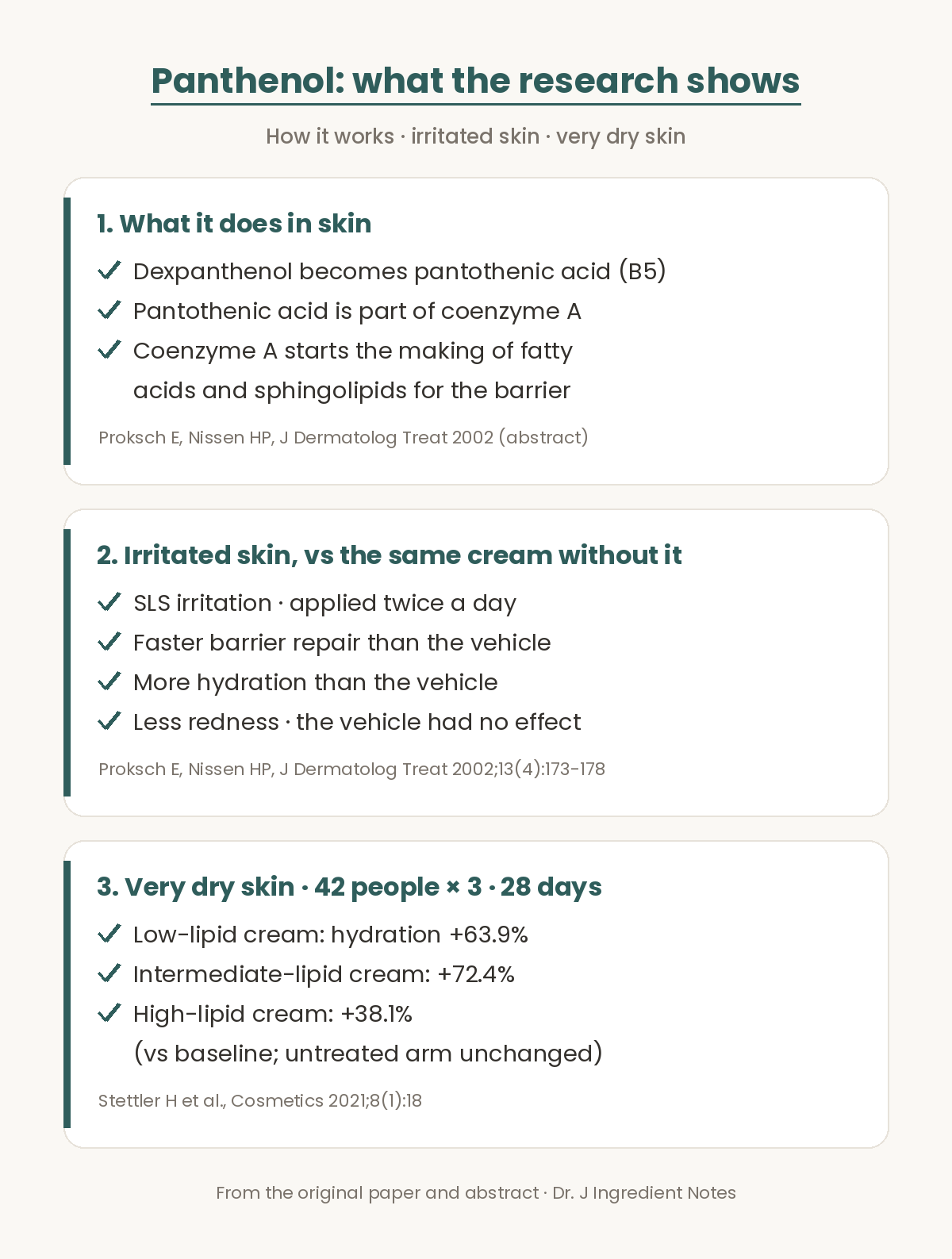
✔ Panthenol and dexpanthenol are names for the same family; in skin, dexpanthenol becomes pantothenic acid (vitamin B5)
✔ On irritated skin, a dexpanthenol cream applied twice a day repaired the barrier faster than the same cream without it
✔ In three 28-day studies on very dry skin (42 people each), skin hydration rose 38.1% to 72.4% from baseline
✔ In the same studies, hydration on the untreated arm did not move
✔ The US Cosmetic Ingredient Review panel concluded panthenol is safe as currently used in cosmetics
――――――――――――――――――――――――――――
Panthenol vs dexpanthenol – why two names
Ingredient lists say panthenol; studies and pharmacy ointments usually say dexpanthenol. Panthenol exists in two mirror-image forms, and the one skin converts to pantothenic acid is the D-form – dexpanthenol. That conversion is why you’ll also see it called provitamin B5.
Why does that matter? Pantothenic acid is a building block of coenzyme A. As the Proksch & Nissen abstract explains, coenzyme A catalyses the early steps in making fatty acids and sphingolipids – lipids that are essential to the layered lipid structure of the stratum corneum and to cell membranes. That is the biological reason people expected panthenol to help a damaged barrier. The studies below are where that expectation was tested.
Inside the bottle, panthenol has more than one job. The Cosmetic Ingredient Review report lists it as a hair-conditioning agent, a skin-conditioning agent (humectant) and a solvent. That is why the same name appears on both a conditioner and a face cream.
――――――――――――――――――――――――――――
On irritated skin – dexpanthenol cream vs the same cream without it
In this study, skin was deliberately irritated with sodium lauryl sulphate (SLS), a cleansing agent, applied in patch-test chambers. The irritated sites were then treated twice a day with either a dexpanthenol cream or the identical cream without dexpanthenol (the vehicle), and some sites were left untreated. Barrier repair, hydration, roughness and redness were measured with instruments rather than judged by eye (Proksch & Nissen, J Dermatolog Treat 2002).
✔ Barrier repair — significantly faster with dexpanthenol than with the vehicle or with no treatment
✔ Stratum corneum hydration — rose with both creams, but significantly more with dexpanthenol
✔ Roughness — fell with both creams, with dexpanthenol again ahead
✔ Redness — significantly reduced with dexpanthenol; the vehicle had no effect
The weight of this study comes from the comparison. Any cream will add some water and oil to the skin; by testing against the same base without dexpanthenol, the study isolates what dexpanthenol itself added. On all four measures, it added something.
※ The abstract does not give the number of participants, the length of the study or the dexpanthenol concentration. A later review article quotes figures for this trial, but I couldn’t confirm them in the original, so I have left them out.
――――――――――――――――――――――――――――
On very dry skin – three studies, 42 people each, 28 days
The second paper reports three parallel studies of panthenol-containing emollients that differed in how much lipid (oil) they contained: low, intermediate and high (Stettler et al., Cosmetics 2021). Participants were 18 to 70 years old and had skin that a dermatologist judged to be very dry, flaky and sensitive. Each person applied the product to one forearm once a day, about 2 mg per square centimetre, and left the other forearm untreated. Which arm got the product was decided at random.
| Emollient 1 lowest lipid |
Emollient 2 intermediate lipid |
Emollient 3 highest lipid |
|
|---|---|---|---|
| Participants | 42 · mean age 59 | 42 · mean age 58 | 42 · mean age 57 |
| Skin hydration day 28 vs baseline |
+63.9% | +72.4% | +38.1% |
| Water loss (TEWL) day 28 vs baseline |
−11.0% (significant) | −5.7% (not significant) | lower, not significant |
| Stratum corneum lipids | cholesterol +9.8% · free fatty acids +3.7% | no change | cholesterol +12.5% · free fatty acids +26.3% |
Three things stand out. First, hydration rose clearly with all three products. Second, on the untreated arm, hydration stayed flat – the paper reports it holding at about the same capacitance reading throughout. That makes it hard to put the rise down to the weather or to people getting used to the measurements. Third, only Emollient 1 significantly reduced water loss (TEWL); the other two moved in the right direction without reaching significance.
So how much of this is panthenol? That’s the honest limit of this paper. The results belong to each cream as a whole: all three also contained lipids such as shea butter and squalane, and the paper does not state the panthenol concentration. The comparison was against untreated skin, not a panthenol-free cream. The study was also open-label – everyone knew what they were applying – and the products were supplied by the manufacturer. None of that makes the numbers wrong, but it tells you what kind of numbers they are.
The intermediate-lipid product gave the largest hydration gain, while the highest-lipid product gave the smallest – a reminder that a richer cream is not automatically a more hydrating one. On tolerability, the paper reports no local or systemic adverse events related to the products over the 28 days.
――――――――――――――――――――――――――――
The two studies side by side
| Proksch & Nissen 2002 | Stettler et al. 2021 | |
|---|---|---|
| Skin | deliberately irritated with sodium lauryl sulphate (SLS) | very dry, flaky and sensitive, as judged by a dermatologist |
| Compared with | the same cream without dexpanthenol (vehicle), and untreated skin | the untreated opposite forearm |
| How often | twice a day | once a day, about 2 mg/cm² |
| Design | vehicle-controlled (numbers of people and days not given in the abstract) | randomised as to which arm was treated · open-label · three studies × 42 people · 28 days |
| Key result | faster barrier repair, more hydration, less roughness, less redness than vehicle | hydration +38.1% to +72.4%; untreated side flat |
Each study fills the other’s gap. The 2002 trial has the right comparison – dexpanthenol against its own vehicle – but its abstract gives no numbers. The 2021 studies have clear numbers, but they describe whole products compared with untreated skin. Put together, they support a modest, specific statement: panthenol has human evidence on two fronts, recovery after irritation and hydration of very dry skin.
――――――――――――――――――――――――――――
Safety – what the Cosmetic Ingredient Review panel concluded
In the US, the Cosmetic Ingredient Review (CIR) expert panel assesses the safety of cosmetic ingredients. In 2022 it reviewed panthenol, pantothenic acid and five derivatives together. Its conclusion is one sentence: all seven are safe in cosmetics in the present practices of use and concentration described in the assessment.
It helps to keep the two questions apart. The CIR conclusion answers “is it safe to use the way it is used now?” – not “how well does it work?”. For the second question, look to the two studies above.
――――――――――――――――――――――――――――
How I use it
✔ When exfoliating acids or retinol leave my skin stinging, I switch to a panthenol-containing cream for a few days
✔ I apply it while skin is still slightly damp after cleansing, and on dry days add a cream on top
✔ For very dry skin I give it 28 days before judging – the length of the Stettler studies
――――――――――――――――――――――――――――
What I left out, and why
✔ Participant numbers, duration and concentration for the 2002 trial — quoted in a review, but not in the original abstract I could read
✔ Wound and burn claims — in a cosmetics article they read like drug claims
✔ “Choose at least X%” — I found no original study comparing panthenol concentrations head-to-head on human skin
✔ Pairing rules with other ingredients — I found no primary study testing panthenol in specific combinations
――――――――――――――――――――――――――――
Three things to check when you buy
✔ Where panthenol sits in the ingredient list — higher up means more of it (see the ingredient-list guide below)
✔ Texture — in the 28-day studies, the intermediate-lipid product gave the largest hydration gain
✔ Where fragrance sits — if this is the cream for your irritated days, you want fragrance low on the list or absent
――――――――――――――――――――――――――――
In one line
Panthenol is converted in skin to vitamin B5, and it has human evidence for recovery after irritation and for hydrating very dry skin. When you read a number, check first what it was compared with.
――――――――――――――――――――――――――――
📌 Earlier guides
📌 Ceramides – the cholesterol and fatty acid ratio (Ingredient Guide 4)
📌 Hyaluronic Acid: How to Read the Molecular Weight (Ingredient Guide 6)
📌 Retinol: Start at 0.1% (Ingredient Guide 1)
📌 How to Read a Korean Cosmetic Ingredient List — Where the Order Stops at 1% (Ingredient Guide 14)
About the author · Dr. J
MS in Veterinary Medicine, PhD in Life Sciences. I worked as a researcher at the Korea Research Institute of Bioscience and Biotechnology (KRIBB) and now run Beaurea, a cosmetics manufacturing company, where I write the formulas myself. This blog reads the research papers and the regulatory documents and turns them into plain-language criteria for choosing ingredients. I don’t recommend specific products here – only criteria that apply to any product.
📄 References
· Proksch E, Nissen HP. Dexpanthenol enhances skin barrier repair and reduces inflammation after sodium lauryl sulphate-induced irritation. J Dermatolog Treat 2002;13(4):173-178
· Stettler H, de Salvo R, Olsavszky R, et al. Cosmetics 2021;8(1):18
· Scott LN, Fiume M, Bergfeld WF, et al. Safety Assessment of Panthenol, Pantothenic Acid, and Derivatives as Used in Cosmetics. Int J Toxicol 2022;41(3 Suppl):77-128
――――――――――――――――――――――――――――
This article summarises published research and safety assessments. It is information, not a diagnosis or a treatment plan. If something about your skin worries you, please talk to a professional.
— Dr. J Ingredient Notes