
🇰🇷 한국어판: 어린이 화장품 기준 – 「어린이용」이라 적으면 따라오는 것, 그리고 상자의 보존제 함량
Hello, this is Dr. J. Today I want to read Korea’s rules for children’s cosmetics straight from the statute, because one of them changes what is printed on the box.
Most countries regulate what may go into a product for a child. Korea does that too, but it adds something unusual: once a product says it is for children, the outer package has to carry the amount of preservative in it, as a number, separate from the ingredient list. I have not found that requirement anywhere else.
And the trigger is not the formula. It is the label. That is the part worth understanding first, so let me start there.
――――――――――――――――――――――――――――
The sources, if you would rather read them first
📄 Korea Ministry of Government Legislation — cosmetics for infants and children — the age brackets and the three documents
📄 Safety Standards for Cosmetics, Annex 2 — the entries that carry an age condition
📄 Commission Regulation (EU) No 1004/2014 — parabens and the nappy area
📄 US FDA — Summary of Cosmetics Labeling Requirements — what a US label has to carry
The Korean annexes open as attachment files, so the text comes up directly rather than through a search form.
――――――――――――――――――――――――――――
――――――――――――――――――――――――――――
Five lines, if you are in a hurry
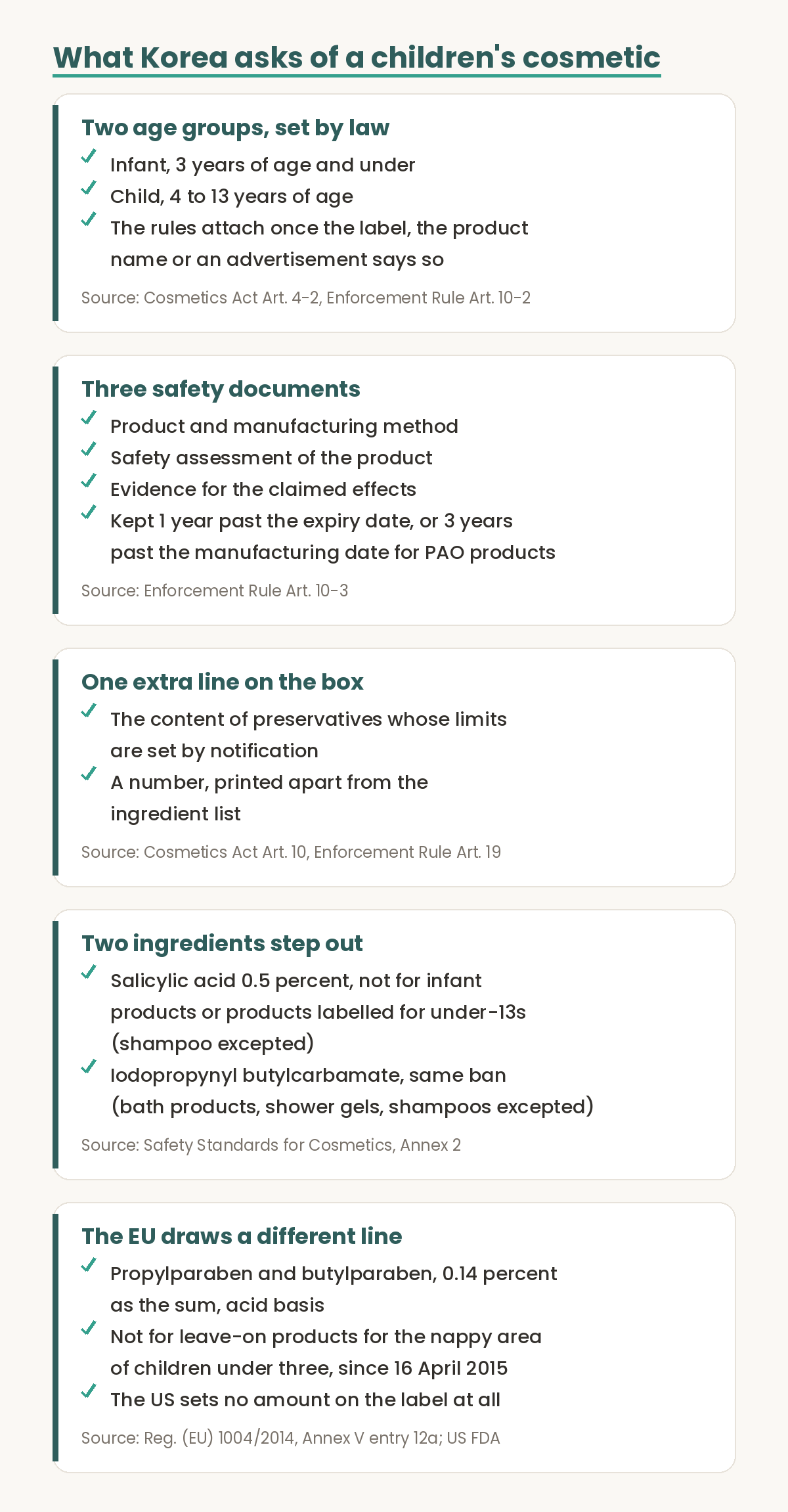
✔ Korean law splits the two groups by age — an infant is 3 and under, a child is 4 to 13
✔ The rules attach the moment the package, the product name or an advertisement says the product is for them
✔ Three safety documents must be written and kept, for a year past the expiry date or three years past the manufacturing date
✔ The outer package gains one line — the content of the preservatives, printed apart from the ingredient list
✔ Salicylic acid and iodopropynyl butylcarbamate step out of products labelled for under-13s
――――――――――――――――――――――――――――
Two age groups, written into the statute
Article 4-2 of the Cosmetics Act and Article 10-2 of its Enforcement Rule define the two groups by age. An infant is three years of age and under. A child is four to thirteen.
The upper bound is worth noticing. Thirteen takes in primary-school age, so a lotion or a lip balm marketed to a nine-year-old sits inside the same rules as a baby lotion. In several other markets the special category stops at three.
――――――――――――――――――――――――――――
The rule starts at the label, not at the formula
This is the part that surprises people. The obligations do not attach because of what is in the bottle. They attach because of what the company says about who it is for.
| Where | What makes the rules attach |
|---|---|
| Packaging | The inner or outer package states, specifically, that the product may be used by an infant or a child |
| Product name | The name of the cosmetic itself carries a reference to infants or children — the name alone is enough |
| Advertising | Newspapers, broadcast, magazines, the internet, posters and signboards, video or film, stating it specifically |
So a very mild formula with no such wording stays outside the rules, and an ordinary formula with the wording falls inside them. The word the statute uses is “specifically”: a vague impression that a child might use it is not the test — naming the group is.
※ This is why the phrase on the front of a Korean box is a regulatory statement rather than a marketing flourish.
――――――――――――――――――――――――――――
Three documents, and how long they are kept
Once that wording is used, the responsible distributor has to prepare and keep product-specific safety documentation. Enforcement Rule Article 10-3 lists three items and sets the retention period.
| Document | Content | Kept until |
|---|---|---|
| ① Product and method | A description of the product and of how it is manufactured | Products labelled with an expiry date — one year after the expiry date of the last batch made or imported Products labelled with a period after opening — three years after the manufacturing date of the last batch |
| ② Safety assessment | A safety assessment of the cosmetic product | |
| ③ Evidence of effect | Evidence for the efficacy or effect claimed for the product |
The retention clock keeps running after the product has left the shelves — a year past the expiry date of the final batch. Failure to prepare or keep the documents carries up to one year of imprisonment or a fine of up to ten million won, and a company can be fined alongside the individual.
※ A shopper cannot ask to see this file. What is useful to know is that the phrase “for children” on a Korean box has a dossier sitting behind it.
――――――――――――――――――――――――――――
One extra line on the box — the preservative content
Here is the part a shopper can actually see. Where a product is labelled or advertised specifically for infants or children, the outer package must carry “the content of preservatives among the raw materials whose standards of use are designated and published”.
Compare that with the ordinary ingredient list. Ingredients are listed in order of how much is present, and in Korea anything at or below 1% may be listed in any order. No amounts appear. On a children’s product, the preservatives come back with a number attached — “phenoxyethanol 0.4%”, printed in its own line.
Two things follow from that line. First, its presence tells you the product is formally labelled for children. Second, it tells you which preservative is in there and how much. If no preservative is used, there is nothing to declare and the line is simply absent.
※ The basis is Article 10 of the Act with Article 19 of the Enforcement Rule. Look for it beside the ingredient list, not inside it.
――――――――――――――――――――――――――――
Two ingredients that step out
Annex 2 of the Safety Standards for Cosmetics sets a maximum for each restricted raw material. Two of those entries carry an age condition, and I opened both.
| Ingredient | Limit | Age condition |
|---|---|---|
| Salicylic acid and its salts | 0.5% as salicylic acid | Not to be used in products for infants, or in products labelled specifically as usable by children aged 13 or under (shampoo excepted) |
| Iodopropynyl butylcarbamate (IPBC) | 0.02% rinse-off · 0.01% leave-on · 0.0075% in deodorants | The same prohibition (bath products, shower gels and shampoos excepted) |
Read the two columns together. 0.5% is the adult ceiling; in a children’s product the ingredient is not permitted at all, not permitted at a lower level. The exceptions in brackets follow the same logic in reverse — products that are rinsed off are treated differently from products that stay on the skin.
――――――――――――――――――――――――――――
Fragrance allergens: 25 names, the same thresholds
If a Korean ingredient list ends with limonene, linalool, citronellol and a few more, those are the fragrance allergens that must be named separately rather than hidden inside “fragrance”. There are 25 of them.
The thresholds are above 0.01% in rinse-off products and above 0.001% in leave-on products. They are not lowered for children’s products — the annex carries no age clause at all.
※ A long tail of names is disclosure, not concealment. For a child who reacts to fragrance, that tail is the part of the label worth reading.
――――――――――――――――――――――――――――
Korea, the EU and the US, side by side
Three regulators, three different places to put the line. Korea hangs its rules on the label, the EU writes age into individual ingredient entries, and the US asks for no amounts on the label at all.
| Where | What applies to a children’s product | Source |
|---|---|---|
| Korea | Infant 3 and under, child 4 to 13. Label or advertise it as such and three safety documents follow, plus the preservative content printed on the package | Cosmetics Act Art. 4-2, Art. 10 Enforcement Rule Art. 10-2, 10-3, 19 |
| European Union | Propylparaben and butylparaben capped at 0.14% as the sum (as acid), and “not to be used in leave-on products designed for application on the nappy area of children under three years of age”; such products carry “Do not use on the nappy area” | Reg. (EU) No 1004/2014 Annex V entry 12a, applying from 16 April 2015 |
| United States | “The ingredients must be declared in descending order of predominance”, and “color additives and ingredients present at one percent or less may be declared without regard for predominance”. No amount has to be shown | US FDA, Summary of Cosmetics Labeling Requirements |
The contrast worth taking away is the middle column of the first row. A Korean children’s box tells you how much preservative is in the product. A European or American one does not, however carefully it is labelled otherwise.
――――――――――――――――――――――――――――
What to check on the box
✔ Does the package say, in so many words, that it is for children? That is what puts it inside these rules
✔ Is there a preservative line separate from the ingredient list, and which preservative is named
✔ If salicylic acid appears, is the product one that gets rinsed off
✔ For a child who reacts to scent, read the names after “fragrance”
✔ Is the expiry date on the container itself, which survives after the box is thrown away
※ A printed line is easier to verify than a claim such as “no preservatives”. Choose on what is written.
――――――――――――――――――――――――――――
What I left out, and why
✔ Whether Korea restricts parabens by age. The EU does. In the extract of Annex 2 I was able to open, the paraben entries carried no age condition — but I could not confirm the full entry, so I am not claiming Korea has no such rule
✔ The sub-paragraph numbers for the preservative-content requirement. Different official sources number it differently, so I cite the Act’s Article 10 with Article 19 of the Enforcement Rule and stop there
✔ “Baby products should be fragrance-free and preservative-free.” There is no primary source for that as a rule, and removing preservatives moves the microbiological question elsewhere rather than removing it
✔ Product names. This blog does not recommend particular products
――――――――――――――――――――――――――――
In one line
In Korea, the rules for a children’s cosmetic begin with the words on the label, not with the formula inside. Say it, and a dossier follows — and the box gains a line telling you how much preservative is in there.
Next in this series: what a “vegan” claim on a cosmetic certifies, which in Korea runs through an industry self-review rather than a government mark — a companion to the organic and natural guide (Ingredient Guide 21).
📌 Earlier guides
📌 How to Read a Korean Cosmetic Ingredient List (Guide 14)
📌 Salicylic Acid (BHA): 0.5% vs 2%, Explained (Guide 8)
📌 Ceramides: the Cholesterol and Fatty Acid Ratio (Guide 4)
📌 Niacinamide: How Much Is Enough (Guide 2)
About the author · Dr. J
MS in Veterinary Medicine, PhD in Life Sciences. I worked as a researcher at the Korea Research Institute of Bioscience and Biotechnology (KRIBB) and now run Beaurea, a cosmetics manufacturing company, where I write the formulas myself. This blog reads the research papers and the regulatory documents and turns them into plain-language criteria for choosing ingredients. I don’t recommend specific products here – only criteria that apply to any product.
📄 References
· Cosmetics Act of Korea, Articles 4-2 and 10
· Enforcement Rule of the Cosmetics Act, Articles 10-2, 10-3 and 19
· Safety Standards for Cosmetics, Annex 2 (restricted raw materials)
· Notification on precautions and fragrance allergen labelling, Annex 2 (25 substances)
· Commission Regulation (EU) No 1004/2014, Annex Ⅴ entry 12a
· U.S. FDA, Summary of Cosmetics Labeling Requirements
――――――――――――――――――――――――――――
This article summarises public statutes and regulatory documents and is not a substitute for diagnosis or treatment. Quoted sentences are as they appear in the law and the notifications, and labelling practice varies between products. If a child’s skin reacts, stop using the product and speak to a professional.
— Dr. J Ingredient Notes