
🇰🇷 이 글의 한국어판 → Korean version (한국어)
Hello, I’m Dr. J. I formulate skincare products in Korea.
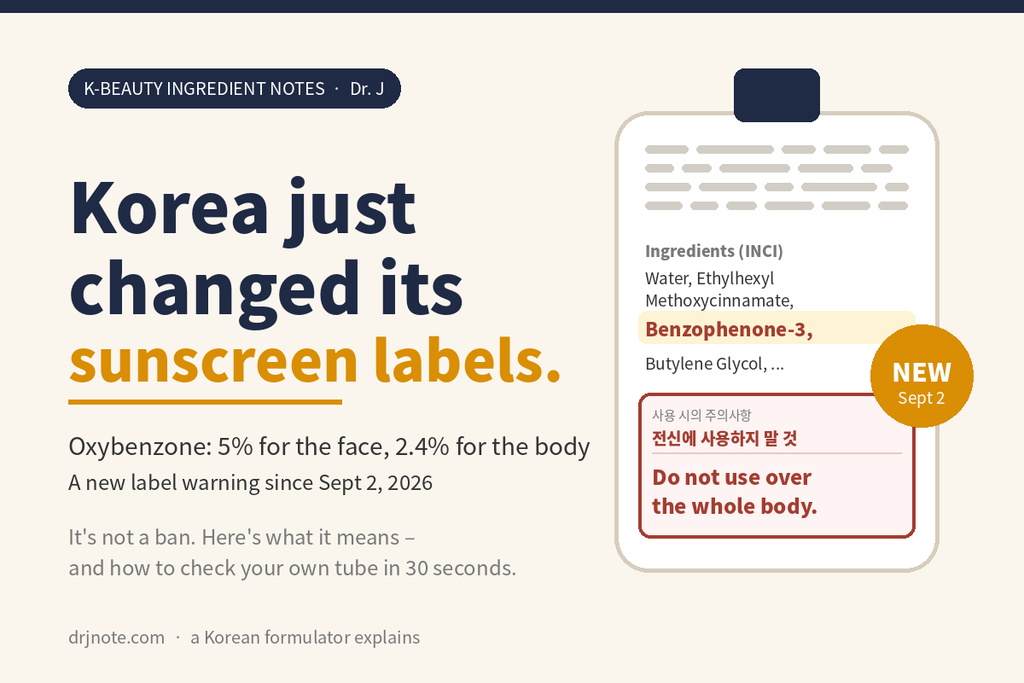
If you’ve ever ordered a Korean sunscreen online – and a lot of Americans do – you may have wondered what’s actually in that tube. This week, every tube sold here started carrying something new on the back.
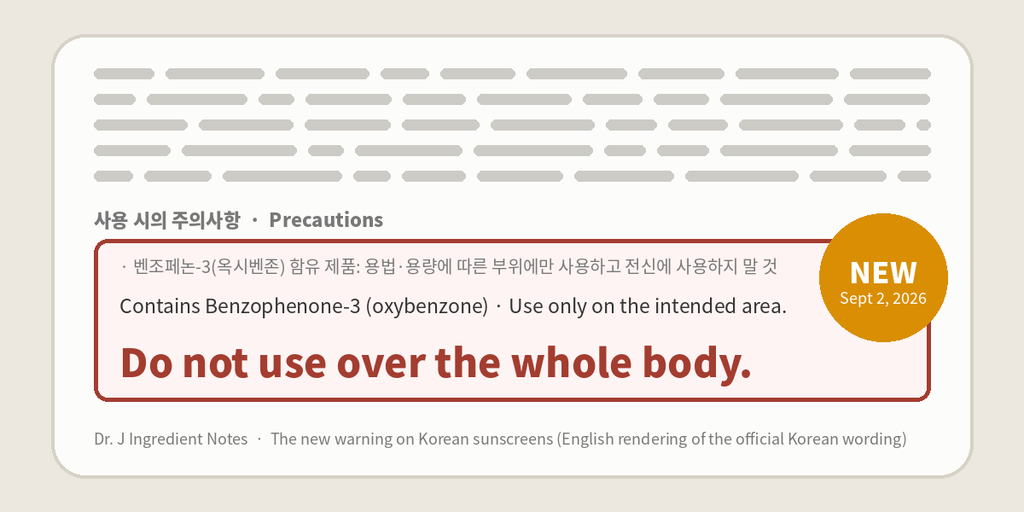
“Use only on the intended area. Do not use over the whole body.”
A sunscreen that says “don’t put this on your body” sounds alarming. It isn’t, once you know what it means – but it’s worth understanding, because the ingredient involved is one you’ll also find in plenty of American sunscreens.
So here are three things: what the ingredient is, why the warning exists, and how to check your own sunscreen in 30 seconds. Plus a short note on why Korean and American sunscreens are built so differently.
The three-line version
✔ It’s not a ban. Those products are still fine to use on the face
✔ Look for “Benzophenone-3” on your ingredient list. If it isn’t there, you can stop reading
1. What is oxybenzone?
Sunscreens block UV in one of two ways. Some ingredients work like a mirror, bouncing light away – zinc oxide and titanium dioxide, the “mineral” filters. Others work like a sponge, absorbing UV and turning it into a little heat – the “chemical” filters.
Oxybenzone (listed on labels as Benzophenone-3) is a sponge. It has been one of the world’s most-used sunscreen ingredients since the 1980s because it spreads well and doesn’t leave a white cast.
Over the past ten years or so, three concerns have been raised about it.
· It is absorbed through the skin. The FDA’s own 2019–2020 studies found it in the bloodstream at levels far above the agency’s threshold for requesting more safety data. The FDA was careful to say this does not prove harm – only that more research is needed
· It washes into the ocean and has been linked to coral damage. Hawaii banned the sale of oxybenzone sunscreens in 2021 for that reason
So the direction regulators are taking around the world isn’t “ban it” – it’s “don’t put a lot of it over a large area.” Korea’s new label is exactly that idea, written on the tube.
2. Why is the face allowed 5% but the body only 2.4%?
The answer is surface area. Your face is about two palms’ worth of skin. Arms, legs and back together are closer to a bedsheet. At the same concentration, a full-body application puts several times more of the ingredient on – and into – you. So the limits are set by body area.
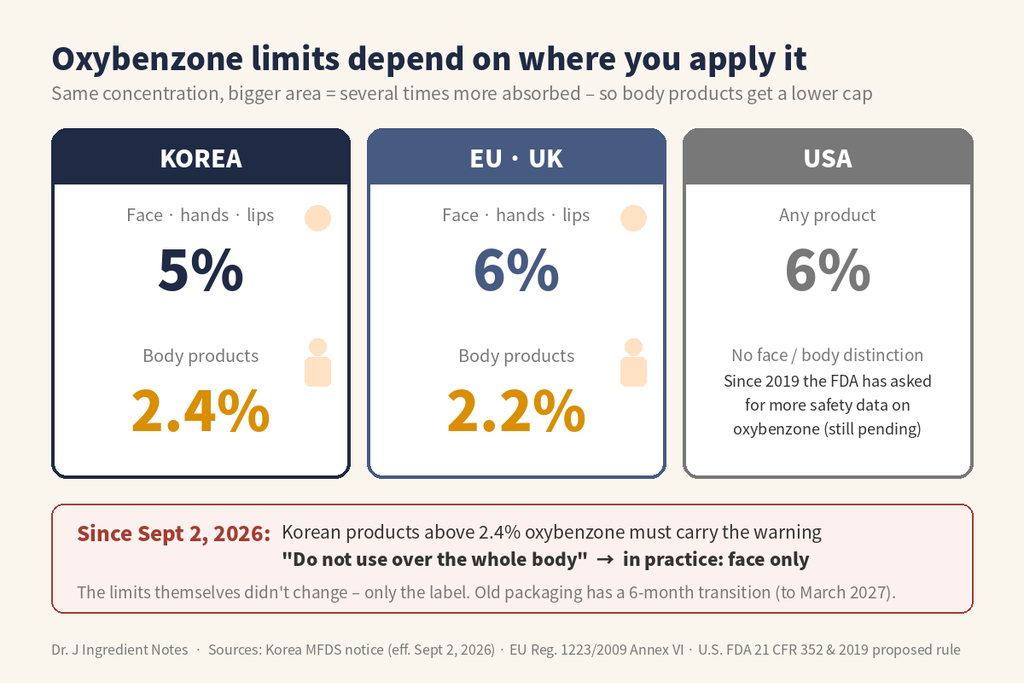
| Product type | Korea | EU / UK | United States |
|---|---|---|---|
| Face, hands, lips | 5% | 6% | 6% (no face/body distinction) |
| Body (whole-body use) | 2.4% | 2.2% |
In other words, a Korean face sunscreen with 3–5% oxybenzone is perfectly within the rules – the label just tells you not to slather it down your arms and legs. What changed on September 2 is the wording on the package, not the limits themselves.
Notice the U.S. column: the FDA still allows 6% with no body-area distinction, and in 2019 it formally asked manufacturers for more safety data on oxybenzone and eleven other filters. That request is still open.
3. Check your sunscreen in 30 seconds
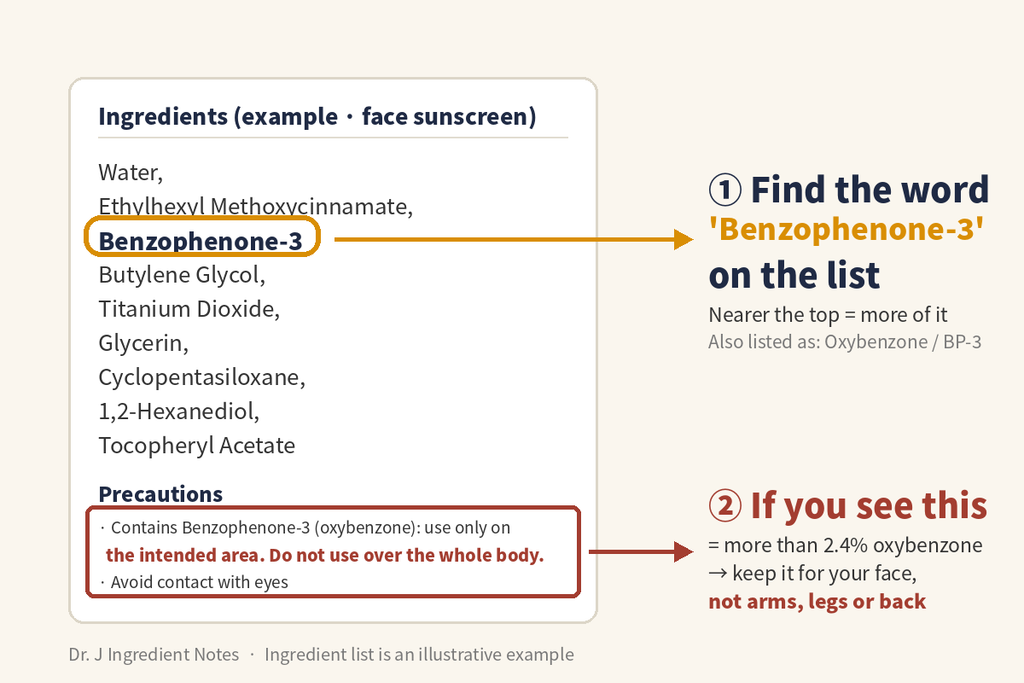
Step 2. Not there? You’re done. This article doesn’t apply to your product
Step 3. It’s there → if it’s a Korean product, look for the new warning. If you see it, use that sunscreen on your face only and pick a different one for your body
From where I sit in manufacturing, most new Korean sunscreens don’t use oxybenzone at all anymore. They lean on mineral filters or on newer chemical filters instead. So for most readers, Step 2 is where this ends.
One caveat: Korea gave brands a six-month grace period, so until March 2027 you may still find older packaging without the warning even if the formula contains oxybenzone. That’s why I’d trust the ingredient list over the warning.
If your skin is sensitive, or you share a sunscreen with grandchildren, the simplest route is a product that lists zinc oxide or titanium dioxide near the top. The old complaint – a chalky white cast – has improved a lot in recent years.
4. Why Korean and American sunscreens feel so different
Here’s the part American readers usually find surprising. The reason Korean sunscreens feel lighter and don’t sting isn’t magic – it’s the ingredient list they’re allowed to draw from.
· Europe permits roughly 30 UV filters; Korea’s list is similar. The U.S. list has about 16
· Filters common in Korean formulas – Uvinul A Plus, Uvinul T150, Tinosorb M – are not on the U.S. list
· On June 9, 2026 the FDA approved bemotrizinol (sold as Tinosorb S / Parsol Shield), its first new UV filter in more than 25 years
· Even so, the company that filed the application gets an 18-month head start, so don’t expect it in every U.S. brand right away
Put the two stories side by side and you get the picture: Korea is tightening the rules on an old filter while the U.S. is just beginning to add new ones. That gap – not marketing – is why so many Americans order sunscreen from Seoul. It’s also why reading the back of the tube matters more than the front, wherever you buy.
5. Whatever you choose – wear it every day
Articles like this sometimes make people think “maybe I’ll just skip sunscreen.” Please don’t. UV exposure is the single biggest driver of skin aging after 50, and the ingredients I covered in earlier posts – vitamin C and glycolic acid – lose much of their benefit without sun protection. Choose your ingredients carefully, then use them daily.
· About a nickel-sized amount for the face, 20–30 minutes before going out
· Reapply every 2–3 hours if you’re outdoors
· Don’t forget neck, ears and the backs of your hands – that’s where age shows first
· Cloudy days and window seats count too
Look for one word on the back of your sunscreen: Benzophenone-3.
If it isn’t there, carry on. If it is, keep that product for your face – and either way, wear sunscreen every day.
▶ Earlier: Not All Vitamin C Serums Work – 3 Conditions the Research Says You Need (link to post 1 EN)
▶ Earlier: Dull, Rough Skin? Glycolic Acid (AHA) – What the Research Shows and How Much Is Safe (link to post 2 EN)
▶ Korean version of this post (한국어판): 선크림 뒷면에 새 문구가 붙습니다 – 옥시벤존 “전신에 사용하지 말 것”
Next time: PDRN (salmon DNA) – the ingredient all over K-beauty ads right now. What it actually does in a cream, how it differs from the injectable version, and the marketing phrases Korea’s own regulator has started flagging.
Curious about an ingredient? Leave a comment and I’ll look up the research and explain it simply.
— Dr. J (MS in Veterinary Medicine · PhD in Life Sciences · former researcher, Korea Research Institute of Bioscience & Biotechnology · founder of a cosmetics manufacturing company)
1. Korea Ministry of Food and Drug Safety (MFDS), amendment to the Regulation on Precautions and Allergen Labeling for Cosmetics – benzophenone-3 warning, effective Sept. 2, 2026 (6-month transition for existing packaging).
2. Cosinkorea, “Benzophenone-3 ‘do not use over the whole body’ warning takes effect Sept. 2” (Aug. 6, 2026); CNC News (Aug. 2026). Korean limits: 5% face/hands/lips, 2.4% body. EU/UK: 6% / 2.2%.
3. U.S. FDA, Sunscreen Drug Products for Over-the-Counter Human Use, proposed rule (Feb. 2019) – oxybenzone among 12 filters needing additional data; U.S. maximum 6%.
4. Matta MK et al., JAMA 2019 and 2020 – FDA studies on systemic absorption of sunscreen active ingredients.
5. Environmental Working Group, “FDA approves first new sunscreen ingredient in 25 years” (June 9, 2026) – bemotrizinol / Parsol Shield, 16 vs. ~30 filters, 18-month exclusivity.
6. The Korea Times, “US finally approves new UV filter. Can it catch up with K-beauty?” (Aug. 13, 2026).
7. State of Hawaii, Act 104 (2018) – oxybenzone and octinoxate sales ban effective Jan. 1, 2021.
※ This article is general information about cosmetic ingredients, not medical advice. Results vary with individual skin.