Tag: MFDS

  • Fragrance on a Korean Cosmetic Label: The One Word That Needs No Permission, and the One That Does (Ingredient Guide 30)

    Cover image for a guide to how Korean cosmetic labels write fragrance. Article 10 of the Cosmetics Act requires every ingredient used in manufacture to be listed on the package. Annex 4 of the Enforcement Rule then says a fragrance material may be written as the single word fragrance, unless it contains one of the 25 allergens the Minister of Food and Drug Safety has notified, in which case the name itself must be written. The neighbouring item of the same annex is different: to hide any other ingredient a company must submit supporting data to the Minister and, if the Minister accepts that disclosure would seriously harm a legitimate interest, the label may read Other Ingredients. One word needs no permission; the other one does. Dr. J Ingredient Notes cover image.

    🇰🇷 한국어판 (Korean version)

    Hello, this is Dr. J. Today I want to read one entry of a Korean labelling annex line by line, because it answers a question people ask in every market: why does the back of the box say only “fragrance”?

    Here is the part that surprised me. In Korea, “fragrance” is a word you may use without asking anyone. The item sitting immediately beside it in the same annex is the opposite: to hide any other ingredient you have to file supporting data and be told yes.

    ――――――――――――――――――――――――――――

    The provisions, if you want them first

    📄 Enforcement Rule of the Cosmetics Act, Annex 4 (labelling standards and method)

    📄 Cosmetics Act Article 10 and Enforcement Rule Article 19 (Korea Cosmetic Association)

    📄 Regulation (EC) No 1223/2009, Articles 19 and 21

    📄 21 CFR 720.8 — trade secret exemption procedure (eCFR)

    The Korean texts are quoted from the attachment file published by the National Law Information Centre. The English wording below is my own rendering of the Korean; where a phrase matters I give it in quotation marks and name the item it comes from.

    ――――――――――――――――――――――――――――

    ――――――――――――――――――――――――――――

    In five lines

    ✔ The rule is every ingredient used in manufacture — Cosmetics Act Article 10
    ✔ A fragrance material may be written as one word — Annex 4, item 3(e)
    ✔ If a notified allergen is in it, the substance is named instead — the proviso to the same item
    ✔ To hide any other ingredient you file data and wait for acceptance — item 3(g)
    ✔ The EU and the US also use one word — ‘parfum’ / ‘aroma’, and ‘fragrance’

    ――――――――――――――――――――――――――――

    The rule — ten items, and the third one is the list

    Article 10(1) of the Cosmetics Act sets out what a cosmetic package has to carry. There are ten items; the third is where today’s question starts.

    No. What Article 10(1) requires Note
    1 The name of the cosmetic
    2 The trade name and address of the business operator
    3 Every ingredient used in the manufacture of the cosmetic ★ today’s provision
    4 The volume or weight of the contents
    5 The batch number also on the primary container
    6 The use-by date or period after opening also on the primary container (Guide 17)
    7 The price
    8 The words or mark for a functional cosmetic Guide 16
    9 Precautions for use
    10 Anything else the Prime Minister’s Ordinance prescribes Enforcement Rule Article 19(4)

    Article 10(2) names four items that must appear on the primary container — the tube or jar itself: the name, the trade name, the batch number and the use-by date or period after opening. The ingredient list is not among them. It belongs to the outer box, which is why a bare tube often carries no ingredients at all.

    ――――――――――――――――――――――――――――

    Seven items inside one entry — Annex 4 read line by line

    How the ingredients are written is settled by Annex 4 of the Enforcement Rule. Entry 3, “ingredients used in the manufacture of the cosmetic”, holds seven items, (a) to (g). Most articles quote only one of them. Here they all are.

    Item What the provision says What it means in practice
    (a) “The letters shall be at least 5 points in size.” The small print on the back has a floor under it
    (b) “They shall be written in order of decreasing content used in the manufacture of the cosmetic.” With a carve-out: ingredients at 1% or less, fragrance materials and colour materials need not follow the order
    (c) “For a blended raw material, the name of each individual blended ingredient shall be written.” A compound raw material is unpacked into its parts
    (d) “Where a different colour material is used for each shade in colour cosmetics, eye cosmetics, hair dyes or nail products, all the colour materials used may be written together after the mark ‘± or +/-’.” That ± on the back of a lipstick (Guide 24)
    (e) “A fragrance material may be indicated as ‘fragrance’.” ★ today’s one word
    (f) “An ingredient used for the purpose of adjusting pH may be written as the product of the neutralisation reaction instead of the ingredient itself.” What came out is written, not what went in
    (g) “… where it would seriously harm the legitimate interest …, the manufacturer or seller shall submit supporting data …, and where the Minister recognises it, <Other Ingredients> may be written.” ★ today’s neighbouring door

    Four of the seven — (d), (e), (f) and (g) — let the label say something other than the plain ingredient name. Only one of the four asks permission.

    ――――――――――――――――――――――――――――

    The exception is a single sentence

    Enforcement Rule of the Cosmetics Act, Annex 4, entry 3, item (e)

    “A fragrance material may be indicated as ‘fragrance’. However, where the constituents of the fragrance material include an allergen notified by the Minister of Food and Drug Safety, it may not be indicated as fragrance and the name of that substance shall be written.”

    The first sentence is the permission; the second takes part of it back. A fragrance accord is often dozens of materials, and the way they are combined is the house’s own formula. The provision covers that whole area with one word.

    What matters for today is what the sentence does not contain. There is no application, no dossier, no decision. The provision opens the door by itself — and that is exactly where item (g) parts company with it.
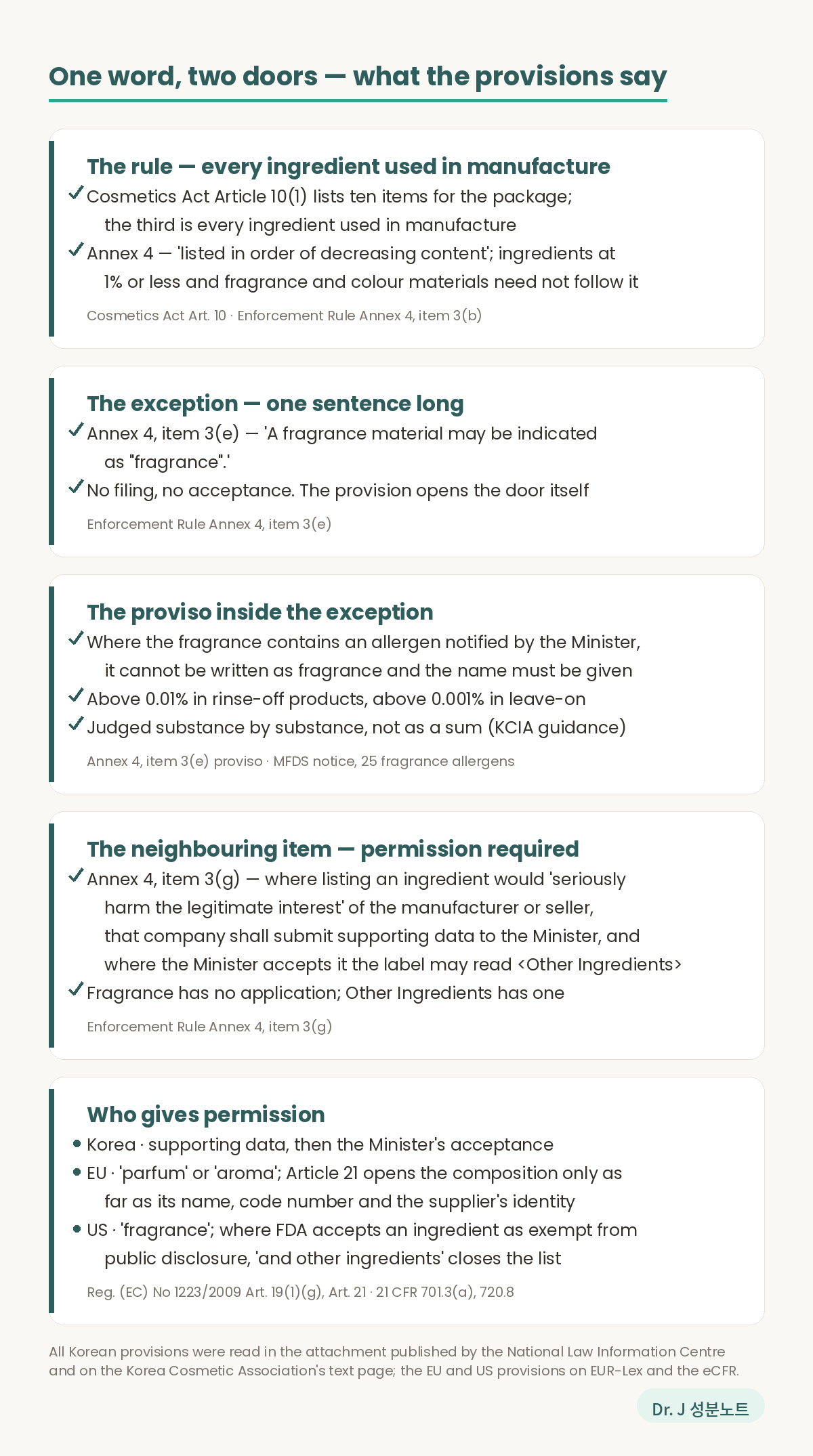
    Evidence card image for the guide to fragrance labelling in Korea. First, the rule. Article 10 paragraph 1 of the Cosmetics Act lists ten items that must appear on a cosmetic package, the third of which is every ingredient used in manufacture, and Annex 4 orders them by decreasing content, except that ingredients at one percent or less and fragrance and colour materials need not follow that order. Second, the exception, which is a single sentence: a fragrance material may be indicated as fragrance. Third, the proviso inside the exception: if the fragrance contains an allergen notified by the Minister of Food and Drug Safety it cannot be written as fragrance and the name of that substance must be written, above 0.01 percent in rinse-off products and above 0.001 percent in leave-on products, judged substance by substance rather than as a sum. Fourth, the neighbouring item. Where listing an ingredient would seriously harm the legitimate interest of the manufacturer or seller, that company must submit supporting data to the Minister, and where the Minister accepts it the label may say Other Ingredients. Fifth, other countries. The European Union writes parfum or aroma under Article 19 of Regulation 1223 of 2009, and the United States writes fragrance under 21 CFR 701.3, with the phrase and other ingredients at the end of the list where the Food and Drug Administration has accepted an ingredient as exempt from public disclosure. All provisions were read in the original texts.

    ――――――――――――――――――――――――――――

    The proviso — when the name has to appear

    Once the proviso bites, “fragrance” is no longer available for that substance and the name itself goes on the label. Korea has notified 25 such substances, and two thresholds decide when they surface.

    Threshold Note
    Rinse-off products above 0.01% body wash, shampoo
    Leave-on products above 0.001% perfume, mist, cream — ten times stricter
    Summed or separate? Separate Korea Cosmetic Association guidance: the figure “refers to the content of each individual substance, so whether to label is judged substance by substance”
    No name on the box does not mean it is absent it may sit under the threshold, or the pack may be small enough to omit
    A name on the box does not mean the product is harsh it means the substance crossed the line and was disclosed

    This is why a perfume or a mist tends to show names like limonene and linalool while a rinse-off product does not. The full list of 25 and the notice behind it are in Ingredient Guide 26.

    ――――――――――――――――――――――――――――

    ★ The neighbouring item — where permission is required

    Item (g) of the same entry is a different road altogether. It is not limited to fragrance: it reaches any ingredient required by Article 10(1)3. What it adds is a condition.

    Enforcement Rule of the Cosmetics Act, Annex 4, entry 3, item (g)

    “Where writing an ingredient under Article 10(1)3 of the Act would seriously harm the legitimate interest of the manufacturer or the seller, the manufacturer or the seller shall submit the supporting data to the Minister of Food and Drug Safety, and where the Minister recognises that the legitimate interest would be harmed, it may be written as <Other Ingredients>.”

    Put the two side by side and the difference is easy to see.

    ‘Fragrance’ — item (e) ‘Other Ingredients’ — item (g)
    Whose permission Nobody’s The Minister of Food and Drug Safety
    What is filed Nothing Supporting data
    What it covers Fragrance materials — scent only Any ingredient under Article 10(1)3 — not limited to scent
    Is there a proviso Yes — the 25 notified allergens None in the text; the acceptance does that work
    What appears on the label fragrance <Other Ingredients>

    So if you ever meet <Other Ingredients> on a Korean box, it is not a gap in the list. It is a line that was argued for and granted. “Fragrance”, by contrast, was there for the taking.

    ⚠ One oddity worth flagging: item (g) still uses the term “manufacturing and selling business operator”, which the Act itself replaced some years ago with “cosmetics responsible distributor”. I could not establish when the annex was last amended, so I have quoted it as it stands.

    ――――――――――――――――――――――――――――

    And some ingredients are not written at all

    “Fragrance” and “Other Ingredients” both rename something. Article 19(2) of the Enforcement Rule does something else again: it lets certain ingredients be left off.

    No. What the provision says Note
    1 “An ingredient that is removed during the manufacturing process and does not remain in the final product” It is not in the product, so it is not on the label
    2 “An incidental ingredient contained in the raw material itself, such as a stabiliser or a preservative, present in a quantity smaller than that which produces its effect” Carried in with a raw material
    3 For packaging of a cosmetic “exceeding 10 millilitres and not exceeding 50 millilitres, or exceeding 10 grams and not exceeding 50 grams”, ingredients other than those listed The exceptions still appear: tar colours, gold leaf, the phosphates in shampoo and rinse, fruit acids (AHA), the efficacy ingredient of a functional cosmetic, and any raw material for which a blending limit has been notified

    Article 19(5) then requires a way back to the full list: either “a telephone number or website address shall be written on the packaging so that consumers can immediately check all the ingredients”, or “printed matter such as a booklet carrying all the ingredients shall be kept at the point of sale at all times”.

    That is why a 30 mL travel size can carry a startlingly short list. It is an abbreviation with a published key, not a secret.

    ――――――――――――――――――――――――――――

    Who gives permission — Korea, the EU and the United States

    Writing scent as one word is not a Korean peculiarity. All three systems do it. What differs is the door next to it.

    Korea EU United States
    The word on the label “fragrance” (Annex 4, item 3(e)) ‘parfum’ or ‘aroma’ — “Perfume and aromatic compositions and their raw materials shall be referred to by the terms ‘parfum’ or ‘aroma’.” (Art. 19(1)(g)) ‘fragrance’ — “except that fragrance or flavor may be listed as fragrance or flavor.” (21 CFR 701.3(a))
    When a name must surface 25 notified allergens above 0.01% / 0.001% Substances whose mention is required under the “Other” column of Annex III (same article) I did not find an equivalent provision while writing this
    Hiding any other ingredient Supporting data → the Minister’s recognition → <Other Ingredients> (item 3(g)) I did not find a labelling omission procedure in the body of the Regulation Where FDA accepts an ingredient as exempt from public disclosure, “the phrase ‘and other ingredients’ may be used at the end of the ingredient declaration” (701.3(a); procedure at § 720.8)
    Order of the list Decreasing content; 1% or less, fragrance and colour materials are free of it “Ingredients in concentrations of less than 1 % may be listed in any order after those in concentrations of more than 1 %.” Ingredients at 1% or less, and colour additives, may be listed without respect to order
    How far disclosure goes The list on the pack; omitted ingredients via phone, website or an in-store booklet Article 21 — “Without prejudice to the protection, in particular, of commercial secrecy …”, and for a fragrance composition the public gets the name and code number of the composition and the identity of the supplier § 720.8(a) describes data “submitted voluntarily to the Food and Drug Administration”

    Read across the last two rows and the axis appears. Every one of the three lets scent be one word; what separates them is who has to say yes before anything else can be hidden. Korea routes it through the Minister, the United States through an FDA acceptance tied to a voluntary filing programme, and the EU handles the same pressure not at the label at all but at the edge of public access — the composition is disclosed as a name, a code number and a supplier.

    For a brand selling into Korea there is a practical consequence. The fragrance word is free, and the other door is paperwork. If a formula depends on keeping one non-fragrance ingredient off the list, that is a filing to plan for, not a labelling style to choose.

    ――――――――――――――――――――――――――――

    Four things to check on the box

    ✔ Find the single word “fragrance” near the end of the list
    ✔ If unfamiliar names sit beside it, they are among the 25 — disclosed because they crossed a threshold
    ✔ An absent name does not mean an absent substance — it may be under the threshold, or the pack may be small
    ✔ <Other Ingredients> means a filing was made and accepted

    ――――――――――――――――――――――――――――

    One line

    “Fragrance” is not a secret kept; it is a bundle the rule allows. “Other Ingredients” is a bundle someone had to ask for. If a particular scent material has bothered your skin before, write the name down and read for it — the 25 are there precisely so that you can.

    ――――――――――――――――――――――――――――

    What I did not write, and why

    ✔ The names and CAS numbers of the 25 allergens — they are already set out in Ingredient Guide 26, so I linked rather than repeated
    ✔ A product that actually carries <Other Ingredients> — I found no example, so I have described the road and stopped there
    ✔ Whether the EU retains a confidentiality route for the label — I did not find one in the body of Regulation 1223/2009, and I could not open the corresponding provision of the former Directive, so I am not claiming that none exists
    ✔ The full text of 21 CFR § 720.8 — I read paragraph (a) and did not read (b) to (g)
    ✔ The amendment history of Annex 4 — which would explain the superseded term in item (g)
    ✔ Claims that “more fragrance names means harsher” — no primary source supports that reading

    About the author · Dr. J

    MS in Veterinary Medicine, PhD in Life Sciences. I worked as a researcher at the Korea Research Institute of Bioscience and Biotechnology (KRIBB) and now run Beaurea, a cosmetics manufacturing company, where I write the formulas myself. This blog reads the research papers and the regulatory documents and turns them into plain-language criteria for choosing ingredients. I don’t recommend specific products here – only criteria that apply to any product.

    📌 Related posts

    📌 Korea’s 25 Fragrance Allergens (Ingredient Guide 26) — the proviso in full, with the list

    📌 How to Read a Korean Cosmetic Ingredient List (Guide 14) — where the order stops at 1%

    📌 Cosmetic Color Additives in Korea (Guide 24) — the neighbouring item, and that ± mark

    📌 Preservative Limits in Korean Cosmetics (Guide 25) — another place where one grouped name carries many substances

    📄 References

    · Cosmetics Act (Korea), Article 10 — paragraph 1, items 1 to 10; paragraph 2, the primary container
    · Enforcement Rule of the Cosmetics Act, Article 19 (paragraphs 2 and 5) and Annex 4, entry 3, items (a) to (g)
    · Notice on precautions for use and labelling of fragrance allergens, Annex 2 · Korea Cosmetic Association ingredient dictionary Q&A
    · Regulation (EC) No 1223/2009, Article 19(1)(g) and Article 21
    · 21 CFR 701.3(a) and 21 CFR 720.8(a)

    ――――――――――――――――――――――――――――

    This article summarises statutes and notices and does not replace diagnosis or treatment. The Korean provisions were opened on the day of writing in the attachment published by the National Law Information Centre and on the Korea Cosmetic Association’s text page; the EU and US provisions on EUR-Lex and the eCFR. Item 3(g) is quoted with the superseded term it still carries. English renderings of the Korean text are mine and are offered for reading, not as an official translation.

    — Dr. J Ingredient Notes
  • Korea Abolished Its Organic Cosmetic Certification: What the 95% and 10% Thresholds Mean Now, and Who Checks Them (Ingredient Guide 18)

    Cover image for a guide to organic and natural cosmetic claims in Korea. Natural cosmetics require 95 percent natural or natural-derived content and organic cosmetics 10 percent organic content, and the government certification scheme ended on 1 August 2025. Dr. J Ingredient Notes, Ingredient Guide 18.

    🇰🇷 한국어판: 유기농 화장품 기준 – 95%와 10%, 그리고 2025년 8월 폐지된 식약처 인증

    Hello, this is Dr. J. If you have been reading about Korean organic cosmetics, almost everything in English still describes a government certification mark. That scheme no longer exists.

    It ended on 1 August 2025. The two definitions left the Cosmetics Act, the certification articles were deleted, and the notification that held the standard was repealed on the same day.

    The thresholds themselves did not change — natural 95%, organic 10%. What changed is who measures them and who checks. This guide walks the regulation, the repeal notices and the industry guide that replaced them, and ends with how the same question is handled in the United States.

    ――――――――――――――――――――――――――――

    Read the sources first

    📄 Guide on Labelling and Advertising of Natural and Organic Cosmetics (2025, Korean)

    📄 Repeal of the standard — MFDS Notice 2025-49

    📄 Repeal of the certifying-body rules — Notice 2025-48

    📄 ISO 16128-2:2017 — the index calculation

    📄 FDA — “Organic” Cosmetics — how the United States handles the word

    The Korean-language sources are linked as they stand; the figures below are read from those originals.

    ――――――――――――――――――――――――――――

    ――――――――――――――――――――――――――――

    The five-line version

    ✓ A natural cosmetic needs 95% natural or natural-derived content

    ✓ An organic cosmetic needs 10% organic, plus 95% natural including that share

    ✓ Korea’s government certification ended on 1 August 2025

    ✓ Certificates issued before then run to their expiry

    ✓ ISO 16128 and written substantiation now carry the claim

    ――――――――――――――――――――――――――――

    The two thresholds

    Start with what is being claimed. The numbers are unchanged from the repealed notification; the method moved to ISO 16128.

    Natural cosmetic Organic cosmetic
    Natural (or derived) content 95% or more 95% or more, including the organic share
    Organic (or derived) content No separate threshold 10% or more
    How it is measured By weight, ISO 16128-2 By weight, ISO 16128-2
    What counts as natural ISO 16128-1 definitions ISO 16128-1 definitions

    A point worth sitting with: an organic cosmetic can be 10-something per cent organic. That is not a shortcut. It is where the line was drawn, and the remaining 85 per cent or so still has to be natural or natural-derived.

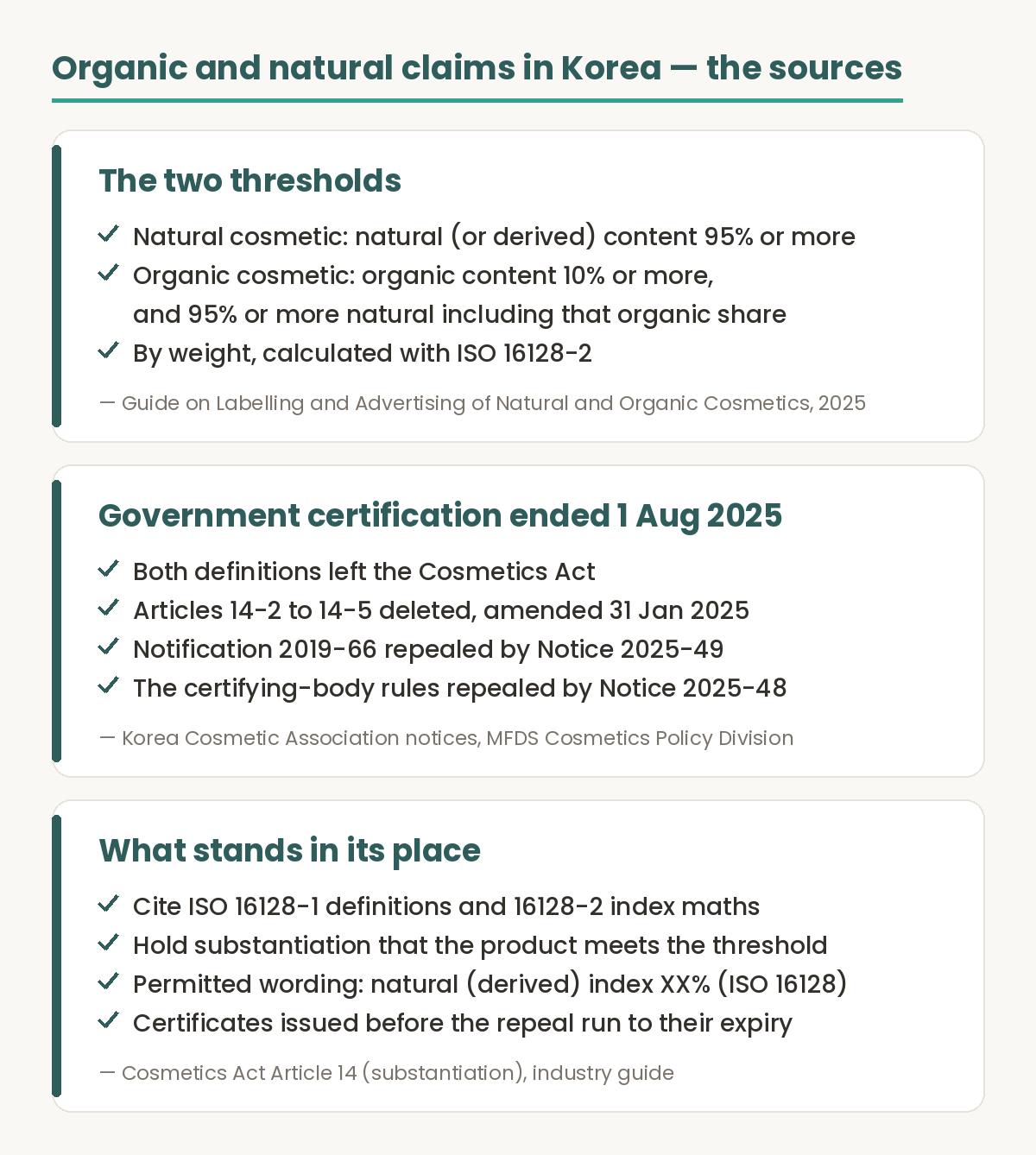
    Evidence figure on organic and natural cosmetic claims in Korea. First, the two thresholds: a natural cosmetic needs 95 percent or more natural or natural-derived content, an organic cosmetic needs 10 percent or more organic content plus 95 percent or more natural content including that organic share, measured by weight and calculated with ISO 16128-2, from the Guide on Labelling and Advertising of Natural and Organic Cosmetics, 2025. Second, government certification ended on 1 August 2025: both definitions left the Cosmetics Act, Articles 14-2 to 14-5 were deleted in the amendment of 31 January 2025, Notification 2019-66 was repealed by Notice 2025-49 and the certifying-body rules by Notice 2025-48, per Korea Cosmetic Association notices and the MFDS Cosmetics Policy Division. Third, what stands in its place: cite the ISO 16128-1 definitions and the 16128-2 index calculation, hold substantiation that the product meets the threshold, use permitted wording such as natural derived index of a given percentage calculated with ISO 16128, and certificates issued before the repeal run to their expiry, under Article 14 of the Cosmetics Act and the industry guide.

    ――――――――――――――――――――――――――――

    What was removed, and when

    What went Instrument Date
    The definitions of natural and organic cosmetics, Cosmetics Act Article 2 Act No. 20767 amended 31 Jan 2025
    Articles 14-2 to 14-5 — certification, validity, certification mark, accredited bodies same Act amended 31 Jan 2025
    Article 13(1)3 and parts of the penalty articles same Act amended 31 Jan 2025
    Notification 2019-66, the standard for natural and organic cosmetics Repeal Notice 2025-49 1 Aug 2025
    The rules on designating certifying bodies Repeal Notice 2025-48 1 Aug 2025

    The Act was amended on 31 January 2025 and the two repeal notices took effect on 1 August 2025. Both notices were posted, with the ministry’s covering document, by the Korea Cosmetic Association.

    The stated reason was to remove duplicate certification. Private schemes were already doing the work, so the government stepped out of it.

    ――――――――――――――――――――――――――――

    Old certificates are still running

    A repeal does not void what was already issued. Certificates remain valid until they expire, and the old validity period was three years.

    So a Korean shelf right now holds two kinds of product: ones carrying the old government mark, and ones labelled against the industry guide with no mark at all. Neither is better by definition — the guarantor is different, and that is the thing to notice.

    ――――――――――――――――――――――――――――

    Before and after, side by side

    Before — Notification 2019-66 Now — industry guide, 2025
    Who set it Ministry of Food and Drug Safety Self-regulatory body for cosmetic labelling and advertising, at the Korea Cosmetic Association
    Natural content 95% or more 95% or more
    Organic content 10% or more 10% or more
    Synthetic ingredients allowed Up to 5%, of which petrochemical moiety 2% or less No such list — ISO 16128 calculation takes its place
    Manufacturing processes Permitted processes listed as physical, chemical and biological Not listed in the guide
    Who checks A certifying body designated by the ministry The company, holding substantiation on file

    The thresholds did not move. The checking did.

    One consequence is easy to miss. The repealed notification carried a 5% cap on synthetic ingredients, with the petrochemical moiety held to 2%, and a list of permitted manufacturing processes. The industry guide has no such list — the ISO 16128 calculation stands in for it. If you find those older figures quoted as current Korean rules, they are out of date.

    ――――――――――――――――――――――――――――

    What carries the claim now

    Two things. The ISO 16128 pair, and substantiation.

    ISO 16128-1:2016 defines which ingredients count as natural, derived natural, organic or derived organic. ISO 16128-2:2017 sets out how to calculate the indexes. The 95 and the 10 are outputs of that calculation.

    The guide also fixes the permitted wording. What a company may print is a phrase of the form “natural (derived) index XX% (calculated under ISO 16128)” — the claim carries its own method. What it may not print, when the product misses the threshold, is a line like “contains natural ingredient X” leaning on a single component.

    And the evidence has to exist on paper:

    Cosmetics Act, Article 14 (Substantiation of labelling and advertising)

    (1) A business operator or seller shall be able to substantiate matters of fact in its own labelling or advertising.

    (3) … shall submit the substantiating material to the Minister of Food and Drug Safety within 15 days of the request.

    Paragraph (4) requires the ministry to order the labelling or advertising stopped if the material is not filed in time and the claim continues. Certification is gone; the checking is not.

    ――――――――――――――――――――――――――――

    Article 13 did not go away

    The definitions and the certification articles were deleted. The prohibition on misleading claims was not.

    Cosmetics Act, Article 13(1) — prohibited labelling and advertising

    1. Labelling or advertising likely to be mistaken for a medicine

    2. … likely to be mistaken for a functional cosmetic when it is not

    3. Deleted <31 Jan 2025>

    5. Any other labelling or advertising likely to deceive consumers or cause them to be mistaken, contrary to fact

    Item 3 was the natural-and-organic provision. Item 5 now covers that ground. The MFDS labelling and advertising guidance of 14 August 2025 also lists, among prohibited expressions, natural or organic wording on a product that does not meet the industry guide.

    ――――――――――――――――――――――――――――

    The private route: COSMOS

    With the state out of it, the scheme most visible on Korean packaging is COSMOS — a non-profit standard built by five European organisations: BDIH (Germany), Cosmebio and Ecocert (France), ICEA (Italy) and the Soil Association (United Kingdom).

    Finished products carry COSMOS ORGANIC or COSMOS NATURAL; raw materials are COSMOS CERTIFIED or COSMOS APPROVED. In Korea the certifying bodies are KTR (Korea Testing & Research Institute) and Control Union Korea.

    A company holding one of these may print it alongside the index wording. It is worth knowing, though, that this is a private guarantee, not a government one.

    ※ The organic-content percentages behind each COSMOS grade were not stated on the public overview page, so they are not quoted here.

    ――――――――――――――――――――――――――――

    Korea and the United States, side by side

    The word “organic” is handled very differently in the two markets, and a Korean product sold in the US runs into the second column.

    Korea United States
    Is there a government definition? There was one in the Cosmetics Act. It was deleted on 31 January 2025 No. FDA says the term is not defined in the laws it enforces
    Who certifies Nobody, since 1 August 2025. Private schemes such as COSMOS continue USDA under the National Organic Program, for agricultural ingredients
    What sets the threshold An industry guide citing ISO 16128-1 and -2 — natural 95%, organic 10% NOP rules for the organic claim; FDA rules still apply to labelling and safety
    What the company must hold Substantiation, due within 15 days of a request (Cosmetics Act Art. 14) Certification records for the NOP claim

    The FDA’s position is blunt: “The term ‘organic’ is not defined in either of these laws or the regulations that FDA enforces.” The definition and the certification sit with the USDA’s National Organic Program, which certifies agricultural ingredients. And a cosmetic bearing an organic claim “must comply with both USDA regulations for the organic claim and FDA regulations for labeling and safety requirements.”

    So the two countries arrived at a similar place from opposite directions. The United States never defined the word for cosmetics. Korea defined it, certified it for years, then handed the measuring to an international standard and the checking to the companies themselves.

    ――――――――――――――――――――――――――――

    What ISO 16128-2 does not cover

    One caution, and it is in the standard’s own scope. ISO 16128-2 is a method for calculating indexes. The overview states that it does not address:

    ✓ Product labelling

    ✓ Human safety

    ✓ Environmental safety

    ✓ Fair trade and other regulatory requirements

    So a high natural index is not a gentleness rating. It counts how much of the formula came from nature, which is a different question from how your skin will respond. For reactive skin, the ingredient list is the more useful page.

    ――――――――――――――――――――――――――――

    What to check on the box

    ✓ Whether a number and a method sit beside the words “natural” or “organic”

    ✓ Whether the wording follows the “natural (derived) index XX% (ISO 16128)” form

    ✓ Whether a private scheme such as COSMOS is named, together with its certifier

    ✓ If a Korean government mark is shown, whether the product’s certificate is still inside its term

    “Contains natural ingredients”, with no number and no scheme, tells you nothing about how much. Turn the box over and read the ingredient list instead — the front of it answers the question faster.

    ――――――――――――――――――――――――――――

    What I left out, and why

    ✓ The repealed notification’s process annex — no longer in force; it appears only in the before-and-after table

    ✓ How many products had been certified, and any revocations — I could not open a primary source

    ✓ The ISO 16128 formulas and the treatment of water — the standard itself is paywalled, so this stops at “a method for calculating indexes”

    ✓ Per-grade organic percentages for COSMOS — not stated on the public overview

    ✓ “Natural means gentle” — no primary source, and it sits against what the ISO scope says

    ――――――――――――――――――――――――――――

    One line

    Natural 95%, organic 10% — and in Korea you now read the wording rather than look for a mark.

    Substantiation came up more than once above. What a cosmetic advertisement may and may not say in Korea is set out in its own guide (Ingredient Guide 19).

    ――――――――――――――――――――――――――――

    📌 Previous guides

    📌 How to Read a Korean Cosmetic Ingredient List (Guide 14) — where to look when there is no index

    📌 Arbutin vs Alpha-Arbutin: What Korea’s 2–5% Means (Guide 15) — another number fixed by notification

    📌 Sunscreen SPF and PA: How to Read the Numbers (Guide 11)

    📌 Skin Concern Ingredient Map

    About the author · Dr. J

    MS in Veterinary Medicine, PhD in Life Sciences. I worked as a researcher at the Korea Research Institute of Bioscience and Biotechnology (KRIBB) and now run Beaurea, a cosmetics manufacturing company, where I write the formulas myself. This blog reads the research papers and the regulatory documents and turns them into plain-language criteria for choosing ingredients. I don’t recommend specific products here – only criteria that apply to any product.

    📄 References

    · Self-Regulatory Body for Cosmetic Labelling and Advertising, Guide on Labelling and Advertising of Natural and Organic Cosmetics, 2025

    · MFDS Repeal Notices 2025-49 and 2025-48, effective 1 August 2025

    · Cosmetics Act (Act No. 20767, amended 31 January 2025), Articles 13 and 14

    · ISO 16128-1:2016 and ISO 16128-2:2017

    · U.S. FDA, “‘Organic’ Cosmetics”, page updated 25 February 2022

    · COSMOS-standard AISBL, public overview

    ――――――――――――――――――――――――――――

    This article summarises statutes, notices and published guidance, and does not recommend a particular product. Rules change; please check the originals before relying on any of it for a decision.

    — Dr. J Ingredient Notes

  • Functional Cosmetics in Korea: The 11 Categories, the Notified Ingredients, and What the Label Certifies (Ingredient Guide 16)

    Cover image for a guide to functional cosmetics in Korea, explaining the eleven categories set by the Cosmetics Act and its Enforcement Rule and what the words on the package certify. Ingredient Guide 16 from Dr. J Ingredient Notes.

    🇰🇷 한국어판: 기능성화장품 뜻과 종류 11가지 – 무엇을 보증하나

    Hello, this is Dr. J. If you have ever turned over a Korean cream and seen the words 기능성화장품 — functional cosmetics — this post is about what that line actually certifies.

    It is not a marketing word. It is a legal category, with a fixed list of eleven things a product is allowed to be, a fixed set of ingredients and amounts, and a fixed sentence the package has to carry. Once you know where the line comes from, the shelf reads differently.

    There is one more reason this is worth reading if you are outside Korea. The EU forbids exactly what Korea requires. Under EU rules, a cosmetic label may not claim that an authority approved it. In Korea, that approval is the label. Same bottle, two opposite drawers — the table further down sets them side by side.

    ――――――――――――――――――――――――――――

    📄 The original documents

    📄 Regulation on the Review of Functional Cosmetics, Annex 4 (Korean)

    📄 Enforcement Rule of the Cosmetics Act, Annex 4 — labelling standards (Korean)

    📄 21 CFR 333.310 — US acne treatment active ingredients

    📄 Commission Regulation (EU) No 655/2013 — common criteria for cosmetic claims

    📄 Regulation (EC) No 1223/2009 on cosmetic products

    🏠 FDA — Is It a Cosmetic, a Drug, or Both?

    The two Korean links download the annex tables themselves. They give the ingredient, the amount, the permitted form, the claim wording and the directions for use, one line each.

    ――――――――――――――――――――――――――――

    ――――――――――――――――――――――――――――

    The short version

    ✔ The Act names five groups; the Enforcement Rule splits them into eleven categories

    ✔ Build a product to a notified ingredient at a notified amount and you file a report instead of a full review

    ✔ Annex 4 lists 9 whitening ingredients, 4 for wrinkles, 29 UV filters and one for acne

    ✔ The package carries the words and the reviewed claim, in type at least as large

    ✔ Hair loss, acne, barrier and stretch marks also carry “not a drug”

    ――――――――――――――――――――――――――――

    Five groups in the Act, eleven categories in the Rule

    Article 2(2) of the Cosmetics Act defines functional cosmetics as products falling under one of five items, “as prescribed by Ordinance of the Prime Minister”. That ordinance is the Enforcement Rule, and its Article 2 is where the list becomes eleven.

    Cosmetics Act, Article 2(2) Enforcement Rule, Article 2 — the eleven categories
    a. Helps whiten the skin 1. Prevents melanin from settling, so freckles and dark spots are held back
    2. Lightens melanin that has already settled
    b. Helps improve wrinkles 3. Firms the skin so wrinkles are eased or improved
    c. Helps tan the skin evenly, or protects it from UV 4. Shields from sunlight for an even tan
    5. Blocks or scatters UV to protect the skin
    d. Helps change, remove or nourish hair colour 6. Changes hair colour, or bleaches and strips it
    7. Removes body hair (physical removal excluded)
    e. Helps prevent or improve dryness, cracking, falling out or keratinization caused by weakened skin or hair function 8. Eases hair loss symptoms (coating and other physical methods excluded)
    9. Eases acne-prone skin (cleansing products)
    10. Restores barrier function so itching improves
    11. Improves the red lines of stretch marks

    Read the table left to right and one thing stands out. Four categories came out of a single item — item e. Hair loss, acne, barrier repair and stretch marks all sit under a sentence about dryness, cracking, falling out and keratinization. Those same four are the ones that must carry the “not a drug” sentence, which we will get to.

    Anything outside these eleven cannot be sold as a functional cosmetic. A Korean pack may still shout about pores or firmness in large type — that is ordinary advertising copy, not this category.

    ――――――――――――――――――――――――――――

    A review, or a report

    Article 4(1) of the Act: “A cosmetics manufacturer, a cosmetics responsible distributor, or a university or research institute prescribed by Ordinance of the Prime Minister that intends to sell a product recognised as a functional cosmetic shall, for each item, either undergo a review by the Minister of Food and Drug Safety as to safety and efficacy, or submit a report to the Minister.”

    The review route asks for a good deal. Article 4 of the Regulation on the Review of Functional Cosmetics sets out what has to be filed:

    ✔ Origin and development history

    ✔ Safety — single-dose toxicity, skin irritation, sensitisation, photo-toxicity, human patch testing

    ✔ Efficacy or function — efficacy testing, human application testing, hair-dye efficacy testing

    ✔ Supporting data for the SPF, water resistance and PA figures

    ✔ Specifications and test methods, with samples

    The report route replaces all of that in three situations: the ingredient, amount, claim, directions, specifications and test methods are already notified; the product is identical in every one of those respects to something already reviewed; or it mixes a reviewed product with a notified one. Article 6 of the same Regulation is the hinge — meet Annex 4 and the data requirement falls away.

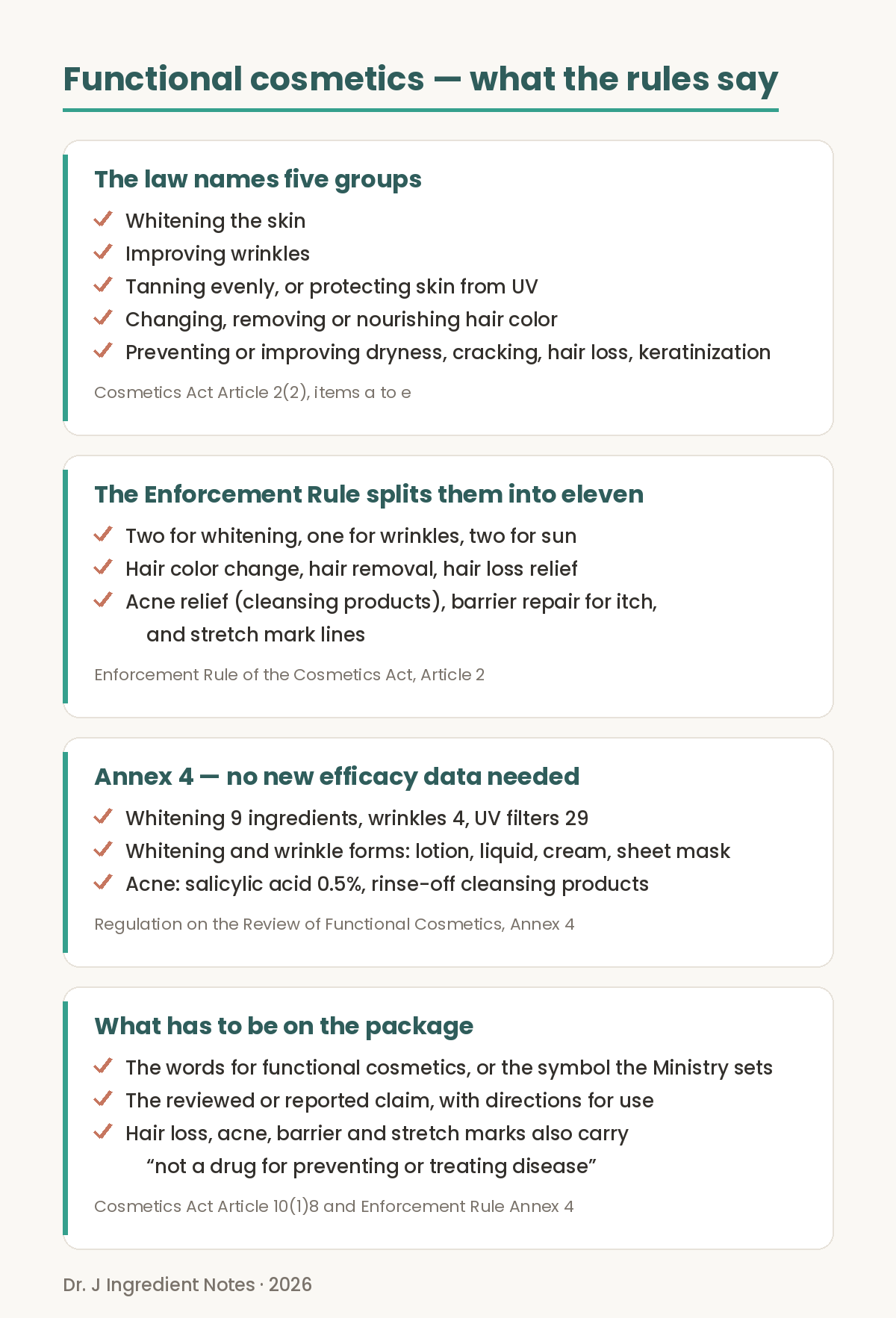
    Evidence card image summarising Korea's rules on functional cosmetics. First, the Cosmetics Act Article 2(2) names five groups: whitening, wrinkle improvement, tanning or UV protection, hair colour change, removal or nourishment, and preventing or improving dryness, cracking, hair loss and keratinization. Second, Article 2 of the Enforcement Rule splits them into eleven categories including acne relief in cleansing products, barrier repair for itch and stretch mark lines. Third, Annex 4 of the Regulation on the Review of Functional Cosmetics lists nine whitening ingredients, four wrinkle ingredients and twenty-nine UV filters, with lotion, liquid, cream and sheet mask as the permitted forms, and salicylic acid 0.5 percent for acne in rinse-off cleansing products. Fourth, the package must carry the words for functional cosmetics or the official symbol, the reviewed or reported claim with directions for use, and for hair loss, acne, barrier and stretch marks the sentence that it is not a drug for preventing or treating disease.

    ――――――――――――――――――――――――――――

    Annex 4 — read its title slowly

    The table is called “Types of functional cosmetics for which data submission is omitted”. So the amounts in it are not ceilings, and they are not “the dose that works best”. They are the amounts at which you no longer have to prove anything new.

    Group in Annex 4 Ingredients Forms and product type Claim wording
    Even tanning · UV protection 29 filters with maximum levels
    benzophenone-3 5% · zinc oxide 25% · titanium dioxide 25% and others
    Lotion, cream and oil; basic and colour make-up product types Carried by the SPF and PA figures
    Skin whitening 9 ingredients Lotion, liquid, cream and sheet mask “Helps whiten the skin”
    Wrinkle improvement 4 ingredients Lotion, liquid, cream and sheet mask “Helps improve skin wrinkles”
    Hair colour change Dyes, bleaches and strippers Set out by form in the table Dyeing, bleaching, stripping
    Hair removal As listed in the table Liquid, cream, lotion, aerosol “Depilation (removal of body hair)”
    Acne-prone skin relief Salicylic acid 0.5% — the only one listed Cleansing product type (soap-based); liquid, lotion, cream “Helps ease acne-prone skin”
    Directions: “rinse off immediately with water”

    The acne row is the one people misread. The directions column says “rinse off immediately with water”, and the product type is a cleansing preparation. That is why so many Korean products with an acne functional claim are face washes rather than leave-on serums.

    Notice also what is not in Annex 4: hair loss, barrier repair and stretch marks. No ingredient has been notified for those three, so a product claiming them goes down the review route. How those individual reviews are decided in practice is something I could not open a source for, so I will leave it there.

    ――――――――――――――――――――――――――――

    The nine and the four, by name

    This is the table to hold against a back label. If one of these names appears and the front says functional cosmetic, the product was most likely built to the notified amount and reported.

    Whitening (9) Amount Wrinkle improvement (4) Amount
    Broussonetia extract 2% Retinol 2,500 IU/g
    Arbutin 2–5% Retinyl palmitate 10,000 IU/g
    Ethyl ascorbyl ether 1–2% Adenosine 0.04%
    Oil-soluble licorice extract 0.05% Polyethoxylated retinamide 0.05–0.2%
    Ascorbyl glucoside 2% — —
    Magnesium ascorbyl phosphate 3% — —
    Niacinamide 2–5% — —
    Alpha-bisabolol 0.5% — —
    Ascorbyl tetraisopalmitate 2% — —

    Both groups also have fixed forms: lotion, liquid, cream and sheet mask. The claim wording is fixed too, and so are the directions (“apply an appropriate amount evenly to the skin”; sheet masks are removed after 10 to 20 minutes).

    That form restriction has a practical edge. The same ingredient at the same percentage in an essence or ampoule falls outside the table, and the product has to be reviewed rather than reported.

    ――――――――――――――――――――――――――――

    Korea, the United States and the EU — three different drawers

    If you buy Korean skincare from abroad, this is the part worth keeping. The same tube can be a state-reviewed “functional cosmetic” in Seoul, an ordinary cosmetic in Paris, and, depending on what the label says, a drug in the United States.

    Korea United States European Union
    Is there a category for this? Yes — “functional cosmetics”, defined in the Cosmetics Act No. A product that claims to affect the structure or function of the body becomes a drug under the FD&C Act No. Everything is a cosmetic product under Regulation 1223/2009
    Who checks before it is sold? MFDS review, or a report, product by product (Act Article 4) No premarket approval for cosmetics. OTC drugs may follow a monograph instead A responsible person must be designated (Art. 4) and the product notified to the Commission (Art. 13)
    Where do the numbers come from? Annex 4 — whitening 9, wrinkles 4, UV filters 29, acne salicylic acid 0.5% Monograph ranges — for acne, salicylic acid 0.5 to 2% (21 CFR 333.310) The Annexes restrict what may be used; they do not set amounts for efficacy
    May the label say a public authority approved it? Yes — the words on the pack are exactly that There is no approval to point to Not allowed. “Claims that indicate that the product has been authorised or approved by a competent authority within the Union shall not be allowed” (Reg. 655/2013)
    What else must the label carry? The reviewed claim with directions; four categories add “not a drug for preventing or treating disease” A Drug Facts panel when the product is an OTC drug Claims must be legal, truthful, evidenced, honest, fair and clear (the six common criteria)

    The last two rows are where the systems genuinely collide. The EU’s common criteria open with this: “Claims that indicate that the product has been authorised or approved by a competent authority within the Union shall not be allowed.” The whole point of the Korean line is the opposite — it tells you the Ministry looked at it.

    The US draws its line somewhere else again. FDA’s own wording is that cosmetics are “intended to be rubbed, poured, sprinkled, or sprayed on… for cleansing, beautifying, promoting attractiveness, or altering the appearance”, while a drug is “intended to affect the structure or any function of the body”. Claim the second thing and the product changes category. FDA also notes that “cosmeceutical” has no meaning under the law.

    So a Korean whitening cream with adenosine at 0.04% is not “approved” anywhere else — the category it belongs to simply does not exist outside Korea. That is worth knowing before you read too much into the words.

    ――――――――――――――――――――――――――――

    What has to be on the package

    ✔ The words 기능성화장품, or the symbol the Minister designates — Act Article 10(1)8

    ✔ The claim and the directions that were reviewed or reported

    ✔ For hair loss, acne, barrier and stretch marks: “not a drug for the prevention or treatment of disease”

    ✔ For products labelled for infants (3 and under) or children (4 to 13): the preservative content

    The placement is fixed as well. Annex 4 of the Enforcement Rule says the sentence goes directly beneath the words 기능성화장품, in type at least as large. So if you can see the words but not the claim, look again just under them.

    ――――――――――――――――――――――――――――

    How I read the label after that

    I treat the line as an answer to one question: which of the eleven, and did it clear the procedure for that one? It is a good answer, and it is a narrow one.

    It does not tell you how much the product will do. The notified amount is the amount that lets a company skip new data, not the amount chosen for the strongest result. So the next thing I look at is the amount and the form.

    For wrinkles, is adenosine there at 0.04%? For whitening, is arbutin or niacinamide in the 2–5% band? And where does that name sit in the ingredient list? Remember that below 1% the order stops meaning anything (Ingredient Guide 14).

    ――――――――――――――――――――――――――――

    Five things to check when buying

    ✔ Is what you want one of the eleven — whitening, wrinkles, sun, and so on

    ✔ Does the claim directly under the words match it

    ✔ Is a notified ingredient in the list — adenosine 0.04%, arbutin 2–5%

    ✔ Is the form lotion, liquid, cream or sheet mask (for whitening and wrinkles)

    ✔ For sun care, are the SPF and PA figures printed alongside

    ――――――――――――――――――――――――――――

    One line

    “Functional cosmetic” means the product cleared a review or a report for one of eleven named claims. Read the sentence under the words first; then read the amount and the form.

    Next up: expiry dates and period-after-opening — the two dates on a Korean package, and what the open-jar symbol means (Ingredient Guide 17).

    ――――――――――――――――――――――――――――

    📌 Earlier posts

    📌 Arbutin vs Alpha-Arbutin: What Korea’s 2–5% Means (Ingredient Guide 15)

    📌 Adenosine 0.04%: Who Decided That Number (Ingredient Guide 12)

    📌 How to Read a Korean Cosmetic Ingredient List (Ingredient Guide 14)

    📌 Sunscreen SPF and PA: How to Read the Numbers (Ingredient Guide 11)

    📌 Niacinamide: How Much Is Enough (Ingredient Guide 2)

    About the author · Dr. J

    MS in Veterinary Medicine, PhD in Life Sciences. I worked as a researcher at the Korea Research Institute of Bioscience and Biotechnology (KRIBB) and now run Beaurea, a cosmetics manufacturing company, where I write the formulas myself. This blog reads the research papers and the regulatory documents and turns them into plain-language criteria for choosing ingredients. I don’t recommend specific products here – only criteria that apply to any product.

    📄 Sources

    · Cosmetics Act (Korea), Articles 2(2), 4 and 10(1)8

    · Enforcement Rule of the Cosmetics Act, Articles 2, 9 and 10, and Annex 4 (labelling standards)

    · Regulation on the Review of Functional Cosmetics (MFDS Notice No. 2023-61), Articles 4 and 6, Annex 4

    · 21 CFR 333.310 — Acne treatment active ingredients (eCFR)

    · Regulation (EC) No 1223/2009, Articles 4, 13 and 20

    · Commission Regulation (EU) No 655/2013, Annex — common criteria

    · US FDA, “Is It a Cosmetic, a Drug, or Both? (Or Is It Soap?)”

    ――――――――――――――――――――――――――――

    This post summarises statutes and regulatory notices and is not a substitute for diagnosis or treatment. If something about your skin worries you, please talk to a professional.

    — Dr. J Ingredient Notes

  • Adenosine 0.04%: Who Decided That Number – Korea’s List of Four Wrinkle Ingredients, a 126-Person Trial, and Why the Figure Vanishes Abroad (Ingredient Guide 12)

    Cover image for a Dr. J Ingredient Notes guide on what adenosine 0.04% means, ingredient guide 12. Adenosine is one of the four ingredients Korea's notification lists for the wrinkle-improvement claim, the listed level is 0.04 percent, and the guide covers a trial in which 126 women aged 45 to 65 applied it around the eyes twice a day for 8 weeks.

    🇰🇷 한국어판: 아데노신 0.04%, 고시가 정한 숫자 (성분 백과 ⑫)

    Hello, I’m Dr. J. Today: adenosine in skincare, and what the 0.04% on the back of a Korean wrinkle cream actually certifies.

    Pick up three Korean wrinkle creams and you will often find the same ingredient at the same level: adenosine, 0.04%. Different brands, different prices, one identical figure. That is odd enough to be worth explaining, and the explanation is the whole of this guide. It is Ingredient Guide 12.

    The short answer: no brand chose that number. It is written into a government document — Annex 4 of Korea’s functional-cosmetics review regulation, which lists four ingredients that may carry a wrinkle claim and the level each one has to be used at. This guide reads those four lines, works out what 0.04% weighs in a jar, goes through the one human trial the number rests on, and then sets the Korean system beside the American and European ones, because neither of those has a list like it.

    ――――――――――――――――――――――――――――

    📄 If you’d rather read the primary sources

    📄 MFDS notification, Annex 4 — functional cosmetics for which data submission is waived (Korean)

    📄 Abella ML (2006) — 126 women, around the eyes, 8 weeks

    📄 Commission Regulation (EU) No 655/2013 — common criteria for cosmetic claims

    📄 US FDA — “Is It a Cosmetic, a Drug, or Both?”

    🏠 Regulation on the Review of Functional Cosmetics (Korea Law Information Center)

    Annex 4 opens as an attachment. The wrinkle ingredients sit alongside the brightening ones in the same table.

    ――――――――――――――――――――――――――――

    ――――――――――――――――――――――――――――

    In four lines, if you’re in a hurry

    ● Adenosine is one of four ingredients Korea lists for the wrinkle-improvement claim

    ● The listed level is 0.04%. Use exactly that and the efficacy dossier is waived

    ● Retinol is listed at 2,500 IU/g, adenosine at 0.04% — different units, so the figures do not compare

    ● 126 women applied it around the eyes for 8 weeks; texture beat placebo from week 3

    ――――――――――――――――――――――――――――

    What it is — a signalling molecule the body already makes

    Adenosine is not a laboratory invention. It is what a cell leaves behind after spending energy, so it is already circulating in the body. Skin cells carry adenosine receptors on their surface, and when the molecule docks there a signal travels inward.

    What happens after that signal is where published accounts diverge, and it is not something I could confirm from the abstracts available to me, so this guide stops there. What is solid is narrower and more useful: Korea placed this molecule on its wrinkle list rather than its brightening or UV lists, and there is a human trial behind it.

    ――――――――――――――――――――――――――――

    Reading the list — four lines, two units

    Here is the wrinkle section of Annex 4 in full. The thing that trips people up is the unit column: the first two entries are given in IU, the last two as a percentage by weight.

    Listed ingredient Listed level Unit Covered in this series
    Retinol 2,500 IU/g activity units Guide 1
    Retinyl palmitate 10,000 IU/g activity units —
    Adenosine 0.04% percent by weight this guide, 12
    Polyethoxylated retinamide 0.05–0.2% percent by weight —

    An IU measures activity, not mass. Putting 2,500 next to 0.04 and concluding that one ingredient is stronger is therefore a category error — each level was set for that ingredient on its own terms.

    Turn 0.04% into something you can picture and it comes to 20 mg in a 50 g jar. That is a normal amount to find near the end of an ingredient list, and finding it there does not mean the product skimped.

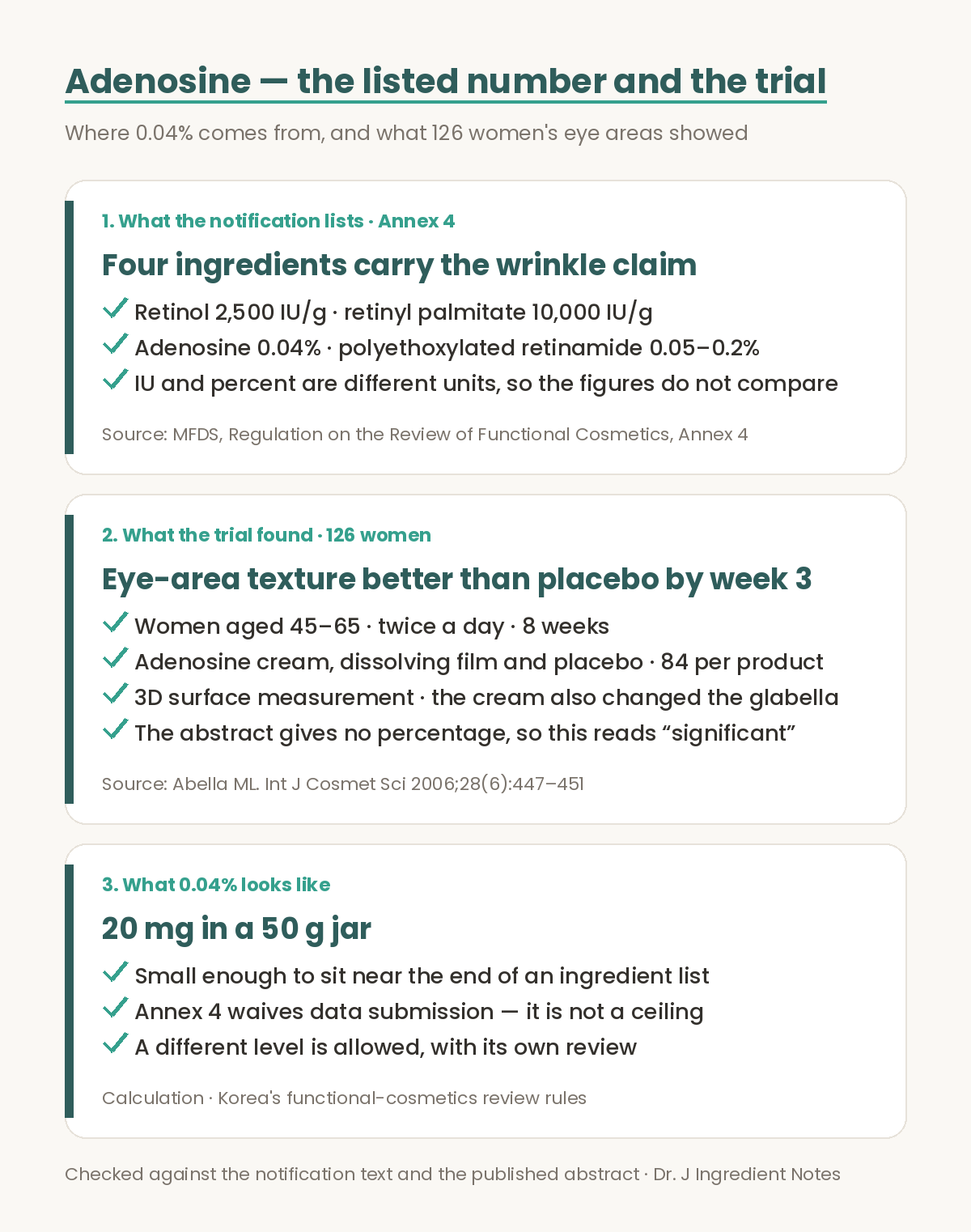
    Evidence figure for adenosine. Annex 4 of Korea's functional-cosmetics review regulation lists four ingredients for the wrinkle claim: retinol at 2,500 IU per gram, retinyl palmitate at 10,000 IU per gram, adenosine at 0.04 percent and polyethoxylated retinamide at 0.05 to 0.2 percent; IU and percent are different units, so the figures do not compare, and because Annex 4 only waives data submission the 0.04 percent is not a ceiling. In a trial of 126 women aged 45 to 65 who applied an adenosine cream, a dissolving film or a placebo around the eyes twice daily for 8 weeks, 84 per product, three-dimensional surface measurement showed eye-area texture significantly better than placebo by week 3 and sustained to week 8, with the cream also changing the glabella, International Journal of Cosmetic Science 2006. 0.04 percent works out at 20 milligrams in a 50 gram jar.

    ――――――――――――――――――――――――――――

    Why every jar says the same thing — what Annex 4 actually is

    Now read the title of the document. Annex 4 is called “Types of functional cosmetics for which data submission is waived.” It is not a table of guaranteed effects. It is a list of formulations that have already been assessed once, so a company matching one does not have to file its own efficacy dossier.

    Route a formulator can take What has to be filed What the label may say
    Match Annex 4 — adenosine at 0.04% efficacy data waived · reporting route wrinkle-improvement functional cosmetic
    A different level, or a different ingredient efficacy and safety data, individual review wrinkle-improvement functional cosmetic
    No listed ingredient, no review — no wrinkle-improvement wording

    So 0.04% is not a ceiling. A company that wants more can have more, provided it brings the evidence and goes through the review. The reason the same figure keeps appearing on the back of the jar is that the first route is lighter, not that the door above it is locked.

    This also settles a question left hanging in the peptide guide. Peptides are nowhere on Annex 4, so a Korean peptide cream carrying the wrinkle wording either contains one of these four listed ingredients as well, or it went through an individual review of its own.

    ――――――――――――――――――――――――――――

    What the trial found — 126 women, around the eyes, 8 weeks

    One human trial sits under all of this. 126 women aged 45 to 65 applied an adenosine product around the eyes twice a day for 8 weeks, comparing an adenosine cream, an adenosine dissolving film and a placebo, with 84 subjects per product.

    Element Detail
    Participants 126 women aged 45–65
    Arms adenosine cream · adenosine dissolving film · placebo, 84 per product
    Site and frequency around the eyes, twice daily, 8 weeks
    Measurement three-dimensional measurement of the skin surface
    Result eye-area texture significantly better than placebo by week 3 · sustained to week 8 · the cream also changed the glabella

    The abstract reports no percentage change, so this guide says “significant” and leaves it there rather than inventing a figure. The number that is worth carrying away is the week 3 mark: the difference appeared inside the first month, which makes 8 weeks a fair window to judge an eye product over.

    ――――――――――――――――――――――――――――

    Why you won’t see 0.04% outside Korea

    If you buy the same category of product in the United States or the European Union, the figure disappears. That is not because the ingredient is treated as weaker there. It is because neither system has a list of pre-cleared wrinkle actives at all, so there is no official level for a label to match.

    Question Korea (MFDS) United States (FDA) European Union
    A list of approved wrinkle actives? Yes — Annex 4, four ingredients at set levels No. Cosmetic products and ingredients need no FDA approval before sale, colour additives excepted No positive list for these actives
    What permits the claim match the listed level, or pass an individual review intended use decides: a claim about appearance stays cosmetic, a claim to affect the structure or function of the body makes it a drug adequate and verifiable evidence under the common criteria of Reg. (EU) 655/2013
    Where the evidence sits with the regulator, before launch with the company; FDA acts after the fact in the Product Information File, open to the authorities
    Does 0.04% mean anything? yes — it is the listed level no regulated meaning no regulated meaning

    One footnote on the American column, because it explains a lot of careful wording on US packaging: the FD&C Act has no category for a cosmetic with drug-like powers, and the FDA says plainly that it “does not recognize any such category as ‘cosmeceuticals.’” So an American anti-wrinkle cream talks about the appearance of lines. A Korean one is allowed to say “wrinkle improvement” outright — because a regulator checked the file first.

    Neither arrangement is strictly better. Korea’s gives you a number you can verify and a claim someone reviewed; the American and European ones leave more room for a formula that does not match any list. What they mean for a shopper is simply different: in Korea, read the claim wording; elsewhere, read the evidence the brand offers.

    ――――――――――――――――――――――――――――

    Using it — an easy ingredient to place

    ✔ Morning or night, either works. After a serum, before a cream

    ✔ Some products carry it alongside retinol. Both are on the same wrinkle list, so they are not a clashing pair

    ✔ There is no ramp-up period to serve. It does not ask for the first-four-weeks routine the retinol guide describes

    ✔ The trial looked at the eye area over 8 weeks. If that is where you’re using it, give it that long

    ✔ Daytime use runs alongside sunscreen — the sunscreen guide’s 2 mg/cm² is the amount that makes that number real

    ――――――――――――――――――――――――――――

    Four things to check when you buy

    Where to look How to read it
    The functional-cosmetic wording On a Korean product this is the tell: it means the listed level was matched, or an individual review was passed. Without it, the wrinkle wording is not allowed
    Where adenosine sits in the list Near the end is normal. Ingredients at 1% or below may be listed in any order, and 0.04% is far below that
    No percentage printed Levels do not have to appear on the label. The claim wording carries that information instead
    Is it made for the eye area That is the site the trial studied. A size and texture suited to the eye area makes 8 weeks of use realistic

    ――――――――――――――――――――――――――――

    In one line

    Adenosine’s 0.04% is a level a regulator set, not one a brand picked — and it is a waiver threshold, not a ceiling. A small number here is not a weak one.

    Next in the series: AHA vs BHA — what actually differs (Ingredient Guide 13). Glycolic acid and salicylic acid are regulated in two different ways, which is where that guide starts. The “1% or below, any order” rule gets its space in Guide 14.

    ――――――――――――――――――――――――――――

    📌 Earlier guides

    📌 Retinol: Start at 0.1% – How to Read the Concentration Numbers (Ingredient Guide 1)

    📌 Skincare Ingredient Compatibility Chart – What to Layer and What to Split

    📌 PDRN (Salmon DNA) Skincare: What a Korean Bio PhD Wants You to Know

    About the author · Dr. J

    MS in Veterinary Medicine, PhD in Life Sciences. I worked as a researcher at the Korea Research Institute of Bioscience and Biotechnology (KRIBB) and now run Beaurea, a cosmetics manufacturing company, where I write the formulas myself. This blog reads the research papers and the regulatory documents and turns them into plain-language criteria for choosing ingredients. I don’t recommend specific products here – only criteria that apply to any product.

    📄 References

    · MFDS, Regulation on the Review of Functional Cosmetics, Annex 4 — types of functional cosmetics for which data submission is waived

    · Abella ML. Int J Cosmet Sci 2006;28(6):447–451 — 126 women aged 45–65, eye area, twice daily, 8 weeks

    · Commission Regulation (EU) No 655/2013 — common criteria for claims used for cosmetic products

    · US FDA, Is It a Cosmetic, a Drug, or Both? (Or Is It Soap?) — FD&C Act secs. 201(i) and 201(g)(1)

    ――――――――――――――――――――――――――――

    This article summarises published research and public regulatory documents. It is information, not a diagnosis or a treatment plan. If something about your skin worries you, please talk to a professional.

    — Dr. J Ingredient Notes