
🇰🇷 한국어판: 화장품 전성분 보는 법 – 1% 이하는 순서가 없다 (성분 백과 ⑭)
Hello, I’m Dr. J. If you are trying to read the ingredient list on a Korean skincare product, here is the rule most guides leave out: ingredients are listed from most to least — but only down to 1%. Below that line, the order is free. This is Ingredient Guide 14.
People often treat the whole list as a ranking and draw conclusions from where something sits. The top of the list does support that. The bottom does not, and the law says so in plain words. Knowing where the ranking stops tells you which parts of a label to read closely and which to read for what is there rather than how much.
The same line runs through the rules in the United States and the European Union, which makes this one of the few label habits that works on a product from almost anywhere. Below, the three sets of rules side by side, plus the one place where Korean labels spell things out: the fragrance allergens.
――――――――――――――――――――――――――――
📄 If you’d rather read the primary sources
📄 Korea — Enforcement Rule of the Cosmetics Act, Annex 4: labelling standards (Korean)
📄 Korea — Annex 2: the 25 fragrance allergens, with CAS numbers (Korean)
📄 Korea — Regulation on Cosmetic Safety Standards, Annex 2: restricted ingredients (Korean)
📄 US — 21 CFR 701.3, designation of ingredients (eCFR)
📄 EU — Regulation (EC) No 1223/2009, Article 19 (EUR-Lex)
📄 EU — Commission Regulation (EU) 2023/1545, the expanded allergen list (EUR-Lex)
🏠 Korean Cosmetic Association ingredient dictionary — paste a name from your label
The two Korean annexes are the ones English-language guides rarely quote. Annex 4 holds the order rule and its 1% proviso; the allergen Annex 2 lists all 25 names.
――――――――――――――――――――――――――――
――――――――――――――――――――――――――――
The short version
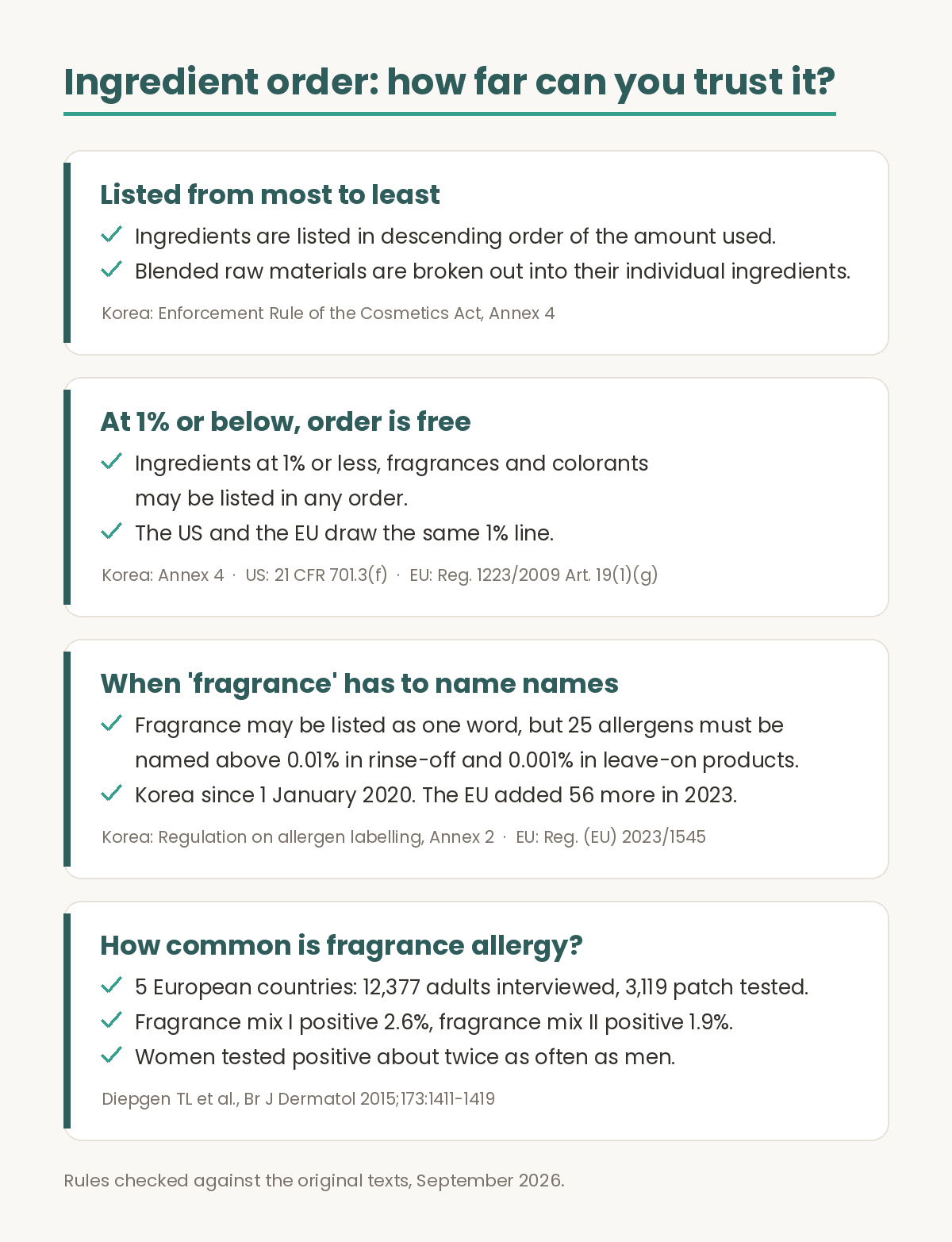
● Ingredients are listed from the largest amount to the smallest
● Ingredients at 1% or less, plus fragrances and colorants, may be listed in any order
● So near the bottom of the list, position does not tell you which is more
● Unfamiliar names after 「fragrance」 are allergens Korea requires by name once they pass a threshold
● The US and the EU draw the same 1% line
――――――――――――――――――――――――――――
Most first — and how far down that holds
Korea’s labelling rules live in Annex 4 of the Enforcement Rule of the Cosmetics Act. The basic instruction is short: list what went into the product starting with the ingredient used in the largest amount. Then come several provisos, and they are what change how you read a label.
| Rule | What the Korean text says | How to read your label |
|---|---|---|
| Basic order | Listed from the ingredient used in the largest amount downward | The first few lines really are in order of amount |
| The 1% proviso | Ingredients used at 1 percent or less, fragrances and colorants may be listed regardless of order | Further down, position no longer tells you which is more |
| Blended raw materials | Each individual ingredient in a blend is named | One raw material can turn into several lines |
| Fragrance | May be listed as 「fragrance」 (향료) | Unless a listed allergen is above the threshold; then it is named too |
| pH adjusters | May be listed as the product of the neutralisation | The name on the label can differ from what went into the tank |
| Colour cosmetics | After 「± or +/-」, all colorants used across the shade range may be listed | A colorant after +/- is not necessarily in your shade |
The second row is the one that matters most. It creates a stretch of the list where the fifth ingredient is not necessarily present in a larger amount than the twelfth. That does not mean the label is wrong. It means the rule stops asking for an order in that stretch.
The pH row explains a small puzzle as well. A formula might use an acid and a base to set the pH, and the label is allowed to show the salt they form instead. If you have ever looked for an ingredient you know is in a product and found a different name, this is one reason.
――――――――――――――――――――――――――――
Where is the 1% line? Clues from the preservative limits
No label marks the 1% point. There are clues, though. Korea’s Regulation on Cosmetic Safety Standards, Annex 2, caps how much of each preservative a product may contain, and several of those caps are at or below 1%.
| Preservative | Korean limit | Note |
|---|---|---|
| Phenoxyethanol | 1.0% | — |
| Benzyl alcohol | 1.0% | 10% when used as a solvent in hair dyes |
| Sorbic acid and its salts | 0.6% | as sorbic acid |
| Benzoic acid and its salts | 0.5% | 2.5% for benzoic acid and its sodium salt in rinse-off products |
| Salicylic acid and its salts | 0.5% | as a preservative; functional-cosmetic limits are separate |
| Parabens | 0.4% single · 0.8% mixed | as acid |
When ingredients like these start to appear, you are probably near or below the 1% line. Fragrance, colorants and thickeners such as carbomer and xanthan gum are usually used below 1% too.
I would not go further than “probably”. A cap is a maximum, not the amount actually used — a product could contain 0.5% phenoxyethanol. From that point down, I stop reading the order and read which ingredients are present.
――――――――――――――――――――――――――――
Behind the word “fragrance” — the 25 allergens Korea names
A fragrance is a blend of many aromatic materials, so it may appear on a label as a single word. Since 1 January 2020, Korea has made an exception. If any of 25 fragrance allergens listed by the Ministry of Food and Drug Safety is above a threshold, it must be named separately after 「fragrance」.
● Rinse-off products — above 0.01%
● Leave-on products — above 0.001%
● Each allergen is judged on its own, not added up with the others (Korean Cosmetic Association guidance)
| 1. Amyl cinnamal | 2. Benzyl alcohol | 3. Cinnamyl alcohol | 4. Citral | 5. Eugenol |
| 6. Hydroxycitronellal | 7. Isoeugenol | 8. Amylcinnamyl alcohol | 9. Benzyl salicylate | 10. Cinnamal |
| 11. Coumarin | 12. Geraniol | 13. Anise alcohol | 14. Benzyl cinnamate | 15. Farnesol |
| 16. Butylphenyl methylpropional | 17. Linalool | 18. Benzyl benzoate | 19. Citronellol | 20. Hexyl cinnamal |
| 21. Limonene | 22. Methyl 2-octynoate | 23. Alpha-isomethyl ionone | 24. Oak moss extract | 25. Tree moss extract |
How common is fragrance allergy? A cross-sectional study across five European countries — Germany, Italy, the Netherlands, Portugal and Sweden — interviewed a random sample of 12,377 adults aged 18 to 74 and patch tested a random subsample of 3,119.
● Fragrance mix I positive: 2.6% (95% CI 2.1–3.2)
● Fragrance mix II positive: 1.9% (95% CI 1.5–2.4)
● Clinically relevant fragrance allergy, estimated conservatively: 1.9%; using a lifetime history of contact dermatitis instead: 0.8%
● Women tested positive about twice as often as men
Diepgen TL et al., British Journal of Dermatology 2015;173:1411-1419
Two or three people in a hundred is not a small number. That is why the extra names after 「fragrance」 are not something hidden — they are something disclosed. If a scent ingredient has bothered you before, keep its name and check it against the label.
――――――――――――――――――――――――――――
Korea, the US and the EU draw the same 1% line
This is not a Korean quirk. Put Korea’s Annex 4 next to the US rule, 21 CFR 701.3, and the EU Cosmetics Regulation, 1223/2009 Article 19, and the structure is almost the same.
| Korea | United States | European Union | |
|---|---|---|---|
| Basic order | Largest amount first | Descending order of predominance | Descending order of weight at the time of addition |
| Below 1% | At 1% or less, plus fragrances and colorants: any order | Not more than 1%: any order, after those above 1%; colour additives last, any order | Less than 1%: any order, after those above 1% |
| Fragrance | 「향료」 (fragrance) | fragrance | parfum · aroma |
| Fragrance allergens | 25 named when above 0.01% rinse-off / 0.001% leave-on, since 1 Jan 2020 | MoCRA (2022) directs FDA to write a rule; as of March 2026 none had been issued | Original 26 plus 56 added by Reg. (EU) 2023/1545, same thresholds; applies to products placed on the market from 31 Jul 2026 |
| Shade ranges | ± or +/- | may contain | may contain or +/- |
Two differences are worth knowing. First, the US and the EU say in so many words that the below-1% ingredients come after the ones above 1%; the Korean text says only “regardless of order”. Second, the EU list of fragrance allergens has grown. Regulation (EU) 2023/1545 kept the original 26 and added 56 more, at the same 0.001% and 0.01% thresholds. Products newly placed on the EU market from 31 July 2026 must comply, and older stock may be sold until 31 July 2028.
In the US, the Modernization of Cosmetics Regulation Act of 2022 directs FDA to set fragrance allergen labelling rules. FDA’s own MoCRA page lists that requirement without a rule attached, and a March 2026 review by the law firm Foley & Lardner reported that none had been issued. For now, a US label may still say “fragrance” and stop.
The practical result: a label follows the rules of the market it was made for. A European product may carry a longer run of named allergens after “parfum” than a Korean one; a US product may carry none. That is a difference in rules, not necessarily in the formula.
――――――――――――――――――――――――――――
Five things to check when you buy
✔ The first few lines — this is the above-1% zone; read it as a ranking
✔ After the first capped preservative — stop comparing amounts by position
✔ Names after 「fragrance」 — check them against any scent ingredient that has bothered you
✔ ± or +/- — in colour cosmetics, colorants after this mark cover the whole shade range, not necessarily yours
✔ Samples of 10 mL or less — Korean rules allow a shorter label; check the full-size product
――――――――――――――――――――――――――――
In one line
The top of the list is a ranking; below 1%, it is a list. Knowing where one turns into the other is half of reading a label.
Next in the series: arbutin and the 2–5% Korea set for brightening claims (Ingredient Guide 15).
――――――――――――――――――――――――――――
📌 Earlier guides
📌 Skincare Ingredient Compatibility Chart – 12 Ingredients
📌 Skin Concern Ingredient Map – Dark Spots, Acne, Pores, Lines
📌 Niacinamide: How Much Is Enough
📌 Salicylic Acid (BHA): 0.5% vs 2%, Explained
📌 Retinol: Start at 0.1% – How to Read the Concentration Numbers
About the author · Dr. J
MS in Veterinary Medicine, PhD in Life Sciences. I worked as a researcher at the Korea Research Institute of Bioscience and Biotechnology (KRIBB) and now run Beaurea, a cosmetics manufacturing company, where I write the formulas myself. This blog reads the research papers and the regulatory documents and turns them into plain-language criteria for choosing ingredients. I don’t recommend specific products here – only criteria that apply to any product.
📄 References
· Korea — Enforcement Rule of the Cosmetics Act, Annex 4: labelling standards and methods
· Korea — Regulation on Precautions for Use and Allergen Labelling of Cosmetics, Annex 2: fragrance allergens
· Korea — Regulation on Cosmetic Safety Standards, Annex 2: restricted ingredients, preservatives
· US — 21 CFR 701.3, Designation of ingredients (eCFR)
· EU — Regulation (EC) No 1223/2009, Art. 19(1)(g); Commission Regulation (EU) 2023/1545 (EUR-Lex)
· US FDA — Modernization of Cosmetics Regulation Act of 2022 (MoCRA) page; Foley & Lardner, “How MoCRA Is Reshaping FDA Oversight of Cosmetics in 2026” (March 2026)
· Diepgen TL et al., Br J Dermatol 2015;173:1411-1419 — fragrance contact allergy in the general population of five European countries
――――――――――――――――――――――――――――
This article summarises regulatory texts and published research. It is information, not a diagnosis or a treatment plan. If something about your skin worries you, please talk to a professional.
— Dr. J Ingredient Notes