Tag: fragrance allergens

  • Fragrance on a Korean Cosmetic Label: The One Word That Needs No Permission, and the One That Does (Ingredient Guide 30)

    Cover image for a guide to how Korean cosmetic labels write fragrance. Article 10 of the Cosmetics Act requires every ingredient used in manufacture to be listed on the package. Annex 4 of the Enforcement Rule then says a fragrance material may be written as the single word fragrance, unless it contains one of the 25 allergens the Minister of Food and Drug Safety has notified, in which case the name itself must be written. The neighbouring item of the same annex is different: to hide any other ingredient a company must submit supporting data to the Minister and, if the Minister accepts that disclosure would seriously harm a legitimate interest, the label may read Other Ingredients. One word needs no permission; the other one does. Dr. J Ingredient Notes cover image.

    🇰🇷 한국어판 (Korean version)

    Hello, this is Dr. J. Today I want to read one entry of a Korean labelling annex line by line, because it answers a question people ask in every market: why does the back of the box say only “fragrance”?

    Here is the part that surprised me. In Korea, “fragrance” is a word you may use without asking anyone. The item sitting immediately beside it in the same annex is the opposite: to hide any other ingredient you have to file supporting data and be told yes.

    ――――――――――――――――――――――――――――

    The provisions, if you want them first

    📄 Enforcement Rule of the Cosmetics Act, Annex 4 (labelling standards and method)

    📄 Cosmetics Act Article 10 and Enforcement Rule Article 19 (Korea Cosmetic Association)

    📄 Regulation (EC) No 1223/2009, Articles 19 and 21

    📄 21 CFR 720.8 — trade secret exemption procedure (eCFR)

    The Korean texts are quoted from the attachment file published by the National Law Information Centre. The English wording below is my own rendering of the Korean; where a phrase matters I give it in quotation marks and name the item it comes from.

    ――――――――――――――――――――――――――――

    ――――――――――――――――――――――――――――

    In five lines

    ✔ The rule is every ingredient used in manufacture — Cosmetics Act Article 10
    ✔ A fragrance material may be written as one word — Annex 4, item 3(e)
    ✔ If a notified allergen is in it, the substance is named instead — the proviso to the same item
    ✔ To hide any other ingredient you file data and wait for acceptance — item 3(g)
    ✔ The EU and the US also use one word — ‘parfum’ / ‘aroma’, and ‘fragrance’

    ――――――――――――――――――――――――――――

    The rule — ten items, and the third one is the list

    Article 10(1) of the Cosmetics Act sets out what a cosmetic package has to carry. There are ten items; the third is where today’s question starts.

    No. What Article 10(1) requires Note
    1 The name of the cosmetic
    2 The trade name and address of the business operator
    3 Every ingredient used in the manufacture of the cosmetic ★ today’s provision
    4 The volume or weight of the contents
    5 The batch number also on the primary container
    6 The use-by date or period after opening also on the primary container (Guide 17)
    7 The price
    8 The words or mark for a functional cosmetic Guide 16
    9 Precautions for use
    10 Anything else the Prime Minister’s Ordinance prescribes Enforcement Rule Article 19(4)

    Article 10(2) names four items that must appear on the primary container — the tube or jar itself: the name, the trade name, the batch number and the use-by date or period after opening. The ingredient list is not among them. It belongs to the outer box, which is why a bare tube often carries no ingredients at all.

    ――――――――――――――――――――――――――――

    Seven items inside one entry — Annex 4 read line by line

    How the ingredients are written is settled by Annex 4 of the Enforcement Rule. Entry 3, “ingredients used in the manufacture of the cosmetic”, holds seven items, (a) to (g). Most articles quote only one of them. Here they all are.

    Item What the provision says What it means in practice
    (a) “The letters shall be at least 5 points in size.” The small print on the back has a floor under it
    (b) “They shall be written in order of decreasing content used in the manufacture of the cosmetic.” With a carve-out: ingredients at 1% or less, fragrance materials and colour materials need not follow the order
    (c) “For a blended raw material, the name of each individual blended ingredient shall be written.” A compound raw material is unpacked into its parts
    (d) “Where a different colour material is used for each shade in colour cosmetics, eye cosmetics, hair dyes or nail products, all the colour materials used may be written together after the mark ‘± or +/-’.” That ± on the back of a lipstick (Guide 24)
    (e) “A fragrance material may be indicated as ‘fragrance’.” ★ today’s one word
    (f) “An ingredient used for the purpose of adjusting pH may be written as the product of the neutralisation reaction instead of the ingredient itself.” What came out is written, not what went in
    (g) “… where it would seriously harm the legitimate interest …, the manufacturer or seller shall submit supporting data …, and where the Minister recognises it, <Other Ingredients> may be written.” ★ today’s neighbouring door

    Four of the seven — (d), (e), (f) and (g) — let the label say something other than the plain ingredient name. Only one of the four asks permission.

    ――――――――――――――――――――――――――――

    The exception is a single sentence

    Enforcement Rule of the Cosmetics Act, Annex 4, entry 3, item (e)

    “A fragrance material may be indicated as ‘fragrance’. However, where the constituents of the fragrance material include an allergen notified by the Minister of Food and Drug Safety, it may not be indicated as fragrance and the name of that substance shall be written.”

    The first sentence is the permission; the second takes part of it back. A fragrance accord is often dozens of materials, and the way they are combined is the house’s own formula. The provision covers that whole area with one word.

    What matters for today is what the sentence does not contain. There is no application, no dossier, no decision. The provision opens the door by itself — and that is exactly where item (g) parts company with it.
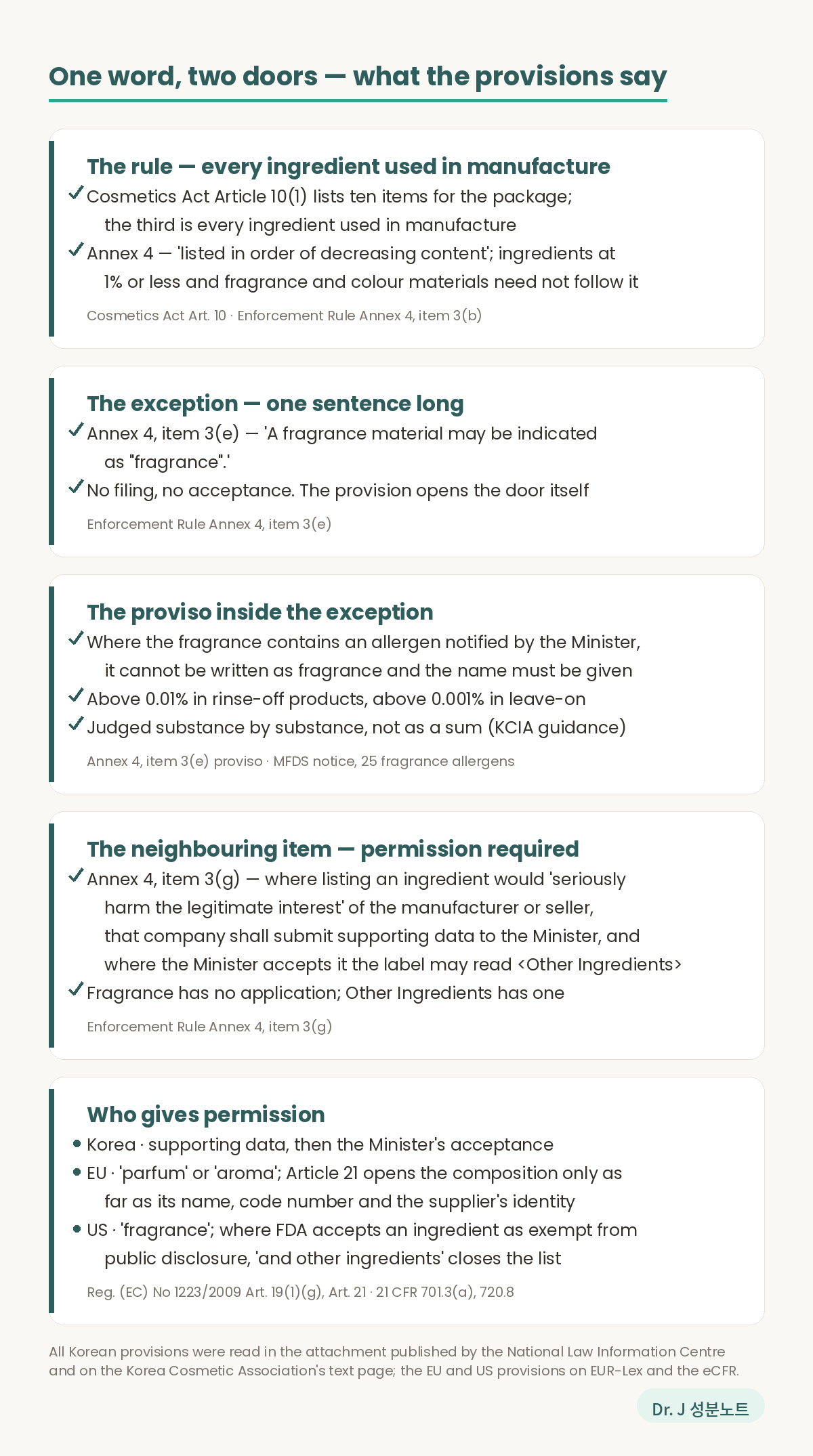
    Evidence card image for the guide to fragrance labelling in Korea. First, the rule. Article 10 paragraph 1 of the Cosmetics Act lists ten items that must appear on a cosmetic package, the third of which is every ingredient used in manufacture, and Annex 4 orders them by decreasing content, except that ingredients at one percent or less and fragrance and colour materials need not follow that order. Second, the exception, which is a single sentence: a fragrance material may be indicated as fragrance. Third, the proviso inside the exception: if the fragrance contains an allergen notified by the Minister of Food and Drug Safety it cannot be written as fragrance and the name of that substance must be written, above 0.01 percent in rinse-off products and above 0.001 percent in leave-on products, judged substance by substance rather than as a sum. Fourth, the neighbouring item. Where listing an ingredient would seriously harm the legitimate interest of the manufacturer or seller, that company must submit supporting data to the Minister, and where the Minister accepts it the label may say Other Ingredients. Fifth, other countries. The European Union writes parfum or aroma under Article 19 of Regulation 1223 of 2009, and the United States writes fragrance under 21 CFR 701.3, with the phrase and other ingredients at the end of the list where the Food and Drug Administration has accepted an ingredient as exempt from public disclosure. All provisions were read in the original texts.

    ――――――――――――――――――――――――――――

    The proviso — when the name has to appear

    Once the proviso bites, “fragrance” is no longer available for that substance and the name itself goes on the label. Korea has notified 25 such substances, and two thresholds decide when they surface.

    Threshold Note
    Rinse-off products above 0.01% body wash, shampoo
    Leave-on products above 0.001% perfume, mist, cream — ten times stricter
    Summed or separate? Separate Korea Cosmetic Association guidance: the figure “refers to the content of each individual substance, so whether to label is judged substance by substance”
    No name on the box does not mean it is absent it may sit under the threshold, or the pack may be small enough to omit
    A name on the box does not mean the product is harsh it means the substance crossed the line and was disclosed

    This is why a perfume or a mist tends to show names like limonene and linalool while a rinse-off product does not. The full list of 25 and the notice behind it are in Ingredient Guide 26.

    ――――――――――――――――――――――――――――

    ★ The neighbouring item — where permission is required

    Item (g) of the same entry is a different road altogether. It is not limited to fragrance: it reaches any ingredient required by Article 10(1)3. What it adds is a condition.

    Enforcement Rule of the Cosmetics Act, Annex 4, entry 3, item (g)

    “Where writing an ingredient under Article 10(1)3 of the Act would seriously harm the legitimate interest of the manufacturer or the seller, the manufacturer or the seller shall submit the supporting data to the Minister of Food and Drug Safety, and where the Minister recognises that the legitimate interest would be harmed, it may be written as <Other Ingredients>.”

    Put the two side by side and the difference is easy to see.

    ‘Fragrance’ — item (e) ‘Other Ingredients’ — item (g)
    Whose permission Nobody’s The Minister of Food and Drug Safety
    What is filed Nothing Supporting data
    What it covers Fragrance materials — scent only Any ingredient under Article 10(1)3 — not limited to scent
    Is there a proviso Yes — the 25 notified allergens None in the text; the acceptance does that work
    What appears on the label fragrance <Other Ingredients>

    So if you ever meet <Other Ingredients> on a Korean box, it is not a gap in the list. It is a line that was argued for and granted. “Fragrance”, by contrast, was there for the taking.

    ⚠ One oddity worth flagging: item (g) still uses the term “manufacturing and selling business operator”, which the Act itself replaced some years ago with “cosmetics responsible distributor”. I could not establish when the annex was last amended, so I have quoted it as it stands.

    ――――――――――――――――――――――――――――

    And some ingredients are not written at all

    “Fragrance” and “Other Ingredients” both rename something. Article 19(2) of the Enforcement Rule does something else again: it lets certain ingredients be left off.

    No. What the provision says Note
    1 “An ingredient that is removed during the manufacturing process and does not remain in the final product” It is not in the product, so it is not on the label
    2 “An incidental ingredient contained in the raw material itself, such as a stabiliser or a preservative, present in a quantity smaller than that which produces its effect” Carried in with a raw material
    3 For packaging of a cosmetic “exceeding 10 millilitres and not exceeding 50 millilitres, or exceeding 10 grams and not exceeding 50 grams”, ingredients other than those listed The exceptions still appear: tar colours, gold leaf, the phosphates in shampoo and rinse, fruit acids (AHA), the efficacy ingredient of a functional cosmetic, and any raw material for which a blending limit has been notified

    Article 19(5) then requires a way back to the full list: either “a telephone number or website address shall be written on the packaging so that consumers can immediately check all the ingredients”, or “printed matter such as a booklet carrying all the ingredients shall be kept at the point of sale at all times”.

    That is why a 30 mL travel size can carry a startlingly short list. It is an abbreviation with a published key, not a secret.

    ――――――――――――――――――――――――――――

    Who gives permission — Korea, the EU and the United States

    Writing scent as one word is not a Korean peculiarity. All three systems do it. What differs is the door next to it.

    Korea EU United States
    The word on the label “fragrance” (Annex 4, item 3(e)) ‘parfum’ or ‘aroma’ — “Perfume and aromatic compositions and their raw materials shall be referred to by the terms ‘parfum’ or ‘aroma’.” (Art. 19(1)(g)) ‘fragrance’ — “except that fragrance or flavor may be listed as fragrance or flavor.” (21 CFR 701.3(a))
    When a name must surface 25 notified allergens above 0.01% / 0.001% Substances whose mention is required under the “Other” column of Annex III (same article) I did not find an equivalent provision while writing this
    Hiding any other ingredient Supporting data → the Minister’s recognition → <Other Ingredients> (item 3(g)) I did not find a labelling omission procedure in the body of the Regulation Where FDA accepts an ingredient as exempt from public disclosure, “the phrase ‘and other ingredients’ may be used at the end of the ingredient declaration” (701.3(a); procedure at § 720.8)
    Order of the list Decreasing content; 1% or less, fragrance and colour materials are free of it “Ingredients in concentrations of less than 1 % may be listed in any order after those in concentrations of more than 1 %.” Ingredients at 1% or less, and colour additives, may be listed without respect to order
    How far disclosure goes The list on the pack; omitted ingredients via phone, website or an in-store booklet Article 21 — “Without prejudice to the protection, in particular, of commercial secrecy …”, and for a fragrance composition the public gets the name and code number of the composition and the identity of the supplier § 720.8(a) describes data “submitted voluntarily to the Food and Drug Administration”

    Read across the last two rows and the axis appears. Every one of the three lets scent be one word; what separates them is who has to say yes before anything else can be hidden. Korea routes it through the Minister, the United States through an FDA acceptance tied to a voluntary filing programme, and the EU handles the same pressure not at the label at all but at the edge of public access — the composition is disclosed as a name, a code number and a supplier.

    For a brand selling into Korea there is a practical consequence. The fragrance word is free, and the other door is paperwork. If a formula depends on keeping one non-fragrance ingredient off the list, that is a filing to plan for, not a labelling style to choose.

    ――――――――――――――――――――――――――――

    Four things to check on the box

    ✔ Find the single word “fragrance” near the end of the list
    ✔ If unfamiliar names sit beside it, they are among the 25 — disclosed because they crossed a threshold
    ✔ An absent name does not mean an absent substance — it may be under the threshold, or the pack may be small
    ✔ <Other Ingredients> means a filing was made and accepted

    ――――――――――――――――――――――――――――

    One line

    “Fragrance” is not a secret kept; it is a bundle the rule allows. “Other Ingredients” is a bundle someone had to ask for. If a particular scent material has bothered your skin before, write the name down and read for it — the 25 are there precisely so that you can.

    ――――――――――――――――――――――――――――

    What I did not write, and why

    ✔ The names and CAS numbers of the 25 allergens — they are already set out in Ingredient Guide 26, so I linked rather than repeated
    ✔ A product that actually carries <Other Ingredients> — I found no example, so I have described the road and stopped there
    ✔ Whether the EU retains a confidentiality route for the label — I did not find one in the body of Regulation 1223/2009, and I could not open the corresponding provision of the former Directive, so I am not claiming that none exists
    ✔ The full text of 21 CFR § 720.8 — I read paragraph (a) and did not read (b) to (g)
    ✔ The amendment history of Annex 4 — which would explain the superseded term in item (g)
    ✔ Claims that “more fragrance names means harsher” — no primary source supports that reading

    About the author · Dr. J

    MS in Veterinary Medicine, PhD in Life Sciences. I worked as a researcher at the Korea Research Institute of Bioscience and Biotechnology (KRIBB) and now run Beaurea, a cosmetics manufacturing company, where I write the formulas myself. This blog reads the research papers and the regulatory documents and turns them into plain-language criteria for choosing ingredients. I don’t recommend specific products here – only criteria that apply to any product.

    📌 Related posts

    📌 Korea’s 25 Fragrance Allergens (Ingredient Guide 26) — the proviso in full, with the list

    📌 How to Read a Korean Cosmetic Ingredient List (Guide 14) — where the order stops at 1%

    📌 Cosmetic Color Additives in Korea (Guide 24) — the neighbouring item, and that ± mark

    📌 Preservative Limits in Korean Cosmetics (Guide 25) — another place where one grouped name carries many substances

    📄 References

    · Cosmetics Act (Korea), Article 10 — paragraph 1, items 1 to 10; paragraph 2, the primary container
    · Enforcement Rule of the Cosmetics Act, Article 19 (paragraphs 2 and 5) and Annex 4, entry 3, items (a) to (g)
    · Notice on precautions for use and labelling of fragrance allergens, Annex 2 · Korea Cosmetic Association ingredient dictionary Q&A
    · Regulation (EC) No 1223/2009, Article 19(1)(g) and Article 21
    · 21 CFR 701.3(a) and 21 CFR 720.8(a)

    ――――――――――――――――――――――――――――

    This article summarises statutes and notices and does not replace diagnosis or treatment. The Korean provisions were opened on the day of writing in the attachment published by the National Law Information Centre and on the Korea Cosmetic Association’s text page; the EU and US provisions on EUR-Lex and the eCFR. Item 3(g) is quoted with the superseded term it still carries. English renderings of the Korean text are mine and are offered for reading, not as an official translation.

    — Dr. J Ingredient Notes
  • Korea’s 25 Fragrance Allergens: When a Name Has to Leave the Word Fragrance (Ingredient Guide 26)

    Cover image for a Dr. J Ingredient Notes article on fragrance allergen labelling in Korea. The Cosmetics Act requires every ingredient to be listed on the package, and the Enforcement Rule allows a perfuming agent to be written as the single word fragrance. When the perfuming agent contains one of the 25 fragrance allergens named in a ministry notice, that word is not enough and the substance must be named. The thresholds are above 0.01 percent in rinse-off products and above 0.001 percent in leave-on products, judged for each substance rather than on the total.

    🇰🇷 한국어판

    Hello, this is Dr. J. Today: Korea’s 25 fragrance allergens, and the rule that decides when one of them stops hiding inside the word fragrance and gets a name of its own on the box.

    Start with the thing most guides skip. A long tail of unfamiliar names after fragrance does not mean the product is heavily perfumed. It means something in the perfume crossed a labelling threshold. The names are not a leak. They are the rule working.

    ――――――――――――――――――――――――――――

    Primary sources first

    📄 Cosmetics Act Article 10 (Korea Cosmetic Association)

    📄 Annex 2, fragrance allergens (Korean Law Information Center)

    📄 Labelling Q&A (Korea Cosmetic Association)

    📄 Regulation (EU) 2023/1545 (EUR-Lex)

    ――――――――――――――――――――――――――――

    ――――――――――――――――――――――――――――

    Five lines, if you are in a hurry

    ✔ A perfuming agent may be written as the single word fragrance

    ✔ But if it contains one of the listed 25, that substance must be named

    ✔ Thresholds: above 0.01% in rinse-off, above 0.001% in leave-on products

    ✔ Judged per substance, never on the sum of them

    ✔ The EU uses the same two figures — and its list is getting much longer

    ――――――――――――――――――――――――――――

    Why a name leaves the word fragrance — a rule in three tiers

    Korean guides usually explain the third tier alone, which makes the rule look arbitrary. It is not. It is a principle, an exception, and a proviso inside the exception.

    Tier What it says Source
    Principle The package lists every ingredient used in manufacturing Cosmetics Act Art. 10(1), item 3
    Exception A perfuming agent may be written as the single word fragrance Enforcement Rule Annex 4 (labelling standards and methods)
    Proviso If the perfuming agent contains a fragrance allergen listed by the ministry, the single word is not enough and the substance must be named Same Annex 4 · MFDS notice Annex 2

    A fragrance is not one ingredient but dozens blended together, which is why the middle tier exists at all. The proviso has applied to products manufactured or imported since 1 January 2020.

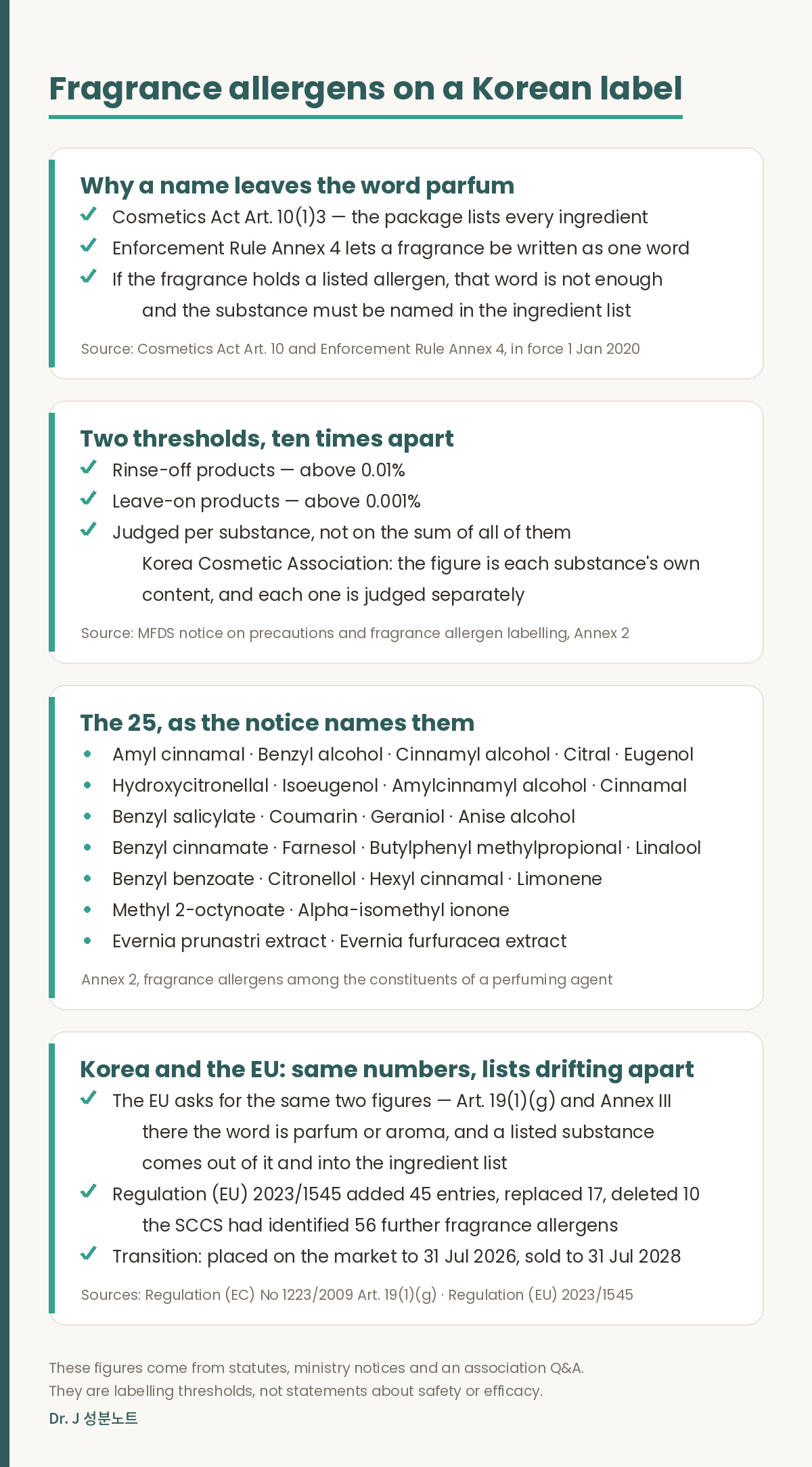
    Evidence figure for an article on fragrance allergen labelling in Korea. First, Cosmetics Act Article 10 paragraph 1 item 3 requires the package to list every ingredient used, Enforcement Rule Annex 4 allows a perfuming agent to be written as one word, and a listed allergen inside that perfuming agent must be named separately; the rule has been in force since 1 January 2020. Second, there are two thresholds ten times apart: above 0.01 percent in rinse-off products and above 0.001 percent in leave-on products, judged per substance rather than on the sum, as the Korea Cosmetic Association question and answer states. Third, the 25 substances are amyl cinnamal, benzyl alcohol, cinnamyl alcohol, citral, eugenol, hydroxycitronellal, isoeugenol, amylcinnamyl alcohol, benzyl salicylate, cinnamal, coumarin, geraniol, anise alcohol, benzyl cinnamate, farnesol, butylphenyl methylpropional, linalool, benzyl benzoate, citronellol, hexyl cinnamal, limonene, methyl 2-octynoate, alpha-isomethyl ionone, evernia prunastri extract and evernia furfuracea extract. Fourth, Korea and the European Union use the same two figures but their lists are drifting apart: the EU works through Article 19 paragraph 1 point g and Annex III of Regulation 1223/2009, and Regulation 2023/1545 added 45 entries, replaced 17 and deleted 10 after the scientific committee identified 56 further fragrance allergens, with a transition until 31 July 2026 for placing on the market and 31 July 2028 for sale.

    ――――――――――――――――――――――――――――

    Two thresholds, ten times apart

    ✔ Rinse-off products — above 0.01%

    ✔ Leave-on products — above 0.001%

    The leave-on figure is ten times lower because the product stays on the skin. That is why perfumes, mists and body lotions carry longer allergen tails than a body wash does.

    One point is easy to get wrong: the figures are not a combined total. The Korea Cosmetic Association’s Q&A puts it plainly — the figure refers to the content of each individual substance, and each is judged on its own. Five allergens at low levels are five separate decisions, not one sum.

    The denominator is the net content of the product. In a 250 g body lotion, 0.05 g of limonene is about 0.02% — over the line, so limonene is named.

    ――――――――――――――――――――――――――――

    The 25, as the notice names them

    # #
    1  Amyl cinnamal 2  Benzyl alcohol
    3  Cinnamyl alcohol 4  Citral
    5  Eugenol 6  Hydroxycitronellal
    7  Isoeugenol 8  Amylcinnamyl alcohol
    9  Benzyl salicylate 10  Cinnamal
    11  Coumarin 12  Geraniol
    13  Anise alcohol 14  Benzyl cinnamate
    15  Farnesol 16  Butylphenyl methylpropional
    17  Linalool 18  Benzyl benzoate
    19  Citronellol 20  Hexyl cinnamal
    21  Limonene 22  Methyl 2-octynoate
    23  Alpha-isomethyl ionone 24  Evernia prunastri (oak moss) extract
    25  Evernia furfuracea (tree moss) extract

    Entries 24 and 25 are not single molecules but botanical extracts. The notice sets no order or format for where the names go; the association recommends following the ordinary ingredient-list method, and the ministry has said that pulling allergens out into a separate block of their own is not appropriate, because it suggests those substances alone are a problem.

    ――――――――――――――――――――――――――――

    When nothing is named

    Situation Why What follows
    Below the threshold Under 0.01% / 0.001% there is no duty to name The substance can be present and still invisible on the box
    Small packages Net content of 10–50 mL (g) leaves no room The listing may be omitted, but the information must be findable on the company’s website
    Online listings — The ingredient list shown on a sales page must carry the allergens too
    Raw material reporting — Allergens that appear on the label are included in the annual raw material report

    So an absent name does not mean an absent substance — and a present name does not mean a bad one. It means a threshold was crossed and the rule asked for daylight.

    There is Korean market data on how this plays out. The Seoul Institute of Health and Environment tested 106 fragranced cosmetics on sale in the city — 85 leave-on (perfume, body mist, body cream, hand cream) and 21 rinse-off (body wash) — screening for 23 of the allergens by GC-MS. One body mist failed the coumarin labelling requirement and was referred for administrative action; the other 105 complied. Measured levels ran from not detected up to about 1.5%.

    ――――――――――――――――――――――――――――

    Korea and the EU: the same two numbers, lists drifting apart

    This is the part worth knowing if you buy Korean products abroad, or sell them there.

    Korea European Union
    Legal basis Cosmetics Act Art. 10 · Enforcement Rule Annex 4 · MFDS notice Annex 2 Regulation (EC) No 1223/2009 Art. 19(1)(g) · Annex III
    The single word fragrance 「Perfume and aromatic compositions and their raw materials shall be referred to by the terms ‘parfum’ or ‘aroma’」
    What comes out of it the 25 substances in Annex 2 「the presence of substances, the mention of which is required under the column ‘Other’ in Annex III」
    Thresholds above 0.01% rinse-off · above 0.001% leave-on the same — 「0,01 % in rinse-off products」 · 「0,001 % in leave-on products」
    Most recent change Annex 2 still stands as amended on 16 December 2019 Regulation (EU) 2023/1545 added 45 entries to Annex III, replaced 17 and deleted 10, after the SCCS identified 56 further fragrance allergens
    Transition — non-compliant products may be placed on the market until 31 July 2026 and sold until 31 July 2028

    Read that last row together with the one above it. From August 2026, the same formula will need a longer allergen list in Brussels than it needs in Seoul. A short tail on a Korean box is not a cleaner perfume, and a long tail on a European one is not a heavier one. The two lists are simply different lengths, and only one of them has just grown.

    The EU also folded in prehaptens and prohaptens — substances that become allergens after air oxidation or metabolism on the skin — and grouped similar substances under shared names to make the labels readable. Korea’s notice has not taken that step.

    ――――――――――――――――――――――――――――

    What to check on the box

    ✔ Look at the tail end of the ingredient list, around the word fragrance

    ✔ A leave-on product showing more names than a rinse-off one is the rule working, not a warning

    ✔ If a scent has stung before, write down that one name and compare boxes

    ✔ On a small bottle with no names, check the brand’s own website listing

    ――――――――――――――――――――――――――――

    In one line

    A name after the word fragrance is not something that slipped out — it is something the rule pulled out. The thresholds are 0.01% and 0.001%, and each substance is judged on its own.

    What I left out, and why

    ✔ CAS numbers for the 25 — the Korean Law Information Center was unreachable the day this was written, so Annex 2 itself could not be opened. The names are taken from two trade publications that match character for character; the numbers are omitted rather than guessed

    ✔ Verbatim text of Enforcement Rule Annex 4 — same reason: the substance of the provision is given, but not in quotation marks

    ✔ The EU’s own list of substances — Annex III tables do not come through in the consolidated text. Only the entry counts stated by the amending regulation are given

    ✔ The current Korean status of butylphenyl methylpropional (Lilial) — the EU moved it to the prohibited annex in 2022. Korea’s prohibited-ingredient annex could not be opened, so whether it may still be used here is not stated either way

    ✔ Prevalence figures for individual allergens — no primary studies were opened for this article, so none are quoted

    ――――――――――――――――――――――――――――

    📌 Earlier guides

    📌 How to Read a Korean Cosmetic Ingredient List (Ingredient Guide 14) — where the order stops at 1%

    📌 Ceramides: cholesterol and fatty acid ratio (Ingredient Guide 4)

    📌 Panthenol: What the Dexpanthenol Studies Show (Ingredient Guide 7)

    📌 Skin Concern Ingredient Map

    About the author · Dr. J

    MS in Veterinary Medicine, PhD in Life Sciences. I worked as a researcher at the Korea Research Institute of Bioscience and Biotechnology (KRIBB) and now run Beaurea, a cosmetics manufacturing company, where I write the formulas myself. This blog reads the research papers and the regulatory documents and turns them into plain-language criteria for choosing ingredients. I don’t recommend specific products here – only criteria that apply to any product.

    📄 Sources

    · Cosmetics Act (Korea), Article 10 · Enforcement Rule, Annex 4 (labelling standards and methods)

    · MFDS notice, Precautions for Use of Cosmetics and Labelling of Fragrance Allergens, Annex 2

    · Korea Cosmetic Association, ingredient dictionary Q&A on allergen labelling

    · MFDS guidance on labelling fragrance allergens (via trade press reporting)

    · Seoul Institute of Health and Environment, survey of 106 fragranced cosmetics

    · Regulation (EC) No 1223/2009, Article 19(1)(g) · Regulation (EU) 2023/1545

    ――――――――――――――――――――――――――――

    This article summarises statutes and ministry notices and is not a substitute for diagnosis or treatment. The Korean Law Information Center was unreachable the day it was written, so the 25 names were cross-checked against an association Q&A and two trade publications, and CAS numbers and verbatim provisions were left out. EU material is taken from the current public text on EUR-Lex.

    — Dr. J Ingredient Notes

  • Children’s Cosmetics in Korea: What the Label Triggers, and Why the Box Prints a Preservative Percentage (Ingredient Guide 20)

    Cover image for a guide to Korea's rules for children's cosmetics, Ingredient Guide 20 from Dr. J Ingredient Notes. Infants are three years of age and under and children are four to thirteen, and once a product says so on the label three rules follow.

    🇰🇷 한국어판: 어린이 화장품 기준 – 「어린이용」이라 적으면 따라오는 것, 그리고 상자의 보존제 함량

    Hello, this is Dr. J. Today I want to read Korea’s rules for children’s cosmetics straight from the statute, because one of them changes what is printed on the box.

    Most countries regulate what may go into a product for a child. Korea does that too, but it adds something unusual: once a product says it is for children, the outer package has to carry the amount of preservative in it, as a number, separate from the ingredient list. I have not found that requirement anywhere else.

    And the trigger is not the formula. It is the label. That is the part worth understanding first, so let me start there.

    ――――――――――――――――――――――――――――

    The sources, if you would rather read them first

    📄 Korea Ministry of Government Legislation — cosmetics for infants and children — the age brackets and the three documents

    📄 Safety Standards for Cosmetics, Annex 2 — the entries that carry an age condition

    📄 Commission Regulation (EU) No 1004/2014 — parabens and the nappy area

    📄 US FDA — Summary of Cosmetics Labeling Requirements — what a US label has to carry

    The Korean annexes open as attachment files, so the text comes up directly rather than through a search form.

    ――――――――――――――――――――――――――――

    ――――――――――――――――――――――――――――

    Five lines, if you are in a hurry

    ✔ Korean law splits the two groups by age — an infant is 3 and under, a child is 4 to 13

    ✔ The rules attach the moment the package, the product name or an advertisement says the product is for them

    ✔ Three safety documents must be written and kept, for a year past the expiry date or three years past the manufacturing date

    ✔ The outer package gains one line — the content of the preservatives, printed apart from the ingredient list

    ✔ Salicylic acid and iodopropynyl butylcarbamate step out of products labelled for under-13s

    ――――――――――――――――――――――――――――

    Two age groups, written into the statute

    Article 4-2 of the Cosmetics Act and Article 10-2 of its Enforcement Rule define the two groups by age. An infant is three years of age and under. A child is four to thirteen.

    The upper bound is worth noticing. Thirteen takes in primary-school age, so a lotion or a lip balm marketed to a nine-year-old sits inside the same rules as a baby lotion. In several other markets the special category stops at three.

    ――――――――――――――――――――――――――――

    The rule starts at the label, not at the formula

    This is the part that surprises people. The obligations do not attach because of what is in the bottle. They attach because of what the company says about who it is for.

    Where What makes the rules attach
    Packaging The inner or outer package states, specifically, that the product may be used by an infant or a child
    Product name The name of the cosmetic itself carries a reference to infants or children — the name alone is enough
    Advertising Newspapers, broadcast, magazines, the internet, posters and signboards, video or film, stating it specifically

    So a very mild formula with no such wording stays outside the rules, and an ordinary formula with the wording falls inside them. The word the statute uses is “specifically”: a vague impression that a child might use it is not the test — naming the group is.

    ※ This is why the phrase on the front of a Korean box is a regulatory statement rather than a marketing flourish.

    ――――――――――――――――――――――――――――

    Three documents, and how long they are kept

    Once that wording is used, the responsible distributor has to prepare and keep product-specific safety documentation. Enforcement Rule Article 10-3 lists three items and sets the retention period.

    Document Content Kept until
    ① Product and method A description of the product and of how it is manufactured Products labelled with an expiry date — one year after the expiry date of the last batch made or imported

    Products labelled with a period after opening — three years after the manufacturing date of the last batch
    ② Safety assessment A safety assessment of the cosmetic product
    ③ Evidence of effect Evidence for the efficacy or effect claimed for the product

    The retention clock keeps running after the product has left the shelves — a year past the expiry date of the final batch. Failure to prepare or keep the documents carries up to one year of imprisonment or a fine of up to ten million won, and a company can be fined alongside the individual.

    ※ A shopper cannot ask to see this file. What is useful to know is that the phrase “for children” on a Korean box has a dossier sitting behind it.

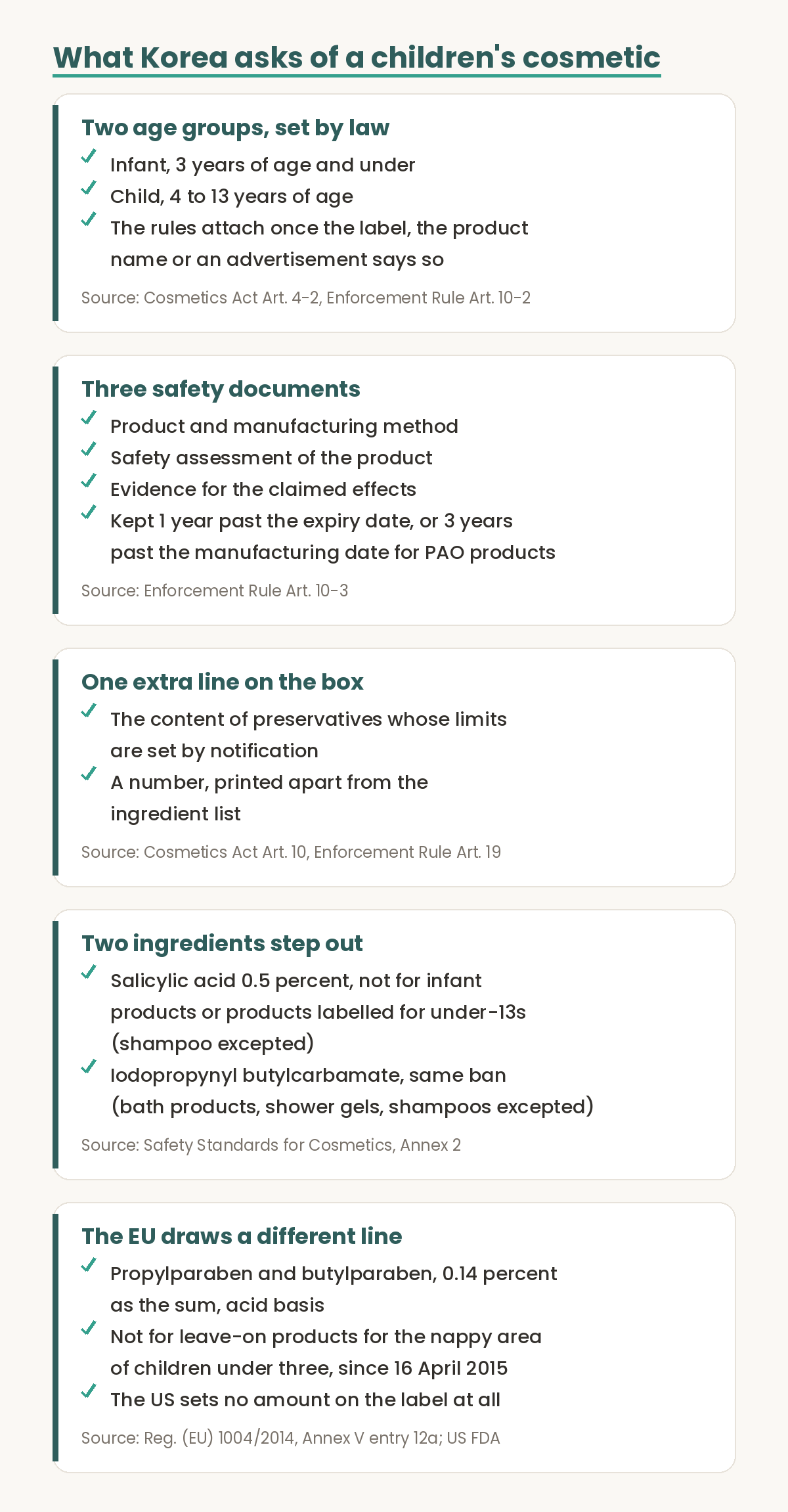
    Chart of what Korea asks of a children's cosmetic. First, two age groups set by law: an infant is three years of age and under, a child is four to thirteen, and the rules attach once the label, the product name or an advertisement says so, under Cosmetics Act Article 4-2 and Enforcement Rule Article 10-2. Second, three safety documents: the product and its manufacturing method, a safety assessment of the product, and evidence for the claimed effects, kept one year past the expiry date or three years past the manufacturing date for products labelled with a period after opening, under Enforcement Rule Article 10-3. Third, one extra line on the box: the content of preservatives whose limits are set by notification, printed as a number apart from the ingredient list, under Cosmetics Act Article 10 and Enforcement Rule Article 19. Fourth, two ingredients step out: salicylic acid at 0.5 percent is not allowed in infant products or products labelled for under-thirteens, shampoo excepted, and iodopropynyl butylcarbamate carries the same ban with bath products, shower gels and shampoos excepted, under Annex 2 of the Safety Standards for Cosmetics. Fifth, the European Union draws a different line: propylparaben and butylparaben are capped at 0.14 percent as the sum on an acid basis and are not for leave-on products for the nappy area of children under three since 16 April 2015, under Regulation 1004/2014 Annex V entry 12a, while the United States sets no amount on the label at all.

    ――――――――――――――――――――――――――――

    One extra line on the box — the preservative content

    Here is the part a shopper can actually see. Where a product is labelled or advertised specifically for infants or children, the outer package must carry “the content of preservatives among the raw materials whose standards of use are designated and published”.

    Compare that with the ordinary ingredient list. Ingredients are listed in order of how much is present, and in Korea anything at or below 1% may be listed in any order. No amounts appear. On a children’s product, the preservatives come back with a number attached — “phenoxyethanol 0.4%”, printed in its own line.

    Two things follow from that line. First, its presence tells you the product is formally labelled for children. Second, it tells you which preservative is in there and how much. If no preservative is used, there is nothing to declare and the line is simply absent.

    ※ The basis is Article 10 of the Act with Article 19 of the Enforcement Rule. Look for it beside the ingredient list, not inside it.

    ――――――――――――――――――――――――――――

    Two ingredients that step out

    Annex 2 of the Safety Standards for Cosmetics sets a maximum for each restricted raw material. Two of those entries carry an age condition, and I opened both.

    Ingredient Limit Age condition
    Salicylic acid and its salts 0.5% as salicylic acid Not to be used in products for infants, or in products labelled specifically as usable by children aged 13 or under
    (shampoo excepted)
    Iodopropynyl butylcarbamate (IPBC) 0.02% rinse-off · 0.01% leave-on · 0.0075% in deodorants The same prohibition
    (bath products, shower gels and shampoos excepted)

    Read the two columns together. 0.5% is the adult ceiling; in a children’s product the ingredient is not permitted at all, not permitted at a lower level. The exceptions in brackets follow the same logic in reverse — products that are rinsed off are treated differently from products that stay on the skin.

    ――――――――――――――――――――――――――――

    Fragrance allergens: 25 names, the same thresholds

    If a Korean ingredient list ends with limonene, linalool, citronellol and a few more, those are the fragrance allergens that must be named separately rather than hidden inside “fragrance”. There are 25 of them.

    The thresholds are above 0.01% in rinse-off products and above 0.001% in leave-on products. They are not lowered for children’s products — the annex carries no age clause at all.

    ※ A long tail of names is disclosure, not concealment. For a child who reacts to fragrance, that tail is the part of the label worth reading.

    ――――――――――――――――――――――――――――

    Korea, the EU and the US, side by side

    Three regulators, three different places to put the line. Korea hangs its rules on the label, the EU writes age into individual ingredient entries, and the US asks for no amounts on the label at all.

    Where What applies to a children’s product Source
    Korea Infant 3 and under, child 4 to 13. Label or advertise it as such and three safety documents follow, plus the preservative content printed on the package Cosmetics Act Art. 4-2, Art. 10
    Enforcement Rule Art. 10-2, 10-3, 19
    European Union Propylparaben and butylparaben capped at 0.14% as the sum (as acid), and “not to be used in leave-on products designed for application on the nappy area of children under three years of age”; such products carry “Do not use on the nappy area” Reg. (EU) No 1004/2014
    Annex V entry 12a, applying from 16 April 2015
    United States “The ingredients must be declared in descending order of predominance”, and “color additives and ingredients present at one percent or less may be declared without regard for predominance”. No amount has to be shown US FDA, Summary of Cosmetics Labeling Requirements

    The contrast worth taking away is the middle column of the first row. A Korean children’s box tells you how much preservative is in the product. A European or American one does not, however carefully it is labelled otherwise.

    ――――――――――――――――――――――――――――

    What to check on the box

    ✔ Does the package say, in so many words, that it is for children? That is what puts it inside these rules

    ✔ Is there a preservative line separate from the ingredient list, and which preservative is named

    ✔ If salicylic acid appears, is the product one that gets rinsed off

    ✔ For a child who reacts to scent, read the names after “fragrance”

    ✔ Is the expiry date on the container itself, which survives after the box is thrown away

    ※ A printed line is easier to verify than a claim such as “no preservatives”. Choose on what is written.

    ――――――――――――――――――――――――――――

    What I left out, and why

    ✔ Whether Korea restricts parabens by age. The EU does. In the extract of Annex 2 I was able to open, the paraben entries carried no age condition — but I could not confirm the full entry, so I am not claiming Korea has no such rule

    ✔ The sub-paragraph numbers for the preservative-content requirement. Different official sources number it differently, so I cite the Act’s Article 10 with Article 19 of the Enforcement Rule and stop there

    ✔ “Baby products should be fragrance-free and preservative-free.” There is no primary source for that as a rule, and removing preservatives moves the microbiological question elsewhere rather than removing it

    ✔ Product names. This blog does not recommend particular products

    ――――――――――――――――――――――――――――

    In one line

    In Korea, the rules for a children’s cosmetic begin with the words on the label, not with the formula inside. Say it, and a dossier follows — and the box gains a line telling you how much preservative is in there.

    Next in this series: what a “vegan” claim on a cosmetic certifies, which in Korea runs through an industry self-review rather than a government mark — a companion to the organic and natural guide (Ingredient Guide 21).

    📌 Earlier guides

    📌 How to Read a Korean Cosmetic Ingredient List (Guide 14)

    📌 Salicylic Acid (BHA): 0.5% vs 2%, Explained (Guide 8)

    📌 Ceramides: the Cholesterol and Fatty Acid Ratio (Guide 4)

    📌 Niacinamide: How Much Is Enough (Guide 2)

    About the author · Dr. J

    MS in Veterinary Medicine, PhD in Life Sciences. I worked as a researcher at the Korea Research Institute of Bioscience and Biotechnology (KRIBB) and now run Beaurea, a cosmetics manufacturing company, where I write the formulas myself. This blog reads the research papers and the regulatory documents and turns them into plain-language criteria for choosing ingredients. I don’t recommend specific products here – only criteria that apply to any product.

    📄 References

    · Cosmetics Act of Korea, Articles 4-2 and 10

    · Enforcement Rule of the Cosmetics Act, Articles 10-2, 10-3 and 19

    · Safety Standards for Cosmetics, Annex 2 (restricted raw materials)

    · Notification on precautions and fragrance allergen labelling, Annex 2 (25 substances)

    · Commission Regulation (EU) No 1004/2014, Annex Ⅴ entry 12a

    · U.S. FDA, Summary of Cosmetics Labeling Requirements

    ――――――――――――――――――――――――――――

    This article summarises public statutes and regulatory documents and is not a substitute for diagnosis or treatment. Quoted sentences are as they appear in the law and the notifications, and labelling practice varies between products. If a child’s skin reacts, stop using the product and speak to a professional.

    — Dr. J Ingredient Notes

  • How to Read a Korean Cosmetic Ingredient List — Where the Order Stops at 1%, and the 25 Fragrance Allergens Behind “Fragrance” (Ingredient Guide 14)

    Cover image for a Dr. J Ingredient Notes guide on how to read a cosmetic ingredient list, ingredient guide 14. Ingredients are listed from the largest amount to the smallest, but ingredients at 1 percent or less, fragrances and colorants may be listed in any order in Korea, and the United States and the European Union draw the same 1 percent line. The guide also covers the 25 fragrance allergens that Korea requires to be named on the label.

    🇰🇷 한국어판: 화장품 전성분 보는 법 – 1% 이하는 순서가 없다 (성분 백과 ⑭)

    Hello, I’m Dr. J. If you are trying to read the ingredient list on a Korean skincare product, here is the rule most guides leave out: ingredients are listed from most to least — but only down to 1%. Below that line, the order is free. This is Ingredient Guide 14.

    People often treat the whole list as a ranking and draw conclusions from where something sits. The top of the list does support that. The bottom does not, and the law says so in plain words. Knowing where the ranking stops tells you which parts of a label to read closely and which to read for what is there rather than how much.

    The same line runs through the rules in the United States and the European Union, which makes this one of the few label habits that works on a product from almost anywhere. Below, the three sets of rules side by side, plus the one place where Korean labels spell things out: the fragrance allergens.

    ――――――――――――――――――――――――――――

    📄 If you’d rather read the primary sources

    📄 Korea — Enforcement Rule of the Cosmetics Act, Annex 4: labelling standards (Korean)

    📄 Korea — Annex 2: the 25 fragrance allergens, with CAS numbers (Korean)

    📄 Korea — Regulation on Cosmetic Safety Standards, Annex 2: restricted ingredients (Korean)

    📄 US — 21 CFR 701.3, designation of ingredients (eCFR)

    📄 EU — Regulation (EC) No 1223/2009, Article 19 (EUR-Lex)

    📄 EU — Commission Regulation (EU) 2023/1545, the expanded allergen list (EUR-Lex)

    🏠 Korean Cosmetic Association ingredient dictionary — paste a name from your label

    The two Korean annexes are the ones English-language guides rarely quote. Annex 4 holds the order rule and its 1% proviso; the allergen Annex 2 lists all 25 names.

    ――――――――――――――――――――――――――――

    ――――――――――――――――――――――――――――

    The short version

    ● Ingredients are listed from the largest amount to the smallest

    ● Ingredients at 1% or less, plus fragrances and colorants, may be listed in any order

    ● So near the bottom of the list, position does not tell you which is more

    ● Unfamiliar names after 「fragrance」 are allergens Korea requires by name once they pass a threshold

    ● The US and the EU draw the same 1% line

    ――――――――――――――――――――――――――――

    Most first — and how far down that holds

    Korea’s labelling rules live in Annex 4 of the Enforcement Rule of the Cosmetics Act. The basic instruction is short: list what went into the product starting with the ingredient used in the largest amount. Then come several provisos, and they are what change how you read a label.

    Rule What the Korean text says How to read your label
    Basic order Listed from the ingredient used in the largest amount downward The first few lines really are in order of amount
    The 1% proviso Ingredients used at 1 percent or less, fragrances and colorants may be listed regardless of order Further down, position no longer tells you which is more
    Blended raw materials Each individual ingredient in a blend is named One raw material can turn into several lines
    Fragrance May be listed as 「fragrance」 (향료) Unless a listed allergen is above the threshold; then it is named too
    pH adjusters May be listed as the product of the neutralisation The name on the label can differ from what went into the tank
    Colour cosmetics After 「± or +/-」, all colorants used across the shade range may be listed A colorant after +/- is not necessarily in your shade

    The second row is the one that matters most. It creates a stretch of the list where the fifth ingredient is not necessarily present in a larger amount than the twelfth. That does not mean the label is wrong. It means the rule stops asking for an order in that stretch.

    The pH row explains a small puzzle as well. A formula might use an acid and a base to set the pH, and the label is allowed to show the salt they form instead. If you have ever looked for an ingredient you know is in a product and found a different name, this is one reason.

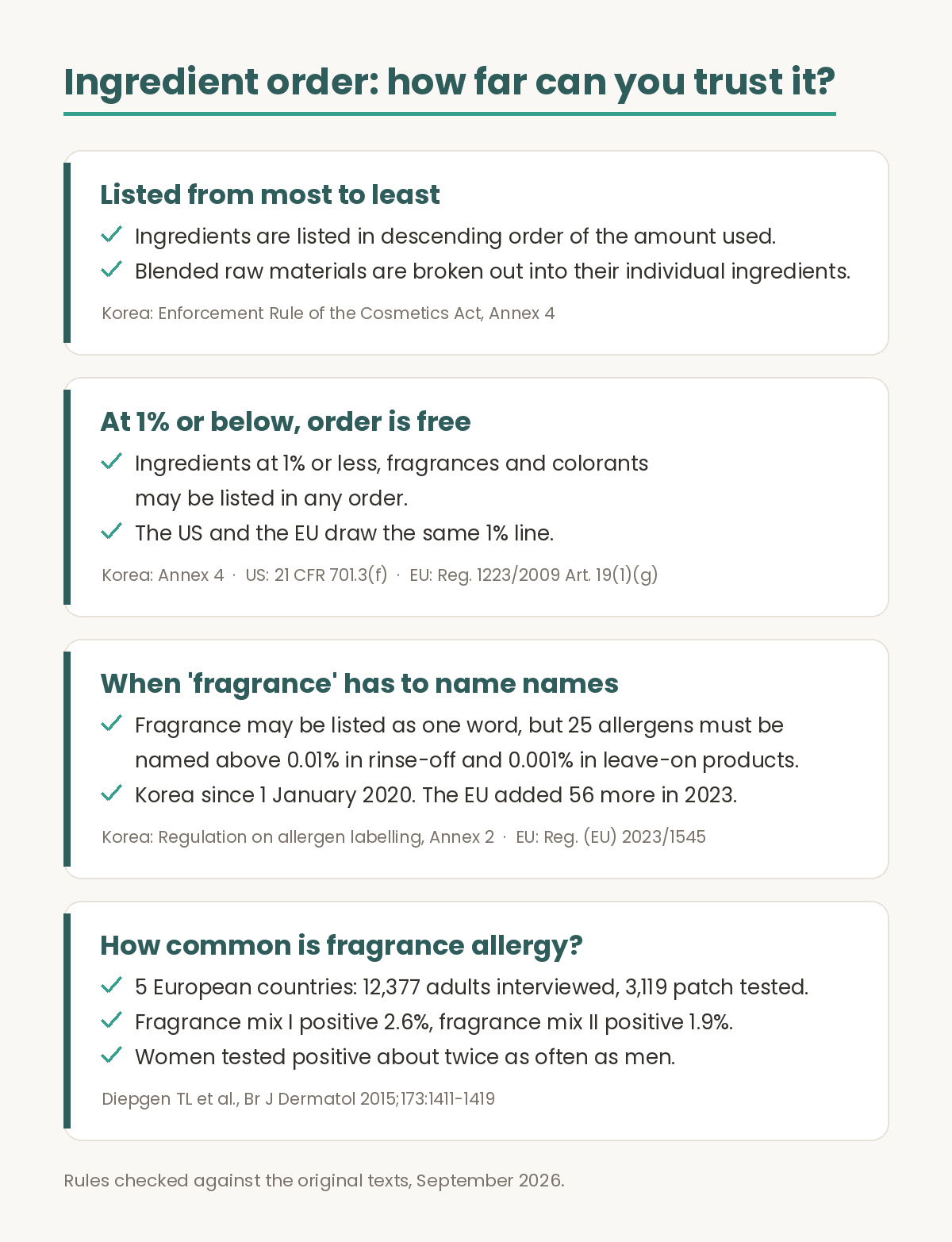
    Evidence figure on how far the order of a cosmetic ingredient list can be trusted. First, ingredients are listed in descending order of the amount used and blended raw materials are broken out into individual ingredients, Korea's Enforcement Rule of the Cosmetics Act, Annex 4. Second, ingredients at 1 percent or less, fragrances and colorants may be listed in any order, and the United States under 21 CFR 701.3(f) and the European Union under Regulation 1223/2009 Article 19(1)(g) draw the same 1 percent line. Third, fragrance may be listed as one word, but 25 allergens must be named when above 0.01 percent in rinse-off and 0.001 percent in leave-on products, in Korea since 1 January 2020, and the EU added 56 more under Regulation (EU) 2023/1545. Fourth, in five European countries 12,377 adults were interviewed and 3,119 were patch tested; fragrance mix I was positive in 2.6 percent and fragrance mix II in 1.9 percent, and women tested positive about twice as often as men, Diepgen and colleagues, British Journal of Dermatology 2015.

    ――――――――――――――――――――――――――――

    Where is the 1% line? Clues from the preservative limits

    No label marks the 1% point. There are clues, though. Korea’s Regulation on Cosmetic Safety Standards, Annex 2, caps how much of each preservative a product may contain, and several of those caps are at or below 1%.

    Preservative Korean limit Note
    Phenoxyethanol 1.0% —
    Benzyl alcohol 1.0% 10% when used as a solvent in hair dyes
    Sorbic acid and its salts 0.6% as sorbic acid
    Benzoic acid and its salts 0.5% 2.5% for benzoic acid and its sodium salt in rinse-off products
    Salicylic acid and its salts 0.5% as a preservative; functional-cosmetic limits are separate
    Parabens 0.4% single · 0.8% mixed as acid

    When ingredients like these start to appear, you are probably near or below the 1% line. Fragrance, colorants and thickeners such as carbomer and xanthan gum are usually used below 1% too.

    I would not go further than “probably”. A cap is a maximum, not the amount actually used — a product could contain 0.5% phenoxyethanol. From that point down, I stop reading the order and read which ingredients are present.

    ――――――――――――――――――――――――――――

    Behind the word “fragrance” — the 25 allergens Korea names

    A fragrance is a blend of many aromatic materials, so it may appear on a label as a single word. Since 1 January 2020, Korea has made an exception. If any of 25 fragrance allergens listed by the Ministry of Food and Drug Safety is above a threshold, it must be named separately after 「fragrance」.

    ● Rinse-off products — above 0.01%

    ● Leave-on products — above 0.001%

    ● Each allergen is judged on its own, not added up with the others (Korean Cosmetic Association guidance)

    1. Amyl cinnamal 2. Benzyl alcohol 3. Cinnamyl alcohol 4. Citral 5. Eugenol
    6. Hydroxycitronellal 7. Isoeugenol 8. Amylcinnamyl alcohol 9. Benzyl salicylate 10. Cinnamal
    11. Coumarin 12. Geraniol 13. Anise alcohol 14. Benzyl cinnamate 15. Farnesol
    16. Butylphenyl methylpropional 17. Linalool 18. Benzyl benzoate 19. Citronellol 20. Hexyl cinnamal
    21. Limonene 22. Methyl 2-octynoate 23. Alpha-isomethyl ionone 24. Oak moss extract 25. Tree moss extract

    How common is fragrance allergy? A cross-sectional study across five European countries — Germany, Italy, the Netherlands, Portugal and Sweden — interviewed a random sample of 12,377 adults aged 18 to 74 and patch tested a random subsample of 3,119.

    ● Fragrance mix I positive: 2.6% (95% CI 2.1–3.2)

    ● Fragrance mix II positive: 1.9% (95% CI 1.5–2.4)

    ● Clinically relevant fragrance allergy, estimated conservatively: 1.9%; using a lifetime history of contact dermatitis instead: 0.8%

    ● Women tested positive about twice as often as men

    Diepgen TL et al., British Journal of Dermatology 2015;173:1411-1419

    Two or three people in a hundred is not a small number. That is why the extra names after 「fragrance」 are not something hidden — they are something disclosed. If a scent ingredient has bothered you before, keep its name and check it against the label.

    ――――――――――――――――――――――――――――

    Korea, the US and the EU draw the same 1% line

    This is not a Korean quirk. Put Korea’s Annex 4 next to the US rule, 21 CFR 701.3, and the EU Cosmetics Regulation, 1223/2009 Article 19, and the structure is almost the same.

    Korea United States European Union
    Basic order Largest amount first Descending order of predominance Descending order of weight at the time of addition
    Below 1% At 1% or less, plus fragrances and colorants: any order Not more than 1%: any order, after those above 1%; colour additives last, any order Less than 1%: any order, after those above 1%
    Fragrance 「향료」 (fragrance) fragrance parfum · aroma
    Fragrance allergens 25 named when above 0.01% rinse-off / 0.001% leave-on, since 1 Jan 2020 MoCRA (2022) directs FDA to write a rule; as of March 2026 none had been issued Original 26 plus 56 added by Reg. (EU) 2023/1545, same thresholds; applies to products placed on the market from 31 Jul 2026
    Shade ranges ± or +/- may contain may contain or +/-

    Two differences are worth knowing. First, the US and the EU say in so many words that the below-1% ingredients come after the ones above 1%; the Korean text says only “regardless of order”. Second, the EU list of fragrance allergens has grown. Regulation (EU) 2023/1545 kept the original 26 and added 56 more, at the same 0.001% and 0.01% thresholds. Products newly placed on the EU market from 31 July 2026 must comply, and older stock may be sold until 31 July 2028.

    In the US, the Modernization of Cosmetics Regulation Act of 2022 directs FDA to set fragrance allergen labelling rules. FDA’s own MoCRA page lists that requirement without a rule attached, and a March 2026 review by the law firm Foley & Lardner reported that none had been issued. For now, a US label may still say “fragrance” and stop.

    The practical result: a label follows the rules of the market it was made for. A European product may carry a longer run of named allergens after “parfum” than a Korean one; a US product may carry none. That is a difference in rules, not necessarily in the formula.

    ――――――――――――――――――――――――――――

    Five things to check when you buy

    ✔ The first few lines — this is the above-1% zone; read it as a ranking

    ✔ After the first capped preservative — stop comparing amounts by position

    ✔ Names after 「fragrance」 — check them against any scent ingredient that has bothered you

    ✔ ± or +/- — in colour cosmetics, colorants after this mark cover the whole shade range, not necessarily yours

    ✔ Samples of 10 mL or less — Korean rules allow a shorter label; check the full-size product

    ――――――――――――――――――――――――――――

    In one line

    The top of the list is a ranking; below 1%, it is a list. Knowing where one turns into the other is half of reading a label.

    Next in the series: arbutin and the 2–5% Korea set for brightening claims (Ingredient Guide 15).

    ――――――――――――――――――――――――――――

    📌 Earlier guides

    📌 Skincare Ingredient Compatibility Chart – 12 Ingredients

    📌 Skin Concern Ingredient Map – Dark Spots, Acne, Pores, Lines

    📌 Niacinamide: How Much Is Enough

    📌 Salicylic Acid (BHA): 0.5% vs 2%, Explained

    📌 Retinol: Start at 0.1% – How to Read the Concentration Numbers

    About the author · Dr. J

    MS in Veterinary Medicine, PhD in Life Sciences. I worked as a researcher at the Korea Research Institute of Bioscience and Biotechnology (KRIBB) and now run Beaurea, a cosmetics manufacturing company, where I write the formulas myself. This blog reads the research papers and the regulatory documents and turns them into plain-language criteria for choosing ingredients. I don’t recommend specific products here – only criteria that apply to any product.

    📄 References

    · Korea — Enforcement Rule of the Cosmetics Act, Annex 4: labelling standards and methods

    · Korea — Regulation on Precautions for Use and Allergen Labelling of Cosmetics, Annex 2: fragrance allergens

    · Korea — Regulation on Cosmetic Safety Standards, Annex 2: restricted ingredients, preservatives

    · US — 21 CFR 701.3, Designation of ingredients (eCFR)

    · EU — Regulation (EC) No 1223/2009, Art. 19(1)(g); Commission Regulation (EU) 2023/1545 (EUR-Lex)

    · US FDA — Modernization of Cosmetics Regulation Act of 2022 (MoCRA) page; Foley & Lardner, “How MoCRA Is Reshaping FDA Oversight of Cosmetics in 2026” (March 2026)

    · Diepgen TL et al., Br J Dermatol 2015;173:1411-1419 — fragrance contact allergy in the general population of five European countries

    ――――――――――――――――――――――――――――

    This article summarises regulatory texts and published research. It is information, not a diagnosis or a treatment plan. If something about your skin worries you, please talk to a professional.

    — Dr. J Ingredient Notes