🇰🇷 한국어판: 맞춤형화장품이란 – 매장에서 섞는 범위와 조제관리사
Hello, this is Dr. J. Today I want to explain customized cosmetics in Korea — the counter where someone mixes a product for you, and what the law lets them do there.
Start with the part most summaries miss. Nothing has to be mixed at all. Decanting a product into a smaller jar is already a customized cosmetic under Korean law. The Act splits the category into two items, (a) and (b), and the second one is just moving contents from one container to another.
This matters beyond Korea, because Korea built something most markets did not: a separate business type in the statute, a national qualification for the person who mixes, and a short list of raw materials that may never be mixed at the counter. The United States and the European Union answer the same question in completely different places. I put all three side by side at the end.
――――――――――――――――――――――――――――
Primary sources
📄 Cosmetics Act of Korea (Korea Legislation Research Institute, Korean and English) — Arts. 2, 2-2, 3-2, 3-4, 5
📄 Notification of a customized cosmetics selling business (Korea Ministry of Government Legislation)
📄 Regulation on Obligations of Customized Cosmetics Sellers — MFDS Notice No. 2022-2
📄 21 U.S.C. § 364 — definition of “facility” (MoCRA)
📄 Regulation (EC) No 1223/2009 on cosmetic products — Arts. 4 and 6
All of these were opened on 7 October 2026. The Cosmetics Act text is the version in force from 2 April 2026 (Act No. 20901, amended 1 April 2025).
――――――――――――――――――――――――――――
――――――――――――――――――――――――――――
Five lines, if you are in a hurry
✔ A customized cosmetic is either mixed or decanted — both count
✔ The shop cannot be notified without a licensed compounding manager on site
✔ Preservatives, UV filters and colorants may not be mixed at the counter
✔ Nothing may be mixed or decanted in advance and kept on a shelf
✔ A shop may not arbitrarily mix or decant finished products it sells, and must report its raw-material list once a year
――――――――――――――――――――――――――――
Two kinds, by law
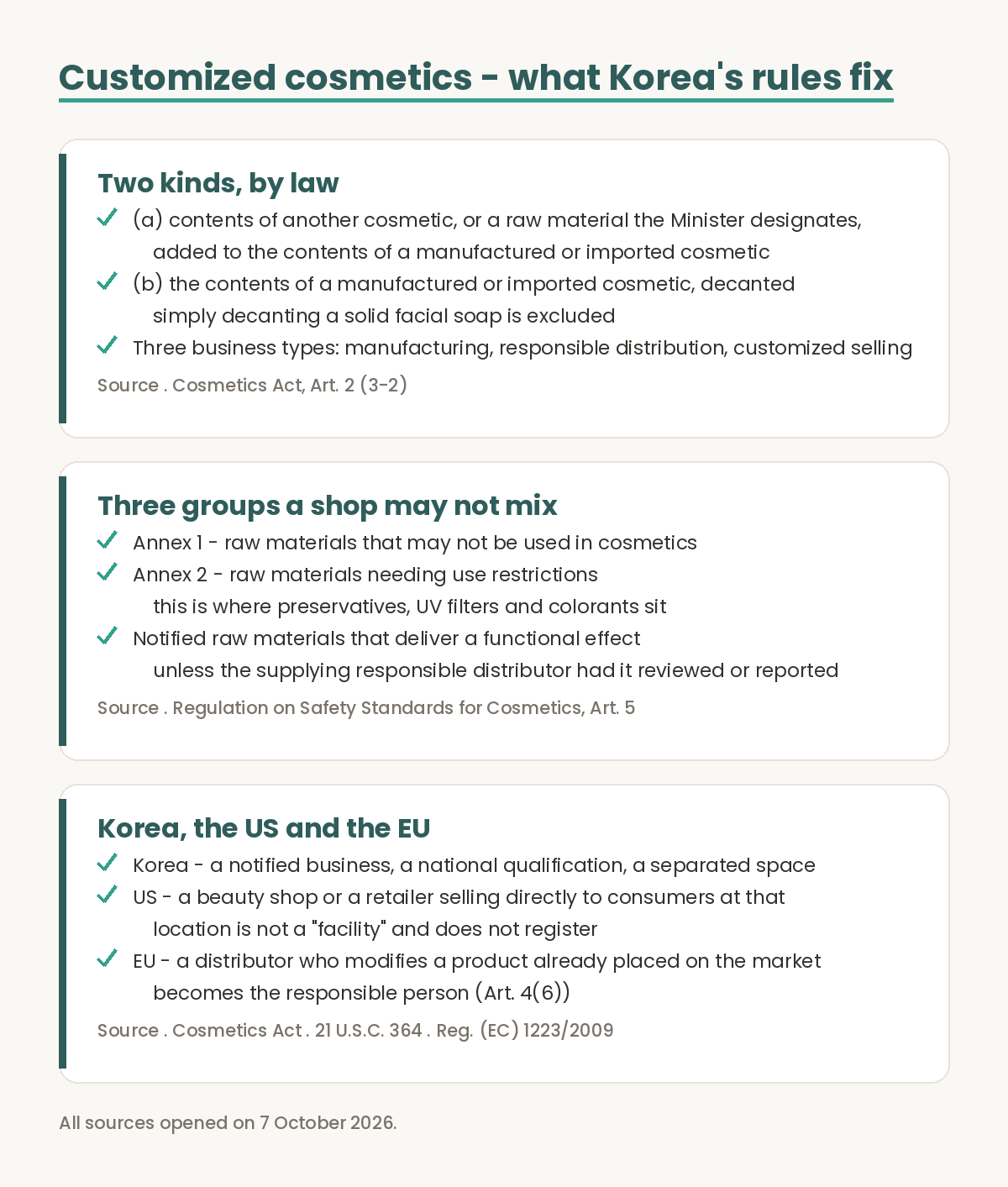
Article 2, subparagraph 3-2 of the Cosmetics Act writes the category out in two items. Most English coverage renders “customized cosmetics” as bespoke blending, which is only half of it.
| Item | What the Act says | What it looks like in the shop |
|---|---|---|
| (a) mixing |
A cosmetic made by adding the contents of another cosmetic, or a raw material the Minister of Food and Drug Safety designates, to the contents of a manufactured or imported cosmetic | Two serums blended into one bottle; an active added to a base |
| (b) decanting |
A cosmetic made by decanting the contents of a manufactured or imported cosmetic Simply decanting a solid facial soap and the like is excluded |
Contents moved from a large container into a smaller one for you |
The exclusion is telling. Cutting a bar of solid soap is not a customized cosmetic. The line is not drawn around the act of dividing something up — it is drawn around handling the contents of a product.
Article 2-2 then lists three business types: cosmetics manufacturing, cosmetics responsible distribution, and customized cosmetics selling. Customized selling is a selling business, not a manufacturing one. Korea did not treat the counter as a small factory; it treated it as a point of sale where someone is allowed to touch the product.
――――――――――――――――――――――――――――
What a shop may not mix
Article 5 of the Regulation on Safety Standards for Cosmetics is written backwards, and that is the interesting part. It does not list what may be used. It says everything except the following three groups may be used in a customized cosmetic.
| Kept out | What sits there | So at the counter |
|---|---|---|
| 1. Annex 1 raw materials that may not be used in cosmetics |
The prohibited list | Never allowed in a cosmetic in the first place |
| 2. Annex 2 raw materials needing use restrictions |
Preservatives, UV filters and colorants, plus every ingredient with a concentration cap | This is why “could you leave the preservative out?” and “could you add sun protection?” are both no |
| 3. Notified functional actives | The brightening and wrinkle actives Korea notifies by name and concentration (arbutin, niacinamide, retinol, adenosine and the rest) | With a proviso — see below |
The third row carries the condition that decides most real cases. The Regulation adds: “except where the cosmetics responsible distributor supplying the raw material to the customized cosmetics seller has had a functional cosmetic including that raw material reviewed, or has submitted a report, under Article 4 of the Cosmetics Act.”
In plain words — if the company supplying the active already carried it through functional-cosmetic review or filing, the counter may mix it. So if a shop offers to add a brightening or wrinkle active, asking whether that review or report exists is a fair and ordinary question. It is not a gotcha; the rule is built so that someone can answer it.
――――――――――――――――――――――――――――
Two more duties people rarely mention
Both sit in Article 5 of the Cosmetics Act, the article on operators’ duties.
✔ Paragraph 3 (inserted 17 August 2021) — a customized cosmetics seller shall not arbitrarily mix or decant cosmetics that are distributed and sold to consumers
✔ Paragraph 6 — the seller shall report a list of every raw material used in customized cosmetics, once a year, to the Minister of Food and Drug Safety
Paragraph 3 closes the obvious shortcut: taking a finished product off the retail shelf and blending it. The contents and raw materials have to have arrived for that purpose. Paragraph 6 means a shop’s raw-material list leaves the shop once a year — this is not a closed counter.
――――――――――――――――――――――――――――
The person, the paperwork and the room
Customized cosmetics selling is a notified business, not a licensed one (Article 3-2, inserted 13 March 2018). But the notification only goes through once the person and the space are already in place.
| What | What the rules fix |
|---|---|
| Filing | Notification form + a copy of the compounding manager’s certificate + a specification of the facilities, to the regional MFDS office |
| Certificate of notification | Carries the notification number and date, the operator, the shop’s name and address, and the compounding manager’s name and certificate number |
| Facilities | The mixing and decanting space must be separated or partitioned from space used for anything else |
| Qualifying exam | Held by the Minister at least once a year, announced 90 days in advance, four subjects (law and institutions / manufacturing and quality control and raw-material standards / distribution and safety control / the character of customized cosmetics) |
| Pass mark | 60% of the total across all subjects and 40% of the marks in every single subject |
| Cheating | The exam is stopped or the pass is voided, and the person is barred for three years (Article 3-4) |
| Changes | A change of operator, shop name or address, or compounding manager must be notified |
| Disqualification | A person under adult guardianship or an undischarged bankrupt; anyone serving a custodial sentence; anyone in a suspended sentence period; anyone whose shop was closed down less than a year ago |
The certificate naming the compounding manager is the hinge. Change the person and you change the notification — the shop and the qualification are tied together on one piece of paper.
――――――――――――――――――――――――――――
“Separated” and “partitioned” are not the same word
The Enforcement Rule only says the mixing and decanting space must be separated or partitioned. The MFDS guideline for customized cosmetics selling businesses, issued in 2020, split the two terms:
✔ Separated — a line or a mesh, leaving enough distance
✔ Partitioned — a wall, a screen, an air curtain and the like, in a state that prevents cross-contamination and outside contaminants from entering
This is something a customer can see. The mixing should not be happening on a corner of the till. (Confirmed through Cosin Korea’s report of 14 May 2020 on the guideline.)
――――――――――――――――――――――――――――
Nothing is mixed in advance
MFDS Notice No. 2022-2 (14 January 2022) and Article 12-2 of the Enforcement Rule set the working routine. These are the lines that a customer actually feels.
| When | What is fixed |
|---|---|
| Before mixing | Check the certificate of analysis for the contents and raw materials · confirm the raw material meets the cosmetic safety standards · check the use-by date and the period after opening |
| While mixing | Do not set the product’s date beyond the raw material’s own use-by date (unless there is scientific ground) · inspect and clean the equipment |
| After mixing | Keep leftover raw material in a sealed container · do not mix or decant in advance and store it before the consumer has chosen |
| After selling | Record lot number, use-by date and date of sale in a sales ledger · explain the contents and cautions to the consumer · report adverse events |
That is why there is a wait at the counter, and why the jar you are handed carries a lot number and a date. The record has to exist.
――――――――――――――――――――――――――――
Korea, the United States and the European Union
Here is the part that is hard to find in English. The same question — who may mix a cosmetic in front of a customer, and under what conditions — lands in three different places.
| Korea | United States | European Union | |
|---|---|---|---|
| Where the rule lives | Cosmetics Act Art. 2-2, 3-2, 3-4; Safety Standards Reg. Art. 5; MFDS Notice 2022-2 | FD&C Act as amended by MoCRA — 21 U.S.C. § 364 | Regulation (EC) No 1223/2009, Arts. 4 and 6 |
| Is counter mixing its own category? | Yes — one of three business types, with its own notification | No — there is no separate retail-compounding regime | No — the Regulation does not address point-of-sale mixing |
| Does the shop register? | It must notify the regional MFDS office before operating | A facility registers, but “facility” excludes “beauty shops and salons, unless such establishment manufactures or processes cosmetic products at that location” and cosmetic product retailers “unless such establishment manufactures or processes cosmetic products that are not sold directly to consumers at that location” | No registration for the act of mixing; products are notified centrally by the responsible person |
| Who carries the duty? | The seller, with a licensed compounding manager named on the certificate | The responsible person — “the manufacturer, packer, or distributor of a cosmetic product whose name appears on the label” | The responsible person; and “the distributor shall be the responsible person where he places a cosmetic product on the market under his name or trademark or modifies a product already placed on the market in such a way that compliance with the applicable requirements may be affected” (Art. 4(6)) |
| Is there a list of what may not be mixed? | Yes — three groups, by regulation | No such list; prohibited and restricted substances apply to the product, not to the counter | No such list; Annexes II–VI apply to the product |
Read the US row again, because it is the sharpest contrast. In the United States a salon or a shop that mixes a product and hands it straight to the customer at that location falls outside the definition of a registrable facility. Korea took the opposite route: it treated that exact act as its own regulated business and attached a state exam to it.
The EU sits in between, and it does so without ever naming the practice. Article 4(6) simply says that whoever modifies a product already on the market becomes the responsible person for it. A European shop that blends two products has not broken a rule about blending — it has quietly inherited the whole compliance file for what it just made.
――――――――――――――――――――――――――――
Reading the numbers carefully
✔ “At least once a year” is the regulation’s phrase, not a schedule. The exam has run more often than that. Dates change each year, so check the announcement rather than any article
✔ A concentration cap is not a statement about what is in a product. An ingredient sitting in Annex 2 means it may not be mixed at the counter — it says nothing about how much of it a finished product contains
✔ “Functional actives may be mixed” is conditional. The review or report has to already exist upstream, at the supplying responsible distributor. It is not something a shop decides
――――――――――――――――――――――――――――
What I left out, and why
✔ The 2026 exam dates — the trade coverage I found carried last year’s schedule, so I kept to the Enforcement Rule’s “at least once a year, announced 90 days ahead”
✔ The compounding manager’s continuing-education hours — I confirmed the legal basis (Act Art. 5, Enforcement Rule Art. 14, Notice 2022-2) and the fine’s basis (Act Art. 40, Enforcement Decree Annex 2), but could not open a primary source giving the hours or the amount
✔ “Customized means it suits your skin better” — there is no primary source for that. What the Act and the notices fix is raw materials, a person and a room, not the size of an effect
✔ The notice number and effective date of the Safety Standards Regulation — I could not open a route that serves the body of that notice, so I cite the article number only
✔ MoCRA’s small-business exemptions and the FDA’s guidance detail — out of scope here; the row above quotes only the statutory definition of “facility”
✔ The penalty for operating without notification — the figure is carried in the Act’s penal provisions, which the bilingual text I used does not serve, so I leave the amount out rather than quote it second-hand
――――――――――――――――――――――――――――
Five things to check in the shop
✔ Is the certificate of notification on the wall? The compounding manager’s name is printed on it
✔ Is the mixing area actually partitioned — a wall or screen, not a line on the counter?
✔ Does the jar you receive carry a lot number and a date?
✔ If a brightening or wrinkle active is offered, is there a review or report behind that raw material?
✔ Were the contents and cautions explained to you? The notice requires it
――――――――――――――――――――――――――――
One line
A customized cosmetic in Korea is not a counter where anything can be mixed. It is a selling business in which the raw materials, the person and the room are all fixed by law. Three things are visible to a customer: the certificate, the partition, and the number on the jar.
Next in this series: Korea’s ban on animal-tested cosmetics — the six exceptions, and why “cruelty-free” is a phrase Korean labels cannot use (Cosmetics Act Art. 15-2).
――――――――――――――――――――――――――――
📌 Related posts
📌 How to Read a Korean Cosmetic Ingredient List (Ingredient Guide 14) — where you check what was mixed in
📌 Salicylic Acid (BHA): 0.5% vs 2%, Explained (Ingredient Guide 8) — an Annex 2 ingredient, seen up close
📌 Arbutin vs Alpha-Arbutin: What Korea’s 2–5% Means (Ingredient Guide 15) — a notified functional active
📌 Niacinamide: How Much Is Enough (Ingredient Guide 2)
About the author · Dr. J
MS in Veterinary Medicine, PhD in Life Sciences. I worked as a researcher at the Korea Research Institute of Bioscience and Biotechnology (KRIBB) and now run Beaurea, a cosmetics manufacturing company, where I write the formulas myself. This blog reads the research papers and the regulatory documents and turns them into plain-language criteria for choosing ingredients. I don’t recommend specific products here – only criteria that apply to any product.
📄 Sources
· Cosmetics Act of Korea, Arts. 2(3-2), 2-2, 3-2, 3-4, 5 (Act No. 20901, amended 1 Apr 2025; in force 2 Apr 2026)
· Enforcement Rule of the Cosmetics Act, Arts. 8-2 to 8-5 and 12-2
· Regulation on Safety Standards for Cosmetics, Art. 5 (raw materials usable in customized cosmetics)
· Regulation on Obligations of Customized Cosmetics Sellers, MFDS Notice No. 2022-2 (14 Jan 2022)
· MFDS guideline for customized cosmetics selling businesses (2020), as reported by Cosin Korea, 14 May 2020
· 21 U.S.C. § 364 — definition of “facility” (FD&C Act as amended by MoCRA)
· Regulation (EC) No 1223/2009 of 30 November 2009 on cosmetic products, Arts. 4 and 6
――――――――――――――――――――――――――――
This article summarises statutes and administrative notices and is not a substitute for diagnosis or treatment. The provisions were checked on 7 October 2026; rules change, and so does what they require. Please speak to a professional about any symptom that worries you.
— Dr. J Ingredient Notes