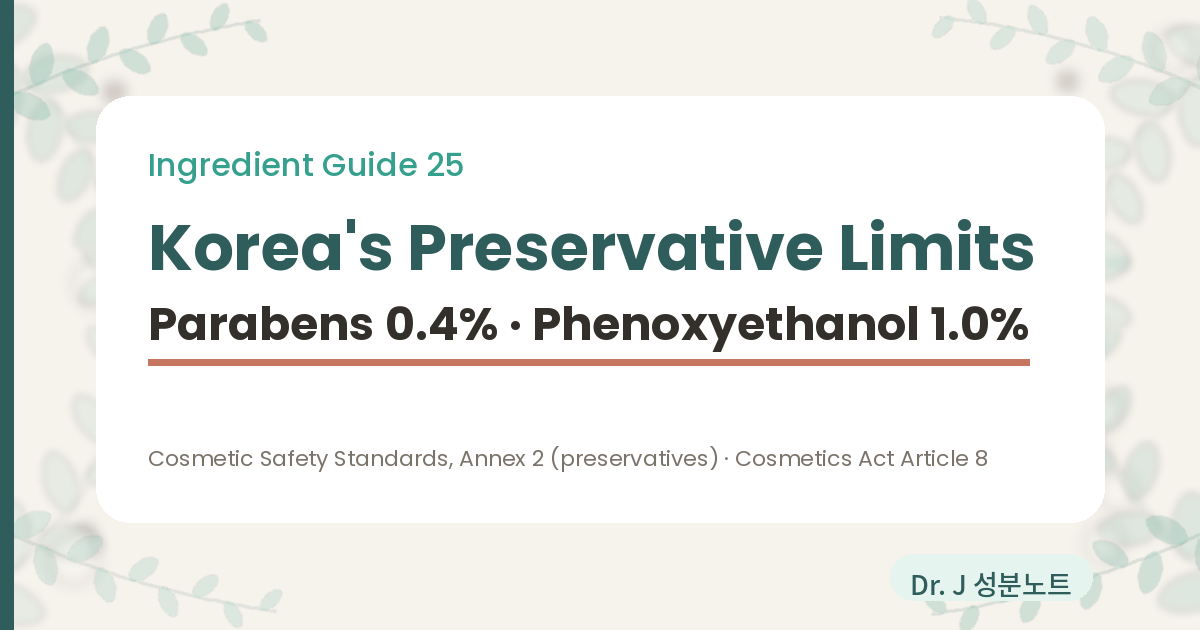
Hello, this is Dr. J. Today we are reading the preservative limits in Korean cosmetics — the numbers behind parabens and phenoxyethanol.
Here is the part that surprises people first. The Korean notice never uses the word “paraben.” Several parabens sit on one grouped line, and the salts ride that line too.
――――――――――――――――――――――――――――
The primary sources
📄 Cosmetics Act Article 8 (Korea Cosmetic Association)
📄 Annex 2, raw materials needing restricted use (Korea Law Information Center)
📄 KCIA ingredient dictionary — ethylparaben
📄 Commission Regulation (EU) No 1004/2014 · No 358/2014
📄 Parabens in Cosmetics (U.S. FDA)
Annex 2 gives each preservative a line of its own: the name, the ceiling, and the condition attached. Find the preservative on your label in that table and you can read off how much is allowed and in which kind of product.
――――――――――――――――――――――――――――
If you are in a hurry — five lines
✔ Preservatives work from an allowed list, the way colorants do
✔ The paraben line reads 0.4% single, 0.8% mixture (as acid)
✔ Phenoxyethanol is 1.0%
✔ The EU cuts butyl- and propylparaben to 0.14% inside the same group
✔ The United States has no rule aimed at preservatives
――――――――――――――――――――――――――――
Article 8 names preservatives first
Korea’s Cosmetics Act splits raw materials into two kinds. Some may never be used. Others may be used under conditions.
| Paragraph | What it does | Text |
|---|---|---|
| Article 8 (1) | Designates the raw materials that may not be used | “The Minister of Food and Drug Safety shall designate and announce the raw materials that may not be used in the manufacture of cosmetics.” |
| Article 8 (2) | Sets conditions of use for preservatives, colorants and UV filters | For raw materials that need special restrictions, “such as preservatives, colorants and ultraviolet blocking agents”, the Minister shall designate and announce the conditions of use, and a preservative, colorant or UV filter whose conditions of use have not been announced may not be used. |
| Article 8 (5) | Reviews those conditions periodically | The Minister shall periodically review the safety of the announced conditions of use, and may change them according to the result. |
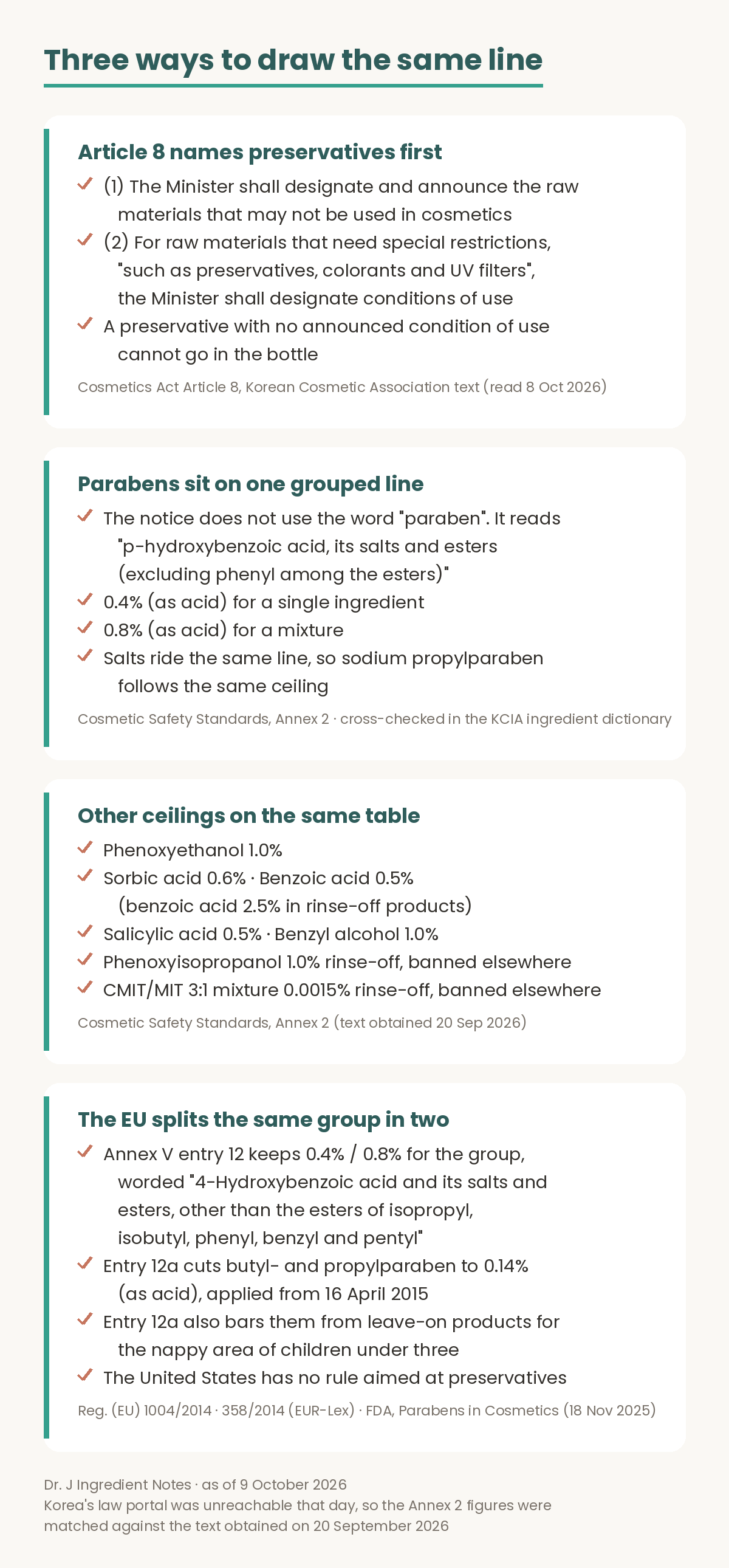
Of the three named in paragraph (2) — preservatives, colorants and UV filters — preservatives come first. And the paragraph closes by barring anything outside the announced list. So a preservative in Korea works from an allowed list, not a banned one: a substance with no announced condition of use cannot go in the bottle at all.
Paragraph (5) adds one more layer. The ceilings are reviewed periodically and may be changed. That is exactly what happened in Europe, twice, to the same group of parabens — these numbers are reviewed values, not fixed ones.
――――――――――――――――――――――――――――
Parabens sit on one grouped line
Open the preservative table in Annex 2 and the word “paraben” is not there. This is what you find instead.
| How the notice writes it | What that one line covers | Limit |
|---|---|---|
| “p-hydroxybenzoic acid, its salts and esters (excluding phenyl among the esters)” |
The esters — methyl-, ethyl-, propyl-, butylparaben The salts — sodium methylparaben, sodium propylparaben The acid itself |
0.4% (as acid) for a single ingredient 0.8% (as acid) for a mixture |
| What the bracket takes out | Phenyl, among the esters | Not on this line |
One group name carries three things at once: the acid itself, the esters, and the salts. So when you see sodium propylparaben on a Korean label, it is not a different substance that slipped past the rule — it is the same line and the same ceiling.
The bracket takes out one ester: phenyl. Europe takes out five. That difference is the next table.
You can see the grouping for yourself in the Korea Cosmetic Association’s ingredient dictionary: open ethylparaben and sodium propylparaben separately and both carry the same notice name and the same figures.
――――――――――――――――――――――――――――
The rest of the preservative table — the conditions matter as much as the numbers
A preservative line is rarely a number on its own. Most of them also say which kind of product the substance may go into.
| Preservative | Limit | Condition attached |
|---|---|---|
| p-hydroxybenzoic acid, its salts and esters (parabens) | 0.4% single · 0.8% mixture | As acid · phenyl ester excluded |
| Phenoxyethanol | 1.0% | — |
| Sorbic acid | 0.6% | — |
| Benzoic acid | 0.5% | 2.5% in rinse-off products |
| Salicylic acid | 0.5% | Not for products for infants, or labelled as usable by children aged 13 or under (shampoo excepted) |
| Benzyl alcohol | 1.0% | 10% as a solvent in hair dyes |
| Phenoxyisopropanol | 1.0% | Rinse-off products only · banned in all others |
| CMIT / MIT mixture | 0.0015% | As a 3:1 mixture · rinse-off only · banned in all others |
| MIT alone | 0.0015% | Rinse-off only · not to be combined with the mixture above · banned in all others |
Three shapes show up. A plain ceiling (phenoxyethanol, sorbic acid). A ceiling that changes with the product (benzoic acid). And a ceiling that comes with a product type attached (phenoxyisopropanol, the isothiazolinones) — for those, “rinse-off only” is the whole point of the line.
Salicylic acid carries an age condition: it is not for products for infants, or for products labelled as usable by children aged 13 or under, with shampoo excepted. That is the same rule that shapes Korea’s children’s cosmetics regime (Ingredient Guide 20).
――――――――――――――――――――――――――――
The EU splits the same group in two
Entry 12 of Annex V to Regulation (EC) No 1223/2009 opens with almost the same sentence as the Korean notice: “4-Hydroxybenzoic acid and its salts and esters, other than the esters of isopropyl, isobutyl, phenyl, benzyl and pentyl”. Same grouping habit, same 0,4% / 0,8%.
What differs is whether the group gets divided again.
| Korea | European Union | United States | |
|---|---|---|---|
| How parabens are written | One grouped line — “p-hydroxybenzoic acid, its salts and esters (excluding phenyl among the esters)” | Two entries — Annex V 12 and 12a | No list of its own |
| Limit | 0.4% single · 0.8% mixture (as acid) | 12 keeps 0,4% / 0,8% 12a sets butyl- and propylparaben at 0,14% (as acid) |
No figure set |
| Esters barred outright | Phenyl | Isopropyl, isobutyl, phenyl, benzyl and pentyl — five (Reg. 358/2014, applied 30 Oct 2014) | — |
| Age or body-area condition | None on the paraben line | 12a — “Not to be used in leave-on products designed for application on the nappy area of children under three years of age” (Reg. 1004/2014, applied 16 Apr 2015) | — |
| Shape of the rule | A preservative needs announced conditions of use before it can be used | A preservative has to be listed in the annex | FDA — “FDA doesn’t have special rules that apply only to preservatives in cosmetics.” |
Europe moved in two steps. From 30 October 2014, five esters were moved out of entry 12 and into the banned annex (Regulation 358/2014) — and that regulation states in its recitals that “measures on propylparaben and butylparaben are under preparation”. From 16 April 2015, those two were cut to 0,14% and given the nappy-area condition (Regulation 1004/2014).
The regulation also explains where 0,14% comes from. The SCCS figure was 0,19% expressed as esters; because entry 12 is written “as acid”, the Commission converted it to 0,14% as acid so the two entries could be read together. The science did not change between those numbers — the unit did.
The United States draws no such line. FDA states plainly that it “doesn’t have special rules that apply only to preservatives in cosmetics”, and that cosmetic ingredients other than color additives do not need FDA approval before going on the market.
――――――――――――――――――――――――――――
One substance, three ways of drawing the line
| Korea | European Union | United States |
|---|---|---|
| Allowed list, by notice under Article 8 (2) | Allowed list, Annex V | No preservative-specific rule |
| Parabens grouped on one line, salts included | Same group, split into 12 and 12a | Methyl-, propyl-, butyl- and ethylparaben named as the most common, with no limit set |
| Conditions attach product types (rinse-off only) and ages (salicylic acid) | Conditions attach product types, body areas and ages | Safety rests on the manufacturer; FDA may act on a marketed product |
This is the part worth carrying away. A Korean label and a European label can show the same preservative at the same percentage and still sit under different rules — and a U.S. label sits under none written for preservatives at all. The number on the back of the bottle does not tell you which system you are reading.
――――――――――――――――――――――――――――
What to check on the box
✔ Preservative names sit near the end of the ingredient list, around the 1% mark
✔ For parabens, read methyl-, ethyl-, propyl-, butyl- and the salt names such as sodium methylparaben
✔ Some ceilings apply to rinse-off products only, so check whether the product stays on the skin
✔ On products labelled for children, Korean packaging prints the preservative content as its own line
✔ A ceiling is the upper bound, not the amount in the jar — two different things
――――――――――――――――――――――――――――
What I left out, and why
✔ The notice number and effective date — Korea’s law portal was unreachable on the day this was written, so I could not confirm the current number of the Cosmetic Safety Standards. Only the article numbers and the annex name are given here
✔ The full Annex 2 preservative table — same reason. The figures above come from the text obtained on 20 September 2026, cross-checked in the KCIA ingredient dictionary
✔ The paraben safety debate — I did not open the review papers or the opinions themselves. What the EU changed, and what FDA says, is the range of this article
✔ The EU figure for phenoxyethanol — a secondary source gives 1.0%, but I could not obtain the annex table itself, so it is not in the comparison
――――――――――――――――――――――――――――
In one line
A preservative is used from a list, within the stated ceiling, in the stated kind of product. Where that line gets drawn is what changes between countries.
Next: the 25 fragrance allergens — why those names are printed separately on the box.
――――――――――――――――――――――――――――
📌 Related reading
📌 How to Read a Korean Cosmetic Ingredient List (Ingredient Guide 14) — where preservative names sit
📌 Salicylic Acid (BHA): 0.5% vs 2% (Ingredient Guide 8) — a preservative on the same annex
📌 Sunscreen SPF and PA (Ingredient Guide 11) — the third material named in Article 8 (2)
📌 AHA vs BHA: Is Glycolic Acid an AHA? (Ingredient Guide 13)
About the author · Dr. J
MS in Veterinary Medicine, PhD in Life Sciences. I worked as a researcher at the Korea Research Institute of Bioscience and Biotechnology (KRIBB) and now run Beaurea, a cosmetics manufacturing company, where I write the formulas myself. This blog reads the research papers and the regulatory documents and turns them into plain-language criteria for choosing ingredients. I don’t recommend specific products here – only criteria that apply to any product.
📄 Sources
· Cosmetics Act of Korea, Article 8 — paragraphs (1), (2) and (5)
· Regulation on Cosmetic Safety Standards, Annex 2 (raw materials needing restricted use), preservatives
· Korea Cosmetic Association ingredient dictionary — ethylparaben, sodium propylparaben, phenoxyisopropanol, methylisothiazolinone, methylchloroisothiazolinone
· Commission Regulation (EU) No 1004/2014 and No 358/2014 (EUR-Lex) · Regulation (EC) No 1223/2009, Annex V entry 12
· U.S. FDA, Parabens in Cosmetics (updated 18 November 2025)
――――――――――――――――――――――――――――
This article summarises statutes and official notices and is not a substitute for diagnosis or treatment. Korea’s law portal was unreachable on the day of writing, so the Annex 2 figures were matched against text obtained earlier and cross-checked in the Korea Cosmetic Association ingredient dictionary; the current notice number is not stated. EU and U.S. material is taken from each authority’s current public text.
— Dr. J Ingredient Notes