Hello, this is Dr. J. Today I want to read one entry of a Korean labelling annex line by line, because it answers a question people ask in every market: why does the back of the box say only “fragrance”?
Here is the part that surprised me. In Korea, “fragrance” is a word you may use without asking anyone. The item sitting immediately beside it in the same annex is the opposite: to hide any other ingredient you have to file supporting data and be told yes.
――――――――――――――――――――――――――――
The provisions, if you want them first
📄 Enforcement Rule of the Cosmetics Act, Annex 4 (labelling standards and method)
📄 Cosmetics Act Article 10 and Enforcement Rule Article 19 (Korea Cosmetic Association)
📄 Regulation (EC) No 1223/2009, Articles 19 and 21
📄 21 CFR 720.8 — trade secret exemption procedure (eCFR)
The Korean texts are quoted from the attachment file published by the National Law Information Centre. The English wording below is my own rendering of the Korean; where a phrase matters I give it in quotation marks and name the item it comes from.
――――――――――――――――――――――――――――
――――――――――――――――――――――――――――
In five lines
✔ The rule is every ingredient used in manufacture — Cosmetics Act Article 10
✔ A fragrance material may be written as one word — Annex 4, item 3(e)
✔ If a notified allergen is in it, the substance is named instead — the proviso to the same item
✔ To hide any other ingredient you file data and wait for acceptance — item 3(g)
✔ The EU and the US also use one word — ‘parfum’ / ‘aroma’, and ‘fragrance’
――――――――――――――――――――――――――――
The rule — ten items, and the third one is the list
Article 10(1) of the Cosmetics Act sets out what a cosmetic package has to carry. There are ten items; the third is where today’s question starts.
| No. | What Article 10(1) requires | Note |
|---|---|---|
| 1 | The name of the cosmetic | |
| 2 | The trade name and address of the business operator | |
| 3 | Every ingredient used in the manufacture of the cosmetic | ★ today’s provision |
| 4 | The volume or weight of the contents | |
| 5 | The batch number | also on the primary container |
| 6 | The use-by date or period after opening | also on the primary container (Guide 17) |
| 7 | The price | |
| 8 | The words or mark for a functional cosmetic | Guide 16 |
| 9 | Precautions for use | |
| 10 | Anything else the Prime Minister’s Ordinance prescribes | Enforcement Rule Article 19(4) |
Article 10(2) names four items that must appear on the primary container — the tube or jar itself: the name, the trade name, the batch number and the use-by date or period after opening. The ingredient list is not among them. It belongs to the outer box, which is why a bare tube often carries no ingredients at all.
――――――――――――――――――――――――――――
Seven items inside one entry — Annex 4 read line by line
How the ingredients are written is settled by Annex 4 of the Enforcement Rule. Entry 3, “ingredients used in the manufacture of the cosmetic”, holds seven items, (a) to (g). Most articles quote only one of them. Here they all are.
| Item | What the provision says | What it means in practice |
|---|---|---|
| (a) | “The letters shall be at least 5 points in size.” | The small print on the back has a floor under it |
| (b) | “They shall be written in order of decreasing content used in the manufacture of the cosmetic.” | With a carve-out: ingredients at 1% or less, fragrance materials and colour materials need not follow the order |
| (c) | “For a blended raw material, the name of each individual blended ingredient shall be written.” | A compound raw material is unpacked into its parts |
| (d) | “Where a different colour material is used for each shade in colour cosmetics, eye cosmetics, hair dyes or nail products, all the colour materials used may be written together after the mark ‘± or +/-’.” | That ± on the back of a lipstick (Guide 24) |
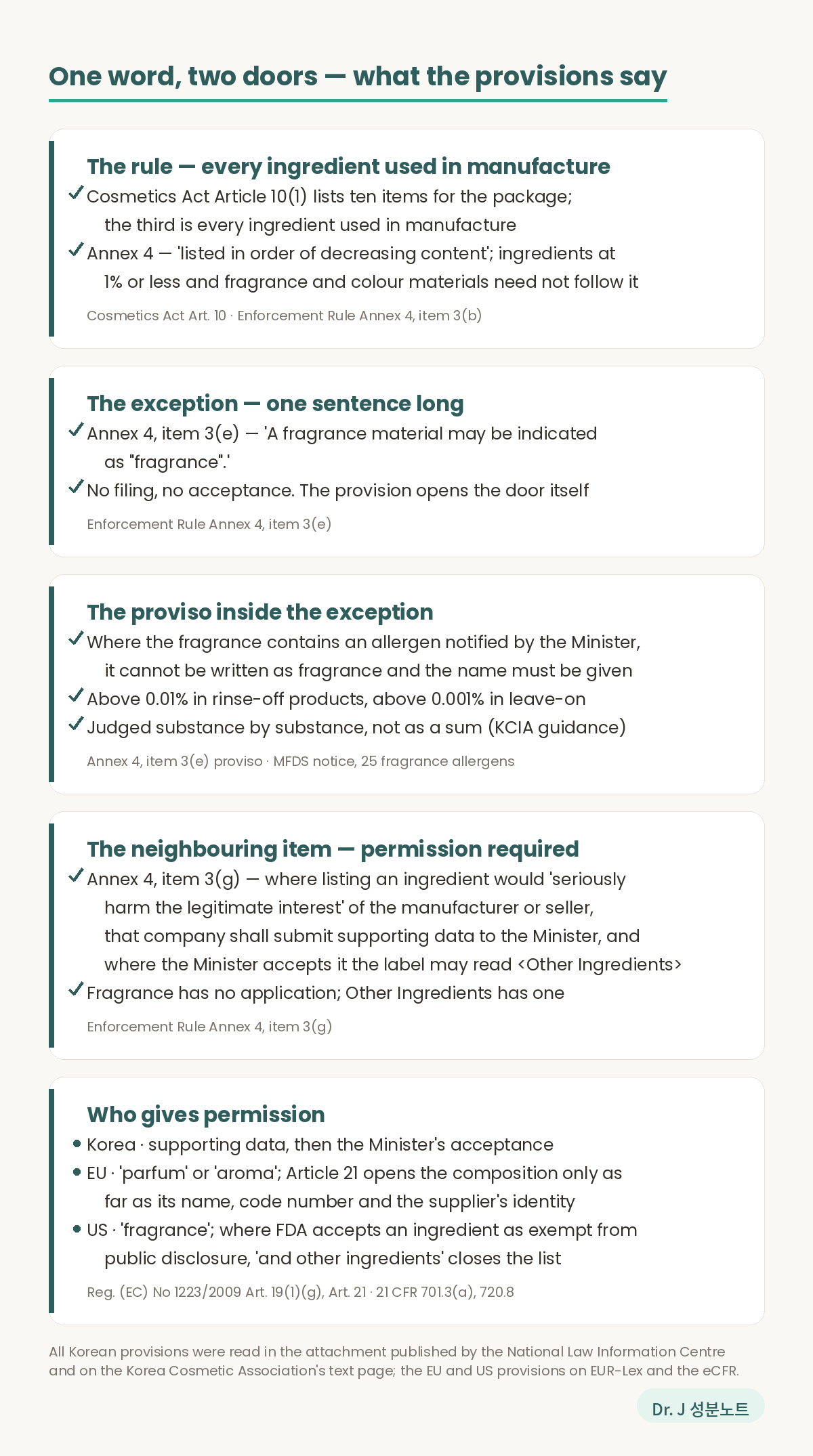
| (e) | “A fragrance material may be indicated as ‘fragrance’.” | ★ today’s one word |
| (f) | “An ingredient used for the purpose of adjusting pH may be written as the product of the neutralisation reaction instead of the ingredient itself.” | What came out is written, not what went in |
| (g) | “… where it would seriously harm the legitimate interest …, the manufacturer or seller shall submit supporting data …, and where the Minister recognises it, <Other Ingredients> may be written.” | ★ today’s neighbouring door |
Four of the seven — (d), (e), (f) and (g) — let the label say something other than the plain ingredient name. Only one of the four asks permission.
――――――――――――――――――――――――――――
The exception is a single sentence
Enforcement Rule of the Cosmetics Act, Annex 4, entry 3, item (e)
“A fragrance material may be indicated as ‘fragrance’. However, where the constituents of the fragrance material include an allergen notified by the Minister of Food and Drug Safety, it may not be indicated as fragrance and the name of that substance shall be written.”
The first sentence is the permission; the second takes part of it back. A fragrance accord is often dozens of materials, and the way they are combined is the house’s own formula. The provision covers that whole area with one word.
What matters for today is what the sentence does not contain. There is no application, no dossier, no decision. The provision opens the door by itself — and that is exactly where item (g) parts company with it.
――――――――――――――――――――――――――――
The proviso — when the name has to appear
Once the proviso bites, “fragrance” is no longer available for that substance and the name itself goes on the label. Korea has notified 25 such substances, and two thresholds decide when they surface.
| Threshold | Note | |
|---|---|---|
| Rinse-off products | above 0.01% | body wash, shampoo |
| Leave-on products | above 0.001% | perfume, mist, cream — ten times stricter |
| Summed or separate? | Separate | Korea Cosmetic Association guidance: the figure “refers to the content of each individual substance, so whether to label is judged substance by substance” |
| No name on the box | does not mean it is absent | it may sit under the threshold, or the pack may be small enough to omit |
| A name on the box | does not mean the product is harsh | it means the substance crossed the line and was disclosed |
This is why a perfume or a mist tends to show names like limonene and linalool while a rinse-off product does not. The full list of 25 and the notice behind it are in Ingredient Guide 26.
――――――――――――――――――――――――――――
★ The neighbouring item — where permission is required
Item (g) of the same entry is a different road altogether. It is not limited to fragrance: it reaches any ingredient required by Article 10(1)3. What it adds is a condition.
Enforcement Rule of the Cosmetics Act, Annex 4, entry 3, item (g)
“Where writing an ingredient under Article 10(1)3 of the Act would seriously harm the legitimate interest of the manufacturer or the seller, the manufacturer or the seller shall submit the supporting data to the Minister of Food and Drug Safety, and where the Minister recognises that the legitimate interest would be harmed, it may be written as <Other Ingredients>.”
Put the two side by side and the difference is easy to see.
| ‘Fragrance’ — item (e) | ‘Other Ingredients’ — item (g) | |
|---|---|---|
| Whose permission | Nobody’s | The Minister of Food and Drug Safety |
| What is filed | Nothing | Supporting data |
| What it covers | Fragrance materials — scent only | Any ingredient under Article 10(1)3 — not limited to scent |
| Is there a proviso | Yes — the 25 notified allergens | None in the text; the acceptance does that work |
| What appears on the label | fragrance | <Other Ingredients> |
So if you ever meet <Other Ingredients> on a Korean box, it is not a gap in the list. It is a line that was argued for and granted. “Fragrance”, by contrast, was there for the taking.
⚠ One oddity worth flagging: item (g) still uses the term “manufacturing and selling business operator”, which the Act itself replaced some years ago with “cosmetics responsible distributor”. I could not establish when the annex was last amended, so I have quoted it as it stands.
――――――――――――――――――――――――――――
And some ingredients are not written at all
“Fragrance” and “Other Ingredients” both rename something. Article 19(2) of the Enforcement Rule does something else again: it lets certain ingredients be left off.
| No. | What the provision says | Note |
|---|---|---|
| 1 | “An ingredient that is removed during the manufacturing process and does not remain in the final product” | It is not in the product, so it is not on the label |
| 2 | “An incidental ingredient contained in the raw material itself, such as a stabiliser or a preservative, present in a quantity smaller than that which produces its effect” | Carried in with a raw material |
| 3 | For packaging of a cosmetic “exceeding 10 millilitres and not exceeding 50 millilitres, or exceeding 10 grams and not exceeding 50 grams”, ingredients other than those listed | The exceptions still appear: tar colours, gold leaf, the phosphates in shampoo and rinse, fruit acids (AHA), the efficacy ingredient of a functional cosmetic, and any raw material for which a blending limit has been notified |
Article 19(5) then requires a way back to the full list: either “a telephone number or website address shall be written on the packaging so that consumers can immediately check all the ingredients”, or “printed matter such as a booklet carrying all the ingredients shall be kept at the point of sale at all times”.
That is why a 30 mL travel size can carry a startlingly short list. It is an abbreviation with a published key, not a secret.
――――――――――――――――――――――――――――
Who gives permission — Korea, the EU and the United States
Writing scent as one word is not a Korean peculiarity. All three systems do it. What differs is the door next to it.
| Korea | EU | United States | |
|---|---|---|---|
| The word on the label | “fragrance” (Annex 4, item 3(e)) | ‘parfum’ or ‘aroma’ — “Perfume and aromatic compositions and their raw materials shall be referred to by the terms ‘parfum’ or ‘aroma’.” (Art. 19(1)(g)) | ‘fragrance’ — “except that fragrance or flavor may be listed as fragrance or flavor.” (21 CFR 701.3(a)) |
| When a name must surface | 25 notified allergens above 0.01% / 0.001% | Substances whose mention is required under the “Other” column of Annex III (same article) | I did not find an equivalent provision while writing this |
| Hiding any other ingredient | Supporting data → the Minister’s recognition → <Other Ingredients> (item 3(g)) | I did not find a labelling omission procedure in the body of the Regulation | Where FDA accepts an ingredient as exempt from public disclosure, “the phrase ‘and other ingredients’ may be used at the end of the ingredient declaration” (701.3(a); procedure at § 720.8) |
| Order of the list | Decreasing content; 1% or less, fragrance and colour materials are free of it | “Ingredients in concentrations of less than 1 % may be listed in any order after those in concentrations of more than 1 %.” | Ingredients at 1% or less, and colour additives, may be listed without respect to order |
| How far disclosure goes | The list on the pack; omitted ingredients via phone, website or an in-store booklet | Article 21 — “Without prejudice to the protection, in particular, of commercial secrecy …”, and for a fragrance composition the public gets the name and code number of the composition and the identity of the supplier | § 720.8(a) describes data “submitted voluntarily to the Food and Drug Administration” |
Read across the last two rows and the axis appears. Every one of the three lets scent be one word; what separates them is who has to say yes before anything else can be hidden. Korea routes it through the Minister, the United States through an FDA acceptance tied to a voluntary filing programme, and the EU handles the same pressure not at the label at all but at the edge of public access — the composition is disclosed as a name, a code number and a supplier.
For a brand selling into Korea there is a practical consequence. The fragrance word is free, and the other door is paperwork. If a formula depends on keeping one non-fragrance ingredient off the list, that is a filing to plan for, not a labelling style to choose.
――――――――――――――――――――――――――――
Four things to check on the box
✔ Find the single word “fragrance” near the end of the list
✔ If unfamiliar names sit beside it, they are among the 25 — disclosed because they crossed a threshold
✔ An absent name does not mean an absent substance — it may be under the threshold, or the pack may be small
✔ <Other Ingredients> means a filing was made and accepted
――――――――――――――――――――――――――――
One line
“Fragrance” is not a secret kept; it is a bundle the rule allows. “Other Ingredients” is a bundle someone had to ask for. If a particular scent material has bothered your skin before, write the name down and read for it — the 25 are there precisely so that you can.
――――――――――――――――――――――――――――
What I did not write, and why
✔ The names and CAS numbers of the 25 allergens — they are already set out in Ingredient Guide 26, so I linked rather than repeated
✔ A product that actually carries <Other Ingredients> — I found no example, so I have described the road and stopped there
✔ Whether the EU retains a confidentiality route for the label — I did not find one in the body of Regulation 1223/2009, and I could not open the corresponding provision of the former Directive, so I am not claiming that none exists
✔ The full text of 21 CFR § 720.8 — I read paragraph (a) and did not read (b) to (g)
✔ The amendment history of Annex 4 — which would explain the superseded term in item (g)
✔ Claims that “more fragrance names means harsher” — no primary source supports that reading
About the author · Dr. J
MS in Veterinary Medicine, PhD in Life Sciences. I worked as a researcher at the Korea Research Institute of Bioscience and Biotechnology (KRIBB) and now run Beaurea, a cosmetics manufacturing company, where I write the formulas myself. This blog reads the research papers and the regulatory documents and turns them into plain-language criteria for choosing ingredients. I don’t recommend specific products here – only criteria that apply to any product.
📌 Related posts
📌 Korea’s 25 Fragrance Allergens (Ingredient Guide 26) — the proviso in full, with the list
📌 How to Read a Korean Cosmetic Ingredient List (Guide 14) — where the order stops at 1%
📌 Cosmetic Color Additives in Korea (Guide 24) — the neighbouring item, and that ± mark
📌 Preservative Limits in Korean Cosmetics (Guide 25) — another place where one grouped name carries many substances
📄 References
· Cosmetics Act (Korea), Article 10 — paragraph 1, items 1 to 10; paragraph 2, the primary container
· Enforcement Rule of the Cosmetics Act, Article 19 (paragraphs 2 and 5) and Annex 4, entry 3, items (a) to (g)
· Notice on precautions for use and labelling of fragrance allergens, Annex 2 · Korea Cosmetic Association ingredient dictionary Q&A
· Regulation (EC) No 1223/2009, Article 19(1)(g) and Article 21
· 21 CFR 701.3(a) and 21 CFR 720.8(a)
――――――――――――――――――――――――――――
This article summarises statutes and notices and does not replace diagnosis or treatment. The Korean provisions were opened on the day of writing in the attachment published by the National Law Information Centre and on the Korea Cosmetic Association’s text page; the EU and US provisions on EUR-Lex and the eCFR. Item 3(g) is quoted with the superseded term it still carries. English renderings of the Korean text are mine and are offered for reading, not as an official translation.
— Dr. J Ingredient Notes