
🇰🇷 한국어판 보기
Hello, this is Dr. J. Today we are reading Korea’s cosmetic colorant rules — which colorants a product may contain, and which it may not.
Here is the part that surprises people. Korea does not regulate colorants by banning the dangerous ones. It writes down the ones you may use, and everything outside that list is off the table. The United States and the European Union work the same way.
――――――――――――――――――――――――――――
The sources, first
📄 Cosmetics Act Article 8 (Korea Cosmetic Association)
📄 Types and Standards of Cosmetic Colorants, MFDS Notice No. 2023-61
📄 Annex 1 — Cosmetic colorants (to Article 3)
📄 Color Additives and Cosmetics (U.S. FDA) · 21 CFR Part 74, Subpart C
📄 Regulation (EC) No 1223/2009, Article 14 (EUR-Lex)
Annex 1 gives every colorant a number, a name, a CI number, a restriction and a remark. Look your product’s colorant up there and the answer to «where may this colour be used» is one line long.
――――――――――――――――――――――――――――
In short, five lines
✔ A colorant that is not on the list cannot be used — this is a permitted list, not a ban list
✔ The notice in force is Types and Standards of Cosmetic Colorants (MFDS Notice No. 2023-61)
✔ Annex 1 has four columns: number, colorant, use restriction, remarks
✔ The restriction column decides where a colour may be used, not how much of it
✔ Red No. 2 and Red No. 102 may not go into products labelled for children
――――――――――――――――――――――――――――
A permitted list, not a ban list
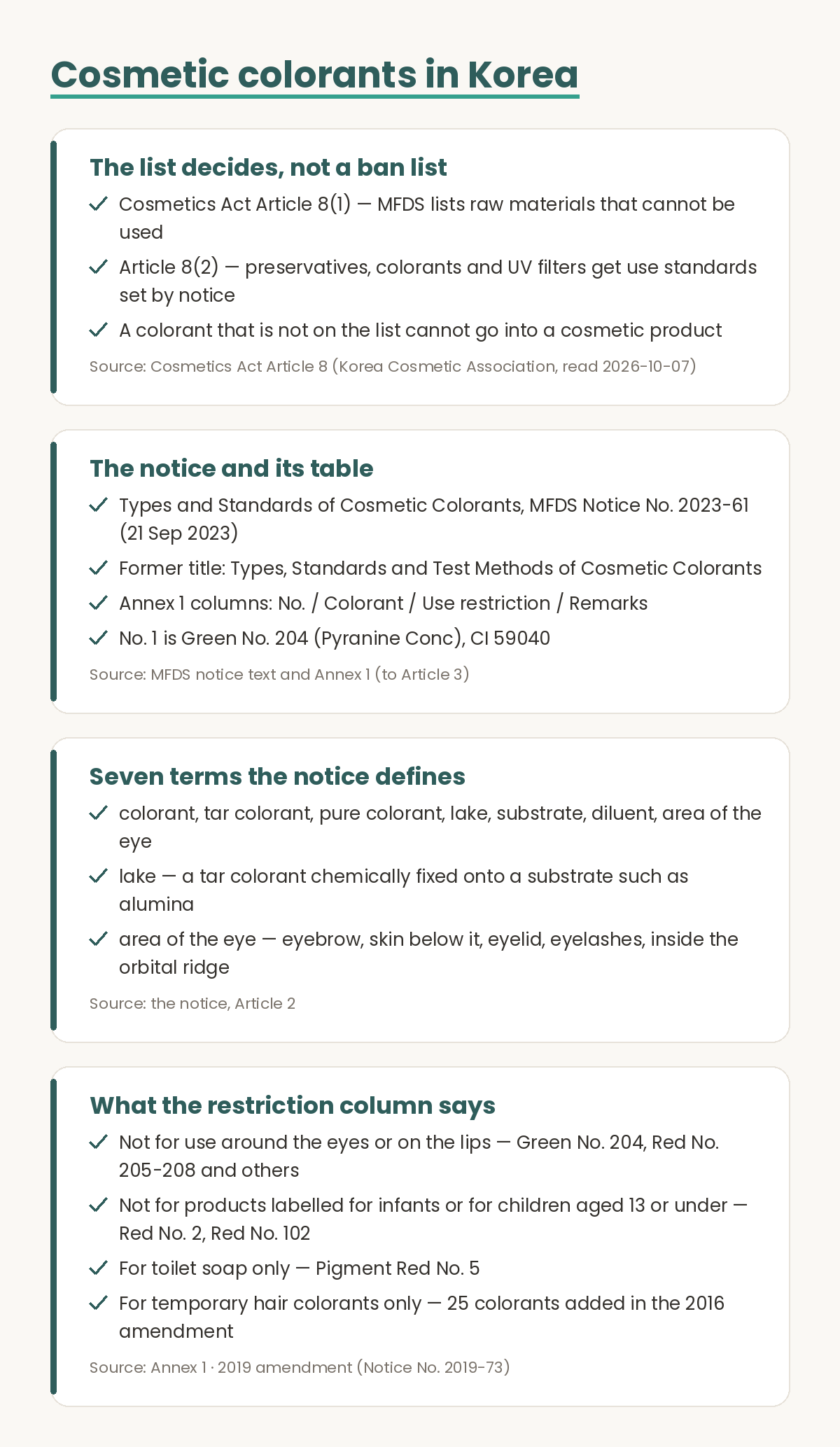
There are two ways to regulate what goes into a cosmetic. You can name the materials that must stay out, or you can name the materials that may go in. Korea’s Cosmetics Act does both — and colorants belong to the second kind.
| Paragraph | What it sets | The text |
|---|---|---|
| Article 8(1) | A list of raw materials that cannot be used | The Minister of Food and Drug Safety shall designate and give public notice of raw materials that cannot be used in manufacturing cosmetics |
| Article 8(2) | Use standards for preservatives, colorants and UV filters | For raw materials that need particular restrictions on use, such as preservatives, colorants and ultraviolet blocking agents, the Minister shall designate and give public notice of their use standards |
Paragraph 1 is the ban list. Paragraph 2 is the permitted list, and colorants are named in it, next to preservatives and ultraviolet filters. The consequence is simple: a colour that has not been written into the notice cannot be used in a cosmetic, even though no rule says it is dangerous.
Read the other way round, every colorant name printed on a Korean cosmetic box has already been through that door.
――――――――――――――――――――――――――――
Seven terms, and the two that matter at the shelf
The notice is called Types and Standards of Cosmetic Colorants (MFDS Notice No. 2023-61, 21 September 2023). Its former title was Types, Standards and Test Methods of Cosmetic Colorants — worth knowing, because a good deal of what is written online still cites the old name. Article 2 defines seven terms.
| Term | How the notice defines it |
|---|---|
| colorant | an ingredient whose main purpose is to give colour to a cosmetic or to the skin |
| tar colorant | a colorant derived from coal tar or its intermediates, or obtained by organic synthesis, together with its lakes, salts and mixtures with diluents |
| pure colorant | the colorant itself, without intermediates, diluents or substrates |
| lake | a tar colorant fixed onto a substrate by chemical bonding — an aluminium lake when the substrate is aluminium |
| substrate | the material a pure colorant is spread onto when a lake is made — alumina, titanium dioxide and the like |
| diluent | a material mixed in to make a colorant easier to handle. It may not be a raw material that cosmetics cannot use |
| area of the eye | the eyebrow, the skin below the eyebrow, the eyelid and the eyelashes, and the area inside the orbital ridge |
Two of them show up on labels.
Lake. A water-soluble colorant fixed onto a powder so that it stays where it is put. On an ingredient list it reads «Red No. 202 Aluminum Lake». The same colour index number behaves differently once it is a lake, which is why colour cosmetics carry the word so often.
Area of the eye. The notice draws the boundary itself: the eyebrow, the skin below it, the eyelid and the eyelashes, and the area inside the orbital ridge. Eyeshadow, eyeliner, mascara and eye cream are all inside it. So a colorant marked «not for use around the eyes» can still colour a lipstick or a blusher — it simply cannot go near the eye.
――――――――――――――――――――――――――――
What the restriction column decides
If you only read one column of Annex 1, read this one. It is not about concentration — it is about place of use, and it comes in four shapes.
| What the restriction column says | Which colorants | Where it came from |
|---|---|---|
| Not for use around the eyes or on the lips | Green No. 204 · Green No. 401 · Orange No. 206 · Orange No. 207 · Purple No. 401 · Red No. 205-208 · Red No. 219 · Red No. 225 · Red No. 405, among others | Annex 1, restriction column |
| Not for products for infants, or for products labelled as usable by children aged 13 or under | Red No. 2 (Amaranth) · Red No. 102 (New Coccine) | The 2019 amendment (Notice No. 2019-73) widened this from infant products alone |
| For toilet soap only | Pigment Red No. 5 | Same 2019 amendment, in force from 31 December 2019 |
| For temporary hair colorants only | basic, HC and disperse series colorants | 25 colorants entered on this condition in the 2016 amendment |
Two reds make the point. Red No. 2 and Red No. 102 are permitted colorants in Korea; they simply cannot go into a product that is labelled as usable by children aged 13 or under. Before the 2019 amendment the bar covered infant products alone.
This is the same construction we met in the children’s cosmetics guide: the rule starts at the label, not at the ingredient. Print «for children» on the box and this line attaches to the product.
――――――――――――――――――――――――――――
Four amendments in ten years
| Notice | When | What changed |
|---|---|---|
| No. 2016-49 | 24 June 2016 | Tar colorants and other colorants were brought into one notice, and 25 colorants for temporary hair colorants were added |
| No. 2019-73 | 2019 | Red No. 2 and Red No. 102 were barred from products labelled for children aged 13 or under; Pigment Red No. 5 became toilet-soap only (stock made or imported before the date had two years to sell through) |
| No. 2020-64 | 20 July 2020 | Toilet soap moved from industrial goods into cosmetics, so colorants usable in toilet soap were added |
| No. 2023-61 | 21 Sep 2023 | The notice in force today. Its title settled as Types and Standards of Cosmetic Colorants |
The 2016 amendment was the structural one. Until then tar colorants had a notice of their own; bringing tar colorants and the rest into a single table is what produced the Annex 1 we read today.
――――――――――――――――――――――――――――
Korea, the United States and the EU: one method, three lists
The FDA states it plainly: «All color additives used in cosmetics (or any other FDA-regulated product) must be approved by FDA.» The EU Cosmetics Regulation does the same job in Article 14(1), which bars «colorants other than those listed in Annex IV». Three jurisdictions, three lists, one method.
| Korea | United States | European Union | |
|---|---|---|---|
| Method | Use the colorants written in Annex 1 of the MFDS notice | Use the colorants on the FDA list — 29 exempt from certification (21 CFR 73), 36 subject to it (21 CFR 74) | Use the colorants listed in Annex IV |
| A colorant off the list | Cannot be used (Cosmetics Act Article 8(2)) | «failure to meet U.S. color additive requirements causes a cosmetic to be adulterated» | «colorants other than those listed in Annex IV… » may not be present (Article 14(1)(c)(i)) |
| Around the eye | The notice defines «area of the eye» and writes the limit into each colorant’s row | The permitted-colorant table carries a separate «Eye Area» column | Written into the conditions of use in Annex IV |
| Batch testing | None | Synthetic organic colors are certified batch by batch: «All batches… shall be certified in accordance with regulations in part 80» | None |
| Hair dye | Colorants for temporary hair colorants sit inside the same list | Coal-tar hair dyes are the stated exception | Hair colorants fall outside Annex IV (Article 14(2)) |
Two differences are worth carrying with you.
The eye is treated as its own place everywhere. The FDA defines the area of the eye as «the area enclosed within the circumference of the supra-orbital ridge and the infra-orbital ridge, including the eyebrow, the skin below the eyebrow, the eyelids and the eyelashes, and conjunctival sac of the eye» — the same boundary Korea’s notice draws, in almost the same words. And where a colour is cleared for that area, the US regulation says so in the colorant’s own section: «FD&C Blue No. 1 may be safely used for coloring cosmetics generally, including cosmetics intended for use in the area of the eye».
Batch certification exists only in the United States. Synthetic organic colors must be submitted to FDA lot by lot — «All batches… shall be certified in accordance with regulations in part 80 of this chapter» — while colors drawn from mineral, plant or animal sources are exempt. Korea and the EU have no equivalent step. If you have wondered why an imported product’s colorant line sometimes carries an extra designation, this is one of the reasons.
――――――――――――――――――――――――――――
What to check on the box
✔ Colorants sit near the end of the ingredient list, as «colour No. N» or a CI number
✔ «Aluminum Lake» means the colour has been fixed so that it does not bleed
✔ On a product labelled for children, look for Red No. 2 and Red No. 102
✔ Eyeshadow, mascara and eye cream are all «area of the eye» products
✔ How deep the colour looks is a question of amount; whether it may be there at all is a question of the list
A long row of colorant names is not a warning sign. Being named at all means the colour is on the list. What is worth checking is not how many there are, but whether this colour belongs in this kind of product.
――――――――――――――――――――――――――――
What I left out, and why
✔ The full Annex 1 table. Korea’s national law portal did not open on the day this was written, so I kept to the shapes of the restriction column and the colorants named in them
✔ How many colorants are on the list. The 2016 amendment carried 127; three amendments have followed, so today’s count may differ and I did not print a number
✔ Safety debates about tar colorants. I could not open primary sources. What the notice settles is where a colour may be used, and that is the scope of this article
✔ The notice’s entry-into-force date and review deadline. I saw them on a mirror but not in the original, so they are not here
――――――――――――――――――――――――――――
One line
A colorant is used where the list says it may be used. Next to the colour’s name on the back of the box, the place it is allowed to go has already been decided.
Next in this series: cosmetic preservatives — parabens, phenoxyethanol, and how to read the limits on the back label.
――――――――――――――――――――――――――――
📌 Related
📌 How to Read a Korean Cosmetic Ingredient List (Ingredient Guide 14) — where colorant names appear
📌 Salicylic Acid (BHA): 0.5% vs 2%, Explained (Ingredient Guide 8) — the preservative named beside colorants in Article 8(2)
📌 Sunscreen SPF and PA: How to Read the Numbers (Ingredient Guide 11) — the third material in the same paragraph
📌 AHA vs BHA: Is Glycolic Acid an AHA? (Ingredient Guide 13)
About the author · Dr. J
MS in Veterinary Medicine, PhD in Life Sciences. I worked as a researcher at the Korea Research Institute of Bioscience and Biotechnology (KRIBB) and now run Beaurea, a cosmetics manufacturing company, where I write the formulas myself. This blog reads the research papers and the regulatory documents and turns them into plain-language criteria for choosing ingredients. I don’t recommend specific products here – only criteria that apply to any product.
📄 References
· Cosmetics Act (Korea), Article 8 — Safety standards for cosmetics
· Types and Standards of Cosmetic Colorants, MFDS Notice No. 2023-61 (21 September 2023), Articles 2, 3, 5 and Annexes 1 and 2
· Types, Standards and Test Methods of Cosmetic Colorants, Notice No. 2016-49 (24 June 2016) and its partial amendment draft
· Notice No. 2019-73 as reported by Cosmorning, 3 September 2019 · Notice No. 2020-64 per the Korea Cosmetic Association
· U.S. FDA, Color Additives and Cosmetics · Color Additives Permitted for Use in Cosmetics · 21 CFR Parts 73, 74 and 80
· Regulation (EC) No 1223/2009, Article 14 and Annex IV
――――――――――――――――――――――――――――
This article summarises statutes and administrative notices and is not a substitute for diagnosis or treatment. The full Annex 1 table could not be retrieved on the day of writing; the restriction wording and the colorants named here were confirmed against the notice text and the 2016 amendment draft. US and EU material is quoted from the current public versions published by those authorities.
— Dr. J Ingredient Notes