🇰🇷 한국어판: 알부틴 효능과 2~5%의 뜻 (성분 백과 ⑮)
Hello, I’m Dr. J. If you have compared arbutin and alpha-arbutin on Korean skincare labels and wondered where the numbers come from, here is the short answer: in Korea, arbutin at 2–5% is written into a government table, and in the EU, both forms have had legal concentration limits since 2025. This is Ingredient Guide 15.
Those two sets of numbers look like they answer the same question. They don’t. The Korean range tells a manufacturer how much arbutin it can use to make a brightening claim without submitting new efficacy data. The EU numbers are safety ceilings. Reading a label well starts with knowing which kind of number you are looking at.
Below: the Korean table itself, the human trial that used a concentration inside that range, the EU entries for arbutin and alpha-arbutin, and why every one of these documents also mentions hydroquinone.
――――――――――――――――――――――――――――
📄 If you’d rather read the primary sources
📄 Korea — Regulation on Review of Functional Cosmetics, Annex 4: brightening ingredients (Korean)
📄 Morag et al. 2015 — arbutin 2.51% cream, 102 women, 8 weeks (PubMed)
📄 EU — SCCS Opinion on alpha-arbutin and beta-arbutin, SCCS/1642/22 (2023)
📄 EU — Commission Regulation (EU) 2024/996, Annex III entries 377 and 378 (EUR-Lex)
📄 US — FDA on OTC skin lightening products (April 2022)
📄 Korea — survey of 40 arbutin brightening products (J Soc Cosmet Sci Korea, 2019)
The Korean annex lists nine brightening ingredients with their amounts and allowed product forms on a single page; the EU regulation gives both arbutins a row of their own, with dates.
――――――――――――――――――――――――――――
――――――――――――――――――――――――――――
The short version
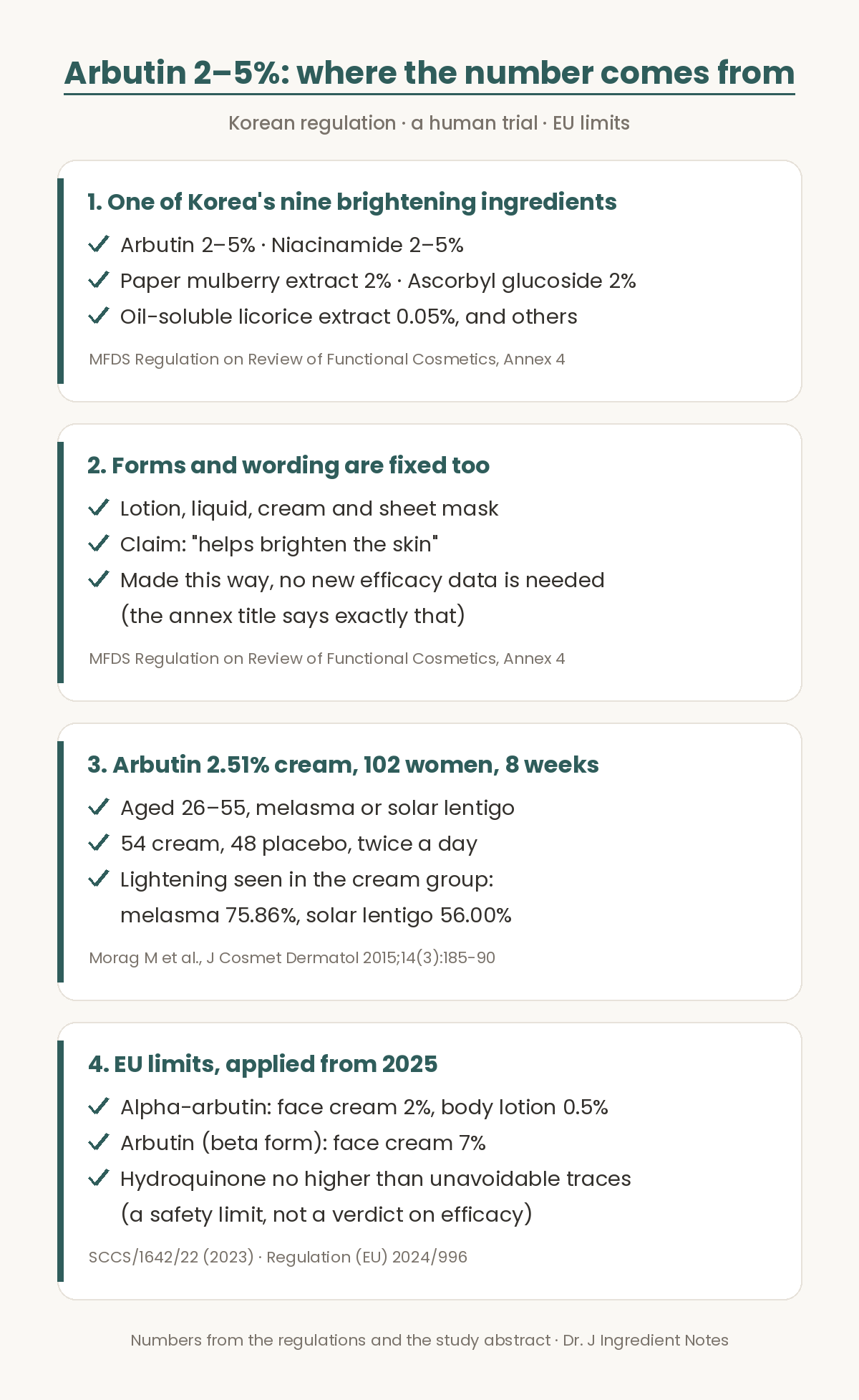
✔ Korea lists arbutin at 2–5% as one of nine brightening ingredients for functional cosmetics
✔ Made within that range and form, a product needs no new efficacy data for its brightening claim
✔ A double-blind trial had 102 women use a 2.51% arbutin cream or placebo for 8 weeks
✔ The EU caps face creams at 2% alpha-arbutin and 7% arbutin, applied from 2025
✔ Every one of these texts watches hydroquinone, because arbutin can break down into it
――――――――――――――――――――――――――――
Who set 2–5%? Korea’s nine brightening ingredients
Korea’s Ministry of Food and Drug Safety (MFDS) runs a functional cosmetics system. A product that claims to brighten the skin, smooth wrinkles or protect against UV is reviewed before it can carry that claim. To keep the process simple for well-studied ingredients, the Regulation on Review of Functional Cosmetics has an annex that lists ingredients and amounts that can be used without new efficacy data. For brightening, the list is nine lines long.
| No. | Ingredient (Korean label name) | Amount |
|---|---|---|
| 1 | Paper mulberry (Broussonetia) extract · 닥나무추출물 | 2% |
| 2 | Arbutin · 알부틴 | 2–5% |
| 3 | Ethyl ascorbyl ether · 에칠아스코빌에텔 | 1–2% |
| 4 | Oil-soluble licorice extract · 유용성감초추출물 | 0.05% |
| 5 | Ascorbyl glucoside · 아스코빌글루코사이드 | 2% |
| 6 | Magnesium ascorbyl phosphate · 마그네슘아스코빌포스페이트 | 3% |
| 7 | Niacinamide · 나이아신아마이드 | 2–5% |
| 8 | Alpha-bisabolol · 알파-비사보롤 | 0.5% |
| 9 | Ascorbyl tetraisopalmitate · 아스코빌테트라이소팔미테이트 | 2% |
The same table fixes three more things:
✔ Product forms — lotion, liquid, cream and sheet mask
✔ Claim wording — “helps brighten the skin” (피부의 미백에 도움을 준다)
✔ Directions — spread an appropriate amount evenly; masks come off after 10–20 minutes
The annex title is worth reading twice: “types of functional cosmetics for which data submission is waived.” So 2–5% is not really a safety ceiling. It is the range inside which a company can use the pre-approved claim without proving efficacy again. A combination outside the list needs its own data. On a Korean label, the words 기능성화장품 (functional cosmetic) together with the brightening claim tell you the product sits inside this framework.
――――――――――――――――――――――――――――
Does arbutin work? What the human trial shows
Among published trials on arbutin in people, one stands out for this question because it used a concentration inside the Korean range and compared it with a placebo.
✔ Who — 102 women aged 26–55 with melasma or solar lentigo (sun spots)
✔ Design — randomised, double-blind, placebo-controlled
✔ What they used — a plant-extract cream containing 2.51% arbutin (54 women) or a placebo cream (48 women)
✔ How long — twice a day on the discoloured areas, for 8 weeks
✔ Result — lightening in 75.86% of the women with melasma and 56.00% of those with solar lentigo in the cream group; 66.67% of the cream group overall
Morag M, Nawrot J, Siatkowski I, Adamski Z, Fedorowicz T, Dawid-Pac R, Urbanska M, Nowak G. Journal of Cosmetic Dermatology 2015;14(3):185-90
Two caveats belong next to those numbers. First, the abstract does not report the placebo group’s figures, so this article does not say how much better than placebo the cream did. Second, the cream was a plant extract that contained arbutin, so the extract’s other components can’t be separated out. What makes the study useful is that it tested a realistic concentration over a realistic period on the kinds of spots people actually buy these products for.
――――――――――――――――――――――――――――
Arbutin vs alpha-arbutin: Korea, the EU and the US side by side
On an ingredient list, Arbutin is the beta form and alpha-Arbutin is its alpha isomer — the same two building blocks, hydroquinone and glucose, joined by a different type of bond. The EU’s safety committee assessed them separately and the EU now limits them separately. Here is how the three markets compare.
| Item | Korea | EU | US |
|---|---|---|---|
| Arbutin (beta) | 2–5% for the pre-approved brightening claim | Face cream up to 7% (Annex III, entry 378) | No arbutin-specific limit found in the FDA rules I checked |
| Alpha-arbutin | Not named in the brightening annex | Face cream 2%, body lotion 0.5% (entry 377) | Same as above |
| Hydroquinone | Checked in market surveys (see below) | “As low as possible”, no higher than unavoidable traces, in both entries | OTC hydroquinone lighteners need an approved new drug application (FDA, 2022) |
| What the number is | A data-waiver range for a claim | A safety ceiling (the SCCS did not assess efficacy) | — |
| Since | — | Not placed on the market from 1 Feb 2025; not made available from 1 Nov 2025 if non-compliant | CARES Act 2020; FDA notice 19 Apr 2022 |
The key point: Korea’s 2–5% and the EU’s 7% were not measured on the same scale. One answers “how much lets you skip efficacy data for a brightening claim”; the other answers “how much is still safe”. The SCCS opinion says plainly that it contains no evaluation of efficacy.
On the US side, the FDA’s April 2022 notice concerns hydroquinone rather than arbutin: after the CARES Act, it says, “all OTC skin lightening products require an FDA approved new drug application before they can be legally marketed.” I did not find an arbutin-specific rule in the FDA material I checked, so the table says exactly that and no more. I also could not confirm from primary sources how an alpha-arbutin product would qualify as a brightening functional cosmetic in Korea, so I have not guessed.
――――――――――――――――――――――――――――
Why hydroquinone keeps coming up: a survey of 40 Korean products
The SCCS describes beta-arbutin as a glucose derivative of hydroquinone that can be hydrolysed by acid or by enzymes back into hydroquinone. That is why both EU entries carry the same condition, and why Korean researchers have tested products on the shelf.
The Incheon Metropolitan City Institute of Public Health and Environment analysed 40 arbutin-containing brightening functional cosmetics sold in Korea.
✔ Hydroquinone detected in 9 products
✔ 7 of them within the standard (0.3–0.9 ppm)
✔ 2 above it (8.4 ppm and 50.5 ppm)
✔ The authors attributed the hydroquinone to arbutin breaking down and called for better quality control
Cho JH, Kim JH, Eom SA et al. Investigation on the Safety of Hydroquinone and Preservatives among Whitening Functional Cosmetics Containing Arbutin in Korea. Journal of the Society of Cosmetic Scientists of Korea 2019;45(4):399-408 (in Korean)
Read the other way, 38 of the 40 products were within the standard. What I take from the survey is narrower: with arbutin, what happens after the product is made matters. So I look at the expiry date on arbutin products and don’t keep an opened jar for months.
――――――――――――――――――――――――――――
Who it suits, and in what order
✔ Uneven tone and dark spots are the natural fit; the trial enrolled women with melasma and sun spots
✔ I put sunscreen first — preventing new pigment before fading what is there. See the SPF and PA guide below
✔ Choose a texture you will use twice a day for 8 weeks; that is what the trial asked of people
✔ If you already use niacinamide from the same Korean list, I found no trial showing what layering the two adds
――――――――――――――――――――――――――――
What this article leaves out, and why
✔ How arbutin reduces pigment — I could not open the review I would have relied on, so there is no mechanism section
✔ Trials comparing arbutin products with prescription creams — they read as drug comparisons, which is outside a cosmetics guide
✔ “Never use arbutin with vitamin C” and similar rules — I found no primary source for them
✔ How alpha-arbutin qualifies in Korea — not confirmed from primary sources, so not stated
――――――――――――――――――――――――――――
Five things to check on the label
✔ 기능성화장품 + the brightening claim — on a Korean product, the sign it sits inside the MFDS framework
✔ Position in the list — at 2% or more, arbutin should appear above the ingredients used at 1% or less (Ingredient Guide 14)
✔ Arbutin or alpha-Arbutin — match the name letter by letter; the limits differ
✔ Product form — lotion, cream, liquid or sheet mask on the Korean list
✔ Expiry date — use within it and don’t keep an opened product for months
――――――――――――――――――――――――――――
In one line
Korea’s 2–5% is a claim-and-data rule; the EU’s 2% and 7% are safety ceilings. On the label, check the functional-cosmetic mark, the exact name, the position in the list and the expiry date.
Next in the series: what the Korean “functional cosmetic” mark actually certifies (Ingredient Guide 16).
――――――――――――――――――――――――――――
📌 Earlier guides
📌 Niacinamide: How Much Is Enough
📌 How to Read a Korean Cosmetic Ingredient List — Where the Order Stops at 1%
📌 Adenosine 0.04%: Who Decided That Number
📌 Tranexamic Acid Cream: What the Melasma Trials Found
📌 Sunscreen SPF and PA: How to Read the Numbers
About the author · Dr. J
MS in Veterinary Medicine, PhD in Life Sciences. I worked as a researcher at the Korea Research Institute of Bioscience and Biotechnology (KRIBB) and now run Beaurea, a cosmetics manufacturing company, where I write the formulas myself. This blog reads the research papers and the regulatory documents and turns them into plain-language criteria for choosing ingredients. I don’t recommend specific products here – only criteria that apply to any product.
📄 References
· Korea — MFDS Regulation on Review of Functional Cosmetics, Annex 4: functional cosmetics for which data submission is waived
· Morag M et al., J Cosmet Dermatol 2015;14(3):185-90 (PMID 26119285)
· Scientific Committee on Consumer Safety, Opinion on alpha-arbutin and beta-arbutin, SCCS/1642/22 (adopted 31 January 2023)
· Commission Regulation (EU) 2024/996 of 3 April 2024 — Regulation (EC) No 1223/2009, Annex III entries 377 and 378
· US FDA, “FDA works to protect consumers from potentially harmful OTC skin lightening products” (19 April 2022)
· Cho JH et al., J Soc Cosmet Sci Korea 2019;45(4):399-408
――――――――――――――――――――――――――――
This article summarises regulatory texts and published research. It is information, not a diagnosis or a treatment plan. If something about your skin worries you, please talk to a professional.
— Dr. J Ingredient Notes