
🇰🇷 한국어판: 자외선차단제 SPF·PA 읽는 법 – 2mg이 만드는 숫자 (성분 백과 ⑪)
Hello, I’m Dr. J.
Two numbers sit on the back of every Korean sunscreen: SPF 50+ and PA++++. They come from two different tests, and a third rule decides how the result is allowed to be printed. This is Ingredient Guide 11, and it follows all three steps through the text of Korea’s Ministry of Food and Drug Safety (MFDS) notification — then sets the Korean rules beside the US ones, because the label in your bathroom may well follow the other book.
Here is the part most people find surprising. Both countries measure protection at 2 mg of product per cm² of skin. Apply half of that, and an SPF 50 falls to roughly 7 by the relationship the research describes. The amount on your skin moves the result far more than the number on the tube does.
――――――――――――――――――――――――――――
📄 If you’d rather read the primary sources
📄 MFDS notification, Annex 3 — test methods and criteria for UV protection (Korean)
📄 21 CFR 201.327 — US OTC sunscreen labeling (eCFR)
📄 Faurschou & Wulf (2007) — how much you apply vs. SPF, 20 volunteers
📄 Hughes et al. (2013) — 903 adults, daily sunscreen, 4.5 years
📄 Green et al. (2011) — 1,621 adults, melanoma at 10 years
🏠 Regulation on the Review of Functional Cosmetics (Korea Law Information Center)
Annex 3 holds the measurement methods and the PA bands; Article 13 holds the labelling rule.
――――――――――――――――――――――――――――
――――――――――――――――――――――――――――
In four lines, if you’re in a hurry
● SPF is how many times more UV it takes to redden protected skin than bare skin. PA is the same arithmetic on the UVA side
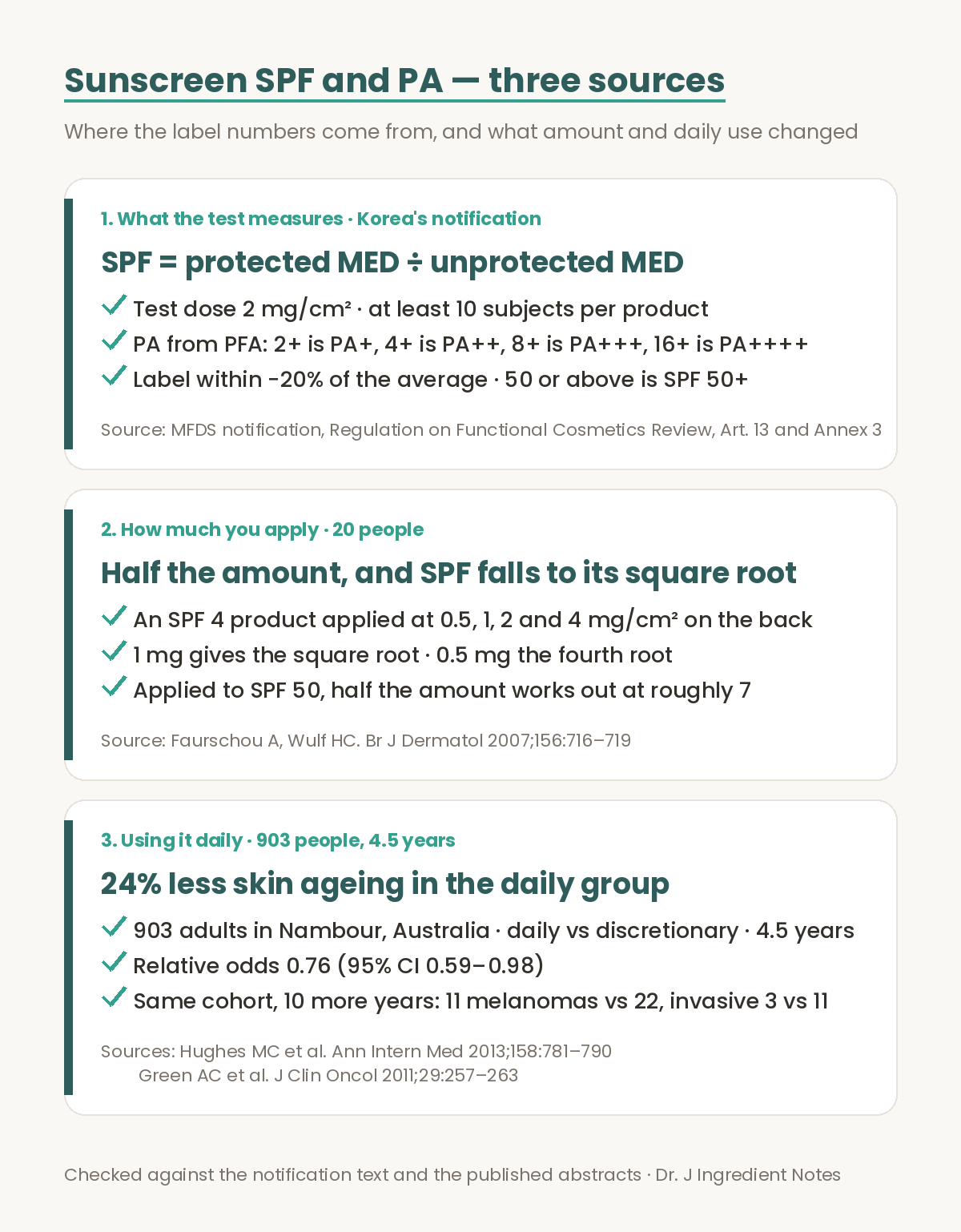
● The test dose is 2 mg/cm². Apply half and SPF drops to its square root
● A Korean label may be printed at the measured average or up to 20% below it. Anything 50 or over is printed SPF 50+
● Among 903 adults using sunscreen daily, skin ageing progressed 24% less over 4.5 years
――――――――――――――――――――――――――――
What is actually measured — redness, then darkening
Put skin under UV and it reddens. The smallest UV dose that produces that redness is the minimal erythema dose (MED), and the Korean notification requires it to be read 16 to 24 hours after exposure. SPF is the MED of skin wearing the product divided by the MED of bare skin.
PA applies the same idea to UVA. UVA shows up as darkening before it shows up as redness, so the reading is taken 2 to 24 hours after exposure, at the smallest dose that leaves a faint persistent tan. That ratio is the protection factor of UVA (PFA), and the PA grade is simply PFA sorted into bands.
| Mark | What it measures | When it is read | Criterion |
|---|---|---|---|
| SPF | UVB · ratio of minimal erythema doses | 16–24 hours | arithmetic mean of 10 or more subjects |
| PA | UVA · ratio of minimal persistent pigment darkening doses (PFA) | 2–24 hours | PFA band decides the number of plus signs |
| Water resistance | protection left after water contact | after the immersion procedure | confidence interval of the ratio at 50% or above |
| Application dose | common to all three tests | — | 2 mg per cm² |
――――――――――――――――――――――――――――
Reading the numbers — 50+, ++++, and minus 20%
One more rule sits between the measurement and the print. The measured value does not go straight onto the tube. Article 13 allows the label to be written at the average or up to 20% below it, and the notification even gives the worked example: if the average is 23, the label may read anything from 19 to 23. So a Korean SPF number is equal to, or lower than, what was measured.
| Label | What it means |
|---|---|
| SPF 25 | the measured average was 25, or above 25 but within 20% |
| SPF 50+ | measured 50 or above. 60 and 90 are printed the same way |
| PA+ | PFA of 2 or more, under 4 |
| PA++ | PFA of 4 or more, under 8 |
| PA+++ | PFA of 8 or more, under 16 |
| PA++++ | PFA of 16 or more |
| Water resistant | passed a test in which at least half the protection survived water contact |
Look at the PA bands and you’ll see that each plus sign doubles the previous one: 2, 4, 8, 16. The step from three pluses to four is larger than it looks.
――――――――――――――――――――――――――――
What the research found ① — the amount, 20 volunteers
Twenty healthy volunteers had five 34 cm² fields marked on their backs, and an SPF 4 product was spread over them at 0.5, 1, 2 and 4 mg per cm². UV was delivered 30 minutes later and the erythema read 22 to 26 hours after that. The relationship between amount and SPF came out exponential (r² = 0.903) — Faurschou & Wulf, 2007.
| Amount applied | What happens to SPF | Worked through for SPF 50 |
|---|---|---|
| 4 mg/cm² | close to the square | higher than the tested value |
| 2 mg/cm² (the test dose) | the value printed on the label | 50 |
| 1 mg/cm² | the square root | about 7 |
| 0.5 mg/cm² | the fourth root | about 2.7 |
――――――――――――――――――――――――――――
What the research found ② — daily use, 903 adults over 4.5 years
In Nambour, Australia, 903 adults under 55 were randomised to daily sunscreen or to discretionary use and followed for 4.5 years (1992–1996). Skin-surface casts taken from the back of the hand were graded for photoageing, and the daily group’s progression came out 24% lower (odds ratio 0.76) — Hughes et al., 2013. Beta-carotene supplementation, tested in the same trial, made no difference.
The same township’s 1,621 adults (aged 25–75) were then followed for 10 more years after the trial ended — Green et al., 2011.
| Outcome | Daily group | Discretionary group | Source |
|---|---|---|---|
| Photoageing progression (4.5 y) | 24% less · odds ratio 0.76 (95% CI 0.59–0.98) | Hughes 2013 | |
| New melanomas (10-year follow-up) | 11 | 22 | Green 2011 |
| Of those, invasive | 3 | 11 | Green 2011 |
What separated the groups, in other words, was not the number on the label. It was how much and how often.
――――――――――――――――――――――――――――
If your bottle is American — 21 CFR 201.327
A US sunscreen is an over-the-counter drug, and its label is written by 21 CFR 201.327. The SPF test dose is the same 2 mg/cm², but almost everything printed around it differs — including the fact that the directions themselves are regulated text, which is why every American bottle carries the same sentences.
The required directions are worth reading as a list, because they are the closest thing either country has to an official instruction manual: apply liberally 15 minutes before sun exposure; reapply at least every 2 hours; use a water resistant sunscreen if swimming or sweating, and reapply after 40 or 80 minutes in the water, whichever time the bottle claims; and reapply immediately after towel drying.
| On the label | Korea (MFDS notification) | United States (21 CFR 201.327) |
|---|---|---|
| UVB number | SPF, measured at 2 mg/cm², printable up to 20% below the average | SPF, measured at 2 mg/cm² |
| Top of the scale | capped at SPF 50+ | not capped — SPF 70 and 100 appear on shelves |
| UVA | graded PA+ to PA++++ from PFA | pass or fail — “Broad Spectrum”, from a critical wavelength of 370 nm or more |
| Water resistance | marked when at least half the protection survives | stated as 40 minutes or 80 minutes |
| Reapplication | not fixed in the notification text | at least every 2 hours, and after towel drying |
| Warning box | general functional-cosmetic wording | Skin Cancer / Skin Aging Alert when the product is not broad spectrum or is under SPF 15 |
The comparison is useful in one practical way. A Korean bottle tells you how much UVA protection it has and stops counting UVB at 50+; an American bottle keeps counting UVB and tells you only whether UVA is covered. Reading both marks — a high SPF and either PA+++/++++ or “Broad Spectrum” — is how you cover the gap either label leaves.
――――――――――――――――――――――――――――
Using it — the amount is what makes the number
✔ 2 mg/cm² is the standard. Two thin passes get you closer to it than one careful one
✔ It goes last in a morning routine — after retinol or peptides, before makeup
✔ Reapply after sweat or water. “Water resistant” means a test was passed, not that the film is permanent; on a US label the bottle also tells you whether that test ran 40 or 80 minutes
✔ The face is not the whole job. Neck, ears and the backs of the hands are the places that get missed
✔ It pairs with the retinol you use at night — daytime protection runs alongside the adjustment period covered in the retinol guide
――――――――――――――――――――――――――――
Five things to check when you buy
✔ The functional-cosmetic statement — in Korea, UV protection is reviewed or reported to the MFDS, so that phrase is what tells you the number came from a test
✔ SPF and PA together — SPF is UVB, PA is UVA. Neither substitutes for the other. On a US label, look for “Broad Spectrum” beside the SPF
✔ Both high for a long day outdoors — remember that each PA plus sign doubles the band
✔ “Water resistant” on water or sweat days — and, on a US bottle, the 40 or 80 minute figure printed with it
✔ A texture you’ll actually use generously — the product that lets you reach 2 mg/cm² every morning is the one doing the work
――――――――――――――――――――――――――――
In one line
SPF and PA are ratios measured at 2 mg/cm², and a Korean label is printed at that value or up to 20% under it. The label decides the number; the amount and the every day decide the result.
Next in the series: adenosine (Ingredient Guide 12).
――――――――――――――――――――――――――――
📌 Earlier guides
📌 Korea Just Put a “Not for the Whole Body” Warning on Oxybenzone Sunscreens
📌 Retinol: Start at 0.1% – How to Read the Concentration Numbers (Ingredient Guide 1)
📌 Skincare Ingredient Compatibility Chart – What to Layer and What to Split
About the author · Dr. J
MS in Veterinary Medicine, PhD in Life Sciences. I worked as a researcher at the Korea Research Institute of Bioscience and Biotechnology (KRIBB) and now run Beaurea, a cosmetics manufacturing company, where I write the formulas myself. This blog reads the research papers and the regulatory documents and turns them into plain-language criteria for choosing ingredients. I don’t recommend specific products here – only criteria that apply to any product.
📄 References
· MFDS, Regulation on the Review of Functional Cosmetics, Article 13 and Annex 3 (UV protection test methods and criteria)
· 21 CFR 201.327 — Over-the-counter sunscreen drug products, labeling and effectiveness testing (US FDA)
· Faurschou A, Wulf HC. Br J Dermatol 2007;156(4):716–719 — 20 volunteers, applied amount vs. SPF
· Hughes MC, Williams GM, Baker P, Green AC. Ann Intern Med 2013;158(11):781–790 — 903 adults, 4.5 years
· Green AC, Williams GM, Logan V, Strutton GM. J Clin Oncol 2011;29(3):257–263 — 1,621 adults, 10-year follow-up
――――――――――――――――――――――――――――
This article summarises published research and public regulatory documents. It is information, not a diagnosis or a treatment plan. If something about your skin worries you, please talk to a professional.
— Dr. J Ingredient Notes
Leave a Reply