
Hello, this is Dr. J.
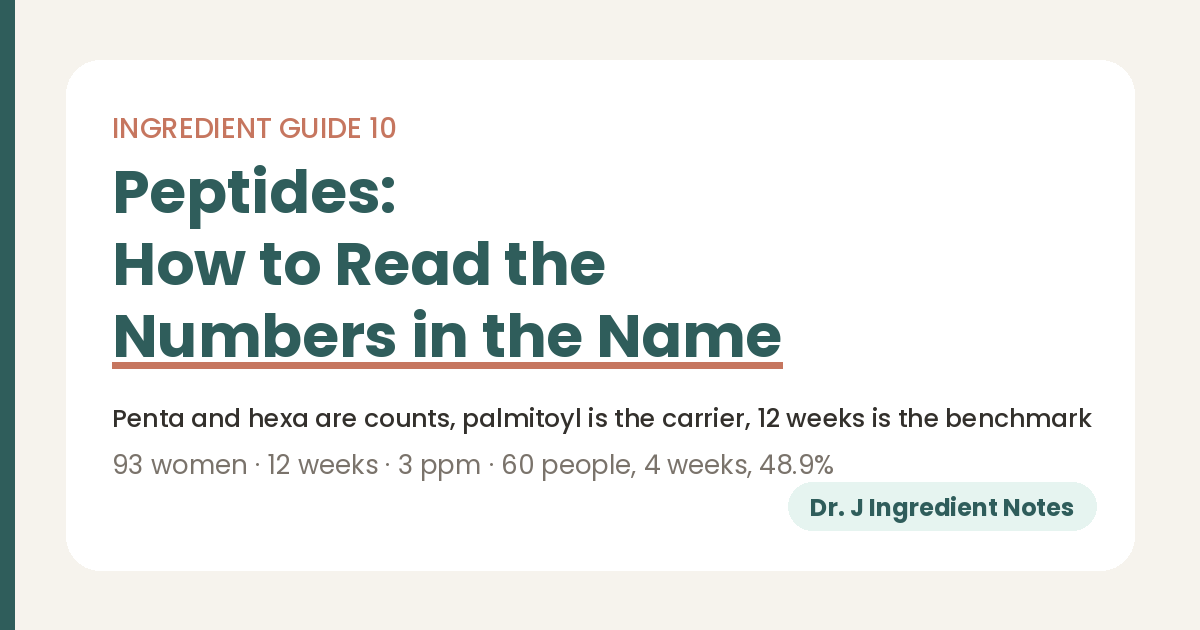
Ingredient Guide number ten is peptides – the long names on the back of wrinkle and firming products, like Palmitoyl Pentapeptide-4 or Acetyl Hexapeptide-8.
Here is the surprising part. The landmark trial for this ingredient used 3 ppm – that is 0.0003%. So finding a peptide near the bottom of an ingredient list is not a red flag. This post explains how to read the numbers and prefixes inside those long names, and then looks at what two trials on real people found.
The short version: peptides are a family in which the evidence differs from one name to the next, so you choose by reading the full name rather than the word “peptide” – and the benchmark is 12 weeks.
🇰🇷 Read this in Korean: 펩타이드 크림, 이름 속 숫자 읽는 법 (성분 백과 ⑩)
―――――――――――――――――――――
📄 Read the sources first
· Robinson LR et al., Int J Cosmet Sci 2005;27(3):155–160 – palmitoyl pentapeptide 3 ppm, 93 women, 12 weeks, split-face
· Wang Y et al., Am J Clin Dermatol 2013;14(2):147–153 – acetyl hexapeptide, 60 people, 4 weeks, placebo-controlled
· Schagen SK, Cosmetics 2017;4(2):16 – a review of cosmetic peptides by type (open access)
· 🏠 COSMILE Europe ingredient database – paste the full INCI name to look it up
The 2005 trial compared the two sides of the same face; the 2013 trial had a separate placebo group. Both designs are spelled out in the abstracts.
―――――――――――――――――――――
15-second summary · no sound
―――――――――――――――――――――
In a hurry? Four lines
✔ A peptide is a short chain of a few amino acids. If collagen is the long chain, a peptide is a fragment of it
✔ Penta, hexa, tri in the name is the amino-acid count. The trailing “-4” or “-8” is a registry index, so a bigger number is not a stronger product
✔ 93 women who applied palmitoyl pentapeptide at 3 ppm for 12 weeks saw fine lines improve significantly versus placebo; in 60 people who applied acetyl hexapeptide for 4 weeks, 48.9% were rated improved versus 0% on placebo
✔ Peptides are not on Korea’s list of four approved wrinkle ingredients. An “anti-wrinkle functional” claim means a listed ingredient is included or an individual review was done
―――――――――――――――――――――
What a peptide is – a fragment of collagen
A protein is a chain of hundreds or thousands of amino acids. Cut a few to a few dozen of them off that chain and you have a peptide. That is why the names carry a count: penta (5), hexa (6), tri (3).
In the collagen guide I explained that topical collagen is too large to get in. Peptides are the answer to exactly that problem: they shrink the molecule. This is not an ingredient that works because it is big. It works because it is small.
―――――――――――――――――――――
How they work – “make more” and “move less”
Peptides are not one thing. A 2017 review sorts cosmetic peptides into three groups by what they do – Schagen, Cosmetics 2017.
| Group | Typical name (as listed) | What it does | Human trial |
|---|---|---|---|
| Signal peptide | Palmitoyl Pentapeptide-4 (Pal-KTTKS) | Resembles a collagen fragment and is designed to tell skin cells to make more collagen | 93 women · 12 weeks · 3 ppm (2005) |
| Neurotransmitter-modulating peptide | Acetyl Hexapeptide-8 (formerly -3) | Patterned on the end of SNAP-25, the protein that passes the “move” signal to muscle, so it dampens that signal where expression lines form | 60 people · 4 weeks (2013) |
| Carrier peptide | Copper Tripeptide-1 (GHK-Cu) | Binds copper and carries it into the skin | The review cites small studies, but I could not read the originals, so no figures appear in this post |
Same word, different jobs – and a different depth of human evidence behind each. This post therefore centres on the two names above that have trials in people.
―――――――――――――――――――――
Reading the numbers – penta, hexa, palmitoyl and ppm
Split “Palmitoyl Pentapeptide-4” into three pieces and it reads itself.
| Piece | Meaning | How to read it |
|---|---|---|
| Palmitoyl | A fatty-acid tail. It helps a water-loving peptide cross the oily stratum corneum | When it is there, the molecule was designed with penetration in mind |
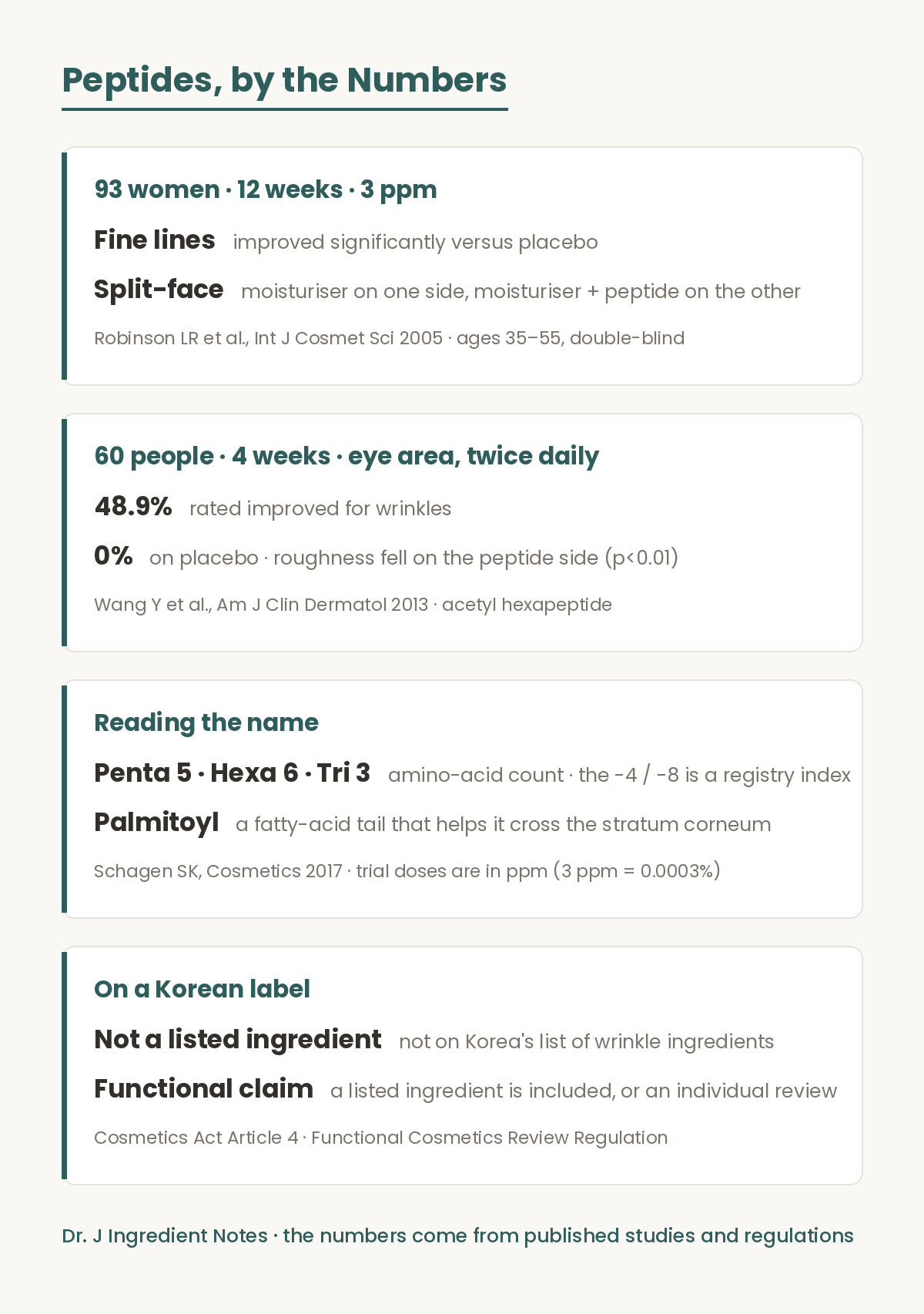
| Penta · Hexa · Tri | Amino-acid count – 5 · 6 · 3 | More amino acids does not mean stronger. Which name it is matters more |
| -4 · -8 | A registry index in the international naming system (INCI) | “-8 beats -3” is a misreading. Acetyl Hexapeptide-3 and -8 are the old and new names of the same ingredient |
| ppm | Parts per million. 3 ppm = 0.0003% | Trial doses are in this unit, so a peptide sitting near the bottom of the list is normal. Ingredients under 1% may be listed in any order |
In short, the numbers in the name are size and index, not strength. Strength is what the trials below are for.
―――――――――――――――――――――
What the trials found – 93 women for 12 weeks, 60 people for 4 weeks
First, 93 women. Caucasian women aged 35–55 applied a moisturiser to one side of the face and the same moisturiser with palmitoyl pentapeptide at 3 ppm to the other, for 12 weeks, in a double-blind, placebo-controlled, left-right randomised design. Both instrument measurements and expert graders found fine lines and wrinkles improved significantly versus placebo, and the women’s own assessments agreed. The peptide was well tolerated – Robinson et al., Int J Cosmet Sci 2005.
Second, 60 people. Sixty Chinese subjects were assigned 3:1 to acetyl hexapeptide or placebo, applied to the crow’s-feet area twice daily for 4 weeks. In the subjective assessment, total anti-wrinkle efficacy was 48.9% in the peptide group and 0% on placebo, and roughness parameters measured from silicone replicas all fell in the peptide group (p<0.01) with no clear change on placebo – Wang et al., Am J Clin Dermatol 2013.
| Trial | People · duration | What was used | What was found |
|---|---|---|---|
| Robinson 2005 | 93 women · 12 weeks | Palmitoyl pentapeptide 3 ppm (split-face) | Fine lines significantly improved vs placebo · well tolerated |
| Wang 2013 | 60 people · 4 weeks | Acetyl hexapeptide (eye area, twice daily) | Rated improved 48.9% vs 0% · roughness fell (p<0.01) |
Read together, the two trials say this. The two peptides with clear names have evidence in people; where the abstract gives no individual percentage, as in 2005, this post says “significantly” and leaves it there. One study delivered a result at 4 weeks, but for the “make more collagen” route the benchmark is 12 weeks. And peptides outside these two names may have a different level of evidence, so the sensible move is to read the name on the box and look up that name.
―――――――――――――――――――――
On a Korean label – reading the “anti-wrinkle functional” claim
In Korea, a product can carry an anti-wrinkle claim only if it uses an ingredient and level approved by the Ministry of Food and Drug Safety, or passes an individual review with safety and efficacy data (Cosmetics Act, Article 4). The approved wrinkle ingredients are four: retinol, retinyl palmitate, adenosine and polyethoxylated retinamide. Peptides are not among them. Other countries regulate claims differently; the studies themselves are the same everywhere.
| What the label shows | What it means |
|---|---|
| “Anti-wrinkle functional cosmetic” + adenosine or retinol in the list | Likely registered on the strength of the listed ingredient. The peptide is along for the ride |
| “Anti-wrinkle functional cosmetic” + no listed ingredient | Passed an individual review, with the peptide or another unlisted active |
| No claim · peptide in the list | An ordinary cosmetic. The ingredient is there but the claim cannot be printed. That does not mean the ingredient is idle |
So the claim tells you a product went through a review, not that it is stronger. It is the same structure as the “whitening” claim in the tranexamic acid guide.
―――――――――――――――――――――
How to use it – gentle enough to go almost anywhere
✔ Morning and evening are both fine. After serum, before cream
✔ It shares a routine comfortably with retinol and niacinamide. It is low-irritation, which makes it an easy first active
✔ For expression lines, acetyl hexapeptide was tested on the crow’s-feet area. Pat a thin layer on exactly that spot
✔ In the morning, sunscreen is half the job. A signal to make collagen goes nowhere if sunlight keeps breaking it down
Which ingredients can share a night is in the ingredient compatibility chart.
―――――――――――――――――――――
Five things to check before you buy
✔ Which peptide? – read the full name on the ingredient list, not the word “peptide” on the front. The names with human trials are above
✔ Is there a “palmitoyl” in front? – a sign the molecule was designed to get in
✔ Is there an anti-wrinkle functional claim? – if so, a listed ingredient is included or an individual review was done
✔ Is it near the bottom of the list? That is fine – trial doses are in ppm. Do not judge by position
✔ Can you give it 12 weeks? – that is how long the collagen-signal trial ran. One jar is too short to judge
Save these five lines for the shop. Reading the back of the box takes five minutes.
―――――――――――――――――――――
One-line summary
🧪 Peptides are an ingredient you choose by reading the name. Penta and hexa are counts, the trailing number is an index, palmitoyl is the carrier – pick a name that has been tested in people and give it 12 weeks, and you are close to what the trials saw.
The next Ingredient Guide is sunscreen: how to read SPF and PA (Ingredient Guide 11) – starting with what the number and the plus signs actually measure.
📌 Earlier posts
· Retinol: Start at 0.1% – How to Read the Concentration Numbers (Ingredient Guide 1)
· Skincare Ingredient Compatibility Chart – 12 Ingredients, What to Layer and What to Split
· Collagen: Topical vs Oral – What the Research Says (Ingredient Guide 5)
· Tranexamic Acid Cream: What the Melasma Trials Found (Ingredient Guide 9)
· Dull, Rough Skin? Glycolic Acid (AHA) – What the Research Shows
About the author · Dr. J
MS in Veterinary Medicine, PhD in Life Sciences. I worked as a researcher at the Korea Research Institute of Bioscience and Biotechnology (KRIBB) and now run Beaurea, a cosmetics manufacturing company, where I write the formulas myself. This blog reads the research papers and the regulatory documents and turns them into plain-language criteria for choosing ingredients. I don’t recommend specific products here – only criteria that apply to any product.
📄 References
· Robinson LR, Fitzgerald NC, Doughty DG, Dawes NC, Berge CA, Bissett DL. Topical palmitoyl pentapeptide provides improvement in photoaged human facial skin. Int J Cosmet Sci 2005;27(3):155–160
· Wang Y, Wang M, Xiao S, Pan P, Li P, Huo J. The anti-wrinkle efficacy of argireline, a synthetic hexapeptide, in Chinese subjects: a randomized, placebo-controlled study. Am J Clin Dermatol 2013;14(2):147–153
· Schagen SK. Topical Peptide Treatments with Effective Anti-Aging Results. Cosmetics 2017;4(2):16
· Korea Cosmetics Act, Article 4 · Regulation on the Review of Functional Cosmetics – listed ingredients and individual review
This article summarises published research and public documents for information. It is not a diagnosis or a treatment. If you have a skin concern that worries you, please see a professional.
— Dr. J Ingredient Notes
Leave a Reply