
🇰🇷 한국어로 읽기 → Korean version
Hello, Dr. J here.
Two serums, one cream, maybe an acne treatment on top.
Many of us layer three or four actives a day.
What goes in the morning, what goes at night?
I built an Ingredient Compatibility Checker to answer that.
Try it right away, or see what it does below first.
In a hurry? These three lines
✔ Every verdict carries an evidence grade — Study-backed / General principle / Theoretical concern
✔ Pick 3–5 and it builds a Morning · Night (Mon/Wed/Fri) · Night (Tue/Sat) routine automatically
1. How to use it – tap, tap more, copy
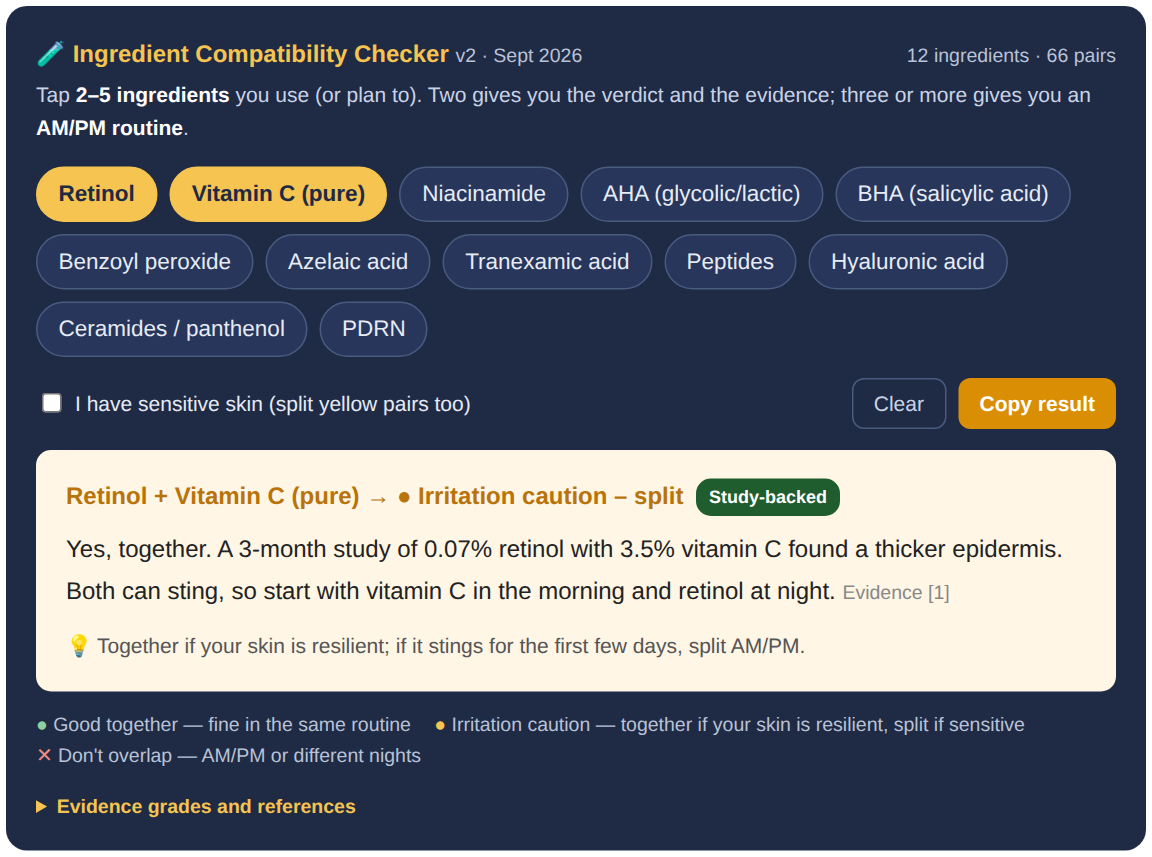
Tap. Pick two of the 12 ingredient buttons.
Above: retinol + vitamin C. “Yes, together,” with
a 3-month study of both as the evidence and “vitamin C in the morning, retinol at night” as the tip.
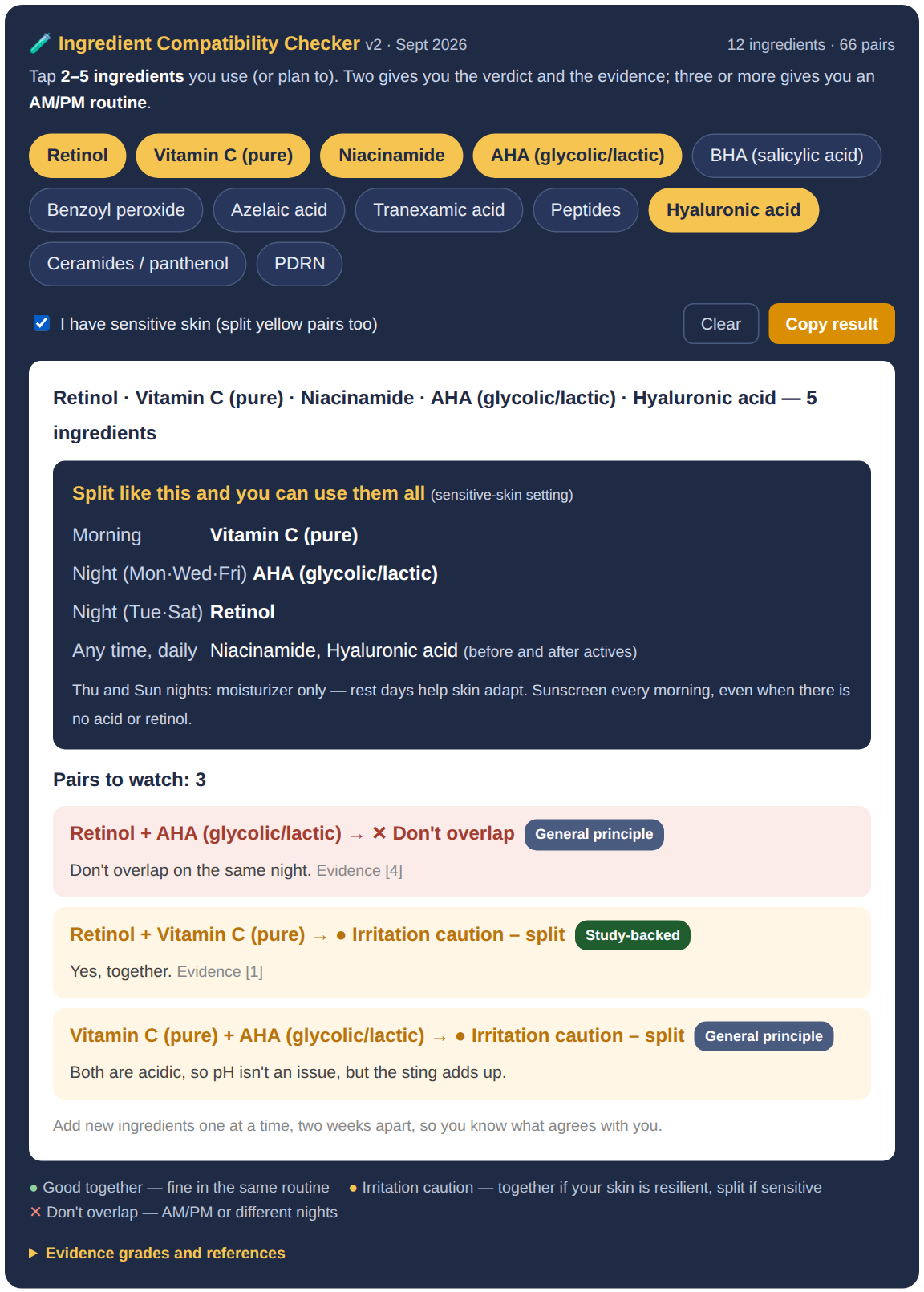
Tap more. With three or more, the screen switches to a routine.
Above: five ingredients with “sensitive skin” switched on.
Vitamin C in the morning, AHA on Mon/Wed/Fri nights, retinol on Tue/Sat nights.
Niacinamide and hyaluronic acid go any time, daily.
Copy. “Copy result” saves it as text,
and the ingredient codes are added to the URL (e.g. #R,C,A) so a shared link opens the same result.
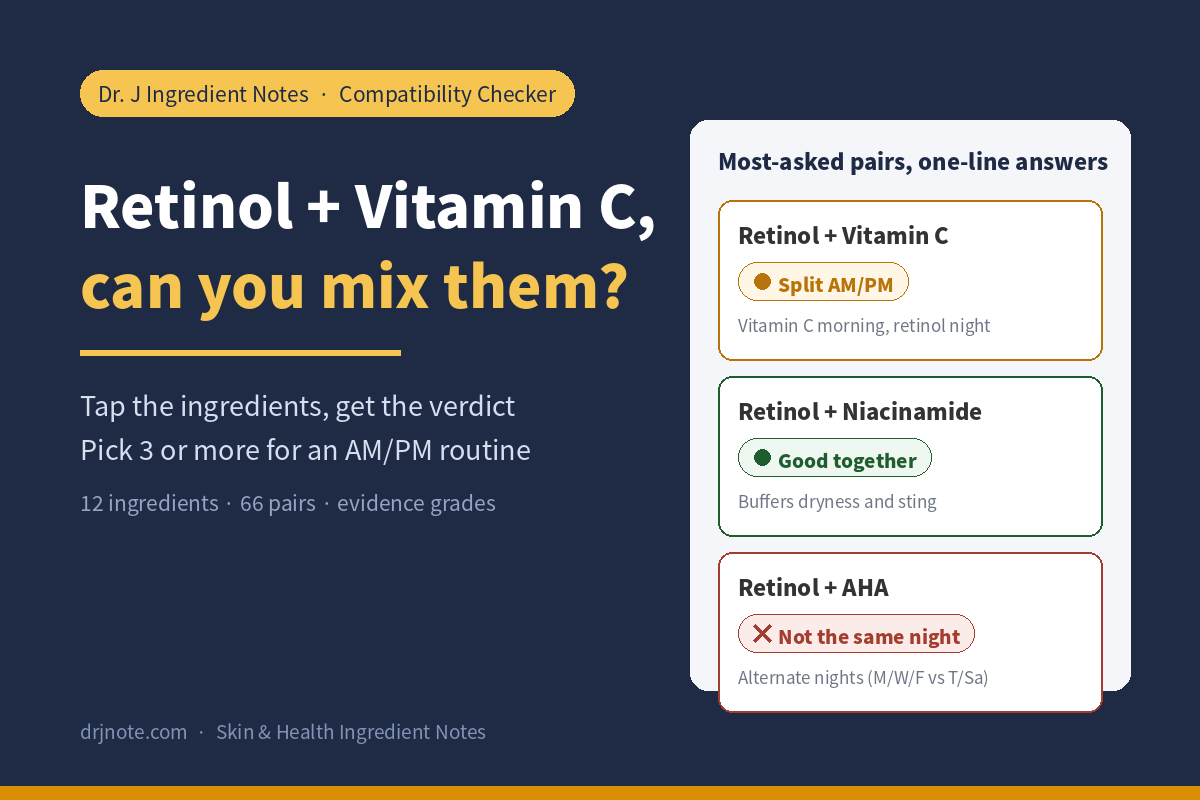
2. The five most-asked pairs, one line each
Copied straight from the checker’s verdicts. The full reasoning is in the tool.
3. How to read the colors
● Yellow — irritation can stack, so split by time
✕ Red — not at the same time (severe irritation, or one breaks the other down)
Evidence grades: Study-backed (a human-skin study or stability experiment with both ingredients), General principle (the usual rule from each ingredient’s properties), Theoretical concern (chemical reasoning).
The full 66-pair chart is in Skincare Ingredient Compatibility Chart.
One-line summary
The checker builds your routine on that rule.
Missing an ingredient? Leave a comment and it goes into the next update.
▶ Read next: Skincare Ingredient Compatibility Chart – 12 Ingredients, What to Layer and What to Split
▶ Previous: Retinol: Start at 0.1% – How to Read the Concentration Numbers
▶ Previous: Not All Vitamin C Serums Work – 3 Conditions the Research Says You Need
🇰🇷 한국어로 읽기 → Korean version
MS in Veterinary Medicine, PhD in Life Sciences. I worked as a researcher at the Korea Research Institute of Bioscience and Biotechnology (KRIBB) and now run Beaurea, a cosmetics manufacturing company, where I write the formulas myself. This blog reads the research papers and the regulatory documents and turns them into plain-language criteria for choosing ingredients. I don’t recommend specific products here – only criteria that apply to any product.
References
1. Seité S et al. “Histological evaluation of a topically applied retinol-vitamin C combination.” Skin Pharmacology and Physiology 2005;18(2):81-87
2. Martin B et al. “Chemical stability of adapalene and tretinoin when combined with benzoyl peroxide in presence and in absence of visible light and ultraviolet radiation.” British Journal of Dermatology 1998;139(Suppl 52):8-11
3. Tanno O et al. “Nicotinamide increases biosynthesis of ceramides as well as other stratum corneum lipids to improve the epidermal permeability barrier.” British Journal of Dermatology 2000;143(3):524-531
4. Milosheska D, Roškar R. “Use of Retinoids in Topical Antiaging Treatments.” Advances in Therapy 2022;39(12):5351-5375
5. Korea MFDS, Regulation on the Review of Functional Cosmetics, Annex 4 — listed brightening ingredients (niacinamide, ascorbyl glucoside, etc.)
6. The niacinamide + vitamin C warning originates from 1960s high-heat, long-duration experiments (nicotinic acid formation); the current consensus is that it does not apply to room-temperature formulas
※ The checker gives general principles; results vary with concentration, formula and pH. It does not recommend or criticize specific products. If you are being treated for a skin condition, consult a dermatologist. The author runs a company that manufactures and sells cosmetics.
Leave a Reply