
Hello, this is Dr. J.
Ingredient Guide number nine is tranexamic acid – a name that now shows up on the back of many dark-spot and melasma products.
Here is the surprising part. This ingredient started life as a drug that stops bleeding. This post follows how an operating-room molecule ended up in a melasma cream, and then looks at how far the topical trials actually go.
The short version: it works on its own, but the numbers are steadier with niacinamide, and the benchmark is 12 weeks.
🇰🇷 Read this in Korean: 트라넥삼산 크림, 기미 연구가 확인한 것 (성분 백과 ⑨)
―――――――――――――――――――――
📄 Read the sources first
· Kim HJ et al., Acta Derm Venereol 2017 – meta-analysis of 11 studies, 667 participants (open access)
· Ebrahimi B et al., J Res Med Sci 2014 – 3% cream, 50 patients, 12 weeks, split-face
· Hsin et al., Cosmetics 2024 – 3% cream and serum, 22 patients, 8 weeks (open access)
· Korea’s functional-cosmetic review rules – listed ingredients vs. individual review (Korean)
· 🏠 COSMILE Europe INCI database – type the name exactly as it appears on the label
The meta-analysis reports topical, oral and injected tranexamic acid separately. This post uses the topical numbers.
―――――――――――――――――――――
15-second summary · no sound
―――――――――――――――――――――
The four lines, if you are in a hurry
✔ Tranexamic acid does not erase melanin. It turns down the signal that tells skin to make more
✔ Cosmetics typically use 2–5%. In Korea it is not on the official whitening-ingredient list, so a “whitening” claim means the product passed an individual review
✔ 50 people with melasma applied a 3% cream for 12 weeks: their melasma score (MASI) fell significantly
✔ Across 11 studies and 667 people, topical use alone is still thinly supported – it works on its own, but the results are steadier with niacinamide
―――――――――――――――――――――
How it works – not an eraser, a signal blocker
When skin is hit by UV, the surface cells (keratinocytes) use an enzyme called plasmin to send melanocytes a “make more pigment” message. Melasma is close to that message being stuck on in one patch of skin.
✔ Tranexamic acid blocks plasmin – the same action it has as an anti-bleeding drug
✔ So unlike vitamin C, which works on pigment that is already there, it slows down new pigment
✔ That is why results take time. Nearly every trial runs 12 weeks
―――――――――――――――――――――
How to read the numbers – 2%, 3%, 5% and the “whitening” claim
The trials used 2%, 3% and 5%, and a 2024 review treats 2–5% as the usual range. On a Korean label, though, the claim tells you more than the percentage. Korea has a regulatory category called “functional cosmetics”: a product may print “whitening” only if it uses an ingredient on the MFDS list at the listed level, or passes an individual review with safety and efficacy data. Tranexamic acid is not on that list.
| What you see on the label | What it means |
|---|---|
| “Whitening functional cosmetic” claim | Because tranexamic acid is not a listed ingredient, the product had to pass an individual MFDS review (safety, efficacy and human-test data) to carry this claim |
| No claim · contains tranexamic acid | A regular cosmetic. The ingredient is there, but the product may not say “whitening” |
| Whitening claim + niacinamide, arbutin, etc. | The claim may rest on a listed ingredient (niacinamide, arbutin, alpha-bisabolol, licorice extract and others) filed without review. Tranexamic acid is along for the ride |
| A percentage (2% · 3% · 5%) | Inside the trial range is fine. With no percentage, the position on the ingredient list is your clue – higher means more; ingredients at 1% or below may be listed in any order |
In short, a “whitening” claim means reviewed, not stronger. And no claim does not mean the ingredient is idle – for that, look at the trials below. Other countries regulate claims differently; the studies themselves are the same everywhere.
―――――――――――――――――――――
What the research found – 50 people for 12 weeks, a 667-person meta-analysis, 22 people for 8 weeks
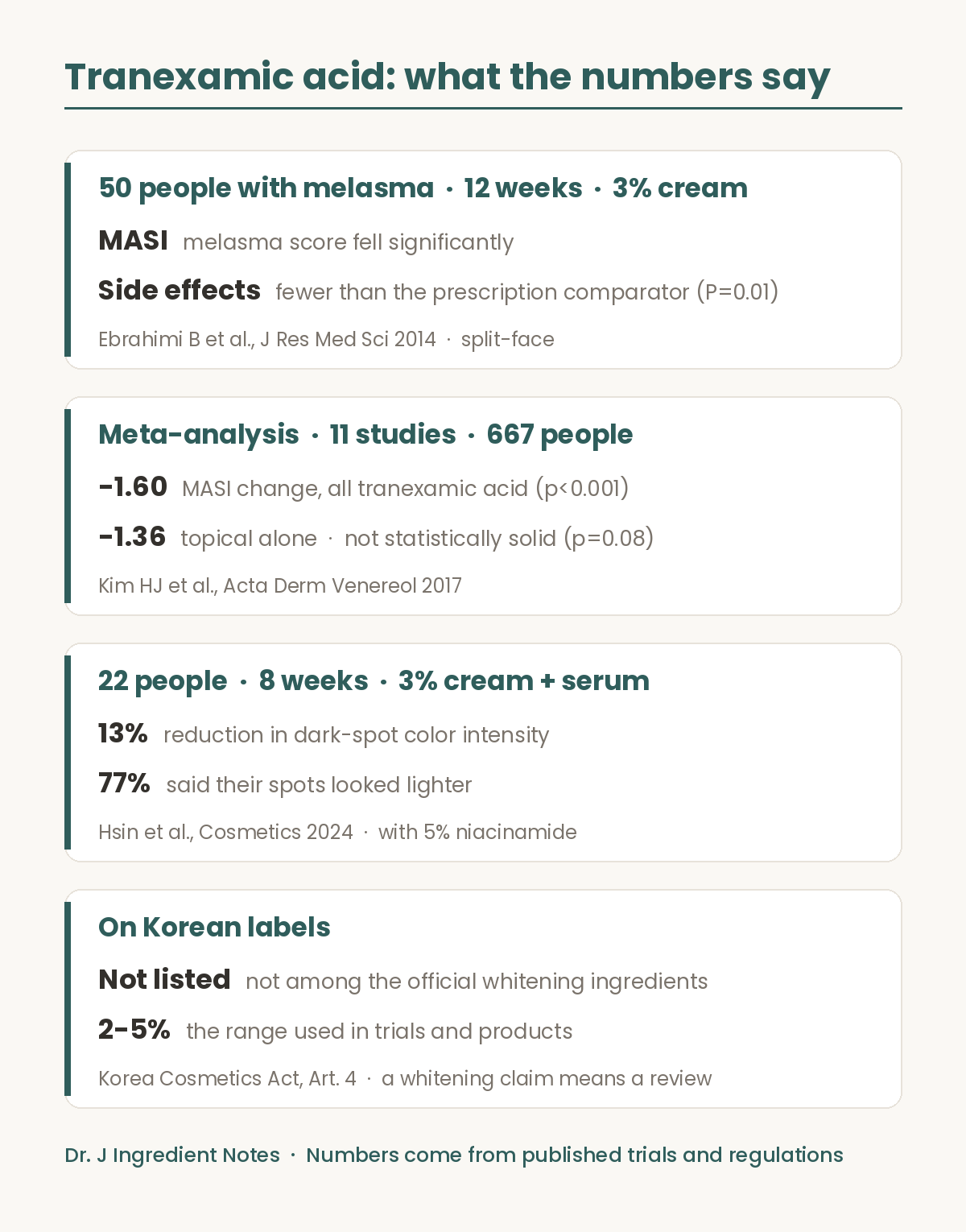
First, 50 people with melasma. Each person applied a 3% tranexamic acid cream to one side of the face and a prescription combination to the other, for 12 weeks. Both sides improved significantly on the melasma score (MASI), with no difference between them. Side effects were significantly fewer on the tranexamic acid side (P=0.01) – Ebrahimi et al., J Res Med Sci 2014.
Second, the 667-person meta-analysis. Pooling 11 studies, tranexamic acid overall lowered MASI by 1.60 (p<0.001). But topical use alone came to 1.36 – not quite statistically solid (p=0.08), because the individual studies disagreed with each other. Side effects were mild: redness, irritation, dryness – Kim HJ et al., Acta Derm Venereol 2017.
Third, 22 people for 8 weeks. Adults aged 45–67 used a 3% tranexamic acid cream and serum that also contained 5% niacinamide, for 8 weeks. Dark-spot color intensity fell 13% (significant), spot size fell 6%, and 77% said their spots looked lighter. No serious adverse effects – Hsin et al., Cosmetics 2024.
| Study | People · duration | What was used | What was found |
|---|---|---|---|
| Ebrahimi 2014 | 50 · 12 weeks | 3% cream alone (split-face) | MASI fell significantly · fewer side effects |
| Kim 2017 meta-analysis | 11 studies · 667 | Topical, oral and injected pooled | Overall −1.60 (p<0.001) · topical alone −1.36 (p=0.08) |
| Hsin 2024 | 22 · 8 weeks | 3% + 5% niacinamide, cream and serum | Spot color −13% · 77% reported lighter spots |
Put the three side by side and this is what they say. Tranexamic acid works on its own, but the studies vary enough that it is too early to call the topical evidence settled. The study that paired it with niacinamide produced steadier numbers. Using the two together is closer to what the research has seen. And every trial ran 8–12 weeks – it is not an ingredient to judge after a few days. Oral tranexamic acid and in-office procedures are outside the scope of this post.
―――――――――――――――――――――
How to use it – order and pairing
✔ Morning and night, right after cleansing, on the spots first, then moisturizer
✔ Niacinamide can be in the same product or the same routine – that is the pairing the trial used
✔ Vitamin C (the “eraser” side) fits in the same routine too – vitamin C in the morning, tranexamic acid at night is one easy split
✔ It is gentle enough that you rarely need to alternate days with retinol or AHAs. If that night stings, move tranexamic acid to the morning
✔ Sunscreen in the morning is half the job. This ingredient slows the signal; if UV keeps sending it, you stay where you started
✔ Oral tranexamic acid is a prescription drug. It is a separate conversation from cosmetics
The ingredient compatibility chart shows which pairs can share a night and which should be split.
―――――――――――――――――――――
Five things to check before you buy
✔ Is the percentage printed? – 2–5% is the trial range
✔ Is there a “whitening” or brightening claim? – in Korea that means a review was passed. Without it, the ingredient still works
✔ Is niacinamide in the formula? – that is the pairing the trial used
✔ Where does tranexamic acid sit on the list? – higher means more
✔ Is there enough for 12 weeks? – this is not an ingredient to judge in under 8 weeks
Save these five lines for the store. Reading the back takes about five minutes.
―――――――――――――――――――――
In one line
🧪 Tranexamic acid slows the signal that tells skin to make pigment. It works on its own, but with niacinamide, over 12 weeks, and under sunscreen is where the research has seen it do best.
Next in the Ingredient Guide: peptides (Guide 10) – many names, uneven evidence, so I will take them one name at a time.
📌 Earlier posts
· Retinol: Start at 0.1% – How to Read the Concentration Numbers (Ingredient Guide 1)
· Skincare Ingredient Compatibility Chart – 12 Ingredients, What to Layer and What to Split
· Dull, Rough Skin? Glycolic Acid (AHA) – What the Research Shows and How Much Is Safe
· Salicylic Acid (BHA): 0.5% vs 2%, Explained (Ingredient Guide 8)
About the author · Dr. J
MS in Veterinary Medicine, PhD in Life Sciences. I worked as a researcher at the Korea Research Institute of Bioscience and Biotechnology (KRIBB) and now run Beaurea, a cosmetics manufacturing company, where I write the formulas myself. This blog reads the research papers and the regulatory documents and turns them into plain-language criteria for choosing ingredients. I don’t recommend specific products here – only criteria that apply to any product.
📄 References
· Kim HJ et al., Acta Derm Venereol 2017 – Efficacy and safety of tranexamic acid in melasma: a meta-analysis and systematic review (11 studies, 667 participants)
· Ebrahimi B, Fatemi Naeini F, J Res Med Sci 2014 – Topical tranexamic acid as a promising treatment for melasma (3% cream, 50 patients, 12 weeks)
· Hsin et al., Cosmetics 2024;11(5):168 – 3% tranexamic acid cream and serum with niacinamide, 22 patients, 8 weeks
· Korea Cosmetics Act, Article 4 – functional-cosmetic review and listed ingredients
This post summarizes published research and public documents for information only. It is not a substitute for diagnosis or treatment. If you have a concern, please consult a professional.
— Dr. J Ingredient Notes