
🇰🇷 한국어로 읽기 → Korean version
Hello, Dr. J here.
Writing the ingredient encyclopedia one entry at a time, something kept bothering me.
It helps the person who searched “retinol” — but not the person who started with “I have dark spots, what do I use?”
So this page starts from the other end.
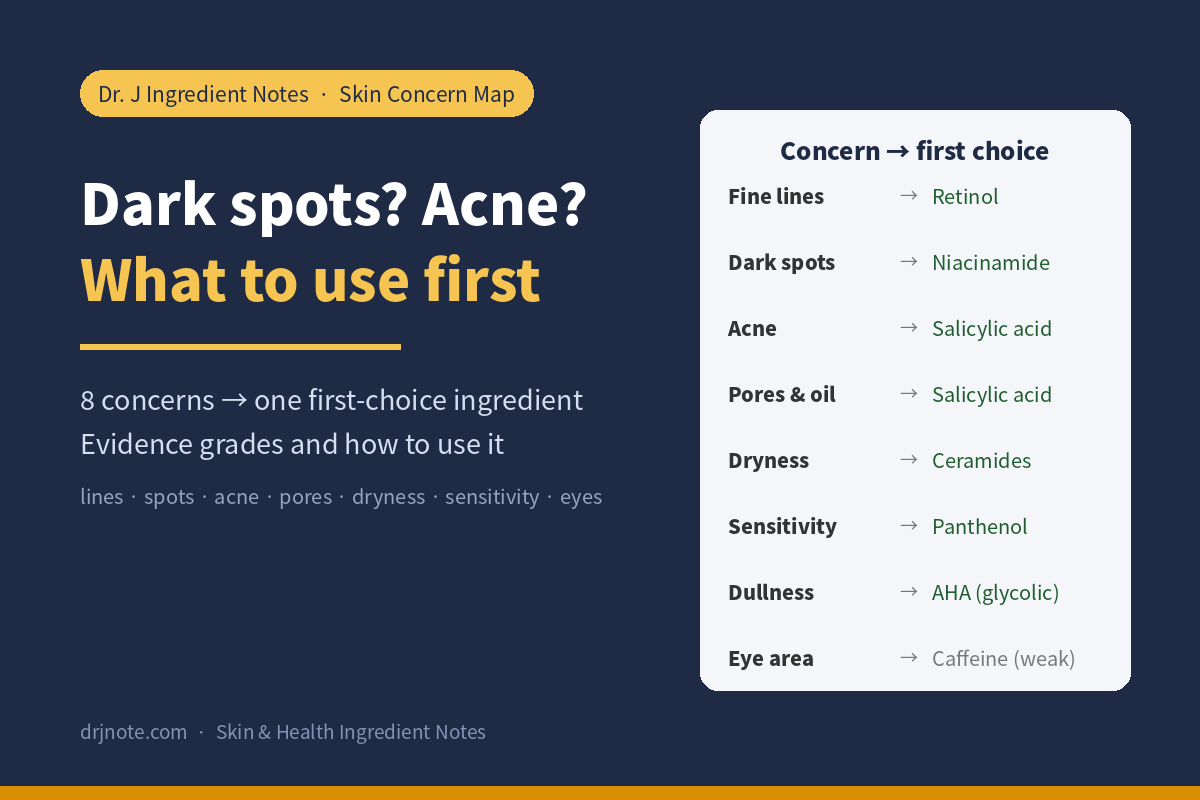
Eight skin concerns, each with one first-choice ingredient, what pairs with it, and an evidence grade.
Tap your concern below and the answer opens.
In a hurry? These eight lines
Dark spots → Niacinamide (+ tranexamic acid)
Acne → Salicylic acid (BHA) (+ azelaic acid)
Pores & oil → Salicylic acid (BHA) (+ niacinamide)
Dryness & barrier → Ceramides (+ hyaluronic acid)
Sensitivity & redness → Panthenol (+ centella)
Dullness & texture → AHA, glycolic acid (+ vitamin C)
Eye area → Caffeine (+ low-dose retinol) — the weak-evidence box
Whatever the concern, the base is morning sunscreen + moisturizer. Without those two, none of the above works properly.
1. Tap your concern
Tap a box to open it. The dot colors are evidence grades — ● strong · ● supporting · ○ weak.
✨1Fine lines & firmnessFirst choice · Retinolopen ▾
First choice ● Retinol / retinal ● Vitamin C 10–20%
Pairs well with ● Peptides · ● Niacinamide · ● Adenosine 0.04% · ● Bakuchiol
A one-year study of 0.1% retinol: crow’s-feet lines improved 44%, uneven pigmentation 84%.
At night, twice a week to start. Vitamin C in the morning.
If retinol stings, try bakuchiol — in a 12-week head-to-head, wrinkle results were similar with less irritation.
🧪 Check retinol · vitamin C · niacinamide in the compatibility checker →
🌤️2Dark spots & melasmaFirst choice · Niacinamideopen ▾
First choice ● Niacinamide 2–5% ● Tranexamic acid 2–5% ● Vitamin C & derivatives
Pairs well with ● Arbutin 2–5% · ● Azelaic acid · ● Retinol · ● Sunscreen
Pigment is made → transferred → deposited in three steps, so you combine ingredients that block different steps.
In one trial, 4% niacinamide matched prescription 4% hydroquinone.
Without sunscreen you tread water; results show after 8–12 weeks.
🧪 Check niacinamide · tranexamic acid · vitamin C in the compatibility checker →
🫧3Acne & breakoutsFirst choice · Salicylic acid (BHA)open ▾
First choice ● Salicylic acid (BHA) ● Benzoyl peroxide (OTC drug)
Pairs well with ● Azelaic acid · ● Niacinamide · ● Retinol · ○ Zinc
Dermatology guidelines list benzoyl peroxide, retinoids, salicylic acid and azelaic acid as the core acne actives.
In Korea, benzoyl peroxide is a pharmacy drug (2.5–5%) and cosmetic salicylic acid is capped at 0.5%; in the US you will see 2% BHA.
Keep benzoyl peroxide away from retinol and vitamin C — BPO in the morning, retinol at night.
🧪 Check BHA · benzoyl peroxide · azelaic acid in the compatibility checker →
🔍4Pores, oil & blackheadsFirst choice · Salicylic acid (BHA)open ▾
First choice ● Salicylic acid (BHA) ● Niacinamide 2–5%
Pairs well with ● Retinol · ● AHA · ○ Clay
No cosmetic ingredient shrinks pores. Less oil and dead skin makes them less visible.
Salicylic acid dissolves the plug inside the pore; 2% niacinamide cut sebum within 4 weeks in one study.
BHA works better 2–3 times a week than daily.
💧5Dryness & weak barrierFirst choice · Ceramidesopen ▾
First choice ● Ceramides + cholesterol + fatty acids ● Hyaluronic acid
Pairs well with ● Glycerin · ● Panthenol · ● Urea 5–10% · ● Squalane
The barrier is built from ceramides, cholesterol and fatty acids, so a product with all three repairs it faster.
If you see cholesterol and fatty acids (or plant oils) next to ceramides on the label, it is well made.
On retinol or acid nights, moisturizer before and after lets you keep using the active.
🧪 Check ceramides · hyaluronic acid in the compatibility checker →
🌿6Sensitivity & rednessFirst choice · Panthenolopen ▾
First choice ● Panthenol / allantoin ● Centella (madecassoside)
Pairs well with ● Azelaic acid · ● Niacinamide · ● Licorice / bisabolol
Subtract before you add. New ingredients one at a time, two weeks apart.
5% panthenol has several barrier-repair and soothing studies; centella has fewer, so it is a supporting player.
For clear redness, azelaic acid — 15% is prescription; cosmetics use around 10%.
🧪 Check panthenol · azelaic acid · niacinamide in the compatibility checker →
🌙7Dullness & rough textureFirst choice · AHA (glycolic)open ▾
First choice ● AHA (glycolic / lactic) ● Vitamin C
Pairs well with ● Retinol · ● PHA (gentler option) · ● Niacinamide
Half of dullness is old dead skin; the rest is pigment and dehydration.
AHA smooths texture, vitamin C brightens. Korean cosmetics: AHA at 10% or less, pH 3.5 or higher.
Acids 1–2 times a week, never on retinol nights. If sensitive, the gentler PHA.
👁️8Eye area (dark circles, puffiness)First choice · Caffeineopen ▾
First choice ● Caffeine (puffiness) ● Low-dose retinol (lines)
Pairs well with ● Hyaluronic acid · ○ Peptides · ○ Vitamin C derivatives
Honestly, this is the weak-evidence zone.
Dark circles mix pigment, blood vessels and shadow, so cosmetics can only do part of the job.
Caffeine reduces puffiness for a while; retinol once or twice a week to start. Pigment type: brighteners above. Vascular type: sleep and sunscreen.
🧪 Check retinol · hyaluronic acid in the compatibility checker →
2. The whole map on one page
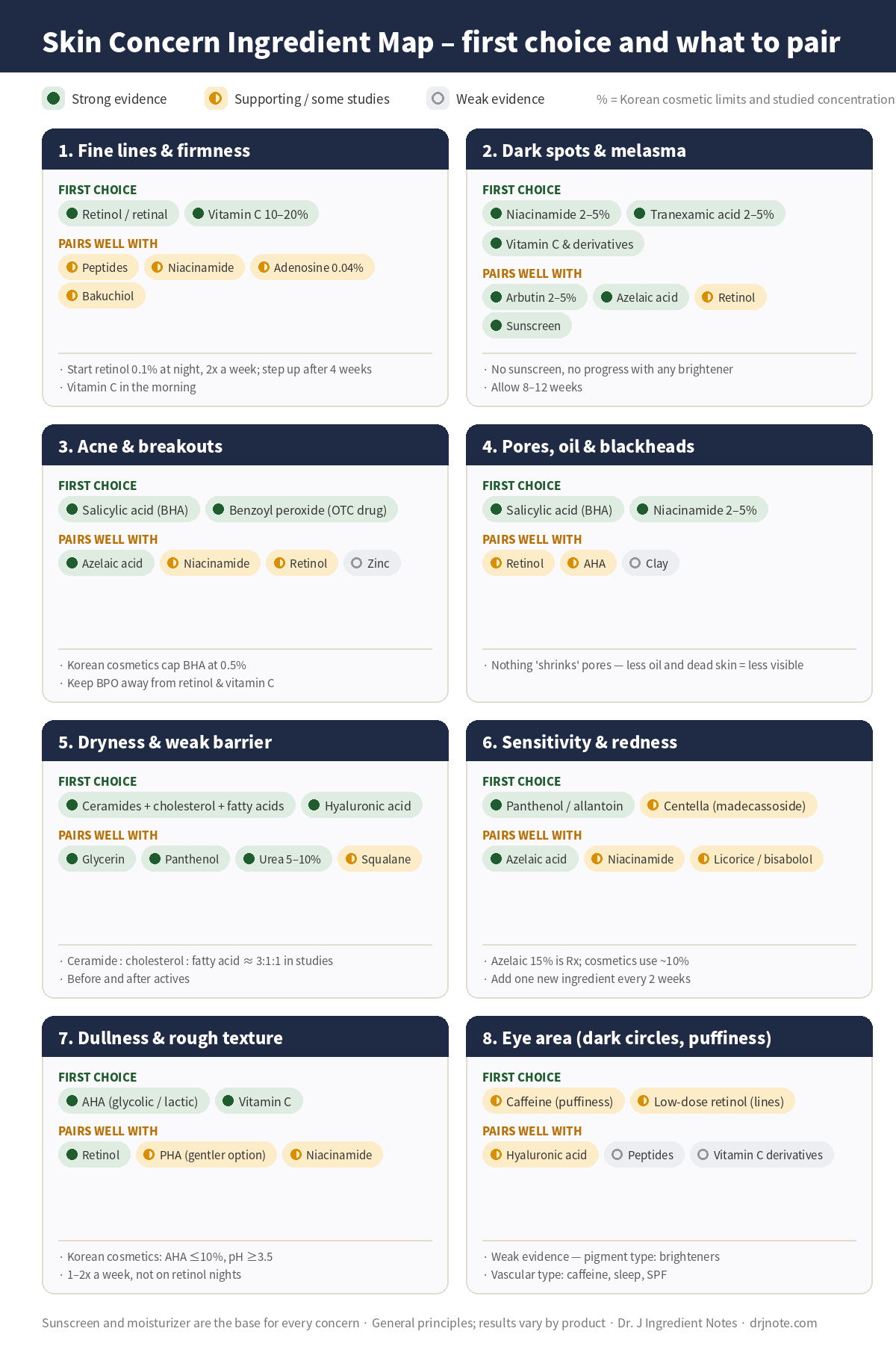
Two kinds of numbers appear: Korean cosmetic limits (functional-cosmetic listings and maximum levels) and concentrations used in studies.
Where the two match (niacinamide 2–5%, for example), you can use the ingredient with confidence.
Save the image — it is handy when you are reading a label in a store.
3. When two concerns overlap
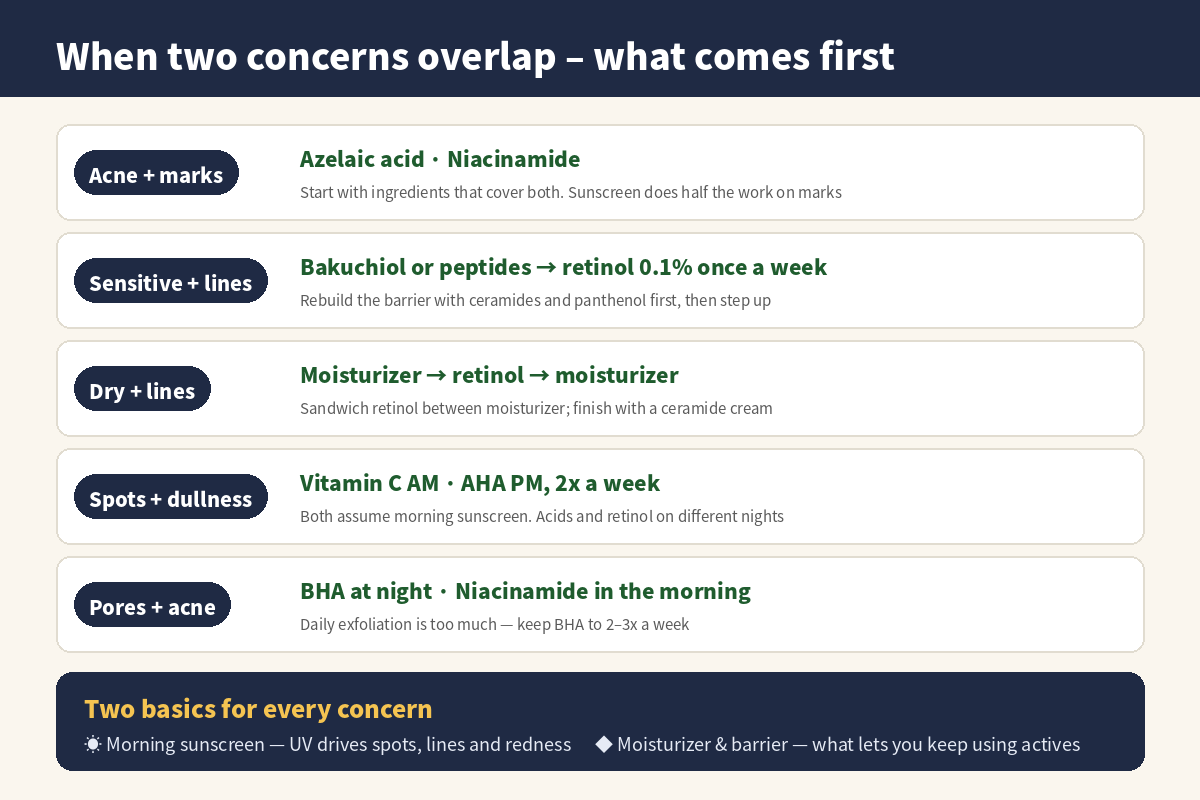
One rule. Start with the ingredient that covers both, and use one irritating active per day.
Sensitive + lines → barrier first, start with bakuchiol → retinol 0.1% once a week
Dry + lines → moisturizer → retinol → moisturizer
Spots + dullness → vitamin C in the morning, AHA twice a week at night
Pores + acne → BHA 2–3 nights a week, niacinamide in the morning
Whether your own ingredients can go together is one tap away in the checker.
🧪 Open the Ingredient Compatibility Checker
4. Two basics for every concern
✔ Moisturizer and barrier — strong actives like retinol, acids and benzoyl peroxide also irritate; a sturdy barrier is what lets you keep using them
Get those two in place, then add concern-specific ingredients one at a time.
One-line summary
Sunscreen and moisturizer are the base. This map is updated as new research appears.
Concern not on the map, or unsure of the order? Leave a comment.
▶ Read next: Ingredient Compatibility Checker – tap your ingredients, get the verdict and an AM/PM routine
▶ Read next: Skincare Ingredient Compatibility Chart – 12 Ingredients, What to Layer and What to Split
▶ Encyclopedia ①: Retinol: Start at 0.1% – How to Read the Concentration Numbers
▶ Previous: Not All Vitamin C Serums Work – 3 Conditions the Research Says You Need
🇰🇷 한국어로 읽기 → Korean version
MS in Veterinary Medicine, PhD in Life Sciences. I worked as a researcher at the Korea Research Institute of Bioscience and Biotechnology (KRIBB) and now run Beaurea, a cosmetics manufacturing company, where I write the formulas myself. This blog reads the research papers and the regulatory documents and turns them into plain-language criteria for choosing ingredients. I don’t recommend specific products here – only criteria that apply to any product.
References
1. Korea MFDS, Regulation on the Review of Functional Cosmetics, Annex 4 — brightening: niacinamide 2–5%, arbutin 2–5%, ascorbyl glucoside 2%, ethyl ascorbyl ether 1–2% / wrinkles: retinol 2,500 IU/g, adenosine 0.04% / acne-prone skin: salicylic acid 0.5% (rinse-off)
2. Korea MFDS, Regulation on Cosmetic Safety Standards — salicylic acid limit 0.5%, urea 10%, labeling required for AHA above 10% or pH below 3.5
3. Randhawa M et al. J Drugs Dermatol 2015;14(3):271-280 — 0.1% stabilized retinol, 52 weeks: crow’s-feet lines −44%, pigmentation −84%
4. Dhaliwal S et al. Br J Dermatol 2019;180(2):289-296 — 0.5% bakuchiol vs 0.5% retinol, 12 weeks
5. Pinnell SR et al. Dermatol Surg 2001;27(2):137-142 — vitamin C absorption peaks at 20%
6. Hakozaki T et al. Br J Dermatol 2002;147(1):20-31 — 5% niacinamide inhibits melanosome transfer
7. Navarrete-Solís J et al. Dermatol Res Pract 2011;2011:379173 — niacinamide 4% vs hydroquinone 4%
8. Draelos ZD et al. J Cosmet Laser Ther 2006;8(2):96-101 — 2% niacinamide reduces sebum
9. Ebrahimi B, Naeini FF. J Res Med Sci 2014;19(8):753-757 — 3% tranexamic acid for melasma
10. Zaenglein AL et al. J Am Acad Dermatol 2016;74(5):945-973 — acne management guidelines
11. Man MQ et al. J Invest Dermatol 1996;106(5):1096-1101 — ceramide : cholesterol : fatty acid 3:1:1
12. Camargo FB et al. J Cosmet Sci 2011;62(4):361-370 — panthenol, hydration and barrier
※ This map gives general principles; results vary with concentration and formula, and with your skin. It does not recommend or criticize specific products. If you are being treated for a skin condition, or are pregnant or breastfeeding, consult a dermatologist before use. The author runs a company that manufactures and sells cosmetics.