
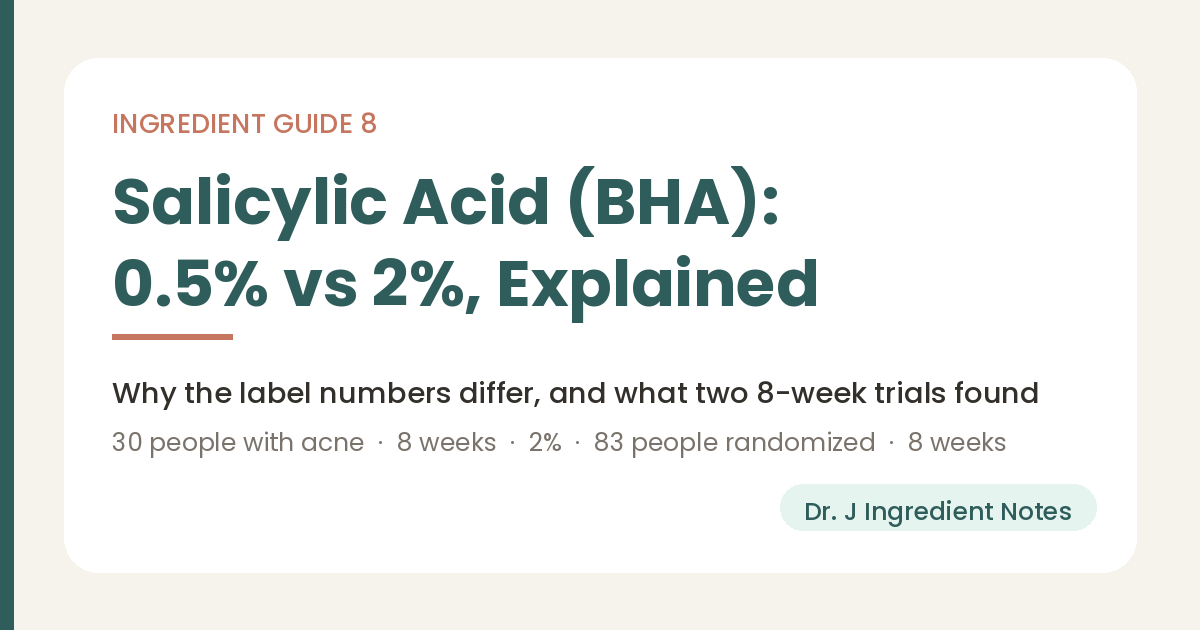
Hello, this is Dr. J.
Ingredient Guide number eight is salicylic acid – the ingredient most labels shorten to BHA.
If you shop for acne or pore products, you will see this name often. What you will also see is that the number on the back changes from product to product: 2% on one cleanser, 0.5% on a toner, 3% on a scalp product.
Here is the surprising part. In Korea, salicylic acid does not have one limit. The same ingredient is capped at 0.5%, 2% or 3% depending on what it is used for. This post explains how to read those numbers, and then walks through two 8-week trials.
🇰🇷 Read this in Korean: 살리실산 BHA, 0.5%와 2% 읽는 법 (성분 백과 ⑧)
―――――――――――――――――――――
📄 Read the sources first
· Korea MFDS, Regulation on Cosmetic Safety Standards, Annex 2 – restricted ingredients (Korean)
· Bilal H et al., Pharmaceuticals 2023 – 30 people with acne, 2% gel, 8 weeks (open access)
· Li S et al., J Cosmet Dermatol 2023 – randomized trial of a salicylic acid serum, 8 weeks
· Arif T, Clin Cosmet Investig Dermatol 2015 – review (open access)
· 🏠 COSMILE Europe INCI database – type the name exactly as it appears on the label
Annex 2 lists the limit for each product category on one line, with a note about children’s products. Salicylic acid appears in two tables – preservatives and other restricted ingredients – so check both.
―――――――――――――――――――――
15-second summary · no sound
―――――――――――――――――――――
The four lines, if you are in a hurry
✔ Salicylic acid is lipid-soluble, so it mixes with sebum. That is where it parts ways with water-soluble AHAs
✔ The 0.5% · 2% · 3% on Korean labels are not strength levels – they are use categories: preservative, rinse-off cleanser active, rinse-off hair-product active
✔ 30 people with acne used a 2% gel twice daily for 8 weeks: lesion counts and severity scores fell significantly
✔ In a randomized trial, 83 people completed 8 weeks of a salicylic acid serum: pore density, sebum and comedones improved
―――――――――――――――――――――
Lipid-soluble – where BHA parts ways with AHA
Salicylic acid is a beta hydroxy acid, BHA. The name looks like glycolic acid (AHA), which I covered in Guide 2, but the two behave differently.
✔ Glycolic acid dissolves in water – it works at the skin surface
✔ Salicylic acid dissolves in oil – it mixes with sebum and reaches into the pore
A 2015 review puts it this way: salicylic acid, unlike the alpha hydroxy acids, is a lipid-soluble agent, miscible with the lipids of the epidermis and with the sebaceous-gland lipids inside hair follicles. That is why it comes up for comedone-prone skin. The review also places its calming, anti-inflammatory action in the 0.5–5% range – Arif T, 2015.
So the question is less “AHA or BHA, which is better?” and more “is my concern at the surface, or in the pore?” Dullness and rough texture have the AHA evidence; sebum and comedones have the BHA evidence.
―――――――――――――――――――――
How to read the numbers – 0.5%, 2% and 3% are use categories
A higher number does not mean a stronger product. Korea’s cosmetic safety standard (Annex 2) sets a separate limit for each use. I read the Korean text and keep the categories as written; other markets set their own limits.
| Number on the label | Used as | Product type |
|---|---|---|
| 0.5% | Preservative | Limit in the preservatives table |
| 2% | Active in a “functional cosmetic” | Rinse-off cleansers for the body and face |
| 3% | Active in a “functional cosmetic” | Rinse-off hair products |
The same table adds two notes.
✔ Not permitted in products for infants, or in products labeled as suitable for children aged 13 and under (shampoo excepted)
✔ The 2% and 3% limits apply only when the product has been reviewed as a functional cosmetic; other products may not use it as an active
“Functional cosmetic” is a Korean regulatory category – a product whose specific claim, such as “soothes acne-prone skin,” has been reviewed by the MFDS. That is why 2% in Korea almost always appears on a rinse-off cleanser with that claim. The small numbers on leave-on toners and serums are either within the preservative limit or belong to a related ingredient with a different name – see the next table.
―――――――――――――――――――――
Finding it on the ingredient list – four names in the salicylic family
| Name on the list (INCI) | What it is |
|---|---|
| Salicylic Acid | The ingredient itself. The limits above apply to this name |
| Capryloyl Salicylic Acid (LHA) | Salicylic acid with a fatty-acid tail attached. It was paired with salicylic acid in the 83-person serum trial |
| Betaine Salicylate | Salicylic acid combined with betaine. Common in leave-on products, especially Korean ones |
| Salix Alba (Willow) Bark Extract | A plant extract. Not salicylic acid itself, so it sits outside the limits above |
A different name means a different limit and a different body of research. Read the numbers in this post against the Salicylic Acid line only.
―――――――――――――――――――――
What the research found – 30 people for 8 weeks, 83 people for 8 weeks
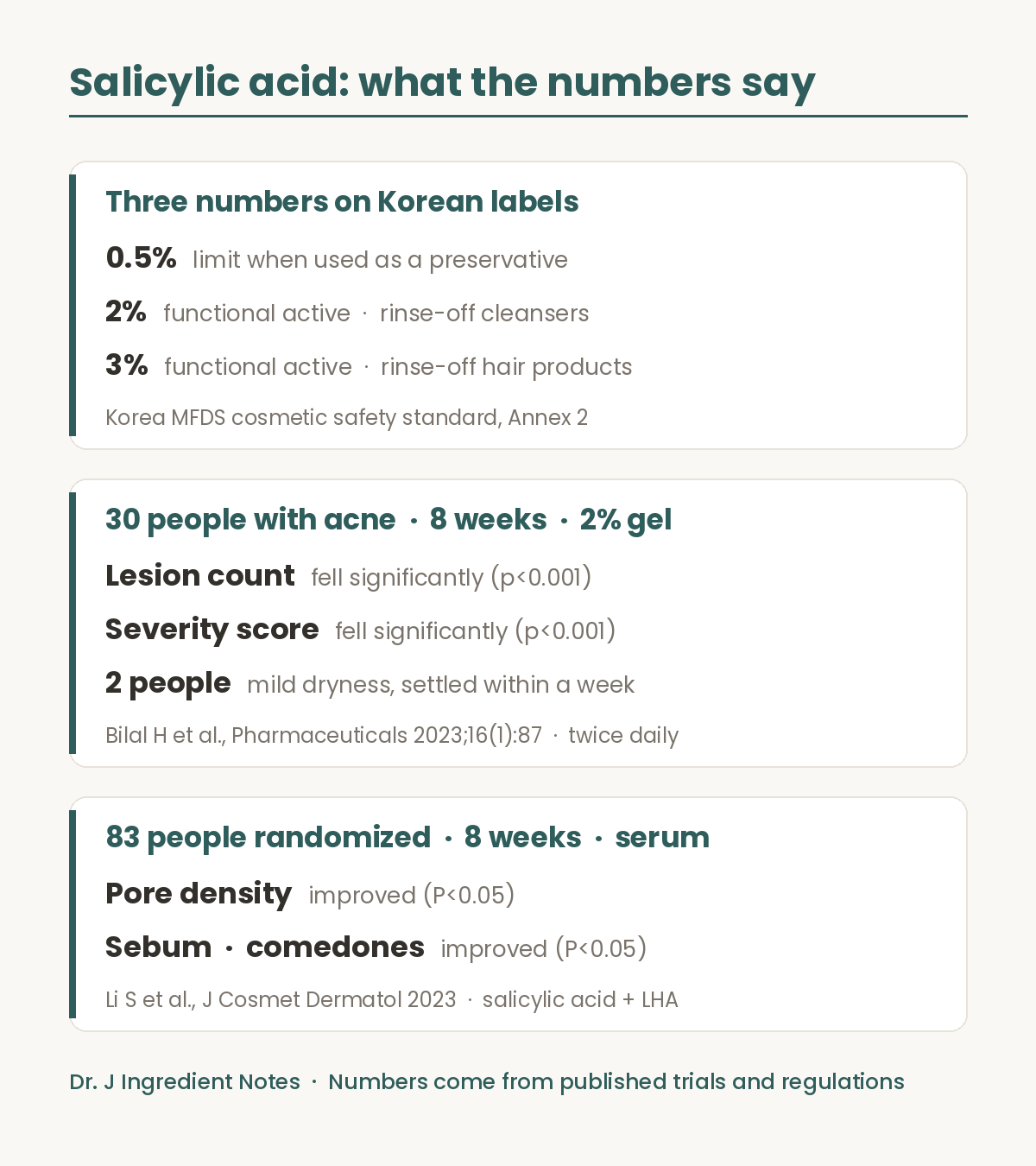
First, 30 people with acne. Thirty acne patients – 12 men and 18 women, average age 22 – used a 2% salicylic acid gel twice daily for 8 weeks, alongside a control group of 10. Total lesion counts and the Global Acne Grading System (GAGS) score fell significantly (p<0.001). Two people had mild dryness and flaking that settled within a week – Bilal et al., Pharmaceuticals 2023. The paper is open access, so the tables are one click away above.
Second, 93 people randomized. A serum containing salicylic acid and lipohydroxy acid was tested over 8 weeks; 93 people were randomized and 83 completed. One group used the serum, the other added a mask. Both groups improved on acne severity, skin-tone evenness, pore density, pigmentation, sebum output, comedones and hydration (P<0.05); the mask group did slightly better on closed comedones and acne severity. No adverse events were reported – Li et al., J Cosmet Dermatol 2023.
| Study | People · duration | What was used | What was found |
|---|---|---|---|
| Bilal 2023 | 30 · 8 weeks | 2% gel, twice daily | Lesion count and severity score fell (p<0.001) |
| Li 2023 | 93 randomized · 83 completed · 8 weeks | Salicylic acid + LHA serum (± mask) | Pore density, sebum, comedones improved (P<0.05) |
| Arif 2015 | Review | — | Lipid-soluble; calming action in the 0.5–5% range |
Both trials ran for 8 weeks. It is not an ingredient to judge after a few days. And with 30 and 83 participants, both are real but small – I would not stretch them to “works for everyone.” This post stays with cosmetic use and leaves professional peel studies aside.
―――――――――――――――――――――
How to use it – order and pairing
✔ Start at 2–3 nights a week. If skin feels dry or stings, cut back
✔ A rinse-off product goes in the cleansing step; a leave-on product goes right after cleansing, followed by moisturizer
✔ On nights you use glycolic acid (AHA) or retinol, alternate the days. Do not stack all three in one evening
✔ Soothing and barrier ingredients – niacinamide, ceramides, panthenol – can sit in the same routine
✔ Wear sunscreen the next morning
✔ If you are pregnant or sensitive to aspirin, ask a professional before starting
The ingredient compatibility chart shows which pairs can share a night and which should be split.
―――――――――――――――――――――
Five things to check before you buy
✔ Is it rinse-off or leave-on? – that is where the limits split
✔ Is the name “Salicylic Acid,” or one of the related names? – check the four-name table above
✔ Where does it sit on the ingredient list? – higher means more. Ingredients at 1% or below may be listed in any order, so a low position is not unusual
✔ Is there a percentage on the front? – if not, the list order is your only clue
✔ Is the product labeled for children 13 and under? – in Korea it cannot contain salicylic acid (shampoo excepted)
Save these five lines for the store. Reading the back takes about five minutes.
―――――――――――――――――――――
In one line
🧪 Salicylic acid works because it is lipid-soluble. The number on the label tells you the use, not the strength – and two 8-week trials show what it did for lesions, pores and sebum.
Next in the Ingredient Guide: tranexamic acid (Guide 9) – the name that keeps coming up for dark spots.
📌 Earlier posts
· Dull, Rough Skin? Glycolic Acid (AHA) – What the Research Shows and How Much Is Safe
· Retinol: Start at 0.1% – How to Read the Concentration Numbers (Ingredient Guide 1)
· Skincare Ingredient Compatibility Chart – 12 Ingredients, What to Layer and What to Split
About the author · Dr. J
MS in Veterinary Medicine, PhD in Life Sciences. I worked as a researcher at the Korea Research Institute of Bioscience and Biotechnology (KRIBB) and now run Beaurea, a cosmetics manufacturing company, where I write the formulas myself. This blog reads the research papers and the regulatory documents and turns them into plain-language criteria for choosing ingredients. I don’t recommend specific products here – only criteria that apply to any product.
📄 References
· Korea MFDS, Regulation on Cosmetic Safety Standards, Annex 2 – Salicylic Acid and its salts
· Bilal H et al., Pharmaceuticals 2023;16(1):87 – 2% salicylic acid gel, 30 people, 8 weeks
· Li S et al., J Cosmet Dermatol 2023 – randomized trial of a salicylic acid/LHA serum, 93 randomized, 83 completed, 8 weeks
· Arif T, Clin Cosmet Investig Dermatol 2015;8:455-461 – review
This post summarizes published research and public documents for information only. It is not a substitute for diagnosis or treatment. If you have a concern, please consult a professional.
— Dr. J Ingredient Notes