
🇰🇷 이 글의 한국어판 → Korean version (한국어)
Hello, I’m Dr. J. I formulate skincare products in Korea.
If you’ve shopped for K-beauty this year, you’ve seen the words “salmon DNA” or “PDRN” on a serum, an ampoule, a sheet mask – probably all three. It’s one of the fastest-growing ingredient trends to come out of Korea, and it’s now filling U.S. shelves and feeds.
Here’s something you probably haven’t seen: what Korea’s own regulator said about it this summer.
That’s a six-fold jump in two and a half years. Of 106 cases in total, 81 (76%) were ads that made a cosmetic sound like a medicine.
I want to be clear about what this does and doesn’t mean. It isn’t a verdict on the ingredient. PDRN is a good, well-studied molecule with a real medical history. The problem is that its name carries so much weight that the marketing ran ahead of what a cream can honestly claim.
So today, three things from a formulator’s chair: what PDRN actually is, why the clinic injection and the jar on your shelf are different products, and which phrases deserve a second look.
One disclosure first: my company makes PDRN products too. That’s exactly why I’d rather you understand the ingredient than buy it on hype – including ours.
The three-line version
✔ An injection places it in the dermis; a cream works at the skin’s surface. Same name, different jobs
✔ A well-made cream can give you hydration, smoother texture and comfort – and if an ad says “regenerates,” “replaces injections” or “at-home Rejuran,” read it twice
1. What PDRN actually is
PDRN stands for polydeoxyribonucleotide. Strip the chemistry away and it means “DNA cut into small pieces.” The DNA is extracted from the milt (reproductive cells) of salmon or trout, because its structure is close enough to human DNA that the body doesn’t treat it as foreign. That’s where the nickname “salmon DNA” comes from.
What matters most is its origin story. PDRN was born as a drug. It has been used in Italy since the 1950s as an injectable for wound healing, and in Korea both an injectable and an over-the-counter wound cream (0.08% PDRN) are approved as medicines for wounds and tissue nutrition.
The famous “salmon injections” you see in Korean clinics (Rejuran and similar) use a close cousin called PN (polynucleotide) – longer DNA chains – approved in Korea as a medical device and placed directly into the dermis by a doctor. As of mid-2026, that injectable is not FDA-approved in the United States.
PDRN became famous as a wound drug, then a clinic treatment – and cosmetics were the last to arrive, riding on that reputation. That is why the ads keep drifting toward medical language.
2. What Korea’s regulator flagged
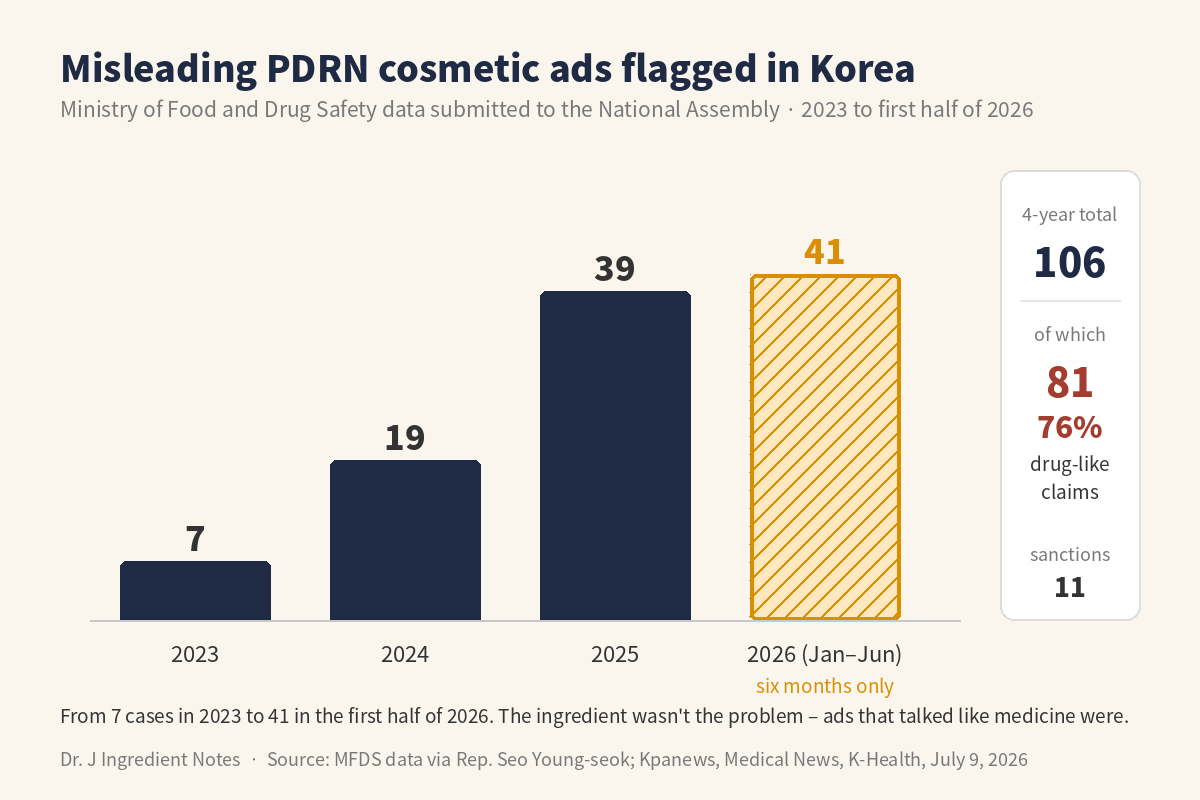
According to data Korea’s Ministry of Food and Drug Safety (MFDS) submitted to the National Assembly in July 2026, misleading PDRN cosmetic ads went from 7 cases in 2023 to 19 in 2024, 39 in 2025, and 41 in just the first six months of 2026. Of the 106 cases, 81 were classified as “likely to be mistaken for a medicine.” Eleven companies received formal sanctions – typically a three- to four-month advertising ban.
The phrases that got companies into trouble looked like this:
· “Removes melanin” – on a product with no approved brightening claim
· “Exosomes and PDRN work in synergy to regenerate and firm”
· Claims that the product penetrates deep into the dermis
In Korea – as in the U.S. – a cosmetic cannot claim to regenerate, treat or cure. Those words belong to drugs and medical devices. The trouble with PDRN is that the ingredient’s name is a drug’s name: put it on a cream and the copy slides toward “medicine” almost by itself. One lawmaker put it bluntly: the ingredient name alone leads consumers to expect drug-level results.
Speaking as someone who makes these products: PDRN is an expensive raw material used in small amounts, with an outsized reputation. That combination tempts marketers. Knowing a handful of phrases – section 4 below – is enough to keep that temptation from working on you.
3. Injection and cream: same ingredient, different address
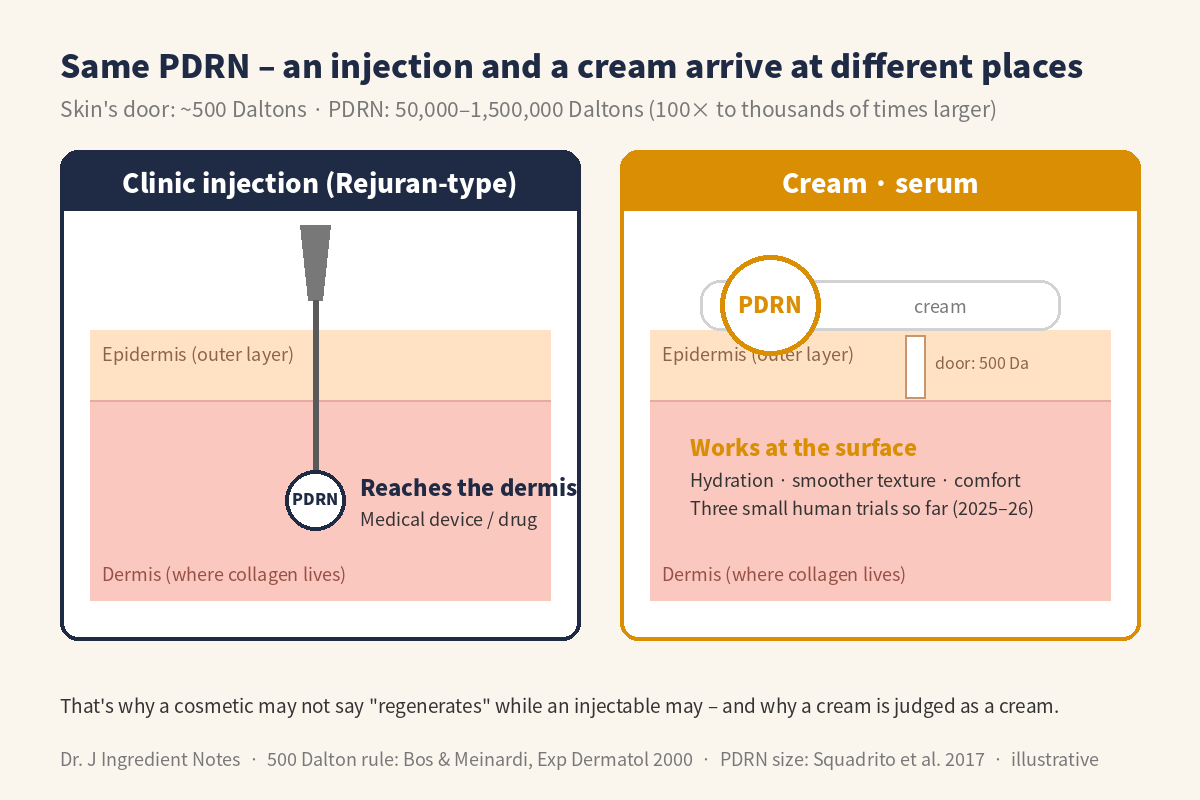
Your skin is a wall built to keep things out, so anything applied on top has to be very small to pass through on its own. Dermatology has a long-standing rule of thumb for this – the “500 Dalton rule”: molecules heavier than about 500 Daltons don’t readily cross intact skin. It’s the same reason hyaluronic acid sits on the surface.
PDRN weighs 50,000 to 1,500,000 Daltons – a hundred to several thousand times the size of that door. That’s why clinics inject it into the dermis, and why the clinical studies behind the injections exist: the ingredient is delivered to where the work happens.
| Clinic injection (Rejuran-type) | Cream / serum | |
|---|---|---|
| Regulated as | Medical device / drug | Cosmetic |
| Where it works | Dermis | Skin surface |
| What the research shows | Texture and elasticity (several trials) | Hydration, smoother texture, comfort (three small trials, 2025–2026) |
| Allowed to say | “Regenerate,” “treat” | “Hydrate,” “smooth,” “soothe” |
So what does a cream do? Quite a lot, at the surface. DNA is a large, water-loving molecule: it holds moisture on the skin and forms a thin, breathable film, so skin feels hydrated, smoother and calmer – much like hyaluronic acid does. And the research on topical PDRN is starting to catch up: three small human studies published in 2025–2026 reported less roughness and more glow in two weeks, better eye-area elasticity and faster moisture recovery in four weeks, and in one 31-person split-face study, eye-wrinkle improvement ahead of retinol. They’re small and mostly company-run, so I read them as “promising,” not “proven” – but they point the same way.
If your skin is dry, sensitive, or recovering from a laser or peel, or if you’re past 50 and your texture has gone rough and dull, a well-made PDRN cream is a reasonable thing to try – for hydration, smoothness and comfort. Judge it by those, over two to four weeks, which is the window the studies used.
4. Four phrases worth a second look
None of these means a product is bad. They mean the marketing has stepped past what a cosmetic can claim – which tells you something about who wrote it.
· “At-home Rejuran,” “instead of injections” – borrowing a clinic treatment’s name
· “Boosts collagen by X%,” “reaches the dermis” – things a cream can’t demonstrate
· “Removes melanin,” “treats wrinkles” – drug claims on a cosmetic
The flip side is worth knowing too: a brand that says “hydrates,” “smooths,” “soothes” – and stops there – is usually the one that knows the rules. In my experience the quiet label is often the better product.
5. A note for U.S. shoppers
On an American label, PDRN won’t appear by that name. Look in the ingredient list for “Sodium DNA” or “Hydrolyzed DNA” – that’s the official INCI name. If you only see “Salmon Milt Extract” or “Salmon Egg Extract,” the product contains a salmon-derived extract but not PDRN as such.
The same name covers everything from finely cut PDRN to plain salmon DNA, so size and concentration matter more than the word on the front. That’s the whole of my next post: how to read a PDRN product and choose one that matches the research.
A PDRN cream is not a salmon injection in a jar – it’s a very good hydrating cream with a serious ingredient behind it.
Expect hydration, smoothness and comfort; look for size and concentration on the label; and when an ad says “regenerates,” read it twice.
▶ Korean version of this post (한국어판): PDRN 크림 광고, 왜 자꾸 적발될까 – 주사와 크림이 다른 이유
▶ Earlier: Korea Just Put a “Not for the Whole Body” Warning on Oxybenzone Sunscreens
▶ Earlier: Dull, Rough Skin? Glycolic Acid (AHA) – What the Research Shows
▶ Earlier: Not All Vitamin C Serums Work – 3 Conditions the Research Says You Need
Next time, part two: How to Choose a PDRN Cream – 5 Conditions from the Research. Molecular size, concentration, source, companion ingredients and label language – with the three human studies laid side by side.
Curious about an ingredient? Leave a comment and I’ll look up the research and explain it simply.
— Dr. J (MS in Veterinary Medicine · PhD in Life Sciences · former researcher, Korea Research Institute of Bioscience & Biotechnology · founder of a cosmetics manufacturing company)
1. Korea MFDS data submitted to the National Assembly (Rep. Seo Young-seok), reported by Kpanews, Medical News (의학신문) and K-Health, July 9, 2026 – 7 / 19 / 39 / 41 cases (2023–H1 2026), 106 total, 81 (76.4%) drug-like claims, 11 sanctions.
2. Bos JD, Meinardi MM. “The 500 Dalton rule for the skin penetration of chemical compounds and drugs.” Experimental Dermatology 2000;9:165-169.
3. Squadrito F et al. “Pharmacological Activity and Clinical Use of PDRN.” Frontiers in Pharmacology 2017;8:224 – PDRN 50–1,500 kDa, salmon/trout origin, injectable 5.625 mg/3 mL.
4. Ye R et al. “Topical medium-length PDRN enhances dermal extracellular matrix repair in photodamaged skin.” PLOS ONE 2026;21(7):e0350905 – 0.1% PDRN, 31 women, 4-week split-face vs retinol (industry study).
5. International Journal of Molecular Sciences 2026;27(1):220 – low-molecular-weight PDRN 1%, 10 volunteers, 4 weeks; Pharmaceutics 2025;17(9):1136 – nano-sized PDRN, 21 Korean women (mean age 58), 2 weeks.
6. Korea Pharmaceutical Information Center – Rejuvenex Cream (PDRN sodium 0.8 mg/g, OTC, indication: wounds and tissue nutrition). Rejuran U.S. status: no FDA authorization identified as of July 2026 (clinic and industry reports).
※ This article is general information about cosmetic ingredients, not medical advice. Results vary with individual skin. The author runs a company that manufactures PDRN-containing cosmetics.