Hello, this is Dr. J.
Ingredient Guide number six is hyaluronic acid. Once autumn arrives, a lot of people tell me their cheeks feel tight right after washing – and this is the ingredient they reach for.
The trouble is the label. One product says low molecular weight, another says high, a third says ultra-low or prints a number like “1,000 daltons” on the front. It is hard to know what to look at. This post explains how to read that number, and then uses two studies on human skin to show what actually changes with molecular weight.
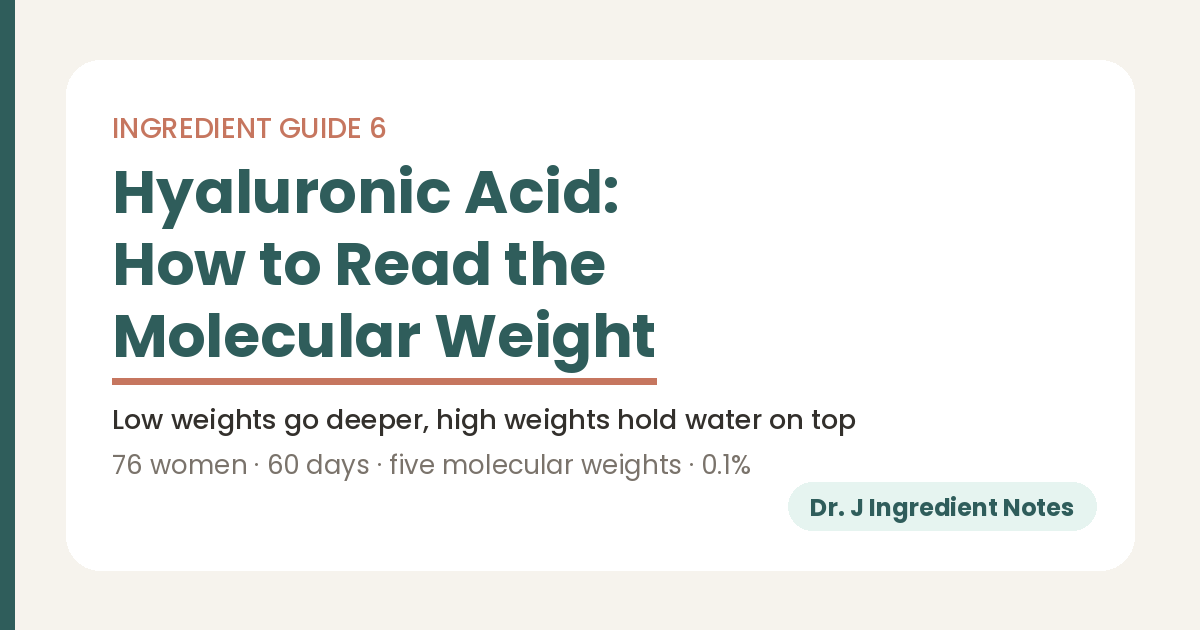
The short version: hydration and elasticity improved with all five molecular weights tested against placebo. Where they split was wrinkle depth.
🇰🇷 Read this in Korean: 히알루론산, 분자량 숫자 읽는 법 (성분 백과 ⑥)
―――――――――――――――――――――
📄 Read the sources first
· Essendoubi M et al., Skin Res Technol 2016;22(1):55–62 – skin penetration by molecular weight, Raman spectroscopy
· Pavicic T et al., J Drugs Dermatol 2011;10(9):990–1000 – 0.1% creams, 76 women, 60 days, five molecular weights
· 🏠 COSMILE Europe ingredient database – look up “Sodium Hyaluronate”
The abstracts give the method and the placebo cream. The 2016 abstract also makes clear that the depth values come from excised skin sections, not skin on a living person.
―――――――――――――――――――――
15-second summary · no sound
―――――――――――――――――――――
In a hurry? Four lines
✔ Molecular weight is read in kilodaltons (kDa). Take a dalton figure and drop three zeros
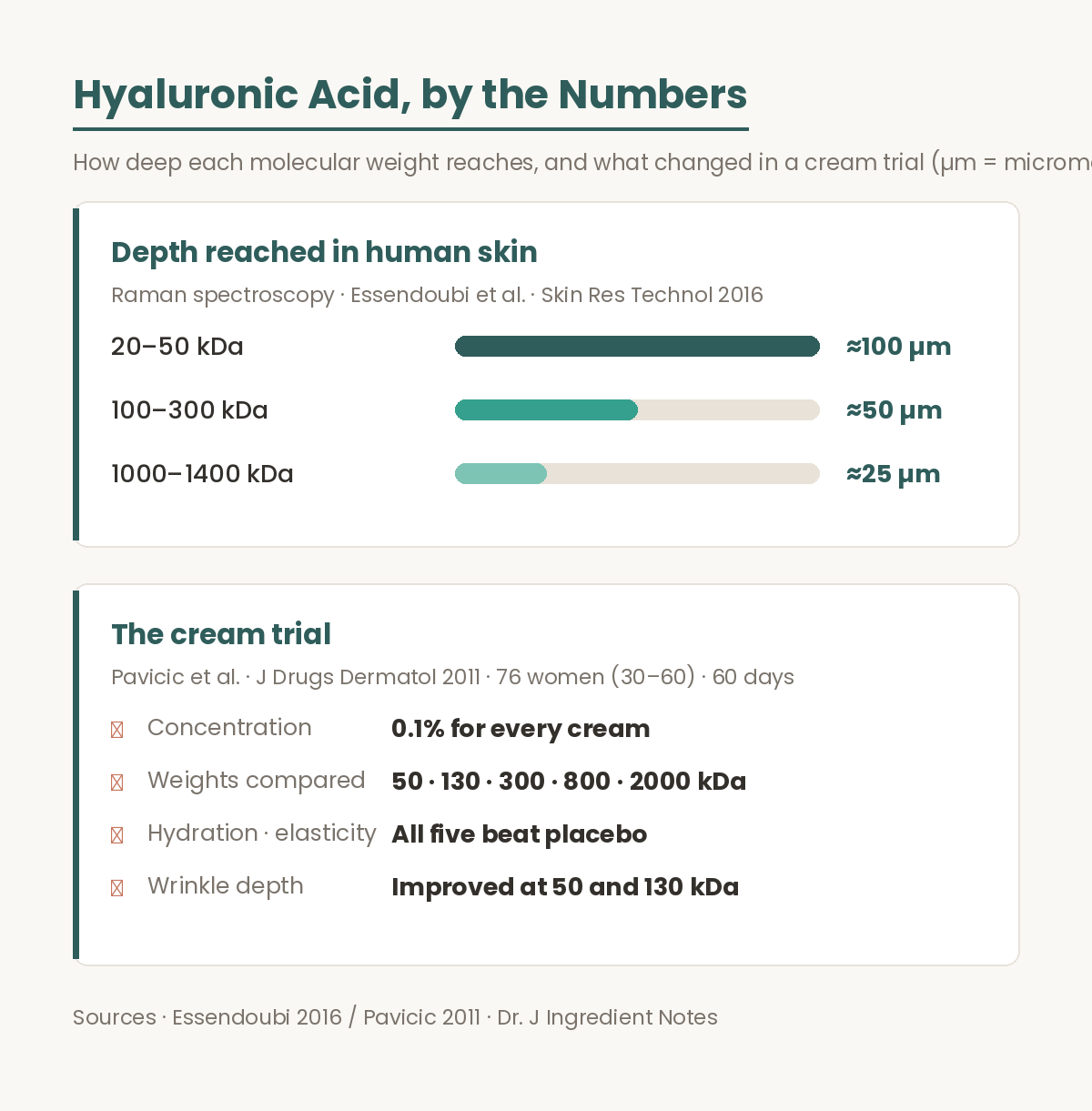
✔ The smaller the number, the deeper it reached – 20–50 kDa about 100 µm, while 1,000–1,400 kDa stayed in the outer layer at about 25 µm
✔ In a 76-woman, 60-day cream trial, hydration and elasticity improved with all five molecular weights versus placebo
✔ Wrinkle depth changed with 50 and 130 kDa. Low weights work at depth, high weights work on the surface
―――――――――――――――――――――
What hyaluronic acid does – a place to hold water
Hyaluronic acid is already in our skin, in the dermis. It attracts and holds water very strongly, so in cosmetics its job is hydration. On an ingredient list it appears as “Sodium Hyaluronate” or “Hyaluronic Acid”.
What separates one product from another is the size of the molecule. Hyaluronic acid is a chain of repeating units. A short chain slips in lightly; a long chain sits on the surface and forms a water-holding layer. If ceramides are the mortar that fills the gaps between the bricks, hyaluronic acid is the wet cloth laid over the wall that holds water. Two ingredients can share the word “moisturising” and still do different jobs.
“How far does a big molecule get?” came up in the collagen guide too. Collagen is a protein and hyaluronic acid is a sugar chain, so they are different kinds of molecule, but the rule is the same: size decides where it goes.
―――――――――――――――――――――
How to read the number – daltons, kilodaltons and the word “low”
Molecular weight is written in daltons (Da). 1,000 daltons make 1 kilodalton (kDa), so 50,000 Da is 50 kDa and 1,000,000 Da is 1,000 kDa. If a product prints daltons, drop three zeros and read it in kDa. “Low” and “high” have no fixed boundary, so the table below uses the ranges the two studies actually tested.
| What the label says | Weight range | How deep it reached | What it does |
|---|---|---|---|
| Low · ultra-low · oligo | Below a few tens of kDa (50,000 Da = 50 kDa) | Past the stratum corneum, about 100 µm (20–50 kDa) | Hydration at depth · the range where wrinkle depth changed |
| Medium | 100–300 kDa | About 50 µm | Hydration · elasticity |
| High | Above 1,000 kDa (1,000,000 Da = 1,000 kDa) | About 25 µm · stays in the stratum corneum | A water-holding layer on the surface · the quick relief for tightness |
So neither “low is better” nor “high is better” is the answer. A product that lists two weights covers the deep layer and the surface at once. Which weight did what is in the two studies below.
―――――――――――――――――――――
How deep did it get – the Raman spectroscopy study
Researchers applied three molecular weights of hyaluronic acid to abdominal skin from a 44-year-old woman, cut the skin in cross-section and mapped the signal layer by layer with Raman spectroscopy. Raman reads the vibration signature of a molecule, so it can tell the applied hyaluronic acid apart from the skin’s own components and show which layer it reached – Essendoubi et al., Skin Res Technol 2016.
✔ 20–50 kDa – about 100 µm
✔ 100–300 kDa – about 50 µm
✔ 1,000–1,400 kDa – about 25 µm, it stayed in the stratum corneum
The smaller the molecule, the deeper it went. One caveat: these values come from excised skin sections, from a single donor, not from skin on a living person. The direction is clear; the exact micrometre figure could differ from one person to the next. That is why the next study matters – people actually used the cream.
―――――――――――――――――――――
As a cream – 76 women, 60 days
The concentration was fixed at 0.1% and only the molecular weight changed: 50, 130, 300, 800 and 2,000 kDa. 76 women aged 30–60 applied the cream to one eye area and the same cream without hyaluronic acid to the other, twice a day for 60 days. Hydration, elasticity and wrinkle depth were measured at baseline, day 30 and day 60 – Pavicic et al., J Drugs Dermatol 2011.
| Measured | 50 · 130 kDa | 300 · 800 · 2,000 kDa |
|---|---|---|
| Hydration | Significantly better than placebo | Significantly better than placebo |
| Elasticity (R2) | Significantly better than placebo | Significantly better than placebo |
| Wrinkle depth | Improved versus placebo – the largest reduction was in these two | No clear difference |
The authors put it down to better penetration at low molecular weight. Read side by side, the two studies say this: if hydration is the goal, the number matters less; if you are hoping for something on wrinkle depth, the low numbers (50–130 kDa) are the ones with evidence behind them. The individual percentages are not in the abstract, so this post says “improved versus placebo” and leaves it there.
―――――――――――――――――――――
How to use it – damp skin and one layer on top
✔ Apply while the skin is still damp after cleansing. It needs water to hold on to
✔ Then seal it with one layer – a cream or an oil. Without a seal, the water it holds heads for the air, and a dry room makes that worse
✔ It sits comfortably in the same routine as retinol, vitamin C or niacinamide. On nights with an active, laying it down first takes the edge off the tightness
✔ In the morning it goes before sunscreen. Thin textures first
Which ingredients can share a night is in the ingredient compatibility chart.
―――――――――――――――――――――
Five things to check before you buy
✔ Are two or more molecular weights listed? – they divide the deep layer and the surface between them
✔ What unit is the number in? – if daltons, drop three zeros and read kDa. A number tells you more than the word “low”
✔ Is it near the top of the ingredient list? – “Sodium Hyaluronate” or “Hyaluronic Acid”. The trial used 0.1%
✔ Is there something to seal it with? – if it is a serum, plan the cream that goes on top as part of the set
✔ Can you give it 60 days? – that is how long the cream trial ran. Hydration you feel at once; wrinkle depth takes time
Save these five lines for the shop. Reading the back of the box takes five minutes.
―――――――――――――――――――――
One-line summary
🧪 Hyaluronic acid is an ingredient you choose by reading the molecular weight. Small numbers go deep, big numbers stay on top – a product with both numbers covers both, and applying it to damp skin and sealing it with one layer completes the set.
The next Ingredient Guide is panthenol (Ingredient Guide 7). Where hyaluronic acid holds water, panthenol calms the barrier.
📌 Earlier posts
· Retinol: Start at 0.1% – How to Read the Concentration Numbers (Ingredient Guide 1)
· Skincare Ingredient Compatibility Chart – 12 Ingredients, What to Layer and What to Split
· Dull, Rough Skin? Glycolic Acid (AHA) – What the Research Shows
· Collagen: Topical vs Oral – What the Research Says (Ingredient Guide 5)
· Ceramides: The Three-Line Label Check (Ingredient Guide 4)
About the author · Dr. J
MS in Veterinary Medicine, PhD in Life Sciences. I worked as a researcher at the Korea Research Institute of Bioscience and Biotechnology (KRIBB) and now run Beaurea, a cosmetics manufacturing company, where I write the formulas myself. This blog reads the research papers and the regulatory documents and turns them into plain-language criteria for choosing ingredients. I don’t recommend specific products here – only criteria that apply to any product.
📄 References
· Essendoubi M, Gobinet C, Reynaud R, Angiboust JF, Manfait M, Piot O. Human skin penetration of hyaluronic acid of different molecular weights as probed by Raman spectroscopy. Skin Res Technol 2016;22(1):55–62
· Pavicic T, Gauglitz GG, Lersch P, Schwach-Abdellaoui K, Malle B, Korting HC, Farwick M. Efficacy of cream-based novel formulations of hyaluronic acid of different molecular weights in anti-wrinkle treatment. J Drugs Dermatol 2011;10(9):990–1000
· COSMILE Europe – INCI ingredient database
This article summarises published research and public documents for information. It is not a diagnosis or a treatment. If you have a skin concern that worries you, please see a professional.
— Dr. J Ingredient Notes