
🇰🇷 한국어판: 피부 노화, 보습크림으로 늦출 수 있을까 – 연구가 잰 자리와 고시가 정한 자리
Hello, this is Dr. J. Today: can a moisturizer slow skin aging? I want to answer it the way the sources actually do — by separating what the studies measured from what the regulation permits you to say.
Start with one finding. Thirty minutes in a drier room was enough to increase fine wrinkles around the eye. Nobody applied anything. Nobody aged. Only the air changed.
That single result tells you where a moisturizer’s job begins. And Korea’s rulebook tells you where it stops — because here, the phrase “helps improve wrinkles” is not a marketing decision. It is a list of four ingredients with concentrations attached.
――――――――――――――――――――――――――――
Read the sources first
📄 Tsukahara et al. 2007 — 20 people, a 70% room and a 40% room
📄 Stettler et al. 2021 — 42 people per arm, 28 days (open access)
📄 MFDS, Functional Cosmetics Review Regulation, Annex 4 — the four wrinkle actives
📄 FDA — Is It a Cosmetic, a Drug, or Both? — how intended use decides
Annex 4 was opened again today, and the four ingredients, their concentrations, the permitted dosage forms and the efficacy sentence were all read from the original.
――――――――――――――――――――――――――――
――――――――――――――――――――――――――――
The five-line version
✓ Moving from a 70% to a 40% humidity room for 30 minutes lowered moisture and elasticity and raised fine wrinkles
✓ A moisturizer used once a day for 28 days raised stratum corneum moisture by 38.1 to 72.4%
✓ Neither study reports a wrinkle-correction figure — that number simply is not there
✓ In Korea, four actives are notified by name and concentration for the wrinkle claim
✓ Glycerin, hyaluronic acid, ceramides and panthenol are not on that list
――――――――――――――――――――――――――――
The two studies, side by side
This article rests on two human studies. Their designs are deliberately different — one changed the air for half an hour, the other applied a cream for four weeks.
| Study | Who, and where measured | Conditions | What was measured |
|---|---|---|---|
| Tsukahara et al. 2007 Skin Res Technol |
20 people eyelid |
30 min in a 70% humidity room, then 30 min at 40% |
Conductance (moisture), elasticity, fine wrinkles |
| Stettler et al. 2021 Cosmetics |
42 people in each of three arms forearm |
Three creams differing in lipid content, once a day for 28 days |
Stratum corneum moisture, user-rated elasticity |
One asks how fast the environment moves the skin. The other asks how much of that a cream puts back. The questions are halves of the same question, which is why they sit together here.
――――――――――――――――――――――――――――
Thirty minutes, two rooms
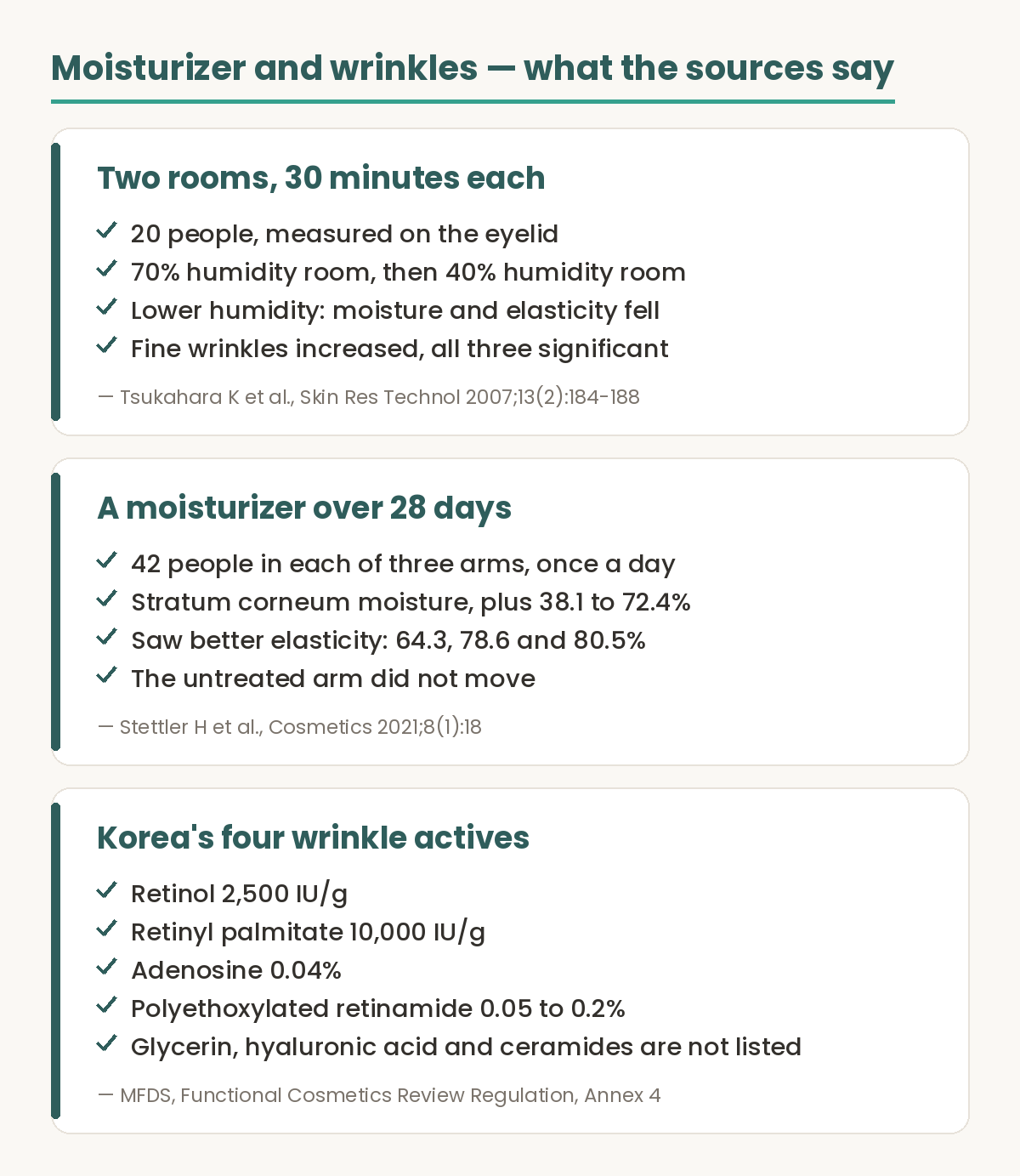
Twenty people had moisture, elasticity and fine wrinkles measured on the eyelid. Once after 30 minutes of adaptation in a room at 70% relative humidity, and again after 30 minutes at 40% (Tsukahara et al., Skin Res Technol 2007).
✓ Moisture fell at the lower humidity
✓ Elasticity fell as well
✓ Fine wrinkles increased — all three differences were statistically significant
The authors put it plainly: a 30-point difference in humidity changes the properties of the skin within 30 minutes. Same people, same products, different air.
So these wrinkles belong to the reversible side of the ledger. They are not the same thing as the lines that deepen over decades, and it is worth keeping the two apart when you judge a cream.
――――――――――――――――――――――――――――
Twenty-eight days with a moisturizer
Three creams containing panthenol were made with different lipid contents. 42 people used each one, once a day, for 28 days (Stettler et al., Cosmetics 2021).
✓ Stratum corneum moisture rose +63.9%, +72.4% and +38.1% from baseline
✓ Users who judged elasticity improved: 64.3%, 78.6% and 80.5%
✓ The untreated opposite forearm did not move
That last line carries weight. It rules out season, room conditions and measurement drift — the numbers moved on the treated side.
One caution: the elasticity figures are what users reported, not an instrument reading. They should not be stacked on top of the moisture numbers as if they were the same kind of evidence.
――――――――――――――――――――――――――――
Where the numbers stop
Lay the two studies out by measure, and the sentence “moisturizer reduces wrinkles” shows you exactly where it breaks.
| Measure | Tsukahara 2007 | Stettler 2021 | Is there a number? |
|---|---|---|---|
| Moisture | Fell significantly at lower humidity | +38.1% to +72.4% from baseline | Yes, in both |
| Elasticity | Fell significantly at lower humidity | 64.3 / 78.6 / 80.5% of users saw improvement | Yes, in both |
| Fine wrinkles | Increased significantly at lower humidity | — | Yes, in one |
| Wrinkle depth or correction | — | — | No. Neither study reports it |
The last row is the point of this article. There is no wrinkle-correction figure in either study. What exists is moisture, elasticity, and fine wrinkles under dry air.
――――――――――――――――――――――――――――
Korea names four actives
Annex 4 of the MFDS Functional Cosmetics Review Regulation lists the ingredients that may carry the wrinkle claim. There are four, and each comes with a concentration.
| No. | Ingredient | Concentration |
|---|---|---|
| 1 | Retinol | 2,500 IU/g |
| 2 | Retinyl palmitate | 10,000 IU/g |
| 3 | Adenosine | 0.04% |
| 4 | Polyethoxylated retinamide | 0.05 – 0.2% |
Permitted dosage forms are lotions, solutions, creams and sheet masks. The efficacy sentence is fixed: 「피부의 주름개선에 도움을 준다」 — helps improve skin wrinkles. Directions are prescribed too, down to removing a sheet mask after 10 to 20 minutes.
Reading the annex again today, glycerin, hyaluronic acid, ceramides and panthenol appear nowhere in it. That is not a verdict on those ingredients. It means they are not on the road that leads to this particular sentence.
※ Note the annex’s own title: “types of functional cosmetics for which data submission is waived.” The listed concentration is not a ceiling. It is the amount at which you need not file fresh efficacy data.
――――――――――――――――――――――――――――
Korea and the United States decide this differently
This is the part that travels badly across borders. The same jar of cream can be described in two quite different ways depending on where it is sold.
| Korea | United States | |
|---|---|---|
| What fixes the wording | A government notification lists four actives with set concentrations. Use one at that level and the efficacy sentence is prescribed | Intended use decides the category. There is no list of approved anti-wrinkle actives |
| The sentence on the box | 「피부의 주름개선에 도움을 준다」 — helps improve skin wrinkles | No prescribed sentence. Wording is the company’s to choose, and to defend |
| Where it can go wrong | Using the phrase without the notified active and the review or report behind it | A claim to treat wrinkles or to affect the skin’s structure or function can make the product a drug under the FD&C Act |
| What the shopper sees | The box prints 기능성화장품 (functional cosmetic) and the efficacy sentence under it | Nothing on pack marks the category |
In the United States, the FD&C Act defines a cosmetic by what it does to appearance, and a drug by intent to affect the structure or any function of the body. The FDA’s own guidance says the category follows intended use — so a claim to treat wrinkles, rather than to make them look softer, can move a product into drug territory.
Korea took the other road. It fixed a short list of actives, attached concentrations, and prescribed the sentence. The upside for a shopper is unusual: you can read the claim off the box and know exactly what was reviewed.
――――――――――――――――――――――――――――
Reading the numbers carefully
✓ The 30-minute study is about air, not about cream — it shows how quickly dry air moves the skin, not what a product does
✓ The 28-day percentages are change from baseline — the drier the starting skin, the larger the possible rise. They do not compare products
✓ Elasticity there is a user rating — a questionnaire result, not an instrument reading
Hold those three in mind and the same figures read differently. What was measured, in whom, under what conditions is the habit worth building.
――――――――――――――――――――――――――――
What I left out, and why
✓ “Moisturizer smooths wrinkles” — Stettler measured moisture and elasticity. There is no wrinkle figure, so none is quoted here
✓ Mechanism of aging (inflammation, glycation and so on) — the primary sources I could open were reviews, so that passage is absent
✓ A list of five moisturizing ingredients — covered in the first autumn guide; linked below instead
✓ Comparisons with procedures or prescription products — out of scope for a cosmetics article
――――――――――――――――――――――――――――
So where does a moisturizer land
✓ Fine lines that come from dryness — this is the moisturizer’s ground, and the 30-minute study is the evidence for it
✓ The phrase “helps improve wrinkles” — this belongs to a functional cosmetic built on one of the four actives
✓ They are not rivals — moisturizer daily, notified active at its stated concentration
Putting cream on every day is maintenance against what the environment takes away. Small, but the 30-minute result shows how quickly that ground shifts.
――――――――――――――――――――――――――――
What to check on the box
✓ In Korea, whether 기능성화장품 and the wrinkle sentence appear together
✓ Which of the four actives it is, and whether the concentration is printed
✓ For the moisturizing side, whether glycerin sits high in the ingredient list, and whether ceramides come with cholesterol and fatty acids
✓ Indoor humidity — 30 minutes is enough to change things. Keep out of the direct path of a heater
――――――――――――――――――――――――――――
One line
A moisturizer’s reach is the fine lines that dryness creates. “Wrinkle improvement” is the work of four notified actives — and the two go together rather than against each other.
Next: custom-blended cosmetics — what the product mixed for you at the counter actually is (Ingredient Guide 22).
――――――――――――――――――――――――――――
📌 Previous guides
📌 Panthenol for Skin: What the Dexpanthenol Studies Show (Guide 7) — the 28-day trial in full
📌 Adenosine 0.04%: Who Decided That Number (Guide 12) — one of the four, on its own
📌 Retinol: Start at 0.1% (Guide 1)
📌 Ceramides: Cholesterol and Fatty Acid Ratio (Guide 4)
📌 Hyaluronic Acid: How to Read the Molecular Weight (Guide 6)
About the author · Dr. J
MS in Veterinary Medicine, PhD in Life Sciences. I worked as a researcher at the Korea Research Institute of Bioscience and Biotechnology (KRIBB) and now run Beaurea, a cosmetics manufacturing company, where I write the formulas myself. This blog reads the research papers and the regulatory documents and turns them into plain-language criteria for choosing ingredients. I don’t recommend specific products here – only criteria that apply to any product.
📄 References
· Tsukahara K et al., Skin Res Technol 2007;13(2):184-188
· Stettler H et al., Cosmetics 2021;8(1):18
· Ministry of Food and Drug Safety, Regulation on the Review of Functional Cosmetics, Annex 4
· U.S. FDA, “Is It a Cosmetic, a Drug, or Both? (Or Is It Soap?)”, page updated 11 September 2024
――――――――――――――――――――――――――――
This article summarises published research and regulatory documents. It is not a diagnosis or a treatment, and it does not recommend a particular product. Figures are quoted as the sources report them; different conditions give different numbers. If a skin concern worries you, please speak to a professional.
— Dr. J Ingredient Notes