
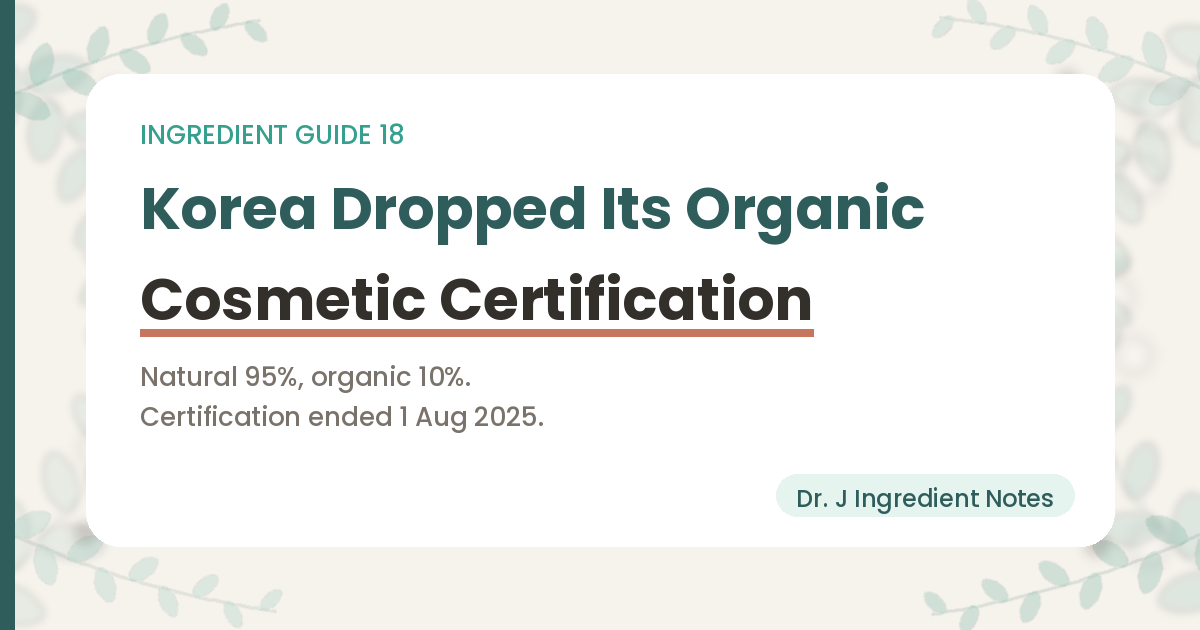
🇰🇷 한국어판: 유기농 화장품 기준 – 95%와 10%, 그리고 2025년 8월 폐지된 식약처 인증
Hello, this is Dr. J. If you have been reading about Korean organic cosmetics, almost everything in English still describes a government certification mark. That scheme no longer exists.
It ended on 1 August 2025. The two definitions left the Cosmetics Act, the certification articles were deleted, and the notification that held the standard was repealed on the same day.
The thresholds themselves did not change — natural 95%, organic 10%. What changed is who measures them and who checks. This guide walks the regulation, the repeal notices and the industry guide that replaced them, and ends with how the same question is handled in the United States.
――――――――――――――――――――――――――――
Read the sources first
📄 Guide on Labelling and Advertising of Natural and Organic Cosmetics (2025, Korean)
📄 Repeal of the standard — MFDS Notice 2025-49
📄 Repeal of the certifying-body rules — Notice 2025-48
📄 ISO 16128-2:2017 — the index calculation
📄 FDA — “Organic” Cosmetics — how the United States handles the word
The Korean-language sources are linked as they stand; the figures below are read from those originals.
――――――――――――――――――――――――――――
――――――――――――――――――――――――――――
The five-line version
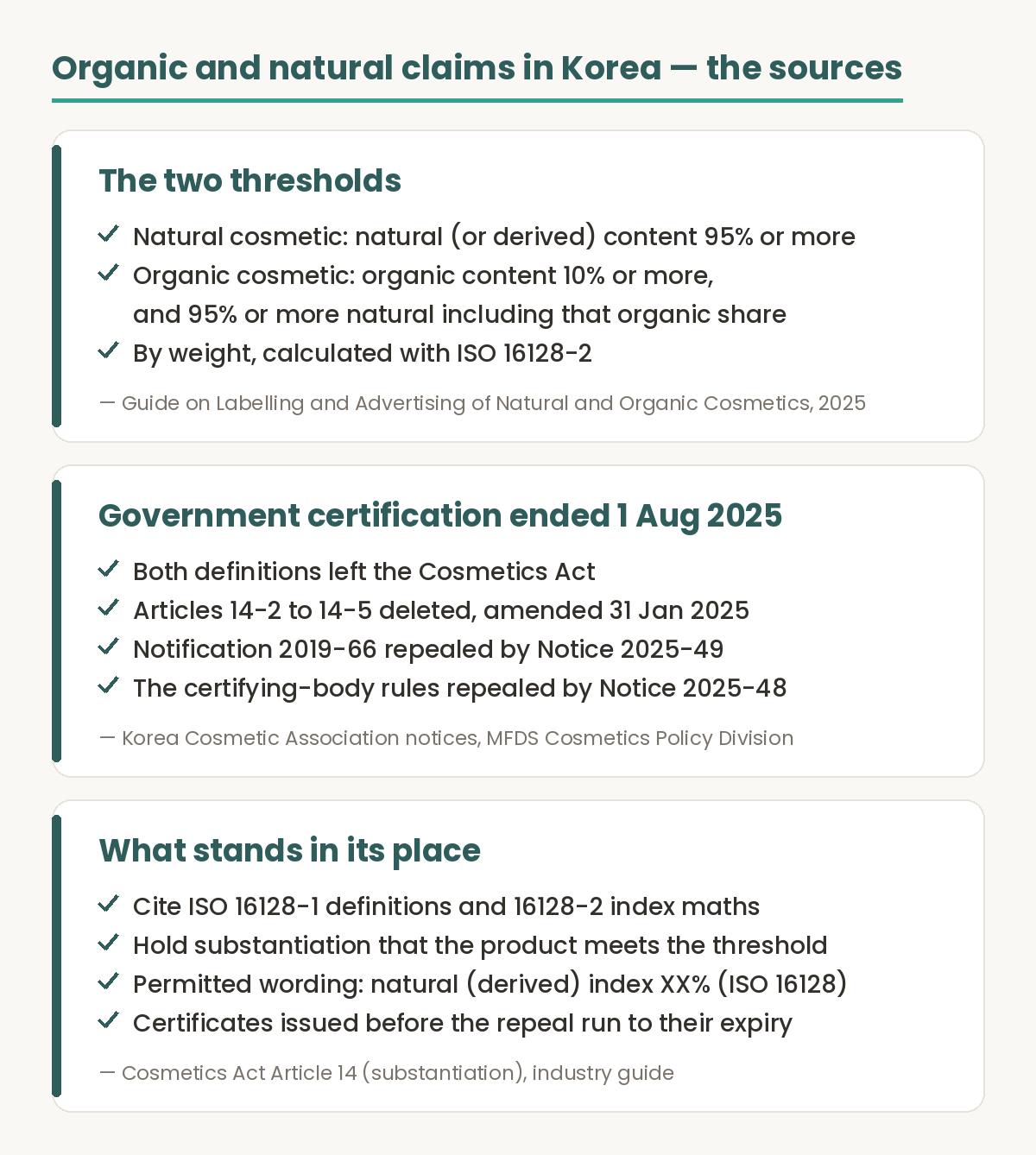
✓ A natural cosmetic needs 95% natural or natural-derived content
✓ An organic cosmetic needs 10% organic, plus 95% natural including that share
✓ Korea’s government certification ended on 1 August 2025
✓ Certificates issued before then run to their expiry
✓ ISO 16128 and written substantiation now carry the claim
――――――――――――――――――――――――――――
The two thresholds
Start with what is being claimed. The numbers are unchanged from the repealed notification; the method moved to ISO 16128.
| Natural cosmetic | Organic cosmetic | |
|---|---|---|
| Natural (or derived) content | 95% or more | 95% or more, including the organic share |
| Organic (or derived) content | No separate threshold | 10% or more |
| How it is measured | By weight, ISO 16128-2 | By weight, ISO 16128-2 |
| What counts as natural | ISO 16128-1 definitions | ISO 16128-1 definitions |
A point worth sitting with: an organic cosmetic can be 10-something per cent organic. That is not a shortcut. It is where the line was drawn, and the remaining 85 per cent or so still has to be natural or natural-derived.
――――――――――――――――――――――――――――
What was removed, and when
| What went | Instrument | Date |
|---|---|---|
| The definitions of natural and organic cosmetics, Cosmetics Act Article 2 | Act No. 20767 | amended 31 Jan 2025 |
| Articles 14-2 to 14-5 — certification, validity, certification mark, accredited bodies | same Act | amended 31 Jan 2025 |
| Article 13(1)3 and parts of the penalty articles | same Act | amended 31 Jan 2025 |
| Notification 2019-66, the standard for natural and organic cosmetics | Repeal Notice 2025-49 | 1 Aug 2025 |
| The rules on designating certifying bodies | Repeal Notice 2025-48 | 1 Aug 2025 |
The Act was amended on 31 January 2025 and the two repeal notices took effect on 1 August 2025. Both notices were posted, with the ministry’s covering document, by the Korea Cosmetic Association.
The stated reason was to remove duplicate certification. Private schemes were already doing the work, so the government stepped out of it.
――――――――――――――――――――――――――――
Old certificates are still running
A repeal does not void what was already issued. Certificates remain valid until they expire, and the old validity period was three years.
So a Korean shelf right now holds two kinds of product: ones carrying the old government mark, and ones labelled against the industry guide with no mark at all. Neither is better by definition — the guarantor is different, and that is the thing to notice.
――――――――――――――――――――――――――――
Before and after, side by side
| Before — Notification 2019-66 | Now — industry guide, 2025 | |
|---|---|---|
| Who set it | Ministry of Food and Drug Safety | Self-regulatory body for cosmetic labelling and advertising, at the Korea Cosmetic Association |
| Natural content | 95% or more | 95% or more |
| Organic content | 10% or more | 10% or more |
| Synthetic ingredients allowed | Up to 5%, of which petrochemical moiety 2% or less | No such list — ISO 16128 calculation takes its place |
| Manufacturing processes | Permitted processes listed as physical, chemical and biological | Not listed in the guide |
| Who checks | A certifying body designated by the ministry | The company, holding substantiation on file |
The thresholds did not move. The checking did.
One consequence is easy to miss. The repealed notification carried a 5% cap on synthetic ingredients, with the petrochemical moiety held to 2%, and a list of permitted manufacturing processes. The industry guide has no such list — the ISO 16128 calculation stands in for it. If you find those older figures quoted as current Korean rules, they are out of date.
――――――――――――――――――――――――――――
What carries the claim now
Two things. The ISO 16128 pair, and substantiation.
ISO 16128-1:2016 defines which ingredients count as natural, derived natural, organic or derived organic. ISO 16128-2:2017 sets out how to calculate the indexes. The 95 and the 10 are outputs of that calculation.
The guide also fixes the permitted wording. What a company may print is a phrase of the form “natural (derived) index XX% (calculated under ISO 16128)” — the claim carries its own method. What it may not print, when the product misses the threshold, is a line like “contains natural ingredient X” leaning on a single component.
And the evidence has to exist on paper:
(1) A business operator or seller shall be able to substantiate matters of fact in its own labelling or advertising.
(3) … shall submit the substantiating material to the Minister of Food and Drug Safety within 15 days of the request.
Paragraph (4) requires the ministry to order the labelling or advertising stopped if the material is not filed in time and the claim continues. Certification is gone; the checking is not.
――――――――――――――――――――――――――――
Article 13 did not go away
The definitions and the certification articles were deleted. The prohibition on misleading claims was not.
1. Labelling or advertising likely to be mistaken for a medicine
2. … likely to be mistaken for a functional cosmetic when it is not
3. Deleted <31 Jan 2025>
5. Any other labelling or advertising likely to deceive consumers or cause them to be mistaken, contrary to fact
Item 3 was the natural-and-organic provision. Item 5 now covers that ground. The MFDS labelling and advertising guidance of 14 August 2025 also lists, among prohibited expressions, natural or organic wording on a product that does not meet the industry guide.
――――――――――――――――――――――――――――
The private route: COSMOS
With the state out of it, the scheme most visible on Korean packaging is COSMOS — a non-profit standard built by five European organisations: BDIH (Germany), Cosmebio and Ecocert (France), ICEA (Italy) and the Soil Association (United Kingdom).
Finished products carry COSMOS ORGANIC or COSMOS NATURAL; raw materials are COSMOS CERTIFIED or COSMOS APPROVED. In Korea the certifying bodies are KTR (Korea Testing & Research Institute) and Control Union Korea.
A company holding one of these may print it alongside the index wording. It is worth knowing, though, that this is a private guarantee, not a government one.
※ The organic-content percentages behind each COSMOS grade were not stated on the public overview page, so they are not quoted here.
――――――――――――――――――――――――――――
Korea and the United States, side by side
The word “organic” is handled very differently in the two markets, and a Korean product sold in the US runs into the second column.
| Korea | United States | |
|---|---|---|
| Is there a government definition? | There was one in the Cosmetics Act. It was deleted on 31 January 2025 | No. FDA says the term is not defined in the laws it enforces |
| Who certifies | Nobody, since 1 August 2025. Private schemes such as COSMOS continue | USDA under the National Organic Program, for agricultural ingredients |
| What sets the threshold | An industry guide citing ISO 16128-1 and -2 — natural 95%, organic 10% | NOP rules for the organic claim; FDA rules still apply to labelling and safety |
| What the company must hold | Substantiation, due within 15 days of a request (Cosmetics Act Art. 14) | Certification records for the NOP claim |
The FDA’s position is blunt: “The term ‘organic’ is not defined in either of these laws or the regulations that FDA enforces.” The definition and the certification sit with the USDA’s National Organic Program, which certifies agricultural ingredients. And a cosmetic bearing an organic claim “must comply with both USDA regulations for the organic claim and FDA regulations for labeling and safety requirements.”
So the two countries arrived at a similar place from opposite directions. The United States never defined the word for cosmetics. Korea defined it, certified it for years, then handed the measuring to an international standard and the checking to the companies themselves.
――――――――――――――――――――――――――――
What ISO 16128-2 does not cover
One caution, and it is in the standard’s own scope. ISO 16128-2 is a method for calculating indexes. The overview states that it does not address:
✓ Product labelling
✓ Human safety
✓ Environmental safety
✓ Fair trade and other regulatory requirements
So a high natural index is not a gentleness rating. It counts how much of the formula came from nature, which is a different question from how your skin will respond. For reactive skin, the ingredient list is the more useful page.
――――――――――――――――――――――――――――
What to check on the box
✓ Whether a number and a method sit beside the words “natural” or “organic”
✓ Whether the wording follows the “natural (derived) index XX% (ISO 16128)” form
✓ Whether a private scheme such as COSMOS is named, together with its certifier
✓ If a Korean government mark is shown, whether the product’s certificate is still inside its term
“Contains natural ingredients”, with no number and no scheme, tells you nothing about how much. Turn the box over and read the ingredient list instead — the front of it answers the question faster.
――――――――――――――――――――――――――――
What I left out, and why
✓ The repealed notification’s process annex — no longer in force; it appears only in the before-and-after table
✓ How many products had been certified, and any revocations — I could not open a primary source
✓ The ISO 16128 formulas and the treatment of water — the standard itself is paywalled, so this stops at “a method for calculating indexes”
✓ Per-grade organic percentages for COSMOS — not stated on the public overview
✓ “Natural means gentle” — no primary source, and it sits against what the ISO scope says
――――――――――――――――――――――――――――
One line
Natural 95%, organic 10% — and in Korea you now read the wording rather than look for a mark.
Substantiation came up more than once above. What a cosmetic advertisement may and may not say in Korea is set out in its own guide (Ingredient Guide 19).
――――――――――――――――――――――――――――
📌 Previous guides
📌 How to Read a Korean Cosmetic Ingredient List (Guide 14) — where to look when there is no index
📌 Arbutin vs Alpha-Arbutin: What Korea’s 2–5% Means (Guide 15) — another number fixed by notification
📌 Sunscreen SPF and PA: How to Read the Numbers (Guide 11)
📌 Skin Concern Ingredient Map
About the author · Dr. J
MS in Veterinary Medicine, PhD in Life Sciences. I worked as a researcher at the Korea Research Institute of Bioscience and Biotechnology (KRIBB) and now run Beaurea, a cosmetics manufacturing company, where I write the formulas myself. This blog reads the research papers and the regulatory documents and turns them into plain-language criteria for choosing ingredients. I don’t recommend specific products here – only criteria that apply to any product.
📄 References
· Self-Regulatory Body for Cosmetic Labelling and Advertising, Guide on Labelling and Advertising of Natural and Organic Cosmetics, 2025
· MFDS Repeal Notices 2025-49 and 2025-48, effective 1 August 2025
· Cosmetics Act (Act No. 20767, amended 31 January 2025), Articles 13 and 14
· ISO 16128-1:2016 and ISO 16128-2:2017
· U.S. FDA, “‘Organic’ Cosmetics”, page updated 25 February 2022
· COSMOS-standard AISBL, public overview
――――――――――――――――――――――――――――
This article summarises statutes, notices and published guidance, and does not recommend a particular product. Rules change; please check the originals before relying on any of it for a decision.
— Dr. J Ingredient Notes