Tag: Korea Cosmetic Association

  • Korea’s Natural Origin Index: The 95% Line, and the Disclaimer That Must Sit Beside the Number (Ingredient Guide 28)

    Cover image for an article on the natural origin index printed on Korean cosmetic packaging. A 2025 industry guide from the Korea Cosmetic Association defines a natural cosmetic as one whose natural and natural-origin content reaches 95 percent of the finished product by weight, calculated under the ISO 16128-2 guideline, and an organic cosmetic as one with organic content of 10 percent or more while natural content stays at 95 percent or more. A product below the threshold may not call an ingredient natural on the pack, but it may print the index itself when the calculation basis is shown. The Korean Ministry of Food and Drug Safety guideline then requires the words Not a natural cosmetic beside that index, while ISO 16128 states that it does not address product communication, human safety or environmental safety. Dr. J Ingredient Notes.

    🇰🇷 한국어판

    Hello, this is Dr. J. Today we read the natural origin index printed on Korean cosmetic packaging — what that number counts, and why the words “Not a natural cosmetic” so often sit right beside it.

    Two things surprise most people. In Korea, “natural cosmetic” is no longer defined in the law. And a product that misses the threshold can still print the index — the rules opened that door on purpose.

    ――――――――――――――――――――――――――――

    The primary sources

    📄 Guide on Labelling and Advertising of Natural and Organic Cosmetics (Korea Cosmetic Association, PDF, Korean)

    📄 Guideline on Labelling and Advertising of Cosmetics (MFDS, 14 Aug 2025, PDF, Korean)

    📄 ISO 16128-2:2017 (abstract)

    📄 U.S. FDA, “‘Organic’ Cosmetics”

    The Korean documents carry the thresholds and the disclaimer wording; the ISO abstract carries the sentence that limits the standard itself.

    ――――――――――――――――――――――――――――

    ――――――――――――――――――――――――――――

    Five lines if you are in a hurry

    ✔ Korea deleted the legal definition of natural and organic cosmetics on 1 August 2025

    ✔ The thresholds now live in a 2025 industry guide: natural 95%, organic 10% plus natural 95%

    ✔ A product below the line may still print the index — with the calculation basis shown

    ✔ Beside that index the front panel carries “Not a natural cosmetic”

    ✔ ISO 16128 states that it does not address labelling, human safety or environmental safety

    ――――――――――――――――――――――――――――

    The definition left the statute book in August 2025

    Until 2025, Korean cosmetics law defined natural cosmetics and organic cosmetics and ran a government certification scheme for them. An amendment that took effect on 1 August 2025 deleted those definitions and the certification provisions together.

    What filled the gap is not another statute. It is a guide published in 2025 by the Korea Cosmetic Association — more precisely by the advertising advisory committee of the self-regulatory review body for cosmetic labelling and advertising. The guide describes itself as setting out the minimum requirements for businesses that want to use these words.

    ※ The repeal itself, and the certification scheme that disappeared with it, were covered in Ingredient Guide 18. This article is about the number that is printed on packs now.

    ――――――――――――――――――――――――――――

    What the guide counts — 95% and 10%

    What the guide says (translated) How to read it
    Natural cosmetic A product whose natural and natural-origin content reaches 95% or more of the finished product by weight, calculated under the ISO 16128-2 guideline The unit is the finished product, not an ingredient. Everything in the bottle is weighed
    Organic cosmetic Organic and organic-origin content of 10% or more of the finished product, with natural content — the organic part included — still at 95% or more Both lines must hold. Organic is a branch of natural here, not an alternative route
    What sits on the natural side Plants and animals, minerals and micro-organisms, and ingredients derived from them Not plants alone. Mineral and fermentation-derived materials belong here too
    The calculation ISO 16128-1 (definitions for ingredients) · ISO 16128-2 (criteria for ingredients and products) A two-part international standard, borrowed as the arithmetic

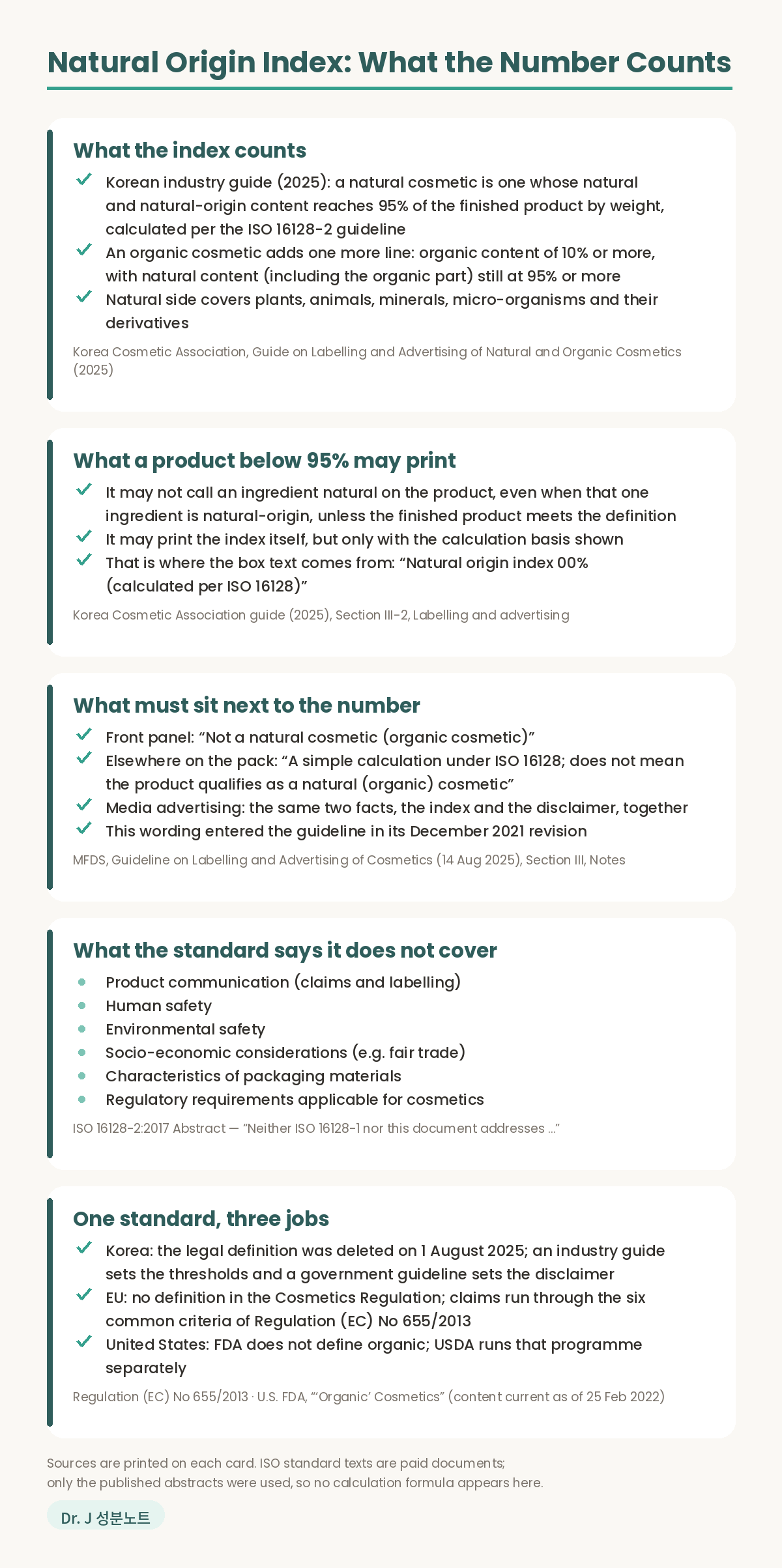
    Evidence graphic on the natural origin index. First, what the index counts: the Korea Cosmetic Association guide of 2025 sets natural content at 95 percent of the finished product by weight under ISO 16128-2, and organic content at 10 percent or more with natural content still at 95 percent or more, counting plants, animals, minerals, micro-organisms and their derivatives. Second, what a product below 95 percent may print: it may not call an ingredient natural on the product, but it may print the index with the calculation basis shown, which is where the wording natural origin index 00 percent calculated per ISO 16128 comes from. Third, what must sit next to the number: the front panel carries Not a natural cosmetic, elsewhere on the pack a line saying the figure is a simple calculation under ISO 16128 and does not mean the product qualifies, and media advertising carries both facts together; this wording entered the guideline in its December 2021 revision. Fourth, what the standard says it does not cover: product communication, human safety, environmental safety, socio-economic considerations, packaging materials and regulatory requirements. Fifth, one standard and three jobs: Korea deleted the legal definition on 1 August 2025 and an industry guide now sets the thresholds, the European Union has no definition in its cosmetics regulation and runs claims through the six common criteria of Regulation 655 of 2013, and in the United States the FDA does not define organic while the USDA runs that programme separately.

    ――――――――――――――――――――――――――――

    The guide’s scope reaches products that print only an index

    This is the clause most summaries skip. The guide does not govern only products that call themselves natural. It also covers products that intend to print nothing but an ISO 16128 index.

    Section of the guide What it sets out
    I. Purpose To give consumers correct information and to set out the minimum requirements for businesses that label and advertise these words
    II. Scope Products labelled or advertised as natural or organic cosmetics, and products that calculate and print a natural or organic (origin) index under the ISO 16128 guideline
    III. Criteria 1. Definitions · 2. Labelling and advertising · 3. Substantiation
    Substantiation A product that labels or advertises these words must be able to substantiate that it meets the criteria

    ――――――――――――――――――――――――――――

    Blocked, then opened — the two sentences that explain the pack

    Section III-2 of the guide places a prohibition and an exception side by side. Read apart, each one misleads; read together, they explain what you see on the shelf.

    What the guide says (translated) In practice
    The prohibition Where the finished product does not meet the definition, the product may not directly label or advertise an ingredient as a natural (origin) or organic (origin) ingredient — even if that particular ingredient is one One natural ingredient does not let the product speak of natural ingredients
    The exception However, where a natural (origin) or organic (origin) index calculated under the ISO 16128 guideline is presented clearly, together with the basis of the calculation, labelling and advertising by index is permitted The number may be spoken. The calculation basis is the price of admission
    The result on the pack “Natural (origin) index 00% (calculated per ISO 16128)” Exactly the string you find on Korean packaging

    So “natural cosmetic” and “natural origin index” are two different claims. The first belongs to finished products above 95%; the second belongs to any product willing to show its arithmetic.

    ――――――――――――――――――――――――――――

    What the MFDS guideline adds — the four permitted wordings

    The Korean Ministry of Food and Drug Safety publishes a Guideline on Labelling and Advertising of Cosmetics (version of 14 August 2025). Its Annex 2, the table of claims that require substantiation, carries a dedicated row: “3. Content concerning ISO natural and organic index labelling and advertising.”

    Permitted wording (as printed in the guideline) Substantiation required
    Natural index 00% (ISO 16128 calculation applied) Substantiated by evidence relating to that finished product
    “In this case it is also necessary to indicate that the figure is calculated under the ISO 16128 guideline, together with wording that prevents consumer misunderstanding.”
    Natural origin index 00% (ISO 16128 calculation applied) same row
    Organic index 00% (ISO 16128 calculation applied) same row
    Organic origin index 00% (ISO 16128 calculation applied) same row

    ※ A footnote in the same annex defines the standard plainly: ISO 16128 is a method (guideline) for obtaining a calculated value for natural and organic content in cosmetics.

    ――――――――――――――――――――――――――――

    Why “Not a natural cosmetic” sits beside the number

    The guideline’s Section III, Notes is where this article’s hinge lies. When an ISO natural or organic index is labelled or advertised, the guideline says the following ways of writing it are to be followed to reduce consumer misunderstanding.

    Where What must appear alongside (translated)
    ① Front panel “Not a natural cosmetic (organic cosmetic)”
    ② Elsewhere on the pack “A simple calculation result under ISO 16128; does not mean the product falls under ‘natural cosmetic (organic cosmetic)’”
    ③ Media advertising “Natural index 00% (a figure calculated under the ISO 16128 guideline). However, this figure does not mean the product qualifies as a natural (organic) cosmetic”

    That small print on the front of the box is not a brand being modest. It is wording the guideline supplies, and the revision history shows when it arrived: the 30 December 2021 edition, recorded as “ISO natural and organic index labelling and advertising method established.”

    ――――――――――――――――――――――――――――

    A prohibition with its own proviso

    Annex 1 of the same guideline lists expressions that may not be used. One line reads:

    MFDS guideline, Annex 1 — expressions that may not be used

    Expressions relating to “natural (Natural)” or “organic (organic)” on a product that does not conform to the Guide on Labelling and Advertising of Natural and Organic Cosmetics (Korea Cosmetic Association).
    Note — businesses wishing to use natural or organic expressions need appropriate supporting documents · “provided that expressions falling under Annex 2, item 3 are excluded.”

    The last clause carries the weight. The prohibition arrives with its exception attached. A product outside the thresholds cannot say “natural”, yet the index wording of Annex 2 item 3 is carved out of that ban — the same architecture as the guide’s “blocked, then opened” pair above.

    ――――――――――――――――――――――――――――

    What the number does not count — six items, named by the standard itself

    The ISO 16128-2 abstract contains one sentence that keeps this whole subject honest.

    ISO 16128-2:2017, abstract

    “Neither ISO 16128-1 nor this document addresses product communication (e.g. claims and labelling), human safety, environmental safety, socio-economic considerations (e.g. fair trade), characteristics of packaging materials or regulatory requirements applicable for cosmetics.”

    The index counts where ingredients came from. Whether a formula is gentle, whether it suits your skin, whether the packaging is sound — none of that is the standard’s business, and it says so.

    Which leaves a gap, and the gap is the interesting part: a standard that refuses to speak about labelling is being used for labelling. Each market has filled that silence differently.

    ――――――――――――――――――――――――――――

    One standard, three jobs — Korea, the EU and the United States

    Korea European Union United States
    Legal definition of natural / organic Deleted on 1 August 2025. The thresholds now sit in a 2025 industry guide No definition in the Cosmetics Regulation FDA does not define it — “The term ‘organic’ is not defined in either of these laws or the regulations that FDA enforces under their authority.”
    Where the criteria live Korea Cosmetic Association guide — natural 95% · organic 10% plus natural 95% Regulation (EC) No 655/2013 and its six common criteria: legal compliance, truthfulness, evidential support, honesty, fairness, informed decision-making For organic, the USDA National Organic Program — “The USDA requirements for the use of the term ‘organic’ are separate from the laws and regulations that FDA enforces for cosmetics.”
    Status of ISO 16128 Named in the guide and the guideline as the calculation method Not named in the Regulation Not named
    What must accompany an index “Not a natural cosmetic (organic cosmetic)” on the front panel No set wording; the claim must clear the common criteria — “If it is claimed on the product that it contains a specific ingredient, the ingredient shall be deliberately present.” No set wording
    Relationship to safety Neither the guide nor the guideline is a safety standard The common criteria govern advertising, not safety FDA — “An ingredient’s source does not determine its safety.”

    ※ The six common criteria are the headings of the Annex to Regulation (EC) No 655/2013, applicable since 11 July 2013. Note what all three jurisdictions share: none of them treats a high natural index as a statement about safety.

    ――――――――――――――――――――――――――――

    Four things to check on the box

    ✔ Look for a percentage next to the word “natural”, not the word alone

    ✔ Look for “calculated per ISO 16128” — the calculation basis is a condition, not decoration

    ✔ If you see “Not a natural cosmetic”, that is an index claim — the line is required, not a confession

    ✔ Judge gentleness from the ingredient list and concentrations, not from the index

    ――――――――――――――――――――――――――――

    In one line

    The natural origin index counts where ingredients came from; it does not measure how gentle a product is. Above 95% a product may be called a natural cosmetic; below it, the figure may still be printed with its calculation shown — and the words “Not a natural cosmetic” go with it.

    What is not in this article, and why

    ✔ The calculation formula itself — ISO standards are paid documents. Only the published abstracts were read

    ✔ The ingredient categories of ISO 16128-1 — same reason; the standard text was not opened

    ✔ Article and clause numbers of the Enforcement Rule — Korea’s national law portal was unreachable on the day of writing, so no provision numbers are cited

    ✔ The approval date of the industry guide — the PDF yields only the year (2025)

    ✔ Certification bodies and marks — none appear in the guide’s text, so none are named here

    ✔ Claims that natural or organic means gentler — no primary source supports them. The ISO sentence above says the standard does not address human safety, which is the honest version of that question

    ――――――――――――――――――――――――――――

    📌 Earlier articles

    📌 How to Read a Korean Cosmetic Ingredient List (Ingredient Guide 14) — checking by name rather than by index

    📌 Bakuchiol vs Retinol (Ingredient Guide 3) — the plant-derived side

    📌 Collagen: Topical vs Oral (Ingredient Guide 5) — the animal-derived side

    📌 Salicylic Acid (BHA): 0.5% vs 2% (Ingredient Guide 8) — who decides a number

    About the author · Dr. J

    MS in Veterinary Medicine, PhD in Life Sciences. I worked as a researcher at the Korea Research Institute of Bioscience and Biotechnology (KRIBB) and now run Beaurea, a cosmetics manufacturing company, where I write the formulas myself. This blog reads the research papers and the regulatory documents and turns them into plain-language criteria for choosing ingredients. I don’t recommend specific products here – only criteria that apply to any product.

    📄 References

    · Korea Cosmetic Association, Guide on Labelling and Advertising of Natural and Organic Cosmetics (established 2025)

    · Ministry of Food and Drug Safety, Guideline on Labelling and Advertising of Cosmetics, guidance no. 0086-07 (14 August 2025) — Annex 1 · Annex 2 item 3 · Section III Notes

    · ISO 16128-1:2016 · ISO 16128-2:2017 (abstracts)

    · Cosmetics Act of Korea, Act No. 20767 (in force 1 August 2025) — deletion of the natural and organic definitions and certification provisions

    · Regulation (EC) No 655/2013 laying down common criteria for the justification of claims used in relation to cosmetic products

    · U.S. FDA, “‘Organic’ Cosmetics” (content current as of 25 February 2022)

    ――――――――――――――――――――――――――――

    This article summarises guidance documents and standard abstracts and is not a substitute for diagnosis or treatment. Passages from the Korean guide and guideline are my translation of the Korean originals; the ISO and FDA sentences are quoted in their published English. Korea’s national law portal was unreachable on the day of writing, so statutory provisions were not re-opened, and ISO standard texts are paid documents, so only the published abstracts were used.

    — Dr. J Ingredient Notes
  • Vegan Cosmetics in Korea: The Three Requirements an Industry Guide Set, and the One Line a Korean Label Cannot Print (Ingredient Guide 21)

    Cover image for a Dr. J Ingredient Notes article on vegan cosmetics in Korea. It shows the title Vegan Cosmetics in Korea, the line three requirements and one banned line, the three requirements set by a 2025 industry guide from the Korea Cosmetic Association, and a note that the phrase not tested on animals cannot be printed on a Korean label because Article 15-2 of the Cosmetics Act already bans selling animal-tested cosmetics.

    🇰🇷 한국어판 읽기

    Hello, this is Dr. J. A Korean cosmetic box that says vegan almost never says “not tested on animals” beside it. Shoppers read the gap as a gap. It is not one — it is a rule.

    Here is the part most summaries skip. No statute anywhere defines the word “vegan” for cosmetics — not in Korea, not in the EU, not in the United States. What differs between the three is what fills that empty space, and what a label is allowed to print next to the word.

    ――――――――――――――――――――――――――――

    Primary sources

    📄 Guide to Vegan Labelling and Advertising of Cosmetics, 2025 (Korea Cosmetic Association, PDF, Korean)

    📄 Cosmetics Act Article 15-2 (Korean Law Information Center)

    📄 Regulation (EU) No 655/2013, common criteria for cosmetic claims (EUR-Lex)

    📄 “Cruelty Free”/“Not Tested on Animals” (U.S. FDA)

    The Korean guide runs to a few pages and has three chapters: purpose, scope, and criteria. The EU regulation carries the six common criteria in its Annex.

    ――――――――――――――――――――――――――――

    ――――――――――――――――――――――――――――

    The five lines, if you are in a hurry

    ✔ “Vegan” is not defined in Korean law — a 2025 industry guide sets the requirements

    ✔ A product must meet all three: no animal ingredient, none animal-tested, and no testing of the finished product

    ✔ Ingredients processed with micro-organisms are allowed — fermentation does not break a vegan claim

    ✔ Share a production line with a non-vegan batch and you wash it thoroughly first

    ✔ A Korean label cannot print “not tested on animals” — the sale is already banned, so the claim would mislead

    ――――――――――――――――――――――――――――

    The word is not in the statute — a 2025 industry guide fills the gap

    Search the Korean Cosmetics Act for “vegan” and nothing comes back. The text that does define it was issued in 2025 by the advertising advisory committee of the self-regulatory review body run by the Korea Cosmetic Association. The guide says of itself that it exists to give advertisers “the minimum requirements for making a vegan claim.”

    Its scope is a single line: “This guide applies to cosmetics that are labelled or advertised as vegan.” A product that does not make the claim is outside it.

    What the guide requires What it means on a shelf
    1 A cosmetic that contains no ingredient of animal origin The ingredient side. Honey, beeswax and lanolin are the familiar examples
    2 A cosmetic that contains no ingredient tested on animals under the Cosmetics Act The ingredient’s history, which never appears on the ingredient list
    3 A cosmetic not itself tested on animals under the Cosmetics Act The finished product, not only its parts
    All “A cosmetic that satisfies all of the requirements below” Miss one and the word may not be printed

    ※ The clause numbers inside the guide do not survive text extraction from the PDF, so this article names the chapters rather than the subparagraphs.

    ――――――――――――――――――――――――――――

    Ingredients, manufacturing, substantiation — the three chapters that follow

    After the definition the guide sets out how to keep to it. The second line below is the one that surprises formulators.

    Chapter The guide’s wording Reading
    Ingredient standard “Ingredients of animal origin and ingredients that have been tested on animals shall not be used. An ingredient that has been processed with micro-organisms not derived from animals (bacteria, yeasts, fungi and the like) may be used.” A fermented ingredient does not break a vegan claim. Using a micro-organism is not the same as using an animal
    Manufacturing and control “Ingredients of animal origin shall be kept from entering a vegan product during manufacture. For example, where a vegan and a non-vegan product are made on the same equipment, machines, equipment, tools and contact surfaces shall be washed thoroughly before the vegan product is made.” A dedicated line is not required. Cleaning is accepted in its place
    Substantiation “A cosmetic labelled or advertised as vegan shall be able to substantiate that it meets the criteria.” Making the claim means holding the file. It runs on the same track as Article 14 of the Cosmetics Act

    The guide cites, as its legal footing, Articles 10, 13 and 14 of the Cosmetics Act with Articles 19, 22 and 23 of the Enforcement Rule and its Annex 5 — and Article 15-2. The guide itself carries no penalty; those provisions do.

    ――――――――――――――――――――――――――――

    What may be said, and what may not

    Two of the four rows below are the ones a brand entering Korea tends to get wrong.

    Situation What the guide sets On the box
    The finished product meets the criteria It may be labelled and advertised as vegan The word describes one finished product
    Only some ingredients meet them “A product may not be labelled or advertised as a vegan cosmetic on the basis of particular ingredients alone, rather than the finished product, even where those ingredients meet the criteria.” “Made with vegan ingredients” and “vegan cosmetic” are different claims
    “Not tested on animals” “Although the distribution and sale of cosmetics tested on animals … is prohibited, wording such as ‘not tested on animals’, which could lead consumers to believe that animal-tested cosmetics are also on the market, may not be used.” Its absence is not an omission — the phrase is not permitted
    Certification marks The guide carries no rule on certifying bodies or marks A mark tells you whose standard was met, which you check separately

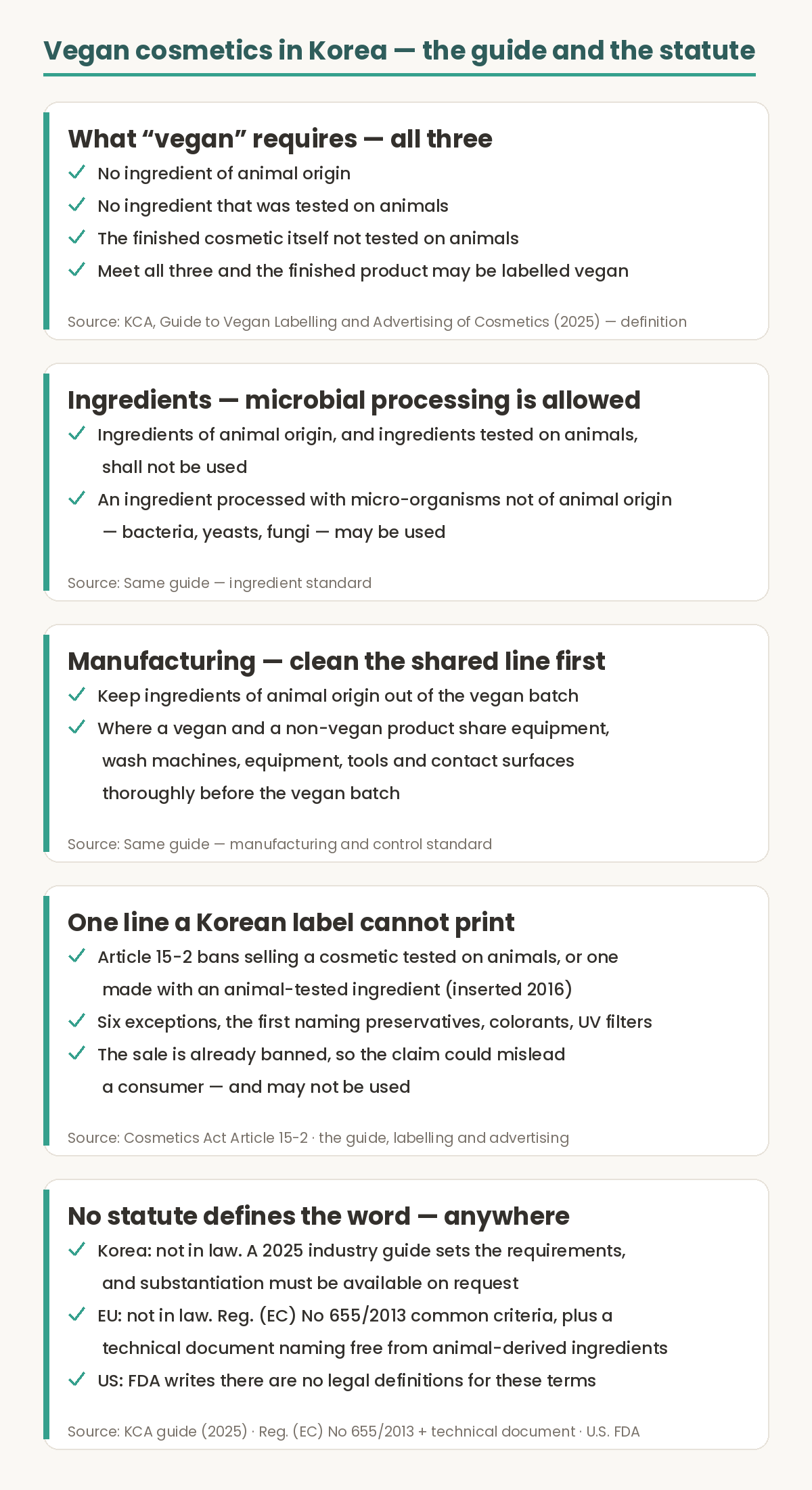
    Evidence figure on vegan cosmetics in Korea, in five parts. First, what vegan requires: all three of no ingredient of animal origin, no ingredient tested on animals, and the finished cosmetic itself not tested on animals; meet all three and the finished product may be labelled vegan. The source is the Korea Cosmetic Association Guide to Vegan Labelling and Advertising of Cosmetics, issued in 2025. Second, the ingredient standard: ingredients of animal origin and ingredients tested on animals shall not be used, while an ingredient processed with micro-organisms not derived from animals, that is bacteria, yeasts or fungi, may be used. Third, the manufacturing and control standard: keep ingredients of animal origin out of the vegan batch, and where a vegan and a non-vegan product share equipment, wash machines, equipment, tools and contact surfaces thoroughly before the vegan batch. Fourth, one line a Korean label cannot print: Article 15-2 of the Cosmetics Act bans distributing or selling a cosmetic tested on animals or one made with an animal-tested ingredient, inserted in 2016, with six exceptions, the first of which names preservatives, colorants and ultraviolet filters; because the sale is already banned, a not-tested-on-animals claim could mislead a consumer and so may not be used. Fifth, no statute defines the word anywhere: in Korea it is not in law and a 2025 industry guide sets the requirements with substantiation available on request, in the European Union it is not in law and Regulation 655 of 2013 sets common criteria alongside a technical document naming free from animal-derived ingredients, and in the United States the Food and Drug Administration writes that there are no legal definitions for these terms.

    ――――――――――――――――――――――――――――

    The statute behind the banned line — Cosmetics Act Article 15-2

    The reason the phrase is off-limits sits in the statute. Korea already bans the sale, so printing the claim would suggest that products without it are the tested ones.

    Paragraph The provision Reading
    (1), main text “A cosmetics responsible distributor or a customised cosmetics seller shall not distribute or sell a cosmetic on which animal testing under Article 2(1) of the Laboratory Animal Act has been conducted, or a cosmetic manufactured (including contract manufacture) or imported using an ingredient on which animal testing has been conducted.” What is blocked is selling. “Including contract manufacture” sits in brackets, and imports are in the same sentence
    (1), proviso “Provided, that this shall not apply in any of the following cases” (amended 13 Mar 2018, 17 Aug 2021) Six exceptions follow (next table)
    (2) “The Minister of Food and Drug Safety shall endeavour to develop alternative test methods and shall take the measures necessary for cosmetics responsible distributors and others to use them.” The duty that pairs with the ban, and the provision that narrows exception 2
    Inserted [This Article Newly Inserted on 3 February 2016] Reported as in force from 4 February 2017; we could not open the addendum itself

    The six exceptions, as the statute words them:

    No. The provision In short
    1 Where necessary to designate standards of use for ingredients requiring particular restriction — preservatives, colorants, ultraviolet filters and the like under Article 8(2) — or to carry out a risk assessment under Article 8(3) of ingredients raising public-health concerns Safety work. Three ingredient classes are named
    2 Where animal testing is necessary because no alternative test method exists (an alternative test method being a method that uses no animals, or that reduces the number of animals used or lessens their pain, recognised as such by the Minister of Food and Drug Safety) Nothing else will do. The definition sits inside the provision
    3 Where animal testing is required by the law of the country of export The receiving market demands it
    4 Where animal testing is required for product development by the law of the country of import The sourcing market demands it
    5 Where an ingredient developed through animal testing under another statute is used in manufacturing a cosmetic A pharmaceutical-track ingredient, for instance
    6 Other cases, designated by the Minister of Food and Drug Safety, where an alternative test is impracticable Room left for a ministry notice

    The penalty is an administrative fine of up to KRW 1 million under Article 40(1)7. Translations of the Korean provisions here are ours.

    ――――――――――――――――――――――――――――

    Korea, the EU and the United States — one word, three situations

    Set the three side by side and the pattern is clear. None of them defines the word. What differs is what stands in for a definition, and whether the adjacent claim is allowed.

    Korea European Union United States
    Is “vegan” defined in law? No. A 2025 industry guide sets three requirements No. Regulation (EU) No 655/2013 sets six common criteria for every claim No. FDA: “there are no legal definitions for these terms”
    What fills the gap A self-regulatory guide, plus a substantiation file Criterion 6, informed decision-making, and a technical document listing “‘free from animal-derived ingredients’, e.g. in products intended for vegans” among acceptable claims Nothing. The claim is left to the company
    “Not tested on animals” May not be printed — Article 15-2 already bans the sale Permitted if the six criteria are met; Regulation (EC) No 1223/2009 Article 18 bans the testing itself Unrestricted. FDA notes firms “may rely on raw material suppliers or contract laboratories to perform any animal testing necessary”
    Who holds the evidence The advertiser — “shall be able to substantiate” The responsible person, in the product information file (Article 2 of 655/2013) The company, by whatever means it chooses

    For a brand, the practical reading is that Korea regulates the words around the claim rather than the claim itself. A pack artwork that pairs “vegan” with “not tested on animals” passes in the EU and the United States and fails in Korea — and the Korean reason is not that the statement is false, but that it is already true of everything on the shelf.

    The EU technical document is worth one caution. It carries the line “IT IS NOT A EUROPEAN COMMISSION DOCUMENT” and is dated as a version of 3 July 2017, agreed by a sub-working group. It is guidance on how to apply the six criteria, not a statute.

    ――――――――――――――――――――――――――――

    Four things to check on a Korean box

    ✔ Next to “vegan”, look for which standard or certifier is named

    ✔ “Made with vegan ingredients” is not the same claim as “vegan cosmetic”

    ✔ A missing “not tested on animals” is not a missing feature — the phrase is not allowed

    ✔ Whether a product is gentle is a question of ingredients and concentrations, read separately

    ――――――――――――――――――――――――――――

    In one line

    No statute defines “vegan” for cosmetics, and in Korea a 2025 industry guide sets three requirements that must all be met. No ingredient of animal origin, none tested on animals, and no testing of the finished product — with fermented ingredients expressly allowed, and one neighbouring phrase expressly forbidden.

    What we left out, and why

    ✔ The guide’s subparagraph numbers — they do not survive text extraction from the PDF, so we name the chapters instead

    ✔ Any vegan certifier or mark — the guide names none, and we verified none as a primary source, so we name none either

    ✔ A list of animal-derived ingredients — the guide carries no such table; honey, beeswax and lanolin appear here as commonly cited examples

    ✔ The commencement date of Article 15-2 — the law portal does not return addenda, so 4 February 2017 rests on press reports

    ✔ Any vegan entry in the MFDS labelling guidance — the 14 August 2025 guidance lists natural and organic wording among restricted expressions, but nothing on vegan or animal testing

    ✔ Claims that vegan products are gentler — no primary source, so not written

    ――――――――――――――――――――――――――――

    📌 Earlier guides

    📌 How to Read a Korean Cosmetic Ingredient List (Guide 14) — where the ingredient names are checked

    📌 Collagen: Topical vs Oral (Guide 5) — an ingredient that comes from an animal

    📌 Bakuchiol vs Retinol — the 44-person trial (Guide 3) — an ingredient that comes from a plant

    📌 Sunscreen SPF and PA: How to Read the Numbers (Guide 11) — one of the three classes named in exception 1

    About the author · Dr. J

    MS in Veterinary Medicine, PhD in Life Sciences. I worked as a researcher at the Korea Research Institute of Bioscience and Biotechnology (KRIBB) and now run Beaurea, a cosmetics manufacturing company, where I write the formulas myself. This blog reads the research papers and the regulatory documents and turns them into plain-language criteria for choosing ingredients. I don’t recommend specific products here – only criteria that apply to any product.

    📄 Sources

    · Korea Cosmetic Association, Guide to Vegan (VEGAN) Labelling and Advertising of Cosmetics (issued 2025), by the advertising advisory committee of the self-regulatory review body for cosmetic labelling and advertising

    · Cosmetics Act of Korea, Article 15-2(1) and (2), Article 40(1)7, Article 8(2) and (3), Articles 10, 13 and 14

    · Laboratory Animal Act, Article 2(1)

    · Ministry of Food and Drug Safety, Guidance on the Management of Cosmetic Labelling and Advertising (14 August 2025)

    · Regulation (EU) No 655/2013, common criteria, Annex points 1–6

    · European sub-working group on claims, Technical document on cosmetic claims, Annex III (version of 3 July 2017)

    · Regulation (EC) No 1223/2009, Article 18

    · U.S. FDA, “Cruelty Free”/“Not Tested on Animals” (content current as of 25 February 2022)

    ――――――――――――――――――――――――――――

    This article summarises an industry guide and statutes for general information and is not a substitute for diagnosis or treatment. On the day it was written the Korean law portal was unreachable, so Article 15-2 was taken verbatim from a statute mirror and the commencement date from press reports. Translations of the Korean provisions and of the guide are ours; the subparagraph numbers inside the guide do not survive text extraction from the PDF, so chapters are named instead.

    — Dr. J Ingredient Notes