
Hello, this is Dr. J.
The fifth ingredient guide is about collagen. The question I am asked most often is whether someone already using a collagen cream also needs to take collagen by mouth.
They share a name, so it is easy to assume they share a job. They do not – the two forms take completely different routes through the body.
Today I will mark out where those routes separate, using a molecular size figure and a daily gram figure.
―――――――――――――――――――――
📄 Read the sources first, if you prefer
· Bos JD, Meinardi MMHM, Exp Dermatol 2000 – the 500 dalton rule for the stratum corneum
· Danessa G et al., Indian J Dermatol Venereol Leprol 2025 – meta-analysis of 10 randomised trials
· 🏠 Korea MFDS functional ingredient search – for anything sold under a Korean health-food claim
The papers carry the doses, durations and effect sizes I have kept out of the text here.
―――――――――――――――――――――
Fifteen-second summary · no sound
―――――――――――――――――――――
The four lines, if you are in a hurry
✔ A collagen molecule is about 300,000 daltons. The figure usually quoted for crossing the stratum corneum is 500
✔ So applied collagen does its work at the surface, holding water
✔ Oral collagen is absorbed as short peptides. Across 10 randomised trials and 646 people, hydration and elasticity improved
✔ The intake approved in Korea is 1 to 3 g a day
―――――――――――――――――――――
How far does applied collagen get – 300,000 daltons against 500
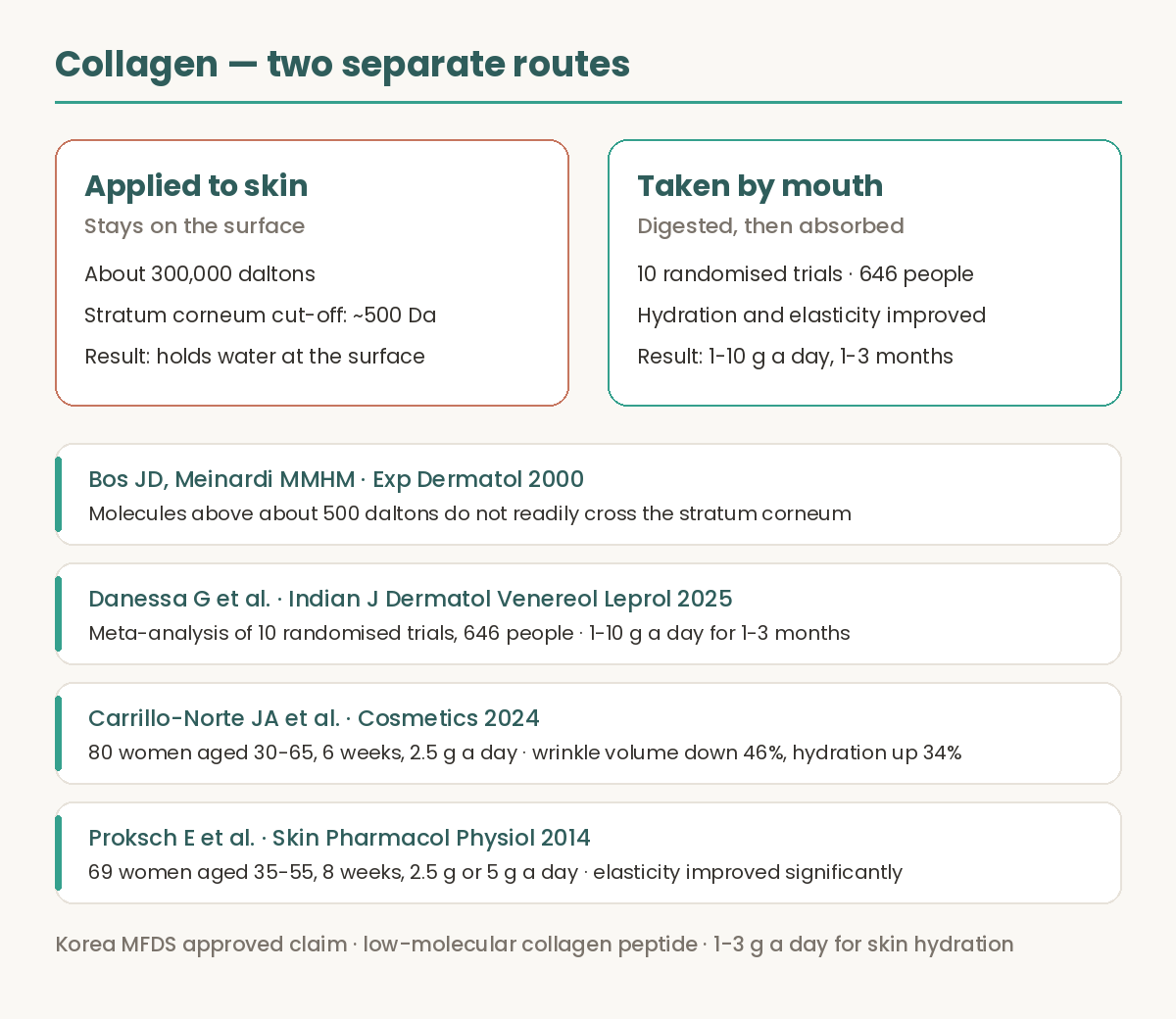
Bos JD and Meinardi MMHM set out the benchmark in Experimental Dermatology in 2000 (volume 9, pages 165–169): for a substance applied to skin to cross the stratum corneum, its molecular weight generally needs to be under 500 daltons.
Collagen comes in at roughly 300,000 daltons – about six hundred times larger. Which means applied collagen has a job of its own, and it is a surface job: a thin layer that holds water where it sits. The same seat that hyaluronic acid and glycerin occupy.
✔ Read a collagen cream as a humectant and film former
✔ When choosing one, the word collagen matters less than the moisturising and barrier ingredients around it
Some labels say hydrolysed collagen instead. That is a smaller, cut-down form – but how far it has been cut is rarely stated on the pack, so the label alone will not settle it. The ingredients listed alongside remain the more reliable signal.
―――――――――――――――――――――
What has been measured for oral collagen – up to 646 people
Danessa G and colleagues published a meta-analysis in Indian J Dermatol Venereol Leprol in 2025. It pooled 10 randomised controlled trials covering 646 people, taking 1 to 10 g a day for one to three months. Both hydration and elasticity moved in the direction of improvement.
The individual trials are worth seeing as well.
✔ Carrillo-Norte JA et al., Cosmetics 2024, volume 11, article 137 – 80 women aged 30 to 65, 6 weeks, 2.5 g a day. Wrinkle volume down 46%, skin hydration up 34%
✔ Proksch E et al., Skin Pharmacol Physiol 2014, volume 27, pages 47–55 – 69 women aged 35 to 55, 8 weeks, 2.5 g or 5 g a day. Elasticity improved significantly; hydration and water loss showed a trend
Products and peptide sizes differ between trials, so the individual numbers do not transfer cleanly from one to another. The direction does.
One limit worth stating plainly: participants were mostly women, and the trials ran 6 to 12 weeks. Whether the same holds for men, or over a longer horizon, is not something this body of work answers.
―――――――――――――――――――――
The two routes side by side
| Applied to skin | Taken by mouth | |
|---|---|---|
| Form | Whole molecule, about 300,000 daltons | Cut into short peptides |
| Route | Stays on the surface | Absorbed in the gut, carried in blood |
| What it does | Holds water, builds a film | Hydration and elasticity measures improved in trials |
| Number to read | What else is in the formula | Grams of collagen per daily serving |
| Time frame | While you are using it | Trials ran 6 to 12 weeks |
Shortened to a line: one works on the surface, the other works from the inside. It is not a choice between them so much as two different seats at the table.
―――――――――――――――――――――
How many grams, and for how long
In Korea, the individually approved ingredient low-molecular collagen peptide (notification 2013-30) carries the claim “may help with skin hydration”, with a daily intake of 1 to 3 g. The trials above used 2.5 to 5 g a day for 6 to 12 weeks, which tells you something on its own: this is not an ingredient you can judge in a fortnight.
On the pack, the number to find is not the capsule count but the grams of collagen in one day’s serving. A sachet marked 3,000 mg is the weight of the sachet; how much of that is collagen is printed separately.
―――――――――――――――――――――
What pairs well – vitamin C and protein
Vitamin C works as a cofactor when the body builds its own collagen, which is why so many collagen products include it.
That said, a supplement does not replace a meal. Eating enough protein comes first; the supplement sits on top of that.
For layering order on the topical side, the ingredient compatibility chart covers twelve ingredients and what to keep apart.
―――――――――――――――――――――
Five things to check before you buy
✔ Cream – is collagen listed alongside hyaluronic acid, glycerin or ceramides
✔ Supplement – grams of collagen per daily serving, not the capsule count
✔ Claim – whether the pack carries an approved wording rather than a promise
✔ Format – powder, liquid or tablet, whichever you will actually take for six weeks or more
✔ Medication – if you take anything regularly, ask your doctor or pharmacist first
―――――――――――――――――――――
In one line
🧪 Applied collagen holds water at the surface; oral collagen is absorbed as peptides. Neither substitutes for the other.
The next ingredient guide is panthenol – the name on the back of every repair cream.
📌 Earlier posts
· Skincare Ingredient Compatibility Chart – 12 ingredients, what to layer and what to split
· Retinol: Start at 0.1% – how to read the concentration numbers
· Dull, Rough Skin? Glycolic Acid (AHA) – what the research shows and how much is safe
About the author · Dr. J
MS in Veterinary Medicine, PhD in Life Sciences. I worked as a researcher at the Korea Research Institute of Bioscience and Biotechnology (KRIBB) and now run Beaurea, a cosmetics manufacturing company, where I write the formulas myself. This blog reads the research papers and the regulatory documents and turns them into plain-language criteria for choosing ingredients. I don’t recommend specific products here – only criteria that apply to any product.
📄 References
· Bos JD, Meinardi MMHM, Exp Dermatol 2000;9(3):165-169
· Danessa G et al., Indian J Dermatol Venereol Leprol 2025
· Carrillo-Norte JA et al., Cosmetics 2024;11:137
· Proksch E et al., Skin Pharmacol Physiol 2014;27(1):47-55
· 🏠 Korea MFDS functional ingredient search
Note: this article reads the research and the regulatory documents and sets out criteria for choosing an ingredient. It does not recommend a particular product. Food supplements are not intended to prevent or treat disease; if you take medication regularly, speak to your doctor or pharmacist first.
Dr. J Ingredient Notes | Ingredient Guide 5 · Collagen