
🇰🇷 한국어판 읽기
Hello, this is Dr. J. Korea has banned animal-tested cosmetics since 2017 — and yet you will almost never see “not tested on animals” printed on a Korean box. Those two facts are connected, and the connection is written down.
Here is the part most summaries skip. What the statute blocks is selling, not testing.
――――――――――――――――――――――――――――
Primary sources
📄 Cosmetics Act Article 15-2 (Korean Law Information Center)
📄 Laboratory Animal Act Article 2, Korean and English (KLRI)
📄 Regulation (EC) No 1223/2009, Article 18 (EUR-Lex)
📄 Animal Testing & Cosmetics (U.S. FDA)
The Korean article carries the six exceptions one subparagraph at a time, and the KLRI page gives the Laboratory Animal Act definition in Korean and English side by side.
――――――――――――――――――――――――――――
――――――――――――――――――――――――――――
The five lines, if you are in a hurry
✔ Selling animal-tested cosmetics has been banned in Korea since 4 February 2017
✔ The word manufacture carries (including contract manufacture), and imports sit in the same sentence
✔ The article lists six exceptions
✔ The penalty is an administrative fine of up to KRW 1 million
✔ That is why a Korean label cannot say “not tested on animals”
――――――――――――――――――――――――――――
What the article actually says
Article 15-2 has two paragraphs. Most English write-ups quote the first and stop; the second is the one that explains where the policy is going.
| Paragraph | Text | What it does |
|---|---|---|
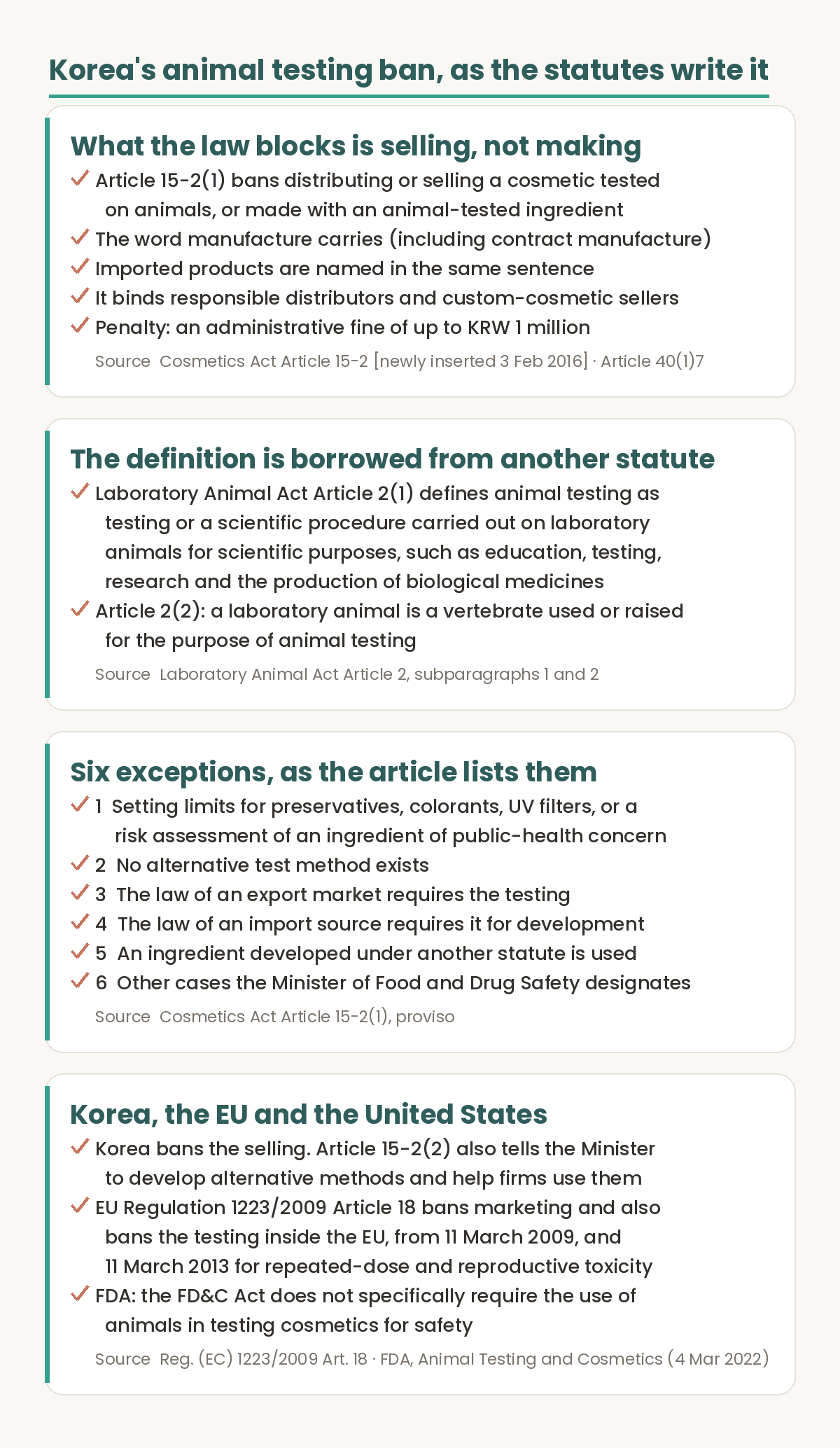
| 15-2(1), main clause | A responsible cosmetics distributor or a custom cosmetics seller shall not distribute or sell a cosmetic for which animal testing, as defined in Article 2(1) of the Laboratory Animal Act, has been carried out, or a cosmetic manufactured (including contract manufacture) or imported using an ingredient on which animal testing has been carried out. | The prohibited act is distribution and sale. Running a test inside Korea is not itself the offence. Contract manufacture and imports are written into the same sentence, which closes the two obvious ways around it |
| 15-2(1), proviso | Provided, that this shall not apply in any of the following cases. | The six exceptions follow (table below) |
| 15-2(2) | The Minister of Food and Drug Safety shall endeavour to develop alternative test methods and shall take the measures necessary for responsible cosmetics distributors and others to use them. | The duty that pairs with the ban. Exception 2 opens whenever no validated alternative exists, so the second paragraph puts the job of narrowing that gap on the regulator |
The article was newly inserted on 3 February 2016 and took effect on 4 February 2017.
――――――――――――――――――――――――――――
The six exceptions, one subparagraph at a time
| No. | As the article lists it | In plain words |
|---|---|---|
| 1 | Where it is necessary to designate use limits for ingredients that require particular restriction on use, such as preservatives, colorants and ultraviolet filters, or to carry out a risk assessment of a cosmetic ingredient raising a public-health concern | Testing done to set a limit, not to launch a product. Korea sets numerical limits for these three groups by notice |
| 2 | Where animal testing is necessary because no alternative test method exists | The gap that paragraph (2) is meant to close |
| 3 | Where animal testing is required under the law of an importing country for the purpose of exporting cosmetics | A market Korea sells into demands it |
| 4 | Where animal testing is required for product development under the law of the country from which the product is to be imported | A market Korea buys from demands it at the development stage |
| 5 | Where an ingredient developed through animal testing under another statute is used in manufacturing cosmetics | Pharmaceutical and other statutes require testing; that ingredient can still be used |
| 6 | Other cases prescribed by the Minister of Food and Drug Safety where it is difficult to carry out a test that can replace animal testing | A notice fills this in. We could not open that notice and say so below |
Exception 1 is worth a second look. Preservatives, colorants and ultraviolet filters are named in the statute itself — the three groups whose limits Korea fixes by notice. The space kept open is the space for safety work.
――――――――――――――――――――――――――――
Who is bound, and what happens
| Korea | Source | |
|---|---|---|
| Who is bound | Responsible cosmetics distributors; custom cosmetics sellers | Article 15-2(1) |
| What is prohibited | Distributing or selling the finished cosmetic, or one made with an animal-tested ingredient, including by contract manufacture or import | Article 15-2(1) |
| Penalty | An administrative fine of up to KRW 1 million | Cosmetics Act Article 40(1)7 |
| Inserted | 3 February 2016 | [Newly inserted 3 Feb 2016] |
| In force | 4 February 2017 | ⚠ the addendum text was not available; confirmed from two Korean newspapers |
An administrative fine is a small number next to the cost of a recall or a relabelling, but it is not the whole pressure. A product that cannot be lawfully distributed is a product retailers will not take.
――――――――――――――――――――――――――――
The definition is borrowed from another statute
The Cosmetics Act does not define animal testing itself. It reaches into the Laboratory Animal Act, Article 2(1), which reads in the official English rendering:
“The term animal testing means testing conducted for laboratory animals or the scientific procedure for scientific purposes, such as education, testing, research and production of biological medicines or such.”
And Article 2(2): “The term laboratory animal means vertebrate used or raised for the purpose of animal testing.”
Because the definition is borrowed, the scope is borrowed too — the line is drawn at vertebrates.
――――――――――――――――――――――――――――
Why no Korean label says “not tested on animals”
The Korea Cosmetic Association publishes a vegan labelling guide (2025) through the industry’s self-regulatory advertising body. It allows the word vegan under three conditions and blocks one phrase outright.
| What the guide sets | Content | Can it go on the box? |
|---|---|---|
| Vegan, condition 1 | The product contains no ingredient of animal origin | Vegan ⭕ where the conditions are met and can be substantiated |
| Vegan, condition 2 | It contains no ingredient on which animal testing has been carried out under the Cosmetics Act | same |
| Vegan, condition 3 | No animal testing has been carried out on the product under the Cosmetics Act | same |
| Blocked phrase | “Animal testing not conducted” and similar wording | ❌ — because the sale of animal-tested cosmetics is already prohibited, the phrase could lead a consumer to believe such products are otherwise on the shelf |
So the absence of the phrase is not a gap in the product. It is a consequence of the ban being universal. If every product on the shelf has to meet the same rule, advertising compliance as a feature is treated as misleading.
One thing we could not settle: whether the term cruelty-free itself is governed anywhere. The MFDS labelling and advertising guidance (14 August 2025) does not list animal-testing wording among its prohibited expressions.
――――――――――――――――――――――――――――
Korea, the EU and the United States
This is the part that is hard to find in English. All three jurisdictions are moving the same way, and all three grip a different part of the chain.
| Korea | European Union | United States | |
|---|---|---|---|
| Instrument | Cosmetics Act Article 15-2 | Regulation (EC) No 1223/2009, Article 18 | No federal prohibition |
| What is prohibited | Distribution and sale of the product | Marketing the product, and performing the test within the EU | Neither required nor prohibited |
| Dates | Inserted 3 Feb 2016, in force 4 Feb 2017 | 11 March 2009; 11 March 2013 for repeated-dose toxicity, reproductive toxicity and toxicokinetics | — |
| Testing inside the territory | Not the object of the article | Prohibited for finished products and for ingredients | Not addressed |
| Who proves safety | The business operator | The responsible person | “It remains the responsibility of the manufacturer to substantiate the safety” (FDA) |
| On alternatives | The Minister shall endeavour to develop alternative methods and help firms use them (15-2(2)) | Validated alternative methods replace the listed tests | “FDA supports the development and use of alternatives to whole-animal testing” |
Put plainly: the EU went as far as “do not run the test”, Korea stopped at “do not sell the result”, and the United States has drawn no federal line at all. The FDA’s own page says the “FD&C Act does not specifically require the use of animals in testing cosmetics for safety” — it does not require it, which is not the same as forbidding it.
For a brand, the practical reading is that Korea is a sales-side jurisdiction. A dossier assembled with animal data for another market does not become acceptable because the testing happened abroad; the product carrying that data is what cannot be distributed here. Exceptions 3 and 4 exist precisely because other markets sometimes demand the opposite.
――――――――――――――――――――――――――――
Four things to check on a Korean box
✔ A missing “not tested on animals” line is not a missing feature — the phrase is not allowed
✔ If the box says vegan, look for what standard it followed
✔ Imported products sit under the same article — being foreign changes nothing
✔ Whether a product is gentle is a question of ingredients and concentrations, read separately
――――――――――――――――――――――――――――
In one line
An animal-tested cosmetic already cannot be sold in Korea. The reason the claim is missing from the label is that the claim is not permitted. The exceptions number six, and the first one names preservatives, colorants and ultraviolet filters.
What we left out, and why
✔ The notice under exception 6 — we could not locate the ministry notice that fills it in
✔ The addendum fixing the commencement date — the law portal does not return addenda, so 4 February 2017 rests on two Korean newspapers rather than the statute book
✔ Any standard for the term “cruelty-free” — not found in the MFDS guidance, and we name no private certifier because we verified none
✔ Korean adoption of specific OECD alternative test guidelines — trade-press reports only
✔ Paragraph (2) was taken verbatim from a statute mirror; the law portal was unreachable on the day this was written
✔ Claims that animal-free products are gentler — no primary source, so not written
――――――――――――――――――――――――――――
📌 Earlier guides
📌 Salicylic Acid (BHA): 0.5% vs 2%, Explained (Guide 8) — the preservative named in exception 1
📌 Sunscreen SPF and PA: How to Read the Numbers (Guide 11) — the UV filter side
📌 Bakuchiol vs Retinol — the 44-person trial (Guide 3) — an ingredient that comes from a plant
📌 How to Read a Korean Cosmetic Ingredient List (Guide 14) — where to check the names
About the author · Dr. J
MS in Veterinary Medicine, PhD in Life Sciences. I worked as a researcher at the Korea Research Institute of Bioscience and Biotechnology (KRIBB) and now run Beaurea, a cosmetics manufacturing company, where I write the formulas myself. This blog reads the research papers and the regulatory documents and turns them into plain-language criteria for choosing ingredients. I don’t recommend specific products here – only criteria that apply to any product.
📄 Sources
· Cosmetics Act of Korea, Article 15-2 (Act No. 20901, amended 1 Apr 2025, in force 2 Apr 2026) and Article 40(1)7
· Laboratory Animal Act, Article 2, subparagraphs 1 and 2 (Korea Legislation Research Institute, Korean–English)
· Korea Cosmetic Association, Guide to Vegan Labelling and Advertising of Cosmetics (2025)
· Regulation (EC) No 1223/2009, Article 18
· U.S. FDA, Animal Testing & Cosmetics (content current as of 4 March 2022)
――――――――――――――――――――――――――――
This article summarises statutes and an industry guide for general information and is not a substitute for diagnosis or treatment. On the day it was written the Korean law portal was unreachable, so paragraph (2) of Article 15-2 was taken from a statute mirror and the commencement date from two newspapers; translations of the Korean provisions are ours except where the Korea Legislation Research Institute’s English text is quoted.
— Dr. J Ingredient Notes