🇰🇷 한국어판
Hello, this is Dr. J. Today, five actives people reach for when they want firmer skin — chosen by what the human studies actually measured.
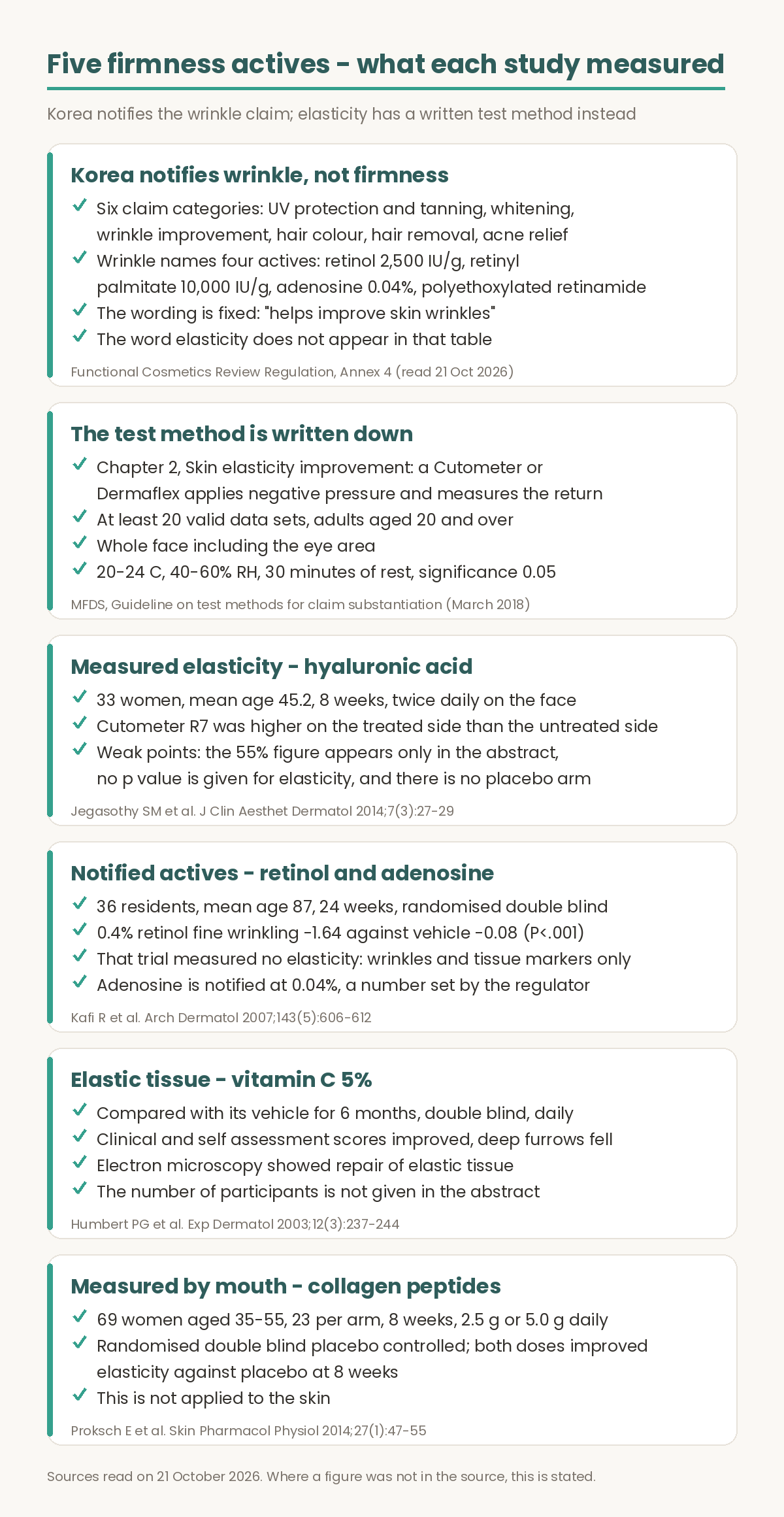
Start with the odd part. In Korea, the regulator reviews “wrinkle improvement” and names the actives for it. It does not use the word elasticity anywhere in that table. Instead it wrote down how to measure elasticity, in a different document.
――――――――――――――――――――――――――――
Primary sources
📄 Functional Cosmetics Review Regulation, Annex 4 (Korea Law Service)
📄 MFDS, Guideline on test methods for claim substantiation (March 2018, PDF, Korean)
📄 Hyaluronic acid, 8-week study (J Clin Aesthet Dermatol 2014)
📄 0.4% retinol, 24-week trial (Arch Dermatol 2007)
Annex 4 holds six claim categories. The guideline holds ten test methods. Elasticity appears in the second document only.
――――――――――――――――――――――――――――
――――――――――――――――――――――――――――
The short version
● Korea notifies six claim categories, and wrinkle improvement names four actives
● The word elasticity is not in that table
● Chapter 2 of the substantiation guideline is “Skin elasticity improvement”
● A Cutometer® or Dermaflex® applies negative pressure and measures the return
● So the test to apply to a product is: what did the study measure?
――――――――――――――――――――――――――――
How Korea splits one face into two boxes
Korean cosmetics law carves out a class called functional cosmetics. For each claim in that class the regulator publishes an annex that names the active and the percentage, and a product built to those numbers is spared from filing new efficacy data. Annex 4 is that table.
| Category | What the annex sets | Reading |
|---|---|---|
| UV protection and tanning | Actives and maximum percentages | Both the name and the number are fixed |
| Whitening | Nine actives (arbutin 2–5%, niacinamide 2–5%, and others) | Same |
| Wrinkle improvement | Four actives (retinol 2,500 IU/g, adenosine 0.04%, and others) | The box next to today’s subject |
| Hair colour change | A list of dye actives | Same |
| Hair removal | Thioglycolic acid 3.0–4.5% | A single active |
| Acne relief | Salicylic acid 0.5% | Same |
| Firmness / elasticity | No category at all | Not a claim the regulator reviews |
The wrinkle box, in full
| Active | Percentage | Reading |
|---|---|---|
| Retinol | 2,500 IU/g | One of the few set in international units |
| Retinyl palmitate | 10,000 IU/g | A larger number than retinol |
| Adenosine | 0.04% | The smallest percentage of the four |
| Polyethoxylated retinamide | 0.05–0.2% | Written as a range |
Annex 4, wrinkle entry — as written
Dosage forms: “limited to lotions, solutions, creams and impregnated masks”
Claim: “helps improve skin wrinkles”
Directions: “apply an appropriate amount evenly to the skin; or apply the product to the skin, remove the support after 10–20 minutes and spread the remaining product evenly (impregnated masks only)”
Even the sentence a brand may print is fixed. Elasticity is in none of those cells.
――――――――――――――――――――――――――――
What exists instead: a written test method
The second document is a civil petitioner guideline published by the Ministry of Food and Drug Safety in March 2018. It sets out how to substantiate ten claims that fall outside the functional class.
| Chapter | Claim | Added |
|---|---|---|
| Ch. 1 | Skin moisturisation | 2012.5 (original) |
| Ch. 2 | Skin elasticity improvement | 2012.5 (original) |
| Ch. 3 | Sebum control | 2012.5 (original) |
| Ch. 4 | Temporary cellulite reduction | 2013.11 |
| Ch. 5 | Suitable for acne-prone skin | 2013.11 |
| Ch. 6 | Dark circle relief | 2014.8 |
| Ch. 7 | Improved skin blood flow | 2015.12 |
| Ch. 8 | Puffiness relief | 2015.12 |
| Ch. 9 | Paraben-free | 2017.3.31 |
| Ch. 10 | Fine dust protection | 2018.3.28 |
Chapter 2, Skin elasticity improvement — the guideline’s own sentences
“This is a test in which a Cutometer® or Dermaflex® applies negative pressure to the skin and measures the degree to which it returns to its original state”
“The number of subjects shall provide at least 20 sets of valid data so that statistical comparison is possible”
“from among adult men and women aged 20 or over”
“The test site shall be the whole face, including the eye area (the measurement site)”
The conditions are written down as well: no air movement or direct sunlight, 20–24 °C and 40–60% relative humidity, 30 minutes of acclimatisation before measurement, a significance level of 0.05, and non-parametric tests as the default when an arm holds 30 subjects or fewer.
⚠ What Chapter 2 does not contain is as telling. There is no list of permitted wordings and no pass mark, and no parameter is named — R2, R5 and R7 appear nowhere. The state writes the procedure and leaves the threshold open.
――――――――――――――――――――――――――――
One study measured elasticity directly — hyaluronic acid
33 women, mean age 45.2 ± 3.9, over 8 weeks at a contract institute in Hamburg. A low molecular weight hyaluronic acid lotion, serum and cream were applied twice a day to the whole face, with measurements at baseline and on days 15, 29 and 57.
Elasticity was read with a Cutometer, and the treated side rose significantly above the untreated side. Moisture, roughness and erythema were measured too; the only p value printed in the body of the paper belongs to erythema.
The weak points belong in the same paragraph. The “up to 55%” figure lives in the abstract and is not carried into the text, no p value is given for elasticity, and there is no placebo arm — the comparison is with an untreated area. The concentration of the product is not disclosed either.
――――――――――――――――――――――――――――
Two are notified actives — retinol and adenosine
The retinol trial measured wrinkles. 36 residents of two long-term care facilities, mean age 87, were followed for 24 weeks in a randomised, double-blind, vehicle-controlled design: 0.4% retinol lotion on one arm, its vehicle on the other, up to three times a week.
Fine wrinkling scores changed by −1.64 (95% CI −2.06 to −1.22) with retinol against −0.08 (−0.17 to 0.01) with vehicle, P<.001. In biopsy subsets, glycosaminoglycan expression rose (P=.02) and procollagen I staining increased (P=.049).
That trial measured no elasticity. It measured wrinkle scores and tissue markers. Adenosine, meanwhile, carries a number the regulator chose: 0.04%, set in Annex 4, not by the brand.
――――――――――――――――――――――――――――
One looked at the fibres — vitamin C 5%
A 5% ascorbic acid cream was compared with its own excipient for 6 months, double-blind, applied daily, with assessments at baseline, 3 months and 6 months and biopsies at the end.
Global scores from both the dermatologist and the volunteer improved against control, the density of the skin microrelief rose and deep furrows fell. Electron microscopy showed repair of elastic tissue, consistent with the clinical and surface findings.
Two limits: the number of participants is not stated in the abstract (healthy female volunteers with photoaged skin is as far as it goes), and what this study saw is tissue, not an elasticity reading.
――――――――――――――――――――――――――――
One was measured by mouth — collagen peptides
69 women aged 35–55, 23 per arm, took 2.5 g or 5.0 g of collagen hydrolysate or placebo once daily for 8 weeks, with a 4-week follow-up after the supplement stopped.
Both doses improved skin elasticity against placebo at 8 weeks, and four weeks after stopping, elasticity remained significantly higher in the older women. Hydration and transepidermal water loss moved in subgroup analysis but not significantly.
This one is not applied to the skin. It belongs on a different shelf from the jar, and the exact figures, p values and the instrument used sit behind a paywall this piece could not open.
――――――――――――――――――――――――――――
The five in one table
| Active | Subjects | Duration | Design | Measured | Result |
|---|---|---|---|---|---|
| Hyaluronic acid | 33 | 8 weeks | Treated vs untreated area | Elasticity | Significantly higher on the treated side |
| Retinol 0.4% | 36 | 24 weeks | Randomised, double-blind, vehicle | Wrinkles, tissue | −1.64 vs −0.08 (P<.001) |
| Adenosine 0.04% | — | — | Set by Annex 4 | — | Notified for wrinkle improvement |
| Vitamin C 5% | not in abstract | 6 months | Double-blind, vehicle | Elastic tissue | Repair on electron microscopy |
| Collagen peptides | 69 | 8 weeks | Randomised, double-blind, placebo | Elasticity (oral) | Both doses above placebo |
And where each one is weak
| Active | What this study cannot say |
|---|---|
| Hyaluronic acid | The 55% figure is abstract-only; no p value for elasticity and no placebo arm; the concentration is undisclosed |
| Retinol | It did not measure elasticity. The cohort is also a mean age of 87 in residential care, which does not transfer cleanly to younger skin |
| Adenosine | What the regulator approved is wrinkle improvement, not an elasticity figure |
| Vitamin C | No participant count in the abstract, and it looked at tissue rather than an elasticity reading |
| Collagen peptides | Not a topical result. The numbers, p values and instrument could not be verified in the full text |
――――――――――――――――――――――――――――
Korea, the United States and the EU — reviewed names and proven names
| Korea | United States | EU | |
|---|---|---|---|
| Ingredient list per claim | Annex 4 of the functional cosmetics regulation — actives and percentages for six claims | None | Positive lists cover colorants, preservatives and UV filters only (Regulation 1223/2009, Art. 14) |
| “Wrinkle” | Reviewed or notified before sale as a functional claim | No approved list of claims | Handled as a claim, under the common criteria |
| “Elasticity” | Chapter 2 writes down the measuring procedure | No procedure written by the regulator | The six common criteria demand evidence |
| In their words | “a Cutometer® or Dermaflex® applies negative pressure to the skin…” | “FDA does not have a list of approved or accepted claims for cosmetics” | “adequate and verifiable evidence” · “state of the art practices” (655/2013) |
| When it is checked | Functional claims before sale; elasticity when asked | No pre-market approval for cosmetics | No pre-market approval; the evidence must exist |
Lined up, the Korean position is unusual in a specific way. One face, two boxes. The claim closest to firmness — wrinkles — is handled by ingredient, in advance. Firmness itself is handled by procedure, afterwards. Neither the United States nor the EU keeps the first box for this kind of claim at all, which is why an exporter reads the two sentences in opposite order: in Seoul the first question is which active and what percentage, and in Brussels or Washington it is what evidence is on file.
――――――――――――――――――――――――――――
What was left out, and why
✔ The niacinamide elasticity trial (Bissett et al., Dermatol Surg 2005) — the abstract could not be opened at a primary source today. Europe PMC returned 429 on all three attempts and Wiley, the journal’s own full text and Semantic Scholar all errored
✔ Injected hyaluronic acid (mesotherapy) — a procedure, not a cosmetic
✔ Lasers, radiofrequency and thread lifts — same reason
✔ Madecassoside — the primary sources found were reviews
✔ A green tea study (Chiu 2005) — oral and topical treatment were given together, so neither arm can be read alone
✔ A pass mark for Chapter 2 — the guideline does not set one
About the author · Dr. J
MS in Veterinary Medicine, PhD in Life Sciences. I worked as a researcher at the Korea Research Institute of Bioscience and Biotechnology (KRIBB) and now run Beaurea, a cosmetics manufacturing company, where I write the formulas myself. This blog reads the research papers and the regulatory documents and turns them into plain-language criteria for choosing ingredients. I don’t recommend specific products here – only criteria that apply to any product.
📌 Related
📌 Adenosine 0.04%: who decided that number — the box next door, wrinkle improvement
📌 Hyaluronic acid: how to read the molecular weight — the one active here that measured elasticity
📌 Collagen: topical vs oral — the longer version of the oral section
📌 Pores and sebum: the test method the regulator wrote down — Chapter 3 of the same guideline
📄 References
· Functional Cosmetics Review Regulation, Annex 4 (Korea Law Service, read 21 October 2026)
· MFDS, Guideline on test methods for the substantiation of cosmetic labelling and advertising (civil petitioner guideline, March 2018), Chapter 2
· Jegasothy SM, Zabolotniaia V, Bielfeldt S. J Clin Aesthet Dermatol 2014;7(3):27-29
· Kafi R, Kwak HSR, Schumacher WE, Cho S, Hanft VN, Hamilton TA, King AL, Neal JD, Varani J, Fisher GJ, Voorhees JJ, Kang S. Arch Dermatol 2007;143(5):606-612
· Humbert PG, Haftek M, Creidi P, Lapière C, Nusgens B, Richard A, Schmitt D, Rougier A, Zahouani H. Exp Dermatol 2003;12(3):237-244
· Proksch E, Segger D, Degwert J, Schunck M, Zague V, Oesser S. Skin Pharmacol Physiol 2014;27(1):47-55
· U.S. FDA, “Cosmetics Labeling Claims” (content current as of 21 November 2022)
· Commission Regulation (EU) No 655/2013, common criteria · Regulation (EC) No 1223/2009, Article 14
――――――――――――――――――――――――――――
This article summarises published research and public regulatory documents; it is not medical advice. Annex 4 and Chapter 2 of the substantiation guideline were read at source on 21 October 2026, and the Korean documents are quoted here in translation. Of the four studies, one does not state its participant count, one measured no elasticity at all, and one was taken by mouth. Those facts are in the tables. Ingredient names and percentages are given as criteria for reading a product, not as a recommendation of any product.
— Dr. J Ingredient Notes