Tag: adenosine

  • Firmness Actives in Korea: Wrinkle Is Notified, Elasticity Is Substantiated

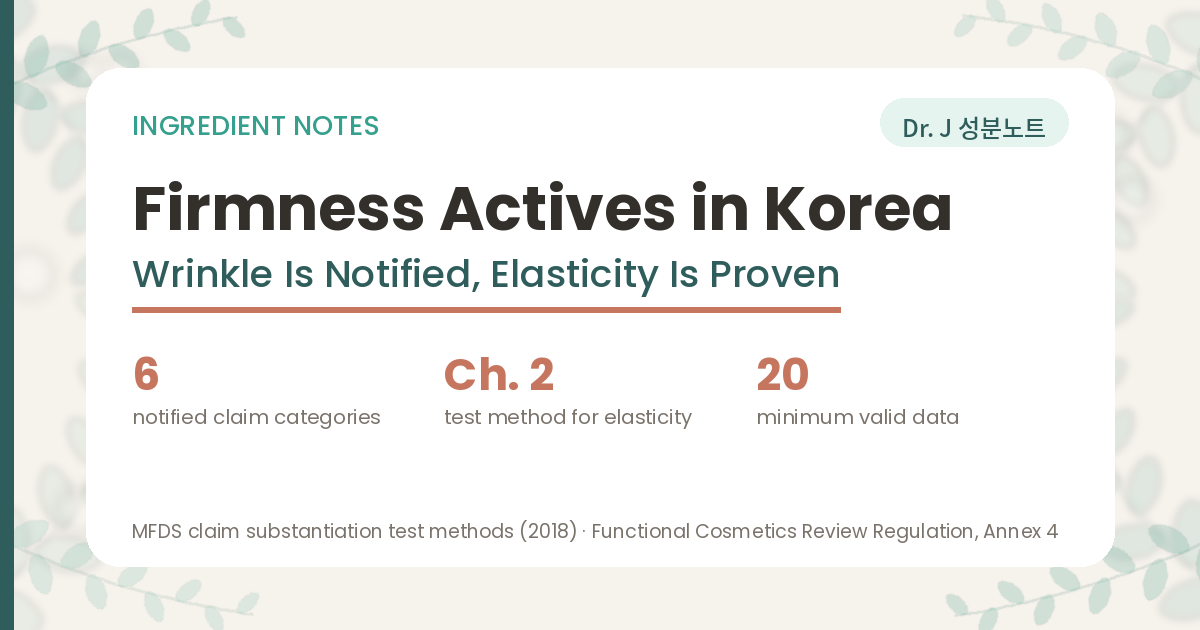
    Cover image for a guide to firmness and elasticity actives in Korean cosmetics. Korea's functional cosmetics notification lists six claim categories, and the wrinkle category names four actives: retinol 2,500 IU per gram, retinyl palmitate 10,000 IU per gram, adenosine 0.04 percent and polyethoxylated retinamide 0.05 to 0.2 percent. The word elasticity does not appear in that table. Instead Chapter 2 of the regulator's claim substantiation guideline writes down how to measure it, with a Cutometer or Dermaflex applying negative pressure and at least 20 valid data sets. Dr. J Ingredient Notes.

    🇰🇷 한국어판

    Hello, this is Dr. J. Today, five actives people reach for when they want firmer skin — chosen by what the human studies actually measured.

    Start with the odd part. In Korea, the regulator reviews “wrinkle improvement” and names the actives for it. It does not use the word elasticity anywhere in that table. Instead it wrote down how to measure elasticity, in a different document.

    ――――――――――――――――――――――――――――

    Primary sources

    📄 Functional Cosmetics Review Regulation, Annex 4 (Korea Law Service)

    📄 MFDS, Guideline on test methods for claim substantiation (March 2018, PDF, Korean)

    📄 Hyaluronic acid, 8-week study (J Clin Aesthet Dermatol 2014)

    📄 0.4% retinol, 24-week trial (Arch Dermatol 2007)

    Annex 4 holds six claim categories. The guideline holds ten test methods. Elasticity appears in the second document only.

    ――――――――――――――――――――――――――――

    ――――――――――――――――――――――――――――

    The short version

    ● Korea notifies six claim categories, and wrinkle improvement names four actives
    ● The word elasticity is not in that table
    ● Chapter 2 of the substantiation guideline is “Skin elasticity improvement”
    ● A Cutometer® or Dermaflex® applies negative pressure and measures the return
    ● So the test to apply to a product is: what did the study measure?

    ――――――――――――――――――――――――――――

    How Korea splits one face into two boxes

    Korean cosmetics law carves out a class called functional cosmetics. For each claim in that class the regulator publishes an annex that names the active and the percentage, and a product built to those numbers is spared from filing new efficacy data. Annex 4 is that table.

    Category What the annex sets Reading
    UV protection and tanning Actives and maximum percentages Both the name and the number are fixed
    Whitening Nine actives (arbutin 2–5%, niacinamide 2–5%, and others) Same
    Wrinkle improvement Four actives (retinol 2,500 IU/g, adenosine 0.04%, and others) The box next to today’s subject
    Hair colour change A list of dye actives Same
    Hair removal Thioglycolic acid 3.0–4.5% A single active
    Acne relief Salicylic acid 0.5% Same
    Firmness / elasticity No category at all Not a claim the regulator reviews

    The wrinkle box, in full

    Active Percentage Reading
    Retinol 2,500 IU/g One of the few set in international units
    Retinyl palmitate 10,000 IU/g A larger number than retinol
    Adenosine 0.04% The smallest percentage of the four
    Polyethoxylated retinamide 0.05–0.2% Written as a range

    Annex 4, wrinkle entry — as written

    Dosage forms: “limited to lotions, solutions, creams and impregnated masks”
    Claim: “helps improve skin wrinkles”
    Directions: “apply an appropriate amount evenly to the skin; or apply the product to the skin, remove the support after 10–20 minutes and spread the remaining product evenly (impregnated masks only)”

    Even the sentence a brand may print is fixed. Elasticity is in none of those cells.

    ――――――――――――――――――――――――――――

    What exists instead: a written test method

    The second document is a civil petitioner guideline published by the Ministry of Food and Drug Safety in March 2018. It sets out how to substantiate ten claims that fall outside the functional class.

    Chapter Claim Added
    Ch. 1 Skin moisturisation 2012.5 (original)
    Ch. 2 Skin elasticity improvement 2012.5 (original)
    Ch. 3 Sebum control 2012.5 (original)
    Ch. 4 Temporary cellulite reduction 2013.11
    Ch. 5 Suitable for acne-prone skin 2013.11
    Ch. 6 Dark circle relief 2014.8
    Ch. 7 Improved skin blood flow 2015.12
    Ch. 8 Puffiness relief 2015.12
    Ch. 9 Paraben-free 2017.3.31
    Ch. 10 Fine dust protection 2018.3.28

    Chapter 2, Skin elasticity improvement — the guideline’s own sentences

    “This is a test in which a Cutometer® or Dermaflex® applies negative pressure to the skin and measures the degree to which it returns to its original state”
    “The number of subjects shall provide at least 20 sets of valid data so that statistical comparison is possible”
    “from among adult men and women aged 20 or over”
    “The test site shall be the whole face, including the eye area (the measurement site)”

    The conditions are written down as well: no air movement or direct sunlight, 20–24 °C and 40–60% relative humidity, 30 minutes of acclimatisation before measurement, a significance level of 0.05, and non-parametric tests as the default when an arm holds 30 subjects or fewer.

    ⚠ What Chapter 2 does not contain is as telling. There is no list of permitted wordings and no pass mark, and no parameter is named — R2, R5 and R7 appear nowhere. The state writes the procedure and leaves the threshold open.
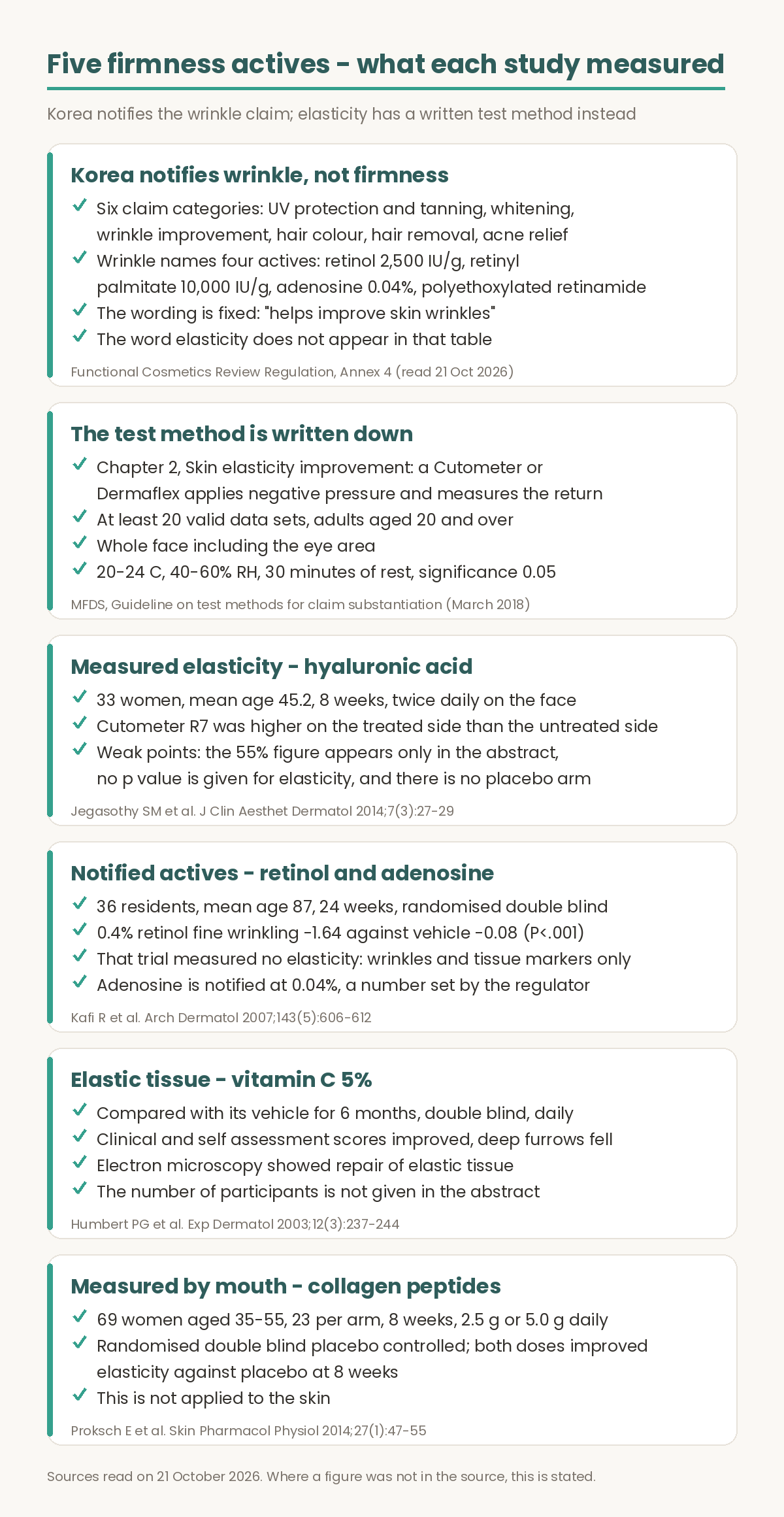
    Evidence summary for five firmness actives. First, Korea notifies wrinkle, not firmness: the six categories are UV protection and tanning, whitening, wrinkle improvement, hair colour change, hair removal and acne relief, and the wrinkle category names four actives with set percentages, while the word elasticity is absent. Second, the test method is written down in Chapter 2 of the claim substantiation guideline: a Cutometer or Dermaflex applies negative pressure and measures how far the skin returns, with at least 20 valid data sets, adults aged 20 and over, the whole face including the eye area, 20 to 24 degrees Celsius and 40 to 60 percent relative humidity, 30 minutes of rest before measurement and a significance level of 0.05. Third, hyaluronic acid measured elasticity directly in 33 women of mean age 45.2 over 8 weeks, where the Cutometer R7 value was higher on the treated side, although the 55 percent figure appears only in the abstract, no p value is given for elasticity and there is no placebo arm. Fourth, retinol and adenosine are the notified actives: a 24 week randomised double blind vehicle controlled trial in 36 residents of mean age 87 found a fine wrinkling change of minus 1.64 against minus 0.08 for vehicle with P below 0.001, and that trial measured no elasticity. Fifth, vitamin C 5 percent was compared with its vehicle for 6 months and electron microscopy showed repair of elastic tissue, but the number of participants is not in the abstract. Sixth, collagen peptides were measured by mouth, not on the skin: 69 women aged 35 to 55 took 2.5 or 5.0 grams daily for 8 weeks and both doses improved elasticity against placebo.

    ――――――――――――――――――――――――――――

    One study measured elasticity directly — hyaluronic acid

    33 women, mean age 45.2 ± 3.9, over 8 weeks at a contract institute in Hamburg. A low molecular weight hyaluronic acid lotion, serum and cream were applied twice a day to the whole face, with measurements at baseline and on days 15, 29 and 57.

    Elasticity was read with a Cutometer, and the treated side rose significantly above the untreated side. Moisture, roughness and erythema were measured too; the only p value printed in the body of the paper belongs to erythema.

    The weak points belong in the same paragraph. The “up to 55%” figure lives in the abstract and is not carried into the text, no p value is given for elasticity, and there is no placebo arm — the comparison is with an untreated area. The concentration of the product is not disclosed either.

    ――――――――――――――――――――――――――――

    Two are notified actives — retinol and adenosine

    The retinol trial measured wrinkles. 36 residents of two long-term care facilities, mean age 87, were followed for 24 weeks in a randomised, double-blind, vehicle-controlled design: 0.4% retinol lotion on one arm, its vehicle on the other, up to three times a week.

    Fine wrinkling scores changed by −1.64 (95% CI −2.06 to −1.22) with retinol against −0.08 (−0.17 to 0.01) with vehicle, P<.001. In biopsy subsets, glycosaminoglycan expression rose (P=.02) and procollagen I staining increased (P=.049).

    That trial measured no elasticity. It measured wrinkle scores and tissue markers. Adenosine, meanwhile, carries a number the regulator chose: 0.04%, set in Annex 4, not by the brand.

    ――――――――――――――――――――――――――――

    One looked at the fibres — vitamin C 5%

    A 5% ascorbic acid cream was compared with its own excipient for 6 months, double-blind, applied daily, with assessments at baseline, 3 months and 6 months and biopsies at the end.

    Global scores from both the dermatologist and the volunteer improved against control, the density of the skin microrelief rose and deep furrows fell. Electron microscopy showed repair of elastic tissue, consistent with the clinical and surface findings.

    Two limits: the number of participants is not stated in the abstract (healthy female volunteers with photoaged skin is as far as it goes), and what this study saw is tissue, not an elasticity reading.

    ――――――――――――――――――――――――――――

    One was measured by mouth — collagen peptides

    69 women aged 35–55, 23 per arm, took 2.5 g or 5.0 g of collagen hydrolysate or placebo once daily for 8 weeks, with a 4-week follow-up after the supplement stopped.

    Both doses improved skin elasticity against placebo at 8 weeks, and four weeks after stopping, elasticity remained significantly higher in the older women. Hydration and transepidermal water loss moved in subgroup analysis but not significantly.

    This one is not applied to the skin. It belongs on a different shelf from the jar, and the exact figures, p values and the instrument used sit behind a paywall this piece could not open.

    ――――――――――――――――――――――――――――

    The five in one table

    Active Subjects Duration Design Measured Result
    Hyaluronic acid 33 8 weeks Treated vs untreated area Elasticity Significantly higher on the treated side
    Retinol 0.4% 36 24 weeks Randomised, double-blind, vehicle Wrinkles, tissue −1.64 vs −0.08 (P<.001)
    Adenosine 0.04% — — Set by Annex 4 — Notified for wrinkle improvement
    Vitamin C 5% not in abstract 6 months Double-blind, vehicle Elastic tissue Repair on electron microscopy
    Collagen peptides 69 8 weeks Randomised, double-blind, placebo Elasticity (oral) Both doses above placebo

    And where each one is weak

    Active What this study cannot say
    Hyaluronic acid The 55% figure is abstract-only; no p value for elasticity and no placebo arm; the concentration is undisclosed
    Retinol It did not measure elasticity. The cohort is also a mean age of 87 in residential care, which does not transfer cleanly to younger skin
    Adenosine What the regulator approved is wrinkle improvement, not an elasticity figure
    Vitamin C No participant count in the abstract, and it looked at tissue rather than an elasticity reading
    Collagen peptides Not a topical result. The numbers, p values and instrument could not be verified in the full text

    ――――――――――――――――――――――――――――

    Korea, the United States and the EU — reviewed names and proven names

    Korea United States EU
    Ingredient list per claim Annex 4 of the functional cosmetics regulation — actives and percentages for six claims None Positive lists cover colorants, preservatives and UV filters only (Regulation 1223/2009, Art. 14)
    “Wrinkle” Reviewed or notified before sale as a functional claim No approved list of claims Handled as a claim, under the common criteria
    “Elasticity” Chapter 2 writes down the measuring procedure No procedure written by the regulator The six common criteria demand evidence
    In their words “a Cutometer® or Dermaflex® applies negative pressure to the skin…” “FDA does not have a list of approved or accepted claims for cosmetics” “adequate and verifiable evidence” · “state of the art practices” (655/2013)
    When it is checked Functional claims before sale; elasticity when asked No pre-market approval for cosmetics No pre-market approval; the evidence must exist

    Lined up, the Korean position is unusual in a specific way. One face, two boxes. The claim closest to firmness — wrinkles — is handled by ingredient, in advance. Firmness itself is handled by procedure, afterwards. Neither the United States nor the EU keeps the first box for this kind of claim at all, which is why an exporter reads the two sentences in opposite order: in Seoul the first question is which active and what percentage, and in Brussels or Washington it is what evidence is on file.

    ――――――――――――――――――――――――――――

    What was left out, and why

    ✔ The niacinamide elasticity trial (Bissett et al., Dermatol Surg 2005) — the abstract could not be opened at a primary source today. Europe PMC returned 429 on all three attempts and Wiley, the journal’s own full text and Semantic Scholar all errored
    ✔ Injected hyaluronic acid (mesotherapy) — a procedure, not a cosmetic
    ✔ Lasers, radiofrequency and thread lifts — same reason
    ✔ Madecassoside — the primary sources found were reviews
    ✔ A green tea study (Chiu 2005) — oral and topical treatment were given together, so neither arm can be read alone
    ✔ A pass mark for Chapter 2 — the guideline does not set one

    About the author · Dr. J

    MS in Veterinary Medicine, PhD in Life Sciences. I worked as a researcher at the Korea Research Institute of Bioscience and Biotechnology (KRIBB) and now run Beaurea, a cosmetics manufacturing company, where I write the formulas myself. This blog reads the research papers and the regulatory documents and turns them into plain-language criteria for choosing ingredients. I don’t recommend specific products here – only criteria that apply to any product.

    📌 Related

    📌 Adenosine 0.04%: who decided that number — the box next door, wrinkle improvement

    📌 Hyaluronic acid: how to read the molecular weight — the one active here that measured elasticity

    📌 Collagen: topical vs oral — the longer version of the oral section

    📌 Pores and sebum: the test method the regulator wrote down — Chapter 3 of the same guideline

    📄 References

    · Functional Cosmetics Review Regulation, Annex 4 (Korea Law Service, read 21 October 2026)

    · MFDS, Guideline on test methods for the substantiation of cosmetic labelling and advertising (civil petitioner guideline, March 2018), Chapter 2

    · Jegasothy SM, Zabolotniaia V, Bielfeldt S. J Clin Aesthet Dermatol 2014;7(3):27-29

    · Kafi R, Kwak HSR, Schumacher WE, Cho S, Hanft VN, Hamilton TA, King AL, Neal JD, Varani J, Fisher GJ, Voorhees JJ, Kang S. Arch Dermatol 2007;143(5):606-612

    · Humbert PG, Haftek M, Creidi P, Lapière C, Nusgens B, Richard A, Schmitt D, Rougier A, Zahouani H. Exp Dermatol 2003;12(3):237-244

    · Proksch E, Segger D, Degwert J, Schunck M, Zague V, Oesser S. Skin Pharmacol Physiol 2014;27(1):47-55

    · U.S. FDA, “Cosmetics Labeling Claims” (content current as of 21 November 2022)

    · Commission Regulation (EU) No 655/2013, common criteria · Regulation (EC) No 1223/2009, Article 14

    ――――――――――――――――――――――――――――

    This article summarises published research and public regulatory documents; it is not medical advice. Annex 4 and Chapter 2 of the substantiation guideline were read at source on 21 October 2026, and the Korean documents are quoted here in translation. Of the four studies, one does not state its participant count, one measured no elasticity at all, and one was taken by mouth. Those facts are in the tables. Ingredient names and percentages are given as criteria for reading a product, not as a recommendation of any product.

    — Dr. J Ingredient Notes
  • Can a Moisturizer Slow Skin Aging? What Two Human Studies Measured, and Where Korea’s Wrinkle Rule Draws the Line (Autumn Guide 3)

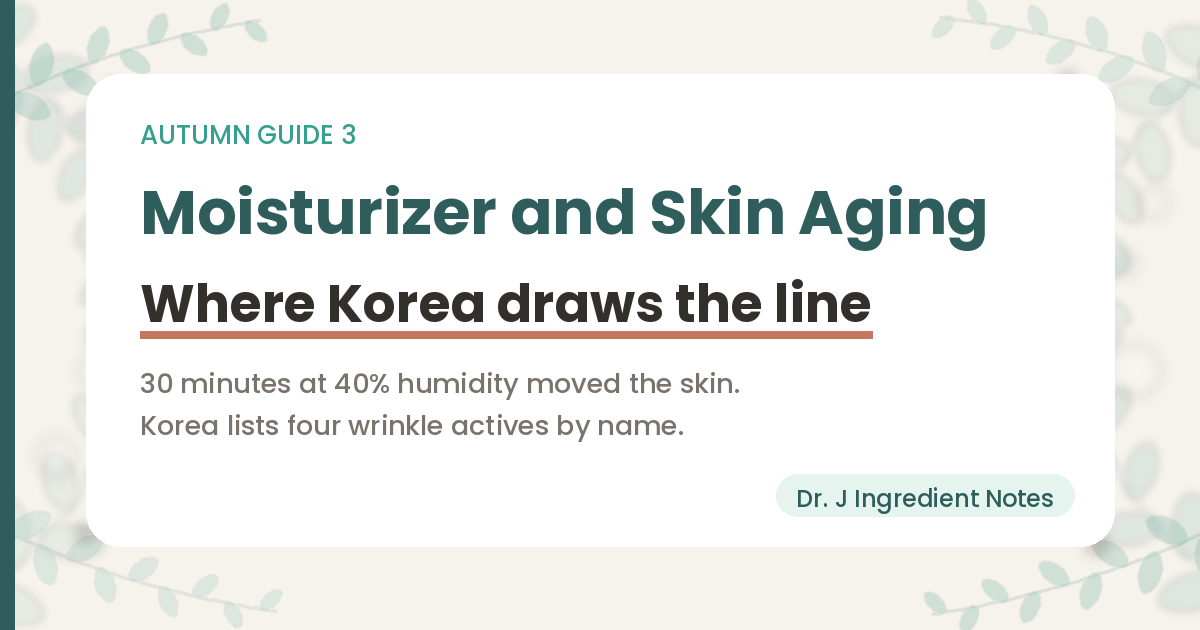
    Cover image for an article asking whether a moisturizer can slow skin aging. It notes a 20-person study measured in a 70 percent humidity room and then a 40 percent humidity room for 30 minutes each, three 28-day moisturizer arms of 42 people, and the four wrinkle actives Korea lists by name. Dr. J Ingredient Notes, Autumn Guide 3.

    🇰🇷 한국어판: 피부 노화, 보습크림으로 늦출 수 있을까 – 연구가 잰 자리와 고시가 정한 자리

    Hello, this is Dr. J. Today: can a moisturizer slow skin aging? I want to answer it the way the sources actually do — by separating what the studies measured from what the regulation permits you to say.

    Start with one finding. Thirty minutes in a drier room was enough to increase fine wrinkles around the eye. Nobody applied anything. Nobody aged. Only the air changed.

    That single result tells you where a moisturizer’s job begins. And Korea’s rulebook tells you where it stops — because here, the phrase “helps improve wrinkles” is not a marketing decision. It is a list of four ingredients with concentrations attached.

    ――――――――――――――――――――――――――――

    Read the sources first

    📄 Tsukahara et al. 2007 — 20 people, a 70% room and a 40% room

    📄 Stettler et al. 2021 — 42 people per arm, 28 days (open access)

    📄 MFDS, Functional Cosmetics Review Regulation, Annex 4 — the four wrinkle actives

    📄 FDA — Is It a Cosmetic, a Drug, or Both? — how intended use decides

    Annex 4 was opened again today, and the four ingredients, their concentrations, the permitted dosage forms and the efficacy sentence were all read from the original.

    ――――――――――――――――――――――――――――

    ――――――――――――――――――――――――――――

    The five-line version

    ✓ Moving from a 70% to a 40% humidity room for 30 minutes lowered moisture and elasticity and raised fine wrinkles

    ✓ A moisturizer used once a day for 28 days raised stratum corneum moisture by 38.1 to 72.4%

    ✓ Neither study reports a wrinkle-correction figure — that number simply is not there

    ✓ In Korea, four actives are notified by name and concentration for the wrinkle claim

    ✓ Glycerin, hyaluronic acid, ceramides and panthenol are not on that list

    ――――――――――――――――――――――――――――

    The two studies, side by side

    This article rests on two human studies. Their designs are deliberately different — one changed the air for half an hour, the other applied a cream for four weeks.

    Study Who, and where measured Conditions What was measured
    Tsukahara et al. 2007
    Skin Res Technol
    20 people
    eyelid
    30 min in a 70% humidity room,
    then 30 min at 40%
    Conductance (moisture), elasticity,
    fine wrinkles
    Stettler et al. 2021
    Cosmetics
    42 people in each of three arms
    forearm
    Three creams differing in lipid content,
    once a day for 28 days
    Stratum corneum moisture,
    user-rated elasticity

    One asks how fast the environment moves the skin. The other asks how much of that a cream puts back. The questions are halves of the same question, which is why they sit together here.

    ――――――――――――――――――――――――――――

    Thirty minutes, two rooms

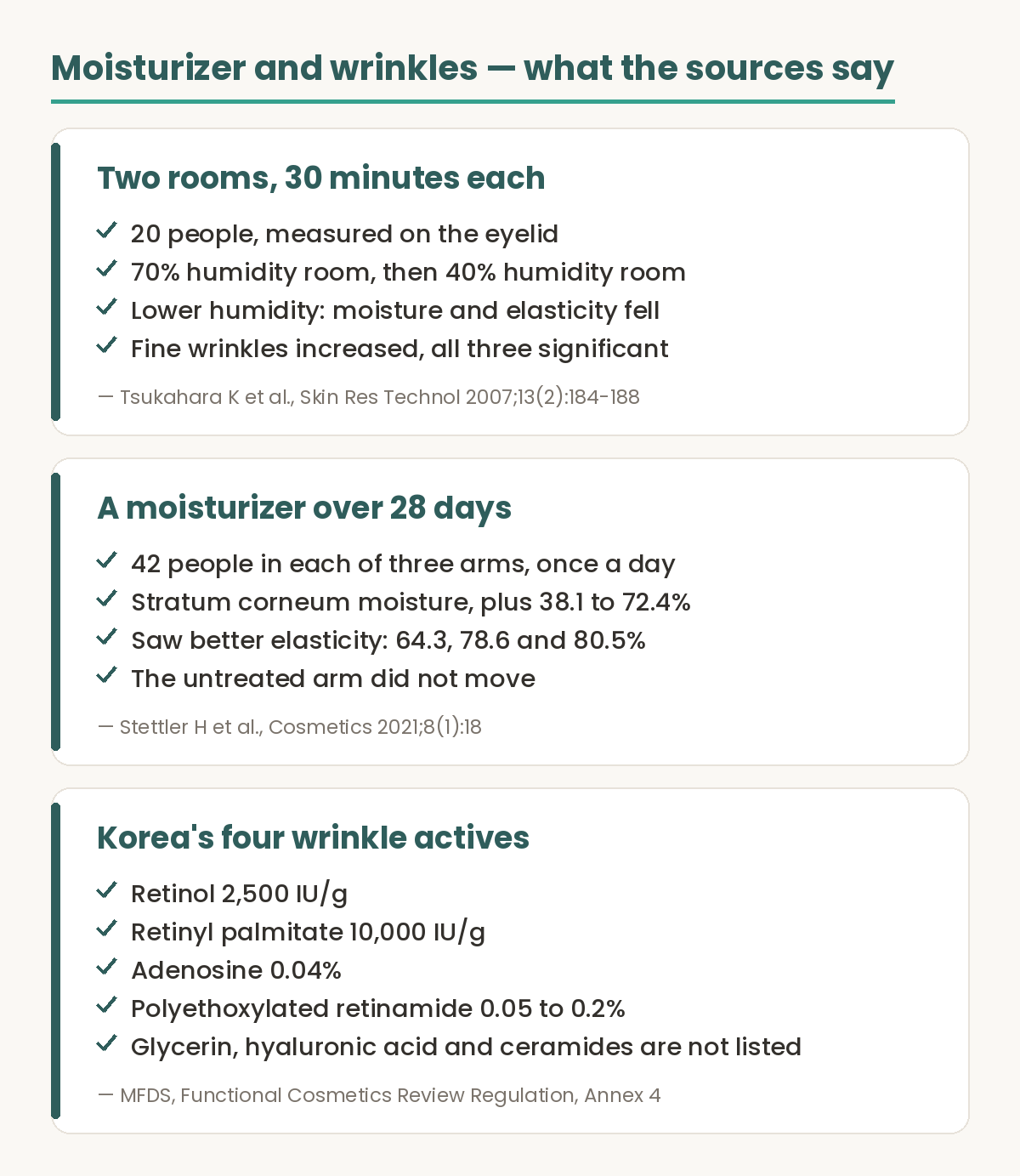
    Twenty people had moisture, elasticity and fine wrinkles measured on the eyelid. Once after 30 minutes of adaptation in a room at 70% relative humidity, and again after 30 minutes at 40% (Tsukahara et al., Skin Res Technol 2007).

    ✓ Moisture fell at the lower humidity

    ✓ Elasticity fell as well

    ✓ Fine wrinkles increased — all three differences were statistically significant

    The authors put it plainly: a 30-point difference in humidity changes the properties of the skin within 30 minutes. Same people, same products, different air.

    So these wrinkles belong to the reversible side of the ledger. They are not the same thing as the lines that deepen over decades, and it is worth keeping the two apart when you judge a cream.

    Evidence figure on moisturizers and wrinkles. First, two rooms for 30 minutes each: 20 people measured on the eyelid moved from a 70 percent humidity room to a 40 percent humidity room, and at the lower humidity moisture and elasticity fell while fine wrinkles increased, all three significant, Tsukahara K and colleagues, Skin Research and Technology 2007, volume 13, issue 2, pages 184 to 188. Second, a moisturizer over 28 days: 42 people in each of three arms applied it once a day, stratum corneum moisture rose 38.1 to 72.4 percent from baseline, 64.3, 78.6 and 80.5 percent of users saw better elasticity, and the untreated arm did not move, Stettler H and colleagues, Cosmetics 2021, volume 8, issue 1, article 18. Third, Korea's four wrinkle actives: retinol 2,500 international units per gram, retinyl palmitate 10,000 international units per gram, adenosine 0.04 percent, polyethoxylated retinamide 0.05 to 0.2 percent, and glycerin, hyaluronic acid and ceramides are not listed, Ministry of Food and Drug Safety, Functional Cosmetics Review Regulation, Annex 4.

    ――――――――――――――――――――――――――――

    Twenty-eight days with a moisturizer

    Three creams containing panthenol were made with different lipid contents. 42 people used each one, once a day, for 28 days (Stettler et al., Cosmetics 2021).

    ✓ Stratum corneum moisture rose +63.9%, +72.4% and +38.1% from baseline

    ✓ Users who judged elasticity improved: 64.3%, 78.6% and 80.5%

    ✓ The untreated opposite forearm did not move

    That last line carries weight. It rules out season, room conditions and measurement drift — the numbers moved on the treated side.

    One caution: the elasticity figures are what users reported, not an instrument reading. They should not be stacked on top of the moisture numbers as if they were the same kind of evidence.

    ――――――――――――――――――――――――――――

    Where the numbers stop

    Lay the two studies out by measure, and the sentence “moisturizer reduces wrinkles” shows you exactly where it breaks.

    Measure Tsukahara 2007 Stettler 2021 Is there a number?
    Moisture Fell significantly at lower humidity +38.1% to +72.4% from baseline Yes, in both
    Elasticity Fell significantly at lower humidity 64.3 / 78.6 / 80.5% of users saw improvement Yes, in both
    Fine wrinkles Increased significantly at lower humidity — Yes, in one
    Wrinkle depth or correction — — No. Neither study reports it

    The last row is the point of this article. There is no wrinkle-correction figure in either study. What exists is moisture, elasticity, and fine wrinkles under dry air.

    ――――――――――――――――――――――――――――

    Korea names four actives

    Annex 4 of the MFDS Functional Cosmetics Review Regulation lists the ingredients that may carry the wrinkle claim. There are four, and each comes with a concentration.

    No. Ingredient Concentration
    1 Retinol 2,500 IU/g
    2 Retinyl palmitate 10,000 IU/g
    3 Adenosine 0.04%
    4 Polyethoxylated retinamide 0.05 – 0.2%

    Permitted dosage forms are lotions, solutions, creams and sheet masks. The efficacy sentence is fixed: 「피부의 주름개선에 도움을 준다」 — helps improve skin wrinkles. Directions are prescribed too, down to removing a sheet mask after 10 to 20 minutes.

    Reading the annex again today, glycerin, hyaluronic acid, ceramides and panthenol appear nowhere in it. That is not a verdict on those ingredients. It means they are not on the road that leads to this particular sentence.

    ※ Note the annex’s own title: “types of functional cosmetics for which data submission is waived.” The listed concentration is not a ceiling. It is the amount at which you need not file fresh efficacy data.

    ――――――――――――――――――――――――――――

    Korea and the United States decide this differently

    This is the part that travels badly across borders. The same jar of cream can be described in two quite different ways depending on where it is sold.

    Korea United States
    What fixes the wording A government notification lists four actives with set concentrations. Use one at that level and the efficacy sentence is prescribed Intended use decides the category. There is no list of approved anti-wrinkle actives
    The sentence on the box 「피부의 주름개선에 도움을 준다」 — helps improve skin wrinkles No prescribed sentence. Wording is the company’s to choose, and to defend
    Where it can go wrong Using the phrase without the notified active and the review or report behind it A claim to treat wrinkles or to affect the skin’s structure or function can make the product a drug under the FD&C Act
    What the shopper sees The box prints 기능성화장품 (functional cosmetic) and the efficacy sentence under it Nothing on pack marks the category

    In the United States, the FD&C Act defines a cosmetic by what it does to appearance, and a drug by intent to affect the structure or any function of the body. The FDA’s own guidance says the category follows intended use — so a claim to treat wrinkles, rather than to make them look softer, can move a product into drug territory.

    Korea took the other road. It fixed a short list of actives, attached concentrations, and prescribed the sentence. The upside for a shopper is unusual: you can read the claim off the box and know exactly what was reviewed.

    ――――――――――――――――――――――――――――

    Reading the numbers carefully

    ✓ The 30-minute study is about air, not about cream — it shows how quickly dry air moves the skin, not what a product does

    ✓ The 28-day percentages are change from baseline — the drier the starting skin, the larger the possible rise. They do not compare products

    ✓ Elasticity there is a user rating — a questionnaire result, not an instrument reading

    Hold those three in mind and the same figures read differently. What was measured, in whom, under what conditions is the habit worth building.

    ――――――――――――――――――――――――――――

    What I left out, and why

    ✓ “Moisturizer smooths wrinkles” — Stettler measured moisture and elasticity. There is no wrinkle figure, so none is quoted here

    ✓ Mechanism of aging (inflammation, glycation and so on) — the primary sources I could open were reviews, so that passage is absent

    ✓ A list of five moisturizing ingredients — covered in the first autumn guide; linked below instead

    ✓ Comparisons with procedures or prescription products — out of scope for a cosmetics article

    ――――――――――――――――――――――――――――

    So where does a moisturizer land

    ✓ Fine lines that come from dryness — this is the moisturizer’s ground, and the 30-minute study is the evidence for it

    ✓ The phrase “helps improve wrinkles” — this belongs to a functional cosmetic built on one of the four actives

    ✓ They are not rivals — moisturizer daily, notified active at its stated concentration

    Putting cream on every day is maintenance against what the environment takes away. Small, but the 30-minute result shows how quickly that ground shifts.

    ――――――――――――――――――――――――――――

    What to check on the box

    ✓ In Korea, whether 기능성화장품 and the wrinkle sentence appear together

    ✓ Which of the four actives it is, and whether the concentration is printed

    ✓ For the moisturizing side, whether glycerin sits high in the ingredient list, and whether ceramides come with cholesterol and fatty acids

    ✓ Indoor humidity — 30 minutes is enough to change things. Keep out of the direct path of a heater

    ――――――――――――――――――――――――――――

    One line

    A moisturizer’s reach is the fine lines that dryness creates. “Wrinkle improvement” is the work of four notified actives — and the two go together rather than against each other.

    Next: custom-blended cosmetics — what the product mixed for you at the counter actually is (Ingredient Guide 22).

    ――――――――――――――――――――――――――――

    📌 Previous guides

    📌 Panthenol for Skin: What the Dexpanthenol Studies Show (Guide 7) — the 28-day trial in full

    📌 Adenosine 0.04%: Who Decided That Number (Guide 12) — one of the four, on its own

    📌 Retinol: Start at 0.1% (Guide 1)

    📌 Ceramides: Cholesterol and Fatty Acid Ratio (Guide 4)

    📌 Hyaluronic Acid: How to Read the Molecular Weight (Guide 6)

    About the author · Dr. J

    MS in Veterinary Medicine, PhD in Life Sciences. I worked as a researcher at the Korea Research Institute of Bioscience and Biotechnology (KRIBB) and now run Beaurea, a cosmetics manufacturing company, where I write the formulas myself. This blog reads the research papers and the regulatory documents and turns them into plain-language criteria for choosing ingredients. I don’t recommend specific products here – only criteria that apply to any product.

    📄 References

    · Tsukahara K et al., Skin Res Technol 2007;13(2):184-188

    · Stettler H et al., Cosmetics 2021;8(1):18

    · Ministry of Food and Drug Safety, Regulation on the Review of Functional Cosmetics, Annex 4

    · U.S. FDA, “Is It a Cosmetic, a Drug, or Both? (Or Is It Soap?)”, page updated 11 September 2024

    ――――――――――――――――――――――――――――

    This article summarises published research and regulatory documents. It is not a diagnosis or a treatment, and it does not recommend a particular product. Figures are quoted as the sources report them; different conditions give different numbers. If a skin concern worries you, please speak to a professional.

    — Dr. J Ingredient Notes

  • Adenosine 0.04%: Who Decided That Number – Korea’s List of Four Wrinkle Ingredients, a 126-Person Trial, and Why the Figure Vanishes Abroad (Ingredient Guide 12)

    Cover image for a Dr. J Ingredient Notes guide on what adenosine 0.04% means, ingredient guide 12. Adenosine is one of the four ingredients Korea's notification lists for the wrinkle-improvement claim, the listed level is 0.04 percent, and the guide covers a trial in which 126 women aged 45 to 65 applied it around the eyes twice a day for 8 weeks.

    🇰🇷 한국어판: 아데노신 0.04%, 고시가 정한 숫자 (성분 백과 ⑫)

    Hello, I’m Dr. J. Today: adenosine in skincare, and what the 0.04% on the back of a Korean wrinkle cream actually certifies.

    Pick up three Korean wrinkle creams and you will often find the same ingredient at the same level: adenosine, 0.04%. Different brands, different prices, one identical figure. That is odd enough to be worth explaining, and the explanation is the whole of this guide. It is Ingredient Guide 12.

    The short answer: no brand chose that number. It is written into a government document — Annex 4 of Korea’s functional-cosmetics review regulation, which lists four ingredients that may carry a wrinkle claim and the level each one has to be used at. This guide reads those four lines, works out what 0.04% weighs in a jar, goes through the one human trial the number rests on, and then sets the Korean system beside the American and European ones, because neither of those has a list like it.

    ――――――――――――――――――――――――――――

    📄 If you’d rather read the primary sources

    📄 MFDS notification, Annex 4 — functional cosmetics for which data submission is waived (Korean)

    📄 Abella ML (2006) — 126 women, around the eyes, 8 weeks

    📄 Commission Regulation (EU) No 655/2013 — common criteria for cosmetic claims

    📄 US FDA — “Is It a Cosmetic, a Drug, or Both?”

    🏠 Regulation on the Review of Functional Cosmetics (Korea Law Information Center)

    Annex 4 opens as an attachment. The wrinkle ingredients sit alongside the brightening ones in the same table.

    ――――――――――――――――――――――――――――

    ――――――――――――――――――――――――――――

    In four lines, if you’re in a hurry

    ● Adenosine is one of four ingredients Korea lists for the wrinkle-improvement claim

    ● The listed level is 0.04%. Use exactly that and the efficacy dossier is waived

    ● Retinol is listed at 2,500 IU/g, adenosine at 0.04% — different units, so the figures do not compare

    ● 126 women applied it around the eyes for 8 weeks; texture beat placebo from week 3

    ――――――――――――――――――――――――――――

    What it is — a signalling molecule the body already makes

    Adenosine is not a laboratory invention. It is what a cell leaves behind after spending energy, so it is already circulating in the body. Skin cells carry adenosine receptors on their surface, and when the molecule docks there a signal travels inward.

    What happens after that signal is where published accounts diverge, and it is not something I could confirm from the abstracts available to me, so this guide stops there. What is solid is narrower and more useful: Korea placed this molecule on its wrinkle list rather than its brightening or UV lists, and there is a human trial behind it.

    ――――――――――――――――――――――――――――

    Reading the list — four lines, two units

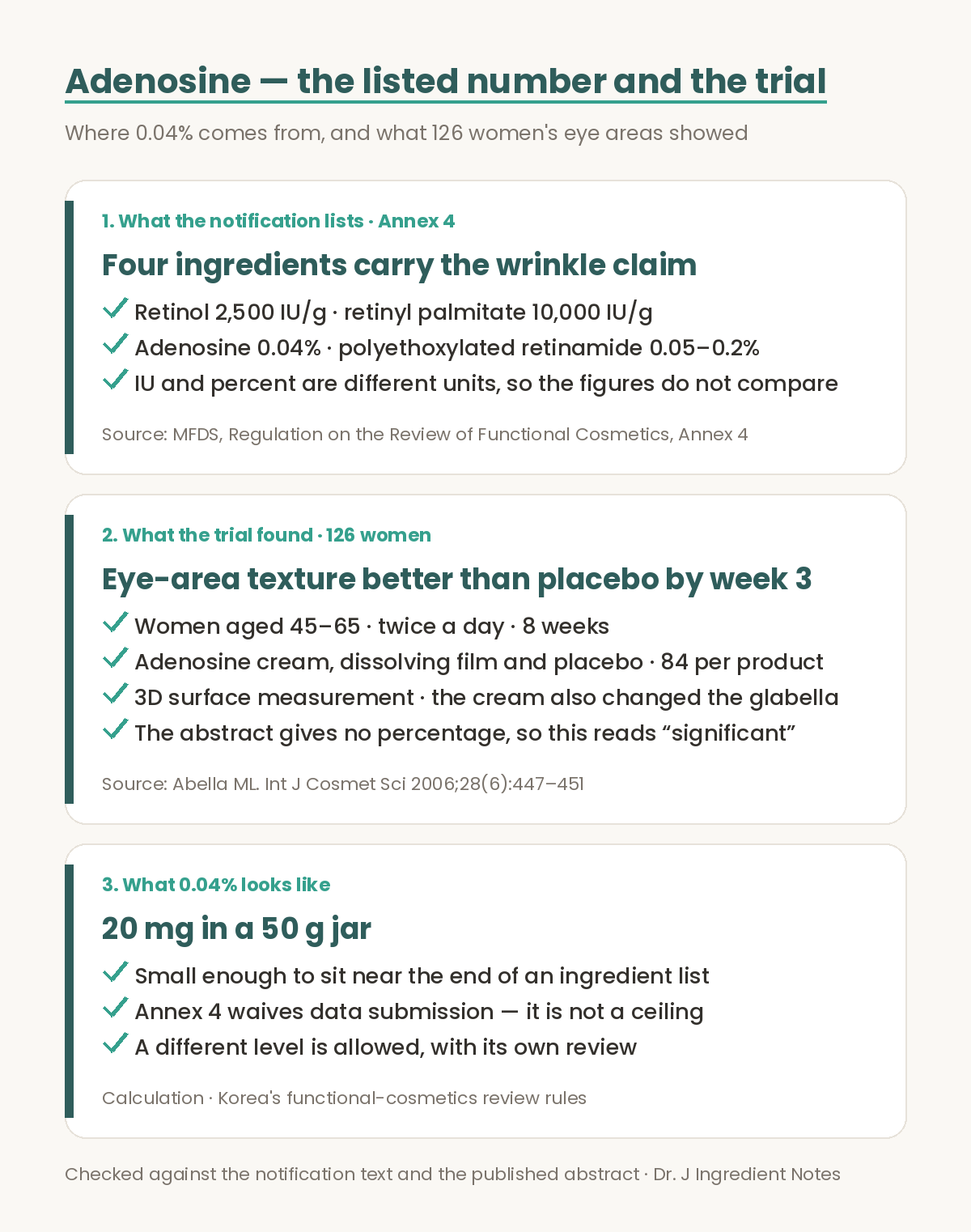
    Here is the wrinkle section of Annex 4 in full. The thing that trips people up is the unit column: the first two entries are given in IU, the last two as a percentage by weight.

    Listed ingredient Listed level Unit Covered in this series
    Retinol 2,500 IU/g activity units Guide 1
    Retinyl palmitate 10,000 IU/g activity units —
    Adenosine 0.04% percent by weight this guide, 12
    Polyethoxylated retinamide 0.05–0.2% percent by weight —

    An IU measures activity, not mass. Putting 2,500 next to 0.04 and concluding that one ingredient is stronger is therefore a category error — each level was set for that ingredient on its own terms.

    Turn 0.04% into something you can picture and it comes to 20 mg in a 50 g jar. That is a normal amount to find near the end of an ingredient list, and finding it there does not mean the product skimped.

    Evidence figure for adenosine. Annex 4 of Korea's functional-cosmetics review regulation lists four ingredients for the wrinkle claim: retinol at 2,500 IU per gram, retinyl palmitate at 10,000 IU per gram, adenosine at 0.04 percent and polyethoxylated retinamide at 0.05 to 0.2 percent; IU and percent are different units, so the figures do not compare, and because Annex 4 only waives data submission the 0.04 percent is not a ceiling. In a trial of 126 women aged 45 to 65 who applied an adenosine cream, a dissolving film or a placebo around the eyes twice daily for 8 weeks, 84 per product, three-dimensional surface measurement showed eye-area texture significantly better than placebo by week 3 and sustained to week 8, with the cream also changing the glabella, International Journal of Cosmetic Science 2006. 0.04 percent works out at 20 milligrams in a 50 gram jar.

    ――――――――――――――――――――――――――――

    Why every jar says the same thing — what Annex 4 actually is

    Now read the title of the document. Annex 4 is called “Types of functional cosmetics for which data submission is waived.” It is not a table of guaranteed effects. It is a list of formulations that have already been assessed once, so a company matching one does not have to file its own efficacy dossier.

    Route a formulator can take What has to be filed What the label may say
    Match Annex 4 — adenosine at 0.04% efficacy data waived · reporting route wrinkle-improvement functional cosmetic
    A different level, or a different ingredient efficacy and safety data, individual review wrinkle-improvement functional cosmetic
    No listed ingredient, no review — no wrinkle-improvement wording

    So 0.04% is not a ceiling. A company that wants more can have more, provided it brings the evidence and goes through the review. The reason the same figure keeps appearing on the back of the jar is that the first route is lighter, not that the door above it is locked.

    This also settles a question left hanging in the peptide guide. Peptides are nowhere on Annex 4, so a Korean peptide cream carrying the wrinkle wording either contains one of these four listed ingredients as well, or it went through an individual review of its own.

    ――――――――――――――――――――――――――――

    What the trial found — 126 women, around the eyes, 8 weeks

    One human trial sits under all of this. 126 women aged 45 to 65 applied an adenosine product around the eyes twice a day for 8 weeks, comparing an adenosine cream, an adenosine dissolving film and a placebo, with 84 subjects per product.

    Element Detail
    Participants 126 women aged 45–65
    Arms adenosine cream · adenosine dissolving film · placebo, 84 per product
    Site and frequency around the eyes, twice daily, 8 weeks
    Measurement three-dimensional measurement of the skin surface
    Result eye-area texture significantly better than placebo by week 3 · sustained to week 8 · the cream also changed the glabella

    The abstract reports no percentage change, so this guide says “significant” and leaves it there rather than inventing a figure. The number that is worth carrying away is the week 3 mark: the difference appeared inside the first month, which makes 8 weeks a fair window to judge an eye product over.

    ――――――――――――――――――――――――――――

    Why you won’t see 0.04% outside Korea

    If you buy the same category of product in the United States or the European Union, the figure disappears. That is not because the ingredient is treated as weaker there. It is because neither system has a list of pre-cleared wrinkle actives at all, so there is no official level for a label to match.

    Question Korea (MFDS) United States (FDA) European Union
    A list of approved wrinkle actives? Yes — Annex 4, four ingredients at set levels No. Cosmetic products and ingredients need no FDA approval before sale, colour additives excepted No positive list for these actives
    What permits the claim match the listed level, or pass an individual review intended use decides: a claim about appearance stays cosmetic, a claim to affect the structure or function of the body makes it a drug adequate and verifiable evidence under the common criteria of Reg. (EU) 655/2013
    Where the evidence sits with the regulator, before launch with the company; FDA acts after the fact in the Product Information File, open to the authorities
    Does 0.04% mean anything? yes — it is the listed level no regulated meaning no regulated meaning

    One footnote on the American column, because it explains a lot of careful wording on US packaging: the FD&C Act has no category for a cosmetic with drug-like powers, and the FDA says plainly that it “does not recognize any such category as ‘cosmeceuticals.’” So an American anti-wrinkle cream talks about the appearance of lines. A Korean one is allowed to say “wrinkle improvement” outright — because a regulator checked the file first.

    Neither arrangement is strictly better. Korea’s gives you a number you can verify and a claim someone reviewed; the American and European ones leave more room for a formula that does not match any list. What they mean for a shopper is simply different: in Korea, read the claim wording; elsewhere, read the evidence the brand offers.

    ――――――――――――――――――――――――――――

    Using it — an easy ingredient to place

    ✔ Morning or night, either works. After a serum, before a cream

    ✔ Some products carry it alongside retinol. Both are on the same wrinkle list, so they are not a clashing pair

    ✔ There is no ramp-up period to serve. It does not ask for the first-four-weeks routine the retinol guide describes

    ✔ The trial looked at the eye area over 8 weeks. If that is where you’re using it, give it that long

    ✔ Daytime use runs alongside sunscreen — the sunscreen guide’s 2 mg/cm² is the amount that makes that number real

    ――――――――――――――――――――――――――――

    Four things to check when you buy

    Where to look How to read it
    The functional-cosmetic wording On a Korean product this is the tell: it means the listed level was matched, or an individual review was passed. Without it, the wrinkle wording is not allowed
    Where adenosine sits in the list Near the end is normal. Ingredients at 1% or below may be listed in any order, and 0.04% is far below that
    No percentage printed Levels do not have to appear on the label. The claim wording carries that information instead
    Is it made for the eye area That is the site the trial studied. A size and texture suited to the eye area makes 8 weeks of use realistic

    ――――――――――――――――――――――――――――

    In one line

    Adenosine’s 0.04% is a level a regulator set, not one a brand picked — and it is a waiver threshold, not a ceiling. A small number here is not a weak one.

    Next in the series: AHA vs BHA — what actually differs (Ingredient Guide 13). Glycolic acid and salicylic acid are regulated in two different ways, which is where that guide starts. The “1% or below, any order” rule gets its space in Guide 14.

    ――――――――――――――――――――――――――――

    📌 Earlier guides

    📌 Retinol: Start at 0.1% – How to Read the Concentration Numbers (Ingredient Guide 1)

    📌 Skincare Ingredient Compatibility Chart – What to Layer and What to Split

    📌 PDRN (Salmon DNA) Skincare: What a Korean Bio PhD Wants You to Know

    About the author · Dr. J

    MS in Veterinary Medicine, PhD in Life Sciences. I worked as a researcher at the Korea Research Institute of Bioscience and Biotechnology (KRIBB) and now run Beaurea, a cosmetics manufacturing company, where I write the formulas myself. This blog reads the research papers and the regulatory documents and turns them into plain-language criteria for choosing ingredients. I don’t recommend specific products here – only criteria that apply to any product.

    📄 References

    · MFDS, Regulation on the Review of Functional Cosmetics, Annex 4 — types of functional cosmetics for which data submission is waived

    · Abella ML. Int J Cosmet Sci 2006;28(6):447–451 — 126 women aged 45–65, eye area, twice daily, 8 weeks

    · Commission Regulation (EU) No 655/2013 — common criteria for claims used for cosmetic products

    · US FDA, Is It a Cosmetic, a Drug, or Both? (Or Is It Soap?) — FD&C Act secs. 201(i) and 201(g)(1)

    ――――――――――――――――――――――――――――

    This article summarises published research and public regulatory documents. It is information, not a diagnosis or a treatment plan. If something about your skin worries you, please talk to a professional.

    — Dr. J Ingredient Notes